

Energy Rehabilitation Drink Supplementation Market Size and Share Analysis- 2026 To 2033
The Energy Rehabilitation Drink Supplementation Market size is anticipated to grow at a CAGR of 6.8%, with USD 11.03 Bn in 2026 and is expected to reach approximately USD 17.50 Bn in 2033. The primary drivers are largely defined by the rising consumer demand for functional and recovery-oriented beverages, increasing adoption of energy and nutritional supplementation products, growing participation in sports and fitness activities, and wider consumption of beverages formulated with caffeine, vitamins, minerals, amino acids, and other functional ingredients. The Sports & Fitness Industry Association recorded 250 million Americans participating in one or more sports, fitness or leisure activities in 2025, the highest level. Year-over-year, total participation rose 1.2%, and core participation reached 158.8 million people.
Key Takeaways
- The caffeine segment is projected to lead the market with 36.5% in 2026. The segment is expected to be fueled by the widespread use of caffeine as a key energy-boosting ingredient, the increasing demand for improved alertness and reduced fatigue among consumers, and the continued incorporation across energy and functional beverage According to the International Food Information Council, 88% of Americans consume caffeine and 83% consume it at least once a day and energy and reduced fatigue were among the top benefits consumers were seeking from foods and beverages in April 2026.
- The supermarket segment is set to lead with 38.0% in 2026. The segment’s growth is owing to extensive product availability, high consumer footfall, strong shelf visibility, availability of multipacks and multiple brands, and consumers’ continued preference for physical grocery channels for beverage purchases. According to FMI, The Food Industry Association, U.S. supermarket sales reached USD 1 trillion in 2025, while supermarkets carried an average of 33,248 items per store; only 8.9% of grocery item sales were conducted online, highlighting the continued importance of physical retail channels.
- North America is expected to acquire the prominent share of 36.0% in 2026. The region’s growth is owing to high consumption of energy beverages, established retail distribution networks, strong presence of major energy drink manufacturers, and sustained consumer demand for caffeine-based functional beverages. According to Monster Beverage Corporation’s 2025 annual filing, Monster Energy drink net sales in the U.S. and Canada reached USD 4.70 Bn in 2025, compared with total global Monster Energy drink sales of USD 7.67 Bn, meaning the U.S. and Canada represented approximately 61.4% of the company’s Monster Energy drink sales.
Market Drivers
Rising Sports and Fitness Participation is Boosting Demand for Energy and Recovery Supplementation
The expanding consumer base for energy and rehabilitation drink supplements is driven by the increased participation in fitness, recreational sports, endurance activities and organized sports. Exercise consumers are increasingly seeking products that can provide them with the hydration, electrolytes, carbohydrates, caffeine, amino acids and other nutrients they need before, during and after they exercise.
The increasing relationship between sport participation and supplementation is also seen in athletes. According to a 2025 peer-reviewed study published in the Journal of the International Society of Sports Nutrition, 63.9% of surveyed athletes consumed sports drinks and 51.6% consumed electrolyte supplements.
Current Events and Their Impact on the Energy Rehabilitation Drink Supplementation Market
Current Event | Description and its Impact |
England Confirms Ban on High-Caffeine Energy Drink Sales to Under-16s (2026) |
|
FDA Advances Front-of-Package Nutrition Labeling Framework for Packaged Foods and Beverages (2026) |
|
- Current Industry Events of 2026
- Market Size Estimation
- Regional Breakdown
- Competitive Landscape
- Customer Intelligence
- Segmental Analysis
- Pricing Analysis
- Key Market Drivers, Challenges & Future Trends
- Customized Insights Section
Segmental Insights
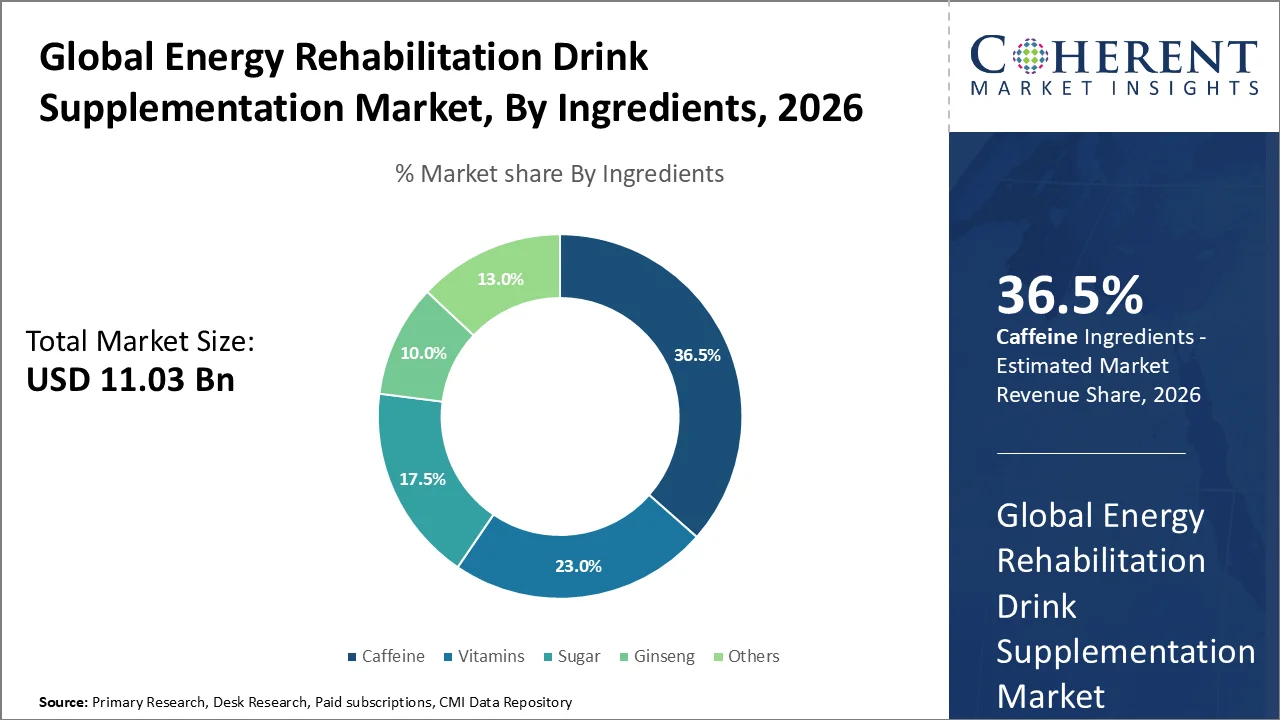
Why is Caffeine Acquiring the Largest Share?
On the basis of ingredients, the caffeine segment is projected to account for the largest Energy Rehabilitation Drink Supplementation Market share of 36.5% in 2026. The segment’s growth is owing to caffeine’s established role in enhancing alertness, reducing perceived fatigue, supporting concentration, and improving exercise performance. Its compatibility with vitamins, amino acids, electrolytes, botanical extracts, and other functional ingredients has also made caffeine a core component of energy and recovery beverage formulations.
A 2025 peer-reviewed U.S. population study in Food and Chemical Toxicology found that approximately 69% of the U.S. population consumed at least one caffeinated beverage per day, and caffeine consumers consumed on average about 210 mg of caffeine per day. In the surveyed population energy drinks contributed to 6.3% of the total caffeine intake.
In August 2026, 7 Brew announced a major retail expansion of its ready-to-drink energy beverage portfolio through Walmart. The company launched five 7 Brew Energy beverages across more than 1,100 Walmart locations, while its canned ready-to-drink coffee portfolio entered approximately 4,400 Walmart stores nationwide.
Why are Supermarkets Acquiring the Largest Market Share?
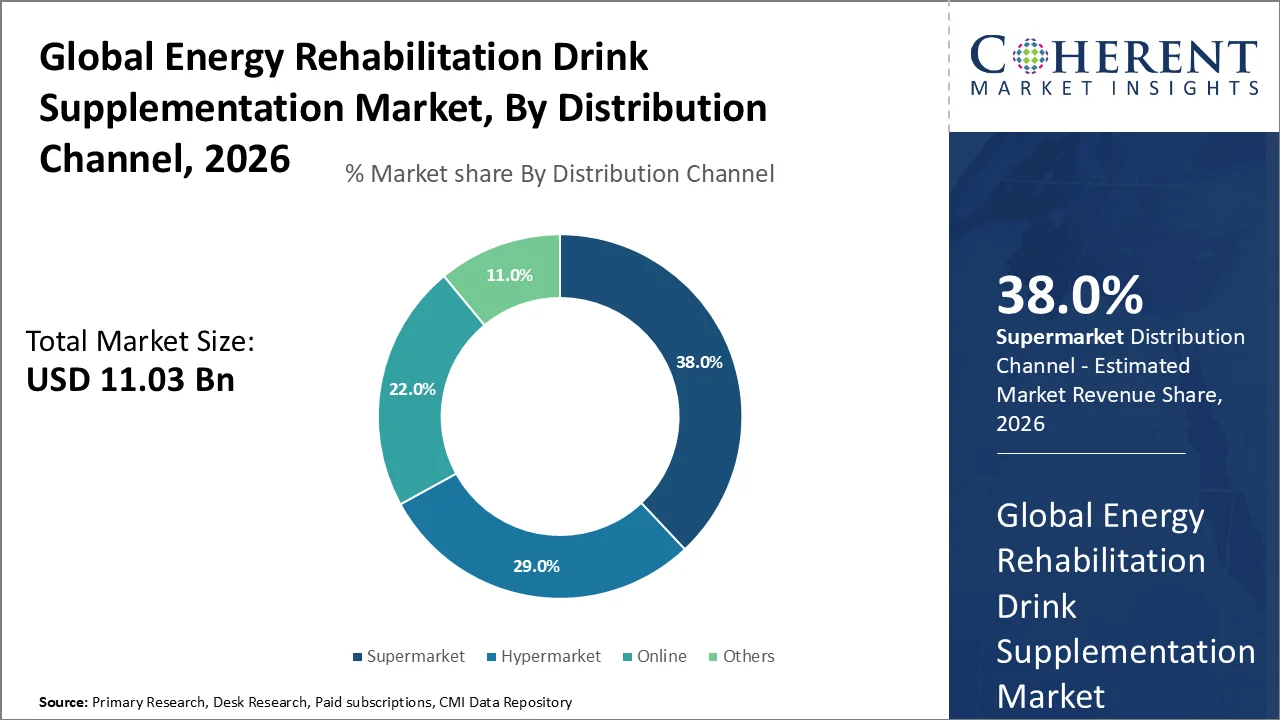
On the basis of distribution channel, the supermarket segment is projected to lead the Energy Rehabilitation Drink Supplementation Market with a major 38.0% share in 2026. The segment’s growth is owing to high consumer footfall, extensive beverage shelf space, immediate product availability, broad brand and flavor assortment, multipack availability, promotional pricing, and consumers’ ability to compare energy and functional drink products at the point of purchase.
According to the U.S. Department of Agriculture Economic Research Service, grocery stores remained the largest food-at-home retail outlet category in 2025, accounting for 56.2% of U.S. food-at-home sales.
In February 2026, Lucky Energy expanded its retail distribution through H-E-B supermarkets in Texas. The company launched five energy drink flavors in 218 H-E-B stores, where the products were merchandised within the retailer’s Healthy Living section.
Energy Rehabilitation Drink Supplementation Market Trends
- The Energy Rehabilitation Drink Supplementation Market is being revolutionized by increasing demand for zero sugar and clean energy formulations as consumers look for energy benefits without high sugar and calorie intake. In June 2026, Tilray Brands launche Hi Ball Energy in the U.K., each 330 ml can contain 100 mg of natural caffeine, B vitamins, guarana and ginseng, with zero sugar and zero calories.
- Increasing consumer demand for energy, hydration and cognitive benefits are driving manufacturers to innovate beyond traditional stimulant-based energy drinks. In May 2025, Anheuser-Busch and 1st Phorm launched Phorm Energy nationwide. The formula includes natural caffeine from green tea, electrolytes for hydration and ingredients to help support mental focus.
- The premium functional energy beverage category is growing stronger as nootropics, adaptogens and functional mushrooms go mainstream. In May 2026, GNC launched the functional beverage Melting Forest through its retail network. Its Energy formulation contains 150 mg of caffeine and has just 5 calories, and contains adaptogenic ingredients like cordyceps, lion's mane and reishi, reflecting increasing product differentiation around energy, cognitive performance and wellness benefits.
Regional Insights
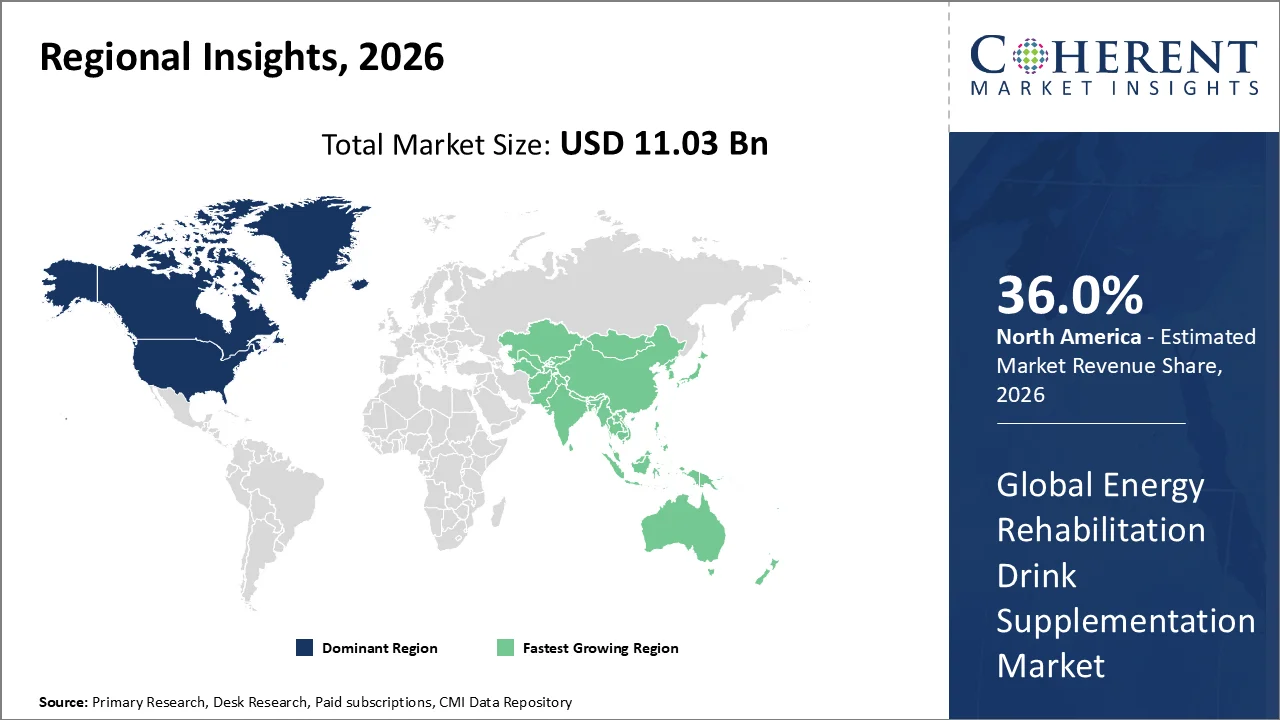
North America Dominates Owing to High Functional Energy Consumption and an Advanced Beverage Distribution Ecosystem
North America is estimated to account for about 36.0% share of the Energy Rehabilitation Drink Supplementation Market in 2026. The region’s dominance is driven by high energy and functional beverage penetration, strong consumer demand for performance and recovery products, a vast direct-store-delivery infrastructure and ongoing innovation in zero-sugar, hydration, caffeine, electrolyte and wellness-focused formulations.
In April 2026, PepsiCo reported that its energy portfolio partnership, covering brands distributed through its U.S. direct-store-delivery system, had gained both volume and value share and represented nearly 20% of the U.S. energy drink category. This highlights the substantial commercial scale of energy-oriented functional beverages and the strength of established distribution infrastructure across North America.
Asia Pacific Energy Rehabilitation Drink Supplementation Market Trends
Asia Pacific is expected to be the fastest-growing region in the Energy Rehabilitation Drink Supplementation Market over the forecast period. The region’s growth is owing to expanding urban populations, increasing participation in fitness and sports, rising disposable incomes, growing adoption of Western-style functional beverages, and greater availability of energy products through convenience stores, vending machines, supermarkets, and e-commerce platforms.
In May 2026, PepsiCo India expanded its Sting Energy portfolio with the launch of Sting Classic Kick in India. The new flavor was introduced nationally to strengthen consumer choice within the rapidly expanding energy beverage category. PepsiCo India described Sting as its flagship energy drink brand and positioned the launch around high-energy consumption occasions among younger consumers.
Growing Functional Energy Innovation and Strong Beverage Demand are Accelerating the Energy Rehabilitation Drink Supplementation Market in the United States
The U.S. Energy Rehabilitation Drink Supplementation Market is witnessing strong growth owing to the high adoption of functional energy beverages, increasing preference for zero-sugar formulations, growing demand for focus and performance benefits, and continuous product innovation by established beverage and sports nutrition companies.
In August 2026, Keurig Dr Pepper reported that its U.S. Refreshment Beverages business generated USD 2.9 billion in net sales during the second quarter of 2026, increasing 10.0% year-on-year. The company stated that growth was led by categories including energy and sports hydration, indicating continued consumer demand for functional beverage products in the U.S.
China Energy Rehabilitation Drink Supplementation Market Trends
China is expected to witness strong growth in the Energy Rehabilitation Drink Supplementation Market over the forecast period. The market’s growth is owing to the rising adoption of energy drinks among younger consumers, rapid expansion of modern retail and convenience channels, increasing interest in functional and zero-sugar beverages, and growing investment by both domestic and international beverage companies.
In August 2026, China Foods Limited reported that its functional drinks business generated RMB 304 million in revenue during the first half of 2026, representing year-on-year growth of more than 50%. The company also stated that Monster’s first-half sales volume had already reached its full-year 2025 target. In addition, the newly launched sugar-free Monster Ultra Violet product contributed RMB 50 million in revenue and accounted for 45% of Monster’s overall growth.
Who are the Major Companies in Energy Rehabilitation Drink Supplementation Industry
Some of the major key players in Energy Rehabilitation Drink Supplementation Market are Rockstar Energy Company, Arizona Beverage Company, Monster Energy Company, Red Bull GmbH, PepsiCo, Inc., Xyience Inc., National Beverage Corporation, Full Throttle Energy
Key News
- In June 2026, Rockstar Energy launched three alcohol-free energy drink mocktail variants Mojito, Piña Colada, and Berry Spritz, in Germany. Germany was selected as the first market globally for the new Rockstar Energy Mocktails.
- In March 2026, AriZona announced its expansion into the energy drink category with a new tea-based energy beverage portfolio. The company positioned the products around tea-derived caffeine, real fruit juice, natural ingredients, and differentiated flavors.
Market Report Scope
Energy Rehabilitation Drink Supplementation Market Report Coverage
| Report Coverage | Details | ||
|---|---|---|---|
| Base Year: | 2025 | Market Size in 2026: | USD 11.03 Bn |
| Historical Data for: | 2020 To 2024 | Forecast Period: | 2026 To 2033 |
| Forecast Period 2026 to 2033 CAGR: | 6.8% | 2033 Value Projection: | USD 17.50 Bn |
| Geographies covered: |
| ||
| Segments covered: |
| ||
| Companies covered: | Rockstar Energy Company, Arizona Beverage Company, Monster Energy Company, Red Bull GmbH, PepsiCo, Inc., Xyience Inc., National Beverage Corporation, Full Throttle Energy Company. | ||
| Growth Drivers: |
| ||
| Restraints & Challenges: |
| ||
Analyst Opinion
- The Energy Rehabilitation Drink Supplementation Market is gradually shifting from conventional stimulant-focused energy drinks toward broader functional beverages combining energy, hydration, recovery, and wellness benefits. FMI’s Power of Beverage 2026 identifies functionality as a major purchase driver, with consumers increasingly looking for beverages that provide energy, hydration, protein, digestive health, and mood-support benefits.
- Product innovation is expected to increasingly converge hydration, protein supplementation, recovery, and active nutrition within a single product. PepsiCo reported in April 2026 that estimated retail sales of Propel have more than doubled since 2019 to over USD 1 billion. The company further expanded the brand in May 2026 with Propel Clear Protein, which delivers 20 g of protein, 3 g of fiber, electrolytes, zero sugar and 90 calories per serving.
- The underlying need for hydration and exercise-recovery supplementation remains substantial and is expected to support long-term category expansion. Gatorade Sports Science Institute research released in July 2026 involving more than 500 physically active women found that 43% arrived at workouts already dehydrated, 57% did not consume adequate carbohydrates during exercise, and participants replaced only 20% of sodium lost during practice.
Speak to the analyst
Want personalized insights?
Take the findings above to one of our principal consultants, or have the report rebuilt around the segments, geographies and competitors you actually track.
Market Segmentation
- By Ingredients (Revenue, USD Bn, 2021-2033)
- Caffeine
- Ginseng
- Sugar
- Vitamins
- Others
- By Distribution Channel (Revenue, USD Bn, 2021-2033)
- Hypermarket
- Supermarket
- Online
- Others
- By Region (Revenue, USD Bn, 2021-2033)
- North America
- U.S.
- Canada
- Latin America
- Brazil
- Mexico
- Argentina
- Rest of Latin America
- Europe
- Germany
- U.K.
- France
- Italy
- Spain
- Russia
- Rest of Europe
- Asia Pacific
- China
- India
- Japan
- Australia
- South Korea
- ASEAN
- Rest of Asia Pacific
- Middle East
- GCC
- Israel
- Rest of Middle East
- Africa
- South Africa
- Central Africa
- North Africa
- North America
Sources
Primary Research Interviews
- Energy and functional beverage manufacturers
- Sports nutrition and dietary supplement manufacturers
- Product formulation and food science experts
- Nutritionists and sports dietitians
- Supermarket, hypermarket, and convenience store procurement managers
- Beverage distributors and retail channel partners
- Fitness centers, sports clubs, and athletic performance professionals
- Key opinion leaders (KOLs) in sports nutrition and functional beverages
Databases
- U.S. Food and Drug Administration (FDA)
- U.S. Department of Agriculture (USDA)
- National Institutes of Health – Office of Dietary Supplements (NIH-ODS)
- Centers for Disease Control and Prevention (CDC)
- World Health Organization (WHO)
- European Food Safety Authority (EFSA)
- Eurostat
- USDA FoodData Central
Magazines
- Beverage Industry
- BevNET
- Food Business News
- Nutraceuticals World
- Nutrition Insight
- FoodNavigator
Journals
- Journal of the International Society of Sports Nutrition
- Nutrients
- Food Chemistry
- Food and Chemical Toxicology
- Journal of Functional Foods
- International Journal of Sport Nutrition and Exercise Metabolism
- Sports Medicine
Newspapers
- Reuters
- The Wall Street Journal
- Financial Times
- The Guardian
- The Economic Times
- The New York Times
Associations
- International Food Information Council (IFIC)
- Council for Responsible Nutrition (CRN)
- Sports & Fitness Industry Association (SFIA)
- FMI – The Food Industry Association
- American Beverage Association (ABA)
- International Society of Sports Nutrition (ISSN)
- European Specialist Sports Nutrition Alliance (ESSNA)
Public Domain Sources
- Company Annual Reports and Investor Presentations
- SEC Filings and Financial Disclosures
- Company Product Launches and Press Releases
- Government Food, Beverage, and Dietary Supplement Regulations
- FDA and EFSA Guidance on Caffeine, Ingredients, and Labeling
- Publicly Available Sports Nutrition and Consumer Health Studies
- Retailer and Distributor Product Portfolio Information
- University and Peer-reviewed Research Publications
Proprietary Elements
- CMI Data Analytics Tool
- Proprietary CMI Existing Repository of Information for the Last 10 Years
Get access to 250+ pages report
Every segment, forecast, competitor profile and data table behind the analysis above — available for instant download.
- ESOMAR Member
- ISO 9001:2015 Certified
- D-U-N-S Registered
- GDPR & CCPA Compliant
Missing comfort of reading report in your local language? Find your preferred language:
Transform your Strategy with Exclusive Trending Reports
Frequently Asked Questions
The Energy Rehabilitation Drink Supplementation Market is expected to reach approximately USD 17.50 Bn in 2033.
Major players operating in the global Energy Rehabilitation Drink Supplementation Market include Rockstar Energy Company, Arizona Beverage Company, Monster Energy Company, Red Bull GmbH, PepsiCo, Inc., Xyience Inc., National Beverage Corporation, and Full Throttle Energy Company.
The high product development and formulation costs and stringent regulatory and labeling requirements are the key factors hampering growth of the market.
The increasing consumer demand for functional energy and recovery beverages and rising sports, fitness, and active lifestyle participation are boosting demand for energy rehabilitation drink supplementation products.
The Energy Rehabilitation Drink Supplementation Market is anticipated to grow at a CAGR of 6.8% between 2026 and 2033.
Among regions, North America is expected to account for the largest share of the global Energy Rehabilitation Drink Supplementation Market, with approximately 36.0% in 2026.
Asia Pacific is expected to be the fastest-growing region over the forecast period, supported by rising sports and fitness participation, growing disposable incomes, increasing functional beverage adoption, and wider product availability through supermarkets, convenience stores, vending machines, and e-commerce channels.