

Mushroom Market Size and Forecast – 2026 to 2033
The mushroom market is estimated to be valued at USD 80.71 Bn in 2026 and is expected to reach USD 159.29 Bn by 2033, exhibiting a compound annual growth rate (CAGR) of 10.2% from 2026 to 2033.
Key Takeaways
- By Product Type, Button Mushrooms acquired the prominent share of 40.8% in 2026 as health and nutritional benefits.
- By Form, Fresh dominates the overall market with an estimated share of 60.8% in 2026 owing to the rising health consciousness.
- By Distribution Channel, Supermarkets/Hypermarkets hold the largest market share of 47% in 2026 owing to its one-stop shopping convenience.
- By Region, North America expected to hold largest market share of 31.1 in 2026 owing to its rising demand for plant-based and functional foods.
Market Overview
The mushroom market is expected to witness positive growth over the next decade. Factors, such as increasing health consciousness among consumers and rising awareness about the nutritional benefits of mushrooms, are expected to boost the demand. Moreover, mushroom is gaining popularity as a meat substitutes due to its rich protein content. The growing vegan and vegetarian population worldwide is also contributing to the increased demand for mushrooms. In addition, mushroom produces high yields using minimal resources, which makes it an attractive option for commercial farming. With innovations surrounding mushroom farming and cultivation, the market is expected to grow steadily in the coming years.
Current Events and their Impact on the Mushroom Market
Current Events | Description and its impact |
Global Climate Change and Agricultural Shifts |
|
Asia-Pacific Supply Chain Dynamics |
|
Fluctuating Global Commodity Prices and Inflation |
|
Import Export Analysis of Mushroom
Between June 2024 and May 2025, India exported 3,136 mushroom shipments, showing a 33% growth compared to the previous year. These shipments were made by 76 exporters to 260 buyers. In May 2025 alone, India recorded 291 shipments — the same as in May 2024 and April 2025. Key export destinations were Bhutan, Nepal, and the United States.
Globally, 164,358 mushroom shipments were exported during the same period, a 59% increase year-over-year. May 2025 saw 12,576 global shipments, with no growth from April 2025 or May 2024. The top global markets were Singapore, Vietnam, and the United States.
Malaysia led global mushroom exports with 89,437 shipments, followed by China (78,181) and South Africa (25,470). India exported $1.98 million worth of dried mushrooms during this period.
- Current Industry Events of 2026
- Market Size Estimation
- Regional Breakdown
- Competitive Landscape
- Customer Intelligence
- Segmental Analysis
- Pricing Analysis
- Key Market Drivers, Challenges & Future Trends
- Customized Insights Section
Segmental Insights
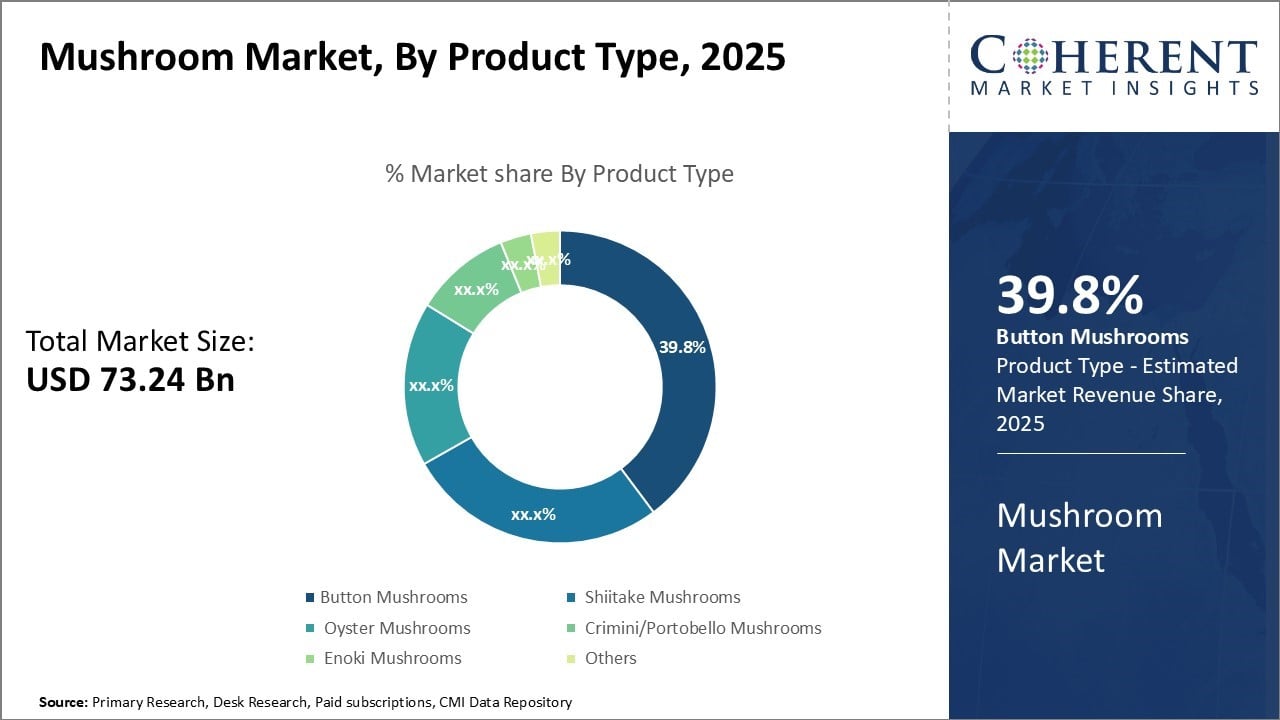
Mushroom Market Insights, By Product Type: Button Mushroom the highest share of the market owing to its increased demand for convenience foods
Button Mushrooms is expected to contribute 40.8% share of the market in 2026. Button mushrooms are versatile and widely used in cuisines across regions. Their mild flavor and meaty texture allow them to be substituted for meat in many vegetarian dishes. Additionally, button mushrooms are commonly used as a pizza or burger topping. The consistent white color and uniform size of button mushrooms also make them appealing from a visual perspective. Their appearance signals mildness and neutrality to consumers compared to more exotic mushroom varieties. Furthermore, button mushrooms are typically the most affordable mushroom type due to economies of scale in production.
For instance, the National Agricultural Statistics Service (NASS), part of the U.S. Department of Agriculture (USDA), has introduced a new nationwide survey targeting mushroom production in the United States. This effort seeks to gather essential data on an industry that, although specialized, holds notable economic and agricultural importance.
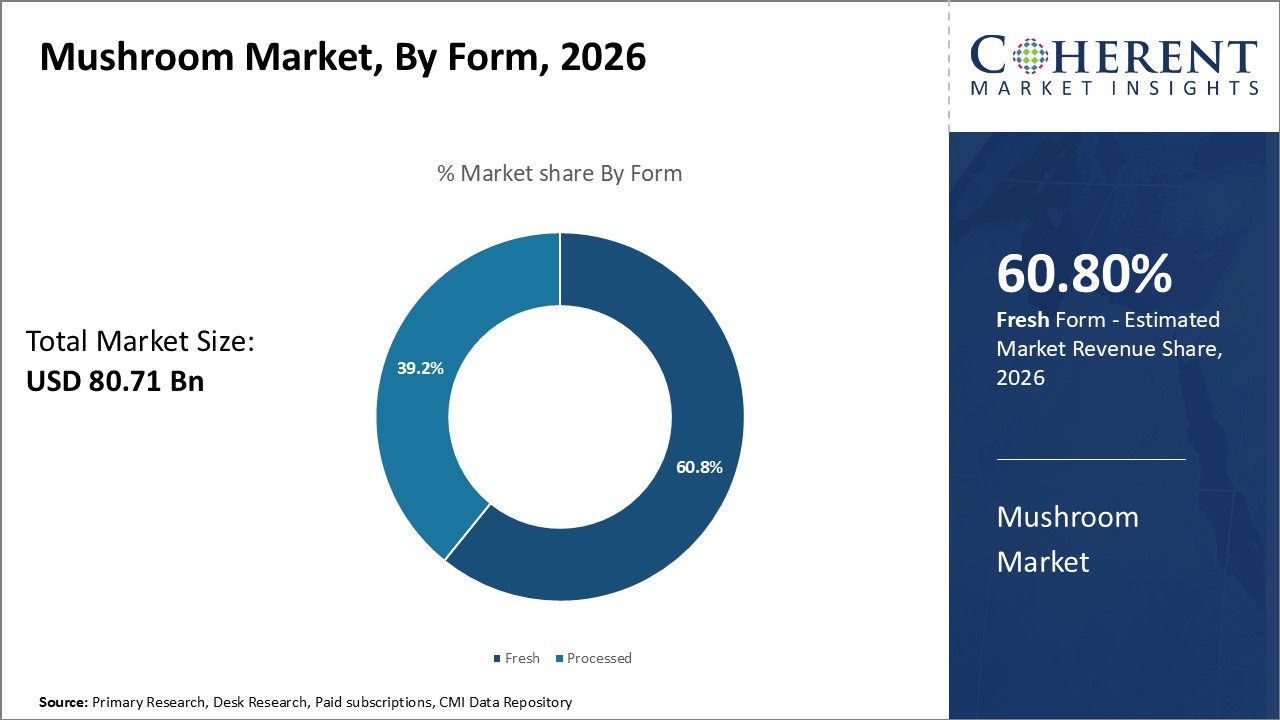
Mushroom Market Insights, By Form: Fresh segment acquires the highest share of the market owing to its demand for organic produce
Fresh mushroom is expected to contribute 60.8% share of the market in 2026. Consumers often prefer buying fresh produce to enjoy peak flavors and nutrients. Fresh mushrooms are also viewed as a more natural ingredient. This preference is reinforced by marketing by supermarkets and producers that emphasize the freshness of mushrooms. Additionally, advancements in cold chain logistics have improved the shelf life of fresh mushrooms, making them conveniently available year-round. While processed mushrooms offer longer shelf life and cost savings, consumers still associate the fresh form with higher quality. Some also enjoy preparing mushrooms in original recipes that require cleaning and slicing the fresh vegetable. The fresh mushroom segment consequently commands a significant premium over processed mushrooms.
For instance, in August 2025, the Mushroom Council and Eataly have launched a three-month promotion to highlight fresh mushrooms as a key ingredient in seasonal cooking. Building on the growing popularity of Mushroom Monday, the partnership covers three locations: New York City, Chicago, and Los Angeles.
Mushroom Market Insights, By Distribution Channel: Supermarket/Hypermarket the highest share of the market owing to its enhanced product visibility and impulse buying
Supermarket/Hypermarket is expected to contribute 47% of the market share in 2026. Supermarkets stock a wide variety of mushrooms including premium exotic varieties alongside basic buttons. The aggregation of products and standardized packaging saves consumers multiple trips to different stores. Customers can complete their weekly mushroom purchase alongside other grocery items in one place. Supermarkets also invest in attractive produce displays and unique mushroom packaging to entice impulse buys. Their scale allows for competitive pricing and frequent promotions. The well-lit, air-conditioned environment keeps mushrooms fresher for longer than traditional wet markets.
In March 2025, Urban Farm-It launched fresh, hand-harvested Lion’s Mane mushrooms in selected Sainsbury’s stores across the UK—the first time this rare variety is available in a UK supermarket. Grown organically in Kent, the 200g punnets are priced at £5, making them an affordable option for shoppers.
Regional Insights
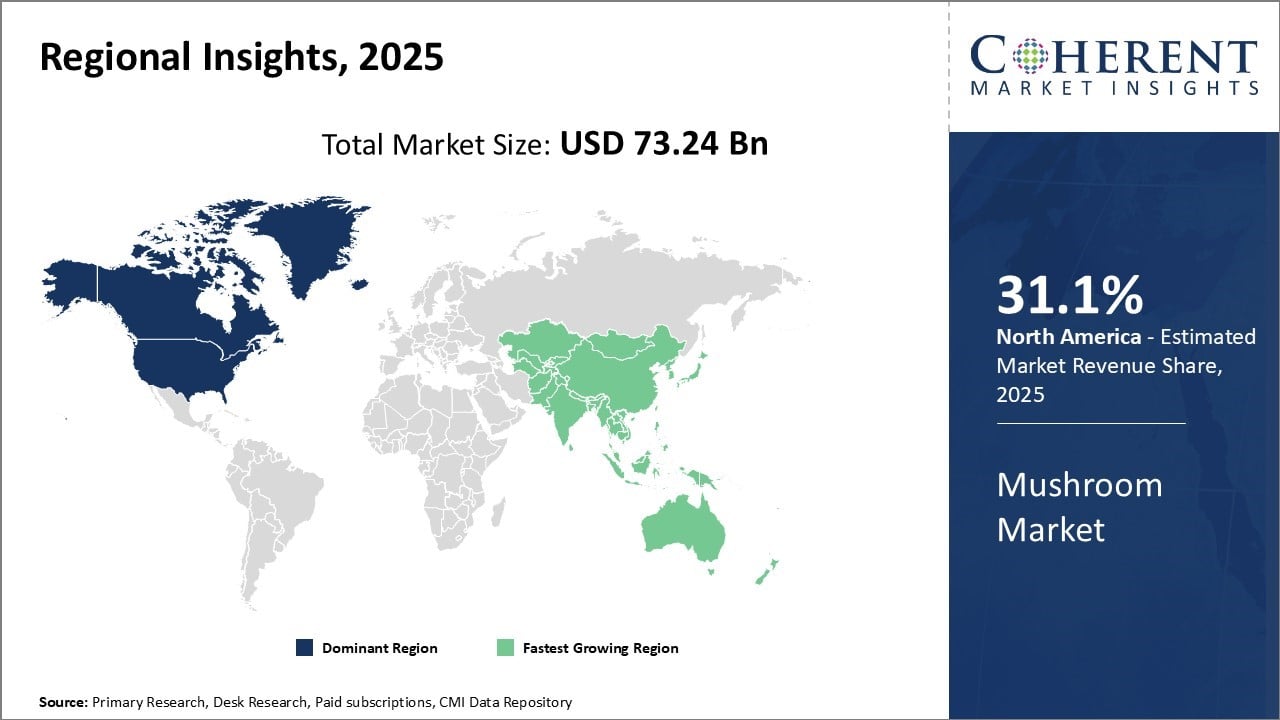
North America Mushroom Market Trends
North America expected to hold largest market share of 31.1% in 2026. Consumers in North America are actively adopting plant-based diets, which drives higher consumption of fresh and processed mushrooms. They favor mushrooms for their nutritional value, meaty texture, and versatility in various meals, supporting the shift toward healthier, sustainable, and protein-rich foods. Additionally, more consumers are choosing to grow mushrooms at home using ready-to-use kits, motivated by a desire for self-sufficiency and fresh produce. This trend shows their growing awareness of food origins and a strong preference for gourmet and exotic mushroom varieties, deepening their connection to mushrooms.
In August 2026, O Boticário introduced EGEO Cogu and EGEO Cogu Mellow in the United States, becoming the first brand in the world to launch a fragrance featuring Boletus Edulis mushroom.
Asia Pacific Mushroom Market Trends
Consumers increasingly choose organic and specialty mushrooms such as shiitake, enoki, and maitake for their health benefits and unique flavors. Rising disposable incomes and growing health awareness drive demand for premium-quality mushrooms, prompting producers to prioritize organic certification and diversify mushroom varieties. Governments in several Asia Pacific countries actively invest in mushroom cultivation by providing subsidies, training, and research support. These initiatives help improve yields, enhance quality, and boost farmer livelihoods, modernizing the industry and ensuring a steady mushroom supply to meet rising demand.
India Mushroom Market Trends
India’s mushroom processing industry is expanding as companies develop value-added products like mushroom powders, canned mushrooms, and ready-to-cook mixes. This growth responds to changing consumer preferences for convenience and helps increase mushroom consumption across diverse demographics. Meanwhile, the Indian government actively promotes mushroom cultivation by offering subsidies, training programs, and infrastructure support. These efforts aim to boost production efficiency, assist small-scale farmers, and drive sustainable growth in rural and peri-urban mushroom farming. For instance, in August 2024, To support farmers in the state in achieving sustainable livelihoods and increasing their earnings, Meghalaya Chief Minister Conrad K Sangma inaugurated North East India’s largest Oyster Mushroom processing plant at Mendipathar in North Garo Hills.
United States Mushroom Market Trends
Producers and retailers are expanding direct-to-consumer channels through online platforms and subscription services for fresh and specialty mushrooms. They provide greater convenience, fresher products, and build stronger relationships with consumers in a competitive market. At the same time, U.S. mushroom companies are adopting eco-friendly packaging, using biodegradable, compostable, and recyclable materials to attract environmentally conscious buyers and support broader sustainability efforts. For instance, South Mill Champs, one of North America's largest mushroom growers, has launched its new snack food venture, Shrooms Snacks. With this brand, the company aims to offer delicious, better-for-you snacks made from mushrooms grown and handpicked on its farms in Kennett Square, Pennsylvania—the mushroom capital of the world.
Market Report Scope
Mushroom Market Report Coverage
| Report Coverage | Details | ||
|---|---|---|---|
| Base Year: | 2025 | Market Size in 2026: | USD 80.71 Bn |
| Historical Data for: | 2020 To 2024 | Forecast Period: | 2026 To 2033 |
| Forecast Period 2026 to 2033 CAGR: | 10.2% | 2033 Value Projection: | USD 159.29 Bn |
| Geographies covered: |
| ||
| Segments covered: |
| ||
| Companies covered: | Holyland Group, The Mushroom Company, Bonduelle Group, Kiril Mischeff Group, Costa Group, Okechamp SA., Monterey Mushrooms Inc., Greenyard, Prochamp, Monaghan Mushrooms, Muniraj Mushroom Farm, Dhruv Agro, Shanghai Finc Food Co. Ltd., B&G Foods Inc., Prochamp B.V, Shanghai Finc Foods Co. Ltd, Dev Bhoomi Frozen Food Products, Hariom Mushroom Farms, and Fruitin Agro Pvt Ltd. | ||
| Growth Drivers: |
| ||
| Restraints & Challenges: |
| ||
Mushroom Market Trend
- Rising Popularity of Functional and Medicinal Mushrooms
Consumers are increasingly turning to mushrooms like lion’s mane, reishi, and chaga for their potential health benefits, including cognitive support and immune enhancement. In August 2025, MushCanyon launched its Functional Mushroom Gummies—a clean-label supplement made with 10:1 fruiting-body extracts. Designed for daily wellness, the gummies support focus, stress relief, immune balance, and energy, combining traditional benefits with modern science in a convenient format. These mushrooms are no longer niche but are becoming mainstream in supplements, beverages, and snacks. This shift reflects a broader wellness movement where natural, plant-based ingredients gain traction, encouraging innovation in product development and expanding mushroom consumption beyond traditional culinary uses.
- Expansion of Sustainable and Vertical Farming
Sustainable cultivation methods, especially vertical farming, are transforming mushroom production by maximizing space and reducing environmental impact. These techniques enable year-round harvesting and local production, cutting transportation costs and carbon footprints. Farmers adopt eco-friendly practices that conserve water and energy, meeting consumer demands for greener food sources while ensuring consistent supply and quality, which supports the long-term growth of the mushroom industry.
Mushroom Market Opportunity
- Growth in Plant-Based and Meat Alternative Products
Mushrooms’ natural umami flavor and texture make them ideal for expanding plant-based and meat alternative markets. Developing mushroom-based protein products addresses consumer demand for nutritious, sustainable, and tasty alternatives to animal products. Innovators can explore diverse formulations—from burgers to jerky—catering to flexitarians, vegetarians, and vegans, thus capturing a broader consumer base seeking environmentally responsible food choices.
Mushroom Market News
- In May 2025, Jomo Kenyatta University of Agriculture and Technology (JKUAT) launched a multimillion-shilling smart agriculture initiative, funded by the South Korean government, to distribute mushroom planting materials to hundreds of farmers across Kenya.
- In February 2025, Dennis Walker launched Mycoday, a functional mushroom chocolate. He formulated the dark chocolate bar with four mushroom species supplied by Finnish functional ingredient provider Nordic Mushrooms, offering benefits ranging from improved cognition to immune health and cholesterol management.
- In April 2025, Plant-based brand Happiee, best known for its seafood alternatives, has expanded its product range by launching easy-cook lion’s mane mushroom chunks. The company claims these chunks, available in Original and Teriyaki flavors, are the first products of their kind in the UK.
Analyst Opinion (Expert Opinion)
- The mushroom market is uniquely positioned at the intersection of evolving consumer preferences, technological innovation, and sustainability imperatives, making it one of the most dynamic segments in the food industry today. From my perspective, the true growth driver isn’t just increased consumption but the mushroom’s transformation from a niche ingredient to a versatile functional food with significant health and environmental credentials.
- Simultaneously, the adoption of vertical farming by innovators like MyForest Foods in the U.S. and Smallhold in New York showcases how technology is reshaping supply chains. These companies produce premium-quality oyster mushrooms with environmental efficiency unmatched by traditional agriculture. MyForest Foods’ facility alone produces over 20,000 pounds weekly using controlled environment agriculture, underscoring a scalable, localized production model that mitigates supply disruptions and reduces carbon footprints — a necessity amid escalating climate concerns.
- However, a critical challenge remains in consumer education and product transparency. Despite increasing demand, inconsistent labeling and fragmented certification standards confuse consumers, dampening trust. Companies that prioritize transparent sourcing and organic certifications will not only differentiate themselves but also foster long-term loyalty in a market where provenance is becoming paramount.
- Apart from this, the mushroom market’s expansion into plant-based meat alternatives is more than a trend—it's a strategic evolution. Products like Quorn, which leverage fungal mycoprotein, have been in the market for decades but are only now benefiting from the surge in plant-based diets. New entrants blending mushrooms with pea or soy proteins address both flavor and texture challenges better than many standalone plant proteins, making mushrooms indispensable in the future of sustainable protein innovation.
Speak to the analyst
Want personalized insights?
Take the findings above to one of our principal consultants, or have the report rebuilt around the segments, geographies and competitors you actually track.
Market Segmentation
- Product Type Insights (Revenue, USD Bn, 2021 - 2033)
- Button Mushrooms
- Shiitake Mushrooms
- Oyster Mushrooms
- Crimini/Portobello Mushrooms
- Enoki Mushrooms
- Others
- Form Insights (Revenue, USD Bn, 2021 - 2033)
- Fresh
- Processed
- Distribution Channel Insights (Revenue, USD Bn, 2021 - 2033)
- Supermarkets/Hypermarkets
- Specialty Stores/Wet Markets
- Online Retailers
- Food Service Distributors
- Direct Sales/Farmer's Markets
- Regional Insights (Revenue, USD Bn, 2021 - 2033)
- North America
- U.S.
- Canada
- Latin America
- Brazil
- Argentina
- Mexico
- Rest of Latin America
- Europe
- Germany
- U.K.
- Spain
- France
- Italy
- Russia
- Rest of Europe
- Asia Pacific
- China
- India
- Japan
- Australia
- South Korea
- ASEAN
- Rest of Asia Pacific
- Middle East & Africa
- GCC Countries
- Israel
- Rest of Middle East & Africa
- North America
- Key Players Insights
- Holyland Group
- The Mushroom Company
- Bonduelle Group
- Kiril Mischeff Group
- Costa Group
- Okechamp SA.
- Monterey Mushrooms Inc.
- Greenyard
- Prochamp
- Monaghan Mushrooms
- Muniraj Mushroom Farm
- Dhruv Agro
- Shanghai Finc Food Co. Ltd.
- B&G Foods Inc.
- Prochamp B.V
- Shanghai Finc Foods Co. Ltd.
- Dev Bhoomi Frozen Food Products
- Hariom Mushroom Farms
- Fruitin Agro Pvt Ltd.
Sources
Primary Research Interviews
- Mushroom cultivators and farmers across India, the U.S., and the Netherlands
- Procurement heads from food processing companies and mushroom-based FMCG brands
- Retail buyers from large supermarket chains and specialty food stores
- Supply chain managers in functional food and plant-based product manufacturing
- R&D leads from nutraceutical and wellness product companies using medicinal mushrooms
Databases
- FAOSTAT (Food and Agriculture Organization of the United Nations)
- USDA Economic Research Service
- Eurostat Agricultural Production Database
- UN Comtrade (International Trade Statistics Database)
- Indian Horticulture Database (National Horticulture Board)
Magazines
- Modern Farmer – coverage of mushroom cultivation trends and sustainability practices
- Food Navigator – articles on mushroom-based product launches and ingredient innovation
- Produce Grower – insights into controlled-environment agriculture and vertical farming
- Specialty Food Magazine – market movement on gourmet and organic mushroom products
Journals
- International Journal of Medicinal Mushrooms – scientific studies on functional mushroom properties
- Food Chemistry – peer-reviewed articles on nutritional and chemical composition of mushrooms
- Journal of Agricultural and Food Chemistry – analysis of post-harvest preservation and processing techniques
- Mycologia – research on fungal biodiversity, cultivation techniques, and breeding
- Journal of Functional Foods – exploration of mushrooms in health and wellness contexts
Newspapers
- The New York Times – coverage of mushroom farming trends and culinary adoption
- The Hindu Business Line – reports on India’s horticulture and agri-tech developments
- The Guardian – features on sustainability and global mushroom consumption
- The Economic Times – news on food retailing and mushroom exports from India
Associations
- Indian Mushroom Growers Association
- North American Mycological Association (NAMA)
- European Mushroom Growers Group (GEPC)
- American Mushroom Institute (AMI)
- Asia-Pacific Mycological Society
Public Domain Sources
- WHO and FAO joint reports on food security and dietary diversification
- Ministry of Agriculture & Farmers Welfare (India) reports on horticulture promotion
- U.S. Department of Agriculture reports and production statistics
- EU Commission briefings on sustainable agriculture and organic produce
- Patents and technical papers from Google Patents and PubMed Central
Proprietary Elements
- CMI Data Analytics Tool, and Proprietary CMI Existing Repository of information for last 8 years
Get access to 250+ pages report
Every segment, forecast, competitor profile and data table behind the analysis above — available for instant download.
- ESOMAR Member
- ISO 9001:2015 Certified
- D-U-N-S Registered
- GDPR & CCPA Compliant
Missing comfort of reading report in your local language? Find your preferred language:
Transform your Strategy with Exclusive Trending Reports
Frequently Asked Questions
The Mushroom Market is estimated to be valued at USD 80.71 Bn in 2026, and is expected to reach USD 159.29 Bn by 2033.
The CAGR of the Mushroom Market is projected to be 10.2% from 2026 to 2033.
Growing health benefits of mushrooms and the rise of plant-based and vegan diets are the major factors driving the growth of the global mushroom market.
Market fragmentation and risk of contamination are the major factors hampering the growth of the global mushroom market.
In terms of product type, button mushrooms is estimated to dominate the market revenue share in 2026.
Holyland Group, The Mushroom Company, Bonduelle Group, Kiril Mischeff Group, Costa Group, Okechamp SA., Monterey Mushrooms Inc., Greenyard, Prochamp, Monaghan Mushrooms, Muniraj Mushroom Farm, Dhruv Agro, Shanghai Finc Food Co. Ltd., B&G Foods Inc., Prochamp B.V, Shanghai Finc Foods Co. Ltd, Dev Bhoomi Frozen Food Products, Hariom Mushroom Farms, and Fruitin Agro Pvt Ltd are the major players.
North America is expected to lead the global mushroom market.