

Global Corn Grit Market Size and Share Analysis – Growth Trends and Forecasts (2026-2033)
Corn Grit Market is estimated to be valued at USD 1,100.2 Mn in 2026 and is expected to reach USD 1,621.8 Mn in 2033, exhibiting a compound annual growth rate (CAGR) of 5.7% from 2026 to 2033.
Key Takeaways
- Based on type of corn grit, Yellow corn grits dominate the market with 67.9% share. This is due to their higher availability and lower cost compared to white corn.
- Based on granulation size, Medium granulation corn grits dominate the market. This is due to their versatile application across both food and industrial uses.
- Based on application, the food industry segment dominates the corn grits market. This is driven by strong demand in breakfast cereals, baking, and snack production.
- Based on distribution channel, Supermarkets/Hypermarkets dominate the corn grits market distribution, primarily. This is due to their widespread reach, bulk purchasing options, and strong in-store visibility.
- Based on end user, the industrial segment dominates the corn grits market, mainly due to large-scale consumption by the food processing, beverage, and animal feed industries.
- By region, North America is the largest market for corn grit, accounting for a market share of over 37.5% in 2026. This is due to the high demand for corn grit in the beverage sector and food, as well as the growing popularity of gluten-free
Market Overview
Rising demand from food processing industries is propelling the corn grit market growth, especially in breakfast cereals and snacks. Increasing interest in gluten-free products and digestible options has led to more corn grits for gluten-free and clean-label applications in the bakery, ready-to-eat foods, and instant mixes markets. Similarly, the rise in functional foods and plant-based diets is increasing use of corn-based food products.
Current Events and Its Impact on Corn Grit Market
Current Events | Description and its impact |
Geopolitical and Regulatory Developments |
|
Epidemiological and Public Health Factors |
|
Economic and Food Industry Infrastructure Trends |
|
Pricing Analysis
Pricing Summary of the Corn Grit Market Corn grits can be found in both bulk industrial and consumer retail packages, which create high price variability. Bulk food-grade corn grits range in price from $0.20 to $0.50 per kilogram depending on grade, moisture, and source. Non-GMO or organic corn grits will be more expensive and range in price from $0.70 to $1.50 per kilogram in specialty and export markets.
In retail packaging, consumer packages in sizes from 500g to 1000g typically fall in the range of $1.00 to $3.00 depending on the brand(s), labeling (e.g., gluten-free), and distribution channel. It is interesting to note the price differentials as traditional bulk suppliers and high-end branded retail can differ by as much as 300%.
- Current Industry Events of 2026
- Market Size Estimation
- Regional Breakdown
- Competitive Landscape
- Customer Intelligence
- Segmental Analysis
- Pricing Analysis
- Key Market Drivers, Challenges & Future Trends
- Customized Insights Section
End-user Feedback and Unmet Needs
- Uniform Quality and Particle Size: End-users want to source uniform quality and particle size corn grits to maintain uniformity in the quality of snacks, cereals, and brewing end-products. Uniformity in grits size impacts processing efficiency, and the flavor and appearance of the end-product warrant improving milling precision.
- GMO and organic choice: With increasing consumer awareness of food provenance, there is a growing demand for non-GMO and certified organic corn grit. End-users, especially in export markets and health-oriented niches, want suppliers able to fulfill clean-label and regulatory requirements.
- Extended Shelf Life and Packaging Innovation: Retail and industrial purchasers are concerned with moisture absorption and deterioration, particularly in tropical regions. There is widespread demand for innovative packaging options that have extended shelf life and preserve product quality throughout storage and transit.
Segmental Insights

Corn Grit Market Insights, By Type of Corn Grits: Higher availability drives demand for yellow corn grits
Yellow corn grits dominate the market with a share of 67.9% primarily due to their higher availability and lower cost compared to white corn. They are widely used in food processing, including snacks, breakfast cereals, and bakery products, due to their distinct flavor and vibrant color. Yellow corn also contains higher levels of beta-carotene (a source of Vitamin A), making it more appealing for health-conscious consumers. Their longer shelf life and versatility in industrial applications further strengthen their market share. Consistent demand from both human consumption and animal feed sectors supports their dominance. In March 2025, Cargill inaugurated a new corn milling plant in Gwalior, Madhya Pradesh, in collaboration with Saatvik Agro Processors. The facility, with an initial capacity of 500 tons per day expandable to 1,000 tons, aims to meet the growing demand for starch derivatives in India's confectionery, dairy, and infant formula sectors. Such initiatives are proliferating the corn grit market demand.
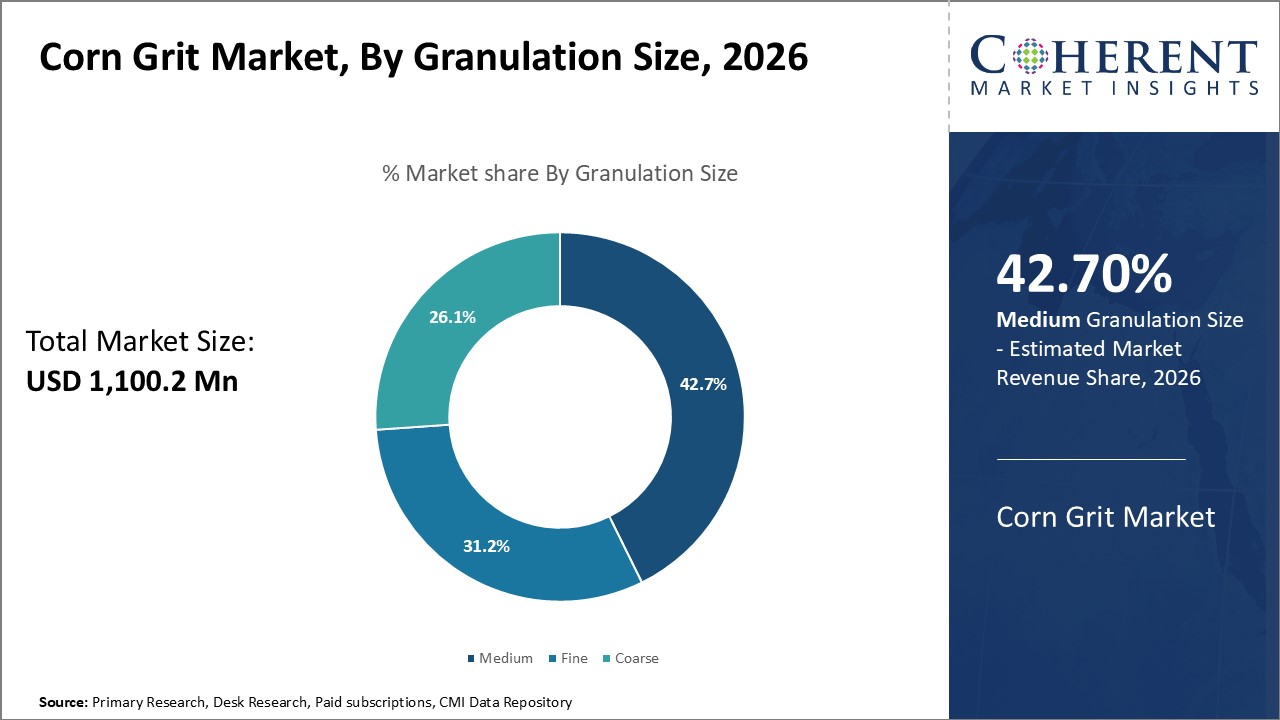
Corn Grit Market Insights, By Granulation Size: Medium granulation corn grits dominate due to their versatile application
Medium granulation corn grits dominate the market due to their versatile application across both food and industrial uses. They strike a balance between texture and cooking time, making them ideal for products like cereals, snacks, and ready-to-eat meals. Medium grits are also preferred in breweries for beer production. Their wider usability compared to fine (used mainly in baking) or coarse (used more in animal feed) gives them an edge. Additionally, higher consumer demand for convenience foods supports this segment’s growth.
Corn Grit Market Insights, By Application: Food Industry Lead the Market Due To Strong Demand in Breakfast Cereals
The food industry segment dominates the corn grits market, driven by strong demand in breakfast cereals, baking, and snack production. Corn grits are valued for their texture, taste, and nutritional content, making them a popular ingredient in ready-to-eat and processed foods. The rise in health-conscious consumers and gluten-free diets has further boosted their use in cereal and bakery products. Additionally, large-scale usage by food manufacturers ensures consistent demand. Their adaptability across diverse food applications solidifies this segment's lead.
Corn Grit Market Insights, By Distribution Channel: Supermarkets/Hypermarkets dominates due to bulk purchasing options
Supermarkets/Hypermarkets dominate the corn grits market distribution, primarily due to their widespread reach, bulk purchasing options, and strong in-store visibility. These retail formats offer consumers the convenience of one-stop shopping and access to multiple brands and package sizes. Their established supply chains and shelf space give them an edge in high-volume sales. Supermarkets also attract health-conscious buyers looking for gluten-free or natural grain options. Overall, their ability to serve both urban and semi-urban populations drives their dominance.
In August 2025, The Beijing Hotel in Juba officially opened the Beijing Supermarket, a sister company aimed at boosting South Sudan's economy by partnering with local producers and creating job opportunities for citizens.
Corn Grit Market Insights, By End User: Industrial segment dominates due to large-scale consumption
The industrial segment dominates the corn grits market, mainly due to large-scale consumption by the food processing, beverage, and animal feed industries. Industrial buyers purchase in bulk for use in products like snacks, breakfast cereals, beer, and pet food. Their consistent demand supports steady production and supply chain stability. Additionally, corn grits are used in non-food applications such as bio-based products, further boosting industrial usage. The scale, frequency, and volume of industrial demand far exceed that of household consumption.
In March 2026, the Yednist’ Food Grain and Legume Processing Plant began operations in the Myrhorod district of Poltava. Part of the Yednist’ Group, the facility uses equipment from Ukrainian manufacturer Olis to produce yellow split peas, corn grits, and corn flour for the B2B market.
Regional Insights
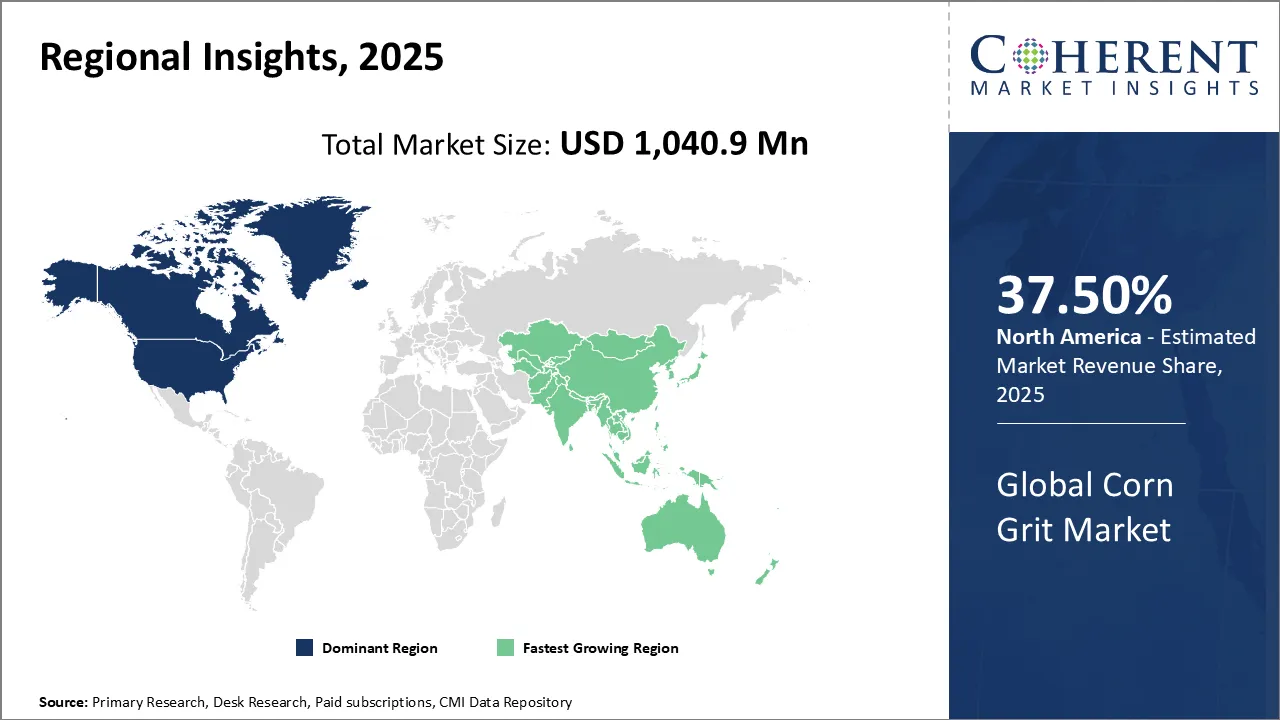
North America Corn Grit Market Trends
North America is the largest market for corn grit, accounting for a market share of over 37.50% in 2026. This is due to the high demand for corn grit in the beverage sector and food, as well as the growing popularity of gluten-free products. The U.S.is the major market in this region, followed by Canada. In July 2026, Grain Craft completed the acquisition of Bunge’s North American dry corn milling assets, which included six production facilities and approximately 600 employees—marking a major expansion in its corn grits and masa operations. This deal underscores sustained investment and consolidation in the region’s corn processing infrastructure, catering to strong demand across food and beverage applications.
Asia Pacific Corn Grit Market Trends
Asia Pacific is the second largest market for corn grit, with a CAGR of over 5% during the forecast period. This market growth is driven by the increasing demand for corn grit in the food and beverage industry, as well as the growing population in the region. China and India are the major markets in this region. In 2024, India transformed from being a top corn exporter into a net importer, estimated to bring in around 1 million tons of corn—primarily from Myanmar and Ukraine.
This dramatic shift resulted from a January policy favoring corn‑based ethanol over sugarcane for gasoline blending, which significantly increased domestic corn demand and squeezed industries like poultry and starch processors.
United States Corn Grit Market Trends
The U.S. remains the largest corn grits market in the world, fueled by strong demand in breakfast cereals, snack foods, brewing, and gluten-free. The use of corn grits by leading food manufacturers, like Kellogg's and General Mills, primarily for their ready-to-eat products, has increased. The growth in clean-label and gluten-free diets is boosting consumer demand for non-GMO and organic. The U.S. also has a well-automated milling infrastructure that allows for higher volumes and quality of production.
For example, in June 2024, Grain Craft announced the completion of their acquisition of Bunge North America's dry corn milling assets, including corn grits plants, so they can grow their share of the U.S snack and cereal ingredient markets. This acquisition highlights the importance that Grain Craft puts on long-term investment in corn grits production.
India Corn Grit Market Trends
India is well on its way to become a fast-growing corn grits market, aided by population growth, more consuming processed foods, and growing corn-based production. Demand for corn grits is growing in snacks, breakfast cereals, and brewing as domestic brands are launching more products. Corn is cost-effective in India because of the large supply base and strong agri-processing sector, making production of affordable corn grits for domestic and export. There is also a growing preference in India for gluten-free and high fiber products.
In February 2024, the India Corn Industry Report highlighted that India imported a record 1 million metric tons of corn in 2024—primarily non‑GMO corn from Myanmar and Ukraine—to meet soaring domestic demand in applications such as ethanol, starch, and food production. This is further propelling the corn grit market in India.
Market Report Scope
Corn Grit Market Report Coverage
| Report Coverage | Details | ||
|---|---|---|---|
| Base Year: | 2025 | Market Size in 2026: | USD 1,100.2 Mn |
| Historical Data for: | 2020 To 2024 | Forecast Period: | 2026 To 2033 |
| Forecast Period 2026 to 2033 CAGR: | 5.7% | 2033 Value Projection: | USD 1,621.8 Mn |
| Geographies covered: |
| ||
| Segments covered: |
| ||
| Companies covered: | Cargill Incorporated, ADM,Bunge,LifeLine Foods,Bob’s Red Mill Natural Foods | ||
| Growth Drivers: |
| ||
| Restraints & Challenges: |
| ||
Global Corn Grit Market Drivers
- Food industry growth: Corn grits are majorly used in the food industry. As the food industry grows, especially in the snack and breakfast segments, demand for corn grits also tends to rise.
- Health consciousness: With the increasing trend towards health and wellness, corn grits, which is gluten-free, can attract consumers those who are looking for alternative grains. These are also rich in fiber, which can be appealing to health-conscious individuals. In June 2024, SITRAPAT, a producer based in Togo, showcased its 100% natural, additive-free, non‑GMO, Kosher, and gluten‑free corn grits (under the EbliFoods brand) at the 2024 Summer Fancy Food Show in New York. This product was specifically positioned to meet rising consumer demand for clean‑label and health‑friendly ingredients.
- Convenience foods: Rise in demand for convenience foods like ready-to-cook meals or quick snacks has driven the corn grit market, as these often use corn grits as an ingredient.
- Biofuel production: Demand for corn for biofuel production, especially ethanol, can indirectly influence the global corn grit market. If more corn is diverted towards biofuel, it could potentially lead to reduced availability or increased prices for corn grits.
Global Corn Grit Market Opportunities
- Gluten-free trend: With increasing awareness about celiac disease and gluten sensitivity, there's growing demand for gluten-free products. Since corn grits are naturally gluten-free, there's a potential to market them as a healthy alternative to wheat-based products.
- Value-added products: Introducing value-added corn grit products, such as fortified vitamins and minerals which are combined with other grains, can cater to the health-conscious consumer segment.
- Organic and non-GMO: Increasing demand for organic and non-GMO products, there is an opportunity for producers to offer certified organic and non-GMO corn grits. In October 2024, Trishla Industries participated in Gulfood Manufacturing 2024, where it showcased premium corn grits produced in its FSSC-certified, sustainable facility in Karnataka, India—emphasizing production standards that support non-GMO sourcing and appeal to clean-label, health-driven markets.
- Diverse culinary applications: With the globalization of cuisines, there is a chance to promote corn grits in various culinary applications around the world, by introducing them to dishes beyond traditional ones.
Global Corn Grit Market Trends
- Health and wellness: Consumers are increasingly focusing on their health and well-being, thus leading to an elevated demand for foods rich in fiber, vitamins, and minerals. Corn grits are a natural source of several essential nutrients, so there is a trend towards positioning them as a health food.
- Clean label movement: Consumers are more concerned about what is in their food, thereby leading to a preference for products with recognizable and natural ingredients. Thus, the demand for corn grits without additives, preservatives, or artificial ingredients is on the rise.
- Ethical and sustainable farming: The focus on sustainable and ethical farming practices has been growing. Corn products that are sourced from farms by using sustainable agricultural practices or from local sources are becoming more popular.
- Globalized cuisine: As people explore global cuisines, dishes that use corn grits, traditionally are popular in certain regions, are gaining popularity worldwide.
Recent Developments
- In July 2025, Cornitos launched Crusties Honey Chilli Potato Balls, a new sweet-and-spicy addition to its revamped Crusties Puffs range. Baked, gluten-free, and made from rice grits, corn grits, potato flakes, and corn oil, the snack offers a guilt-free crunch in line with the brand’s focus on mindful eating.
- In October 2024, Trishla Industries engaged with international buyers in the breakfast and snacking industries by offering corn grit solutions at Gulfood Manufacturing 2024. This included corn grit that is better than prices due to enhanced purity, consistent granulation, and extreme extrudability.
Analyst view of the Global Corn Grit Market
- Global corn grit market is expected to grow steadily driven by the increasing demand for convenience foods across regions. Corn grit is a popular breakfast food and finds wide application in baked goods due to its texture and binding properties. North America dominates the market which is aided by the large breakfast food industry in the US. Asia Pacific is likely to emerge as the fastest growing market with the rising health-conscious population fueling consumption of corn-based products in countries like India and China.
- However, price volatility of corn may negatively impact the market players as corn is the primary raw material for producing grits. Unfavorable weather conditions can disrupt corn supply and lift prices. Substitutes like oats, wheat, and rice also provide competition. Nevertheless, corn grit manufacturers are focused on new product launches fortified with vitamins, minerals, and proteins to tap the health-conscious demographic. The launch of gluten-free and organic variants is also expanding the consumer base.
- Online retail is expected to offer lucrative growth opportunities for corn grit suppliers. E-commerce giants are boosting the product discovery rate. Leading brands are engaged in promotional activities on digital channels and partnering with online food retailers to boost market growth. The market is consolidated with key market players from North America which have a strong base. Local players in emerging economies may look at regional expansion opportunities through tie-ups with local food processing companies.
Market Segmentation
- By Type of Corn Grits (Revenue, USD Mn, 2021 - 2033)
- Yellow Corn Grits
- White Corn Grits
- By Granulation Size (Revenue, USD Mn, 2021 - 2033)
- Fine
- Medium
- Coarse
- By Application (Revenue, USD Mn, 2021 - 2033)
- Food Industry
- Breakfast Cereals
- Baking
- Snacks
- Beverage Industry (e.g., beer production)
- Animal Feed
- Other Industrial Uses
- Food Industry
- By Distribution Channel (Revenue, USD Mn, 2021 - 2033)
- Direct Sales
- Distributor
- Online Retailers
- Supermarkets/Hypermarkets
- Specialty Stores
- By End User (Revenue, USD Mn, 2021 - 2033)
- Households
- Industrial
- By Region (Revenue, USD Mn, 2021 - 2033)
- North America
- U.S.
- Canada
- Latin America
- Brazil
- Argentina
- Mexico
- Rest of Latin America
- Europe
- Germany
- U.K.
- Spain
- France
- Italy
- Russia
- Rest of Europe
- Asia Pacific
- China
- India
- Japan
- Australia
- South Korea
- ASEAN
- Rest of Asia Pacific
- Middle East
- GCC Countries
- Israel
- Rest of Middle East
- Africa
- South Africa
- North Africa
- Central Africa
- North America
- Top Companies in Global Corn Grit Market
- Cargill Incorporated
- ADM
- Bunge
- LifeLine Foods
- Bob’s Red Mill Natural Foods
Sources
Primary Research Interviews
- Corn processing plant managers and production heads
- Agricultural commodity traders and distributors
- Food & beverage manufacturers utilizing corn grits
- Equipment suppliers for corn processing machinery
- Others
Databases
- USDA National Agricultural Statistics Service (NASS)
- FAO Corporate Statistical Database (FAOSTAT)
- Global Trade Atlas
- Others
Magazines
- Milling & Grain Magazine
- World Grain Magazine
- Feed & Grain Magazine
- Corn & Soybean Digest
- Others
Journals
- Journal of Cereal Science
- Food and Bioprocess Technology
- Cereal Chemistry International
- Others
Newspapers
- AgriPulse
- The Western Producer
- Farm Progress
- Successful Farming
- Others
Associations
- National Corn Growers Association (NCGA)
- Corn Refiners Association (CRA)
- International Grains Council (IGC)
- American Feed Industry Association (AFIA)
- Others
Public Domain Sources
- U.S. Department of Agriculture (USDA) reports
- Food and Agriculture Organization (FAO) publications
- International Monetary Fund (IMF) commodity data
- World Bank agricultural statistics
- Others
Proprietary Elements
- CMI Data Analytics Tool
- Proprietary CMI Existing Repository of information for last 8 years
Get access to 250+ pages report
Every segment, forecast, competitor profile and data table behind the analysis above — available for instant download.
- ESOMAR Member
- ISO 9001:2015 Certified
- D-U-N-S Registered
- GDPR & CCPA Compliant
Missing comfort of reading report in your local language? Find your preferred language:
Transform your Strategy with Exclusive Trending Reports
Frequently Asked Questions
The Corn Grit Market is estimated to be valued at USD 1,100.2 Mn in 2026, and is expected to reach USD 1,621.8 Mn by 2033.
Price volatility, alternative grains, pesticide and GMO concerns, and climatic uncertainties are the key factors hampering growth of the global corn grit market.
Food industry growth, health consciousness, convenience foods, and biofuel production are the major factors driving the market growth.
The price of a corn grits processing machine in India ranges from ₹1.5 lakh to ₹6 lakh, depending on capacity and automation level.
Corn grits are used in food products like breakfast cereals, snacks, baking, beer brewing, and also in animal feed and industrial applications.
The leading component segment is direct sale.
Cargill, Incorporated, ADM, Bunge, LifeLine Foods, Bob’s Red Mill Natural Foods are the major players operating in the market.