

Grapefruit Market Size and Share Analysis - Growth Trends and Forecasts (2026-2033)
The Grapefruit Market size is anticipated to grow at a CAGR of 3.7% with USD 10.1 Bn in 2026 and is expected to reach USD 13 Bn in 2033. The primary drivers are defined by rising demand for fresh citrus fruits, increasing use of grapefruit in juice and concentrate production, health-focused consumer preference for vitamin-rich fruits, and expanding export-oriented production in China, South Africa, Spain, and the U.S. According to USDA FAS, global fresh grapefruit production is forecast at 7.0 million tons in 2025/26, while global fresh consumption is projected at 6.5 million tons. This is strengthening the demand across retail, foodservice, beverages, nutraceutical ingredients, as well as citrus processing applications.
Key Takeaways
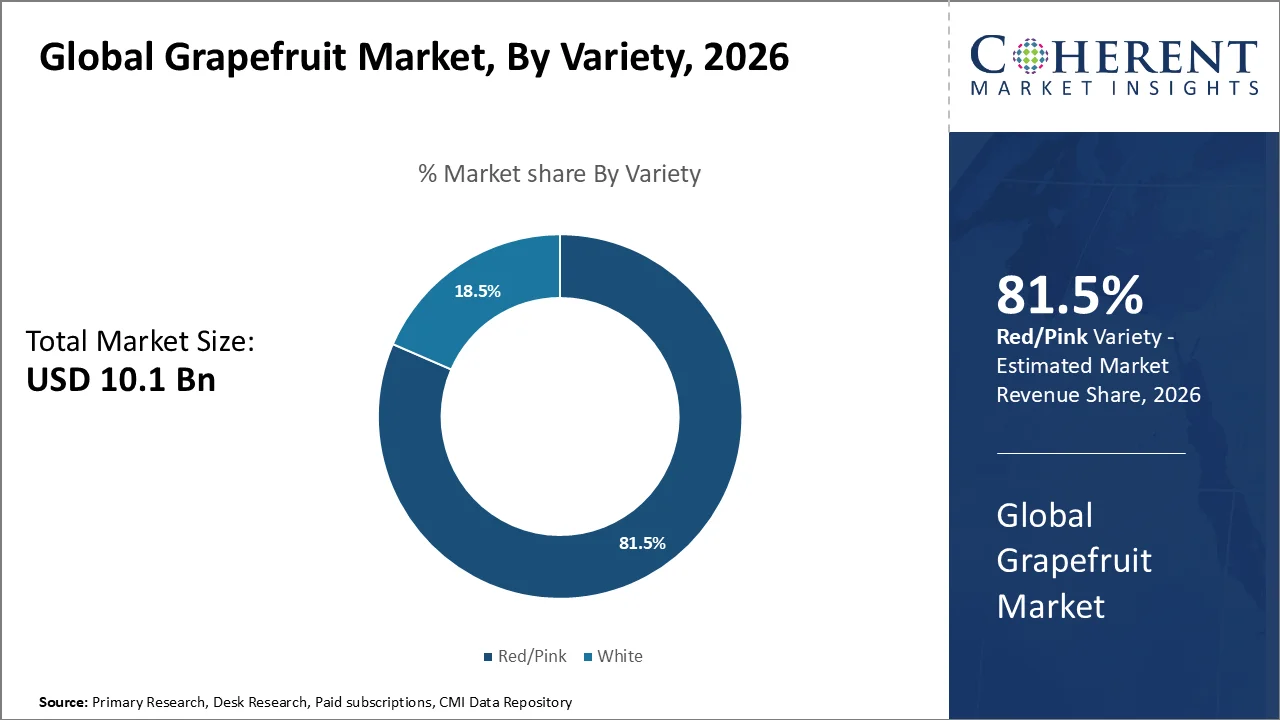
- The red/pink segment is likely to dominate the market with 81.5% in 2026. The segment’s growth is owing to the sweeter taste, attractive flesh color, broad retail availability, and strong consumer preference for fresh fruit, juices, salads, and breakfast applications globally.
- The direct intake segment is set to lead with 54.2% in 2026. The segment’s growth is owing to the rising demand for nutrient-rich whole fruits and convenient healthy snacks.
- The business to consumers segment is set to lead with 28.4% in 2026. The segment’s growth is owing to the availability through supermarkets, hypermarkets, fruit stores, farmers’ markets, and online grocery According to USDA ERS, approximately 63% of U.S. grapefruit production in 2024/25 was destined for the fresh market.
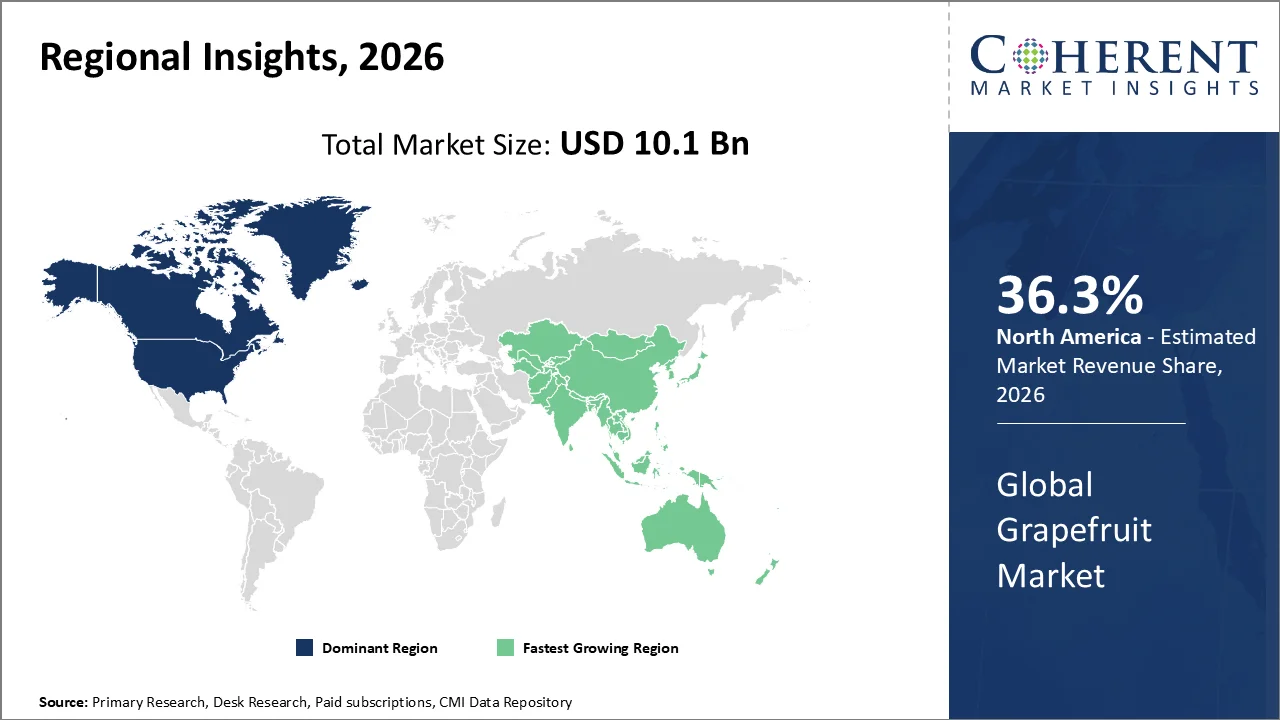
- North America is expected to acquire the prominent share of 36.3% in 2026. The region’s growth is owing to the established cultivation, retail networks, and high awareness of citrus nutrition. USDA ERS reported that S. grapefruit production reached 299,000 tons in 2024/25.
Segmental Insights
Why is Red/Pink Segment Acquiring the Largest Share?
On the basis of variety, the red/pink segment is projected to account for the largest Grapefruit Market share of 81.5% in 2026. The segment’s growth is owing to the better sweetness perception, attractive flesh color, and strong acceptance in export markets. Red grapefruit varieties such as Star Ruby and Ruby Red are preferred in retail and foodservice because they offer stronger visual appeal than white grapefruit.
USDA NASS forecast Florida red grapefruit at 1.10 million boxes in 2025/26, while white grapefruit was forecast at only 100,000 boxes, highlighting red grapefruit’s stronger commercial base in one of the key U.S. production regions.
South Africa also supports the red grapefruit segment through Star Ruby exports. USDA FAS Pretoria notes that Star Ruby is the most exported grapefruit variety from South Africa and the dominant variety grown in the country. This strengthens red and pink grapefruit’s position across premium export channels.
- Current Industry Events of 2026
- Market Size Estimation
- Regional Breakdown
- Competitive Landscape
- Customer Intelligence
- Segmental Analysis
- Pricing Analysis
- Key Market Drivers, Challenges & Future Trends
- Customized Insights Section
Direct Intake hold the Largest Market Share
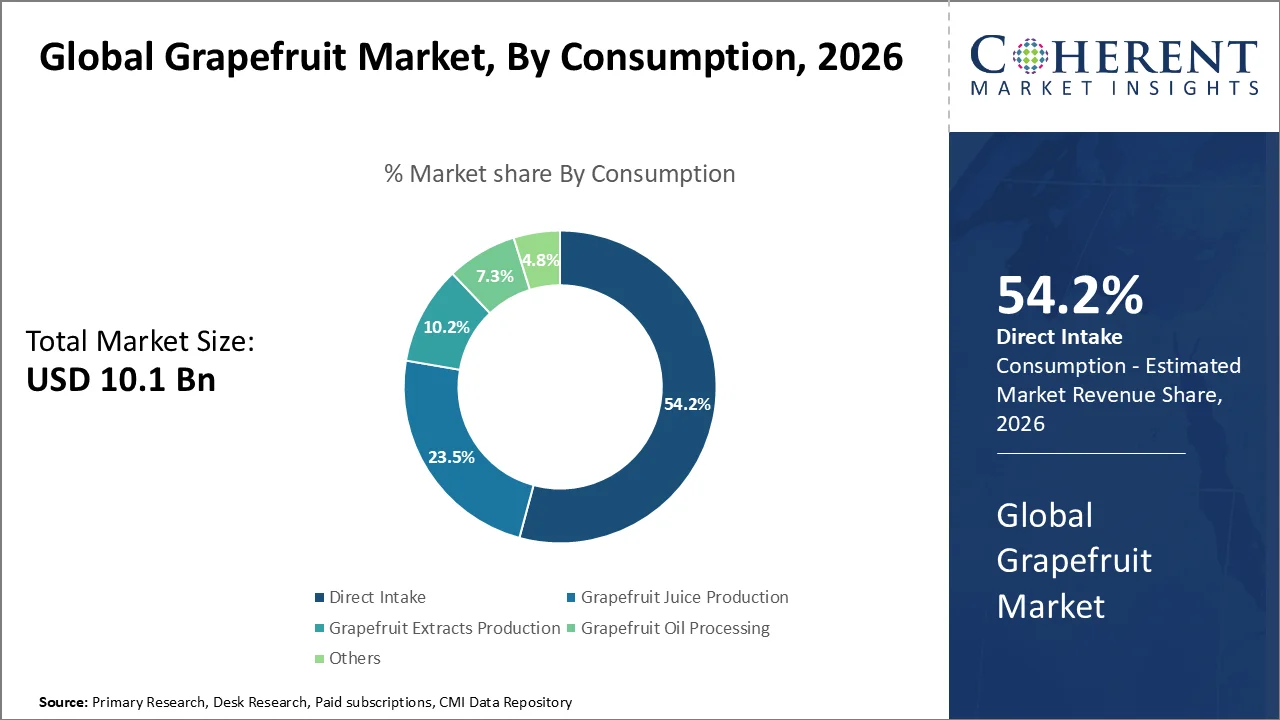
On the basis of consumption, the direct intake segment lead with a major 54.2% share in 2026. The growth is owing to the household diets, retail channels, and foodservice demand.
The U.S. Department of Agriculture forecasts the global fresh grapefruit production at 7 million metric tons in 2025/26, up 2% from the previous season as output expands in China, the United States, and the European Union.
In November 2025, the USDA announced an intended USD 10 million purchase of grapefruit under Section 32 for distribution through food banks and nutrition assistance programs. This procurement initiative is expected to improve fresh-fruit access, support growers facing surplus conditions, and reinforce institutional demand for whole grapefruit across the United States during the forecast period overall ahead.
Market Drivers
Rising Innovations in Fresh Citrus Retail are Transforming the Grapefruit Market in the U.S.
The U.S. grapefruit market is being reshaped by the retail packaging innovation, in-store fresh juice programs, as well as renewed marketing around summer citrus. The retailers are positioning grapefruit as a convenient, colorful, and health-oriented fresh fruit rather than just a traditional breakfast item. This is important because the U.S. grapefruit supply remains concentrated in California, Texas, and Florida. The USDA NASS forecast the U.S. grapefruit production at 7.7 million boxes in 2025/26 including 4.3 million boxes in California, 2.2 million boxes in Texas, and 1.2 million boxes in Florida.
In April 2025, Sunkist Growers launched a new grapefruit combo bag and summer citrus retail program in the U.S. This is supported by a grapefruit display contest running from May to August. The firm stated that nearly 80% of surveyed consumers viewed the combo bag as an incremental addition to their fruit basket, thereby indicating the potential to expand repeat purchases as well as new usage occasions.
HLB-Tolerant Grapefruit Selections: A Major Breakthrough in Grapefruit Market
HLB-tolerant citrus breeding is emerging as a major breakthrough for the grapefruit market, especially in regions such as Florida and Texas where citrus greening disease has affected productivity, fruit quality, and grove economics. Huanglongbing, also known as citrus greening, reduces tree productivity and lowers fruit quality, making disease tolerance a strategic requirement for long-term grapefruit supply stability.
In August 2025, UF/IFAS reported early-season sweet orange and grapefruit selections with improved tolerance to Huanglongbing. The research identified a new “Flame” grapefruit-derived bud sport named Lennon Flame, which produces later-maturing fruit and showed healthier leaves and better fruit quality. UF/IFAS stated that the selection is available in the Division of Plant Industry repository for propagation and that newer selections are being propagated for multi-location field trials.
Current Events and Their Impact on the Grapefruit Market
Current Event | Description and its Impact |
EU Extends Citrus Black Spot Control Measures Until 2028, March 2025 |
|
USDA Increase in Florida Citrus Marketing-Order Assessment |
|
Grapefruit Market Trends
- Rising consumer preference for fresh, nutrient-dense, and low-calorie fruits is strengthening the grapefruit consumption via supermarkets.
- Growing demand for red and pink grapefruit varieties is supporting the premium positioning. This is owing to their sweeter taste, color, as well as suitability for direct consumption.
- Expansion of grapefruit juice, concentrates, essential oils, extracts, and functional beverages is creating opportunities for both processors and ingredient suppliers.
- Improving harvest conditions across major grapefruit-producing countries are strengthening the global supply availability and supporting the international trade. The global grapefruit exports are expected to reach 634,000 tons, thereby reflecting the continued importance of international markets in balancing regional production surpluses and also meeting consumption demand in import-dependent countries.
- Increased health awareness supports the demand, although medicine interactions remain a restraint. The U.S. Food and Drug Administration states that grapefruit can alter the effectiveness of certain prescription and over-the-counter drugs. European Union grapefruit production is forecast at 126,000 metric tons in 2025/26, with Spain contributing more than three-quarters and supplying 50% of grapefruit consumed in the region.
Regional Insights
North America Dominates Owing to the Concentrated U.S. Production and Juice-Processing Demand
The North America region accounts for 36.3% of the market share in 2026. The region’s growth is owing to the concentrated U.S. production, established fresh-fruit distribution, juice-processing demand, and Canada’s dependence on imported fruit.
Florida’s Department of Agriculture reported that grapefruit generated USD 28.7 million in production value in 2024, representing 19% of total U.S. grapefruit value.
In March 2026, HI-CHEW and Menchie’s Frozen Yogurt launched a limited-edition grapefruit flavor nationwide. The nonfat frozen yogurt combined sweet and tart citrus notes, contained no artificial colors or high-fructose corn syrup, and targeted springtime dessert consumers.
Asia Pacific Grapefruit Market Trends
Asia Pacificis expected to witness strong growth in market over the forecast period. The region’s growth is owing to the production in China, steady import demand in Japan, and varietal innovation in Australia.
The U.S. Department of Agriculture’s December 2025 China Citrus Annual forecasts combined pomelo and grapefruit production at 5.35 million metric tons in marketing year 2025/26, with Fujian, Guangdong, Guangxi, and Jiangxi remaining major producing areas. In Japan, the grapefruit imports reached 32,850 metric tons in marketing year 2024/25, with South Africa supplying 52.8% of the total, thereby highlighting the sustained regional demand for imported fruit.
In June 2026, the New South Wales Government announced an A$1.97 million citrus research investment, jointly supported by Hort Innovation and government partners, to evaluate more than 60 new citrus varieties, including grapefruit, across Australian growing conditions.
Improving Domestic Output are Accelerating the Grapefruit Market in United States
In the United States, the Grapefruit Market is influenced by the improving domestic output, health-related dietary changes, and international trade dynamics. In March 2026, the U.S. Department of Agriculture’s Economic Research Service projected the U.S. grapefruit production at 311,000 tons for the 2025/26 season, thus representing a 4% year-on-year increase. This higher supply can improve the fruit availability for fresh consumption, juice processing, as well as foodservice channels.
China Grapefruit Market Trends
China remains the most important country in the global grapefruit and pomelo category. USDA FAS forecasts China’s fresh grapefruit production at 5.4 million tons in 2025/26, up by 115,000 tons, supported by increased demand and adoption of new varieties by farmers. China also imports grapefruit during domestic supply gaps. USDA FAS forecasts China grapefruit imports at 115,000 tons, supported by shipments from Laos arriving mainly from April to July. This indicates that China is not only a producer but also a seasonal import market, supporting regional trade opportunities.
Who are the Major Companies in Grapefruit Industry
Some of the major key players in Grapefruit Market are NXP Semiconductors, Renesas Electronics Corporation, STMicroelectronics, Texas Instruments Incorporated, HDL Automation, Hogar Controls, Honeywell International, Inc., Control4, Legrand, Silicon Laboratories, Signify N.V., Somfy Systems Inc., LEEDARSON, Maven Systems Pvt. Ltd., TIS Control Limited, Microchip Technology Inc., Digi International Inc., and Thales Group.
Key News
- In August 2025, Morrisons launched Explore Sweet Sunrise grapefruit across U.K. stores nationwide at an introductory price of £1. The limited-edition Jackson grapefruit, developed by Fresh Hub Group and Myton Food Group, provides tropical sweetness, low seeds, as well as premium positioning.
- In July 2025, a coalition of South African citrus growers launched the SummerStar Ruby campaign in Germany to reposition grapefruit as a healthy, versatile summer fruit. The initiative aims to expand the demand across Europe, with market launches planned for 2026.
Market Report Scope
Grapefruit Market Report Coverage
| Report Coverage | Details | ||
|---|---|---|---|
| Base Year: | 2025 | Market Size in 2026: | USD 10.1 Bn |
| Historical Data for: | 2020 To 2024 | Forecast Period: | 2026 To 2033 |
| Forecast Period 2026 to 2033 CAGR: | 3.7% | 2033 Value Projection: | USD 13 Bn |
| Geographies covered: |
| ||
| Segments covered: |
| ||
| Companies covered: | Bontoux SAS, Citrus and Allied Essences Ltd., doTERRA International, LLC., Eckes Granini Group, Hale Groves, Hyatt Fruit Company, IMG Citrus, Lionel Hitchen Limited, Mountain Rose Herbs, Symrise AG, and Young Living Essential Oils | ||
| Growth Drivers: |
| ||
| Restraints & Challenges: |
| ||
Analyst Opinion
- Grapefruit market growth is supported by growing consumer interest in fresh, nutrient-rich, and naturally functional foods. The market is not expanding only because of changing food trends—it is also benefiting from the continued preference for citrus fruits that offer refreshing taste, versatility, and perceived health benefits.
- The U.S. grapefruit production has become concentrated in California. During 2024–2025, California produced 164,000 tons, compared with 80,000 tons in Texas and 55,000 tons in Florida. California accounted for approximately 54.8% of national production, thereby highlighting the growing importance of Western growers, packing facilities, as well as distribution networks.
- Disease and phytosanitary risks will shape profitability. APHIS quarantines in Texas and EU citrus black spot measures show that grapefruit supply chains are more compliance-driven. The growers with traceability, pest-control systems, resistant varieties, and export-quality fruit will be better positioned than small unorganized producers.
Speak to the analyst
Want personalized insights?
Take the findings above to one of our principal consultants, or have the report rebuilt around the segments, geographies and competitors you actually track.
Market Segmentation
- By Variety (Revenue, USD Bn, 2021-2033)
- Red/ Pink
- White
- By Consumption (Revenue, USD Bn, 2021-2033)
- Direct Intake
- Grapefruit Oil Processing
- Grapefruit Juice Production
- Grapefruit Extracts Production
- Others
- By Distribution Channel (Revenue, USD Bn, 2021-2033)
- Business to Business
- Business to Consumers
- By Region (Revenue, USD Bn, 2021-2033)
- North America
- U.S.
- Canada
- Latin America
- Brazil
- Mexico
- Argentina
- Rest of Latin America
- Europe
- Germany
- U.K.
- France
- Italy
- Spain
- Russia
- Rest of Europe
- Asia Pacific
- China
- India
- Japan
- Australia
- South Korea
- ASEAN
- Rest of Asia Pacific
- Middle East
- GCC
- Israel
- Rest of Middle East
- Africa
- South Africa
- Central Africa
- North Africa
- North America
Sources
Primary Research Interviews
- Grapefruit growers and citrus farm owners
- Citrus processors and juice concentrate manufacturers
- Fresh fruit exporters and importers
- Fruit wholesalers and distributors
- Supermarket and hypermarket procurement managers
- Food and beverage manufacturers using grapefruit ingredients
- Cold chain logistics providers
- Agricultural economists and citrus industry experts
- Key opinion leaders (KOLs) in fruit processing and citrus trade
Databases
- Food and Agriculture Organization of the United Nations (FAO)
- United States Department of Agriculture (USDA)
- International Trade Centre (ITC) Trade Map
- UN Comtrade Database
- World Bank
- Organisation for Economic Co-operation and Development (OECD)
- Eurostat
- National Agricultural Statistics Service (NASS)
Magazines
- FreshPlaza
- The Packer
- Produce Blue Book
- Citrus Industry Magazine
- Fruitnet
- Produce Business
Journals
- Food Chemistry
- Journal of Food Science
- Scientia Horticulturae
- Postharvest Biology and Technology
- HortScience
- Journal of Agricultural and Food Chemistry
Newspapers
- Reuters
- Bloomberg
- The Wall Street Journal
- The New York Times
- The Guardian
- Financial Times
Associations
- World Citrus Organisation
- International Fresh Produce Association
- Florida Citrus Mutual
- Citrus Australia
- California Citrus Mutual
- European Fresh Produce Association
- Citrus Growers’ Association of Southern Africa
Public Domain Sources
- Company Annual Reports and Investor Presentations
- Government Agriculture Ministry Publications
- Import Export and Customs Data
- USDA Citrus Production Reports
- FAO Crop Production Statistics
- Retail Price and Consumer Spending Reports
- Food Safety and Quality Standard Publications
Proprietary Elements
- CMI Data Analytics Tool
- Proprietary CMI Existing Repository of Information for Last 10 Years
Get access to 250+ pages report
Every segment, forecast, competitor profile and data table behind the analysis above — available for instant download.
- ESOMAR Member
- ISO 9001:2015 Certified
- D-U-N-S Registered
- GDPR & CCPA Compliant
Missing comfort of reading report in your local language? Find your preferred language:
Transform your Strategy with Exclusive Trending Reports
Frequently Asked Questions
The Grapefruit Market is expected to reach USD 13 Bn in 2033
Major players operating in the global Grapefruit Market include NXP Semiconductors, Renesas Electronics Corporation, STMicroelectronics, Texas Instruments Incorporated, HDL Automation, Hogar Controls, Honeywell International, Inc., Control4, Legrand, Silicon Laboratories, Signify N.V., Somfy Systems Inc., LEEDARSON, Maven Systems Pvt. Ltd., TIS Control Limited, Microchip Technology Inc., Digi International Inc., and Thales Group.
The severe supply chain constraints caused by citrus greening disease (HLB), dangerous medication interactions that deter consumption, and competition from other citrus fruits are the key factors hampering growth of the market.
The soaring consumer demand for natural immune-boosting foods (vitamin C), increased utilization of extracts in wellness and nutraceuticals, and the rising popularity of grapefruit oils in clean-beauty and cosmetics is boosting the demand for Grapefruit.
The Grapefruit Market is anticipated to grow at a CAGR of 3.7% between 2026 and 2033.
Among regions, North America is expected to account for a largest market share in the global Grapefruit Market over the forecast period.
The market outlook remains positive due to rising global demand for immune-boosting citrus fruits, natural juices, and specialized industrial extractions.