

Sunflower Seeds Market Analysis & Forecast: 2026-2033
The sunflower seeds market is estimated to be valued at USD 1.22 Bn in 2026 and is expected to reach USD 1.83 Bn by 2033, exhibiting a compound annual growth rate (CAGR) of 6.0% from 2026 to 2033.
Key Takeaways
- Based on Breeding Technology, the Hybrids segment leads the market holding an estimated share of 57.9% in 2026, owing to superior agronomic performance and yield potential.
- Based on Distribution Channel, the Offline segment leads the market holding an estimated share of 58.8% in 2026, as it provide an easily accessible one-stop-shop for various farming inputs.
- Based on Region, Europe is estimated to lead the market with a share of 75. 7% in 2026. While, Asia Pacific is projected to be the fastest growing region during the forecast period.
Market Overview
The demand for sunflower seeds is steadily increasing due to the numerous health benefits they offer, making them a popular choice among health-conscious consumers. Rich in antioxidants, magnesium, vitamin E, and healthy unsaturated fats, sunflower seeds contribute to improved heart health, reduced inflammation, and enhanced immune function. This growing awareness of their nutritional value is fueling consumer preference for natural and wholesome snacks, as well as their incorporation into various food products. Additionally, the trend towards plant-based diets and clean-label foods is further driving the sunflower seeds market demand globally. As more consumers seek nutrient-dense, convenient, and tasty options to support a healthy lifestyle, the market is poised for significant growth throughout the forecast period.
Current Events and Their Impact on the Sunflower Seeds Market
Current Event | Description and its Impact |
Technological Advancements in Agriculture |
|
Changes in Consumer Preferences and Health Trends |
|
Import and Export on the Sunflower Seeds Market
The global sunflower seeds market is shaped by concentrated export and import activities across key countries. In 2024, Mainland China led exports with USD 819.5 million worth of sunflower seeds, accounting for 17.6% of global exports, followed closely by Romania, France, Bulgaria, and Turkey. Together, these five countries made up nearly two-thirds of total exports. Notably, Moldova and Serbia experienced significant export growth, with increases of over 50%. On the import side, Bulgaria, the Netherlands, Romania, Russia, and Spain were the top importers, collectively representing around one-third of global imports. Europe remains the dominant region for sunflower seed imports, accounting for more than 70% of the total. The market is expected to grow steadily, driven primarily by rising demand for sunflower seed oil and its derivatives. Overall, the sunflower seed trade reflects a stable yet cautiously optimistic outlook, with evolving production and trade dynamics influencing global supply and demand.
- Current Industry Events of 2026
- Market Size Estimation
- Regional Breakdown
- Competitive Landscape
- Customer Intelligence
- Segmental Analysis
- Pricing Analysis
- Key Market Drivers, Challenges & Future Trends
- Customized Insights Section
Segmental Insights
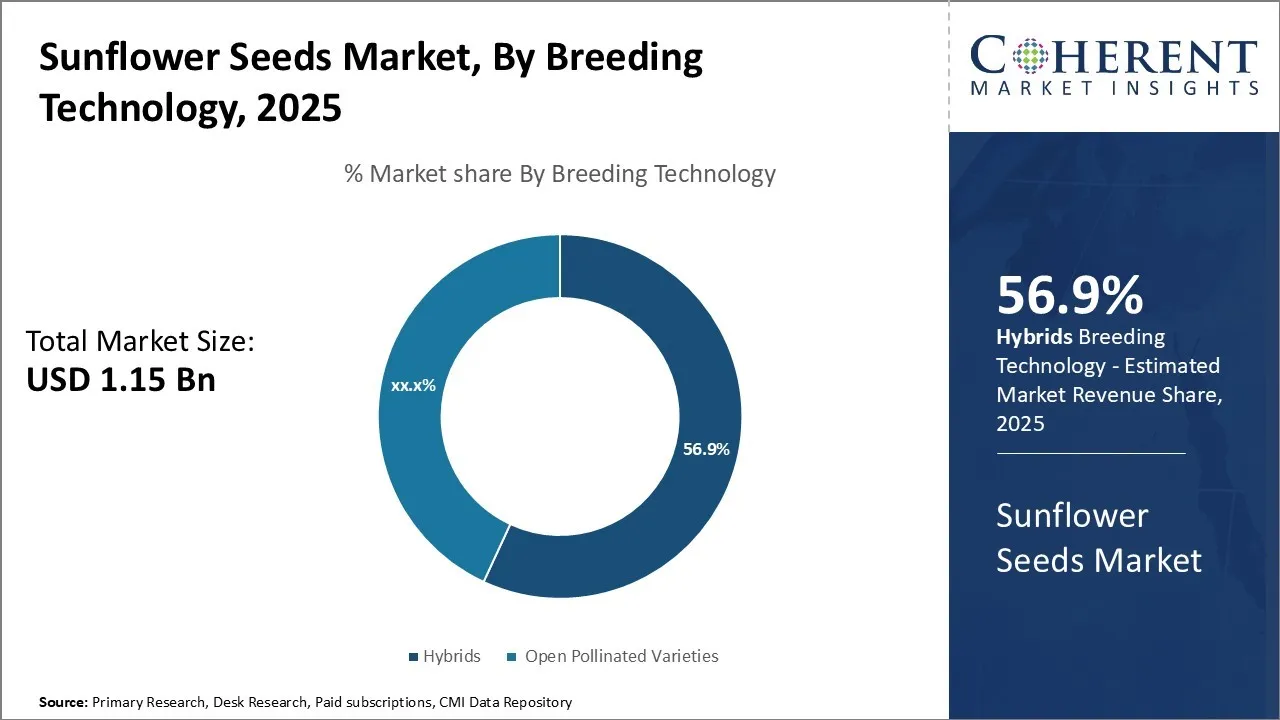
Sunflower Seeds Market Insights, By Breeding Technology - Hybrids holds the dominant share owing to Superior Agronom ic Performance
In terms of breeding technology, the hybrids segment is estimated to contribute 57.9% share of the market in 2026, owing to superior agronomic performance and yield potential. Hybrid sunflower seeds offer farmers higher and more consistent yields compared to open pollinated varieties. On average, hybrid varieties deliver 10-15% greater yields depending on environmental conditions. Their uniform genetic composition makes them more resistant to diseases and pests, reducing production costs for farmers through lower pesticide and fertilizer requirements. Hybrids also exhibit uniform maturity that allows farmers to harvest the entire crop within a short time window. This boosts efficiency during critical harvest periods.
For instance, in April 2025, Dr. Panjabrao Deshmukh Krishi Vidyapeeth (PDKV), Akola, introduced the PDKV Suraj (PDKVSH 964) hybrid sunflower, a high-yielding variety recommended for cultivation in Maharashtra. Released in 2024, this hybrid matures in 89–90 days and offers a productivity of 18–22 quintals per hectare. It is moderately resistant to Alternaria and leaf hopper, and exhibits tolerance to blast and rust diseases.
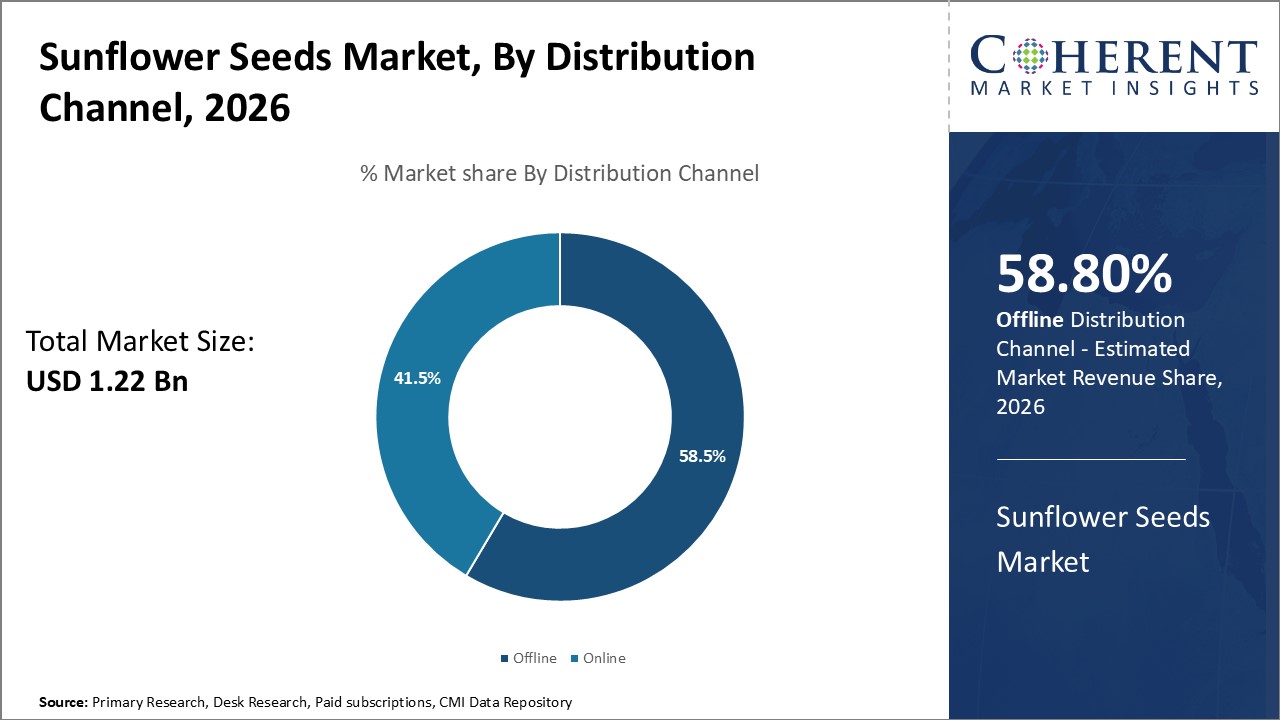
Sunflower Seeds Market Insights, By Distribution Channel - Offline Acquires the largest share
In terms of distribution channel, the offline segment is estimated to contribute 58.8% share of the market in 2026. Most sunflower farmers, especially in developing countries, rely on local agro-dealers and seed merchants to procure their seed requirements. These traditional offline channels provide an easily accessible one-stop-shop for various farming inputs. Dealers maintain large inventories of different seed varieties tailored to local soil and climate conditions. They also possess in-depth knowledge about the latest hybrids and advise farmers on the best-suited options. This personalized guidance forms a crucial decision support system for growers with limited access to external information. Offline retailers also offer farmers value-added services such as crop consultation, seed treatment, and post-purchase support. These conveniences have helped offline channels retain their popularity over online alternatives with farmers even in remote rural geographies.
For instance, in May 2025, the Bhartiya Kisan Union (Charuni) urged Haryana Chief Minister Nayab Singh Saini to advance the procurement of sunflower seeds. The union emphasized that early procurement would prevent farmers from incurring additional transportation costs and selling their produce at lower rates to private traders.
Regional Insights
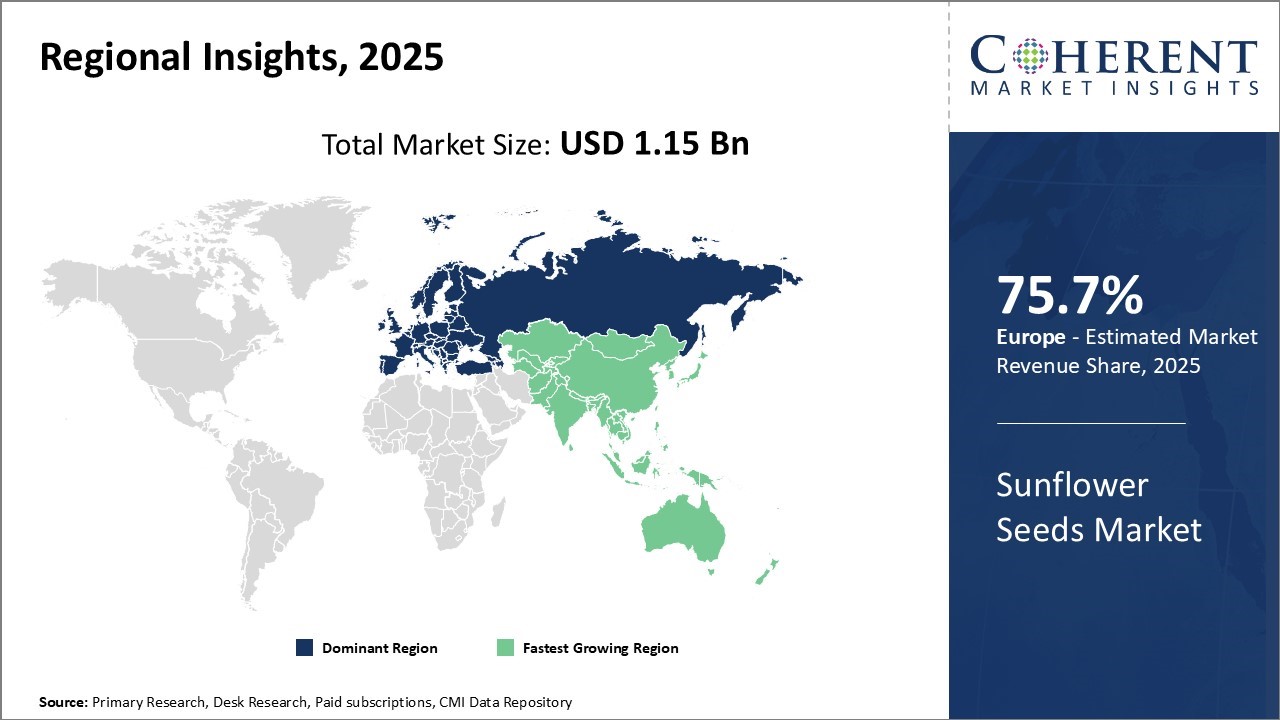
Europe Sunflower Seeds Market Analysis & Trends
Europe is anticipated to generate the highest revenue share 75.7% in 2026. The domination of sunflower seeds in the European market can be ascribed to good farming practices and advantageous government regulations that promote oilseed production. Major producers such as the U.K. have ideal growing conditions and rely on sunflower as a prominent crop. The market also benefits from a strong distribution network and established brands catering to the region's health-conscious demographic.
For instance, Romania is projected to remain the European Union's largest producer of sunflower seeds in the 2026/26 marketing season, according to EU Commission forecasts. The country is expected to harvest approximately 2.2 million tonnes, marking a 50% increase from the previous year.
Asia Pacific Sunflower Seeds Market Analysis & Trends
The Asia Pacific region exhibits the fastest growth, fueled by the rising health awareness and increasing incorporation of seeds into the daily diet. Populations in China and India are looking to supplement traditional cuisines with nutritious snack options. Local players such as Takki Co.Ltd. have strengthened their market position through innovative product launches and effective marketing initiatives targeted at youth.
For instance, in June 2026, a new seed production facility for corn and sunflower has been inaugurated in southeastern Kazakhstan's Zhetysu region. The plant is capable of processing and preparing up to 10 tons per hour of seeds, enhancing the local agricultural infrastructure.
Sunflower Seeds Market Outlook for Key Countries
The U.S. Sunflower Seeds Market Trends
The U.S. sunflower seeds market remains stable, driven by major players like Sunopta and Archer Daniels Midland investing in new seed varieties and advanced farming techniques. These companies lead as top exporters, using strong supply chains and sustainable practices to maintain the country’s global market presence.
For instance, U.S. sunflower acreage is projected to increase significantly in 2026, with growers planning to plant over 1.07 million acres, a 49% rise from 2024, according to the USDA. This expansion is primarily driven by heightened demand for sunflower oil and tight seed stocks. Oil-type sunflower acreage is expected to reach approximately 960,500 acres, marking a 62% increase from the previous year.
China Sunflower Seeds Market Trends
China's market is undergoing rapid transformation as changing lifestyles and expanding modern retail drive higher consumption. Domestic brands including Luhua and Xiangshan have broadened their portfolio beyond roasted seeds into oil and meal.
In May 2026, China exported $56.7M and imported $5.33M of Sunflower seeds, resulting in a positive trade balance of $51.4M. Between April 2026 and May 2026, the exports of Sunflower seeds from China increased by $3.66M (6.9%), from $53.1M to $56.7M.
India Sunflower Seeds Market Trends
India leads the South Asian sunflower seeds market, shifting from traditional bulk sales to convenient packaged formats. Rising urbanization, health awareness, and expanding retail channels are driving this change, with manufacturers sustainable packaging and flavors to meet growing demand.
For instance, in March 2026, the Government of India has sanctioned the procurement of 1,972 metric tonnes (MT) of sunflower seeds in Telangana for the 2026-26 season. This initiative aims to support local farmers by ensuring a fair Minimum Support Price (MSP) for their produce. The procurement process will be overseen by the Telangana State Civil Supplies Corporation (TSCSC) and the Telangana State Cooperative Oilseeds Growers Federation (TSCOGF).
Brazil Sunflower Seeds Market trends
Brazil’s sunflower seeds market shows strong potential, driven by innovative startups offering value-added products tailored for urban consumers. Additionally, local producers are supplying high-quality ingredients to food manufacturers targeting international markets, boosting Brazil’s global presence in the sunflower seeds industry.
For instance, Sunflower harvesting is progressing positively in Brazil's Midwest, particularly in Mato Grosso and Goiás, where 27,000 and 19,500 hectares have been planted, respectively. Nuseed hybrids are yielding well even in challenging conditions, such as sandy soils.
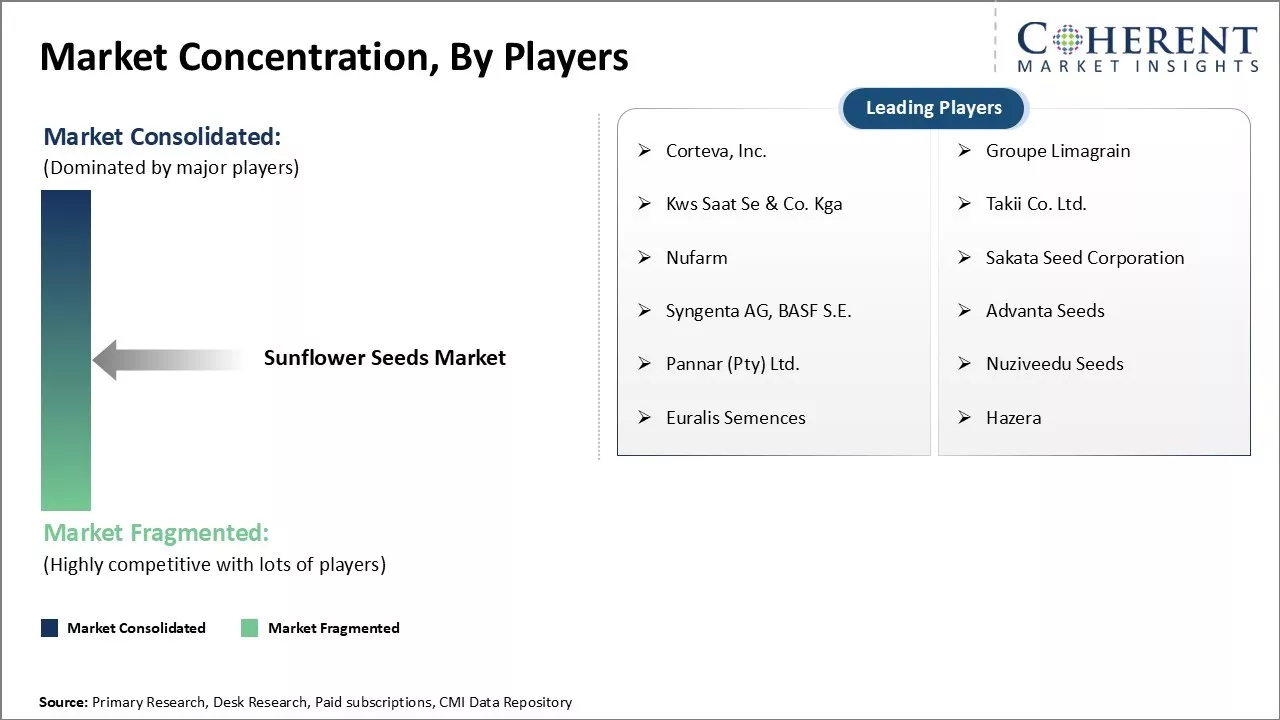
Market Concentration and Competitive Landscape
Sunflower Seeds Industry News
- In August 2025, Argentina has officially opened its market to Ukrainian sunflower seeds for sowing, marking a significant development in agricultural trade between the two nations. This decision follows successful coordination of phytosanitary requirements, ensuring compliance with Argentina’s import standards. The announcement was made by Serhiy Tkachuk, head of Ukraine's State Service for the Protection and Regulation of Food and Consumer Protection.
- In August 2025, Dyson unveiled "Farm to Formulation" hair beauty line, the Dyson Omega™ Nourishing Collection. The collection, featuring an oil and a spray, uses sunflower seed oil cultivated at Dyson’s own farm in Lincolnshire, England.
- In March 2025, KIND Snacks partnered with Carl Beakman to launch a new line of seed bars, available in two flavors: Sunflower Seeds & Strawberry and Pumpkin Seeds, Raspberry & Dark Chocolate.
Analyst Opinion (Expert Opinion)
The sunflower seeds market value is poised for transformative growth driven primarily by evolving consumer preferences toward healthier snacking options and the expanding application of sunflower seeds in the food processing sector. Notably, the increasing awareness of the nutritional benefits—such as high vitamin E content, antioxidants, and unsaturated fats is reshaping consumer behavior, particularly in developed markets where demand for plant-based and functional foods is accelerating.
Empirical evidence highlights a rising penetration of flavored and ready-to-eat sunflower seed products, which cater to convenience-seeking consumers. For instance, in North America, product innovations introducing spicy, roasted, and salted variants have captured significant shelf space in mainstream retail outlets, indicating a shift beyond traditional raw seed consumption. Additionally, the proliferation of sunflower seeds in bakery and confectionery applications underscores their versatility and value addition potential.
From a supply chain perspective, strategic partnerships between seed producers and food manufacturers are fostering streamlined distribution and enhanced product customization. This is exemplified by collaborations in Europe where sustainable sourcing and traceability have become critical, aligning with stringent regulatory frameworks and consumer demand for transparency.
It is also imperative to acknowledge the impact of evolving agricultural practices and technological advancements in seed processing, which are improving yield quality and shelf life, thereby addressing previous limitations related to perishability and flavor retention.
Speak to the analyst
Want personalized insights?
Take the findings above to one of our principal consultants, or have the report rebuilt around the segments, geographies and competitors you actually track.
Market Report Scope
Sunflower Seeds Market Report Coverage
| Report Coverage | Details | ||
|---|---|---|---|
| Base Year: | 2025 | Market Size in 2026: | USD 1.22 Bn |
| Historical Data for: | 2020 To 2024 | Forecast Period: | 2026 To 2033 |
| Forecast Period 2026 to 2033 CAGR: | 6.0% | 2033 Value Projection: | USD 1.83 Bn |
| Geographies covered: |
| ||
| Segments covered: |
| ||
| Companies covered: | Corteva, Inc., Groupe Limagrain, Kws Saat Se & Co. Kga, Takii Co. Ltd., Nufarm, Sakata Seed Corporation, Syngenta AG, BASF S.E., Advanta Seeds, Pannar (Pty) Ltd., Nuziveedu Seeds, Euralis Semences, and Hazera | ||
| Growth Drivers: |
| ||
| Restraints & Challenges: |
| ||
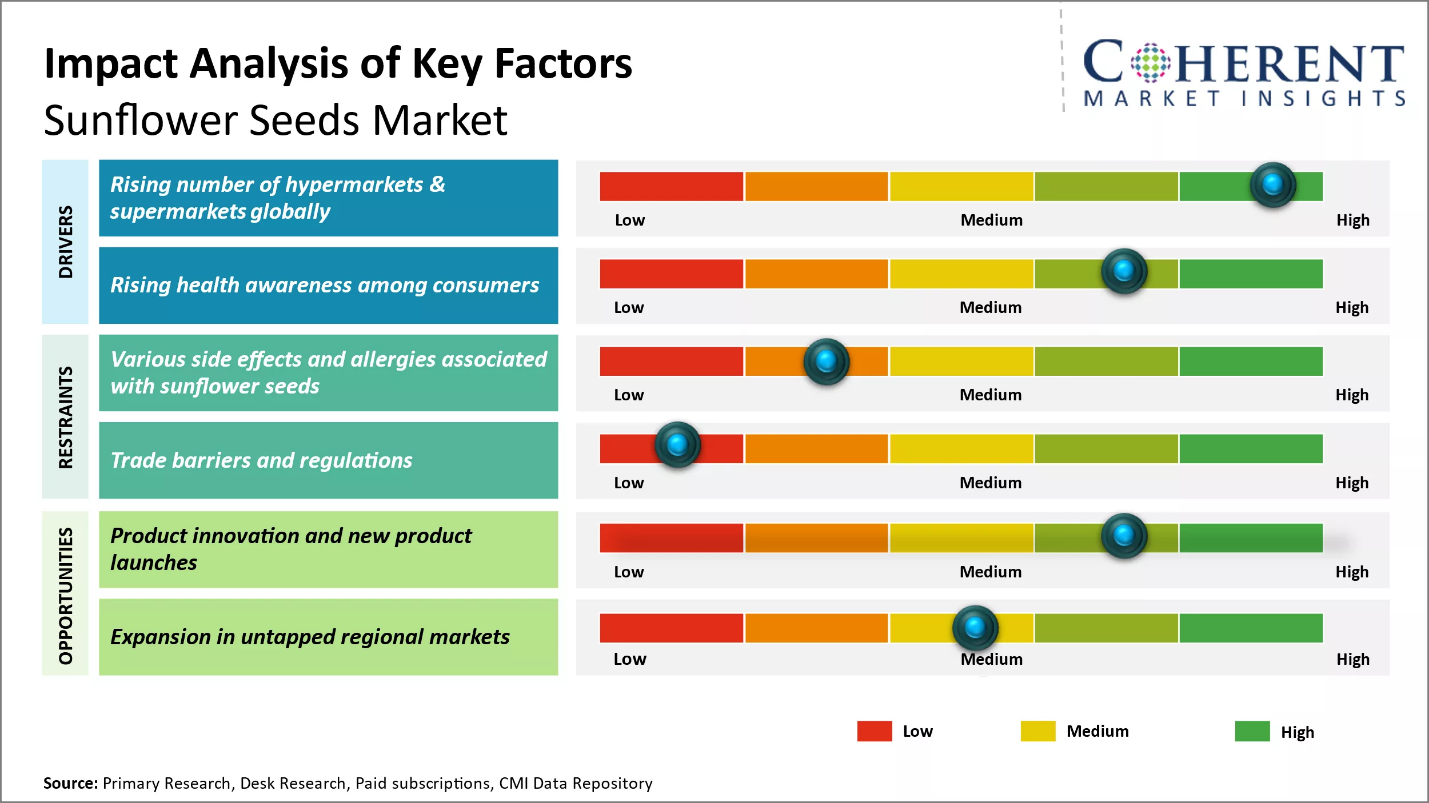
Sunflower Seeds Market Driver
- Rising number of hypermarkets & supermarkets globally
With increasingly hectic lifestyles and dual-income families on the rise, consumers prefer doing their grocery shopping under one roof from large-format stores that offer a wide selection of products from all categories. This has propelled the growth of hypermarkets and supermarkets worldwide in recent years. These stores dedicate significant shelf space to snacks and impulse purchases, stocking a diverse range of snacks, including sunflower seeds, to suit evolving customer preferences. Moreover, hypermarkets and supermarkets make sunflower seeds highly visible and accessible to shoppers through attractive displays and promotional campaigns. For instance, in January 2025, Mondelēz International's BelVita brand has introduced Energy Snack Bites, aiming to provide a convenient mid-morning snack for busy consumers. Available in two flavors, Banana Dark Chocolate with Sunflower Seed and Blueberry with Sunflower Seed, the bites are crafted with real ingredients and contain no high fructose corn syrup, artificial flavors, colors, or sweeteners.
Sunflower Seeds Market Opportunity
- Product innovation and new product launches
The sunflower seeds market provides a huge opportunity for companies to drive growth through continuous product innovation and new product launches. As consumer preferences evolve towards healthy yet convenient snacks options, there is a scope to develop sunflower seeds-based snacks and bakery products with additional nutritional value. Companies investing in R&D are coming up with innovative seed varieties that are high in nutrients like vitamins, minerals and healthy fats. For instance, in July 2025, Expana has introduced two new benchmarks to enhance transparency in the global sunflower oil market: the EU Sunflower Seed FOB and the Egyptian Sunflower Oil CIF. These benchmarks provide real-time pricing data for key regions, addressing a 20% production gap in EU sunflower seeds and tracking crude oil prices in Egypt, a major import hub.
Market Segmentation
- By Breeding Technology Insights (Revenue, USD, 2026 - 2033)
- Hybrids
- Open Pollinated Varieties & Hybrid Derivatives
- By Distribution Channel Insights (Revenue, USD, 2026 - 2033)
- Offline
- Online
- By Regional Insights (Revenue, USD, 2026 - 2033)
- North America
- U.S.
- Canada
- Latin America
- Brazil
- Argentina
- Mexico
- Rest of Latin America
- Europe
- Germany
- U.K.
- Spain
- France
- Italy
- Russia
- Rest of Europe
- Asia Pacific
- China
- India
- Japan
- Australia
- South Korea
- ASEAN
- Rest of Asia Pacific
- Middle East
- GCC Countries
- Israel
- Rest of Middle East
- Africa
- South Africa
- North Africa
- Central Africa
- North America
- Key Players Insights (Revenue, USD Bn, 2021 - 2033)
- Corteva, Inc.
- Groupe Limagrain
- Kws Saat Se & Co. Kga
- Takii Co. Ltd.
- Nufarm
- Sakata Seed Corporation
- Syngenta AG, BASF S.E.
- Advanta Seeds
- Pannar (Pty) Ltd.
- Nuziveedu Seeds
- Euralis Semences
- Hazera
Sources
Primary Research Interviews from the following stakeholders
Stakeholders
- Interviews with sunflower seed farmers, seed distributors, processing plant managers, agricultural input suppliers, export/import traders, and retail category managers across major global producing and consuming regions.
Specific Stakeholders
- Agricultural extension officers and crop consultants in major sunflower growing regions
- Procurement and supply chain heads at edible oil companies and seed processors
- Quality control and R&D managers at seed breeding companies and biotech firms
- Export managers at port authorities and commodity exchange representatives
- Retail buyers and category managers at large supermarket chains and health food stores
- Nutritionists and product developers at snack food manufacturers using sunflower seeds as ingredients
Databases
- Food and Agriculture Organization (FAO) Statistics Database
- United States Department of Agriculture (USDA) – Foreign Agricultural Service (FAS) Data
- UN Comtrade Database (Agricultural Commodities)
- Ministry of Agriculture & Farmers Welfare, India
- European Commission – Agriculture and Rural Development Data
- Russian Federal State Statistics Service (Rosstat)
- Argentine Ministry of Agriculture, Livestock and Fisheries Data Portal
- Turkish Statistical Institute (TurkStat) – Agricultural Production Statistics
Magazines
- Modern Farmer
- Oil & Fats International
- World Grain
- AgriBusiness Global
- Seed World
- Food Navigator – Ingredients Section
- Snacks Food & Beverage Industry Magazine
Journals
- Journal of Oilseed Brassica
- Industrial Crops and Products (Elsevier)
- Journal of Agricultural and Food Chemistry
- Seed Science Research
- Journal of Food Science and Technology
- Crop Science
- Food Chemistry
Newspapers
- The Economic Times – Agriculture & Commodity Markets
- Financial Express – Agri Business and Commodities
- Reuters Agriculture News
- The Hindu Business Line – Agriculture Section
- Bloomberg Commodities News
- South China Morning Post – Agricultural Trade Reports
- The Guardian – Food and Farming
Associations
- International Sunflower Association (ISA)
- National Sunflower Association (USA)
- Indian Oilseeds and Produce Export Promotion Council (IOPEPC)
- European Oilseed and Proteinmeal Industry Association (FEDIOL)
- Agricultural and Processed Food Products Export Development Authority (APEDA), India
- Oilseeds Advisory Board (India)
- Sunflower Growers’ Associations of Russia, Ukraine, Argentina
Public Domain Sources
- Food and Agriculture Organization (FAO) – Global Agricultural Monitoring
- U.S. Department of Agriculture (USDA) Reports and Crop Production Data
- Ministry of Agriculture & Farmers Welfare, Government of India Reports
- European Commission – Directorate-General for Agriculture and Rural Development
- Agricultural Census Reports (various countries)
- World Bank – Agricultural Development Data
- National Agricultural Statistics Service (NASS), USA
- Reserve Bank of India (RBI) Reports on Agri Commodities
Proprietary Elements
- CMI Data Analytics Tool, and Proprietary CMI Existing Repository of information for last 8 years
Get access to 250+ pages report
Every segment, forecast, competitor profile and data table behind the analysis above — available for instant download.
- ESOMAR Member
- ISO 9001:2015 Certified
- D-U-N-S Registered
- GDPR & CCPA Compliant
Missing comfort of reading report in your local language? Find your preferred language:
Transform your Strategy with Exclusive Trending Reports
Frequently Asked Questions
The Sunflower Seeds Market is estimated to be valued at USD 1.22 Bn in 2026, and is expected to reach USD 1.83 Bn by 2033.
The CAGR of the Sunflower Seeds Market is projected to be 6.0% from 2026 to 2033.
Rising number of hypermarkets & supermarkets globally and rising health awareness among consumers are the major factors driving the market growth.
Various side effects and allergies associated with sunflower seeds and Trade barriers and regulations are the major factors hampering the market growth.
In terms of breeding technology, the hybrids segment is estimated to dominate the market revenue share in 2026.
Corteva, Inc., Groupe Limagrain, Kws Saat Se & Co. Kga, Takii Co. Ltd., Nufarm, Sakata Seed Corporation, Syngenta AG, BASF S.E., Advanta Seeds, Pannar (Pty) Ltd., Nuziveedu Seeds, Euralis Semences, and Hazera are the major players.
Europe is expected to lead the sunflower seeds market.