

Pectin Market Analysis & Forecast : 2026-2033
The Pectin Market size is valued at USD 1.12 Bn in 2026 and is expected to reach USD 1.76 Bn by 2033, growing at a compound annual growth rate (CAGR) of 6.7% from 2026 to 2033.
Key Takeaways
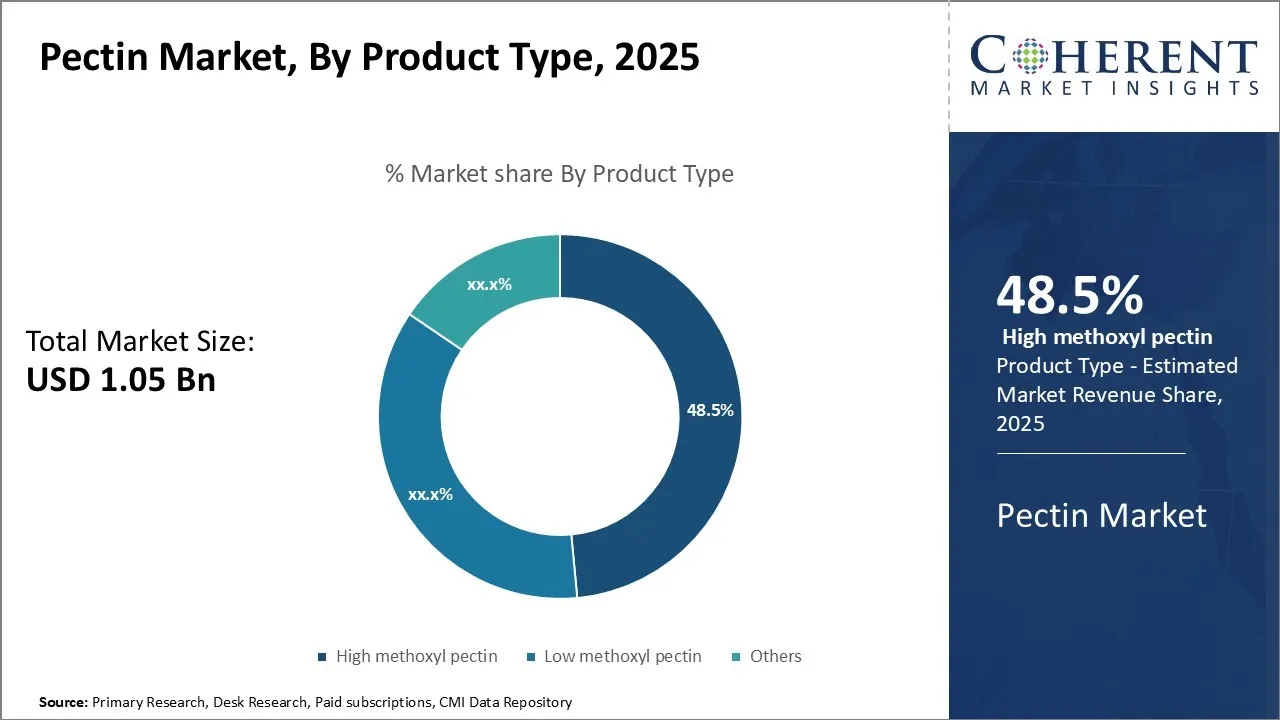
- By Product Type, the High‑Methoxyl pectin segment is expected to dominate the market with 49.5% shares in 2026.
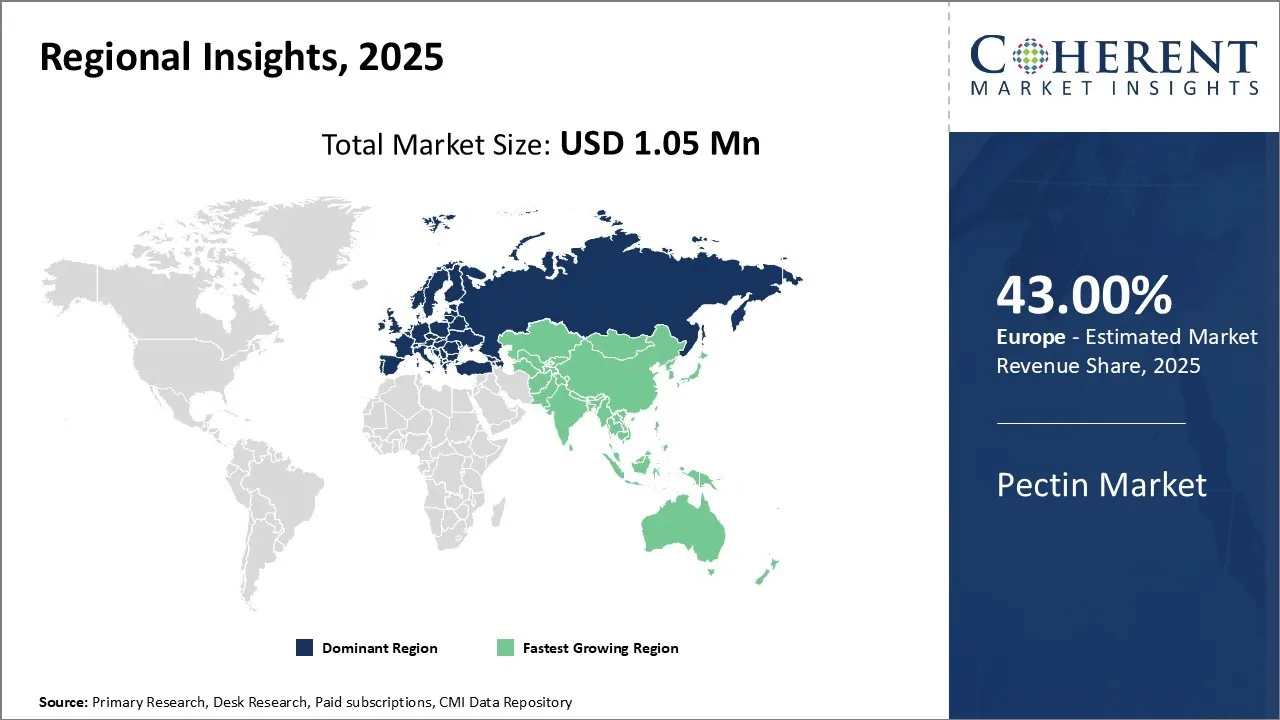
- By Region, Europe currently leads with over 43% market share in 2026, owing to a mature F&B industry and strong demand for functional/healthy foods.
Market Overview
The market is experiencing strong growth due to the rising demand for clean-label and natural ingredients in the food and beverage industry, along with growing health awareness among consumers. Moreover, increasing applications of pectin in pharmaceuticals, personal care, and dietary supplements are expected to boost the Pectin Market Growth. However, factors such as supply chain challenges due to seasonal fruit availability and stringent food safety regulations are expected to hamper the growth of the global pectin market.
Current Events and Its Impact on the Pectin Market
Event | Description and Impact |
Climate Change and Extreme Weather Events |
|
Health and Wellness Consumer Trends Acceleration |
|
European Union Regulatory Changes and Food Safety Standards |
|
Segmental Insights
- Current Industry Events of 2026
- Market Size Estimation
- Regional Breakdown
- Competitive Landscape
- Customer Intelligence
- Segmental Analysis
- Pricing Analysis
- Key Market Drivers, Challenges & Future Trends
- Customized Insights Section
Global Pectin Market Insights, by Product Type
High methoxyl pectin segment is expected to lead the global pectin market during the forecast period. This is owing to its wide application across food and beverage industry. High methoxyl pectin is favored for its superior gelling properties in high-sugar and low-pH environments. These features make it an ideal for products such as jellies, jams, dairy desserts, and fruit preparation.
Growing demand for natural and clean-label ingredients will also drive the adoption of high methoxyl pectin as it is derived from plant sources such as citrus peels and apple pomace. Moreover, innovations made in food processing and growing demand from emerging economies are anticipated to boost the demand.
Regional Insights
Europe Pectin Market Analysis and Trends
Europe is expected to hold largest share of around 43.00% of the global pectin market in 2026. Significant growth of the food and beverages industry in the region, along with swiftly rising demand for functional and healthy foods, is the key factor boosting the market growth in the region. The competitive business is bringing more opportunities owing to pectin vast application, which helps propel the product demand.
Asia Pacific Pectin Market Analysis and Trends
Asia Pacific is estimated to register a CAGR of 5.69%, in terms of revenue, from 2026 to 2032. The product type sector in the region is anticipated to be the key factor for the market growth owing to the presence of some of the largest pectin manufacturers, including Yantai Andre Pectin Co., Ltd.
Pectin Market Dominating Countries
Brazil Pectin Market Analysis and Trends
Brazil is taking centerstage in the global market during the forecast period. This growth is attributed by the benefits from abundant citrus fruit production, particularly oranges, which is considered as a primary source of pectin. Brazil is considered as a well-established citrus processing industry and supplies a significant proportion of raw material that is needed for pectin extraction.
Germany Pectin Market Analysis and Trends
Germany plays an important role in the growth of pectin industry, it is considered as a hub for research, development, and manufacturing. The major supplier of pectin processing and formulation companies such as Herbstreith & Fox are headquartered in Germany. The advanced food processing system of Germany and strong regulatory standards will contribute to its leadership in high-quality pectin production.
Market Drivers
- Increasing demand from food and beverage industry
The food and beverage industry has shown rising pectin market demand in recent years. Pectin is a soluble fiber extracted from the peel and pulp of citrus fruits as well as from apple pomace. It acts as a gelling, thickening and stabilizing agent in various food products.
The usage of pectin has increased in the food sector as consumers are increasingly health conscious and seeking out food items with additional fiber content. Pectin allows manufacturers to create fiber-rich products without comprising on taste or texture. It is commonly used in jams, jellies, fruit fillings, desserts and fruit-based snacks/beverages. As the demand for convenient, processed and functional food options grows, pectin serves as an important ingredient to meet this demand in a healthy way.
- Growing health awareness among consumers
Growing health awareness among consumers is a major factor driving the growth of the global pectin market price. More and more people are becoming conscious about their diet and focusing on consuming healthy and nutritious food products. Pectin derived from citrus fruits and apple pomace is considered to have several health benefits.
It aids in digestion and helps regulate blood sugar levels. Its high fiber content adds bulk to the diet and helps manage weight. Due to these properties, pectin is increasingly finding applications in various foods like dairy products, jams and jellies, bakery fillings and other confectionery items.
In recent years, research studies have highlighted additional health benefits of pectin. For instance, laboratory and clinical studies have found that pectin may help lower cholesterol levels and reduce blood pressure.
- Increasing preferences for functional and healthy foods
Increasing health consciousness among consumers has driven significant demand for functional and healthy foods globally in recent years. People are now more aware about risks of various lifestyle diseases and want to make wiser choices. This growing awareness has translated into higher demand for foods that are nutritious and provide added health benefits. Pectin, a soluble fiber extracted from citrus fruits and apples, is being widely utilized by food manufacturers due to its various health properties.
Pectin is proven to aid in digestion and help manage blood sugar levels. It is also effective in lowering cholesterol levels. Due to these multi-functional benefits, pectin finds widespread use in yogurts, jams, fruit spreads, dairy products and weight management products. Consumers prefer foods containing pectin as it adds fiber content and makes the products more filling.
Market Opportunities
- Innovation in food textures
Innovation in food textures is poised to provide significant opportunities for growth in the global pectin market. As consumers are becoming more health-conscious and demanding healthier yet enjoyable eating experiences, food manufacturers are increasingly looking at novel texturizing solutions to meet these evolving needs. Pectin, a commonly used textural agent extracted from citrus fruits and apples, allows companies to create varied textures in many reduced-sugar, dairy-free and gluten-free food products.
Currently, pectin is mostly used in jams, jellies and other fruit-based spreads to achieve the perfect gel formation. However, its uses are expanding into other areas. For instance, pectin is helping reduce saturated fat and calories in dairy alternatives like yogurt without compromising on creaminess. It allows vegetarian and vegan meat alternatives made from plant proteins to replicate meat fibers and mimic textures of real meat.
Pectin extraction methods are also advancing, with technologies to produce modified or amidated forms of pectin that provide unique textural profiles different from regular pectin. This enables product development teams to test diverse textures in applications like baking, confectionery, beverages.
- Export opportunities in developing nations
Export opportunities in developing nations present a promising growth avenue for the global pectin market companies. Developing economies across Asia, Africa, and Latin America are witnessing substantial economic development and increase in consumer incomes. As living standards rise in these regions, Benefits of pectin in processed food and beverages is growing steadily. This works in favor of the pectin market trends since the product finds wide applications as a key ingredient in various food items.
Pectin is widely used as a gelling agent, stabilizer and thickening agent in jams, jellies, fruit juices, dairy products, and other foods. The rising availability of these convenience and packaged food options is fueling pectin consumption.
Market Trends
- Fortification of food products
The trend of fortifying food products with additional nutrients and minerals is having a significant impact on the global pectin market. Pectin is often used as a gelling and thickening agent in fortified food products due to its ability to help carry and disperse vitamins, minerals, and other micronutrients throughout products.
As consumers increasingly seek out fortified options in their diets, food producers are responding by introducing a wide variety of fortified foods, beverages, and snacks. Pectin plays an important role in ensuring the stability and uniform delivery of added nutrients in these fortified products.
- Shift towards organic and clean label ingredients
The global pectin market has been witnessing significant changes owing to the rising trend of shifting towards organic and clean label ingredients. Consumers are increasingly demanding food products with simple and understandable ingredient labels that do not contain artificial preservatives, colors, or synthetic additives.
They prefer products containing readily recognizable ingredients sourced from natural origins. This changing preference has pushed food manufacturers to minimize or remove questionable ingredients and replace them with organic and non-GMO pectin market trends in order to meet relevant certification standards.
Pectin falls under this category of a naturally derived and clean label additive. It is a neutral polysaccharide extracted from citrus fruits or apple pomace with gelling, thickening, and stabilizing properties. Pectin performs the function of a stabilizer and texturizer without the addition of artificial or synthetic components.
Given this clean label profile, pectin is widely replacing additives like carrageenan, guar gum, and xanthan gum in various food applications such as yogurt, jams and jellies, bakery products, beverages, and dairy alternatives. The ingredient is also deemed 'generally regarded as safe' by regulatory bodies worldwide which bolsters its clean label credentials.
Market Report Scope
Pectin Market Report Coverage
| Report Coverage | Details | ||
|---|---|---|---|
| Base Year: | 2025 | Market Size in 2026: | USD 1.12 Bn |
| Historical Data for: | 2020 To 2024 | Forecast Period: | 2026 To 2033 |
| Forecast Period 2026 to 2033 CAGR: | 6.7% | 2033 Value Projection: | USD 1.76 Bn |
| Geographies covered: |
| ||
| Segments covered: |
| ||
| Companies covered: | CP Kelco, Cargill Incorporated, DuPont | Danisco, Herbstreith & Fox, Yantai Andre Pectin Co., Ltd, Naturex group, Silvateam Food Ingredients, CEAMSA, and Lucid Colloids Ltd. | ||
| Growth Drivers: |
| ||
| Restraints & Challenges: |
| ||
Analyst Opinion ( Expert Opinion)
- The pectin market forecast to witness strong growth over the coming years due to increasing demand for clean-label and natural ingredients in the food and beverage industry. Pectin is widely used as a gelling and thickening agent in jams, jellies, beverages, and dairy alternatives.
- Continued investments by food manufacturers to develop low-sugar, fiber-rich, and functional products will drive the demand for pectin. However, supply volatility caused by seasonal dependence on citrus and apple crops poses a challenge to market growth.
- Europe currently dominates the pectin market and is expected to remain the major consumer over the long term. This is due to the presence of established food processing industries and high demand for functional foods. However, Asia Pacific is likely to emerge as the fastest growing market, with countries like China and India increasing production and consumption of processed foods.
- High-methoxyl pectin holds the largest share of the market. Its strong gelling properties and compatibility with acidic, high-sugar products make it ideal for use in fruit preserves and confectionery. The development of low-methoxyl and amidated pectin provides opportunities for growth in reduced-sugar and health-focused applications.
Speak to the analyst
Want personalized insights?
Take the findings above to one of our principal consultants, or have the report rebuilt around the segments, geographies and competitors you actually track.
Pectin Market Key Developments
- In September 2023, Cargill launched its new rage LM Conventional pectin that is developed with proprietary technology and deliver novel texture and also used in products that are marketed with organic claims.
- In July 2025, Remedy’s Nutrition introduced its naturally Modified Citrus Pectin (MCP) supplement, a unique fiber blend created to promote immune and cellular health.
Market Segmentation
- By Product Type (Revenue, USD Bn, 2021 - 2033)
- High methoxyl pectin
- Low methoxyl pectin
- Others
- By Application (Revenue, USD Bn, 2021 - 2033)
- Jams & Jellies
- Beverages
- Bakery Fillings & Toppings
- Dairy Products & Frozen Desserts
- Confectionery
- Meat & Poultry Products
- Dietary Supplements
- Functional Food
- Pharmaceutical
- Personal Care & Cosmetics
- Others (Detergents)
- By Region (Revenue, USD Bn, 2021 - 2033)
- North America
- U.S.
- Canada
- Latin America
- Brazil
- Argentina
- Mexico
- Rest of Latin America
- Europe
- Germany
- U.K.
- Spain
- France
- Italy
- Russia
- Rest of Europe
- Asia Pacific
- China
- India
- Japan
- Australia
- South Korea
- ASEAN
- Rest of Asia Pacific
- Middle East
- GCC Countries
- Israel
- Rest of Middle East
- Africa
- South Africa
- North Africa
- Central Africa
- Top Companies in this Market
- CP Kelco
- Cargill Incorporated
- DuPont | Danisco
- Herbstreith & Fox,
- Yantai Andre Pectin Co., Ltd.
- Naturex group
- Silvateam Food Ingredients
- CEAMSA
- Lucid Colloids Ltd.
Sources
Primary Research Interviews
- Pectin manufacturers and suppliers
- Food and beverage industry executives
- Agricultural raw material suppliers
- Regulatory affairs specialists
- Others
Databases
- FAO Statistical Database (FAOSTAT)
- Euromonitor International
- IBISWorld Industry Reports
- Grand View Research Database
- Others
Magazines
- Food Processing Magazine
- Prepared Foods Magazine
- Food Manufacturing Magazine
- Ingredient Solutions Magazine
- Others
Journals
- Food Hydrocolloids Journal
- Journal of Food Science
- Food Chemistry Journal
- Others
Newspapers
- Food Business Magazine
- Food Industry Executive
- Nutraceuticals World
- Natural Products Insider
- Others
Associations
- International Pectin Producers Association (IPPA)
- European Food Safety Authority (EFSA)
- Food and Agriculture Organization (FAO)
- Institute of Food Technologists (IFT)
- Others
Public Domain Sources
- USPTO Patent Database
- FDA Food Additive Database
- European Commission Health & Consumer Protection
- Codex Alimentarius Commission
- Others
Proprietary Elements
- CMI Data Analytics Tool
- Proprietary CMI Existing Repository of information for last 8 years.
Get access to 250+ pages report
Every segment, forecast, competitor profile and data table behind the analysis above — available for instant download.
- ESOMAR Member
- ISO 9001:2015 Certified
- D-U-N-S Registered
- GDPR & CCPA Compliant
Missing comfort of reading report in your local language? Find your preferred language:
Transform your Strategy with Exclusive Trending Reports
Frequently Asked Questions
The Pectin Market size is estimated to be valued at USD 1.12 Bn in 2026, and is expected to reach USD 1.76 Bn by 2033.
Stringent international quality standards and high dependency on seasonal crops are the key factors hampering the growth of the global market.
Increasing demand from food and beverage industry, growing health awareness among consumers and increasing preferences for functional and healthy foods are the major factors driving the global pectin industry growth.
The high methoxyl pectin is the leading product type segment in the global pectin market.
The major players operating in the global pectin market are CP Kelco, Cargill Incorporated, DuPont | Danisco, Herbstreith & Fox, Yantai Andre Pectin Co., Ltd, Naturex group, Silvateam Food Ingredients, CEAMSA, and Lucid Colloids Ltd.
Europe leads the global market.
The CAGR of the Pectin Market is projected to be 6.7% from 2026 to 2033.