

Fructose Market Size and Share Analysis- Growth Trends and Forecasts (2026-2033)
The Fructose Market size is anticipated to grow at a CAGR of 3.8%, with USD 5.71 Bn in 2026 and is expected to reach USD 7.41 Bn in 2033. The primary drivers are largely defined by the rising consumption of processed foods and beverages, growing demand for fructose-based sweeteners in bakery and confectionery products, increasing use of high-fructose corn syrup in beverage formulations, and expanding applications of fructose across pharmaceutical and food-processing industries. According to the USDA Economic Research Service (ERS), inflation-adjusted U.S. food spending reached USD 2.51 trillion in 2025, including USD 1.10 trillion for food at home and USD 1.41 trillion for food away from home.
Key Takeaways
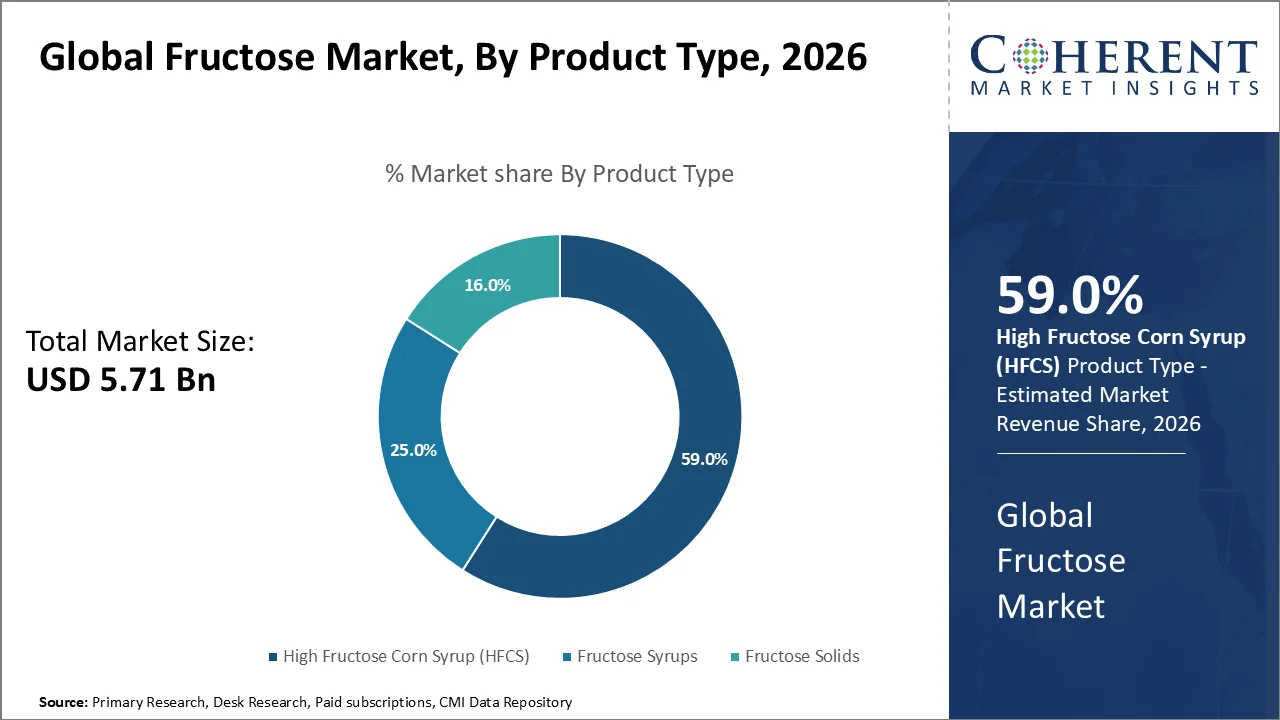
- The High Fructose Corn Syrup (HFCS) segment is likely to dominate the market with 59.0% in 2026. The segment’s growth is owing to its widespread utilization in beverages, processed foods, bakery products, cereals, dairy products, and confectionery, along with its liquid form, high solubility, and established large-scale corn-processing infrastructure. The Food and Agricultural Policy Research Institute at the University of Missouri (FAPRI-MU) projects U.S. HFCS production at approximately 7.51 million tons in 2025/26, while domestic HFCS use is projected at approximately 6.57 million tons.
- The beverages segment is set to lead with 67.8% in 2026. The segment’s growth is owing to the extensive use of fructose and HFCS in carbonated soft drinks, energy drinks, sports drinks, flavored beverages, and other liquid formulations. The USDA ERS identifies the beverage industry as the major user of HFCS-55, while HFCS-42 is also used across beverages and other processed foods.
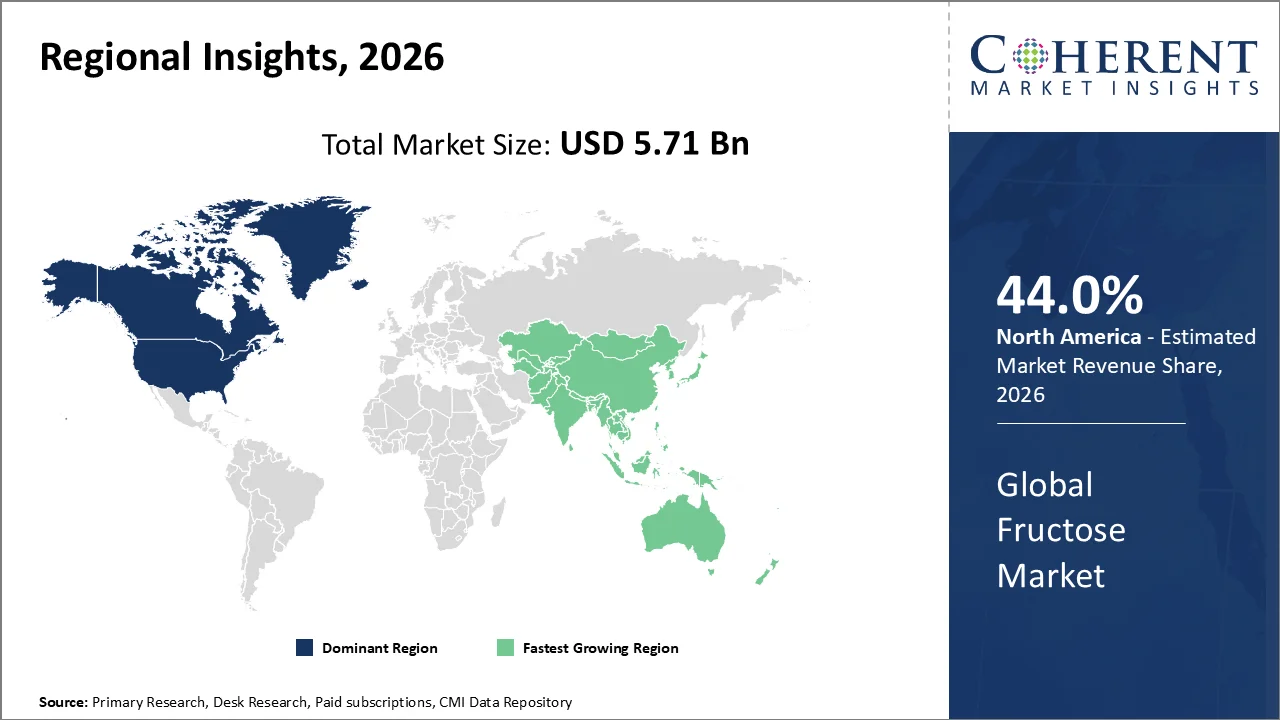
- North America is expected to acquire the prominent share of 44.0% in 2026. The region’s growth is owing to the established food and beverage manufacturing industry, high utilization of corn-derived sweeteners, large-scale corn wet-milling capacity, and extensive consumption of processed foods and beverages across the U.S. and Mexico. According to the USDA ERS, 53.0 pounds of corn sweeteners, including HFCS, glucose syrup, and dextrose, were available per person for consumption in the U.S. in 2023, demonstrating the region’s substantial existing sweetener consumption base.
Market Drivers
Expansion of Processed Food and Beverage Manufacturing is Accelerating Fructose Demand
The continued expansion of the global processed food and beverage industry is a major driver of the Fructose Market, as fructose and fructose-based syrups are extensively incorporated into beverages, bakery products, cereals, confectionery, dairy products, sauces, and other formulated foods. The U.S. FDA specifically lists fructose and high-fructose corn syrup as sweeteners present in drinks, baked products, candy, and many processed foods. HFCS-42 is primarily used in processed foods, cereals, baked goods and some beverages while HFCS-55 is primarily used in soft drinks.
The scale of downstream food processing continues to expand the addressable application base for fructose. According to Food Drink Europe’s Data & Trends 2026, the EU food and drink industry generates approximately €1.5 trillion in annual turnover, €300 billion in value added, and employs around 4.8 million people, making it the EU’s largest manufacturing industry.
Current Events and Their Impact on the Fructose Market
Current Event | Description and its Impact |
U.S. Expands SNAP Restrictions on Sugar-Sweetened Beverages Across Multiple States (2026) |
|
FDA Advances Front-of-Package Added-Sugar Labeling Framework (2026) |
|
- Current Industry Events of 2026
- Market Size Estimation
- Regional Breakdown
- Competitive Landscape
- Customer Intelligence
- Segmental Analysis
- Pricing Analysis
- Key Market Drivers, Challenges & Future Trends
- Customized Insights Section
Segmental Insights
Why is High Fructose Corn Syrup (HFCS) Acquiring the Largest Share?
On the basis of product type, the High Fructose Corn Syrup (HFCS) segment is projected to account for the largest Fructose Market share of 59.0% in 2026. The segment’s dominance is owing to its established use in carbonated beverages, bakery products, condiments, cereals, dairy products, and other processed foods, along with its high solubility, consistent sweetness, moisture-retention properties, and suitability for large-scale liquid food and beverage processing.
The Corn Refiners Association’s 2025 HFCS economic assessment indicates the commercial importance of this sweetener. The study estimates that a complete removal of HFCS from the U.S. food supply could reduce corn prices by as much as USD 0.34 per bushel and result in approximately USD 5.1 billion in lost farm revenue.
In May 2026, ADM announced a multimillion-dollar investment to upgrade its corn-processing facility in Clinton, Iowa. The project will install two high-speed corn receiving pits, each capable of handling 25,000 bushels per hour, along with additional grain storage and infrastructure improvements.
Beverages Hold the Largest Market Share
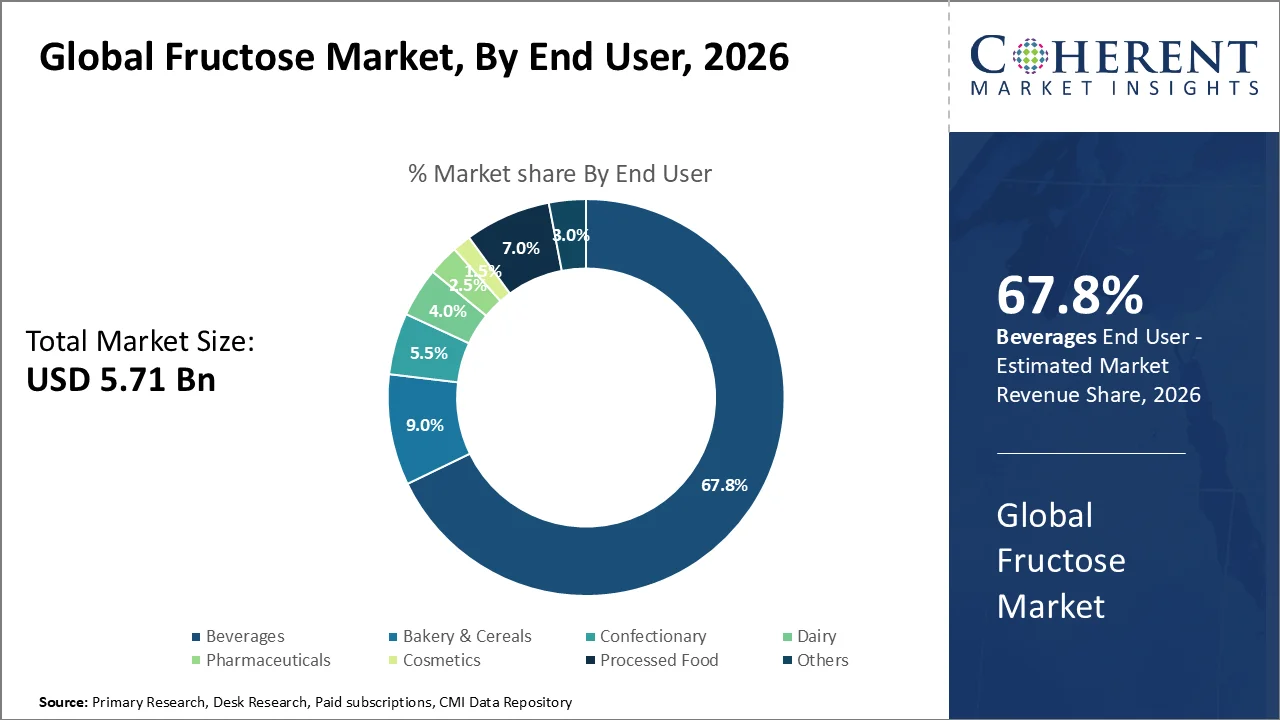
On the basis of end user, the beverages segment is projected to lead the Fructose Market with a 67.8% share in 2026. The segment’s dominance is owing to the extensive use of fructose-based sweeteners in carbonated soft drinks, energy drinks, sports drinks, flavored beverages, juice drinks, and other ready-to-drink formulations. Liquid fructose and HFCS are particularly suitable for beverages because they provide high solubility, consistent sweetness, easy blending, and efficient large-scale processing.
The Coca-Cola Company operating data 2025 The size of the global beverage industry. Coca-Cola system sold approximately 33.8 billion unit cases globally in 2025, with sparkling soft drinks accounting for 69% of its global unit-case volume. The company added that consumers drink finished beverages with its trademarks at a rate of about 2.2 billion servings daily, illustrating the huge amount of sweetened and formulated beverages consumed around the world.
In February 2026, Keurig Dr Pepper (KDP) unveiled more than 35 new beverage varieties spanning its carbonated soft drinks, teas, waters, energy drinks and juice-drink portfolios.
Fructose Market Trends
- The trend toward lower-sugar food and beverage formulations is changing the way fructose is used, with manufacturers increasingly combining smaller quantities of nutritive sweeteners with fibers, high-intensity sweeteners, and other functional ingredients. PepsiCo reported that in August 2026, its 2025 global beverage portfolio volume contained no more than 100 calories from added sugars per 12 oz serving in 68% of its products, surpassing its 67% goal.
- The growing use of crystalline fructose in blended sweetening systems is supporting premium and reduced-sugar formulations. Tate & Lyle states that its KRYSTAR crystalline fructose has a sweetness index of 117 compared with sucrose at 100, allowing formulators to achieve equivalent sweetness with different sweetener combinations. The company also reports that combining crystalline fructose with monk fruit in a dairy application can reduce sugar and calories by approximately 25–30% compared with cane sugar alone.
- Functional and wellness-oriented beverages are becoming an important area of sweetener innovation. In May 2025, PepsiCo completed its USD 1.95 billion acquisition of prebiotic soda brand poppi, whose beverages contain no more than 5 grams of sugar per serving. The transaction reflects growing investment in beverages that combine controlled sweetness with functional ingredients, encouraging greater use of customized sweetener systems rather than conventional high-sugar formulations.
Regional Insights
North America Dominates Owing to the Established Food & Beverage Processing and Sweetener Infrastructure
North America is expected to account for a prominent 44.0% share of the Fructose Market in 2026. The region’s dominance is owing to the extensive consumption of processed foods and beverages, established corn-refining and sweetener manufacturing infrastructure, widespread application of HFCS in commercial food formulations, and the presence of major ingredient companies across the U.S., Canada, and Mexico.
Statistics Canada said, sales in Canadian food-product manufacturing rose 2.0% in December 2025 to CAD 13.3 billion, helped by higher volumes across a range of industries including sugar and confectionery, fruit and vegetable processing, specialty foods and dairy products.
In April 2026, Primient launched a new operating structure comprising Biosolutions, Sweeteners, Performance Starches, and Agrifunctionals, reaffirming Sweeteners as a dedicated business unit serving food and beverage manufacturers.
Asia Pacific Fructose Market Trends
Asia Pacific is expected to be the fastest-growing region in the Fructose Market over the forecast period. Growth is being driven by the rapid expansion of processed-food manufacturing, increasing consumption of packaged foods and beverages, rising disposable incomes, urbanization, and expanding ingredient-processing capacity across China, India, Japan, and Southeast Asian countries.
India is providing a particularly strong food-processing growth base. In February 2026, India’s Ministry of Food Processing Industries said the country’s food-processing sector had grown 6.55% annually over the last nine years, compared with 6.06% for overall manufacturing. The sector GVA grew from ₹1.34 lakh crore in 2014-15 to ₹2.24 lakh crore in 2023-24. Processed foods had a share of 20.4% in agri-food exports in 2024-25.
In May 2026, Ingredion Incorporated entered into a strategic partnership with Sanstar Limited (India) which includes a 9% equity investment and establishment of a joint venture for specialty food, beverage, and pharmaceutical ingredients.
Large Beverage Manufacturing Base and Established Corn-Sweetener Supply Chain are Supporting the Fructose Market in the United States
The U.S. Fructose Market is driven by a large food and beverage manufacturing base, robust corn wet-milling infrastructure, and ongoing commercial applications of fructose and HFCS in beverages, bakery products, cereals, dairy products, confectionery, sauces, and other processed foods.
According to the U.S. Bureau of Labor Statistics (July 2026), U.S. food and beverage manufacturing employed about 2.1 million people in 2024 and is projected to exceed 2.2 million by 2034. The industry represented 16% of total U.S. manufacturing employment, highlighting the large downstream base for fructose, HFCS, and other sweetening ingredients.
China Fructose Market Trends
China is expected to be a major contributor to the growth of the Fructose Market, due to the rapid expansion of the food manufacturing sector, rising production of packaged foods and beverages, and the availability of abundant corn-processing and agricultural raw materials in the country. These factors create good conditions for the use of fructose syrups and other sweeteners from starch in beverages, bakery, confectionery, dairy and convenience foods.
According to the USDA Foreign Agricultural Service (April 2026), China produced approximately 20 million metric tons of starch-based sugars in 2025. This category specifically includes fructose syrup, crystalline glucose, maltose syrup, and maltodextrin.
Who are the Major Companies in Fructose Industry
Some of the major key players in Fructose Market are Atlantic Chemicals Trading GMBH, A & Z food additives Co. Ltd, Biovittoria Limited, Cargill Incorporated, Celanese Corporation, Cumberland Packing Corp, and Dulcette.
Key News
- In August 2026, Celanese Corporation announced an agreement to sell an additional 19% stake in its Nutrinova food ingredients joint venture to Mitsui & Co. for approximately USD 152 million.
- In February 2025, Avantium N.V., a leading developer of renewable and circular polymer materials achieved a key milestone at its FDCA Flagship Plant in Delfzijl, the Netherlands. The company successfully received and stored the first volumes of High Fructose Syrup (HFS), supplied by feedstock partner Tereos, in preparation for the plant’s start-up.
Market Report Scope
Fructose Market Report Coverage
| Report Coverage | Details | ||
|---|---|---|---|
| Base Year: | 2025 | Market Size in 2026: | USD 5.71 Bn |
| Historical Data for: | 2020 To 2024 | Forecast Period: | 2026 To 2033 |
| Forecast Period 2026 to 2033 CAGR: | 3.8% | 2033 Value Projection: | USD 7.41 Bn |
| Geographies covered: |
| ||
| Segments covered: |
| ||
| Companies covered: | Atlantic Chemicals Trading GMBH, A & Z food additives Co. Ltd, Biovittoria Limited, Cargill Incorporated, Celanese Corporation, Cumberland Packing Corp, and Dulcette. | ||
| Growth Drivers: |
| ||
| Restraints & Challenges: |
| ||
Analyst Opinion
- The Fructose Market is expected to maintain steady underlying demand from processed foods, snacks, confectionery, and beverages, even as the composition of sweetening systems evolves. Mondelēz International’s 2025 State of Snacking study found that around one in four consumers who eat snacks or confectionery in surveyed markets are consuming more than previously, while nearly 50% occasionally replace meals with snacks.
- Sugar reduction and reformulation will increasingly determine competitive positioning within the fructose industry. Kraft Heinz reported that it had reduced approximately 65.3 million pounds of total sugar across its global portfolio, exceeding its target of more than 60 million pounds. Meanwhile, Nestlé states that its proprietary sugar-reduction technology can reduce intrinsic sugars in ingredients such as milk or malt by up to 30% with minimal impact on taste and texture.
- The transition toward blended and reduced-sugar sweetening systems is likely to create both pressure and innovation opportunities for fructose manufacturers. Ingredion’s 2025 global consumer research across five major markets found that complex sweetener systems performed better than single sweeteners in taste testing, while its formulation technologies can support products with up to 50% sugar reduction.
Speak to the analyst
Want personalized insights?
Take the findings above to one of our principal consultants, or have the report rebuilt around the segments, geographies and competitors you actually track.
Market Segmentation
- By Product Type (Revenue, USD Bn, 2021-2033)
- High Fructose Corn Syrup (HFCS)
- Fructose Syrups
- Fructose Solids
- By End User (Revenue, USD Bn, 2021-2033)
- Bakery & Cereals
- Beverages
- Confectionary
- Dairy
- Pharmaceuticals
- Cosmetics
- Processed Food
- Others
- Global Fructose Market , By Region (Revenue, USD Bn, 2021-2033)
- North America
- U.S.
- Canada
- Latin America
- Brazil
- Mexico
- Argentina
- Rest of Latin America
- Europe
- Germany
- U.K.
- France
- Italy
- Spain
- Russia
- Rest of Europe
- Asia Pacific
- China
- India
- Japan
- Australia
- South Korea
- ASEAN
- Rest of Asia Pacific
- Middle East
- GCC
- Israel
- Rest of Middle East
- Africa
- South Africa
- Central Africa
- North Africa
- North America
Sources
Primary Research Interviews
- Fructose and specialty sweetener manufacturers
- High Fructose Corn Syrup (HFCS) producers
- Corn wet-milling and starch-processing companies
- Food and beverage formulation specialists
- Procurement managers from beverage, bakery, confectionery, and dairy companies
- Food ingredient distributors and suppliers
- Nutrition scientists and food technologists
- Key opinion leaders (KOLs) in sweeteners and food ingredients
Databases
- U.S. Department of Agriculture – Economic Research Service (USDA ERS)
- USDA Foreign Agricultural Service (USDA FAS)
- Food and Agriculture Organization (FAOSTAT)
- World Bank
- Organisation for Economic Co-operation and Development (OECD)
- U.S. Census Bureau
- Eurostat
Magazines
- Food Business News
- FoodNavigator
- Beverage Industry
- Food Processing
- Baking Business
- ConfectioneryNews
Journals
- Food Chemistry
- Journal of Agricultural and Food Chemistry
- Food Research International
- Journal of Food Science
- Comprehensive Reviews in Food Science and Food Safety
- International Journal of Food Science & Technology
Newspapers
- The Wall Street Journal
- Financial Times
- Reuters
- The Economic Times
- The Guardian
Associations
- Corn Refiners Association (CRA)
- International Sweeteners Association (ISA)
- International Food Information Council (IFIC)
- FoodDrinkEurope
- American Beverage Association
- National Confectioners Association (NCA)
- American Bakers Association (ABA)
Public Domain Sources
- Company Annual Reports and Investor Presentations
- U.S. Food and Drug Administration (FDA) Publications
- USDA Sugar and Sweeteners Yearbook Tables
- USDA Agricultural Outlook and Commodity Reports
- Government Food Processing and Agricultural Statistics
- Company Press Releases and Product Announcements
- Food Labeling, Added-Sugar, and Sweetener Regulatory Publications
- Patent Databases such as WIPO, USPTO, and Google Patents
Proprietary Elements
- CMI Data Analytics Tool
- Proprietary CMI Existing Repository of Information for the Last 10 Years
Get access to 250+ pages report
Every segment, forecast, competitor profile and data table behind the analysis above — available for instant download.
- ESOMAR Member
- ISO 9001:2015 Certified
- D-U-N-S Registered
- GDPR & CCPA Compliant
Missing comfort of reading report in your local language? Find your preferred language:
Transform your Strategy with Exclusive Trending Reports
Frequently Asked Questions
The Fructose Market is expected to reach USD 7.41 Bn in 2033, from USD 5.71 Bn in 2026.
Major players operating in the global Fructose Market include Atlantic Chemicals Trading GMBH, A & Z food additives Co. Ltd, Biovittoria Limited, Cargill Incorporated, Celanese Corporation, Cumberland Packing Corp, and Dulcette.
Rising health concerns related to excessive fructose consumption and growing consumer preference for low-sugar and sugar-free products are the key factors hampering market growth.
Rising consumption of processed foods and beverages, increasing use of HFCS in carbonated and functional beverages, growing demand from bakery and confectionery products, and expanding food-processing applications are driving the Fructose Market.
The Fructose Market is anticipated to grow at a CAGR of 3.8% between 2026 and 2033.
Among regions, North America is expected to dominate the Fructose Market with a 44.0% share in 2026, supported by established corn-refining infrastructure, strong food and beverage manufacturing, and high utilization of corn-derived sweeteners.
Asia Pacific is expected to be the fastest-growing region over the forecast period, driven by expanding processed-food manufacturing, increasing consumption of packaged foods and beverages, urbanization, and rising ingredient-processing capacity.