

Lipid Testing Market Size and Forecast: 2026 - 2033
The Lipid Testing Market is estimated to be valued at USD 5.7 Bn in 2026 and is expected to reach USD 6.89 Bn by 2033, exhibiting a compound annual growth rate (CAGR) of 7.9% from 2026 to 2033.
Key Takeaways
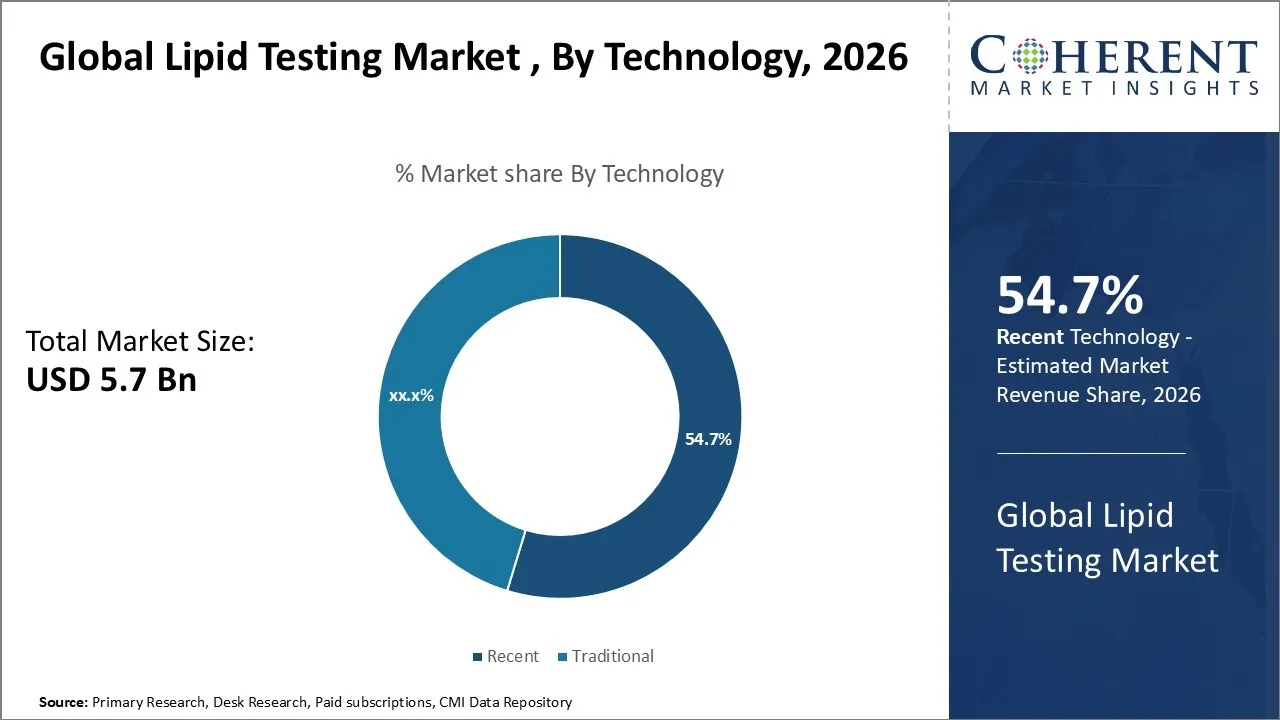
- By Technology, Recent hold the largest market share of 54.7% in 2026 owing to its rising prevalence of cardiovascular and metabolic diseases.
- By Application, Food and Beverages expected to hold largest market share of 52.1% in 2026 owing to the growth of processed foods and ingredients.
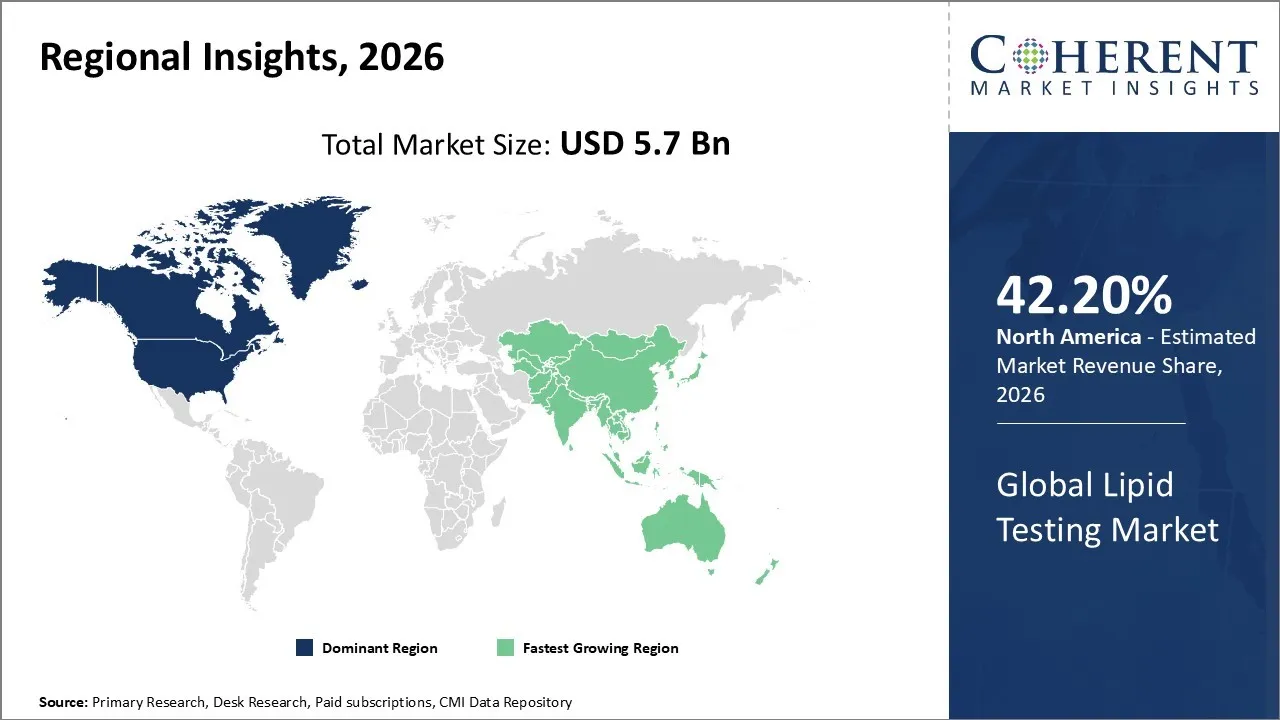
- By Region, North America dominates the overall market with an estimated share of 42.2% in 2026 owing to the high & rising prevalence of cardiovascular and metabolic diseases.
Market Overview
Healthcare providers and patients are increasingly demanding cholesterol and triglyceride assessments to manage cardiovascular and metabolic disorders, which drives the lipid testing market. Hospitals, diagnostic laboratories, clinics, and point-of-care facilities actively use lipid tests for routine screening and ongoing disease monitoring. The growing emphasis on preventive healthcare, rising awareness of heart health, and continuous advancements in automated and rapid testing technologies further accelerate market growth. North America leads the market with its strong healthcare infrastructure, while Asia-Pacific expands steadily by improving access to diagnostic services.
Current Events and Its Impact on the Lipid Testing Market
Current Events | Description and its impact |
Regulatory and Policy Developments in Healthcare |
|
Technological Advancements in Diagnostic Platforms |
|
Economic and Market Dynamics |
|
Segmental Insights
- Current Industry Events of 2026
- Market Size Estimation
- Regional Breakdown
- Competitive Landscape
- Customer Intelligence
- Segmental Analysis
- Pricing Analysis
- Key Market Drivers, Challenges & Future Trends
- Customized Insights Section
Lipid Testing Market Insights, By Technology - Recent contribute the highest share of the market owing to its decentralization of testing services
Recent hold the largest market share of 54.7% in 2026. Rising cases of lifestyle-related disorders, including obesity and diabetes, are driving demand for continuous lipid monitoring and accelerating growth in the lipid testing market. The expanding geriatric population is increasing the need for routine cholesterol screening. Healthcare systems are incorporating lipid testing into standard preventive care programs, boosting overall test volumes. Providers are expanding decentralized diagnostic options, such as point-of-care and home-based testing, to improve accessibility. Ongoing advancements in assay accuracy and faster turnaround times are further encouraging broader clinical adoption worldwide.
Lipid Testing Market Insights, By Application - Food and Beverages contribute the highest share of the market owing to its rising consumer demand for healthy, nutritional foods
Food and Beverages expected to hold largest market share of 52.1% in 2026. The food and beverage industry actively increases demand for lipid testing by requiring precise fat profiling and quality verification in processed and packaged products. Manufacturers use lipid analysis to comply with labeling regulations and substantiate claims such as low fat, trans-fat-free, or fortified formulations. Consumers’ growing preference for healthier and functional foods encourages companies to closely monitor lipid composition. Producers also conduct routine lipid testing to maintain product stability, prevent rancidity, and extend shelf life across manufacturing facilities.
Regional Insights
North America Lipid Testing Market Trends
North America dominates the overall market with an estimated share of 42.20% in 2026. The North America lipid testing market is actively transforming as healthcare providers adopt point-of-care diagnostics and integrate digital solutions into laboratories. Providers are emphasizing early cardiovascular risk assessment, which drives greater use of routine lipid panels across all age groups. Direct-to-consumer testing and home sample collection are gaining traction, enhancing patient convenience. Diagnostic companies are partnering with healthcare networks to streamline testing workflows, while ongoing innovations in automated analyzers and data management systems continue to improve efficiency and support faster, more informed clinical decisions throughout the region. For instance, In November 2025, the Family Heart Foundation, a leading organization for research, education, and advocacy on genetic dyslipidemias, launched the Lp(a) AW(a)RE™ initiative to engage key U.S. healthcare stakeholders and promote awareness, screening, and diagnosis of elevated Lipoprotein(a), also known as Lp(a).
Asia Pacific Lipid Testing Market Trends
The Asia Pacific lipid testing market is actively expanding as growing awareness of cardiovascular health and lifestyle-related disorders increases demand for routine lipid monitoring. Healthcare providers are enhancing access by developing infrastructure, especially in urban centers, and establishing more diagnostic laboratories and point-of-care facilities. Governments and private organizations are promoting preventive health programs, encouraging regular cholesterol and triglyceride testing. Diagnostic companies are adopting automated and portable testing technologies to improve efficiency and accuracy, while investments in regional distribution and educational initiatives are boosting market reach across emerging countries. For instance, in July 2024, the Cardiological Society of India (CSI) has released pioneering guidelines for managing dyslipidemia, using comprehensive Indian data to address the country’s diverse challenges and variations in dyslipidemia prevalence.
United States Lipid Testing Market Trends
The United States lipid testing market is actively growing as healthcare providers prioritize proactive management of cardiovascular risks. Hospitals, clinics, and diagnostic laboratories are routinely integrating lipid panels into preventive care programs. Patients are increasingly using point-of-care testing and direct-to-consumer services to monitor lipid levels conveniently at home. Diagnostic companies are deploying advanced automated analyzers and implementing data management solutions to enhance accuracy and streamline workflows. Furthermore, partnerships between healthcare networks and testing providers are expanding accessibility and improving efficiency across the country.
India Lipid Testing Market Trends
The India lipid testing market is actively growing as increasing awareness of heart disease and lifestyle-related disorders motivates demand for routine cholesterol and triglyceride monitoring. Urban healthcare centers are expanding access to diagnostic laboratories and point-of-care testing, while government and private preventive health initiatives are promoting regular screenings. Hospitals and clinics are implementing modern automated analyzers and portable testing devices to improve accuracy and efficiency. Moreover, diagnostic companies are investing in patient education and regional distribution networks to boost the availability and adoption of lipid testing nationwide.
End-user Feedback and Unmet Needs in the Lipid Testing Market
- Accessibility and Convenience: End-users, including patients and clinicians, seek more convenient testing options. Many find centralized laboratories time-consuming and location-dependent. There is growing demand for point-of-care devices, home testing kits, and mobile sample collection services that allow quicker, easier access to lipid profiling without frequent hospital visits.
- Speed and Efficiency of Results: Clinicians and patients emphasize faster turnaround times for lipid test results. Delays in receiving reports can hinder timely diagnosis and treatment adjustments. Users prefer automated analyzers and rapid diagnostic solutions that provide accurate results within minutes or hours, enabling proactive disease management and improved clinical decision-making.
- Accuracy and Reliability: End-users frequently highlight concerns over inconsistent or inaccurate test results. Variations between laboratories and methods reduce trust in lipid measurements. There is an unmet need for standardized assays, robust quality control, and advanced technologies that deliver precise and reproducible results across different settings.
Lipid Testing Market Trend
Rise of Point-of-Care and Home-Based Testing
The market is shifting toward point-of-care and home-based lipid testing solutions, enabling patients to monitor cholesterol and triglyceride levels conveniently. Portable devices, rapid test kits, and telehealth integration allow real-time results and remote consultations. This trend caters to the increasing demand for preventive healthcare and personalized monitoring, reducing dependence on centralized laboratories and encouraging proactive management of cardiovascular and metabolic disorders across diverse patient populations.
Integration with Digital Health and AI Platforms
Diagnostic companies are increasingly integrating lipid testing with digital health platforms, electronic health records, and AI-driven analytics. This trend allows clinicians to track patient lipid profiles over time, identify risk patterns, and provide data-driven treatment recommendations. Automated reporting and predictive insights enhance clinical efficiency, streamline decision-making, and support personalized patient care in both hospital and outpatient settings.
In August 2024, researchers at the University of Toronto’s Leslie Dan Faculty of Pharmacy developed a novel platform that combines artificial intelligence and combinatorial chemistry to identify the most effective lipid nanoparticles for targeted mRNA delivery to specific tissues.
Market Report Scope
Lipid Testing Market Report Coverage
| Report Coverage | Details | ||
|---|---|---|---|
| Base Year: | 2025 | Market Size in 2026: | USD 5.7 Bn |
| Historical Data for: | 2020 To 2024 | Forecast Period: | 2026 To 2033 |
| Forecast Period 2026 to 2033 CAGR: | 7.9% | 2033 Value Projection: | USD 6.89 Bn |
| Geographies covered: |
| ||
| Segments covered: |
| ||
| Companies covered: | Intertek Group Plc., Microbac Laboratories Inc., Eurofins Scientific SE, Campbell Brothers Limited, General Mills Inc., TUV Nord Group, Bureau Veritas S.A., Ltd., AsureQuality Limited, ALS Limited, NEOGEN Corporation, Mérieux NutriSciences Corporation, and SGS SA. | ||
| Growth Drivers: |
| ||
| Restraints & Challenges: |
| ||
Lipid Testing Market News
- In January 2026, Orange Health Labs launched Orange One, a health management product replacing the traditional pay-per-test model. It offers customers a comprehensive full-body check-up covering over 114 blood markers, including Apo A1, Apo B, Troponin I, HOMA-IR, and an expanded hormonal and vitamin profile.
- In August 2025, Labcorp, in partnership with Amazon Web Services (AWS), launched Test Finder, a generative AI tool that lets healthcare providers describe conditions in plain language and receive tailored lab test recommendations.
Analyst Opinion (Expert Opinion)
- The lipid testing market is reshaped by the clinical urgency created by global dyslipidemia prevalence. With over 1.3 billion adults exhibiting elevated LDL cholesterol worldwide, clinicians are increasingly prioritizing detailed lipid profiling rather than simple total cholesterol checks, reflecting deeper cardiovascular risk stratification needs rather than routine testing alone. This shift is evident in the rapid expansion of advanced LDL‑P particle number assays, which grew by more than 30 percent over recent years as medical practice moves toward precision risk characterization rather than binary high‑low classifications.
- Furthermore, the persistent integration of point‑of‑care technologies and digital reporting is materially altering care pathways. Point‑of‑care lipid tests now account for a meaningful share of total lipid tests, enabling real‑time clinical decisions that were previously only possible with laboratory turnaround times. Home testing kits have also witnessed accelerated adoption in affluent markets, reflecting genuine consumer demand for empowered self‑monitoring, not just convenience.
- Despite this progress, a critical constraint remains the variability in assay standardization across platforms. Many advanced lipid markers deliver incremental insight, but inconsistent cross‑platform results undermine confidence among primary care providers and limit guideline adoption, particularly outside cardiology specialties. Quality control participation for newer assays lags behind traditional tests, revealing a systemic gap between technological capability and clinical trust.
Speak to the analyst
Want personalized insights?
Take the findings above to one of our principal consultants, or have the report rebuilt around the segments, geographies and competitors you actually track.
Market Segmentation
- By Technology
- Recent
- Traditional
- By Application
- Food and Beverages
- Food Ingredients
- By Regional Insights
- North America
- U.S.
- Canada
- Latin America
- Brazil
- Argentina
- Mexico
- Rest of Latin America
- Europe
- Germany
- U.K.
- Spain
- France
- Italy
- Russia
- Rest of Europe
- Asia Pacific
- China
- India
- Japan
- Australia
- South Korea
- ASEAN
- Rest of Asia Pacific
- Middle East
- GCC Countries
- Israel
- Rest of Middle East
- Africa
- South Africa
- North Africa
- Central Africa
- North America
- Key Players Insights
- Intertek Group Plc.
- Microbac Laboratories Inc.
- Eurofins Scientific SE
- Campbell Brothers Limited
- General Mills Inc.
- TUV Nord Group
- Bureau Veritas S.A., Ltd.
- AsureQuality Limited
- ALS Limited
- NEOGEN Corporation
- Merieux NutriSciences Corporation
- SGS SA
Sources
Primary Research interviews
- Laboratory directors and managers at clinical and diagnostic labs
- Cardiologists and endocrinologists specializing in lipid disorders
- Researchers in lipidomics and metabolic studies
- Medical device and diagnostics equipment specialists
- Hospital procurement and laboratory purchasing heads
Databases
- PubChem
- ClinicalTrials.gov
- NCBI (National Center for Biotechnology Information)
- WHO Global Health Observatory
- FDA databases for diagnostic devices
Magazines
- Clinical Laboratory News
- MedTech Outlook
- Laboratory Equipment
- Medical Device & Diagnostic Industry (MD+DI)
- Lab Manager Magazine
Journals
- Journal of Lipid Research
- Clinical Chemistry
- Atherosclerosis
- Lipids in Health and Disease
- Journal of Clinical Lipidology
Newspapers
- The New York Times (Health Section)
- The Guardian (Health & Science Section)
- The Wall Street Journal (Healthcare Section)
- Reuters Health
- Bloomberg Health
Associations
- American Heart Association (AHA)
- American College of Cardiology (ACC)
- International Atherosclerosis Society (IAS)
- National Lipid Association (NLA)
- European Atherosclerosis Society (EAS)
Public Domain sources
- WHO reports on cardiovascular and metabolic diseases
- CDC reports on cholesterol and lipid disorders
- NIH publications and research briefs
- Government health statistics portals
- Open-access medical research repositories
Proprietary Elements
- CMI Data Analytics Tool
- Proprietary CMI Existing Repository of information for last 8 years
Get access to 250+ pages report
Every segment, forecast, competitor profile and data table behind the analysis above — available for instant download.
- ESOMAR Member
- ISO 9001:2015 Certified
- D-U-N-S Registered
- GDPR & CCPA Compliant
Missing comfort of reading report in your local language? Find your preferred language:
Transform your Strategy with Exclusive Trending Reports
Frequently Asked Questions
The Lipid Testing Market is estimated to be valued at USD 5.7 Bn in 2026 and is expected to reach USD 6.89 Bn by 2033.
Increasing demand for processed food products and stringent government regulations imposed on food safety are some of the major factors that are expected to propel growth of the market over the forecast period.
Rising awareness regarding the nutritional value of fast food, street food, ready to eat food, and all types of beverages such as packaged juices and carbonated beverages manufacturing companies are improving their quality of with a reduced rate of food adulteration are the latest trends in the market.
Lack of food safety infrastructure and resources in certain regions of Asia Pacific and Africa is one of the major factors hampering the market growth.
Major players operating in the market include Intertek Group Plc., Microbac Laboratories Inc., Eurofins Scientific SE, Campbell Brothers Limited, General Mills Inc., TUV Nord Group, Bureau Veritas S.A., Ltd. and AsureQuality Limited, ALS Limited, NEOGEN Corporation, Mérieux NutriSciences Corporation, and SGS SA.