

Cosmetics Market Size and Trends - 2026 to 2033
The global cosmetics market is estimated to be valued at USD 338.31 Bn in 2026 and is expected to reach USD 492.13 Bn in 2033, exhibiting a compound annual growth rate (CAGR) of 5.5% from 2026 to 2033.
Key Takeaways
- Based on the product type, the Skin Cosmetics segment is projected to capture around 41% share in the market by the year 2026.
- Based on category, the organic & natural segment is likely to hold a significant share of 62.7% in 2026 because consumers are focused on looking for chemical-free and eco-friendly cosmetics products.
- By distribution channel, store-based will likely capture a market share of 34.6% in 2026, driven by its wide availability and increased consumer confidence in retail outlets and in-store product experience.
- By region, the Asia Pacific is expected to dominate the global cosmetics market with a 40% market share in the year 2026, while North America will be the fastest-growing region.
Market Overview
The cosmetic industry is witnessing a boom due to the increase in per capita spending on cosmetic and personal care products. The growth of all product categories is being widely driven by rising consumer awareness related to personal grooming, beauty trends, and skincare routines. Additionally, innovations in formulations, premiumization of products, and social media influences, together with celebrity endorsements, have further propelled growth.
Current Events and Its Impact on the Cosmetics Market
Current Events | Description and its impact |
EU Regulatory Changes and Sustainability Mandates |
|
Inflation and Supply Chain Disruptions |
|
Smart and Sustainable Packaging in Cosmetics Market
Smart and sustainable packaging will redesign the cosmetic marketplace for 2025 by blending innovation, functionality, and environmentally conscious design to meet the evolving expectations of both consumers and the industry.
It involves adding QR codes, NFC tags, containers that can be refilled on-site, and other measures into cosmetics packaging for improved product safety, traceability, and consumer interaction. It is used in skin care, makeup, and personal care, thus providing a set of opportunities for real-time product information, authenticity, and proper use instructions.
Greater awareness of ecological concerns has accelerated the pace of adoption of more eco-friendly packaging solutions, such as recyclable tubes, biodegradable jars, and refillable compacts. Regulatory pressures, coupled with a marked consumer preference for green products, have led to brands being more innovative by way of bio-based materials, water-soluble films, and minimalistic design that results in reduced waste.
For instance, in March 2025, L’Oréal launched its Refill & Reuse initiative for select skincare and makeup lines, introducing refillable cartridges and reusable outer packaging, significantly reducing plastic waste and aligning with circular economy principles.
- Current Industry Events of 2026
- Market Size Estimation
- Regional Breakdown
- Competitive Landscape
- Customer Intelligence
- Segmental Analysis
- Pricing Analysis
- Key Market Drivers, Challenges & Future Trends
- Customized Insights Section
Segmental Insights
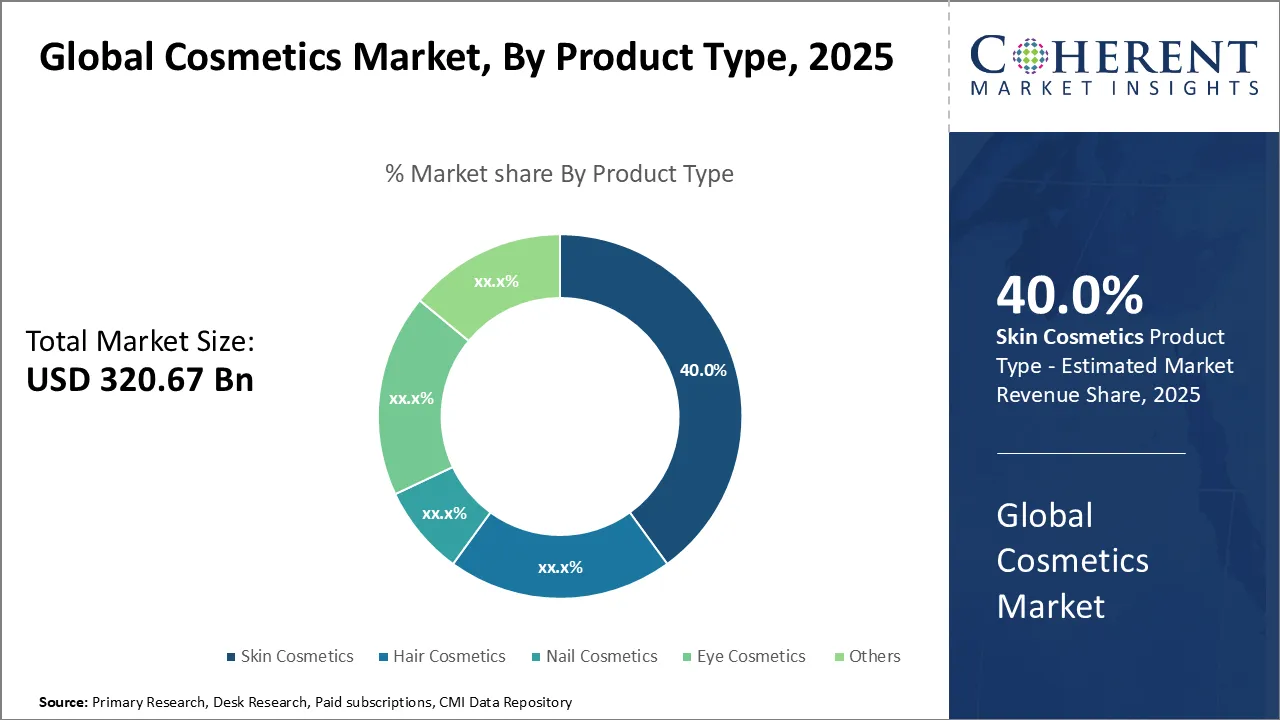
Cosmetics Market Insights, By Product Type: Skin Cosmetics Leads Driven by Rising Skincare Demand and Innovations
By product type, the skin cosmetics segment accounts for 41% of market share in 2026. The growth of this segment is predominantly driven by the increasing demand for skin care products, rising awareness related to personal grooming, and continuous innovation at the level of formulations. The segment of skincare products includes several products, such as creams, serums, and lotions, which have enjoyed wide adoption due to perceived health and aesthetic benefits.
Every brand is focused on product differentiation through advanced ingredients, premium packaging, and multifunctional offerings, in order to meet changing consumer needs. The growth in demand for anti-aging, brightening, and natural ingredient-based products accelerates the market further.
For instance, in April 2025, Emami launched a new skincare solution “Pure Glow”, targeting the brightening cream category.
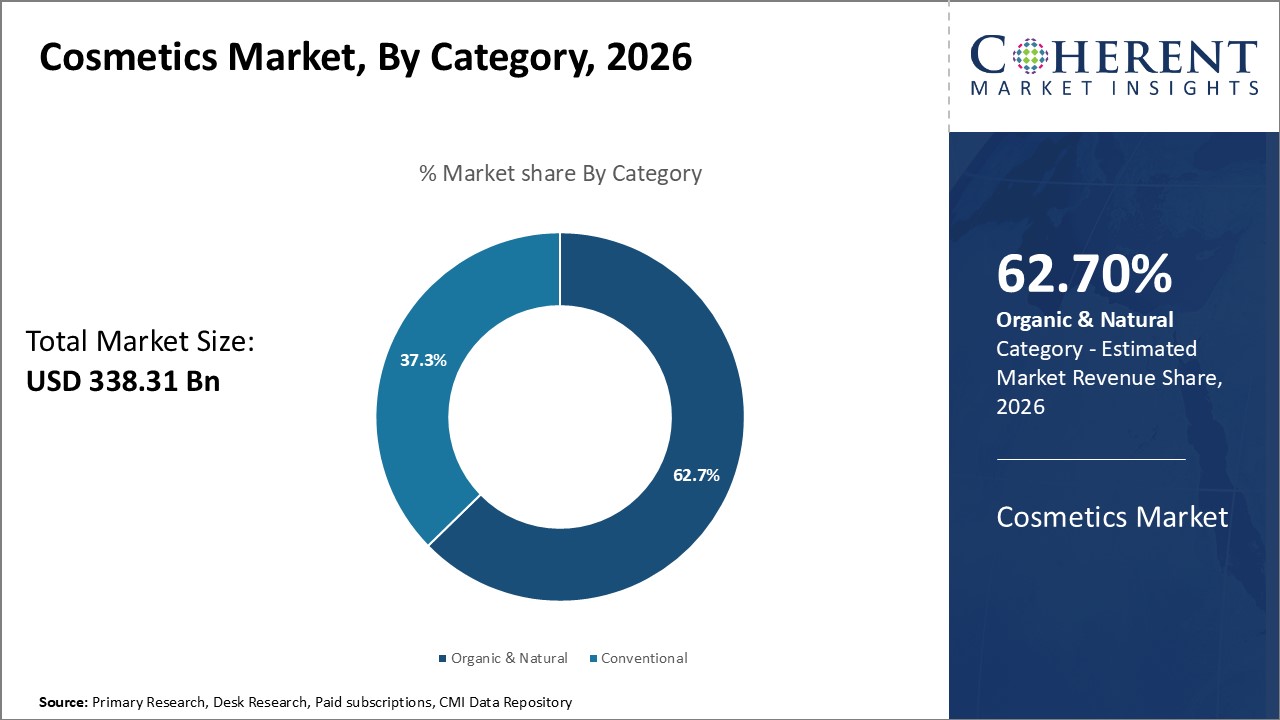
Cosmetics Market Insights, By Category: Organic & Natural Segment Gains Traction Amid Eco-Conscious Trends
By category, Organic & Natural contributes 62.7% of the market share in 2026, supported by increasing consumer preference for chemical-free and eco-friendly cosmetic products. The increasing awareness related to product safety, sustainability, and clean beauty standards will also drive adoption for organic formulation.
Brands respond by offering plant-based ingredients, cruelty-free certifications, and transparent labeling-all in the quest to lure conscious consumers. The growth of e-commerce sites coupled with social media advocacy further increases the reach for organic and natural products, calling for wider adoption across diverse demographics.
For instance, in July 2025, NATRUE announced “Natural Cosmetics Week 2025” (scheduled for 17–23 Nov 2025), to highlight the benefits and transparency of certified natural and organic cosmetics worldwide.
Cosmetics Market Insights, By Distribution Channel: Store-Based Segment Leads Due to Availability and Consumer Trust
By distribution channel, Store-Based accounted for a market share of 33.6% in 2025 due to wider availability, consumer trust in retail outlets, and improved in-store product experience. Physical stores enable consumers to test a product, seek expert advice, and compare multiple products before making a purchase decision, thereby encouraging higher adoption.
Retailers are increasing their budgets to visually appealing displays, in-store sampling, and interactive experiences to increase engagement. Moreover, premium brand counters and exclusive product launches in stores will help to generate consumer confidence and loyalty.
For instance, in August 2025, NARS opened its second standalone store in India at Palladium Mall in Mumbai.
Regional Insights
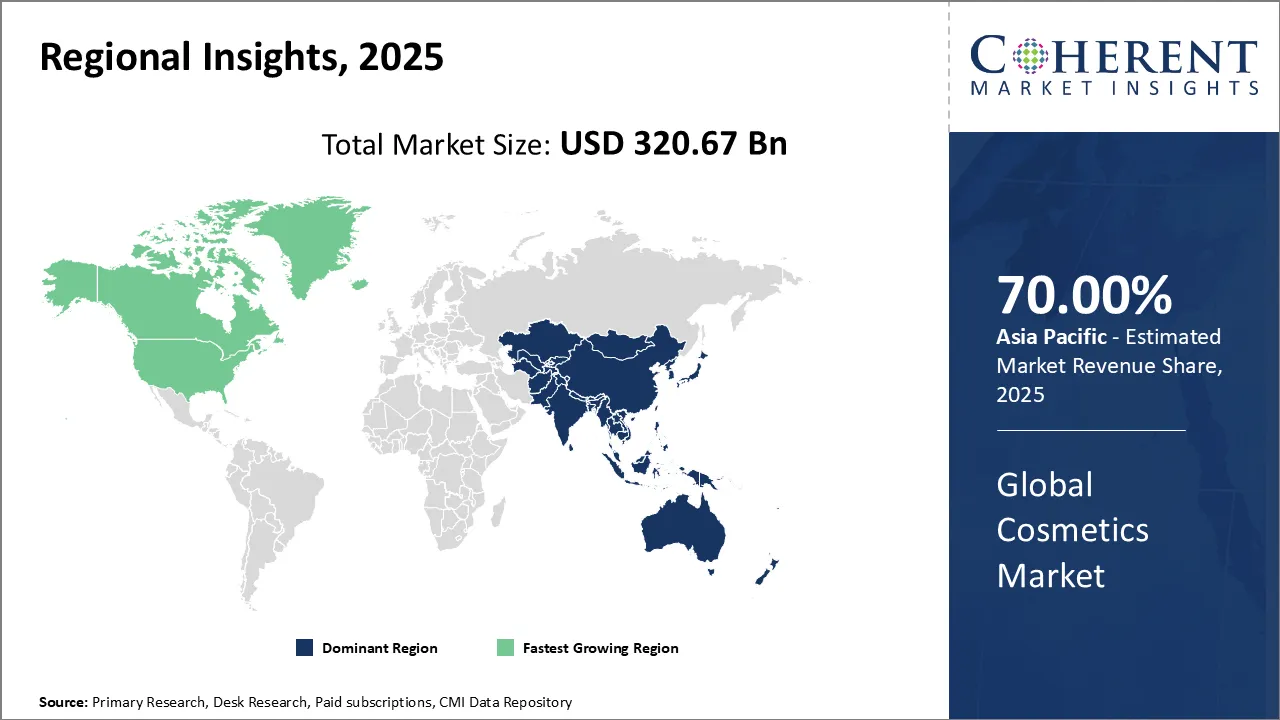
Asia Pacific Cosmetics Market Analysis & Trends
The Asia Pacific region is expected to dominate the cosmetics market, with a 40% share by 2026, owing to surging disposable incomes, increasing awareness about personal grooming, and growing demand for skincare and beauty products in countries such as China, India, and Japan. In addition, cosmetic consumption is driven by rapid urbanization, expanding retail networks, and a growing middle-class population. Production capabilities and product offerings from local manufacturers and international brands are being continuously developed to cater to consumers' changing preferences across the region.
For instance, in March 2026, the Body Shop expanded its vegan skincare and makeup lines across Asia Pacific, boosting visibility of organic and natural cosmetics and reinforcing market growth in the region.
North America Cosmetics Market Analysis & Trends
North America is expected to be the fastest-growing region in the global cosmetics market. With strong consumer interest in premium, organic, and innovative cosmetic products, coupled with well-established retail infrastructure and high per capita spending, the segment is growing. Expansion of offline stores and e-commerce platforms will allow easy availability and access to a wide portfolio range for consumers in the U.S. and Canada. The regulatory standards related to formulations and packaging are pushing brands to innovate, enabling the demand for eco-friendly and sustainable cosmetic products.
For instance, in January 2026, Estée Lauder launched its Advanced Night Repair Serum with improved bioactive formulations in North America, capturing significant consumer interest and reinforcing the leading position of skin cosmetics in the market.
Cosmetics Market Outlook Country-Wise
U.S. Cosmetics Market Trends
The U.S. cosmetics market is experiencing steady growth in 2026, underpinned by growing consumer awareness regarding skincare and makeup, personal grooming, high per capita expenditure, and a rise in demand for premium and organic products. The expansion of e-commerce, launching of new and innovative products, along with the growing popularity of sustainable and eco-friendly formulations, is driving the market of skincare, haircare, and color cosmetics segments. Regulatory standards and a shift in consumer preference toward cruelty-free and clean beauty products encourage brands to innovate in formulations and packaging.
For instance, in May 2026, e.l.f. Beauty announced it would acquire rhode (the skincare brand founded by Hailey Bieber) in a deal worth up to USD 1 billion. This move expands e.l.f.’s portfolio into prestige skincare and highlights rising consolidation and shifting consumer demand in the U.S. beauty market.
China Cosmetics Market Trends
China’s cosmetics market is expanding rapidly in 2026 due to increasing disposable incomes, growing urbanization, and a rising interest by consumers in beauty, skincare, and personal care products. This is increasingly driven by e-commerce, social media, and consumer demand for better-quality, organic, and natural cosmetics. International and domestic brands are introducing innovative products that cater to local preferences, while in-store and online retail channels continue to expand accessibility.
For instance, in April 2026, Florasis (Huaxizi) was highlighted for its advanced “smart factory” in Hangzhou, underlining growing adoption of tech‑driven manufacturing in China’s cosmetics industry.
Market Report Scope
Cosmetics Market Report Coverage
| Report Coverage | Details | ||
|---|---|---|---|
| Base Year: | 2025 | Market Size in 2026: | USD 338.31 Bn |
| Historical Data for: | 2020 To 2024 | Forecast Period: | 2026 To 2033 |
| Forecast Period 2026 to 2033 CAGR: | 5.5% | 2033 Value Projection: | USD 492.13 Bn |
| Geographies covered: |
| ||
| Segments covered: |
| ||
| Companies covered: | L’Oreal S.A, Unilever plc., The Procter & Gamble Company, The Estee Lauder Companies Inc., Shiseido Company, Limited, LVMH Moët Hennessy, Kao Corporation., Oriflame Holding AG, Avon Products Inc., Revlon, Inc. | ||
| Growth Drivers: |
| ||
| Restraints & Challenges: |
| ||
Cosmetics Market Drivers
Increasing consumer spending on cosmetics & personal care products
The consumption pattern among the young population has changed with an aspiration to look good, which is expected to drive personal care products and, consequently, cosmetic products. Moreover, the growing youth population, increasing adoption of social media platforms, launch of innovative products, and easy availability of the products across the globe are also expected to support the growth of the global cosmetics market.
Increasing working women population in emerging countries
The growing working women population has led to an increased per capita disposable income of the consumers, which has changed consumer spending behavior. Cosmetics play an important role in enhancing one’s beauty and physical appearance. Improvements in the current lifestyles of the individuals are anticipated to drive the sales of cosmetics in the near future. The sales of skin cosmetics, eye makeup, and lip cosmetics are expected to be significant owing to the daily usage of the products by the women
Cosmetics Market Opportunities
Increasing demand for natural & organic cosmetics
The phenomenon of ‘returning to original nature’ is becoming a fashion statement with more and more people interested in buying only chemical-free products. Increasing awareness of harmful ingredients present in cosmetics might restrict market growth. The adoption of organic and natural cosmetics will result in narrowing down the scope of the cosmetics market.
Analyst Opinion (Expert Opinion)
The cosmetics market is undergoing a profound transformation driven by sustainability, digital engagement, and personalization. Consumers in strategic markets such as China and the U.S. increasingly demand clean, organic, and refillable products. Companies that don't have these traits may face erosion of market share, since the younger demographics, including Gen Z, tend to make choices based on ethical sourcing and brand transparency.
Sustainability is no longer optional. Big players are embedding the concept of the circular economy at the product-design phase, introducing refillable cartridges and reusable packaging for skincare and makeup lines, reflecting a shift toward eco-conscious innovation.
Personalization and experience-driven engagement have become important differentiators. Brands incorporating sustainable packaging, innovative product designs, and digital tools are better poised to reinforce brand loyalty and improve brand perception amidst an ever-evolving marketplace.
Speak to the analyst
Want personalized insights?
Take the findings above to one of our principal consultants, or have the report rebuilt around the segments, geographies and competitors you actually track.
Cosmetics Industry News
- In June 2025, L’Oréal S.A. launched the global “#JoinTheRefillMovement” initiative across its brands (Lancôme, L’Oréal Paris, Kérastase, La Roche‑Posay, YSL Beauty, etc.), encouraging consumers to adopt refillable packaging and promoting sustainability.
- In April 2025, Unilever plc acquired the personal care brand Wild, a brand known for natural, refillable and sustainable deodorants/bodycare products, indicating Unilever’s strategic shift toward premium, eco‑friendly and high-growth segments.
- In November 2024, Shiseido launched an “Online Beauty Consultation Service” specifically tailored for people with hearing loss, under its inclusive‑beauty commitment.
Market Segmentation
- Product Type Insights (Revenue, USD Bn & KT, 2026 - 2033)
- Skin Cosmetics
- Hair Cosmetics
- Nail Cosmetics
- Eye Cosmetics
- Others
- Category Insights (Revenue, USD Bn & KT, 2026 - 2033)
- Organic & Natural
- Conventional
- Distribution Channel Insights (Revenue, USD Bn & KT, 2026 - 2033)
- Store-Based
- Non-Store-based
- Regional Insights (Revenue, USD Bn & KT, 2026 - 2033)
- North America
- U.S.
- Canada
- Latin America
- Brazil
- Argentina
- Mexico
- Rest of Latin America
- Europe
- Germany
- U.K.
- Spain
- France
- Italy
- Russia
- Rest of Europe
- Asia Pacific
- China
- India
- Japan
- Australia
- South Korea
- ASEAN
- Rest of Asia Pacific
- Middle East & Africa
- GCC Countries
- Israel
- Rest of Middle East & Africa
- North America
- Key Players Insights (Revenue, USD Bn, 2021 - 2033)
- L’Oreal S.A
- Unilever plc.
- The Procter & Gamble Company
- The Estee Lauder Companies Inc.
- Shiseido Company, Limited
- LVMH Moët Hennessy
- Kao Corporation.
- Oriflame Holding AG
- Avon Products Inc.
- Revlon, Inc.
Sources
Primary Research Interviews from the following stakeholders
Stakeholders
- Interviews with cosmetics manufacturers, brand marketing heads, R&D managers, raw material suppliers, retail chain managers, and sustainability officers across major regional markets.
Specific stakeholders
- R&D and innovation heads at leading cosmetics companies (e.g., L’Oréal, Unilever, Estée Lauder, Shiseido, Procter & Gamble, Revlon)
- Procurement and supply chain managers at personal care and beauty brands (e.g., Avon, Oriflame, Kao Corporation)
- Operations and production managers at cosmetic packaging converters and equipment suppliers (e.g., Amcor, RPC, Berry Global)
- Sustainability and circular economy leads at cosmetic brand-owner alliances (e.g., Ellen MacArthur Foundation, Sustainable Packaging Coalition)
- Retail and e-commerce managers focused on in-store and online cosmetics distribution (e.g., Sephora, Ulta Beauty, Amazon, Alibaba)
- Quality control and regulatory teams in personal care and beauty product manufacturing
- Marketing and product development teams launching innovative or eco-friendly cosmetic lines
Databases
- United Nations Comtrade Database – Cosmetics Trade Data
- World Trade Organization (WTO) Trade Statistics
- Eurostat – Cosmetic Product and Material Flow Database
- U.S. Census Bureau – Personal Care Product Statistics
- China Customs Statistics – Cosmetic Imports/Exports
- Directorate General of Commercial Intelligence and Statistics (DGCIS), India – Cosmetic Product Data
- Japan External Trade Organization (JETRO) – Beauty Product Trade
- Korea Customs Service Data Portal – Cosmetic Industry Data
- Food and Drug Administration (FDA) – Cosmetics and Personal Care Regulations
- Indian Ministry of Commerce & Industry – Cosmetic Exports/Imports
- European Chemicals Agency (ECHA) – Cosmetic Ingredient Regulations
Magazines
- Cosmetics Business
- Beauty Packaging
- Premium Beauty News
- Global Cosmetic Industry (GCI)
- Happi Magazine
- Personal Care Magazine
- Cosmetics Design
- BeautyMatter
- Packaging Europe – Beauty Section
- Beauty Packaging & Ingredients Insights
Journals
- International Journal of Cosmetic Science
- Journal of Cosmetic Dermatology
- Journal of Cosmetic Science
- Cosmetics & Toiletries
- Skin Research and Technology
- Journal of Applied Polymer Science – Cosmetic Packaging Section
- Journal of Cleaner Production – Personal Care Product Sustainability
- Resources, Conservation & Recycling – Beauty Packaging Studies
Newspapers
- The Wall Street Journal – Consumer & Beauty News
- The Economic Times – Cosmetics & Personal Care Industry
- Business Standard – FMCG & Beauty
- Financial Times – Luxury & Personal Care Reports
- Nikkei Asia – Cosmetics & Personal Care Market
- The Hindu Business Line – Manufacturing & Beauty
- South China Morning Post – Cosmetics Industry
- The Guardian – Beauty & Sustainability
Associations
- Personal Care Products Council (PCPC)
- European Federation for Cosmetic Ingredients (EFfCI)
- Indian Cosmetic & Toiletries Association (ICTA)
- Sustainable Packaging Coalition (SPC) – Beauty Sector
- Cosmetic, Toiletry, and Fragrance Association (CTFA)
- British Beauty Council
- Japan Cosmetic Industry Association (JCIA)
- Cosmetics Alliance Canada
Public Domain Sources
- U.S. Food and Drug Administration (FDA) – Cosmetics & Personal Care Regulations
- European Chemicals Agency (ECHA) – Cosmetic Ingredient & Packaging Reports
- Ministry of Environment, Forest and Climate Change (MoEFCC), India – Packaging and Waste Guidelines
- Organisation for Economic Co-operation and Development (OECD) – Cosmetic Market and Circularity Reports
- United Nations Environment Programme (UNEP) – Plastic and Packaging Sustainability Reports
- European Environment Agency (EEA) – Packaging Waste & Cosmetics Data
- Reserve Bank of India (RBI) – FMCG & Cosmetic Industry Statistics
- Department for Promotion of Industry and Internal Trade (DPIIT), India – Cosmetics Sector Reports
- Central Pollution Control Board (CPCB), India – Extended Producer Responsibility Data
Proprietary Elements
- CMI Data Analytics Tool
- Proprietary CMI Existing Repository of information for last 8 years
*Definition: Cosmetics are one of the popular consumer goods especially among females. Some of the cosmetics are hair cosmetics, skin cosmetic, nail and eye cosmetics.
Get access to 250+ pages report
Every segment, forecast, competitor profile and data table behind the analysis above — available for instant download.
- ESOMAR Member
- ISO 9001:2015 Certified
- D-U-N-S Registered
- GDPR & CCPA Compliant
Missing comfort of reading report in your local language? Find your preferred language:
Transform your Strategy with Exclusive Trending Reports
Frequently Asked Questions
The Cosmetics Market is estimated to be valued at USD 338.31 Bn in 2026, and is expected to reach USD 492.13 Bn by 2033.
The CAGR of the Cosmetics Market is projected to be 5.5% from 2026 to 2033.
Increasing consumer spending on cosmetics & personal care products is fuelling growth of the market.
The Skin Cosmetics segment is the leading product type segment in the market.
Side- effects of harmful chemicals is the major factors restraining growth of the market.
L’Oreal S.A, Unilever plc., The Procter & Gamble Company, The Estee Lauder Companies Inc., Shiseido Company, Limited, LVMH Moët Hennessy, Kao Corporation., Oriflame Holding AG, Avon Products Inc., Revlon, Inc.