

Glycerol Market Size and Forecast — 2026-2033
Glycerol Market is estimated to be valued at USD 4.02 Bn in 2026 and is expected to reach USD 7.16 Bn in 2033, exhibiting a compound annual growth rate (CAGR) of 8.6% from 2026 to 2033.
Drivers
- Increasing demand for biodiesel
Growing consumers' preferences towards naturally-sourced products and the increasing demand for biodiesel from the transportation industry is augmenting the market growth of global glycerol market. Glycerol is a clean and renewable fuel, thus growing strict environmental rules & regulations associated with carbon emissions is driving demand for biodiesel. Hence, the growing demand for naturally-sourced products among consumers is projected to foster the market growth of global glycerol market.
- Personal care glycerol
Increasing demand for glycerol from the personal care segment is expected to foster the market growth. It is used in the production of personal care and cosmetic products such as moisturizers, shampoos, toothpaste, hair conditioners, and body wash. In moisturizing creams, it is used to smoothen the skin by offering moisture to the skin surface. Moreover, it is also used to add to shaving creams and eye drops. The growing demand for glycerol from personal care is projected to propel the market growth of global glycerol market.
Market Opportunities
- Pharmaceutical industry
The increasing use of glycerol in the pharmaceutical industry is expected to bring new market growth opportunities over the forecast period. It is used in the pharmaceutical industry to extract and prevent the inert substance from precipitating upon standing. Moreover, the growing demand for environment-friendly products and favorable government policies is also contributing to the market growth of the global glycerol market. Thus, the growing demand for glycerol from the pharmaceutical industry is propelling the market growth.
- Food & Beverage industry
The growing use of glycerol as a sweetener in foods for diabetic patients is expected to serve major opportunities in the near future. The growing prevalence of lifestyle diseases such as diabetes is again expected to drive the demand for glycerol as a sweetener in food products. Moreover, the increasing production of biofuels is also projected to offer profitable opportunities for the market of global glycerol market. Hence, the growing demand for glycerol as a sweetener in low-carb diets and diabetic food is projected to foster the market growth.
Market Trends
- Using glycerol in processed and dairy products
The increasing trend of using glycerol in various processed, dairy products, canned, and functional foods is expected to propel the market growth. Glycerol is used as a sweetener, thickener, and humectants in food formulations. Food grade glycerol is produced from vegetable, animal sources such as palm, coconut, and soybean. Moreover, it is also prepared synthetically from propylene. Thus, the growing demand for processed and dairy products is projected to foster the market growth.
- Growing strategic partnerships among key players
Growing strategic partnerships and agreements among key manufacturers is one of the emerging trends in the market. For instance, in June 2022, Kao Corp. an manufacture introduced Bioré Guard Mos Block Serum, a natural citronella oil-based topical mosquito repellent. The serum has a widely expanding formula that blocks mosquitoes and provides shield-like coverage on the skin.
- Current Industry Events of 2026
- Market Size Estimation
- Regional Breakdown
- Competitive Landscape
- Customer Intelligence
- Segmental Analysis
- Pricing Analysis
- Key Market Drivers, Challenges & Future Trends
- Customized Insights Section
Report Coverage
| Report Coverage | Details | ||
|---|---|---|---|
| Base Year: | 2025 | Market Size in 2026: | USD 4.02 Bn |
| Historical Data for: | 2020 To 2024 | Forecast Period: | 2026 To 2033 |
| Forecast Period 2026 to 2033 CAGR: | 8.6% | 2033 Value Projection: | USD 7.16 Bn |
| Geographies covered: | North America, Europe, Asia Pacific, Latin America, Rest of World | ||
| Segments covered: |
| ||
| Companies covered: | Proctor & Gamble Chemicals, Dial Corporation, Croda, Dow Chemicals, Godrej Industries Ltd., Emery Oleochemicals, IOI Group, Kuala Lumpur Kepong Berhad, Wilmar International, and Sofiprotéol Group | ||
| Growth Drivers: |
| ||
| Restraints & Challenges: |
| ||
Market Restraints
- Increasing price of vegetable oil and fatty alcohol
The increasing price of vegetable oil and fatty alcohol is a major factor hindering the market growth of the global glycerol market. Furthermore, the high price of raw materials due to the growing demand from food and pharmaceutical applications is projected to propel the market growth of global glycerol market.
The costly refining process is projected to be expected to limit the demand for glycerol. This factor is expected to hamper the market growth of the global glycerol market over the forecast period.
Detailed Market segment
Figure1: Global Glycerol Market Share by Application in 2026
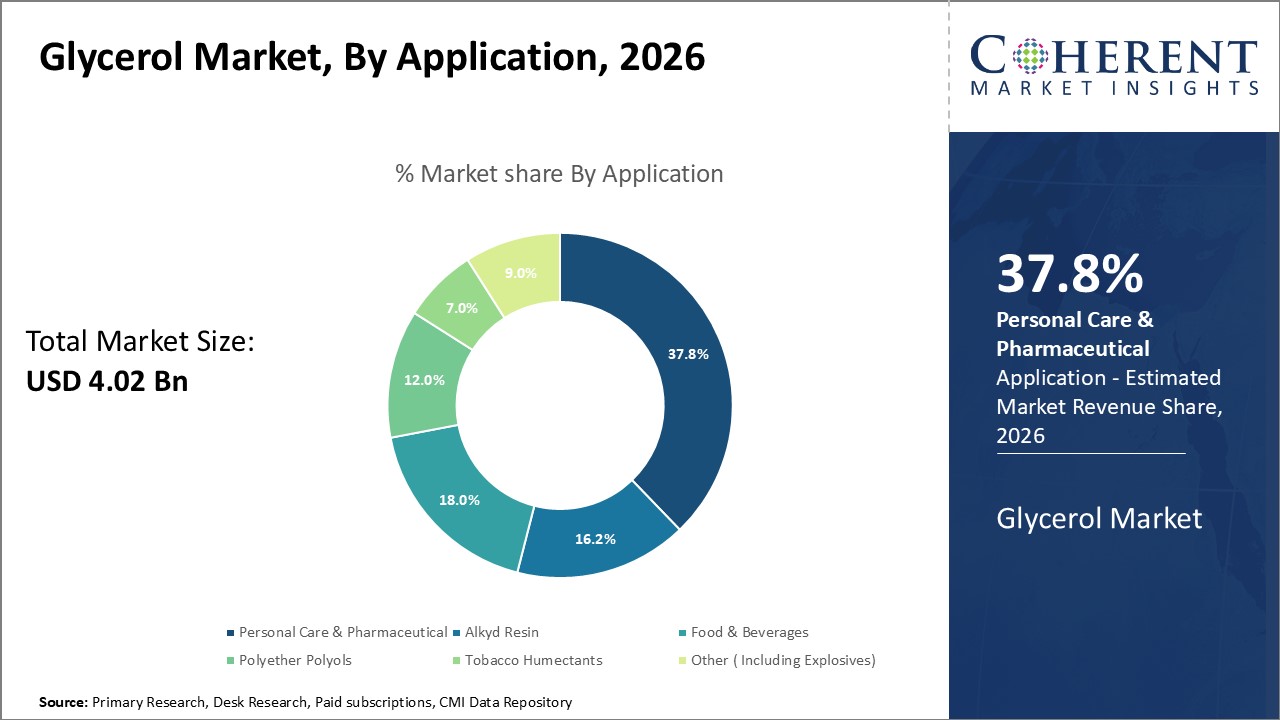
The personal care & pharmaceutical segment from the applications segment held the dominant position in the market and accounted for 37.8% of the market share in the global glycerol market in 2026. The segment is expected to reach US$ 5.57 billion in 2033.
Glycerol is used in the medical, pharmaceutical, and personal care preparations mainly as a means of improving smoothness, providing lubrication, and as a humectant. It is found in allergen immunotherapies, cough syrups, elixirs and expectorants, toothpaste, mouthwashes, skin care products, shaving cream, hair care products, glycerin soaps, and water-based personal lubricants. Nitroglycerin is the most commonplace treatment for chronic angina, the chest pain of heart disease.
Figure 2: Global Glycerol Market, by Region, in 2026
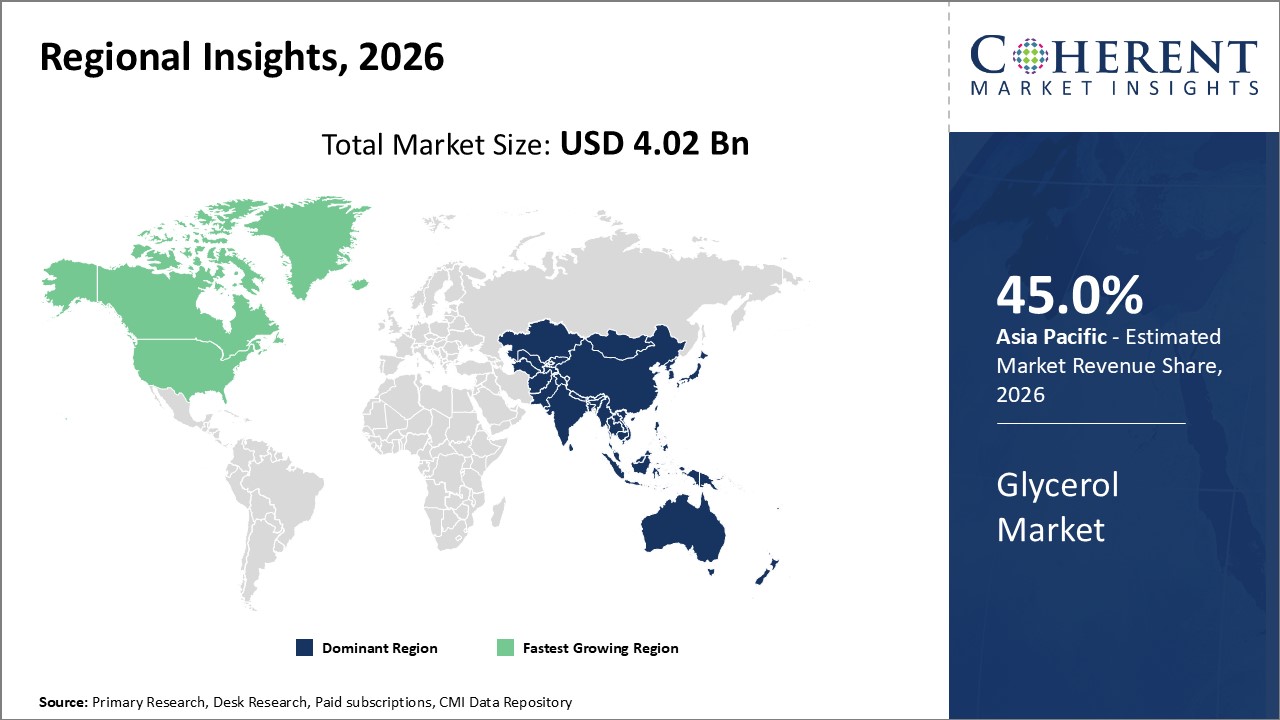
Asia Pacific held the dominant position in the global glycerol market in 2026, accounting for 45.0% share in terms of volume, followed by North America and Europe respectively.
Recent Developments:
- On April 1, 2020, the growing amount of biodiesel produced worldwide leads to more than two billion tons of glycol entering in the market which is used in the pharmaceuticals, cosmetics & food industries. The valorization of glycol can be done by electrochemical oxidation. The electrochemical oxidation of glycol can be performed to produce electricity using a fuel cell.
- On March 4, 2021, an Australia-based refiner, AMV will build a pilot plant at its 200,000 build schwechat refinery to produce advanced biofuels using waste-based glycerol from 2023.The facility will use a catalyst to produce around 1.23 mnl/year of propanol from glycerol which is a by-product or waste product from the production of biodiesel, Around 1.2 l of liter of crude glycerol needed to produce a liter of propanol according to AMU.
- On March 25, 2021, Scientists from Singapore's Nanyang Technological University (NTU) created an antibacterial gel bandage out of the husks of the popular tropical fruit Durian. NTU scientists generated a soft gel similar to silicon sheets by extracting high grade cellulose from Durian husks and mixing it with glycerol. This soft gel can be cut into bandages of various shapes and sizes
Competitive Section:
Proctor & Gamble Chemicals, Dial Corporation, Croda, Dow Chemicals, Godrej Industries Ltd., Emery Oleochemicals, IOI Group, Kuala Lumpur Kepong Berhad, Wilmar International, and Sofiprotéol Group
Sources
Primary Research Interviews
- Glycerol producers (e.g., Wilmar International, IOI Oleo, Cargill, Emery Oleochemicals, Godrej Industries)
- Pharma, food, personal care and biodiesel co-product buyers
- Biorefinery operators
Databases
- UN Comtrade glycerol trade data
- Eurostat oleochemical data
- USDA biodiesel data
Magazines
- Inform Magazine (AOCS)
- ICIS Chemical Business
Journals
- Journal of the American Oil Chemists' Society (AOCS)
- Industrial Crops and Products (Elsevier)
Newspapers
- Reuters Commodities
- Financial Times – Commodities
Associations
- AOCS
- APAG / Cefic
- National Biodiesel Board / Clean Fuels Alliance
Public Domain Sources
- U.S. FDA GRAS data
- EFSA evaluations
- ResearchGate publications on glycerol valorization
Proprietary Elements
- CMI Data Analytics Tool, Proprietary CMI Existing Repository of information for last 10 years.
*Definition: Glycerol is produced from biodiesel and is consider as a clean-burning fuel across a wide range of industries. Moreover, glycerol is one of the key ingredients in the manufacturing of resins and gums which are further used to produce paints and coatings. Furthermore, it is also used in personal care products due to its humectant and solvent properties.
Get access to 250+ pages report
Every segment, forecast, competitor profile and data table behind the analysis above — available for instant download.
- ESOMAR Member
- ISO 9001:2015 Certified
- D-U-N-S Registered
- GDPR & CCPA Compliant
Missing comfort of reading report in your local language? Find your preferred language:
Transform your Strategy with Exclusive Trending Reports
Frequently Asked Questions
The Glycerol Market is estimated to be valued at USD 4.02 Bn in 2026, and is expected to reach USD 7.16 Bn by 2033.
The CAGR of the Glycerol Market is projected to be 8.6% from 2026 to 2033.
Increasing demand for biodiesel and rapid growth in the personal care industry are the factors fuelling the market growth.
The personal care & pharmaceuticals segment in applications is the leading component segment in the market.
Costly refining process and the increasing price of vegetable oil are expected to hinder the market growth.
The major players operating in the market include Proctor & Gamble Chemicals, Dial Corporation, Croda, Dow Chemicals, Godrej Industries Ltd., Emery Oleochemicals, IOI Group, Kuala Lumpur Kepong Berhad, Wilmar International, and Sofiprotéol Group.