

Cosmetic Packaging Market Size and Trends - 2026 to 2033
The global cosmetic packaging market is estimated to be valued at USD 64.70 Bn in 2026 and is expected to reach USD 90.44 Bn by 2033, exhibiting a compound annual growth rate (CAGR) of 4.9% from 2026 to 2033.
Key Takeaways
- Based on Material Type, the Plastic segment is expected to lead the market with 59.2% share in 2026, owing to its cost-effective, lightweight, and versatile packaging solutions.
- Based on Product Type, the Bottle segment is expected to hold 36% share in 2026, preferred format for liquid and semi-liquid cosmetics, offering both functionality and brand appeal.
- Based on Application, the Skincare segment is projected to account for 36.1% share in 2026, fueled by growing consumer focus on wellness and anti-aging.
- Based on Region, North America is set to lead the market with 38.3% share in 2026. While, Asia Pacific is anticipated to be the fastest growing region.
Market Overview
The cosmetic packaging market is witnessing significant growth trends. There is a rising demand for eco-friendly and sustainable packaging solutions across different cosmetic product types. Manufacturers are focusing on innovative packaging designs with emphasis on product branding and marketing. Rapid urbanization, increasing disposable incomes, and changing lifestyles especially in emerging economies are also driving the demand for enhanced personal care and beauty products, fueling the need for effective cosmetic packaging. However, availability of alternatives and fluctuations in raw material prices can hamper the cosmetic packaging market growth.
Current Events and their Impacts on the Cosmetic Packaging Market
Current Event | Description and its Impact |
Sustainability Regulations and Environmental Policies |
|
Technological Disruption and Digital Transformation |
|
Smart Packaging in Cosmetic Packaging Market
Smart packaging is transforming the cosmetic packaging market by merging technology with consumer experience. It includes features like QR codes, NFC tags, and augmented reality that offer personalized skincare guidance, product authentication, and interactive content. These innovations enhance brand engagement, build trust, and combat counterfeiting. As consumers seek more transparency and customization, smart packaging enables brands to deliver tailored solutions while reinforcing product value. With rising demand for connected beauty experiences, smart packaging is becoming a key driver of growth and differentiation in the global cosmetic packaging market.
For instance, in October 2025, Nivea launched interactive cosmetic packaging that offers personalized skincare guidance. By scanning a QR code on the product, users access tailored advice based on their skin needs. This smart packaging enhances consumer engagement, bridges physical and digital experiences, and reflects a growing trend in the cosmetic industry toward connected, user-centric solutions.
- Current Industry Events of 2026
- Market Size Estimation
- Regional Breakdown
- Competitive Landscape
- Customer Intelligence
- Segmental Analysis
- Pricing Analysis
- Key Market Drivers, Challenges & Future Trends
- Customized Insights Section
Segmental Insights
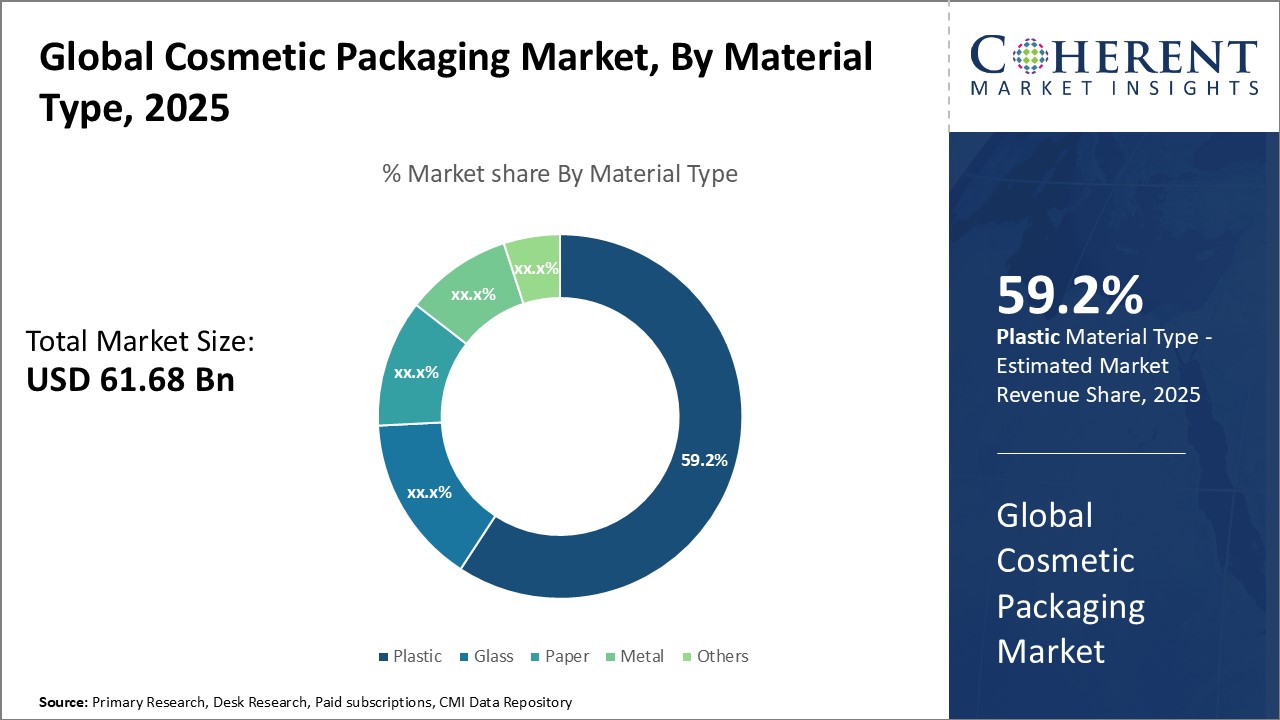
Cosmetic Packaging Market Insights, By Material Type: Plastic Leads with Its Cost-Effective, Lightweight, And Versatile Packaging Solutions
In terms of material type, the plastic contributes 59.2% share of the market in 2026. Its widespread use is attributed to its lightweight nature, cost-effectiveness, and adaptability across various product formats. Plastic packaging offers excellent design flexibility, allowing brands to create innovative shapes and finishes that appeal to consumers. Moreover, advancements in sustainable plastics and recycling technologies have helped mitigate environmental concerns, making plastic a more acceptable choice even among eco-conscious brands. While glass and metal are favored for luxury and premium products, plastic remains the go-to material for mass-market cosmetics due to its durability and scalability.
For instance, in February 2025, Mitsubishi Chemical Group and ALBION partnered to recycle used plastic cosmetic containers into new packaging using advanced chemical recycling. The process converts waste into oil, then into recycled polypropylene resin. With plans to launch products by 2025, this initiative promotes a circular economy and reduces environmental impact in the cosmetic packaging industry.
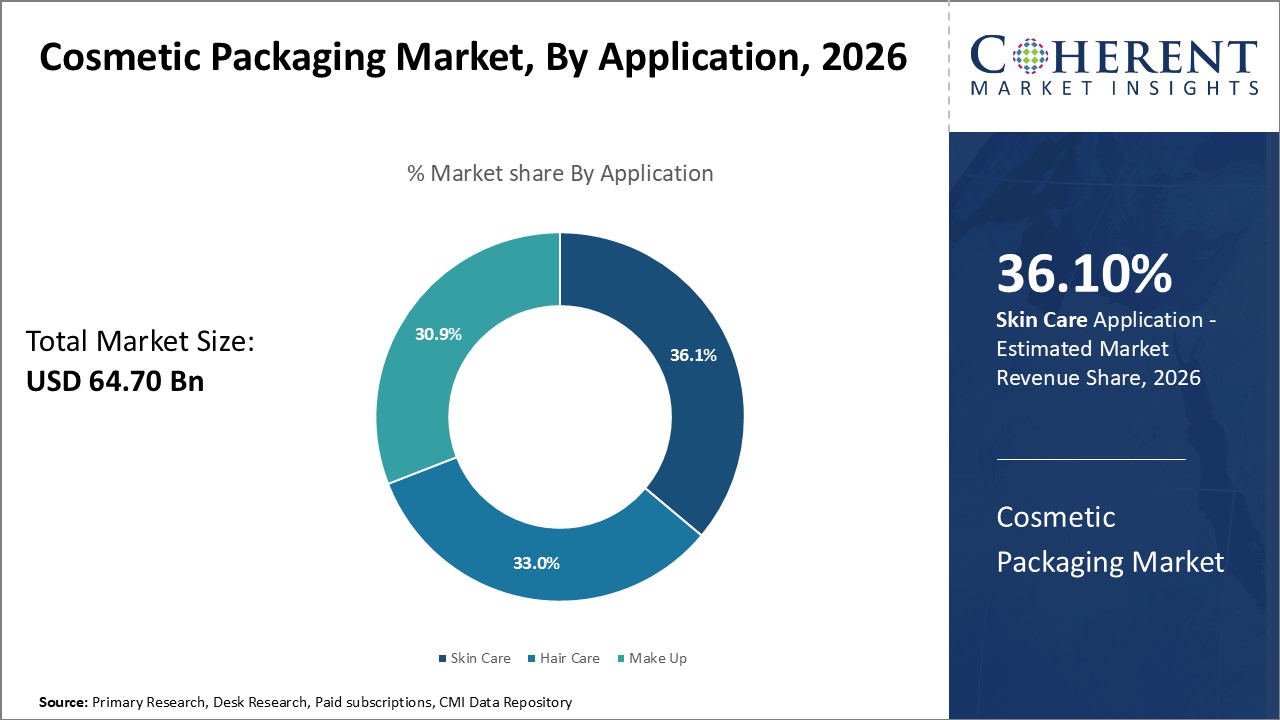
Cosmetic Packaging Market Insights, By Application: Skin Care Drives the Highest Demand, Fueled by Growing Consumer Focus on Wellness and Anti-Aging
In terms of application, skin care contributes 36.1% share in 2026 to the global cosmetic packaging market. This segment includes a wide array of products such as moisturizers, cleansers, serums, sunscreens, and exfoliants, each requiring specific packaging solutions to preserve efficacy and enhance user experience. The rise in consumer awareness about skin health, coupled with growing demand for anti-aging and organic products, has fueled the expansion of this category. Packaging in skin care often emphasizes functionality, like airless pumps and UV-protective containers, as well as aesthetics, reflecting the brand’s commitment to quality and innovation. As skin care routines become more elaborate, the need for diverse and specialized packaging continues to grow.
For instance, in April 2025, Aptar Beauty expanded its airless packaging portfolio in Latin America with sustainable, high-performance solutions for skincare and dermal products. The new Sierra, Moda, and Luna lines offer recyclable, customizable formats in 15–50 ml sizes, supporting local production and fast market access. These innovations cater to eco-conscious skincare brands seeking premium, protective packaging.
Cosmetic Packaging Market Insights, By Product Type: Bottles Remain the Preferred Format for Liquid and Semi-Liquid Cosmetics, Offering Both Functionality and Brand Appeal
In terms of product type, bottles contribute 36% share to the market in 2026. Their popularity stems from their versatility in storing liquids, creams, and gels, and their compatibility with various dispensing mechanisms such as pumps, droppers, and sprays. Bottles offer a balance of practicality and visual appeal, often serving as the primary packaging for cleansers, toners, shampoos, and lotions. In 2026, brands are increasingly investing in sustainable bottle designs, including refillable formats and biodegradable materials, to align with environmental goals. The ability to customize bottle shapes, colors, and finishes also makes them a powerful tool for brand differentiation on retail shelves and digital platforms.
For instance, in October 2024, Unilever introduced a fully recyclable pump for its Vaseline skincare bottles, eliminating metal springs to support its plastic reduction goals. This innovation enhances the sustainability of bottle packaging in cosmetics, aligning with Unilever’s commitment to circular design and reducing environmental impact across its product portfolio
Regional Insights
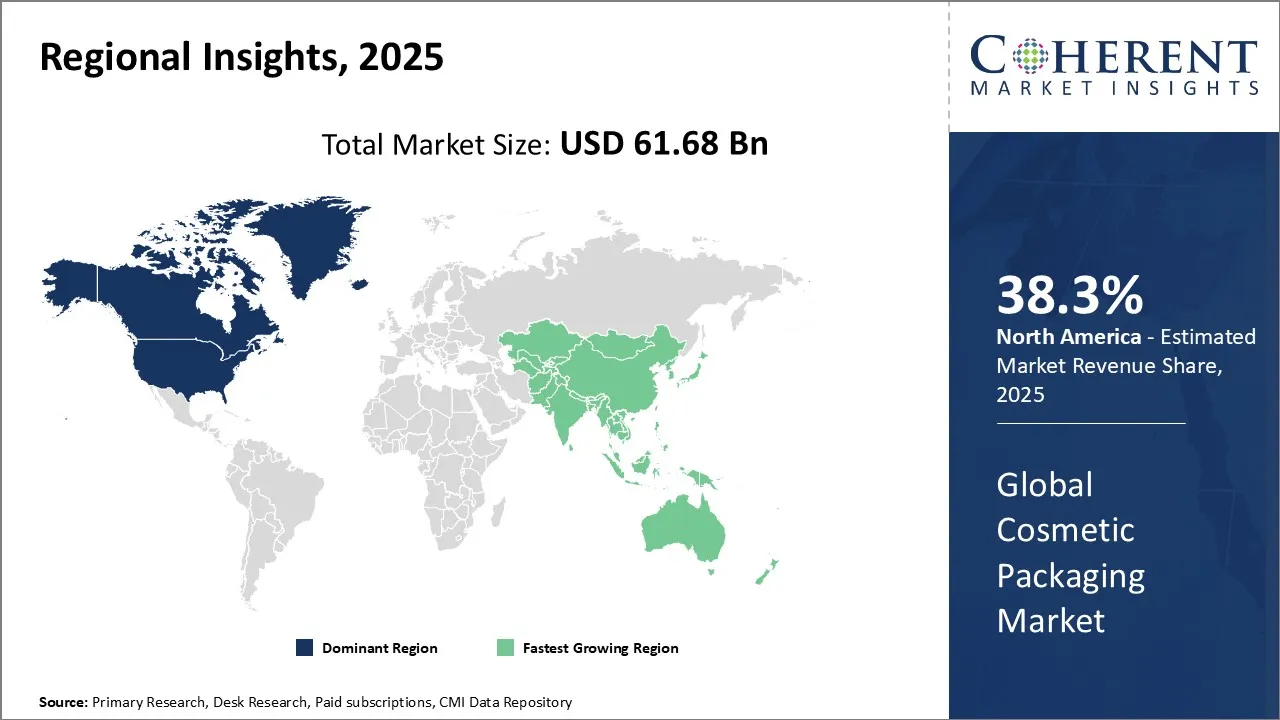
North America Cosmetic Packaging Market Analysis & Trends
North America has established itself as the dominant player in the global cosmetic packaging market with 38.3% of the market share in 2026 driven by top manufacturers like Aptar, RPC Group, and HCP Packaging. The U.S. and Canada’s booming cosmetic industry, fueled by innovation and rising personal care spending, has spurred investment in advanced manufacturing. This enables scale and cost advantages over global rivals. Local firms also export to Europe, Latin America, and Asia Pacific, offering customized solutions like airless bottles and multi-functional components. Strong IP laws protect their designs, reinforcing dominance. Despite competition from China and Europe, North America’s infrastructure and economies of scale remain unmatched.
For instance, in December 2024, Albéa’s North America Collection introduced sustainable cosmetic packaging for lipsticks, mascaras, skincare, and personal care. Made with recyclable materials like r-PET and mono-material PP, the range includes refillable jars, dual-compartment bottles, and customizable compacts. Locally produced at the Matamoros plant, it supports faster delivery, reduced emissions, and eco-conscious beauty innovation.
Asia Pacific Cosmetic Packaging Market Analysis & Trends
The Asia Pacific region has emerged as the fastest growing market globally, with countries like China, India, Indonesia, and Vietnam seeing double-digit growth. Key drivers include rising incomes, youth-driven beauty trends, and Western influence. Though still developing in tech and design, the region attracts major global investments. North American and European brands are setting up local units to cut costs and stay close to consumers. New advanced facilities, low-cost skilled labor, and expanding supplier networks make APAC a prime manufacturing hub. If current momentum continues, the region could challenge traditional market leaders in the next decade.
For instance, in September 2026, Cosfinity showcased its diverse cosmetic packaging range at COSMOPACK Asia Hong Kong, featuring innovative designs for lipsticks, mascaras, compacts, and more. Highlights include citrus-inspired lip gloss tubes and metallized foundation bottles. With a focus on aesthetics and functionality, Cosfinity reinforces its position as a creative leader in the global beauty packaging industry.
Cosmetic Packaging Market Outlook Country-Wise
The U.S. Cosmetic Packaging Market Trends
The U.S. cosmetic packaging market is booming due to rising demand for beauty and personal care products, driven by premiumization, sustainability, and e-commerce growth. Consumers seek high-quality, eco-friendly, and visually appealing packaging. Advanced technologies like smart labels and airless pumps, along with brand-manufacturer collaborations, fuel innovation and meet evolving consumer expectations.
For instance, in May 2026, Origins, part of Estée Lauder Companies, launched on Amazon’s U.S. Premium Beauty store, expanding its digital reach. The brand also updated its packaging portfolio to enhance sustainability, aligning with its Responsible Beauty commitment. These changes reflect Origins’ focus on eco-conscious skincare and improving the environmental impact of its jars, tubes, and bottles.
China Cosmetic Packaging Market Trends
China’s cosmetic packaging market is booming due to rising demand for beauty and personal care products, premiumization trends, and eco-conscious consumer behavior. The surge in e-commerce drives need for durable, attractive packaging, while innovations like smart labels and airless pumps gain popularity. Global brands invest locally, accelerating design and technology advancements.
For instance, in September 2026, Galderma launched Alastin in China, introducing the brand’s refreshed premium packaging for the first time. The updated design reflects Alastin’s science-driven skincare positioning and enhances its visual identity. This strategic move supports Galderma’s expansion into China’s fast-growing aesthetic market, aligning product presentation with consumer expectations for high-performance and sophisticated beauty solutions.
Market Report Scope
Cosmetic Packaging Market Report Coverage
| Report Coverage | Details | ||
|---|---|---|---|
| Base Year: | 2025 | Market Size in 2026: | USD 64.70 Bn |
| Historical Data for: | 2020 To 2024 | Forecast Period: | 2026 To 2033 |
| Forecast Period 2026 to 2033 CAGR: | 4.9% | 2033 Value Projection: | USD 90.44 Bn |
| Geographies covered: |
| ||
| Segments covered: |
| ||
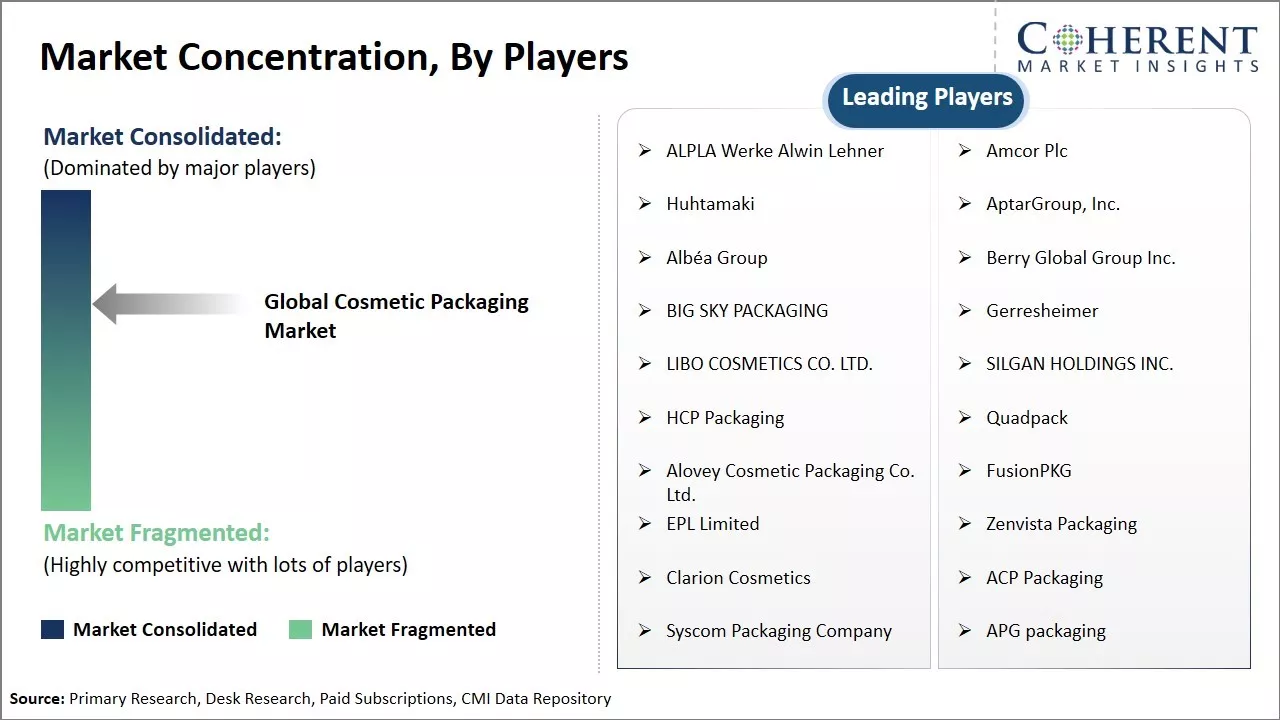
| Companies covered: | ALPLA Werke Alwin Lehner, Amcor Plc, Huhtamaki, AptarGroup, Inc., Albéa Group, Berry Global Group Inc., BIG SKY PACKAGING, Gerresheimer, LIBO COSMETICS CO. LTD., SILGAN HOLDINGS INC., HCP Packaging, Quadpack, Alovey Cosmetic Packaging Co. Ltd., FusionPKG, EPL Limited, Zenvista Packaging, Clarion Cosmetics, ACP Packaging, Syscom Packaging Company, and APG packaging | ||
| Growth Drivers: |
| ||
| Restraints & Challenges: |
| ||
Cosmetic Packaging Market Driver
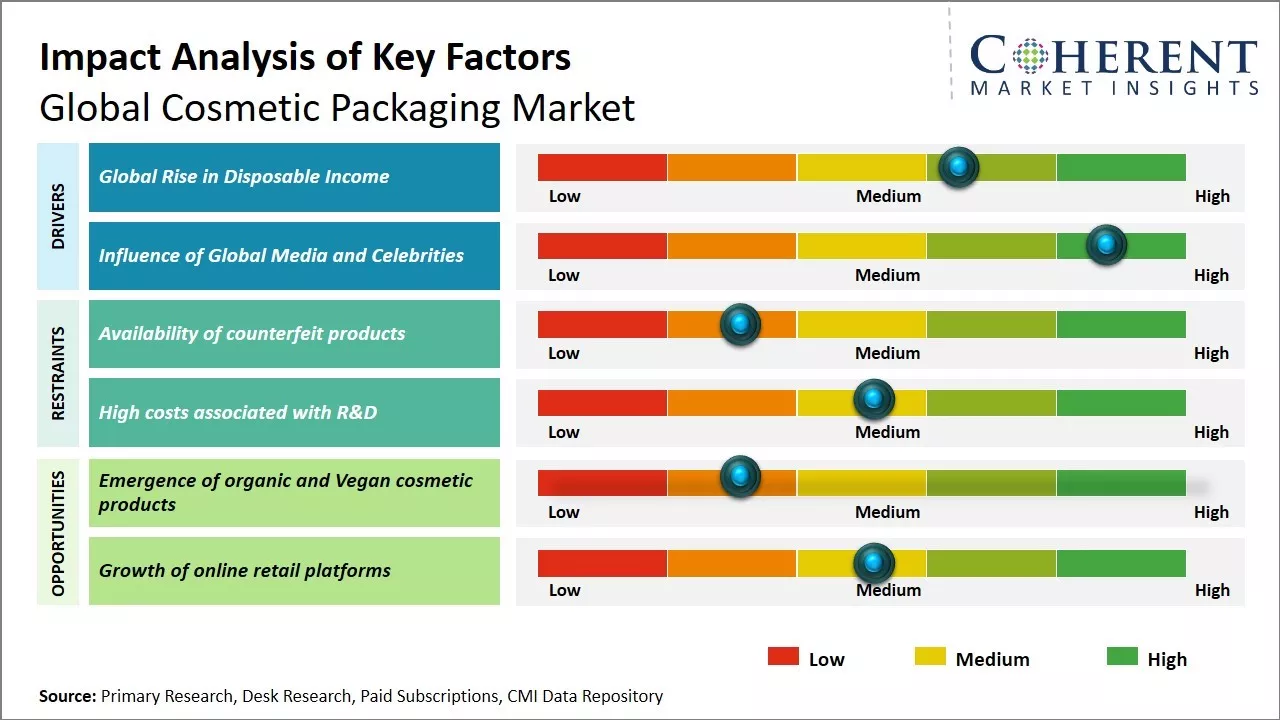
Global Rise in Disposable Income
Rising global disposable incomes have significantly boosted the cosmetic packaging market research in recent years. As people have more spendable income left after paying for essential items, they are increasingly spending on luxury items and personal care products. Consumers are willing to pay premium prices for products that come in attractive, innovative, and sustainable packaging designs. Manufacturers are innovating packaging designs and materials to cater to the evolving preferences of consumers with higher spending power. There is a growing demand for biodegradable packaging made from recycled or plant-based materials. Luxury packaging formats like compacts, sprays, jars and roll-ons are gaining traction. Digitization has also opened new opportunities for interactive and customized packaging. The cosmetic industry is investing heavily in R&D to develop smart and connected packaging incorporated with advanced technologies like augmented reality. For example, some products allow consumers to preview shades through their mobile phones. Personalization is another emerging trend as it allows consumers to feel special. This rising pool of discretionary spending in developing nations will continue driving the worldwide cosmetic market and its packaging needs going forward. Higher disposable incomes will create more opportunities for innovations meeting the evolving requirements of these consumers.
Market Concentration and Competitive Landscape
Influence of Global Media and Celebrities
The availability of counterfeit cosmetic products poses a major challenge to the growth and cosmetic packaging market share globally. Counterfeit cosmetic products are easily available in both online and offline markets which is making it difficult for genuine brands to differentiate themselves. Customers often get confused between original and fake products due to the deceptive packaging of counterfeits. This is negatively impacting the brand image and sales of legitimate cosmetic brands. Counterfeit products use inferior and sometimes toxic ingredients which can cause harm to the health and safety of consumers. People are becoming wary of trying new brands or expensive products due to fears of purchasing spurious items. Loss of consumer confidence poses a serious threat to the demand for genuine cosmetic products and corresponding packaging materials. The prevalence of counterfeiting is also causing significant financial losses to packaging manufacturers as well as cosmetic companies. A study by the European Union Intellectual Property Office estimates that the global trade in counterfeit cosmetics results in annual lost revenues of over USD10 billion for legitimate brands. This wide availability of fakes weakens the competitive positions of original brands in the market. It disincentivizes investments in product innovation, branding and premium packaging experiences. Unless strong measures are taken by regulators and law enforcement to curb the menace of counterfeiting, it will continue restricting the prospects of long-term growth for the global cosmetic packaging industry.
Cosmetic Packaging Market Opportunity
Emergence of organic and Vegan cosmetic products
The availability of counterfeit cosmetic products is posing a major challenge for the growth of the global cosmetic packaging market forecast. Counterfeit cosmetic products are easily available in both online and offline markets which is making it difficult for genuine brands to differentiate themselves. Customers often get confused between original and fake products due to the deceptive packaging of counterfeits. This is negatively impacting the brand image and sales of legitimate cosmetic brands. Counterfeit products use inferior and sometimes toxic ingredients which can cause harm to the health and safety of consumers. People are becoming wary of trying new brands or expensive products due to fears of purchasing spurious items. Loss of consumer confidence poses a serious threat to the demand for genuine cosmetic products and corresponding packaging materials.
Analyst Opinion (Expert Opinion)
The cosmetic packaging market value is going through a strategic change in which decisions about packaging have a direct effect on brand equity, pricing power, and perceptions of sustainability. Sustainability has become the most important factor in competition. Consumers now prefer products with packaging that can be shown to be eco-friendly, and brands that use post-consumer recycled (PCR) materials or mono-material designs are gaining trust. Refillable packaging is still a small part of the market, but it is growing quickly. Major beauty companies like L'Oréal have set up refill stations and modular systems to cut down on waste and boost repeat sales.
Material choices are splitting the market into distinct groups. For example, glass and aluminum are popular in high-end lines because they feel good to the touch, while engineered polymers and flexible refills are popular in mass and e-commerce channels because they are cheaper. People are also showing real resistance to too much packaging, which makes it even riskier for businesses to ignore sustainability.
At the same time, digital and smart packaging with QR or NFC-enabled authentication and engagement has become a measurable CRM tool that helps brands fight counterfeiting and get more people to sign up for or refill their subscriptions. Successful players will make sure that new packaging ideas match up with claims about the environment that can be proven, metrics for measuring engagement, and unique looks. At this point, packaging is no longer just a cost center; it is a strategic tool that can affect customer loyalty, compliance with regulations, and long-term profitability across global cosmetic value chains.
Speak to the analyst
Want personalized insights?
Take the findings above to one of our principal consultants, or have the report rebuilt around the segments, geographies and competitors you actually track.
Cosmetic Packaging Industry News
- In 2023, Dow launched two new sustainable grades for perfume and cosmetic packaging.
- In October 2025, McKernan Packaging Clearing House launched new e-commerce features, enabling U.S. customers to purchase packaging components more quickly and conveniently.
Market Segmentation
- Material Type Insights (Revenue, USD Bn & KT, 2026 - 2033)
- Glass
- Paper
- Plastic
- Metal
- Others
- Product Type Insights (Revenue, USD Bn & KT, 2026 - 2033)
- Jars
- Tubes
- Bottles
- Pumps & Dispensers
- Sachets
- Others
- Application Insights (Revenue, USD Bn & KT, 2026 - 2033)
- Skin Care
- Hair Care
- Makeup
- Regional Insights (Revenue, USD Bn & KT, 2026 - 2033)
- North America
- U.S.
- Canada
- Latin America
- Brazil
- Argentina
- Mexico
- Rest of Latin America
- Europe
- Germany
- U.K.
- Spain
- France
- Italy
- Russia
- Rest of Europe
- Asia Pacific
- China
- India
- Japan
- Australia
- South Korea
- ASEAN
- Rest of Asia Pacific
- Middle East & Africa
- GCC Countries
- Israel
- Rest of Middle East & Africa
- Key Players Insights (Revenue, USD Bn, 2021 - 2033)
- ALPLA Werke Alwin Lehner
- Amcor Plc
- Huhtamaki
- AptarGroup, Inc.
- Albea Group
- Berry Global Group Inc.
- BIG SKY PACKAGING
- Gerresheimer
- LIBO COSMETICS CO. LTD.
- SILGAN HOLDINGS INC.
- HCP Packaging
- Quadpack
- Alovey Cosmetic Packaging Co. Ltd.
- FusionPKG
- EPL Limited
- Zenvista Packaging
- Clarion Cosmetics
- ACP Packaging
- Syscom Packaging Company
- APG packaging
Sources
Primary Research Interviews from the following stakeholders
Stakeholders
- Interviews with cosmetic packaging manufacturers, raw material suppliers, brand packaging managers, sustainability heads, design consultants, and procurement leads across major global regions.
- Discussions with packaging converters, contract manufacturers, cosmetic brand owners, and logistics partners involved in primary and secondary packaging supply chains.
Specific stakeholders
- Packaging development managers at leading beauty and personal care brands (e.g., L’Oréal, Estée Lauder, Unilever, Shiseido)
- Sustainability and innovation lead at FMCG and cosmetics companies (e.g., P&G, Beiersdorf, Johnson & Johnson, Natura & Co)
- Operations and procurement heads at cosmetic packaging converters (e.g., Albea Group, AptarGroup, HCP Packaging)
- Product designers and R&D heads from cosmetic packaging firms specializing in plastic, glass, and paper-based packaging
- Material science experts and packaging engineers working on bioplastics, PCR (post-consumer recycled) content, and refillable systems
- Heads of distribution and supply chain from e-commerce platforms and retail chains involved in cosmetic packaging delivery
- Printing and labeling specialists, cap & closure manufacturers, and tube & bottle producers
Databases
- UN Comtrade Database
- World Trade Organization (WTO) Trade Statistics
- Eurostat
- U.S. Census Bureau – International Trade Data
- Directorate General of Commercial Intelligence and Statistics (DGCIS), India
- Japan External Trade Organization (JETRO)
- China Customs Statistics
- Korea Customs Service Data Portal
- Bureau of Economic Analysis (U.S.)
- Organisation for Economic Co-operation and Development (OECD) Trade and Environment Statistics
Magazines
- Packaging World
- Beauty Packaging Magazine
- Cosmetics Business
- Personal Care Magazine
- European Pharmaceutical Manufacturer (Packaging Section)
- Asia Packaging News
- Packaging Strategies
- Plastic Packaging Europe
- Sustainable Packaging News
- Brand Packaging
Journals
- Journal of Packaging Technology and Research
- International Journal of Cosmetic Science
- Journal of Cleaner Production (Elsevier)
- Polymers and Polymer Composites
- Packaging Technology and Science (Wiley)
- Journal of Applied Polymer Science
- Resources, Conservation & Recycling (Elsevier)
- Materials Today: Sustainability
- International Journal of Design Creativity and Innovation
Newspapers
- The Wall Street Journal – Consumer & Retail
- The Economic Times – FMCG & Packaging Industry
- The Hindu Business Line – Manufacturing & Materials
- Financial Times – Beauty & Retail Insights
- Nikkei Asia – Consumer Products & Packaging Supply Chain
- South China Morning Post – Industry & Manufacturing
- The Guardian – Sustainable Business
- Business Standard – Packaging and Consumer Goods
Associations
- World Packaging Organisation (WPO)
- European Federation of Corrugated Board Manufacturers (FEFCO)
- All India Plastic Manufacturers’ Association (AIPMA)
- Indian Institute of Packaging (IIP)
- Society of Cosmetic Chemists (SCC)
- Plastic Recyclers Europe (PRE)
- Association for Packaging and Processing Technologies (PMMI)
- Sustainable Packaging Coalition (SPC)
- National Association for Container Distributors (NACD)
- Packaging Industry Association of India (PIAI)
- Cosmetic, Toiletry and Perfumery Association (CTPA), UK
- Federation des Entreprises de la Beaut (FEBEA), France
Public Domain Sources
- Ministry of Commerce and Industry (Government of India)
- Ministry of Environment, Forest and Climate Change (MoEFCC), India
- U.S. Environmental Protection Agency (EPA) – Sustainable Materials Management Reports
- European Environment Agency (EEA) – Packaging Waste Statistics
- Ministry of Economy, Trade and Industry (METI), Japan
- European Chemicals Agency (ECHA) – Packaging Material Regulations
- Food and Drug Administration (FDA), U.S. – Cosmetic Packaging Guidelines
- India Investment Grid – Chemicals and Packaging Sector
- Reserve Bank of India (RBI) – FMCG and Manufacturing Reports
- NITI Aayog – Circular Economy and Plastic Waste Roadmap
- United Nations Environment Programme (UNEP) – Sustainable Packaging Framework
Proprietary Elements
- CMI Data Analytics Tool
- Proprietary CMI Existing Repository of information for last 8 years
Definition: The global cosmetic packaging market consists of companies that manufacture packaging for cosmetic and personal care products like jars, bottles, tubes, caps, pumps, and containers used to package a wide range of beauty products including skin care, hair care, color cosmetics, perfumes, and others. The packaging is designed to protect the product, prevent leakage, promote the brand, and provide convenient usage. This market caters to large cosmetic brands as well as small and private label producers around the world.
Get access to 250+ pages report
Every segment, forecast, competitor profile and data table behind the analysis above — available for instant download.
- ESOMAR Member
- ISO 9001:2015 Certified
- D-U-N-S Registered
- GDPR & CCPA Compliant
Missing comfort of reading report in your local language? Find your preferred language:
Transform your Strategy with Exclusive Trending Reports
Frequently Asked Questions
The Cosmetic Packaging Market is estimated to be valued at USD 64.70 Bn in 2026, and is expected to reach USD 90.44 Bn by 2033.
The CAGR of the Cosmetic Packaging Market is projected to be 4.9% from 2026 to 2033.
Global rise in disposable income and influence of global media and celebrities are the major factors driving the growth of the global cosmetic packaging market.
Rising prices of raw materials and stringent regulations and fluctuating prices of raw materials are the major factors hampering the growth of the global cosmetic packaging market.
In terms of material type, plastic segment is estimated to dominate the market revenue share in 2026.
ALPLA Werke Alwin Lehner, Amcor Plc, Huhtamaki, AptarGroup, Inc., Albéa Group, Berry Global Group Inc., BIG SKY PACKAGING, Gerresheimer, LIBO COSMETICS CO. LTD., SILGAN HOLDINGS INC., HCP Packaging, Quadpack, Alovey Cosmetic Packaging Co. Ltd., FusionPKG, EPL Limited, Zenvista Packaging, Clarion Cosmetics, ACP Packaging, Syscom Packaging Company, and APG packaging are the major players.
North America is expected to lead the global cosmetic packaging market.