

Dairy Ingredients Market Size and Share Analysis - Growth Trends and Forecasts (2026–2033)
The Dairy Ingredients Market size is anticipated to grow at a CAGR of 3.7%, from USD 65.30 Bn in 2026 to approximately USD 84.38 Bn by 2033. The market’s growth is mainly driven by the rising demand for protein-rich and fortified food products, increasing consumption of infant nutrition and sports nutrition products, wider use of dairy proteins in functional foods and beverages, and growing demand for clean-label and value-added ingredients. Dairy ingredients such as whey proteins, milk powders, casein, lactose, and milk protein concentrates are increasingly used across bakery and confectionery products, nutritional supplements, beverages, clinical nutrition, and convenience foods due to their nutritional, functional, emulsifying, and texture-enhancing properties. According to the Food and Agriculture Organization of the United Nations, global milk production was forecast to reach approximately 992.3 million tonnes in 2025, representing an increase of 1.4% compared with 2024. Global per-capita consumption of milk and
Key Takeaways
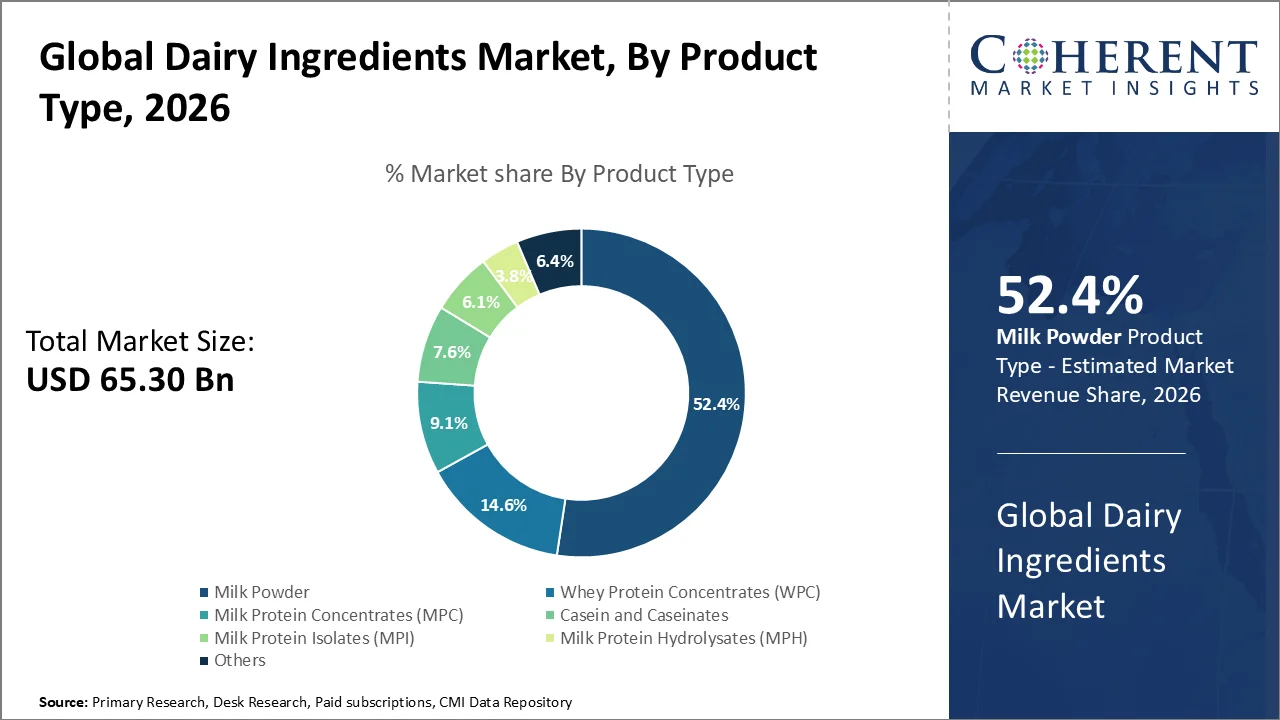
- The milk powder segment is expected to dominate the market with an estimated 52.4% share in 2026. The segment’s growth is owing to the longer shelf life, ease of transportation and storage, competitive cost, and extensive utilization of skimmed and whole milk powders in bakery, confectionery, infant formula, dairy beverages, and nutritional products. According to the USDA Foreign Agricultural Service’s July 2026 forecast, global whole milk powder exports are projected to reach approximately 2.03 million metric tonnes in 2026, with New Zealand accounting for around 1.50 million metric tonnes.
- The bakery products segment is set to lead the market with an estimated 24.8% share in 2026. The segment’s growth is owing to the increasing use of milk powders, whey ingredients, lactose, permeate, milkfat, and other dairy ingredients to improve browning, flavor, texture, emulsification, moisture retention, protein content, and sodium reduction in bread, cakes, cookies, crackers, pastries, and bakery mixes. The U.S. Dairy Export Council identifies six major dairy ingredient groups, cheese, lactose, milkfat, milk powders, permeate, and whey, as providing functional and nutritional benefits across bakery formulation.
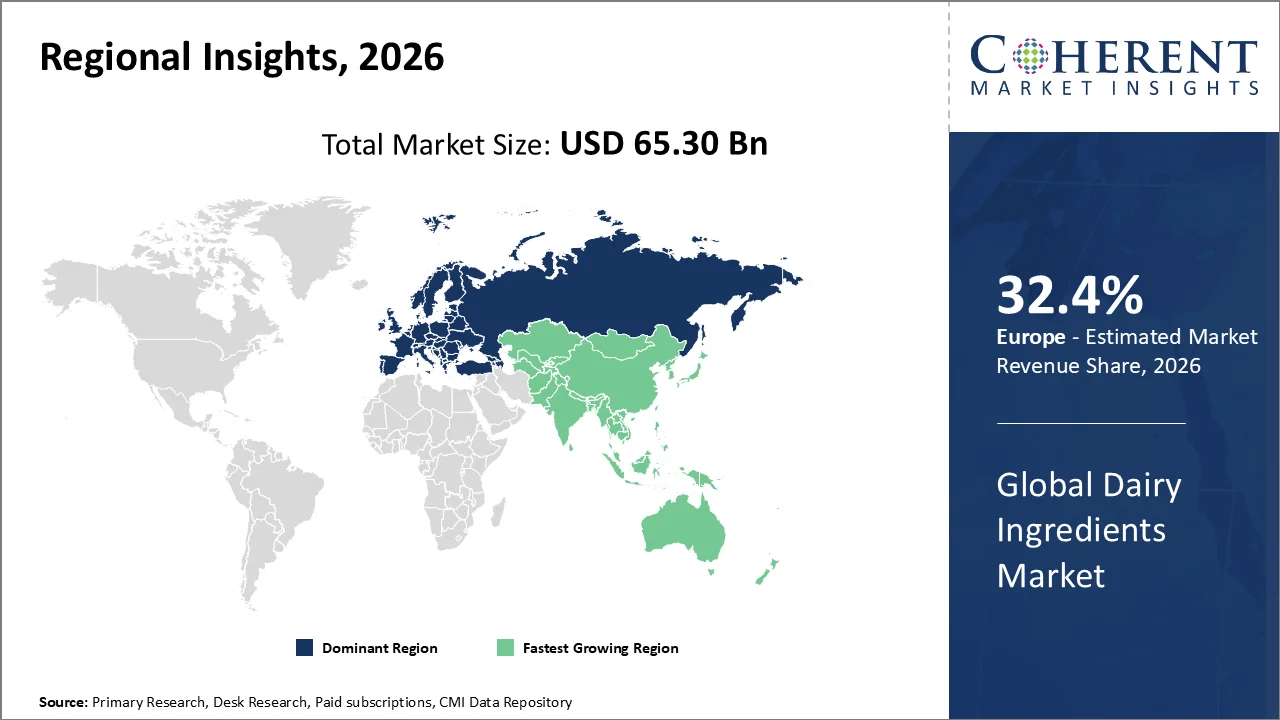
- The European region is projected to lead the global dairy ingredients market with a market share of about 32.4% in 2026. The leadership of Europe in the global dairy ingredients market can be attributed to its developed system of collecting milk, advanced facilities for dairy products, high-quality requirements for ingredients, production of milk powder and dairy proteins, and the availability of prominent dairy ingredients companies. According to Eurostat, the total milk production in the EU was about 161.8 million tons in 2024, out of which 150.8 million tons was delivered to dairies for further processing.
Market Drivers
Rising Demand for High-Protein and Functional Nutrition is Accelerating the Dairy Ingredients Market
The global dairy ingredients market is becoming more dynamic because of the growing consumer inclination towards protein-rich, functional, and nutrition-dense food products. The use of whey protein concentrate, milk protein concentrate, milk protein isolate, caseinate, and hydrolyzed dairy proteins is becoming more prevalent in sports nutrition products, functional drinks, high-protein foods, yogurt, bakery products, and meal replacement products.
Arla Foods Ingredients announced in November 2025 that more than 40% of consumers who are conscious about their health chose dairy proteins for adding protein to their diet, while more than 30% had dairy proteins through guilt-free snacks. Arla Foods Ingredients also launched the application concept for drinks including yoghurt drink containing 25 grams of protein, a cookie having 27% protein, brownie with 25% protein, and a snack bite with up to 40% protein.
Expansion of Specialized and Life-Stage Nutrition is Driving Ingredient Innovation
Increasing demand for dairy-based ingredients for infant formula, therapeutic nutrition, aging well products, and recovery products is another factor that will significantly boost market growth. Specific dairy ingredients like whey protein concentrates, milk fat globule membranes, lactoferrin, caseinates, lactose, and milk protein isolates are desirable due to their ease of digestion, high quality of amino acids, immune-stimulating properties, and capacity to deliver nutritional benefits through smaller amounts of the product.
The World Health Organization’s 2025 guidance on managing undernutrition among older people recommends daily protein intake of approximately 1.0–1.2 grams per kilogram of body weight for undernourished individuals. People recovering from weight loss, acute illness, or injury may require up to 1.5 grams per kilogram per day. This clinical emphasis on protein intake is supporting the development of dairy protein-based oral nutritional supplements, fortified beverages, and medical nutrition products for aging populations and patients requiring nutritional recovery.
In April 2025, Food Standards Australia New Zealand approved bovine milk fat globule membrane-enriched whey protein concentrate for voluntary use in infant formula at concentrations of 0.14–0.28 grams per 100 kilojoules.
Current Events and Their Impact on the Dairy Ingredients Market
Current Event | Description and its Impact |
India Approves Revised National Programme for Dairy Development—NPDD (March 2025) |
|
U.S. FDA Implements Updated “Healthy” Food-Labeling Criteria (April 2025) |
|
- Current Industry Events of 2026
- Market Size Estimation
- Regional Breakdown
- Competitive Landscape
- Customer Intelligence
- Segmental Analysis
- Pricing Analysis
- Key Market Drivers, Challenges & Future Trends
- Customized Insights Section
Segmental Insights
Why is Milk Powder Acquiring the Largest Share?
On the basis of product type, the milk powder segment, comprising skimmed milk powder and whole milk powder, is projected to account for the largest dairy ingredients market share of 52.4% in 2026. The segment’s growth is owing to milk powder’s longer shelf life, ease of transportation, relatively economical pricing, consistent composition, and extensive utilization across bakery, confectionery, infant formula, dairy beverages, recombined milk, and nutritional products.
The USDA Foreign Agricultural Service forecasts that skimmed milk powder exports from major global suppliers will reach approximately 2.07 million metric tonnes in 2026. The European Union alone is expected to produce around 1.48 million metric tonnes of skimmed milk powder, maintaining its position as the world’s largest SMP producer. The significant production and international trade volumes demonstrate the scale, availability, and commercial importance of milk powder within the dairy ingredients industry.
In October 2025, Lactalis Ingredients announced the presentation of a lactose-free skimmed milk powder at Food Ingredients Europe 2025, alongside its broader portfolio of skimmed, whole, and fat-filled milk powders.
Bakery Products Hold the Largest Market Share
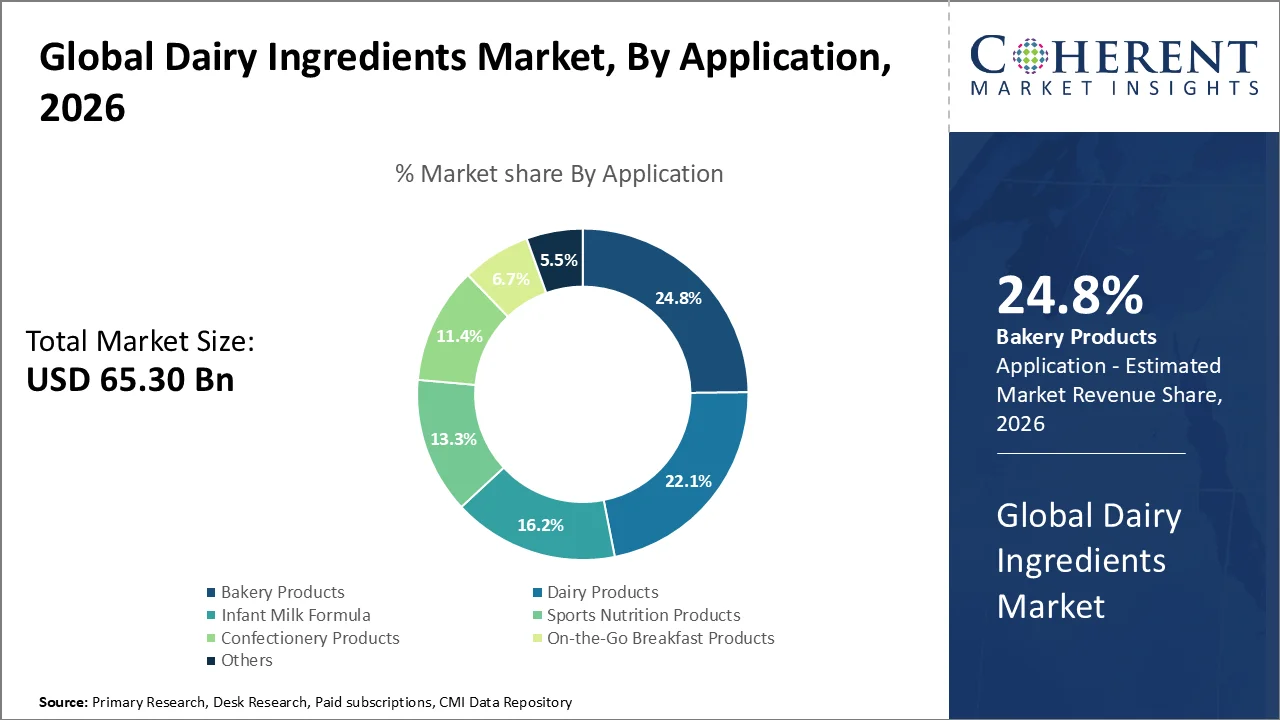
On the basis of application, the bakery products segment is projected to account for the largest dairy ingredients market share of 24.8% in 2026. The segment’s growth is owing to the extensive use of milk powders, whey proteins, milk protein concentrates, lactose, permeate, butter, and other dairy ingredients in bread, cakes, cookies, biscuits, pastries, crackers, fillings, glazes, and bakery premixes. Fonterra reported that its Anchor whipping cream was being used in approximately 260 million cakes annually through bakery and beverage outlets in China.
In February 2026, Lactalis Ingredients displayed sweet whey powders that have high fluidity properties suitable for bakery applications due to their lack of caking and Maillard reactions and ability to withstand hot and humid conditions in storage. Lactalis Ingredients currently offers dairy ingredients in over 100 countries, thus showing that bakery-compatible dairy ingredients have been commercially used.
Dairy Ingredients Market Trends
- The growing requirement for higher levels of protein and convenient forms of nutrition has resulted in the adoption of whey protein concentrates, milk protein isolates, caseinates, and milk protein concentrates in ready-to-drink drinks, yogurts, snacks, and meal replacement products. In March 2025, FrieslandCampina Ingredients introduced Nutri Whey ProHeat, which is a whey protein, heat stable and suitable for use in high protein drinks. It was claimed by the company that 71% of people care about their protein intake.
- The development of bioactive and condition-specific dairy proteins will help the market move out from being used just in sports and general nutrition into other markets. In 2026, Hilmar launched its new product PROtelyze Bio-Brain, which is a hydrolyzed whey protein isolate, offering a scientifically researched whey peptide for memory, focus, and brain function. The ingredient offers the specific peptide in one gram per day consumption and was honored with the Breakthrough Award for Dairy Ingredient Innovation in 2026.
- Increased emphasis on carbon-friendly, traceable and sustainably-sourced dairy ingredients is affecting the purchasing behavior of food, beverages and nutrition companies. In their quest to meet their sustainability targets, dairy processors are increasingly implementing systems aimed at managing greenhouse gas emissions, improving water quality, use of renewable energy sources and supply chain traceability. The 2025 annual report from Dairygold revealed that its sustainability program had conducted 2,094 water-quality farm visits and was supporting applications worth EUR 5 million.
Regional Insights
Europe Dominates Owing to its Advanced Dairy-Processing Infrastructure and Large Ingredient Production Base
The European market is projected to capture about 32.4% of the overall dairy ingredients market globally in 2026. The dominant position held by the European market can be attributed to its efficient milk collection systems, sophisticated spray-drying and membrane filtration technologies, food quality considerations, and manufacturing of milk powders, whey ingredients, casein, lactose, and milk protein concentrates.
Eurostat data released in November 2025 showed that EU dairies produced approximately 2.7 million tonnes of dairy powder products from 19.0 million tonnes of skimmed milk and 4.8 million tonnes of whole milk in 2024. Germany produced more whey, butter, cheese, and drinking milk than any other EU country, while the Netherlands accounted for approximately 17% of EU whey production. These figures demonstrate Europe’s extensive processing capacity and its ability to supply high-volume and specialized dairy ingredients.
Asia Pacific is the Fastest-Growing Dairy Ingredients Market
The Asia Pacific dairy ingredients market is forecast to record the fastest growth, at a CAGR of approximately 4.52% during 2026–2033. Regional growth is owing to increasing incomes, population expansion, urbanization, modernization of dairy-processing infrastructure, and rising demand for infant formula, functional beverages, protein-fortified foods, bakery products, and sports nutrition.
According to the OECD–FAO Agricultural Outlook 2025–2034, Asia, particularly India and Pakistan, is expected to record the strongest growth in fresh dairy consumption. More than half of the projected increase in global milk production over the coming decade is expected to originate from these two countries. Milk-solids consumption is projected to increase to approximately 30 kg per capita in India and 46 kg per capita in Pakistan, creating a larger raw-material and demand base for dairy ingredient processing.
In September 2025, FrieslandCampina Ingredients opened an expanded application and innovation center in Singapore, increasing its research and development space in the country by approximately 30%.
Large Dairy-Processing Base and High-Value Protein Investments are Accelerating the Dairy Ingredients Market in the United States
The U.S. dairy ingredients industry is supported by its large milk-processing base, extensive whey-valorization capacity and growing production of high-protein ingredients for sports nutrition, medical nutrition, infant formula and functional beverages. The United States has good manufacturing facilities of whey protein concentrate, lactose, milk protein concentrate, skimmed milk powder, and other dried dairy ingredients.
According to data provided by the USDA National Agricultural Statistics Service, production of whey protein concentrates from the United States amounted to about 502 million pounds in 2025, representing a growth of 2.1% against 2024. Production of lactose experienced a growth of 2.6% and stood at about 1.14 billion pounds.
In March 2025, Hilmar Cheese Company officially opened its new dairy-processing facility in Dodge City, Kansas. In addition to producing cheese, the facility manufactures a range of innovative whey proteins for customers worldwide.
Premium Nutrition and Domestic Ingredient Processing are Strengthening the Dairy Ingredients Market in China
China is expected to witness continued development in the dairy ingredients market owing to increasing demand for functional nutrition, specialized milk powders, infant nutrition, healthy-aging products, high-protein foods, and locally manufactured dairy proteins. The market is gradually moving beyond conventional liquid milk toward higher-value ingredients such as lactoferrin, micellar casein, demineralized whey powder, hydrolyzed proteins, and specialty milk powders.
In June 2026, China Mengniu Dairy officially launched MnmpX, a new dairy ingredients brand, at the Hi & Fi Asia-China 2026 exhibition in Shanghai. The new business-to-business ingredient platform includes high-value dairy ingredients such as lactoferrin, membrane-filtered casein, D90 demineralized whey powder, milk proteins, and other whey-derived ingredients.
Who are the Major Companies in Dairy Ingredients Industry
Some of the major key players in Dairy Ingredients Market are Friesland Campina, Fonterra Co-operative Group Ltd., Dairy Farmers of America, Arla Foods, Glanbia Plc., Euroserum, Groupe Lactalis, Saputo Inc., Volac International Limited, and Devondale Murray Goulburn.
Key News
- In May 2026, FrieslandCampina announced an investment program of more than EUR 90 million across its Bedum, Veghel, and Workum facilities in the Netherlands. The program will expand production of WPC80, instantized whey proteins, and Nutri Whey ProHeat, with full operational capacity targeted for 2028.
- In March 2026, Fonterra completed the sale of its Mainland Group consumer and associated businesses to Lactalis. Following the transaction, Fonterra announced that it would concentrate its capital, research, and operational resources on its core Ingredients and Foodservice businesses, marketed primarily through NZMP and Anchor Food Professionals.
Market Report Scope
Dairy Ingredients Market Report Coverage
| Report Coverage | Details | ||
|---|---|---|---|
| Base Year: | 2025 | Market Size in 2026: | USD 65.30 Bn |
| Historical Data for: | 2020 To 2024 | Forecast Period: | 2026 To 2033 |
| Forecast Period 2026 to 2033 CAGR: | 3.7% | 2033 Value Projection: | USD 84.38 Bn |
| Geographies covered: |
| ||
| Segments covered: |
| ||
| Companies covered: | Friesland Campina, Fonterra Co-operative Group Ltd., Dairy Farmers of America, Arla Foods, Glanbia Plc., Euroserum, Groupe Lactalis, Saputo Inc., Volac International Limited, and Devondale Murray Goulburn. | ||
| Growth Drivers: |
| ||
| Restraints & Challenges: |
| ||
Analyst Opinion
- The dairy ingredients market is increasingly shifting from commodity powders toward high-value whey proteins and specialized nutritional ingredients. This transition is improving margins and encouraging processors to invest in filtration, fractionation, and drying technologies. In November 2025, Tirlán invested EUR 126 million in setting up a new whey processing plant in Ireland to produce high quality nutritional proteins, which will be clear whey products for lifestyle and performance nutrition. The plant will be operational in mid-2027, demonstrating the faith that the producers have in their future demand.
- New categories in the field of health and nutrition will allow Arla Foods Ingredients to penetrate new markets for dairy ingredients, beyond sports nutrition and infant formulas. In April 2026, the company launched new high-protein concepts targeting consumers taking GLP-1 weight management drugs. The company mentioned that in 2025, 11% of consumers worldwide and 18% in the United States were taking GLP-1 drugs to manage their weight. The products offered by the company contained from 10 to 21 grams of protein per serving, thus offering new possibilities for beta-lactoglobulin, whey proteins, milk minerals, and milk fat globule membrane ingredients.
- The market outlook remains positive, although supply availability and ingredient-price volatility will influence near-term growth. According to the U.S. Dairy Export Council’s international demand analysis covering data through April 2026, global dairy trade to China increased by 7.8% over the latest three-month period, supported by renewed whole milk powder and milk-fat demand. The same analysis indicated a 5.7% three-year CAGR in global WPC80+ trade, while strong domestic demand in the U.S. and Europe constrained exportable high-protein whey supply. In the analyst’s view, companies with secure milk sourcing, flexible production lines, and diversified regional customers will be best positioned to capture market growth
Speak to the analyst
Want personalized insights?
Take the findings above to one of our principal consultants, or have the report rebuilt around the segments, geographies and competitors you actually track.
Market Segmentation
- By Product Type (Revenue, USD Bn, 2021-2033)
- Milk Powder (Skimmed Milk Powder & Whole Milk Powder)
- Milk Protein Caseinates (MPC)
- Milk Protein Isolates (MPI)
- Milk Protein Hydrolysates (MPH)
- Casein and Caseinates
- Whey protein Concentrates (WPC)
- Others
- By Application (Revenue, USD Bn, 2021-2033)
- Bakery products
- Dairy Products
- Confectionery Products
- On-The-Go Breakfast Products
- Sports Nutrition Products
- Infant Milk Formula
- Others
- By Region (Revenue, USD Bn, 2021-2033)
- North America
- U.S.
- Canada
- Latin America
- Brazil
- Mexico
- Argentina
- Rest of Latin America
- Europe
- Germany
- U.K.
- France
- Italy
- Spain
- Russia
- Rest of Europe
- Asia Pacific
- China
- India
- Japan
- Australia
- South Korea
- ASEAN
- Rest of Asia Pacific
- Middle East
- GCC
- Israel
- Rest of Middle East
- Africa
- South Africa
- Central Africa
- North Africa
- North America
Sources
Primary Research Interviews
- Dairy ingredient manufacturers and milk-processing companies
- Whey protein, casein, lactose, and milk powder producers
- Dairy cooperative procurement and production managers
- Food and beverage formulation specialists
- Infant nutrition, sports nutrition, and clinical nutrition manufacturers
- Bakery, confectionery, and dairy product manufacturers
- Dairy ingredient distributors and import–export companies
- Quality assurance, food safety, and regulatory professionals
- Dairy farm associations and milk procurement organizations
- Key opinion leaders in dairy science, food technology, and nutrition
Databases
- Food and Agriculture Organization Corporate Statistical Database—FAOSTAT
- OECD–FAO Agricultural Outlook Database
- USDA Foreign Agricultural Service—Production, Supply and Distribution Database
- USDA National Agricultural Statistics Service
- Eurostat—Milk and Dairy Product Statistics
- United Nations Comtrade Database
- World Bank Open Data
- International Trade Centre—Trade Map
- Food and Agriculture Organization—Food Outlook Database
- European Commission—Milk Market Observatory
Magazines
- Dairy Reporter
- Dairy Industries International
- Dairy Foods Magazine
- Food Business News
- FoodNavigator
- Food Ingredients First
- New Food Magazine
- International Dairy Magazine
Journals
- Journal of Dairy Science
- International Dairy Journal
- Dairy Science & Technology
- Journal of Food Engineering
- Food Hydrocolloids
- LWT—Food Science and Technology
- Food Chemistry
- Journal of Functional Foods
- International Journal of Food Science & Technology
- Comprehensive Reviews in Food Science and Food Safety
Newspapers
- Reuters
- Financial Times
- The Wall Street Journal
- The Economic Times
- The Hindu BusinessLine
- The Guardian
- South China Morning Post
- Nikkei Asia
Associations
- International Dairy Federation
- American Dairy Products Institute
- U.S. Dairy Export Council
- European Dairy Association
- Dairy Farmers of America
- Dairy Australia
- National Dairy Development Board
- Global Dairy Platform
- International Whey Conference
- National Milk Producers Federation
Public Domain Sources
- Company annual reports and investor presentations
- Dairy ingredient manufacturers’ product portfolios and technical documents
- Government dairy production, trade, and agricultural statistics
- Milk procurement and dairy-processing policy documents
- Food safety and dairy ingredient regulatory publications
- University dairy science and food technology research publications
- Patent databases such as WIPO, USPTO, Espacenet, and Google Patents
- Publicly available dairy processing and nutrition research reports
- Import–export statistics for milk powders, whey proteins, lactose, and casein
- Sustainability and emissions reports published by dairy processors
- Product launch, capacity expansion, partnership, and acquisition announcements
Proprietary Elements
- CMI Data Analytics Tool
- Proprietary CMI Existing Repository of Information for the Last 10 Years
Get access to 250+ pages report
Every segment, forecast, competitor profile and data table behind the analysis above — available for instant download.
- ESOMAR Member
- ISO 9001:2015 Certified
- D-U-N-S Registered
- GDPR & CCPA Compliant
Missing comfort of reading report in your local language? Find your preferred language:
Transform your Strategy with Exclusive Trending Reports
Frequently Asked Questions
The global Dairy Ingredients Market is expected to reach approximately USD 84.38 Bn by 2033, compared with USD 65.30 Bn in 2026.
Major players operating in the global Dairy Ingredients Market include Friesland Campina, Fonterra Co-operative Group Ltd., Dairy Farmers of America, Arla Foods, Glanbia Plc., Euroserum, Groupe Lactalis, Saputo Inc., Volac International Limited, and Devondale Murray Goulburn
Volatility in raw milk prices and high processing and production costs are the key factors hampering market growth. Other challenges include stringent food-safety requirements, competition from plant-based ingredients, and fluctuations in international dairy trade.
Increasing demand for high-protein and functional food products, rising consumption of sports and clinical nutrition products, growing utilization of dairy proteins in infant formula, and wider adoption of milk powders and whey ingredients in processed foods are driving market growth.
The global Dairy Ingredients Market is anticipated to grow at a CAGR of approximately 3.7% during 2026–2033.
Europe is expected to account for the largest share of the global Dairy Ingredients Market, with an estimated 32.4% share in 2026. The region benefits from advanced dairy-processing infrastructure, extensive milk collection, strong production of milk powders and dairy proteins, and the presence of established ingredient manufacturers.
Asia Pacific is expected to be the fastest-growing regional market, with an estimated CAGR of approximately 4.52% during 2026–2033. Growth is supported by increasing dairy consumption, rising incomes, expanding processing capacity, and growing demand for infant nutrition, functional foods, bakery products, and sports nutrition.