

Epoxidized Soybean Oil Market Size and Forecast — 2026-2033
The global epoxidized soybean oil market is estimated to be valued at USD 1.31 Bn in 2026 and is expected to reach USD 1.79 Bn by 2033, exhibiting a compound annual growth rate (CAGR) of 4.6% from 2026 to 2033.
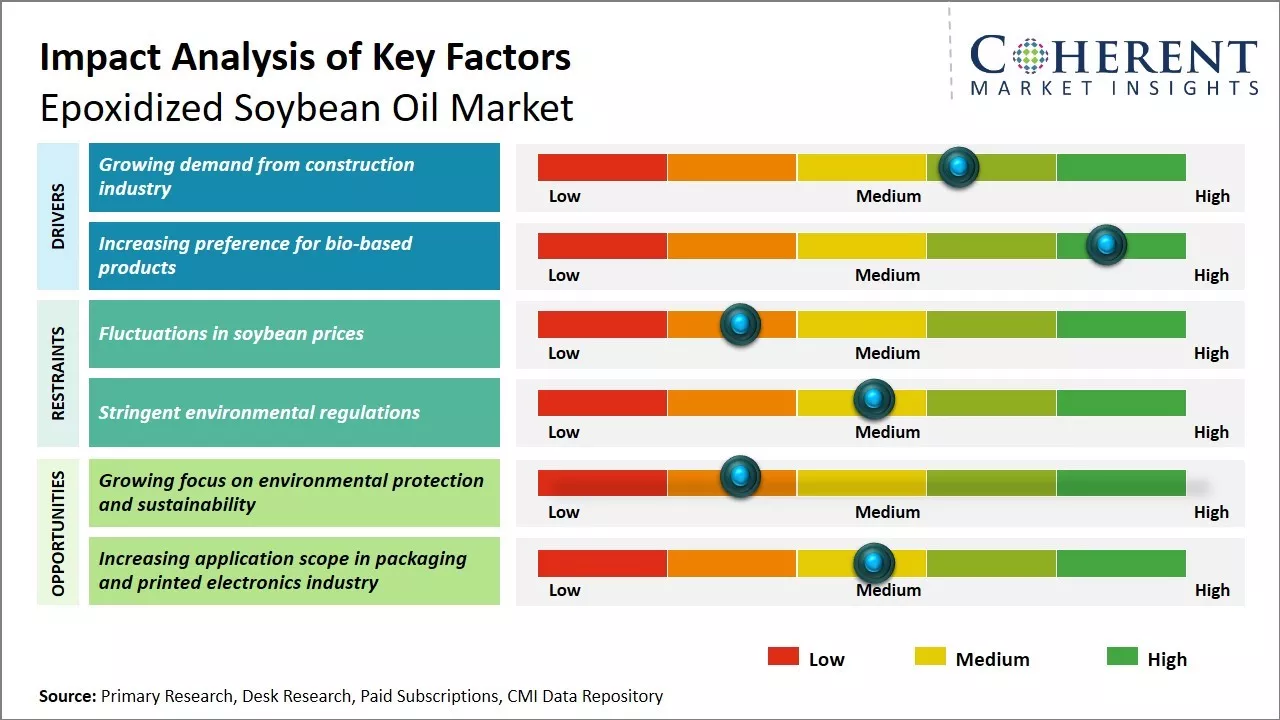 The market is expected to witness positive growth over the forecast period. Epoxidized soybean oil is increasingly being used as a plasticizer in PVC formulations owing to its advantages over conventional phthalate plasticizers. It is considered a safer alternative to phthalates due to its easy dispersibility, low volatility and non-toxic nature. Growing regulatory push towards non-phthalate plasticizers along with increasing demand from end-use industries such as adhesives, automotive, and medical devices is expected to drive the demand for epoxidized soybean oil. Furthermore, positive outlook in the construction industry across major economies will further aid the market growth during the forecast period.
Growing demand from construction industry
The construction industry has been a major driving force contributing to the growth of the global epoxidized soybean oil market. For instance, according to data published by the U.S. Census Bureau in 2021, in the U.S., public construction expenditure increased significantly in 2021 as compared to 2017. In 2021, the government spent approximately USD 9.06 billion on residential construction. This is due to increased public spending on residential buildings as a result of the post-pandemic work-from-home culture. Epoxidized soybean oil (ESBO) finds widespread application in sealants, coatings, and adhesive formulations across residential and non-residential construction projects. It is increasingly replacing petroleum-based alternatives due to its superior performance properties and environment-friendliness.
ESBO exhibits excellent flexibility and adhesion qualities along with high stability against UV light and moisture. These properties make it extremely useful in formulations of sealants and caulk guns applied on walls, floors, windows, and other parts of buildings. The ability of ESBO to adhere strongly to various surfaces such as wood, concrete, ceramic/stone tiles without primer has helped to boost its popularity. Furthermore, epoxidized soybean oil imparts toughening and flexibility to coatings suitable for applications inside buildings, floors, driveways and other exterior surfaces.
Insights, By Raw Material
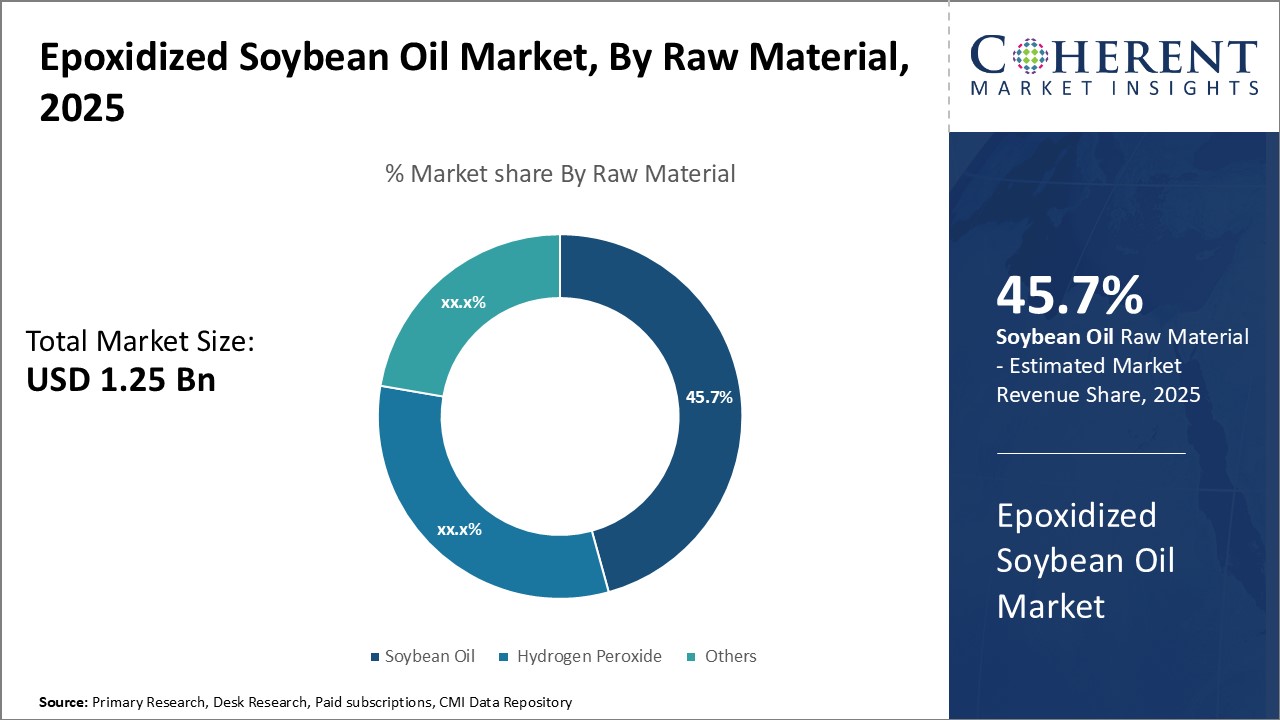 Insights, By Raw Material: Affordable and readily available feedstock
By raw material, soybean oil contributes 46.7% share of the market owing to its affordable and readily available nature as a feedstock. Soybean oil is one of the most commonly produced and consumed vegetable oils globally. Major soybean producing regions include North America, South America, and Europe. The substantial production of soybean ensures stable supply and competitive prices for soybean oil. As a raw material for epoxidized soybean oil, soybean oil offers advantages over other alternatives such as linseed oil and canola oil. It has desirable properties such as high dry matter content and oxidative stability which make it suitable for epoxidation process. The widespread cultivation of soybean and global supply chains help to keep prices of soybean oil moderately low. This provides epoxidized soybean oil produced from soybean an edge over high cost alternatives.
Insights, By Application
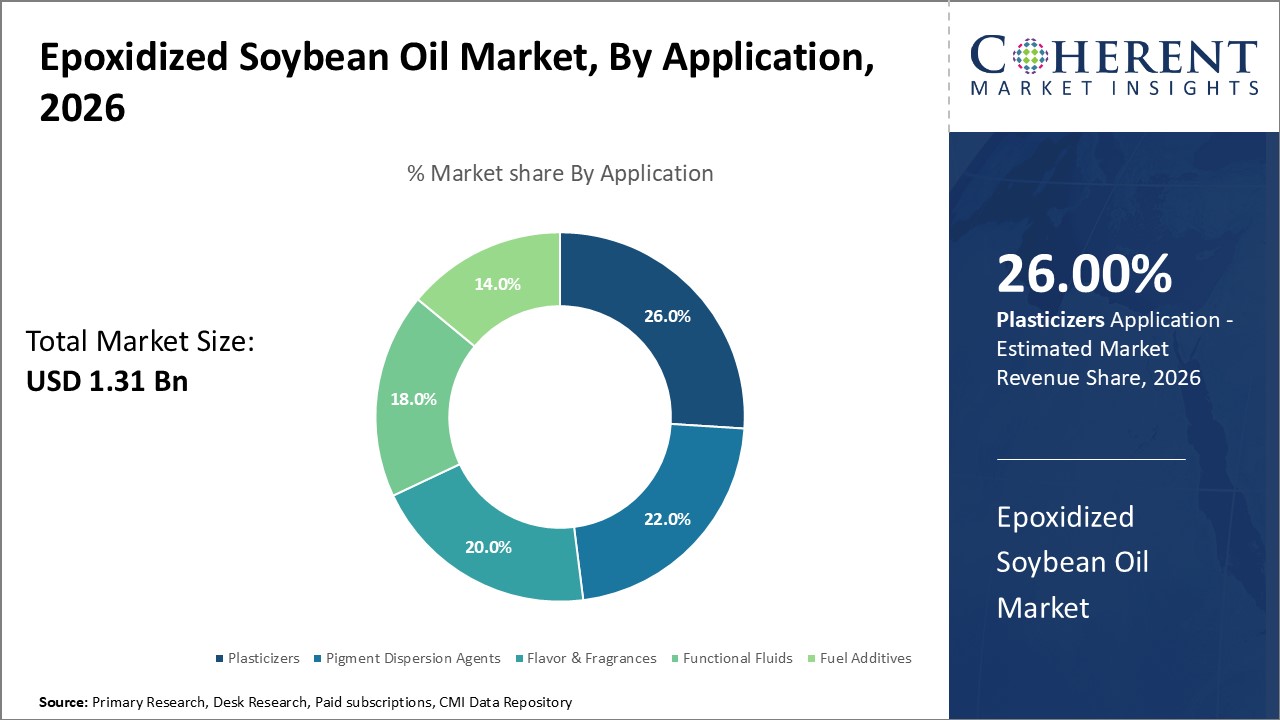
Insights, By Application: Versatile applications across industries
By application, plasticizers contribute the 26% share of the market owing to the versatile usage of epoxidized soybean oil as a plasticizer. Epoxidized soybean oil is a key ingredient in plasticizer formulations used in PVC and other plastics. It enhances the flexibility and extends the shelf life of plastics. Epoxidized soybean oil plasticizers efficiently replace phthalates without compromising performance. They enable production of phthalate-free plastics which witness higher demand globally. Further, epoxidized soybean oil plasticizers support manufacturing of innovative eco-friendly products. Their renewably sourced, biodegradable nature attracts use in various applications across construction, wires & cables, floors & walls coatings and more. This wide compatibility and sustainability advantage drives significant consumption of epoxidized soybean oil as plasticizers.
Insights, By End Use Industry
Insights, By End Use Industry: Growth in food processing industries
By end use industry, food & beverages contributes the 30.3% share of the market owing to the rapid growth being witnessed in the global food processing industry. Epoxidized soybean oil finds wide application as an emulsifier and stabilizer in processed food products. It helps to maintain consistency, texture, and shelf life of packaged food items. Further, it is approved by various food regulatory bodies globally due to its clean label and non-GMO profile. This supports its increased use in snacks, baked goods, soups and other convenient food items with longer shelves. Meanwhile, rising health consciousness is pushing demand for minimally processed and natural food items where epoxidized soybean oil based formulations gain relevance. Driven by the scaling food processing sector and clean label trend, consumption of epoxidized soybean oil remains concentrated in the food & beverage end use.
Regional Insights
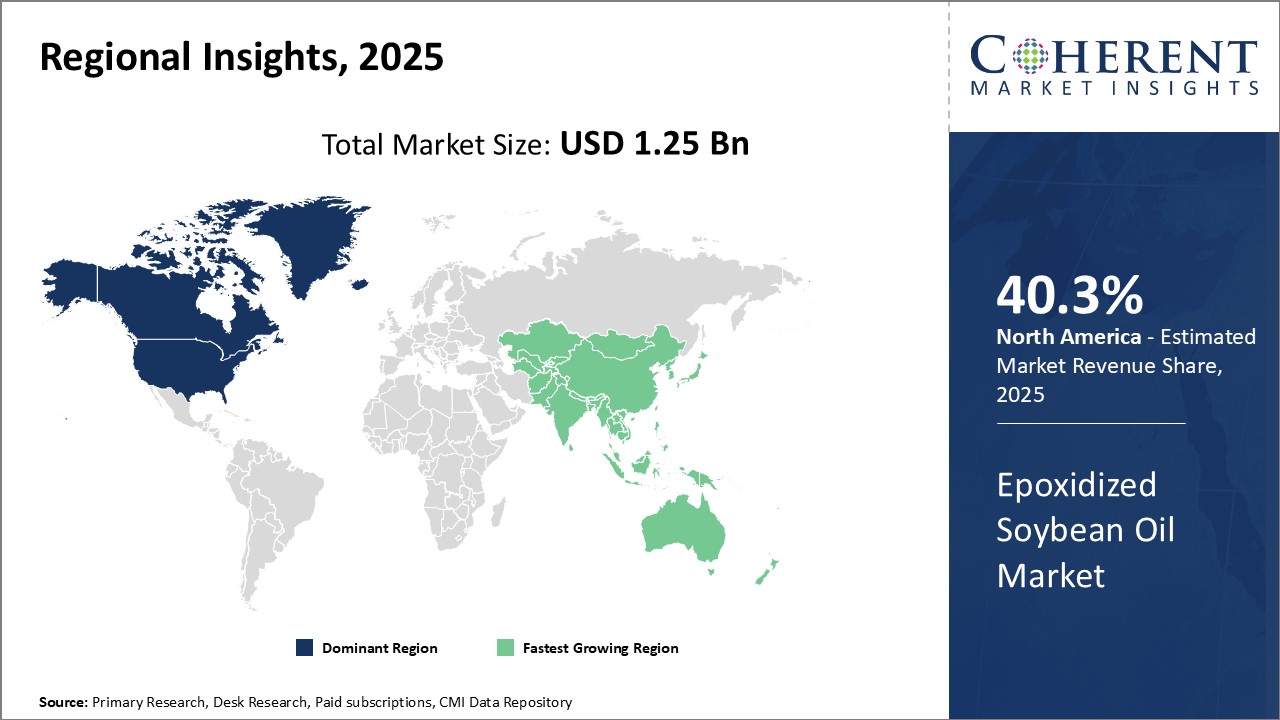 North America has established itself as the dominant region in the global epoxidized soybean oil market and accounted for 40.3% of the market share. The large presence of end use industries such as plastics & rubber has created a sizable demand for epoxidized soybean oil over the years. Major market players from the paints & coatings industry are based in the U.S. and have helped to establish the region's prominence in this market. North America is also a significant exporter of epoxidized soybean oil to other developed markets.
The Asia Pacific region has emerged as the fastest growing market for epoxidized soybean oil globally over the recent past. Countries such as China and India have experienced rapidly expanding construction and automotive sectors which have substantially boosted the demand for adhesives, sealants, and plasticizers - the major application areas of epoxidized soybean oil. Growing population and rising disposable income have facilitated the growth of end use industries in Asia Pacific. Evolving environmental regulations in the region favoring bio-based and eco-friendly products are benefiting the market. Major market players have also been shifting their production facilities to Asia in order to gain access to rising local demand as well as for exporting to ASEAN countries and the Middle East region. Increasing industrial and infrastructure development especially in Southeast Asian countries is expected to present new market opportunities for epoxidized soybean oil suppliers.
Market Players, Key Development, and Competitive Intelligence
 Increasing preference for bio-based products
The rising health, environmental, and sustainability concerns among consumers have augmented the demand for bio-based and natural ingredients across various industries in recent years. For instance, according to the data published by the Biotechnology Industry Research Assistance Council (BIRAC) in 2023, India’s BioEconomy experienced robust growth in 2022, surging by 29% to reach a substantial value of USD 137.24 billion. This sector, encompassing economic activities derived from biological resources, played a pivotal role in India’s economy, by contributing 4% to the gross domestic product (GDP) and employing over 2 million people. The growth was propelled by escalating demand for bio-based products and services, supportive government initiatives, and decreasing costs in biotechnology and biomanufacturing. This transition towards green and clean-label products is positively impacting the global epoxidized soybean oil market.
ESBO is derived from soybean oil through epoxidation, which is a much cleaner process as compared to methods that are used to produce competing petrochemical-derived epoxies. Being completely natural and plant-based, it poses negligible threats to human or environmental health. The biodegradable and renewable attributes of epoxidized soybean oil are appealing to many commercially sensitive companies wanting to boost their sustainability credentials.
Key Developments
- CHS Inc. Announced in September 2021 that it expanded and renovated its soybean processing plant in Mankato, Minnesota, due to the increasing global demand for soybean oil. The project, which costs more than USD 60 million, is the second phase of CHS investments to capitalize on changing market dynamics and opportunities to grow market access. When upgrades are completed, annual refined soybean oil production at the Mankato facility will increase by more than 35%.
- In September 2021, Cargill completed the acquisition of Arkema's epoxides business, which specializes in producing epoxidized vegetable oils. This move was in response to the growing demand for bio-based solutions in the plasticizers and polyols market. The acquisition allowed Cargill to gain end-to-end production capabilities in bio-based plasticizers and polyols, thus enabling the company to better serve its industrial customers with nature-derived alternatives to traditional petroleum-based additives.
- In August 2022, SK Capital Partners, a New York-based private investment firm, completed the acquisition of Valtris Specialty Chemicals from H.I.G. Capital. Valtris, headquartered in Independence, Ohio, is a global leader in specialty performance additives and precursors, offering innovative solutions and products to customers in various industries, including plastics, coatings, adhesives, and sealants, pharmaceuticals, flavors and fragrances, and personal care products.
*Definition: The global epoxidized soybean oil market consists of companies that are involved in the manufacturing and sales of epoxidized soybean oil as a key industrial organic compound. Epoxidized soybean oil is derived from soybean oil through epoxidation, a process where unsaturated vegetable oils react with peroxides to produce oxirane rings in the molecule chains. It is used as a plasticizer for PVC, synthesizing food additives, and coating.
- Current Industry Events of 2026
- Market Size Estimation
- Regional Breakdown
- Competitive Landscape
- Customer Intelligence
- Segmental Analysis
- Pricing Analysis
- Key Market Drivers, Challenges & Future Trends
- Customized Insights Section
Market Report Scope
Epoxidized Soybean Oil Market Report Coverage
| Report Coverage | Details | ||
|---|---|---|---|
| Base Year: | 2025 | Market Size in 2026: | USD 1.31 Bn |
| Historical Data for: | 2020 To 2024 | Forecast Period: | 2026 To 2033 |
| Forecast Period 2026 to 2033 CAGR: | 4.6% | 2033 Value Projection: | USD 1.79 Bn |
| Geographies covered: |
| ||
| Segments covered: |
| ||
| Companies covered: | Makwell Plasticizers Pvt Ltd., Llc, Shenzen Kaiqi Chemical Co., Ltd., Arkema SA, Chs Inc., Ferro Corporation, Hairma Chemicals (Gz) Ltd., Anhui Tianyi Environmental Protection Tech. Co.,Ltd, Shandong Novista Chemicals Co.,Ltd (Novista Group), Adeka Corporation, Hallstar, American Chemical Service, Zhejiang Jiaao Enprotech Stock Co., Ltd., Fujian Zhishang Biomass Materials Co., Ltd., Chang Chun Petrochemical Co., Ltd., NAN YA Plastics Corporation, Hebei Jingu Plasticizer Co., Ltd., Puyang Chengyi Plasticizer Co. Ltd, Chaohu Xiangfeng Plastic Aids Co., Ltd | ||
| Growth Drivers: |
| ||
| Restraints & Challenges: |
| ||
Analyst Opinion (Expert Opinion)
 Market Challenges: Fluctuations in soybean prices
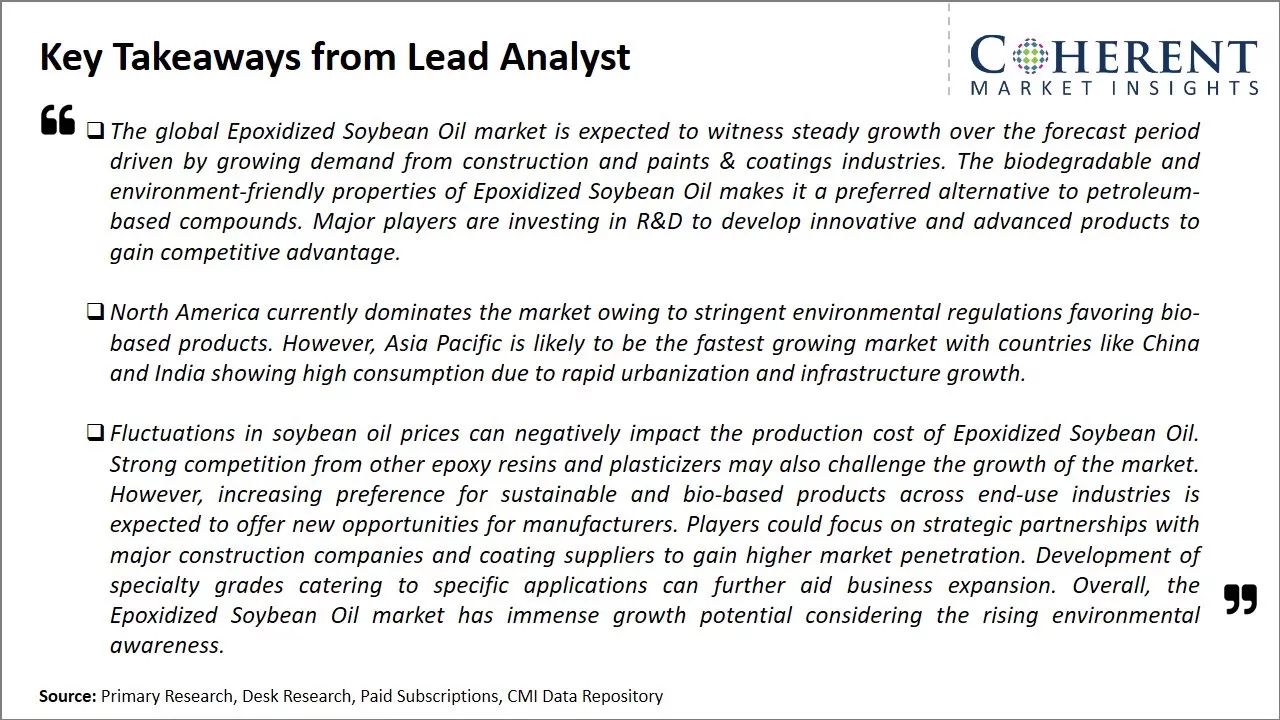
The epoxidized soybean oil market faces certain challenges. Due to the changes in consumer preference towards natural and organic products, synthetic additives are being replaced. Epoxidized soybean oil needs to compete with other natural alternatives. Moreover, fluctuations in soybean prices affect the raw material cost of epoxidized soybean oil. Changing regulations also impact the adoption of epoxidized soybean oil in different applications.
Market Opportunities: Growing focus on environmental protection and sustainability
Despite challenges, there are opportunities for growth. Increasing demand for bio-based and sustainable products from industries like construction, automotive, and adhesives offers potential for epoxidized soybean oil. As regulations promote usage of renewable materials, epoxidized soybean oil can see expanding use in manufacturing plasticizers, lubricants and stabilizers. Moreover, application development in emerging areas like 3D printing provides scope to increase market penetration.
Speak to the analyst
Want personalized insights?
Take the findings above to one of our principal consultants, or have the report rebuilt around the segments, geographies and competitors you actually track.
Market Segmentation
- Raw Material Insights (Revenue, USD Bn, 2021 - 2033)
- Soybean Oil
- Hydrogen Peroxide
- Others (Formic Acid and Acetic Acid)
- Application Insights (Revenue, USD Bn, 2021 - 2033)
- Plasticizers
- Pigment Dispersion Agents
- Flavor & Fragrances
- Functional Fluids
- Fuel Additives
- End Use Industry Insights (Revenue, USD Bn, 2021 - 2033)
- Food & Beverages
- Personal & Healthcare
- Adhesives & Sealants
- Automotive & Transportation
- Others (Agriculture, etc.)
- Regional Insights (Revenue, USD Bn, 2021 - 2033)
- North America
- U.S.
- Canada
- Latin America
- Brazil
- Argentina
- Mexico
- Rest of Latin America
- Europe
- Germany
- U.K.
- Spain
- France
- Italy
- Russia
- Rest of Europe
- Asia Pacific
- China
- India
- Japan
- Australia
- South Korea
- ASEAN
- Rest of Asia Pacific
- Middle East & Africa
- GCC Countries
- Israel
- Rest of Middle East & Africa
- North America
- Key Players Insights
- Makwell Plasticizers Pvt Ltd., Llc
- Shenzen Kaiqi Chemical Co., Ltd.
- Arkema SA
- Chs Inc.
- Ferro Corporation
- Hairma Chemicals (Gz) Ltd.
- Anhui Tianyi Environmental Protection Tech. Co.,Ltd
- Shandong Novista Chemicals Co.,Ltd (Novista Group)
- Adeka Corporation
- Hallstar
- American Chemical Service
- Zhejiang Jiaao Enprotech Stock Co., Ltd.
- Fujian Zhishang Biomass Materials Co., Ltd.
- Chang Chun Petrochemical Co., Ltd.
- NAN YA Plastics Corporation
- Hebei Jingu Plasticizer Co., Ltd.
- Puyang Chengyi Plasticizer Co. Ltd
- Chaohu Xiangfeng Plastic Aids Co., Ltd
Get access to 250+ pages report
Every segment, forecast, competitor profile and data table behind the analysis above — available for instant download.
- ESOMAR Member
- ISO 9001:2015 Certified
- D-U-N-S Registered
- GDPR & CCPA Compliant
Missing comfort of reading report in your local language? Find your preferred language:
Transform your Strategy with Exclusive Trending Reports
Frequently Asked Questions
The Epoxidized Soybean Oil Market is estimated to be valued at USD 1.31 Bn in 2026, and is expected to reach USD 1.79 Bn by 2033.
The CAGR of the Epoxidized Soybean Oil Market is projected to be 4.6% from 2026 to 2033.
Growing demand from construction industry and increasing preference for bio-based products are the major factor driving the growth of Epoxidized Soybean Oil Market.
Fluctuations in soybean prices and stringent environmental regulations are the major factor hampering the growth of Epoxidized Soybean Oil Market.
In terms of Raw Material, Soybean Oil, estimated to dominate the market revenue share 2026.
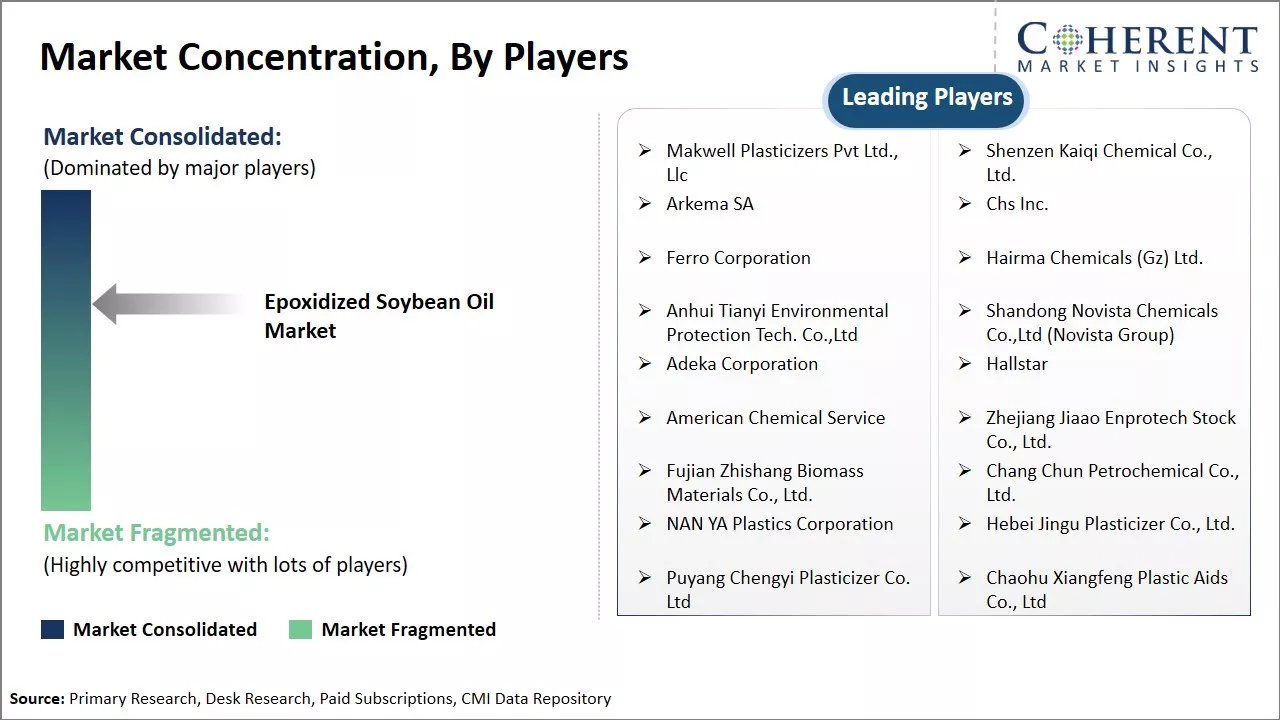
Makwell Plasticizers Pvt Ltd., Llc, Shenzen Kaiqi Chemical Co., Ltd., Arkema SA, Chs Inc., Ferro Corporation, Hairma Chemicals (Gz) Ltd., Anhui Tianyi Environmental Protection Tech. Co.,Ltd, Shandong Novista Chemicals Co.,Ltd (Novista Group), Adeka Corporation, Hallstar, American Chemical Service, Zhejiang Jiaao Enprotech Stock Co., Ltd., Fujian Zhishang Biomass Materials Co., Ltd., Chang Chun Petrochemical Co., Ltd., NAN YA Plastics Corporation, Hebei Jingu Plasticizer Co., Ltd., Puyang Chengyi Plasticizer Co. Ltd, Chaohu Xiangfeng Plastic Aids Co., Ltd are the major players.
North America is expected to lead the Epoxidized Soybean Oil Market.