

Frozen Ready Meal Market Size and Forecast — 2026-2033
Overview
Ready Meals are complete meals that are already prepared, which are available in trays and require to be heated before serving. Frozen foods are said to be preserved foods, which resist the decay process and inhibit bacterial growth. Socio-economic expansion such as increasing women labor pool and an increasing number of single-member households has resulted in an increase in demand for convenience and minimal preparation foods that help save time and effort. An increase in growth of tourism and robust gross domestic product (GDP) are projected to increase demand for frozen foods.
Moreover, product availability and retail shelf space play a key role in triggering growth of the frozen ready meal market. Distribution is a key factor in the current frozen food market. The factors hindering growth of this market include increasing number of private labels and local and unorganized brands. The innovative packaging of private and local brands attracts an enormous amount of consumers, ultimately fueling growth of the global market. Increase in the number of manufacturers of frozen food in the recent past, has led to large competition in the global market. Low cost of products provided by various suppliers has created a greater opportunity for users to choose a preferred supplier from a large number of global suppliers available in the market.
Frozen Ready Meal Market Size and Forecast – 2026 – 2033
The Frozen Ready Meal Market size is estimated to be valued at USD 73.09 billion in 2026 and is expected to reach USD 115.08 billion by 2033, exhibiting a compound annual growth rate (CAGR) of 6.7% from 2026 to 2033.
Key Takeaways
Product Type segment: Fully cooked meals captured a dominant industry share of 56% owing to consumer preference for ready-to-eat options that save time while delivering quality nutrition. Meal kits are witnessing fastest growth supported by increasing consumer interest in experiential food preparation.
Distribution Channel segment: Supermarkets and hypermarkets hold a leading share of 49%, benefiting from enhanced cold chain infrastructure and location accessibility. Online retail emerges as the fastest-growing channel driven by convenience and expanding digital penetration.
Regional insights: North America leads with a commanding industry share close to 35%, propelled by high disposable income and mature foodservice sectors. Asia Pacific depicts the fastest CAGR, fueled by urban population growth and evolving regional supply chains supporting business growth in countries like China and India.
Frozen Ready Meal Market – Segmentation Analysis
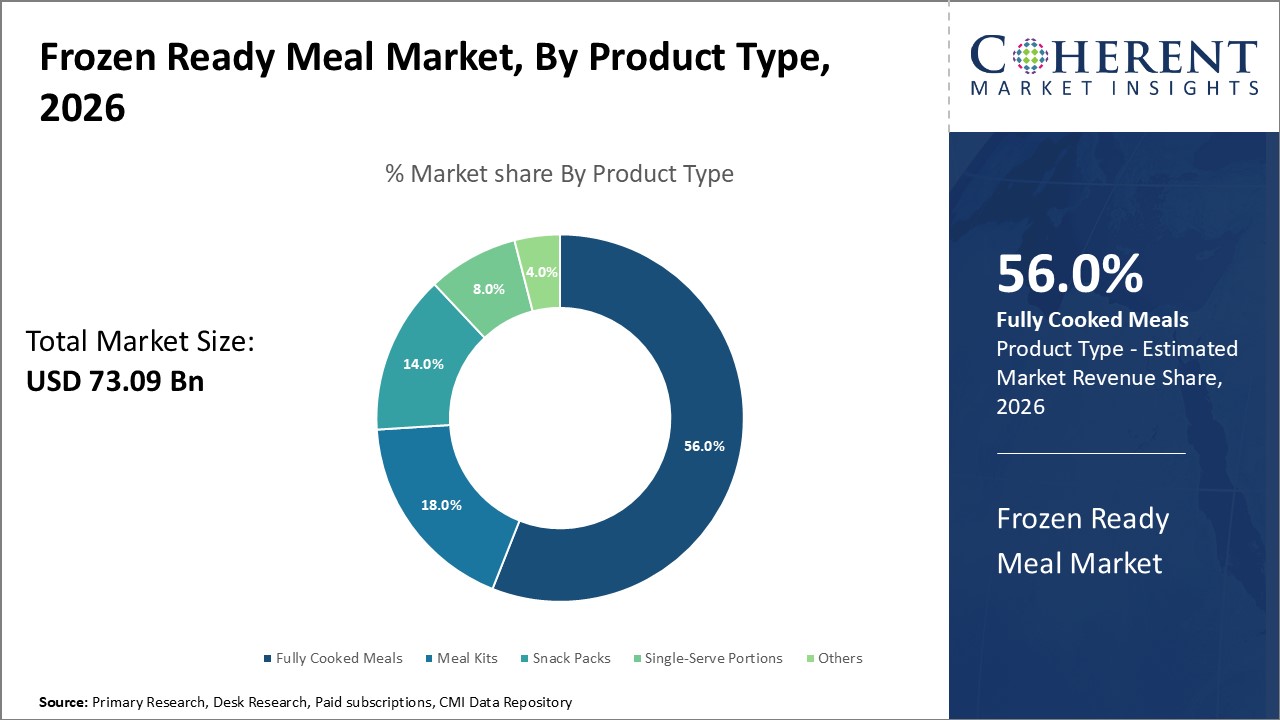
Frozen Ready Meal Market Insights, By Product Type
Meal kits, snack packs, single-serve portions, completely cooked meals, and other product types make up the market's segmentation. Of these, fully cooked meals hold a 56% market share. The reason fully cooked meals are at the top is because consumers choose ready-to-eat options that take little preparation time, which makes them a necessary option for hectic lives. New developments in packaging technologies that maintain flavor and freshness support the segment's expansion.
Frozen Ready Meal Market Insights, By Distribution Channel
In terms of Distribution Channel, the market comprises supermarkets/hypermarkets, convenience stores, online retail, foodservice, and others, with supermarkets/hypermarkets dominating at a 48% market share. The dominance results from wide product assortments, strong cold chain networks, and consumer trust in these retail formats.
Frozen Ready Meal Market Insights, By End User
Household consumers retain a substantial 62% market share, while business establishments, institutional buyers, and other consumers make up the market's End User segment. Demand is driven by households as frozen meals become more popular for daily nourishment due to reduced family sizes and hectic work schedules.
Frozen Ready Meal Market Insights, By Geography
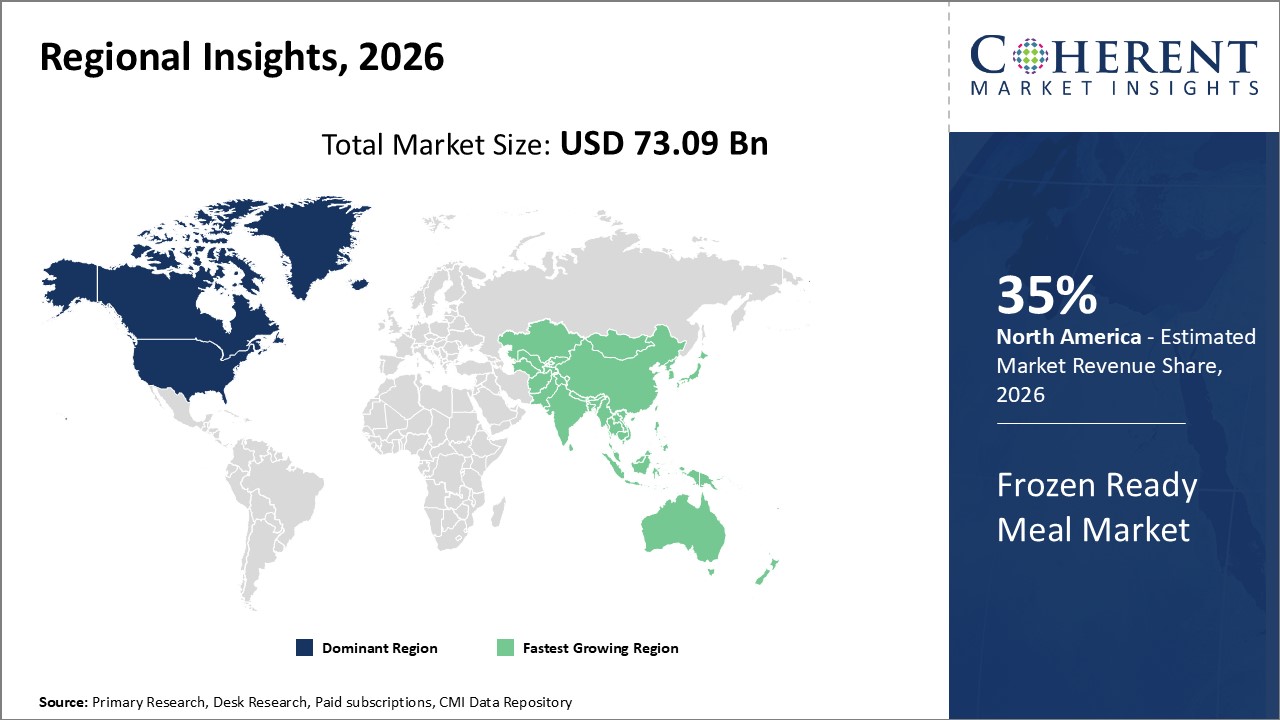
North America Frozen Ready Meal Market Analysis and Trends
The presence of significant multinational manufacturers and a large industry share of approximately 35% support the dominance of the frozen ready meal market in North America. Market revenue is greatly influenced by the region's well-established retail ecosystem, robust cold chain infrastructure, and health-conscious customers. Well-known businesses like Nestlé and Kraft Heinz keep coming up with new ideas and expanding their market shares by diversifying their product lines and using digital sales platforms.
Asia Pacific Frozen Ready Meal Market Analysis and Trends
Asia Pacific, meantime, is growing at the quickest rate, with a CAGR of about 8.3%. Expansion is being driven by factors such as changing food choices, rising disposable income, and rapid urbanization. Market accessibility is accelerated by the growing presence of supermarkets and online retail platforms in nations like China and India. In order to promote the broad use of frozen ready meals, regional players are making significant investments in cold storage and distribution networks.
Frozen Ready Meal Market Outlook for Key Countries
Market Analysis and Trends for Frozen Ready Meals in the United States
The USA frozen ready meal market remains a pivotal contributor with diverse consumer bases demanding convenient yet healthy food options. In 2025, frozen meal consumption grew by 14%, spurred by urban professionals and students. Key players such as Conagra Brands and Tyson Foods continue to invest in plant-based and organic ready meals, expanding their product portfolios. Additionally, robust online retail channels and promotional strategies have enhanced market revenue and competitive positioning within the country.
Market Analysis and Trends for Frozen Ready Meals in China
China's market is marked by expanding urban centres and a growing middle-class population, which is rapidly embracing frozen ready meals. The sector observed an 18% increase in frozen ready meal sales in 2025, driven by rising demand for affordable convenience and international cuisines. Local companies alongside multinational firms are investing in cold chain logistics and e-commerce platforms, facilitating greater market penetration in tier 2 and tier 3 cities.
Analyst Opinion
Demand-side indicators reveal a pronounced uptick in consumer adoption of frozen ready meals in urban areas, driven by the growing dual-income household base. For instance, data from 2025 show that the U.S. urban centers experienced a 16% surge in frozen ready meal purchases compared to 2023, highlighting convenience as a key driver.
Supply-side metrics illustrate a strategic ramp-up in production capabilities, with major manufacturers increasing frozen ready meal production capacity by over 20% in Asia Pacific between 2023 and 2025 to meet expanding demand. Export volumes from leading players in this region saw a 12% year-on-year rise, demonstrating expanding global reach.
Pricing dynamics are influenced by raw material cost inflation and premiumization trends. In 2025, the average retail price for premium healthy frozen ready meals increased by 8% in Europe, reflecting added ingredients like organic vegetables and lean proteins, which are gaining traction among health-conscious consumers.
Micro-indicators such as product diversification into plant-based and ethnic cuisine frozen ready meals are reshaping consumption patterns. Notably, plant-based variants accounted for approximately 19% of new product launches globally in 2025, signaling a shift towards sustainable and healthier food options.
- Current Industry Events of 2026
- Market Size Estimation
- Regional Breakdown
- Competitive Landscape
- Customer Intelligence
- Segmental Analysis
- Pricing Analysis
- Key Market Drivers, Challenges & Future Trends
- Customized Insights Section
Market Scope
| Report Coverage | Details | ||
|---|---|---|---|
| Base Year: | 2025 | Market Size in 2026: | USD 73.09 billion |
| Historical Data for: | 2020 To 2024 | Forecast Period: | 2026 To 2033 |
| Forecast Period 2026 to 2033 CAGR: | 6.7% | 2033 Value Projection: | USD 115.08 billion |
| Geographies covered: |
| ||
| Segments covered: |
| ||
| Companies covered: | Nestlé S.A., Conagra Brands Inc., Kraft Heinz Company, Nomad Foods Ltd., Tyson Foods, Inc., General Mills, Inc., Ajinomoto Co., Inc., McCain Foods Limited, Hormel Foods Corporation, Mondelez International, Pinnacle Foods | ||
| Growth Drivers: |
| ||
Growth factors
The frozen ready meal market growth is anchored in several critical factors. Increasing urbanization and busier lifestyles have led to heightened demand for convenience foods, as evidenced by a 14% year-on-year growth in frozen meal consumption among working professionals in 2025.
Rising health awareness is driving product reformulations with enhanced nutritional profiles, supported by a 12% surge in sales of low-calorie and plant-based frozen ready meals globally last year. E-commerce proliferation facilitates wider product accessibility, with online frozen meal sales growing at a CAGR of 18% during 2023-2025. Finally, evolving retail infrastructure, particularly the expansion of cold chain facilities in emerging markets like India and Southeast Asia, is catalysing market penetration and consumer reach.
Frozen Ready Meal Market Development
In June 2026, Nissin Foods expanded beyond its traditional cup noodles by launching a new line of frozen foods tailored for GLP-1 users and other health-conscious consumers seeking nutrient-rich meal options.
Market Trends
The frozen ready meal market is undergoing noteworthy shifts emphasizing sustainability, customization, and technology integration. Recent trends include the adoption of eco-friendly packaging materials, with companies reducing plastic use by over 30% in 2025, responding to growing environmental concerns. Customizable frozen ready meals catering to dietary preferences like keto, gluten-free, and paleo diets are gaining momentum, evidenced by a 20% rise in such product launches worldwide last year. Additionally, adoption of AI and IoT in supply chain management is optimizing inventory and reducing food waste, with key players reporting a 15% improvement in operational efficiency through such innovations in 2025.
Key Players
Conagra Brands Inc.
Kraft Heinz Company
Nomad Foods Ltd.
Tyson Foods, Inc.
General Mills, Inc.
Ajinomoto Co., Inc.
McCain Foods Limited
Hormel Foods Corporation
Mondelez International
Pinnacle Foods
Competitive strategies predominantly focus on product innovation, geographical expansion, and strategic partnerships. For example, Nestlé introduced a line of plant-based frozen ready meals in 2025, which increased its market share by approximately 4% in North America within six months. Similarly, Conagra Brands leveraged e-commerce platforms for direct-to-consumer distribution, resulting in a 26% boost in online sales during 2023. Kraft Heinz prioritized acquisition strategies, highlighted by its purchase of organic frozen ready meal brands, bolstering its portfolio and market footprint in Europe.
Frozen Ready Meal Market Future Outlook
The market for frozen ready meals has a bright future because of rising customer demand for quick and easy food options due to urbanization and busy lifestyles. As consumer preferences for single-serve, microwave-ready, allergy-free, and plant-based meal options increase, the market is anticipated to develop. Product quality, shelf life, and customer appeal are all being improved by technological developments in freezing and packing. Protein-rich, clean-label, and healthier options are becoming more popular, and this trend is being aided by innovation from major industry participants.
Regional growth varies, with Asia-Pacific experiencing significant rise due to rising incomes and urban lifestyles, while North America is experiencing robust demand. Product offers are being shaped by sustainability and regulatory developments, while foodservice and digital retail channels are expanding their market reach. All things considered, the market will be distinguished by ongoing innovation, diversification, and growth into developing nations.
Historical Analysis
In 2019, Conagra Brands, Inc. under its brand Gardein aimed to fulfill the growing demand for plant-based food by expanding its line of meat-free dishes. The latest innovations made by the company included various plant-based options for snacks and meals. The frozen ready meals added by the company included Chick'n Wings, Tenders and Nuggets, Breakfast Bowls, Italian Saus'age Patties and others.
In September 2019, Campbell Soup Co.’s sponsor teamed up with NFL stars Dak Prescott and Saquon Barkley for the launch of a new brand platform called “Champions of Chunky.” This new brand platform adopted an integrated marketing campaign comprising social media engagements and local market activations.
In 2019, Lightlife Foods announced that the Lightlife Burger and Lightlife Ground, the plant-based meat products, would be available in the meat aisle at thousands of stores across North America in frozen form. The company ensured that these frozen products were free from artificial flavors, soy and gluten and thus, took into consideration the better well-being of the people.
Sources
Primary Research interviews:
Logistics & cold chain providers
Quick service restaurant (QSR) procurement managers
E-commerce grocery platform category managers
Databases:
Mintel GNPD (Global New Products Database)
UN Comtrade Database
FAOSTAT
Magazines:
Refrigerated & Frozen Foods Magazine
Food & Drink International
Food Business News
Journals:
Food Quality and Preference
International Journal of Food Microbiology
Journal of Food Engineering
Newspapers:
The Times of India
The New York Times
Business Standard
Associations:
European Federation of Food Science and Technology (EFFoST)
International Association for Food Protection (IAFP)
Institute of Food Technologists (IFT)
Get access to 250+ pages report
Every segment, forecast, competitor profile and data table behind the analysis above — available for instant download.
- ESOMAR Member
- ISO 9001:2015 Certified
- D-U-N-S Registered
- GDPR & CCPA Compliant
Missing comfort of reading report in your local language? Find your preferred language:
Transform your Strategy with Exclusive Trending Reports
Frequently Asked Questions
Leading market players include Nestlé, Conagra Brands, Kraft Heinz, and Nomad Foods, who dominate through a combination of product innovation, strategic acquisitions, and expansive distribution networks.
The Frozen Ready Meal Market size is projected to expand from USD 73.09 billion in 2026 to USD 115.08 billion by 2033, reflecting substantial growth driven by evolving consumer demands.
Household consumers represent the largest growth opportunity, accounting for 62% of market share with increasing adoption of frozen meals for convenience and nutritional value.
Market trends indicate growing integration of plant-based proteins, sustainable packaging, and digital sales platforms, which are reshaping how frozen ready meals are developed, marketed, and distributed.
The landscape is highly competitive, focusing on innovation and cost-efficiency, with challenges including raw material price volatility and meeting diverse consumer health expectations.
Market players prioritize omnichannel distribution, product portfolio diversification, and strategic partnerships to enhance market penetration and consumer reach.