

Food Certification Market Size and Forecast — 2026-2033
Overview
Food certification is verification by regulatory bodies, which ensures that the processes, systems, and products in the food supply chain are according to the accepted limits of food safety standard. It is based on results of inspections, audits, and tests, which provide assurance to the consumer that the food products are according to the national and international food quality standard. It includes processes related to the storage, handling, and preparation of food products. The benefits of food certification are consistent production of safe and quality food products with reduced risks of contamination, which decreases food recalls from the market.
The demand for good quality food, increasing health consciousness, increasing demand for convenience food, and government intervention are the major drivers for the growth of food certification market. The time-consuming and expensive certification process and lack of resources and infrastructure in emerging economies are major challenges for food certification market.
Food Certification Market Size and Forecast – 2026 – 2033
The Food Certification Market size is estimated to be valued at USD 5.31 billion in 2026 and is expected to reach USD 10.82 billion by 2033, exhibiting a compound annual growth rate (CAGR) of 10.7% from 2026 to 2033.
Key Takeaways
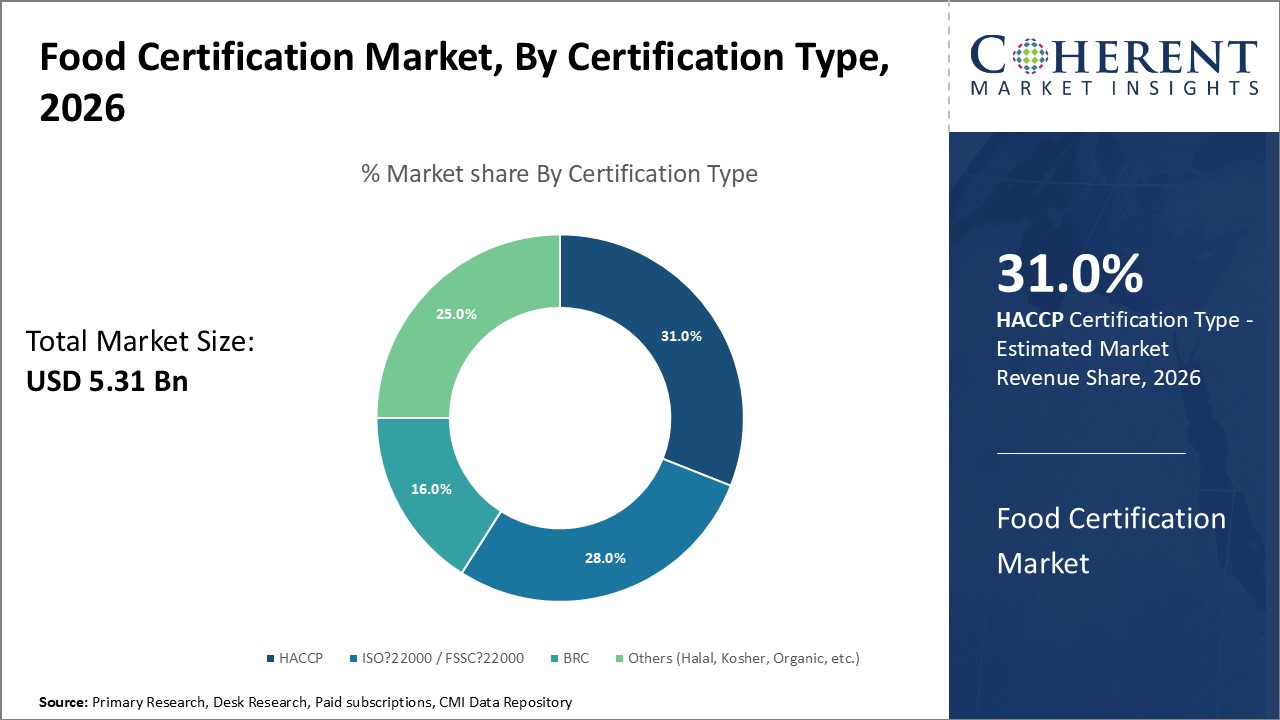
HACCP dominates certification types contributing 31% market share owing to regulatory mandates in manufacturing. ISO 22000 and FSSC 22000 present fast growth prospects.
Dairy products application segment leads due to global demand for safe dairy, while organic and specialty foods show fastest incremental gains.
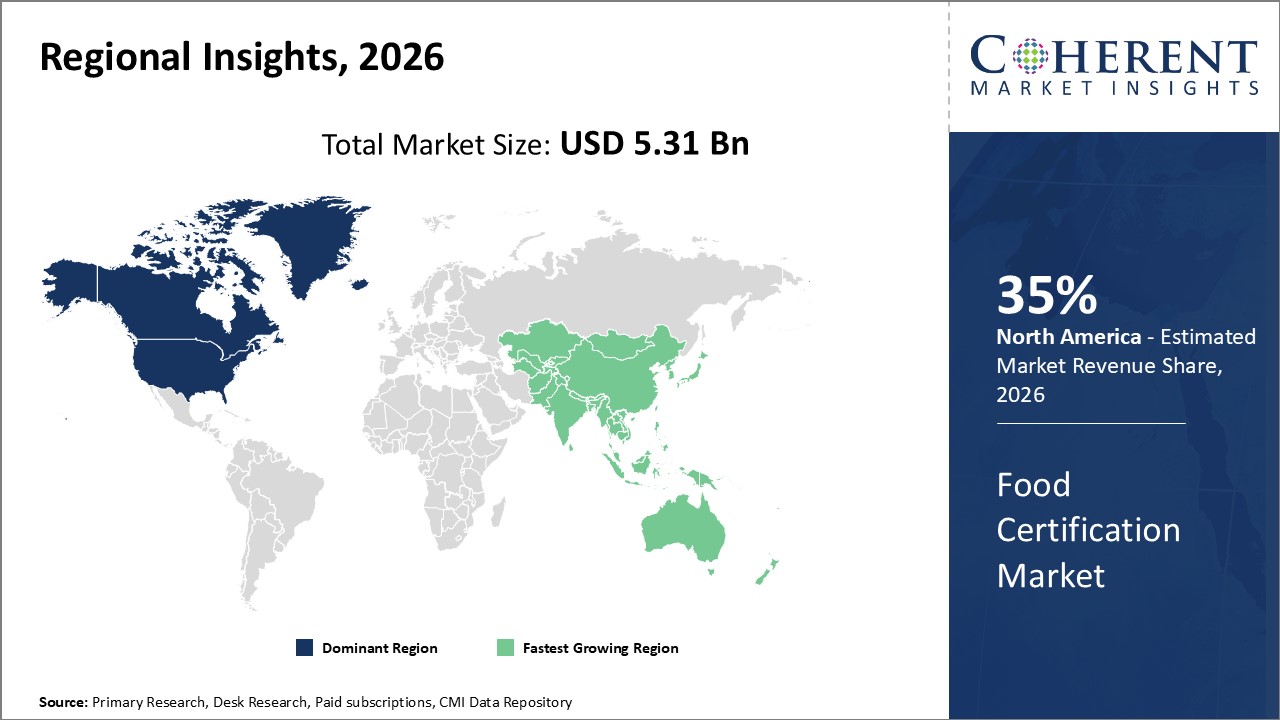
North America holds a commanding 35% share in market revenue driven by stringent safety demands and advanced certification infrastructure.
Asia Pacific is the fastest-growing region fueled by expanding food exports and expanding regulatory frameworks, with compound annual growth outpacing others.
Food Certification Market – Segmentation Analysis
Food Certification Market Insights, By Certification Type
In terms of Certification Type, the market is segmented into HACCP, ISO 22000, BRC, FSSC 22000, and Others, among which HACCP dominates the market share at 31%. HACCP’s dominance stems from its regulatory mandates across multiple countries and wide acceptance across food manufacturing processes ensuring hazard control.
Food Certification Market Insights, By Application
In terms of Application, the market is segmented into Dairy Products, Meat & Poultry, Seafood, Fruits & Vegetables, Processed Food, and Others. Dairy Products dominate the market share as food safety concerns and strict packaging regulations in the dairy sector necessitate extensive certification at multiple supply chain stages.
Food Certification Market Insights, By End-User Industry
In terms of End-User Industry, the segmentation includes Retail, Food Service, Manufacturing, Exporters, and Others. Retail dominates the market share, largely because food safety certifications serve as key trust markers for consumers and retailers mandate certifications from suppliers for product listing.
Food Certification Market Insights, By Geography
North America Food Certification Market Analysis and Trends
Given strong regulatory frameworks like FSMA regulations and the existence of established certification bodies, North America dominates the food certification market in terms of revenue, accounting for around 35% of the entire market share. The United States is the leader in the broad use of organic food certifications, which are closely related to sustainability and consumer safety issues.
Asia Pacific Food Certification Market Analysis and Trends
Despite a compound annual growth rate (CAGR) of over 12%, Asia Pacific is growing at the quickest rate, driven by the rapid expansion of export-oriented food manufacturing in nations like China and India. This trend is being accelerated by government policies that favor more foreign direct investments in agribusiness and advances in food safety. In order to facilitate market dynamics, companies such as SGS SA and Eurofins Scientific have increased their local presence.
Food Certification Market Outlook for Key Countries
United States Food Certification Market Analysis and Trends
The USA’s food certification market continues to be a global benchmark driven by strong legislative mandates and consumer-driven quality consciousness. The FDA’s evolving FSMA regulations have enforced tighter control over food safety protocols, significantly boosting certification market revenue. Companies such as NSF International and Intertek have reported a 20% increase in certification contracts across organic and non-GMO food categories in the past year. Additionally, increased imports and exports necessitate compliance with international standards, further driving business growth.
Market Analysis and Trends for Food Certification in the Brazil
Brazil’s food certification market is witnessing accelerated growth aligned with its role as a major food exporter. Stringent certification to access markets in North America and Europe, coupled with national policy initiatives, stimulates certification demand especially in meat and commodities sectors. Notably, Bureau Veritas reported a 15% surge in certifications related to sustainable agricultural practices in 2025. Local companies are increasingly investing in traceability systems to align with international food safety and quality standards, underscoring Brazil’s expanding market share in the regional food certification ecosystem.
Analyst Opinion
One critical growth driver underlined by market insights is the scaling number of food processing facilities undergoing certification to meet export requirements. For instance, in 2025, over 15% increase in facilities certified under international hygiene standards was recorded in Asia Pacific, driving a notable uptick in market share for this region.
Price sensitivity in emerging markets also affects the adoption rate of premium certifications. Recent data from Latin America indicates a 12% rise in demand for cost-efficient certification types as local producers aim to penetrate developed markets without incurring exorbitant certification expenses.
Demand from specialized sectors such as infant nutrition and organic products is rapidly expanding due to increasing consumer preferences for safer and cleaner labels. The North American region accounted for nearly 35% of market revenue in 2026, largely driven by organic food certifications in retail outlets.
Regulatory enhancements in the European Union, with updated frameworks implemented in 2025, have raised compliance thresholds, forcing market players to upgrade certification procedures. This translated into a 17% increase in market growth in Europe, reflecting higher demand for accredited laboratories and certification bodies.
- Current Industry Events of 2026
- Market Size Estimation
- Regional Breakdown
- Competitive Landscape
- Customer Intelligence
- Segmental Analysis
- Pricing Analysis
- Key Market Drivers, Challenges & Future Trends
- Customized Insights Section
Market Scope
| Report Coverage | Details | ||
|---|---|---|---|
| Base Year: | 2025 | Market Size in 2026: | USD 5.31 billion |
| Historical Data for: | 2020 To 2024 | Forecast Period: | 2026 To 2033 |
| Forecast Period 2026 to 2033 CAGR: | 10.7% | 2033 Value Projection: | USD 10.82 billion |
| Geographies covered: |
| ||
| Segments covered: |
By End-User Industry: Retail, Food Service, Manufacturing, Exporters, Others | ||
| Companies covered: | SGS SA, Bureau Veritas, Intertek Group plc, DNV GL, TUV SUD, NSF International, UL LLC, Eurofins Scientific, Lloyd’s Register, Kiwa NV | ||
| Growth Drivers: |
| ||
Growth factors
Growth in international food trade acts as a strong catalyst due to heightened certification demands to ensure compliance with import regulations. For instance, the US-China trade protocols have increasingly mandated stringent certification protocols since 2023, leading to greater certification market growth.
Increasing consumer preference for organic and sustainable food products promotes certifications specifically tailored for eco-friendly production processes, with organic food certifications growing over 14% annually across North America and Europe.
Enhanced regulatory frameworks such as the FDA’s FSMA updates and tightening EU food safety policies directly push manufacturers toward certified standards, ensuring measurable food quality and safety, which influences market dynamics decisively.
Food Certification Market Development
- In September 2026, NSF, a prominent global organization focused on public health and safety, introduced its latest standard, NSF P525: Safe Food Packaging. This new protocol is a significant step toward tackling food contact chemicals (FCCs), many of which are known to be carcinogenic, mutagenic, reprotoxic (CMR), endocrine disruptors, and bioaccumulative.
Market Trends
The food certification industry is witnessing a steady adoption of blockchain and IoT technologies to enhance transparency and traceability in certification processes.
In 2025, a pilot project in Europe involving blockchain-enabled certification reduced fraud incidences by approximately 30%, demonstrating the shift towards digital transformation.
Another emerging trend is the rising prominence of eco-labels and certifications aligned with sustainability goals, mirroring consumer demand for environmentally responsible sourcing.
Additionally, micro-certifications focusing on niche segments like allergen-free or fair trade appear increasingly relevant as consumers shift towards personalized and ethical consumption.
Key Players
SGS SA
Bureau Veritas
DNV GL
TUV SUD
NSF International
UL LLC
Lloyd’s Register
Kiwa NV
Several leading companies have adopted strategic partnerships and technology-enabled certification services to expand their footprint. For example, Intertek’s integration of digital traceability tools enhanced audit efficiency and lowered turnaround times by 25% in 2025. Similarly, SGS SA leveraged regional collaborations to increase penetration across Asia Pacific, resulting in a 20% revenue boost from certification services in developing economies.
Future Prospects for the Food Certification Market
The growing need from consumers worldwide for transparency, food safety, and quality assurance is driving the food certification market's optimistic outlook. Global regulatory scrutiny is increasing, which forces suppliers and manufacturers to embrace globally accepted certification standards in order to maintain compliance and gain a competitive edge in export markets. The efficiency and dependability of certification procedures are being improved by technological developments like blockchain-based traceability systems and digital audits, which are becoming more popular.
Market expansion is being driven by the growth of the global food commerce as well as an increase in food safety events. Adoption is accelerating in emerging nations, particularly in Asia-Pacific, as a result of government efforts to raise food safety regulations, urbanization, and rising middle-class consumer awareness. Sustainable, organic, and specialized food certifications are also receiving more attention as a result of changing consumer tastes and environmental concerns. To satisfy a variety of industry demands and bolster their certification portfolios, market participants are investing in automation and innovation, which is helping to sustain the global market's growth.
Historical Analysis
In July 2018, ALS Limited added a rapid test to its scope of NATA accredited tests. The organization was committed to embracing technology for delivering faster quality results and thus, aimed at providing cost-effective and rapid microbial testing services. With this addition, the company was in a position of providing Enterobacteriaceae Petrifilm results within 24 hrs.
In March 2018, Intertek had launched a food hygiene control solution for the hospitality and food services industry, with the food hygiene mark with the objective of providing the customers with confidence that the sites were committed to food safety and quality assurance.
In April 2016, UL Registrar LLC approved a certification body for the Equitable Food Initiative. The company offered certification and auditing services to growers who were seeking added confidence within their food safety, labor and pest management practices.
According to the report published in December 2015 by the World Health Organization (WHO), 1 out of 10 people suffered from foodborne illness and 420,000 died due to consuming contaminated food. Increasing incidents of foodborne illness raised awareness among consumers. For instance, in 2017, chicken eggs which were distributed in European and Asian markets were found to be contaminated with fipronil, which was classified as a hazardous Class II pesticide by the World Health Organization (WHO). Consumption of fipronil caused nausea, vomiting, headache, dizziness, and seizures.
Sources
Primary Research interviews:
Food safety officers and quality assurance managers
Supply chain & procurement heads in FMCG
Regulatory officials (food safety inspectors, government representatives)
Databases:
USDA Database
Eurostat
Codex Alimentarius (standards repository)
Magazines:
Food Processing Magazine
Food Business News
The Food Safety Magazine
Journals:
Food Policy
Journal of Food Protection
Trends in Food Science & Technology
Newspapers:
Financial Times (Food Industry section)
The Guardian (Sustainable Food section)
The Wall Street Journal (Food Industry & Regulations)
Associations:
Global Food Safety Initiative (GFSI)
International Organization for Standardization (ISO)
Food Safety and Standards Authority of India (FSSAI)
Get access to 250+ pages report
Every segment, forecast, competitor profile and data table behind the analysis above — available for instant download.
- ESOMAR Member
- ISO 9001:2015 Certified
- D-U-N-S Registered
- GDPR & CCPA Compliant
Missing comfort of reading report in your local language? Find your preferred language:
Transform your Strategy with Exclusive Trending Reports
Frequently Asked Questions
Leading players include SGS SA, Bureau Veritas, Intertek Group, and DNV GL, which control significant market share through diversified certification portfolios and regional expansions.
The market size is projected to grow from USD 5.31 billion in 2026 to USD 10.82 billion by 2033, with a CAGR of 10.7%.
The retail sector presents the largest growth potential driven by consumer demand for certified safety assurances.
Trends indicate increased digitization of certification processes and the rise of specialized eco-friendly certifications, influencing market revenue and business growth.
The landscape is moderately consolidated with key players adopting technology-driven solutions; however, varying regional regulatory norms and price sensitivity form significant market challenges.
Strategies include strategic partnerships, digital tool integration, and geographically focused expansions to boost market share and meet evolving client demands.