

Global Adhesives and Sealants Market Size and Forecast – 2026-2033
The Global Adhesives and Sealants Market is estimated to be valued at USD 72.96 Bn in 2026 and is expected to reach USD 104.74 Bn by 2033, exhibiting a compound annual growth rate (CAGR) of 5.3% from 2026 to 2033.
Key Takeaways of the Adhesives and Sealants Market
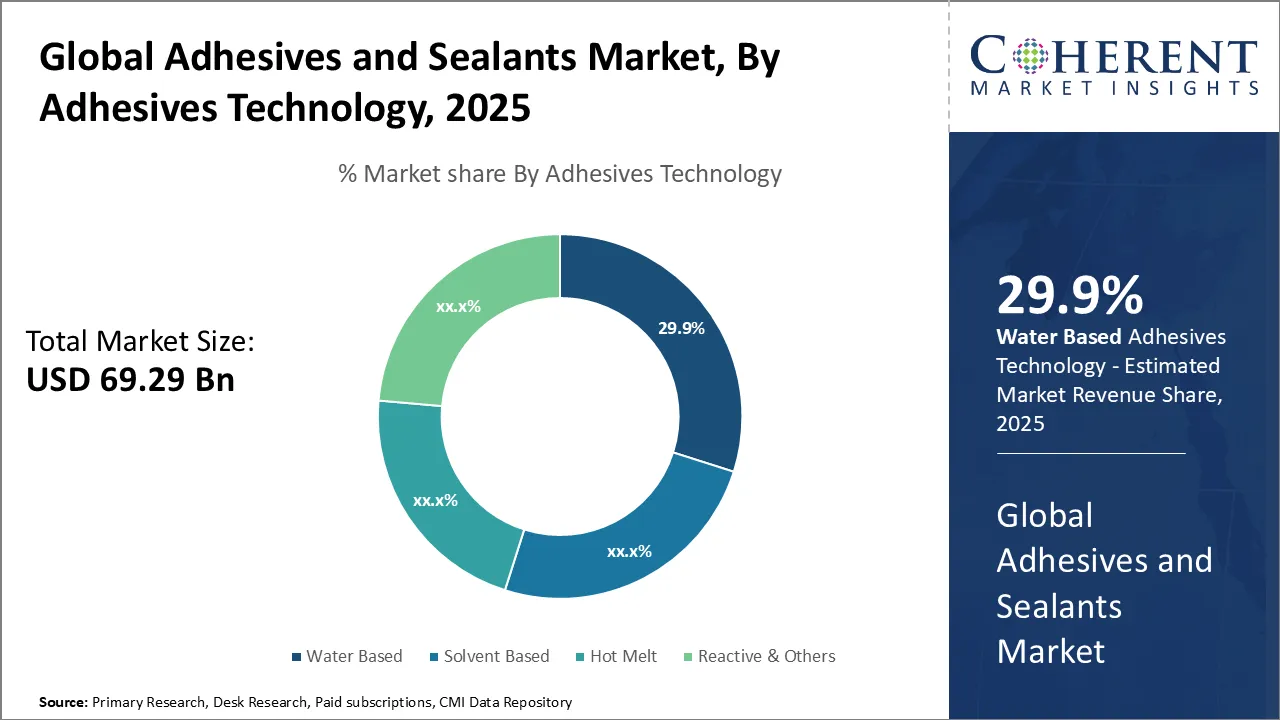
- The water-based segment is expected to account for 30.9 % of the global adhesives and sealants market by 2026.
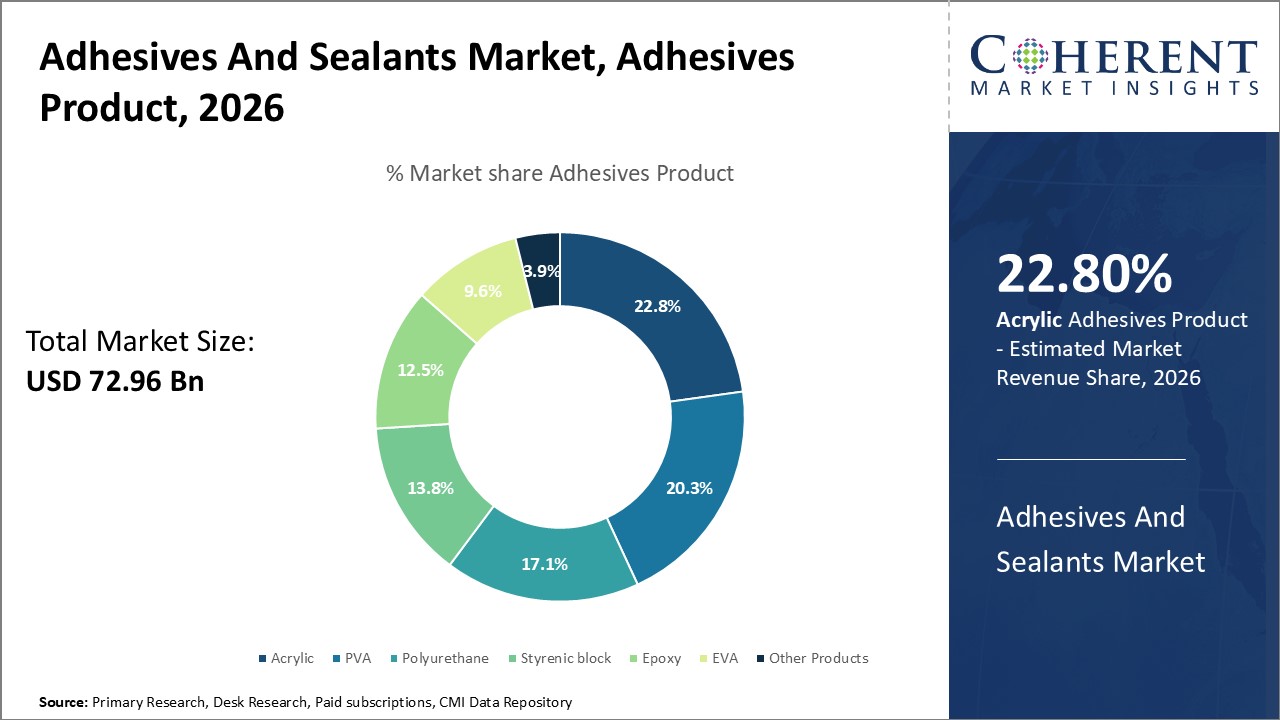
- The acrylic segment is projected to represent 22.8 % of the global adhesives and sealants market in 2026.
- The paper & packaging segment is expected to account for 30.2 % of the market in 2026.
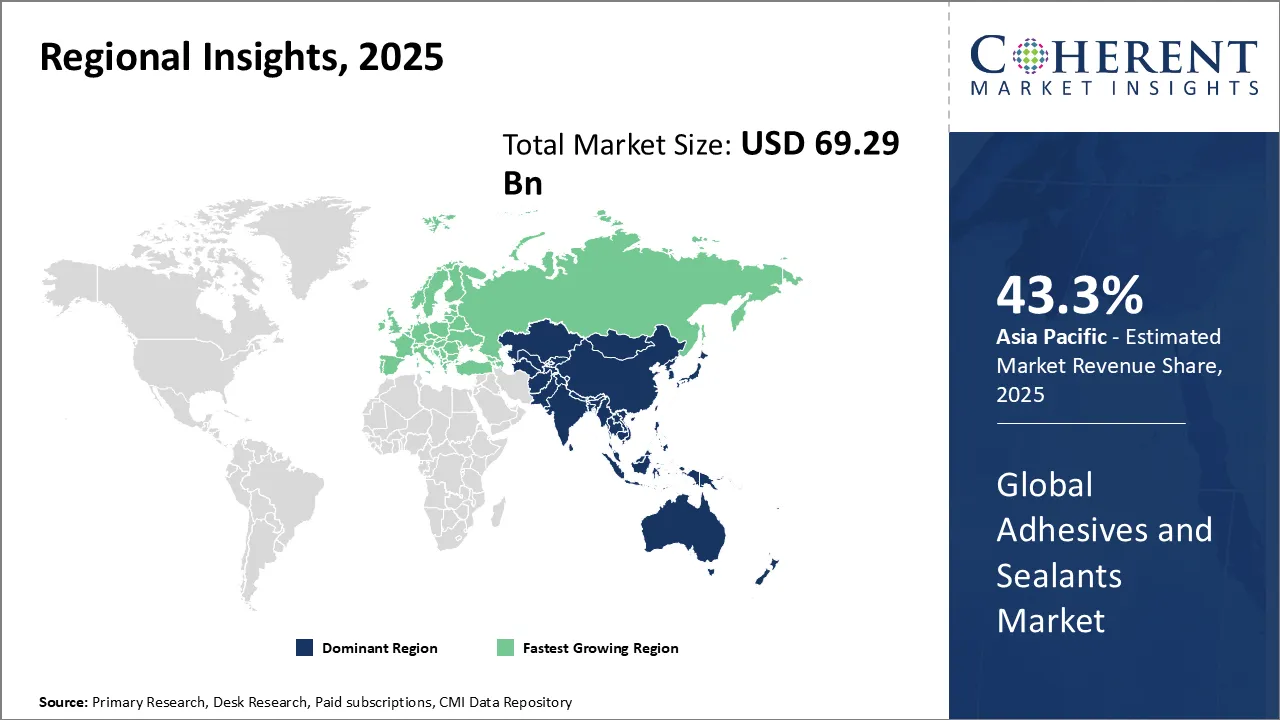
- Asia Pacific is expected to lead the global adhesives and sealants market in 2026 with a 43.3 % share. Europe, with a 29.5% share, is expected to be the fastest-growing region.
Market Overview
Current market trends highlight a significant shift towards eco-friendly and bio-based adhesives and sealants driven by environmental regulations and consumer preference for sustainable products. Additionally, innovations in nanotechnology and advancements in formulation chemistry are enhancing product performance, durability, and application versatility. The increasing integration of industrial adhesives in lightweight materials for automotive and aerospace sectors further propels market expansion, underscoring the evolving role of adhesives and sealants in improving structural integrity and energy efficiency.
Current Events and Its Impact
Current Events | Description and its impact |
Shift to Bio-based and Circular Economy Products |
|
Technology Innovations in Formulation and Performance |
|
Segmental Insights
- Current Industry Events of 2026
- Market Size Estimation
- Regional Breakdown
- Competitive Landscape
- Customer Intelligence
- Segmental Analysis
- Pricing Analysis
- Key Market Drivers, Challenges & Future Trends
- Customized Insights Section
Adhesives and Sealants Market Insights, By Adhesives Technology – Water Based Segment Dominates Due to a Shift Towards Sustainability and Versatility
The water based segment is expected to hold 30.9% share of the global adhesives and sealants market in 2026, primarily driven by their environmental advantages and broad applicability across industries. One of the key factors propelling the growth of the water-based segment is the increasing demand for eco-friendly and low-VOC solutions. Stringent environmental regulations worldwide have pushed manufacturers and end users to seek alternatives to solvent-based adhesives, which tend to emit higher levels of harmful VOCs. Water-based adhesives, which use water as the primary carrier, present a safer and more sustainable option that aligns with global efforts to reduce air pollution and promote greener manufacturing.
Another significant driver of this segment is the versatility of water-based adhesives across multiple sectors. These adhesives offer excellent bonding properties for porous and non-porous substrates, making them ideal for applications ranging from packaging and woodworking to textiles and consumer goods. Their ease of application and cleanup, coupled with reduced toxicity, make them highly favored in industries with stringent health and safety standards, such as food packaging and medical device assembly.
Adhesives and Sealants Market Insights, Adhesives Product – Acrylic Segment Dominates Due to its Superior Performance and Versatile Applications
The acrylic segment is projected to hold 22.8% share of the global adhesives and sealants market in 2026, largely because of their superior performance characteristics and adaptability across numerous sectors. The inherent attributes of acrylic adhesives, such as strong bonding capabilities, resistance to UV radiation, and excellent durability in harsh environmental conditions, position them as preferred choices in both industrial and consumer applications.
One of the primary growth factors for acrylic adhesives is their chemical and mechanical robustness, which allows them to bond dissimilar materials like metals, plastics, glass, and composites effectively. This versatility is especially valuable in sectors such as automotive, construction, and electronics, where complex assemblies require reliable adhesives that can withstand exposure to weather, chemicals, and mechanical stress. Their resistance to aging and environmental degradation ensures the longevity of bonded assemblies, which is critical for safety and product lifecycle considerations.
Adhesives and Sealants Market Insights, By Adhesives Application - Paper & Packaging Segment Dominates Due to the Expanding Use of Adhesives Driven by E-Commerce and Sustainability Trends
The paper & packaging segment is expected to hold 30.2% share of the market in 2026, owing to the immense and evolving demand for packaging solutions. One of the fundamental drivers of adhesive use in this segment is the exponential growth of e-commerce and the consequent surge in packaging requirements. With more consumers shopping online, there is a critical need for durable, reliable, and efficient packaging materials that can protect products during transit while maintaining sustainability credentials.
Adhesives in paper and packaging offer robust bonding for a variety of materials including corrugated cartons, flexible packaging films, labels, and cartons. The ability to maintain strong adhesion under diverse environmental conditions, such as temperature fluctuations and humidity, is vital to ensuring package integrity, thereby fostering the demand for innovative adhesive formulations optimized for this segment.
Regional Insights
Asia Pacific Adhesives and Sealants Market Analysis and Trends
The Asia Pacific region is projected to lead the market with a 43.3% share in 2026, due to rapid industrialization, urbanization, and infrastructure development across emerging economies like China, India, South Korea, and Southeast Asian countries. Increasing automotive production, booming electronics manufacturing, and expanding construction projects drive demand significantly. Supportive government initiatives promoting manufacturing and export-led growth trajectories, such as “Make in India” and China’s industrial policies, accelerate market activity.
Presence of global players including Sika AG, Bostik (Arkema), and local companies is complemented by growing investments in R&D facilities to customize products for regional requirements and price sensitivity. This dynamic environment fosters innovation and large-scale adoption of advanced adhesives and sealants.
Europe Adhesives and Sealants Market Analysis and Trends
The Europe region is expected to exhibit the fastest growth in the market contributing 29.5% share in 2026, shaped by a highly regulated and innovation-driven industrial landscape. The region is home to leading automotive hubs (Germany, France, Italy), a strong aerospace sector, and a flourishing construction industry—all of which create consistent demand for advanced adhesives and sealants.
European manufacturers such as Henkel, Sika AG, Arkema (Bostik), and Wacker Chemie drive the market through high R&D intensity and a strong focus on sustainability. Strict EU environmental directives, such as REACH regulations and the European Green Deal, have accelerated the development of bio-based, low-VOC, and recyclable adhesive solutions.
Global Adhesives and Sealants Market Outlook for Key Countries:
U.S. Adhesives and Sealants Market Trends
The U.S. adhesives and sealants market thrives on technological advancements and a broad industrial base that includes the aerospace, automotive, and healthcare sectors demanding high-performance adhesives and sealants. Leading companies, such as 3M, Henkel, and H.B. Fuller, invest heavily in innovation, focusing on sustainable and bio-based products to comply with federal environmental regulations. The country’s sophisticated distribution networks and strong intellectual property protections encourage continuous R&D, while government incentives toward green manufacturing support market expansion.
China Adhesives and Sealants Market Trends
China’s adhesives and sealants market is propelled by massive infrastructure investments and a rapidly growing electronics manufacturing landscape. Leading domestic companies like ChemChina, alongside global players such as Sika and Bostik, have expanded their footprint and localized product offerings to serve diverse industrial needs. The government’s “Made in China 2026” initiative emphasizes high-technology industries, further stimulating demand for specialized adhesives and sealants. Trade policies focused on self-reliance in raw materials and innovation enhance the region’s competitive edge, making China a vital hub in the global supply chain.
Germany Adhesives and Sealants Market Trends
Germany continues to lead Europe’s adhesives and sealants market with its strong automotive industry, precision engineering, and construction sectors. Companies such as Henkel, Wacker Chemie, and Sika maintain a challenging innovation environment where durability, performance, and sustainability are key. Export-oriented manufacturing benefits from the country’s strategic location within Europe and well-developed logistical infrastructure. Also, strict EU regulations on emissions and chemical safety push manufacturers towards greener, high-performance adhesives, reinforcing Germany’s leadership in advanced material applications.
India Adhesives and Sealants Market Trends
India’s adhesives and sealants market is characterized by rapid industrial growth and expanding infrastructure projects, driving demand particularly in construction, automotive, and packaging applications. International companies like H.B. Fuller and local firms such as Pidilite Industries focus on affordability and environmental compliance to capture the price-sensitive yet increasingly quality-conscious consumer base. Government policies such as “Make in India” provide incentives that encourage foreign direct investment and technology transfer. The growing middle class and urbanization underpin increasing adoption of adhesives and sealants across varied industries.
Japan Adhesives and Sealants Market Trends
Japan’s adhesives and sealants market emphasizes innovation, particularly in electronics, automotive, and aerospace sectors. Major companies like Shin-Etsu Chemical and Three Bond (Sekisui Kagaku) are recognized for developing cutting-edge, high-performance products that meet the stringent quality requirements of domestic and export markets. Japan benefits from a strong culture of precision manufacturing and an ecosystem that favors continuous improvement and technological advancement. Government support of R&D and collaboration between industry and academia further bolsters the country’s competitive position in specialty adhesives and sealants.
End User Feedback and Unmet Needs in the Adhesives and Sealants Market
Positive User Experience: Seamless Integration in Industrial Applications
One of the most frequently cited examples of positive end user feedback stems from the use of high-performance adhesives and sealants in the automotive and manufacturing industries. A global automotive manufacturer, for instance, reported exceptional satisfaction with a specific sealant product used in the assembly of electric vehicle (EV) battery packs. The sealant, praised for its superior thermal stability and resistance to harsh chemicals, enabled faster assembly times, enhanced product durability, and reduced the need for frequent maintenance.
This has resulted in increased operational efficiency and a significant reduction in long-term maintenance costs. The end-user's ability to seamlessly integrate this sealant into automated production lines further highlighted the product's ease of use, consistent performance, and reliability, creating a competitive edge for both the manufacturer and its suppliers.
Unmet Needs in the Adhesives and Sealants Market
Technological Gaps: A key unmet need is the development of adhesives and sealants that can be used in increasingly complex and specialized environments, such as in high-performance electronics, renewable energy applications, and bio-compatible medical devices. There is a growing demand for products that offer greater versatility across diverse substrates (e.g., plastics, metals, composites), as well as enhanced resistance to extreme temperatures, moisture, and chemicals. Addressing these gaps could allow manufacturers to tap into emerging industries and provide solutions for applications that are currently underserved.
Customization and Flexibility: Another significant need is the demand for more customized solutions that cater to specific application requirements. While general-purpose adhesives and sealants are widely available, many industrial users require formulations tailored to their unique operational conditions. The inability to customize products for specific environmental conditions, such as extreme temperatures or exposure to aggressive chemicals, remains a challenge. Providing more flexible, customizable solutions could foster deeper customer loyalty and attract new users with specific needs.
Market Players, Key Development, and Competitive Intelligence
Key Developments
- In May 2024, B. Fuller, the world’s largest pure-play adhesives company, announced its acquisition of ND Industries Inc., a U.S.-based leader in specialty adhesives and fastener locking and sealing solutions. This strategic acquisition strengthens H.B. Fuller's product portfolio, particularly in high-growth, high-margin sectors like automotive, electronics, and aerospace. It also adds ND's Vibra-Tite brand to its offerings, which include epoxy, cyanoacrylate, UV-curable, and anaerobic technologies. Furthermore, the acquisition expands H.B. Fuller's capabilities with ND's network of pre-applied coating centers and custom equipment, which will now operate under H.B. Fuller's Engineering Adhesives division.
- In January 2023, Avery Dennison signed an agreement to acquire Thermopatch, a leading player in textile labeling, heat transfers, and embellishments, primarily serving the sports, workwear, and industrial laundry sectors. This acquisition supports Avery Dennison's strategy to strengthen its position in external embellishments and branded solutions, which align closely with adhesive and sealant technologies for heat transfer labels and textile bonding. By integrating Thermopatch into its Apparel Solutions division, Avery Dennison enhances its portfolio of adhesive-based branding solutions, fueling innovation and growth in the global apparel and textile markets.
- In February 2023, 3M introduced a new medical adhesive, 3M Medical Tape 4578, which provides a wear time of up to 28 days. This extended wear time, compared to the previous 14-day adhesive, is designed for use with various sensors, health monitors, and long-term medical wearables. The new adhesive offers significant benefits, including cost savings, enhanced data collection, and reduced patient disruption. Additionally, the product provides liner-free stability and can be stored for up to one year, offering device manufacturers greater flexibility in their design processes.
Top Strategies Followed by Global Adhesives and Sealants Market Players
- Established industry leaders prioritize heavy investments in research and development to innovate high-performance products that meet evolving customer demands across various sectors, including automotive, construction, and electronics. These players aim to stay ahead of the curve by developing adhesives and sealants that offer enhanced properties such as greater durability, environmental resistance, and faster curing times.
- For instance, Henkel has launched advanced low-VOC and high-durability adhesives for the automotive industry, aligning with sustainability and stricter emission standards. Similarly, 3M’s innovations in structural adhesives support lightweight vehicle design, enhancing fuel efficiency and crash safety.
- Mid-level players in the adhesives and sealants market adopt a somewhat different approach, focusing on delivering cost-effective solutions that carefully balance product quality with affordability to attract price-sensitive consumers. Recognizing the growing demand for budget-friendly yet reliable adhesives, they tailor their offerings for sectors such as packaging, woodworking, and general assembly, where price competitiveness is a decisive factor.
- For example, H.B. Fuller has strengthened its position in the packaging and woodworking sectors, offering cost-effective hot-melt adhesives that appeal to price-sensitive customers.
- Small-scale players in the adhesives and sealants domain differentiate themselves by focusing on niche segments, emphasizing specialized features or innovative product offerings tailored to specific applications or industries. Their agility allows them to quickly adopt cutting-edge technologies—such as bio-based adhesives or smart sealants with enhanced functional properties—which can provide a competitive edge despite limited resources. To amplify their market presence, these smaller companies often form local alliances with startups, regional manufacturers, or distributors.
- For example, Collano Adhesives has introduced smart sealants with enhanced functional properties for specific electronics and healthcare applications. Its agility enables it to adopt new technologies quickly, giving them a competitive edge despite limited resources.
Market Report Scope
Adhesives and Sealants Market Report Coverage
| Report Coverage | Details | ||
|---|---|---|---|
| Base Year: | 2025 | Market Size in 2026: | USD 72.96 Bn |
| Historical Data for: | 2020 To 2024 | Forecast Period: | 2026 To 2033 |
| Forecast Period 2026 to 2033 CAGR: | 5.3% | 2033 Value Projection: | USD 104.74 Bn |
| Geographies covered: |
| ||
| Segments covered: |
| ||
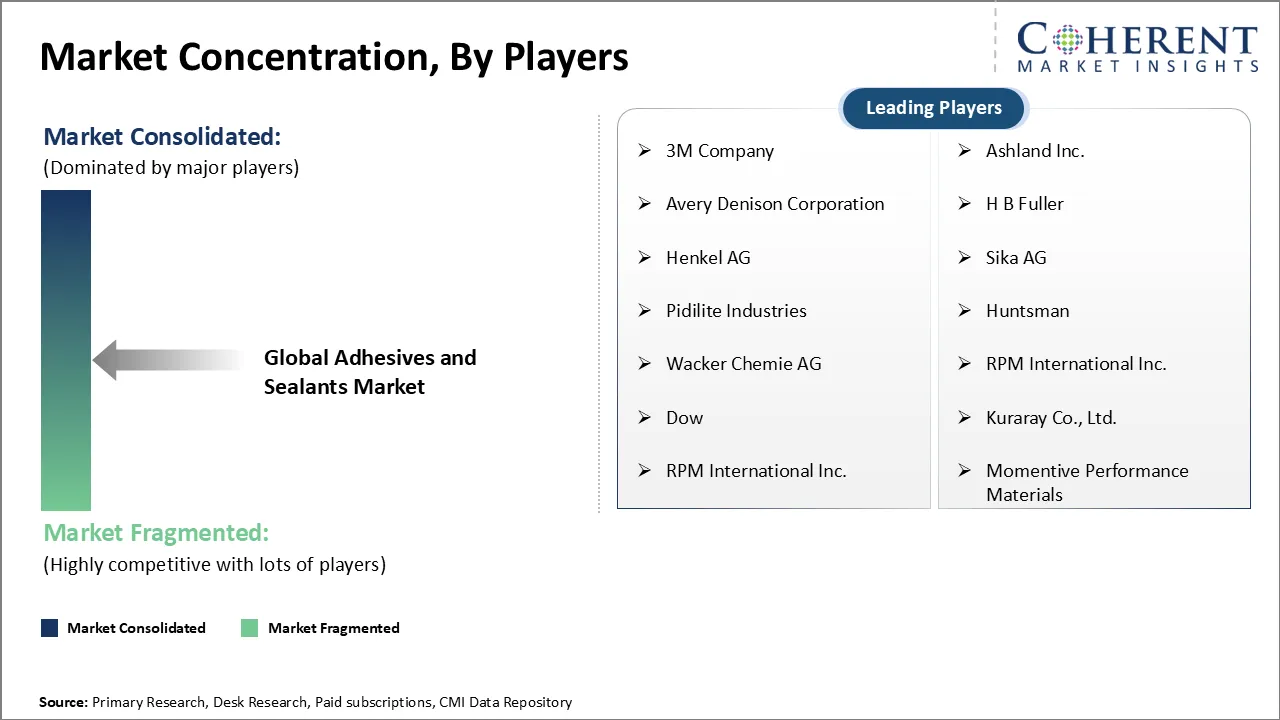
| Companies covered: | 3M Company, Ashland Inc., Avery Denison Corporation, H B Fuller, Henkel AG, Sika AG, Pidilite Industries, Huntsman, Wacker Chemie AG, RPM International Inc., Dow, Kuraray Co., Ltd., RPM International Inc., and Momentive Performance Materials | ||
| Growth Drivers: |
| ||
| Restraints & Challenges: |
| ||
Adhesives and Sealants Market Dynamics
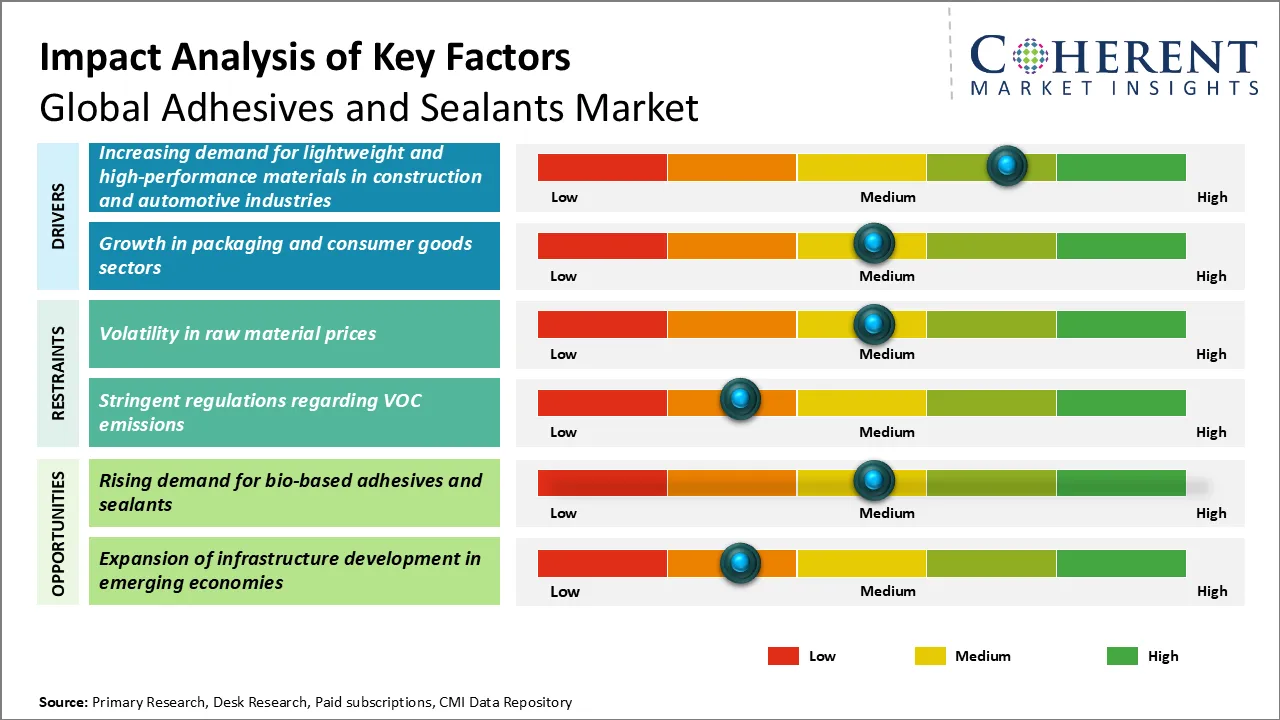
Adhesives and Sealants Market Driver - Increasing Demand for Lightweight and High-Performance Materials in Construction and Automotive Industries
The growing emphasis on improving fuel efficiency and reducing carbon emissions has significantly driven the demand for lightweight and high-performance materials in both the construction and automotive industries, subsequently fueling the adhesives and sealants market. In the automotive sector, manufacturers are increasingly adopting advanced composites and lightweight metals such as aluminum and magnesium to replace traditional steel components, aiming to enhance vehicle performance and meet stringent environmental regulations.
For example, BMW’s use of structural adhesives in its i-Series electric vehicles (such as the BMW i3 and i8), where carbon fiber-reinforced plastics (CFRP) and aluminum are bonded using high-performance adhesives instead of traditional welding. This not only reduces vehicle weight but also improves crash performance and structural integrity.
Adhesives and Sealants Market Opportunity - Rising Demand for Bio-Based Adhesives and Sealants
The growing awareness about environmental sustainability and stringent regulations on volatile organic compounds (VOCs) emissions are driving significant demand for bio-based adhesives and sealants in the global market. Manufacturers across various industries—such as automotive, construction, packaging, and electronics—are actively seeking eco-friendly alternatives to conventional synthetic adhesives that rely heavily on petrochemical resources. Bio-based adhesives, derived from renewable raw materials like starch, soy protein, and natural resins, offer reduced carbon footprints and enhanced biodegradability, aligning perfectly with green building certifications and corporate sustainability goals.
For example, Arkema (Bostik) developed bio-based hot melt adhesives under its SAF and Flexcryl ranges, made from renewable feedstocks, targeting packaging, automotive interiors, and construction applications.
Analyst Opinion (Expert Opinion)
- The global adhesives and sealants market is experiencing robust growth, driven by advancements in technology and increasing demand across various sectors, including construction and automotive. Insights from the European Adhesive and Sealant Conference (2023) and the Global Adhesives Summit (2022) underscored the pivotal role of innovation, with companies like Henkel and 3M spearheading developments in eco-friendly formulations.
- Henkel’s recent launch of a bio-based adhesive line reflects the industry's shift towards sustainability, addressing consumer demand for environmentally responsible products. Discussions at these events highlighted the importance of performance enhancements, such as improved bond strength and durability, particularly in high-stress applications. However, challenges such as raw material price fluctuations and increasing regulatory scrutiny were noted as potential barriers to growth.
- Companies that prioritize R&D to develop smart adhesives with integrated functionalities will likely gain a competitive edge. Additionally, partnerships with key industries to create tailored solutions can facilitate market penetration. Ultimately, the adhesives and sealants market’s trajectory will depend on its ability to innovate while effectively meeting the evolving needs of diverse applications and sustainability mandates.
Speak to the analyst
Want personalized insights?
Take the findings above to one of our principal consultants, or have the report rebuilt around the segments, geographies and competitors you actually track.
Market Segmentation
- Adhesives Technology Insights (Revenue, USD Bn, 2021 - 2033)
- Water Based
- Solvent Based
- Hot Melt
- Reactive & Others
- Adhesives Product Insights (Revenue, USD Bn, 2021 - 2033)
- Acrylic
- PVA
- Polyurethane
- Styrenic block
- Epoxy
- EVA
- Other Products
- Adhesives Application Insights (Revenue, USD Bn, 2021 - 2033)
- Paper & Packaging
- Consumer & DIY
- Building & Construction
- Furniture & Woodworking
- Footwear & Leather
- Automotive & Transportation
- Medical
- Other Applications
- Sealants Product Insights (Revenue, USD Bn, 2021 - 2033)
- Silicones
- Polyurethanes
- Acrylic
- Polyvinyl Acetate
- Others
- Sealants Application Insights (Revenue, USD Bn, 2021 - 2033)
- Construction
- Automotive
- Packaging
- Assembly
- Consumers
- Others
- Regional Insights (Revenue, USD Bn, 2021 - 2033)
- North America
- U.S.
- Canada
- Latin America
- Brazil
- Argentina
- Mexico
- Rest of Latin America
- Europe
- Germany
- U.K.
- Spain
- France
- Italy
- Russia
- Rest of Europe
- Asia Pacific
- China
- India
- Japan
- Australia
- South Korea
- ASEAN
- Rest of Asia Pacific
- Middle East
- GCC Countries
- Israel
- Rest of Middle East
- Africa
- South Africa
- North Africa
- Central Africa
- North America
- Key Players Insights
- 3M Company
- Ashland Inc.
- Avery Denison Corporation
- H B Fuller
- Henkel AG
- Sika AG
- Pidilite Industries
- Huntsman
- Wacker Chemie AG
- RPM International Inc.
- Dow
- Kuraray Co., Ltd.
- RPM International Inc.
- Momentive Performance Materials
Sources
Primary Research Interviews
- R&D Director – Leading Adhesive Technology Manufacturer
- Procurement Manager – Major Construction Chemicals Distributor
- Product Development Head – Well-Known Sealant Brand
- Sustainability Manager – Green Building Certification Body
Stakeholders
- Manufacturers
- End-use Sectors:
- Construction (structural adhesives, waterproofing sealants)
- Automotive OEMs and Aftermarket Suppliers
- Electronics/Appliance Manufacturers (PCB, device assembly)
- Packaging, Paper & Board (carton and case adhesives)
- Footwear & Leather, Woodworking, DIY
- Regulatory & Certification Bodies
- E-commerce Platforms and Retailers
- Technology Integration Players: Automation, smart dispensing systems
Databases
- UN Comtrade Database – International trade of adhesives and sealants
- India Import Export (EXIM) Database – Regional adhesives and sealants trade flows
- Global Construction Chemicals Database
- Platts Chemical Market Database
- CEIC Global Chemical Production Database
Magazines
- Adhesives & Sealants Industry Magazine – Trends and new technologies
- Chemical Week – Market updates for adhesives, resins and sealants
- European Coatings Journal – Adhesive and sealant raw materials
- Asian Chemicals News – Market movements in APAC
- Modern Packaging – Innovations in packaging adhesives
Journals
- International Journal of Adhesion and Adhesives – New formulations, performance studies
- Journal of Materials Science – Material compatibility and bond strengths
- Journal of Applied Polymer Science – Advances in sealant chemistry
- Journal of Construction and Building Materials – Use cases in construction
- Polymer Engineering & Science – Adhesive applications in manufacturing
Newspapers
- The Chemical Engineer – Global market movements
- The Times of India – India adhesives market and construction projects
- China Daily – Asia-Pacific regional production and demand
- The Financial Times – Industry M&A and market expansion news
- Wall Street Journal – Global demand drivers and corporate strategies
Associations
- Adhesive and Sealant Council (ASC)
- European Adhesive & Sealant Manufacturers Association (FEICA)
- American Chemical Society (ACS) – Division of Polymeric Materials
- China National Adhesives Industry Association
- International Union of Pure and Applied Chemistry (IUPAC)
- Sustainable Green Building Council
Public Domain Sources
- U.S. EPA – Regulations for VOC content in adhesives/sealants
- European Chemicals Agency (ECHA) – REACH regulation and chemical safety
- European Commission – Construction Product Regulation, packaging guidelines
- World Health Organization – Occupational exposure studies
Proprietary Elements
- CMI Data Analytics Tool, Proprietary CMI Existing Repository of information for last 8 years.
Get access to 250+ pages report
Every segment, forecast, competitor profile and data table behind the analysis above — available for instant download.
- ESOMAR Member
- ISO 9001:2015 Certified
- D-U-N-S Registered
- GDPR & CCPA Compliant
Missing comfort of reading report in your local language? Find your preferred language:
Transform your Strategy with Exclusive Trending Reports
Frequently Asked Questions
The global adhesives and sealants market is estimated to be valued at USD 72.96 Bn in 2026 and is expected to reach USD 104.74 Bn by 2033.
The CAGR of global adhesives and sealants market is projected to be 5.3% from 2026 to 2033.
Key environmental regulations impacting the adhesives and sealants market include restrictions on volatile organic compounds (VOCs), compliance with REACH (Registration, Evaluation, Authorization, and Restriction of Chemicals) in the EU, and adherence to EPA guidelines in the U.S. for chemical emissions.
Sustainable adhesives and sealants are evolving through increased adoption of bio-based materials, such as plant starch, cellulose, and natural resins, driven by environmental regulations, consumer demand for eco-friendly products, and technological advancements in adhesive performance.
Increasing demand for lightweight and high-performance materials in construction and automotive industries and growth in packaging and consumer goods sectors are the major factors driving the growth of the global adhesives and sealants market.
Volatility in raw material prices and stringent regulations regarding VOC emissions are the major factors hampering the growth of the global adhesives and sealants market.
In terms of adhesives technology, water based is estimated to dominate the market revenue share in 2026.