

Global Industrial Adhesives Market Size and Share Analysis – 2026 to 2033
Industrial Adhesives Market is estimated to be valued at USD 51.02 Bn in 2026 and is expected to reach USD 80.86 Bn in 2033, exhibiting a compound annual growth rate (CAGR) of 6.8% from 2026 to 2033.
Key Takeaways
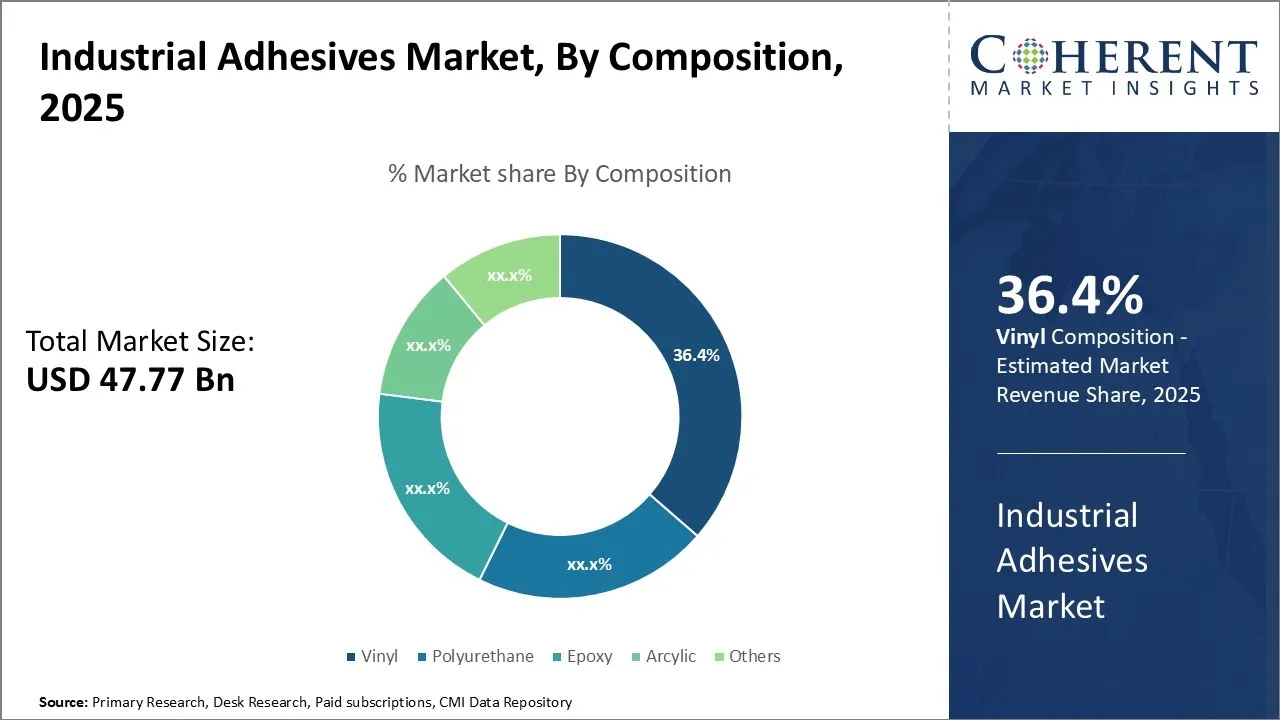
- Based on Composition, The Vinyl Segment is expected to dominate the global market over the forecast period with a market share of 37.4%. This is due to their versatility, cost-effectiveness, and strong bonding capabilities across various substrates like plastics, metals, and wood.
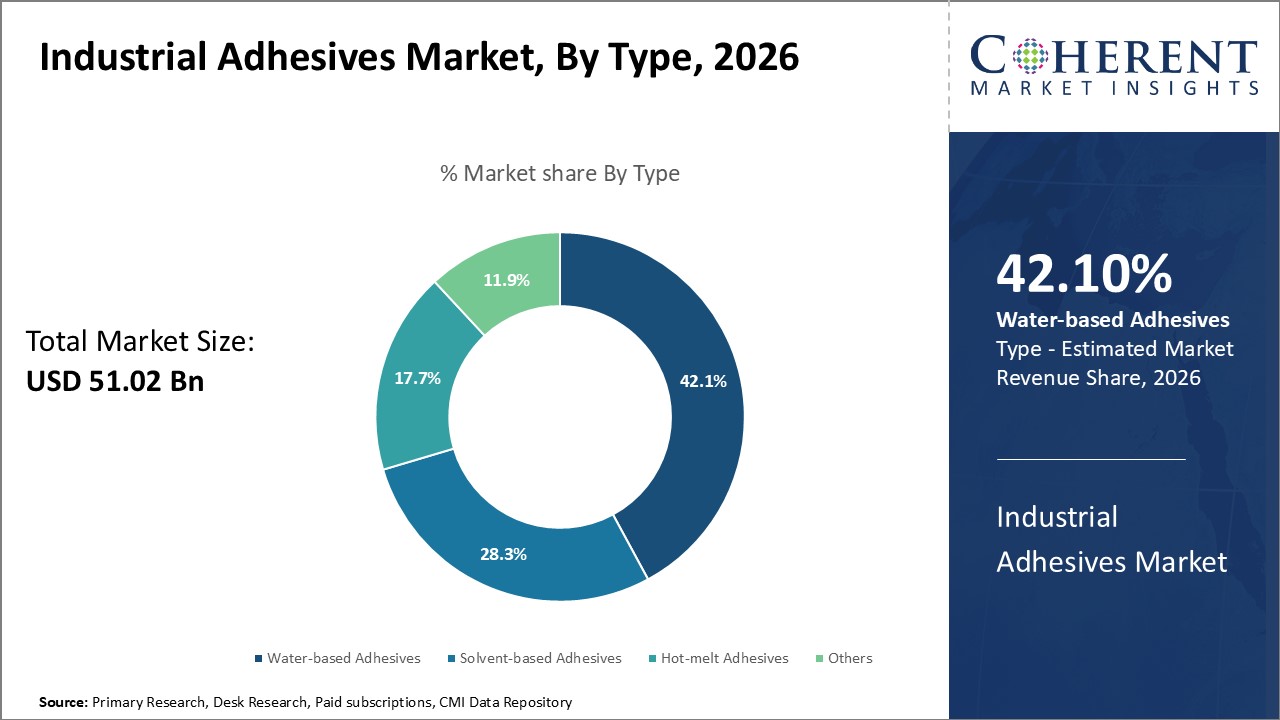
- Based on Type, the Water-Base segment is expected to hold the largest share of the market in 2026, driven by its eco-friendly, non-toxic composition and rising use in packaging and food applications.
- Based on End User, the Automotive Industry segment is expected to contribute the highest share of the market in 2026, attributed to the growing manufacturing passenger car.
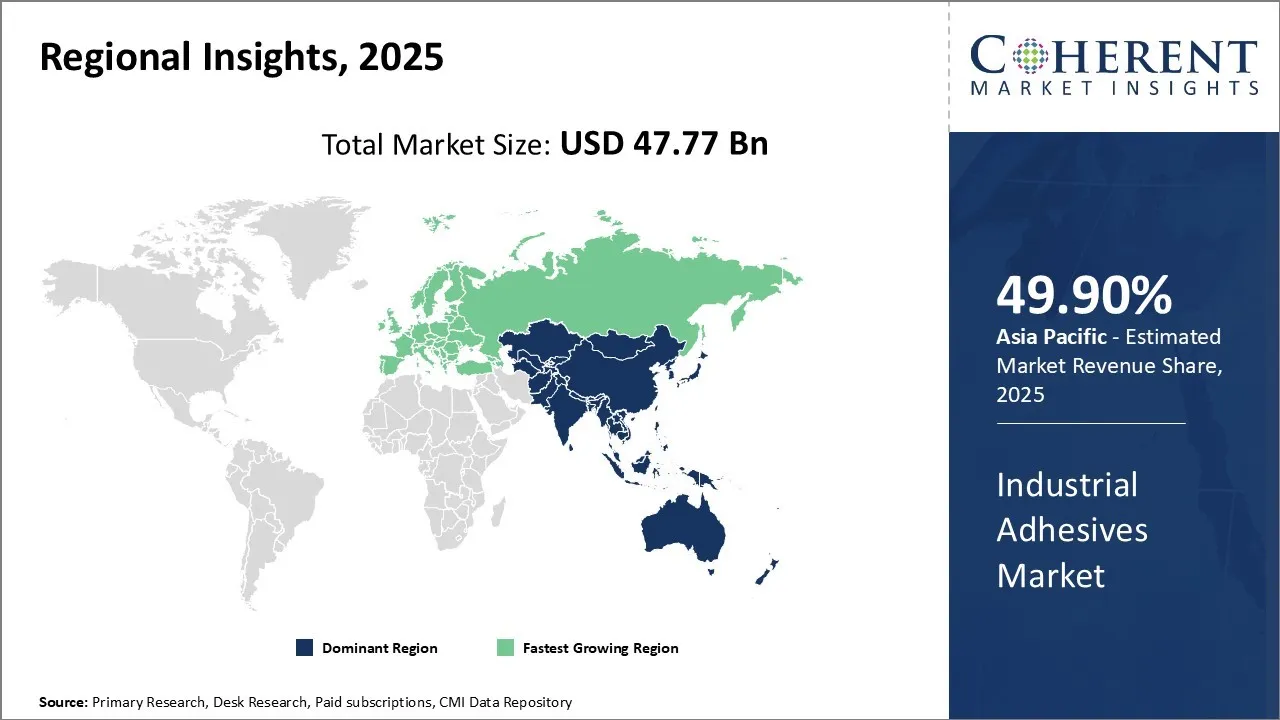
- Based on Region, Asia Pacific is expected to dominate the global market with 49.9% shares in 2026. This is due to the growing manufacturing of passenger cars.
Market Overview
The industrial adhesives market is being propelled by rising demand from large-scale industries such as automotive, construction, packaging, electronics, and aerospace, where high-performance, light, and tough bonding materials are critical. Growing interest in replacing welding and mechanical fasteners with adhesives for weight savings and improved aesthetic appeal is also fueling adoption. In addition, the move toward energy-efficient manufacturing and sustainability has been impacting low-VOC, solvent-free, and bio-based adhesive formulating demand.
Current Events and Its Impact on Industrial Adhesives Market
Current Events | Description and its impact |
Henkel Introduces Bio-Based Adhesive Series for Automobiles |
|
3M Develops AI-Enabled Adhesive Dispensing System
|
|
Segmental Insights
- Current Industry Events of 2026
- Market Size Estimation
- Regional Breakdown
- Competitive Landscape
- Customer Intelligence
- Segmental Analysis
- Pricing Analysis
- Key Market Drivers, Challenges & Future Trends
- Customized Insights Section
Global Industrial Adhesives Market Insights, By Composition
Based on composition, the Vinyl is expected to dominate the global market with 37.4% share in 2026, due to their versatility, cost-effectiveness, and strong bonding capabilities across various substrates like industrial adhesives market bonding plastic to metal, and wood.
These are widely used in packaging, construction, and automotive industries due to their durability and ease of application. Vinyl adhesives also offer good resistance to moisture and chemicals. Additionally, ongoing innovations in water-based vinyl formulations align with environmental regulations, further boosting demand.
Global Industrial Adhesives Market Insights, By Type
Based on type, the water-based segment has a major share in the global industrial adhesives market and is expected to continue growing at a rapid pace. It is made from non-toxic ingredients and is eco-friendly, thus resulting in increased adoption in packaging and food applications.
Hot melt Adhesives segment is also expected to witness significant growth in the near future. Hot-melt adhesives come in cartridge, pen, powder, granulate or mesh form and melt at high temperatures. They are often applied with a glue gun and can be sprayed or dispensed onto the surface to be bonded. They are solvent free, with no mixing required.
Global Industrial Adhesives Market Insights, By End Use Industry
Based on end use industry, the Automotive Industry is expected to dominate the global market over the forecast period and this is attributed to the growing manufacturing passenger car. Construction Industry segment is also expected to witness significant growth in the near future and this is owing to the rapid urbanization and industrialization.
Regional Insights
Asia Pacific Industrial Adhesives Market Analysis and Trend
Asia Pacific is expected to dominate the global industrial adhesives market with 49.9% share in 2026, due to growth in the construction sector. In addition, the demand for automotive adhesives is expected to increase owing to a surge in the sale of passenger cars. Moreover, growing demand from packaging, furniture, automotive, and a variety of other end use applications is further anticipated to augment regional market growth.
North America Industrial Adhesives Market Analysis and Trend
North America is expected to exhibit the fastest growth of the market, attributed to the established industrial sector. Also, ongoing technological advancements due to heavy investment in R&D is again fueling regional market growth.
Industrial Adhesives Market Dominating Countries
United States Industrial Adhesives Market Analysis and Trend
The U.S. is an important industrial adhesives market, fueled by its advanced manufacturing sectors, e.g., automotive, aerospace, and electronics. High demand for performance adhesives and tough environmental regulations fuel growth, especially in green and low-VOC products. Major companies like 3M and Henkel have a strong local footprint and R&D infrastructure, which should support growth.
Germany Industrial Adhesives Market Analysis and Trend
Germany dominates the European industrial adhesives industry with assistance from its premium automotive and engineering industries. German producers are known to be accurate and of high quality, thus focusing on specialty and high-performance adhesives. Germany also invests heavily in green adhesive technologies to meet the EU's Green Deal as well as the objectives of industrial decarbonization.
China Industrial Adhesives Market Analysis and Trend
China is the global largest producer and user of industrial adhesives due to its massive manufacturing complex for electronics, construction, and consumer goods. Competitive prices, strong domestic demand, and increasing exports are driving market development. Local firms are also increasing R&D to make a shift from low-end products to value-added adhesive products.
Japan Industrial Adhesives Market Analysis and Trend
Japan holds a big share in the industrial adhesives market, particularly in sophisticated applications like electronics, automotive, and semiconductor. The country is quality- and innovation-aware, with ongoing innovation of high-performance adhesives for miniaturization and precision devices. The country's environmental legislation also stimulates demand for clean, solvent-free Quantities.
Market Report Scope
Industrial Adhesives Market Report Coverage
| Report Coverage | Details | ||
|---|---|---|---|
| Base Year: | 2025 | Market Size in 2026: | USD 51.02 Bn |
| Historical Data for: | 2020 To 2024 | Forecast Period: | 2026 To 2033 |
| Forecast Period 2026 to 2033 CAGR: | 6.8% | 2033 Value Projection: | USD 80.86 Bn |
| Geographies covered: |
| ||
| Segments covered: |
| ||
| Companies covered: | Henkel, 3M, Bostik, Avery Dennision, H.B. Fuller, Jowat, and Pidilite Industries Limited | ||
| Growth Drivers: |
| ||
| Restraints & Challenges: |
| ||
Global Industrial Adhesives Market Drivers
- Growing demand from packaging industry to propel market growth
Industrial adhesives are a type of bonding materials used to join two or more substrates together. They are produced from natural and synthetic polymeric materials. These substances can be used either wet or dry and are available in a range of textures, viscosities, and strengths. They are widely used in packaging industry as they are highly effective and provide excellent performance characteristics.
In July 2025, Dow launched INNATE TF 220, a recyclable BOPE packaging resin used alongside laminating adhesives to create flexible packaging with 10% post-consumer recycled content. The solution improves production efficiency, durability, and aesthetics while minimizing manufacturing waste, and was tested in China’s first fully recyclable laundry detergent pack with Liby, underscoring adhesives’ crucial role in sustainable packaging systems.
- Growing demand for sustainable and durable products to augment market growth
Rising demand for sustainable and durable products is a significant factor that is projected to drive the market growth in the near future. This is due to the increasing construction of residential and commercial buildings in emerging countries.
The rapid development of e-commerce sector is another factor that is projected to fuel the growth of this market. The market is also boosted by rising middle-class household income in developing countries.
Global Industrial Adhesives Market Opportunities
Industrial adhesives market is expected to witness lucrative growth opportunities in the future due to rapid urbanization, increasing population, growing new construction and infrastructure development activities. Increasing demand for construction materials that offer high adherence, improved performance and simpler application methods are further drive the market for industrial adhesives.
Growing demand for water-based adhesives due to rising environmental concerns is expected to offer additional market opportunities. Water-based adhesives are manufacture from water, polymers and a choice of additives. They cure by the evaporation of the water and are often used in gluing porous or semi-porous materials such as cardboard, paper, and wood.
Global Industrial Adhesives Market Trends
- Shift towards a greener technology
A shift toward greener and sustainable technologies is projected to boost the demand for bio-based industrial adhesives in the near future. Key manufacturers are investing heavily in the research and development of eco-friendly alternatives to petrochemical-based products. Moreover, adhesives based on natural products are a fast-growing segment of the market because they offer excellent strength, durability and performance at a lower cost.
Global Industrial Adhesives Market: Key Developments
- In 2024, Power Adhesives introduced Tecbond 214B, the world's first totally certified biodegradable shape hot melt adhesive. With 45% bio-based content, it provides high bonding strength yet breaks down naturally into water, carbon dioxide, and organic matter. It facilitates circular economy strategies and reduces microplastic pollution.
Analyst View
- The market for industrial adhesives is propelled by growing demand from the automotive and packaging industries, where adhesives help to increase structural strength and manufacturing productivity. Increased industrialization in emerging economies, especially in Asia Pacific, further speeds up market growth through enhanced manufacturing activity and infrastructure projects. Increasing output in consumer goods, furniture, and non-woven fabrics industries also significantly supports adhesive demand.
- Key drivers are the automotive sector's move towards light materials and the packaging sector's requirement for flexible, tough solutions. Industrialization in developing economies—India, China, and Vietnam—drives growth as manufacturing bases widen. The market is however constrained by tight environmental regulations aimed at volatile organic compound emissions and raw material price volatility, which undermine cost stability and innovation.
- Opportunities come from the trend towards sustainable, bio-based adhesives, supporting global environmental policies and corporate sustainability initiatives. Asia Pacific leads the world with its huge manufacturing presence, urbanization, and infrastructure spending. The region gains from shifting automotive production bases and increased use of specialist adhesives in aerospace and high-performance markets.
Market Segmentation
- Global Industrial Adhesives Market, By Composition (Revenue, USD Bn, 2021 - 2033)
- Polyurethane
- Epoxy
- Vinyl
- Acrylic
- Others
- Global Industrial Adhesives Market, By Type (Revenue, USD Bn, 2021 - 2033)
- Water-based Adhesives
- Solvent-based Adhesives
- Hot-melt Adhesives
- Others
- Global Industrial Adhesives Market, By End Use Industry (Revenue, USD Bn, 2021 - 2033)
- Packaging Industry
- Construction Industry
- Automotive Industry
- Electrical & Electronics
- Others
- Global Industrial Adhesives Market, By Region (Revenue, USD Bn, 2021 - 2033)
- North America
- U.S.
- Canada
- Latin America
- Brazil
- Argentina
- Mexico
- Rest of Latin America
- Europe
- Germany
- U.K.
- Spain
- France
- Italy
- Russia
- Rest of Europe
- Asia Pacific
- China
- India
- Japan
- Australia
- South Korea
- ASEAN
- Rest of Asia Pacific
- Middle East
- GCC Countries
- Israel
- Rest of Middle East
- Africa
- South Africa
- North Africa
- Central Africa
- North America
- Company Profiles
- Henkel
- 3M
- Bostik
- Avery Dennision
- H.B. Fuller
- Jowat
- Pidilite Industries Limited
Sources
Primary Research Interviews
- Industrial Adhesive Manufacturers
- Raw Material Suppliers
- End-User Industry Representatives (Automotive, Construction, Electronics)
- Distributors and Retailers
- Others
Databases
- Global Trade Information Services (GTIS)
- Euromonitor International
- Others
Magazines
- Adhesives & Sealants Industry Magazine
- Chemical Engineering Magazine
- Industrial Paint & Powder Magazine
- Coatings World Magazine
- Others
Journals
- International Journal of Adhesion and Adhesives
- Journal of Applied Polymer Science
- Progress in Polymer Science
- Others
Newspapers
- Chemical & Engineering News
- Plastics News
- European Chemical News
- Asian Chemical News
- Others
Associations
- Adhesive and Sealant Council (ASC)
- European Adhesive & Sealant Industry Association (FEICA)
- China Adhesive and Tape Industry Association (CATIA)
- Japan Adhesive Industry Association (JAIA)
- Others
Public Domain Sources
- Company Annual Reports and SEC Filings
- Government Statistical Offices
- International Trade Administration Reports
- World Bank Industrial Data
- Others
Proprietary Elements
- CMI Data Analytics Tool
- Proprietary CMI Existing Repository of information for last 8 years
*Definition: Industrial adhesives are a great choice for bonding metals, plastics, and other surfaces that are exposed to chemicals or extreme heat.
Get access to 250+ pages report
Every segment, forecast, competitor profile and data table behind the analysis above — available for instant download.
- ESOMAR Member
- ISO 9001:2015 Certified
- D-U-N-S Registered
- GDPR & CCPA Compliant
Missing comfort of reading report in your local language? Find your preferred language:
Transform your Strategy with Exclusive Trending Reports
Frequently Asked Questions
The Industrial Adhesives Market size is estimated to be valued at USD 51.02 Bn in 2026, and is expected to reach USD 80.86 Bn by 2033.
The CAGR of the global Market is projected to be 6.8% from 2026 to 2033.
Growing demand from packaging industry and rising demand for sustainable and durable products are fuelling growth of the market.
The Vinyl segment is the leading segment in the market.
Fluctuating price of raw materials is the major factors restraining growth of the market.
Henkel, 3M, Bostik, Avery Dennision, H.B. Fuller, Jowat, and Pidilite Industries Limited.
Yes, there are health concerns associated with industrial adhesives, especially during manufacturing, application, and curing processes.