

Hydro Chlorofluorocarbon Market Size and Share Analysis- 2026 To 2033
The Hydro Chlorofluorocarbon Market size is anticipated to grow at a CAGR of 3.8%, with USD 1.7 Bn in 2026 and is expected to reach USD 2.2 Bn by 2033. The primary drivers are largely defined by the continued servicing requirements of legacy refrigeration and air-conditioning equipment, sustained cooling demand across developing economies, expansion of commercial and industrial refrigeration applications, and increasing use of recovered and reclaimed HCFC refrigerants for maintaining existing systems. According to the U.S. Environmental Protection Agency (EPA) is phasing out the production and consumption of HCFCs gradually, with a complete 100% phase-out targeted for 2030 in the U.S. This will reduce their use in a variety of applications, including refrigeration, air conditioning, foam-blowing, and other industrial uses.
Key Takeaways
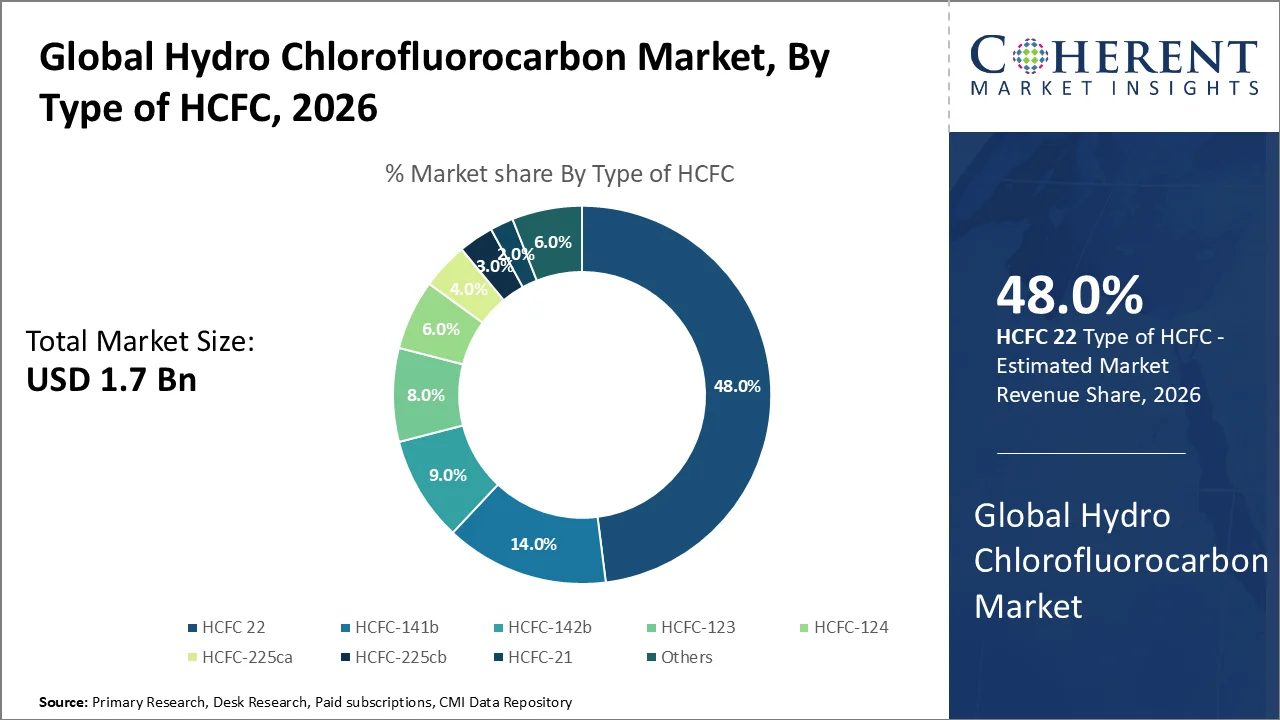
- The HCFC-22 segment is likely to dominate the market with 48.0% in 2026. The segment’s dominance is owing to its historically extensive use in residential and commercial air-conditioning, refrigeration systems, heat pumps, and the continuing servicing requirements of the large installed base of R-22 equipment. The U.S. EPA states that HCFC-22 (R-22) was the most common refrigerant in residential heat pumps and air-conditioning systems for many decades, although U.S. servicing demand has shifted to reclaimed, recycled, and previously produced material following the phase-out of virgin HCFC-22.
- Refrigeration segment is projected to lead with 42.0% in 2026. The dominance of this segment is due to the significant installed base of domestic, commercial, industrial, and transport refrigeration equipment that still needs HCFCs for servicing, particularly in developing economies. According to India’s Ozone Cell, implementation of HPMP Stage-II reduced HCFC consumption by 8,190 MT by 2023, while refrigeration and air-conditioning servicing activities are expected to continue through 2040, highlighting the continuing aftermarket requirement from legacy equipment.
- The polyurethane foam segment is expected to account for approximately 60.0% of the foam market in 2026. Its prominent position is associated with the historical use of HCFC-141b as a blowing agent in rigid polyurethane insulation used in appliances, construction, cold-chain equipment, and other thermal-insulation applications. According to the UNEP Technology and Economic Assessment Panel (TEAP), approximately 80% of HCFC-141b used in Article 5 countries has already been replaced with non-fluorocarbon alternatives.
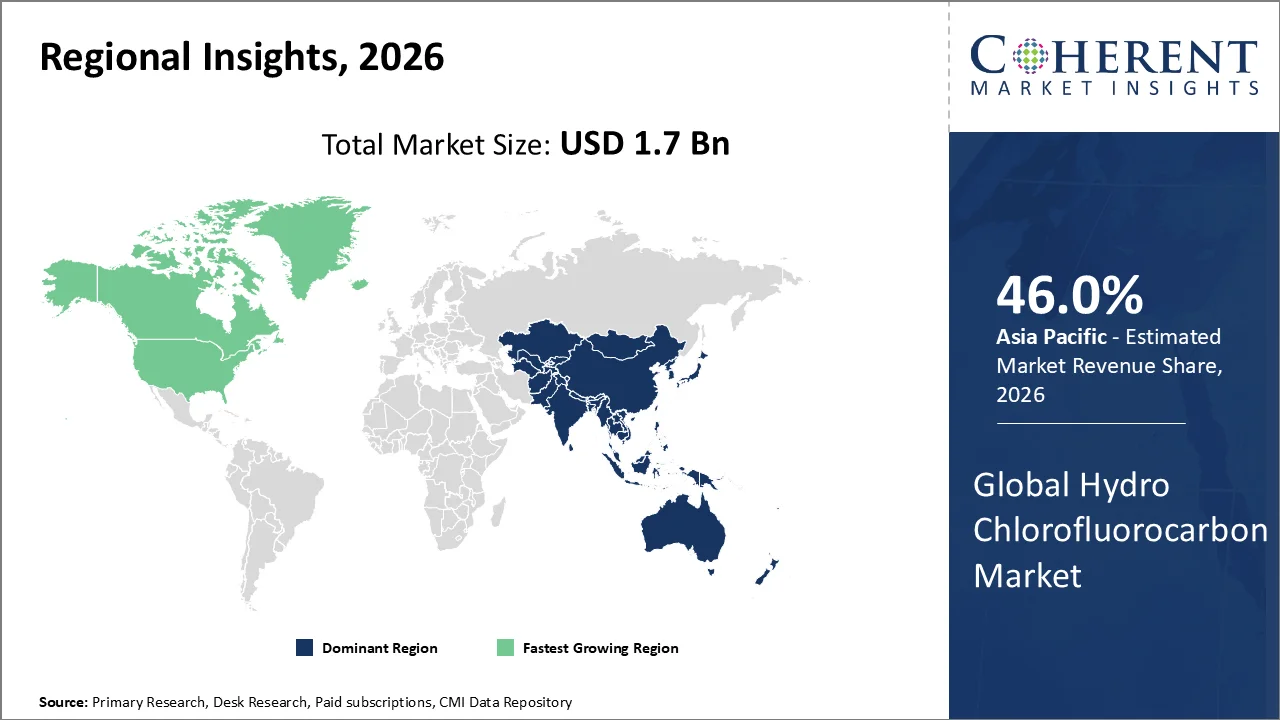
- Asia Pacific is expected to acquire the prominent share of approximately 46.0% in 2026. The region’s dominance is owing to its large refrigeration and air-conditioning installed base, significant fluorochemical manufacturing capacity, continuing servicing demand, and comparatively later HCFC phase-out timetable across developing economies. HCFC Phase-out Management Plan Stage III (2023–2030), the country is targeting an additional reduction of 10,678.87 metric tons of HCFC consumption, while the transition is projected to deliver approximately 19.24 million metric tons of CO₂-equivalent emission reductions from 2030 onward.
Market Drivers
Large Installed Base of HCFC-Based Refrigeration and Air-Conditioning Equipment Sustains Servicing Demand
The Hydro Chlorofluorocarbon Market continues to receive near-term support from the large installed base of refrigeration and air-conditioning equipment that still operates on HCFC-22. New equipment is increasingly using alternative refrigerants, but existing systems still require refrigerant for maintenance, leakage replacement, repair and servicing, especially in developing economies.
In 2026, India’s Ozone Cell continued its dedicated Training & Certification Program for RAC Service Technicians under HPMP Stage-III. The official training curriculum specifically covers installation and repair of room air conditioners using HCFC-22, HFC-32 and flammable refrigerants.
Current Events and Their Impact on the Hydro Chlorofluorocarbon Market
Current Event | Description and its Impact |
China Tightens HCFC Production and Consumption Quotas for 2026 |
|
Developing Countries Enter the Final HCFC Phase-Out Stage Following the 2025 Reduction Milestone |
|
- Current Industry Events of 2026
- Market Size Estimation
- Regional Breakdown
- Competitive Landscape
- Customer Intelligence
- Segmental Analysis
- Pricing Analysis
- Key Market Drivers, Challenges & Future Trends
- Customized Insights Section
Segmental Insights
Why is HCFC-22 Acquiring the Largest Share?
On the basis of HCFC type, the HCFC-22 segment is projected to account for the largest Hydro Chlorofluorocarbon Market share of 48.0% in 2026. The segment’s dominance is owing to the extensive installed base of residential and commercial air-conditioning, heat-pump, and refrigeration systems that historically relied on HCFC-22, together with continuing servicing and refrigerant-replacement requirements for legacy equipment.
The U.S. Environmental Protection Agency (EPA), in its August 2026 update, identifies HCFC-22 or R-22 as the most common HCFC still in use today, particularly in existing air-conditioning and refrigeration equipment. EPA reports that approximately 50 certified refrigerant reclaimers currently operate across the U.S., and specifically notes that reclaimed HCFC-22 played an important role in maintaining adequate supplies for servicing equipment following the phase-out of virgin production.
Why does Refrigeration Hold the Largest Market Share?
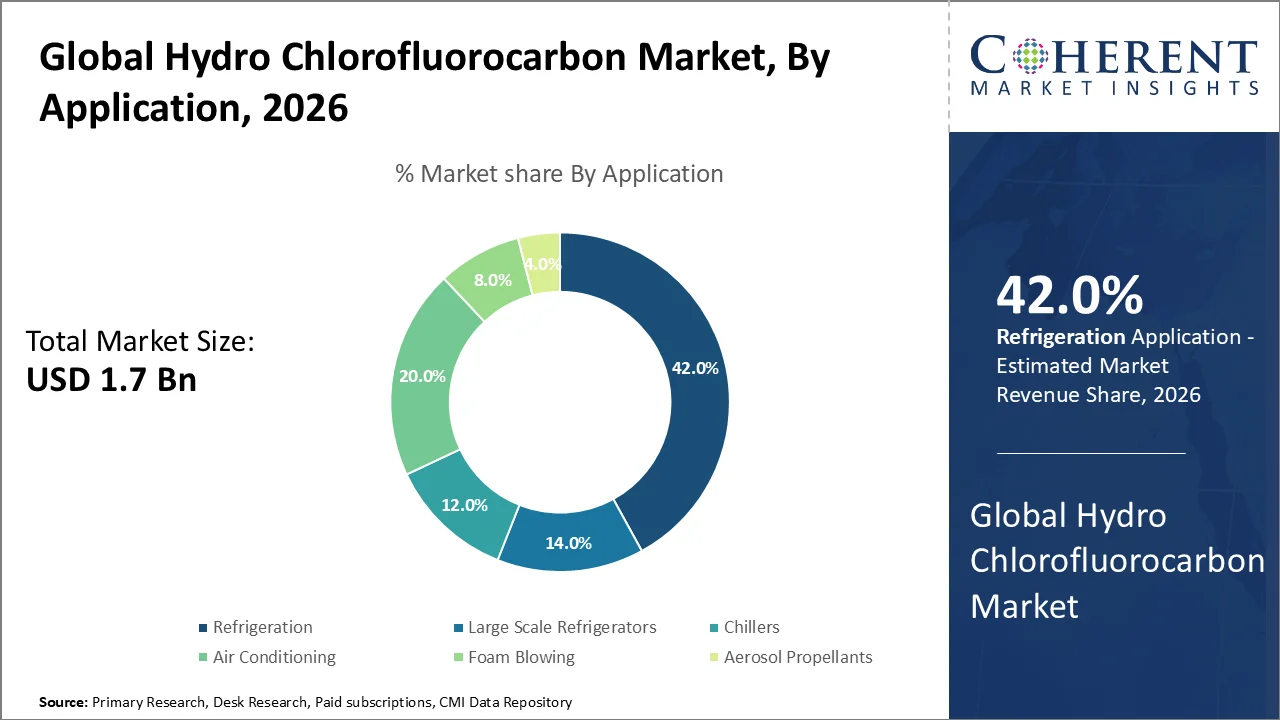
On the basis of application, the refrigeration segment is set to lead the Hydro Chlorofluorocarbon Market with 42.0% share in 2026. The segment’s dominance is owing to the extensive use of HCFC refrigerants across legacy commercial refrigeration, cold storage, food processing, refrigerated transport, and industrial refrigeration equipment, particularly in developing economies where equipment replacement occurs gradually.
According to UNEP, in June 2026, poor cold-chain infrastructure leads to the loss of an estimated 526 million tons of food each year, roughly 12% of global food production and enough to feed around 1 billion people.
In June 2026, A-Gas and Solstice Advanced Materials entered into a strategic agreement to expand supply of lower-GWP refrigerants using reclaimed materials for existing refrigeration systems.
Why is Polyurethane Foam Acquiring the Largest Share?
On the basis of foam type, the polyurethane foam segment is expected to account for approximately 60.0% of the Hydro Chlorofluorocarbon foam market in 2026. The segment’s prominent position is owing to the historical use of HCFC-141b as a blowing agent in rigid polyurethane foam, particularly for thermal insulation in refrigerators, cold-storage panels, buildings, pipes, appliances, and industrial equipment.
In a December 2025 assessment, the Multilateral Fund reported that, at the start of Stage II of the HCFC Phase-out Management Plan, some 30% of India’s remaining HCFC consumption was in polyurethane foam, highlighting the historically important role of foam manufacturing in HCFC demand.
In September 2025, Vitapur Nigeria Ltd, a subsidiary of Vitafoam Nigeria Plc, commissioned an Optimized System House in Lagos and phased out HCFC-141b completely from its polyurethane foam operations. The conversion eliminates more than 301 metric tons of HCFC-141b consumption annually.
Hydro Chlorofluorocarbon Market Trends
- The growing shift from virgin HCFC supply toward refrigerant recovery, recycling, and reclamation is reshaping the aftermarket for legacy refrigeration and air-conditioning systems. The U.S. EPA reported that total HFC reclamation increased by approximately 30% in 2024 compared with 2023 and noted that a similar expansion in reclamation occurred during the HCFC phase-out. This indicates an increasingly circular supply model for servicing older HCFC-based equipment as virgin availability declines.
- The accelerating adoption of low-GWP refrigerants is reducing HCFC use in newly manufactured cooling equipment. In April 2026, UNEP and ASHRAE released an updated refrigerant designation and safety-classification resource covering new refrigerants introduced into international markets.
- The increasing concentration of HCFC-22 consumption in chemical feedstock applications is becoming an important structural trend as emissive refrigeration uses are phased out. According to UNEP’s 2026 TEAP Progress Report, HCFC-22 feedstock use increased from 978,084 tonnes in 2023 to 990,395 tonnes in 2024 and represented approximately 51% of total reported ODS feedstock volume.
Regional Insights
Asia Pacific Dominates Owing to the Large Installed Cooling Base and Expanding Cold-Chain Infrastructure
The Asia Pacific region is expected to account for approximately 46.0% of the Hydro Chlorofluorocarbon Market share in 2026. The region’s dominance is owing to the large installed base of refrigeration and air-conditioning equipment, extensive cold-chain infrastructure, strong fluorochemical manufacturing activity, and continuing servicing requirements for legacy HCFC-based systems across China, India, and Southeast Asia.
Cold-chain expansion is also strengthening the underlying refrigeration equipment base. According to India’s Ministry of Food Processing Industries, 395 integrated cold-chain projects had been approved as of June 2025, with 291 operational projects providing 25.52 lakh metric tonnes of annual preservation capacity and 114.66 lakh metric tonnes of processing capacity. This continued expansion increases refrigeration and maintenance activity across one of Asia Pacific’s largest developing economies.
In February 2026, Navin Fluorine International Limited commenced commercial production at its new 40,000-tonnes-per-annum hydrofluoric acid facility in Dahej, Gujarat. The project involved an investment of approximately INR 450 crore and expands the company’s upstream fluorochemical manufacturing base.
North America Hydro Chlorofluorocarbon Market Trends
North America is expected to witness the fastest growth in the service- and reclamation-driven Hydro Chlorofluorocarbon Market over the forecast period. The region’s growth opportunity is primarily associated with the continued maintenance of legacy HCFC-22 refrigeration and air-conditioning equipment, established refrigerant recovery infrastructure, and increasing commercialization of reclaimed refrigerants rather than new HCFC production.
The U.S. EPA stated in August 2026 that HCFC-22 remains the most commonly used HCFC in the U.S., with the refrigerant continuing to be present in existing air-conditioning and refrigeration equipment. Although new HCFC-22 production and imports ended in 2020, EPA confirms that existing systems can continue to be serviced using recovered, reclaimed, or previously produced HCFC-22.
In August 2026, Chemours launched Opteon ZE (R-1234ze(E)) and Opteon 515B (R-515B) for stationary chiller applications in North America, including data centers, commercial buildings and other large-scale cooling systems.
Large Legacy R-22 Installed Base and Expanding Refrigerant Lifecycle Services are Supporting the U.S. Hydro Chlorofluorocarbon Market
The U.S. Hydro Chlorofluorocarbon Market is increasingly centered on the servicing, recovery, reclamation, and retrofit requirements of legacy HCFC-22 equipment. Although virgin R-22 production and imports have ended, a sizeable installed base of residential and commercial air-conditioning systems continues to operate, creating residual demand for reclaimed and recovered HCFC-22.
Investment is also increasing in refrigerant lifecycle-management infrastructure. In January 2026, J.F. Lehman & Company acquired majority stakes in Reclamation Technologies USA and Tradewater, establishing a new environmental-services platform focused on refrigerant recovery, reclamation, gas separation, cylinder programs, and lifecycle management.
China Hydro Chlorofluorocarbon Market Trends
The China Hydro Chlorofluorocarbon Market remains significant owing to the country’s large refrigeration and air-conditioning manufacturing base and extensive installed stock of HCFC-22 equipment. However, the market is undergoing accelerated structural transition as manufacturers replace HCFCs with lower-ODP and lower-GWP refrigerants while regulated HCFC demand becomes increasingly concentrated in servicing and permitted industrial applications.
According to a 2025 UNIDO assessment, China remains the world’s largest producer of room air-conditioning equipment and the largest consumer of HCFC-22 in this sector. Under its HCFC conversion program, more than 2.2 million R-290-compatible room air-conditioning units have been supported through enterprise conversions, while over 505,000 R-290 split air-conditioning units have already been sold domestically. Of these, 41% achieved the highest energy-efficiency class.
Who are the Major Companies in Hydro Chlorofluorocarbon Industry
Some of the major key players in Hydro Chlorofluorocarbon Market are Honeywell International Inc, Exxon Mobil Corporation, E.I. du Pont de Nemours & Company, Harp International Ltd, Daikin Industries, Ltd., Arkema S.A., Sinochem Group, Solvay S.A., ZEON Corporation, The Danfoss Group, Emerson Electric Co., GEA Group AG, Johnson Controls Inc., United Technologies Corporation.
Key News
- In October 2025, Honeywell International completed the spin-off of its Advanced Materials business as Solstice Advanced Materials. The newly independent company includes Honeywell’s former refrigerants and applied-solutions portfolio, including Solstice and Genetron refrigerants and blowing agents.
- In February 2025, Carrier launched its new V-Series WeatherMaster rooftop units using R-454B, marketed as Puron Advance. The series covers 27.5- to 100-ton cooling capacities, while R-454B has a GWP of 466, approximately 75% below R-410A.
Market Report Scope
Hydro Chlorofluorocarbon Market Report Coverage
| Report Coverage | Details | ||
|---|---|---|---|
| Base Year: | 2025 | Market Size in 2026: | USD 1.7 Bn |
| Historical Data for: | 2020 To 2024 | Forecast Period: | 2026 To 2033 |
| Forecast Period 2026 to 2033 CAGR: | 3.8% | 2033 Value Projection: | USD 2.2 Bn |
| Geographies covered: |
| ||
| Segments covered: |
| ||
| Companies covered: | Honeywell International Inc, Exxon Mobil Corporation, E.I. du Pont de Nemours & Company, Harp International Ltd, Daikin Industries, Ltd., Arkema S.A., Sinochem Group, Solvay S.A., ZEON Corporation, The Danfoss Group, Emerson Electric Co., GEA Group AG, Johnson Controls Inc., United Technologies Corporation. | ||
| Growth Drivers: |
| ||
| Restraints & Challenges: |
| ||
Analyst Opinion
- The Hydro Chlorofluorocarbon Market is transitioning from a broad-volume refrigerant market toward a smaller, highly regulated servicing and specialty-use market. According to the UNEP Technology and Economic Assessment Panel’s 2026 assessment, implementation of approved HCFC Phase-out Management Plans is expected to eliminate around 84% of the original HCFC consumption eligible for Multilateral Fund assistance.
- The refrigeration and air-conditioning servicing sector are expected to provide the strongest short- to medium-term demand support for HCFCs. UNEP’s May 2026 technology assessment confirms that HCFC-22 continues to be used in some newly produced small air-conditioning and heat-pump equipment, even as manufacturers increasingly adopt alternatives such as HC-290, HFC-32, and R-454B.
- Government-supported transition programs are simultaneously accelerating the contraction of conventional HCFC applications and creating opportunities across retrofit, refrigerant recovery, technician services, and replacement technologies. At its 98th meeting in June 2026, the Multilateral Fund approved USD 111.3 million for 149 projects and activities covering 93 countries, including new and ongoing programs to reduce HCFC consumption in 26 countries
Speak to the analyst
Want personalized insights?
Take the findings above to one of our principal consultants, or have the report rebuilt around the segments, geographies and competitors you actually track.
Market Segmentation
- By Type of HCFC (Revenue, USD Bn, 2021-2033)
- HCFC 22
- HCFC 141b
- HCFC 142b
- HCFC 123
- HCFC 124
- HCFC 225ca
- HCFC 225cb
- HCFC 21
- Others
- By Application (Revenue, USD Bn, 2021-2033)
- Refrigeration
- Domestic
- Commercial
- Transport
- Large Scale Refrigerators
- Supermarkets
- Industrial
- Chillers
- Displacement
- Centrifugal
- Air Conditioning
- Portable
- Single Split
- Multi Split
- Mobile
- Foam Blowing
- Aerosol Propellants
- Refrigeration
- By Foam (Revenue, USD Bn, 2021-2033)
- Polyurethane Foam (PU)
- Appliances
- Apparel Automotive
- Building & Construction
- Electronics
- Flooring
- Furnishing
- Marine
- Medical
- Packaging
- Polystyrene Foam (PS)
- Building & Construction
- Food Packaging
- Transportation
- Other Application
- Phenolic Foam
- Building & Construction
- Insulation
- Other Applications
- Others
- Automotive
- Building & Construction
- Packaging
- Other Applications
- Polyurethane Foam (PU)
- By Region (Revenue, USD Bn, 2021-2033)
- North America
- U.S.
- Canada
- Latin America
- Brazil
- Mexico
- Argentina
- Rest of Latin America
- Europe
- Germany
- U.K.
- France
- Italy
- Spain
- Russia
- Rest of Europe
- Asia Pacific
- China
- India
- Japan
- Australia
- South Korea
- ASEAN
- Rest of Asia Pacific
- Middle East
- GCC
- Israel
- Rest of Middle East
- Africa
- South Africa
- Central Africa
- North Africa
- North America
Sources
Primary Research Interviews
- Refrigerant manufacturers and fluorochemical producers
- HVAC and refrigeration equipment manufacturers
- Refrigerant distributors and wholesalers
- Refrigeration and air-conditioning service technicians
- Foam manufacturers and blowing-agent suppliers
- Cold-chain and commercial refrigeration operators
- Environmental compliance and refrigerant-management professionals
- Procurement managers from HVAC, refrigeration, appliance, and industrial companies
- Key opinion leaders (KOLs) in refrigerants, fluorochemicals, and ozone-depleting substances
Databases
- United Nations Environment Programme (UNEP) Ozone Secretariat Database
- Multilateral Fund for the Implementation of the Montreal Protocol
- U.S. Environmental Protection Agency (EPA)
- International Energy Agency (IEA)
- World Bank
- UN Comtrade Database
- Eurostat
- China Ministry of Ecology and Environment
- Government of India – Ozone Cell
Magazines
- Cooling Post
- Accelerate Magazine
- ACHR NEWS
- Refrigeration World
- Air Conditioning, Heating & Refrigeration News
- Refrigeration and Air Conditioning Magazine
Journals
- International Journal of Refrigeration
- Applied Thermal Engineering
- Energy and Buildings
- Building and Environment
- Journal of Cleaner Production
- Environmental Science & Technology
- Atmospheric Environment
Newspapers
- Reuters
- Financial Times
- The Wall Street Journal
- The Economic Times
- China Daily
- Business Standard
Associations
- ASHRAE
- International Institute of Refrigeration (IIR)
- Air-Conditioning, Heating, and Refrigeration Institute (AHRI)
- Alliance for Responsible Atmospheric Policy
- European Partnership for Energy and the Environment (EPEE)
- Refrigeration Service Engineers Society (RSES)
- Refrigeration and Air Conditioning Manufacturers Association of India (RAMA)
Public Domain Sources
- UNEP Technology and Economic Assessment Panel (TEAP) Reports
- Montreal Protocol and HCFC Phase-out Management Plan (HPMP) Reports
- U.S. EPA Ozone-Depleting Substances and Refrigerant Phase-out Publications
- Government HCFC Production and Consumption Quota Notifications
- Company Annual Reports and Investor Presentations
- Company Product Launches, Press Releases, and Sustainability Reports
- National Refrigeration and Air-Conditioning Policy Documents
- Refrigerant Recovery, Recycling, and Reclamation Statistics
- Import–Export and Fluorochemical Trade Statistics
- Patent Databases including WIPO, USPTO, and Google Patents
Proprietary Elements
- CMI Data Analytics Tool
- Proprietary CMI Existing Repository of Information for the Last 10 Years
Get access to 250+ pages report
Every segment, forecast, competitor profile and data table behind the analysis above — available for instant download.
- ESOMAR Member
- ISO 9001:2015 Certified
- D-U-N-S Registered
- GDPR & CCPA Compliant
Missing comfort of reading report in your local language? Find your preferred language:
Transform your Strategy with Exclusive Trending Reports
Frequently Asked Questions
The Hydro Chlorofluorocarbon Market is expected to reach USD 2.2 Bn in 2033, compared with USD 1.7 Bn in 2026, according to the collateral.
Major players operating in the global Hydro Chlorofluorocarbon Market include Honeywell International Inc, Exxon Mobil Corporation, E.I. du Pont de Nemours & Company, Harp International Ltd, Daikin Industries, Ltd., Arkema S.A., Sinochem Group, Solvay S.A., ZEON Corporation, The Danfoss Group, Emerson Electric Co., GEA Group AG, Johnson Controls Inc., and United Technologies Corporation.
Stringent environmental regulations, HCFC phase-out mandates, and declining production and consumption quotas are the major factors hampering growth of the market.
Increasing servicing demand from legacy HCFC-based refrigeration and air-conditioning systems and rising HCFC-22 feedstock demand for fluoropolymer production are the key factors supporting the market.
The collateral reports a CAGR of 3.8% for the 2026-2033 forecast period.
Among regions, Asia Pacific is expected to account for the prominent market share of approximately 46.0% in 2026, owing to its large refrigeration and air-conditioning installed base, extensive cold-chain infrastructure, fluorochemical manufacturing activity, and continuing servicing demand for legacy HCFC systems.
The HCFC-22 segment is projected to account for the largest market share of 48.0% in 2026. Its dominance is supported by the extensive installed base of residential and commercial air-conditioning, refrigeration, and heat-pump systems using R-22.