

Global Ammonia Market Analysis & Forecast - 2026 to 2033
Global Ammonia Market size is expected to reach USD 137.13 Bn by 2033, from USD 88.25 Bn in 2026, exhibiting a compound annual growth rate (CAGR) of 6.5% during the forecast period (2026-2033).
Key Takeaways
- By Application, Fertilizers Segment is poised to hold around 36.6% shares in the global Ammonia market outlook during the forecast period.
- Based on Region, Asia Pacific is projected to account 48.0% shares in the global ammonia market in 2026.
Market Overview
Ammonia (NH3) is a compound that is composed of one nitrogen and three hydrogen atoms. It is usually found as a gas. It is colorless and highly soluble in water, and has a pungent odor. Ammonia is essential for many biological processes and serves as a precursor for amino acid and nucleotide synthesis. Ammonia is produced naturally through the breakdown of organic waste matter in the environment. It is used in the fertilizer, chemical, pharmaceutical, pulp and paper, mining, fiber, and plastics industries. The feedstock that is used for ammonia production is natural gas and fuel oil.
Current Events and Its Impact on the Ammonia Market
Event | Description and Impact |
Russia-Ukraine Conflict and Energy Crisis |
|
Global Food Security Crisis and Agricultural Demand |
|
Green Ammonia and Decarbonization Initiatives |
|
Pricing analysis
Ammonia pricing globally ranges from $200 to $800 per metric ton, depending on grade, purity, region, and end-use application. Agricultural use—driven by fertilizer production—dominates demand, with agricultural-grade ammonia priced between $200–$550/MT, varying by season and nitrogen content. Peak seasons can push farm-gate prices up by 20–40%.
In industrial applications, prices are higher due to regulatory and purity requirements. Industrial-grade ammonia used in explosives and refrigeration is priced between $310–$650/MT, with refrigeration-specific grades ranging from $380–$600/MT.
High-purity ammonia for chemical manufacturing (e.g., acrylonitrile, caprolactam) ranges from $350–$600/MT, with regional premiums in Europe and Asia. Specialty use in pharmaceuticals and electronics commands the highest prices, from $600 to $1,200/MT, reflecting ultra-high purity standards.
Key pricing drivers include natural gas volatility, seasonal agricultural demand, and regional regulatory policies. The rise of green ammonia is also influencing contract pricing, with low-carbon variants fetching a premium above conventional rates.
- Current Industry Events of 2026
- Market Size Estimation
- Regional Breakdown
- Competitive Landscape
- Customer Intelligence
- Segmental Analysis
- Pricing Analysis
- Key Market Drivers, Challenges & Future Trends
- Customized Insights Section
Segmental Insights
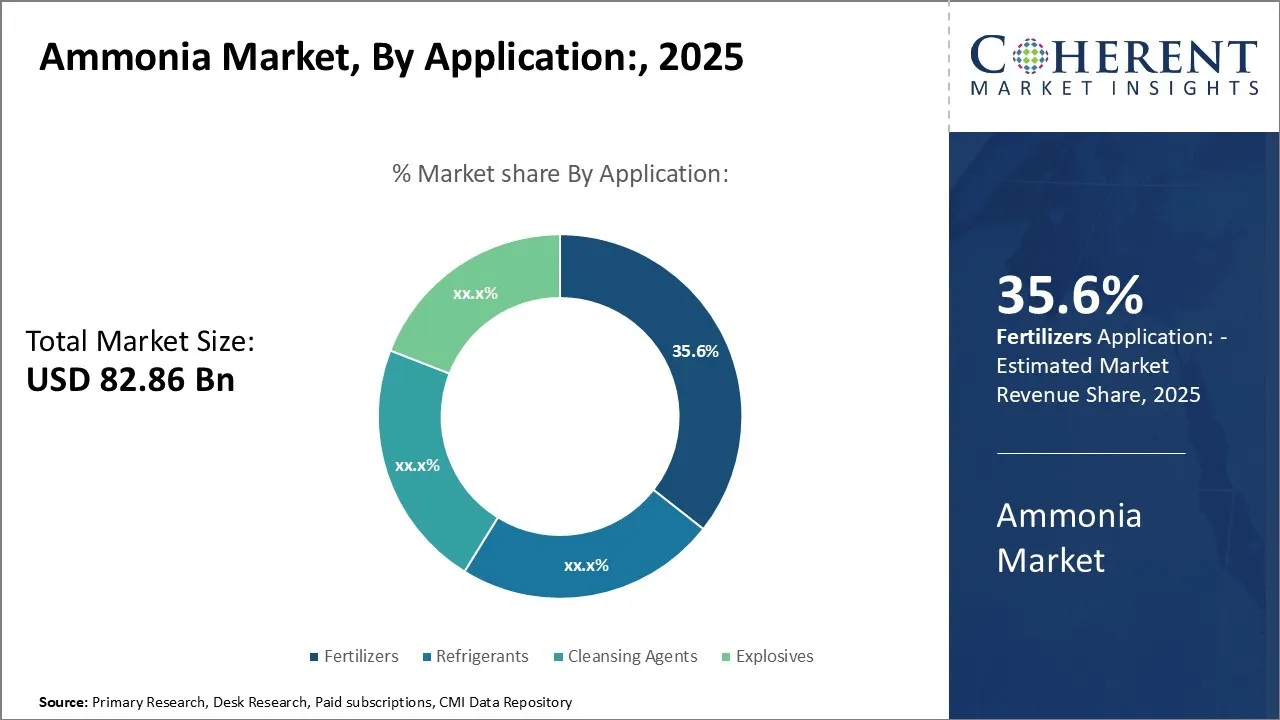
Ammonia Market Insights, By Application
The application segment of the ammonia market is categorized into fertilizers, refrigerants, cleansing agents, and explosives. Among these, the fertilizers sub-segment is projected to hold the largest share, accounting for 36.6% of the market in 2026. This dominance is primarily attributed to the critical role of ammonia in the production of nitrogen-based fertilizers such as urea, ammonium nitrate, and ammonium sulfate. The growing global demand for agricultural productivity to support food security continues to drive the use of ammonia in fertilizers.
Fertilizer-grade ammonia is favored for its cost-efficiency and high nitrogen content, making it indispensable for soil nutrient management across various cropping systems. Additionally, its widespread adoption in both developed and emerging agricultural economies sustains its leading market position. While other application segments such as refrigerants and explosives also contribute to market revenues, their share remains lower due to relatively niche industrial uses and regulatory constraints.
The demand in cleansing agents and explosives is expected to grow steadily, driven by expansion in industrial cleaning and mining sectors, yet not at the scale observed in fertilizer applications. Therefore, the fertilizer segment remains the cornerstone of the ammonia market’s application landscape.
Regional Insights
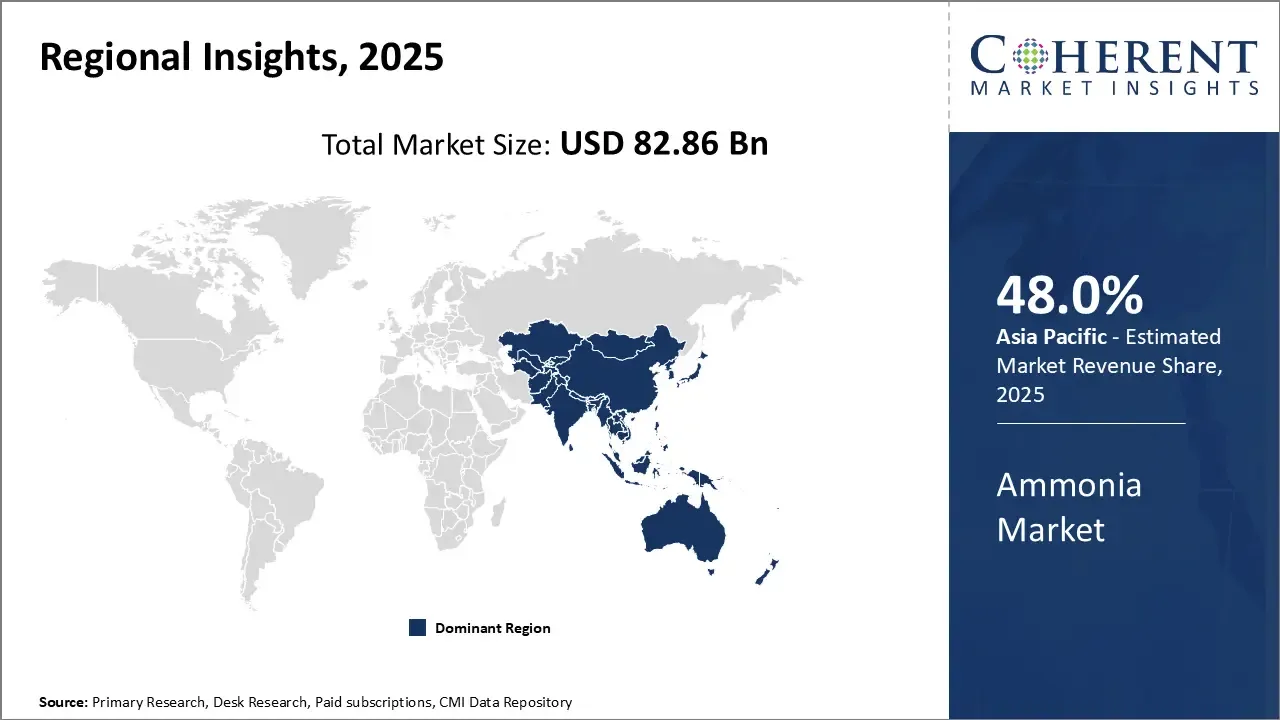
Asia Pacific Ammonia Market Analysis and Trends
Asia Pacific leads the global ammonia market with 48.0% market share during the forecast period. The region’s dominance is anchored by large-scale agricultural demand, particularly in India and China, where ammonia is a key input for nitrogen-based fertilizers. Industrial expansion, urban infrastructure projects, and growing applications in chemical manufacturing continue to fuel consumption.
Rapid urbanization, favorable government policies supporting agriculture, and rising investments in domestic production capacity reinforce Asia Pacific’s leadership in both consumption and output.
Europe Ammonia Market Analysis and Trends
Europe establishing itself as a second leading region in ammonia production and green ammonia innovation. Countries like Germany, the Netherlands, and France are key players, leveraging strong agricultural sectors and industrial capabilities. European Union decarbonization targets have accelerated R&D efforts toward low-emission ammonia processes. Europe also plays a significant role in global ammonia exports, and its integration of circular economy principles supports long-term market resilience.
North America Ammonia Market Analysis and Trends
North America Ammonia Market is driven by robust agricultural output and technological innovation. The United States and Canada dominate regional demand, with significant ammonia usage across organic fertilizer production, industrial refrigeration, and chemical synthesis. The region is also at the forefront of clean ammonia research, with carbon capture and hydrogen-ammonia integration gaining traction. Stable regulatory environments and continued investments in smart agriculture contribute to sustained market expansion.
Dominating Countries in the Ammonia Market
China Ammonia Market Analysis and Trends
China is the largest contributor in the Asia Pacific region, supported by massive fertilizer production and consumption, industrial demand, and strong government support for agricultural modernization. Its domestic production infrastructure is among the most extensive globally, and ongoing investments in low-emission ammonia technologies are expanding the country’s influence in both local and export markets.
India Ammonia Market Analysis and Trends
India plays a pivotal role in the Asia Pacific market due to its reliance on ammonia-based fertilizers for food production. Government subsidies, public-private partnerships in agriculture, and growing industrial use cases are contributing to a steady rise in ammonia demand. Domestic production is increasing as the country looks to reduce import dependency and boost food security.
United States Ammonia Market Analysis and Trends
The U.S. is the leading market in North America, with extensive ammonia usage in agriculture and industrial sectors. It also serves as a hub for clean ammonia innovation, supported by robust R&D ecosystems and policy incentives promoting green energy transitions. Emerging applications in hydrogen storage and power generation are opening new avenues for ammonia growth in the country.
Market Report Scope
Ammonia Market Report Coverage
| Report Coverage | Details | ||
|---|---|---|---|
| Base Year: | 2025 | Market Size in 2026: | USD 88.25 Bn |
| Historical Data for: | 2020 To 2024 | Forecast Period: | 2026 To 2033 |
| Forecast Period 2026 to 2033 CAGR: | 6.5% | 2033 Value Projection: | USD 137.13 Bn |
| Geographies covered: |
| ||
| Segments covered: |
| ||
| Companies covered: | Yara International ASA, BASF SE, CF Industries Holdings, Inc., Nutrien Ltd., Potash Corporation of Saskatchewan Inc., Dangyang Huaqiang Chemical Co., Ltd., Shanxi Jinfeng Coal Chemical Co Ltd., GTS Chemical Holdings plc.,Togliattiazot, OCI Nitrogen B.V., Agrium Inc., Sabic, and Koch Fertilizer, LLC. | ||
| Growth Drivers: |
| ||
| Restraints & Challenges: |
| ||
Global Ammonia Market Drivers
- Strong demand from agricultural sector
Strong growth from the agricultural market is currently driving the demand in the market. Ammonia is an important agricultural input as fertilizers are an integral part of farming used to increase the crop production as well as the productivity. As per an estimate published by FAO of UN, the global consumption of fertilizer nutrient soared from 0.10 Bn tons in 2000 to 0.19 Bn tons in 2019. Most of the rise in nutrient demand is matched with the increased use of nitrogen fertilizers like ammonia and urea. The ever-rising population puts even more burden on the agricultural sector to increase food production further. To satisfy the ever-increasing need for cereals, grains, oilseeds, and other agricultural commodities, farmers across the globe have no option but to use chemical fertilizers to enhance soil productivity and increase yield. The use of primary nitrogen fertilizer ammonia is critical for land cultivators. Supporting these farmers in elevating productivity is indeed indispensable.
- Fertilizer production
Implementation of fertilizers has become a necessity for farmers in the recent years because of rapid increase in population and shrinking arable land. Over the past decades, the demand for fertilizers is expected to keep increasing. Ammonia is one type of fertilizer which tremendously increases yield. It is also used as a building block in making other nitrogen fertilizers which includes urea, ammonium nitrates and nitric acid. Agriculture land is immensely important for the sustenance of the population, utilizing all the available resources is a global phenomena. Out of the total 5.1 Bn hectares of agricultural lands in 1960, 0.2 Bn is lost by 2019 which indicates a concerning number. Simultaneously, the global population has increased and is projected to grow in the future. To tackle this issue, farmers all over the world are required to make appropriate use of every available resource.
Global Ammonia Market Opportunities
- Growth in agricultural industry
The agricultural industry has shown tremendous growth potential globally which can drive opportunities for the ammonia market. Ammonia is widely used as a key nitrogen fertilizer for improving soil quality and increasing crop yields. With the growing global population and rising demand for food, focus on increasing farm outputs is surging.
Several governments and organizations are putting significant efforts towards boosting agricultural production. For instance, in 2022, the United Nations has projected that the agricultural output needs to grow by 60% by 2050 to feed the increasing population. So, addressing the challenges of rising food demand, shrinking farmland, and climate change impacts requires significant boost to farm productivity from existing land.
Ammonia fertilizers can play a central role here by supporting higher yields per hectare. Their rising use will thus provide continued opportunities for growth in this market going forward.
- Increasing demand for refrigerants
The use of refrigerants plays a big role in cooling and refrigeration applications across many industries such as the food, industrial, and commercial sectors. With rising global temperatures due to climate change, the demand for effective and efficient cooling solutions is increasing rapidly.
Ammonia is widely used as a natural and cost-effective refrigerant and its applications are growing. It has been recognized by organizations like United Nations Environment Programme as one of the natural refrigerants of the future with zero ozone depletion potential. Compared to other synthetic refrigerants, ammonia provides better energy efficiency and lower operating costs for users over the lifetime of equipment.
In 2021, according to the reports provided by the United Nations Environment Program, the global average temperatures in 2020 have been more than 1-degree Celsius above pre industrial levels. This has made cooling an indispensable part of daily lives and many industrial processes. The food processing and storage industry in particular relies heavily on ammonia for large-scale refrigeration needs to prevent spoilage.
With global population expected to grow by 2 Bn in the next 30 years, the demand for food production and preservation is projected to increase substantially according to the United Nations World Population Prospects report 2022. This makes ammonia refrigeration the technology of choice for future-proof, sustainable, and cost-effective cooling in the food industry.
Global Ammonia Market Trends
- Shift toward green ammonia
The shift toward green ammonia production is having a significant influence on the market. With the rising focus on decarbonization and the development of carbon-neutral technologies, green ammonia is emerging as a viable clean fuel alternative. Green ammonia is produced through the electrolysis of water and nitrogen from air with renewable electricity like solar or wind. This makes it a carbon-free fuel that can help reduce emissions from hard-to-abate sectors like shipping and heavy industries.
Major market players across the ammonia supply chain are making strategic investments and forming partnerships to ramp up green ammonia capacity. For instance, fertilizer giant, Yara International, entered an agreement with Horisont Energi, clean energy company, in 2021, to jointly develop the world's first large-scale green ammonia project in Norway, which aims to produce 100,000 tons of carbon-free ammonia per year by 2028.
Similarly, ENN Group, provides research and development for clean energy sources and Haldor Topsoe, company specializes in technologies aimed at reducing carbon emissions announced a cooperation deal in 2022 to establish a green ammonia production demonstration plant in China by using renewable power from solar and wind. The plant is projected to produce 5,000 tons of green ammonia annually.
- Technology advancements in production process
Advancements in production technologies are significantly impacting the market growth. Traditionally, ammonia has been manufactured through the energy-intensive Haber-Bosch process requiring high pressure and temperature. However, new technologies are developing that promise to reduce the carbon footprint of ammonia production.
For example, several companies are exploring electrochemical and electro catalytic processes that use renewable electricity to split nitrogen and hydrogen directly from air and water. These methods use cheaper non-metallic catalysts and operate at ambient temperature and pressure. They could help ammonia manufacturers lower their electricity costs and transition to more sustainable power sources.
According to the United Nations Economic Commission for Europe, these novel techniques have already achieved laboratory scale proof-of-concept and are being optimized for industrial deployment by 2030. The potential energy efficiencies from such emerging technologies are encouraging ammonia producers to invest in production capacity upgrades. Leading fertilizer firm, CF Industries, plans to incorporate technology developed by a fellow U.S.-based startup, GenH2 into its existing Haber-Bosch facilities by 2025.
Analyst’s Viewpoint
- The market is driven by the increasing demand for ammonia from the agricultural and industrial sectors. Ammonia is widely used as a fertilizer for crop production and with growing population; food demand will continue to rise sustaining the fertilizer need. Recovery in economic activities post pandemic will further aid the agricultural sector growth.
- Major restraints for the market could be stringent environmental regulations around ammonia production and use. However, manufacturers are increasingly investing in carbon capture technologies to make production processes more sustainable and meet regulatory compliances.
- Transition towards green ammonia also opens new opportunities. Asia Pacific dominates the market and is expected to retain its position. Developing countries like India and China will be the fastest growing regional markets due to their massive agro-based economies and growing industrialization.
- In conclusion, the market is expected for steady expansion driven by various macroeconomic and industry specific growth factors. While environmental regulations could impact production levels, focus on emission reduction and green technologies will help sustain demand over the long term. The growth outlook across regions may vary with Asia Pacific pacing ahead but opportunities exist worldwide.
Recent Developments
- In October 2025, Professor Lee Anna from POSTECH’s Mechanical Engineering department and Senior Researcher Kang Hong-jae at KIMM said they’ve developed an ammonia propellant that produces zero carbon emissions.
- In January 2024, Syzygy Plasmonics announced the world's first light-powered reactor cell for industrial chemical reactions which met initial performance targets and is available for order in stacks that is designed to produce up to 5 tons of hydrogen per day. Syzygy has completed more than 1,500 hours of testing of its Rigel cell to produce hydrogen from ammonia. Testing of the first-of-a-kind 200 kg/d light-powered ammonia e-cracking cell began in late 2023 and is ongoing.
Market Segmentation
- By Form (Revenue, USD Bn, 2021 - 2033)
- Liquid
- Gas
- Powder
- By Application (Revenue, USD Bn, 2021 - 2033)
- Fertilizers
- Refrigerants
- Cleansing Agents
- Explosives
- By End Use Industry (Revenue, USD Bn, 2021 - 2033)
- Agriculture
- Pharmaceutical
- Textile
- Chemical
- Plastics
- Pulp and Paper
- Others (Mining, Water Treatment, etc.)
Regional Insights (Revenue, USD Bn, 2021 - 2033)
- North America
- U.S.
- Canada
- Latin America
- Brazil
- Argentina
- Mexico
- Rest of Latin America
- Europe
- Germany
- U.K.
- Spain
- France
- Italy
- Russia
- Rest of Europe
- Asia Pacific
- China
- India
- Japan
- Australia
- South Korea
- ASEAN
- Rest of Asia Pacific
- Middle East
- GCC Countries
- Israel
- Rest of Middle East
- Africa
- South Africa
- North Africa
- Central Africa
- North America
- Top Companies in this Market
- Yara International ASA
- BASF SE
- CF Industries Holdings, Inc.
- Nutrien Ltd.
- Potash Corporation of Saskatchewan Inc.
- Dangyang Huaqiang Chemical Co., Ltd.
- Shanxi Jinfeng Coal Chemical Co Ltd.
- GTS Chemical Holdings plc.
- Togliattiazot
- OCI Nitrogen B.V
- Agrium Inc.
- Sabic
- Koch Fertilizer, LLC
Sources
Primary Research Interviews
- Ammonia production plant managers and executives
- Chemical fertilizer manufacturers
- Industrial ammonia distributors and suppliers
- Agriculture industry specialists and consultants
- Others
Databases
- Chemical Economics Handbook (CEH)
- Global Trade Atlas
- ICIS Database
- Fertilizer Outlook Database
- Others
Magazines
- Chemical Engineering Magazine
- Fertilizer International
- Chemical Processing Magazine
- Ammonia Industry Magazine
- Others
Journals
- Journal of Cleaner Production
- Applied Catalysis B Environmental
- Chemical Engineering Science
- Others
Newspapers
- Chemical Week
- ICIS Chemical Business
- Fertilizer Week
- Farm Chemical International
- Others
Associations
- International Fertilizer Association (IFA)
- Fertilizer Institute (TFI)
- European Fertilizer Manufacturers Association (Fertilizers Europe)
- Asian Agricultural Input Association (AAIA)
- Others
Public Domain Sources
- U.S. Geological Survey (USGS) Mineral Commodity Summaries
- Food and Agriculture Organization (FAO) Statistics
- International Energy Agency (IEA) Reports
- EPA Chemical Production Reports
- Others
Proprietary Elements
- CMI Data Analytics Tool
- Proprietary CMI Existing Repository of information for last 8 years
*Definition: Ammonia is an inorganic chemical compound composed of nitrogen and hydrogen with the formula NH3. It is a colorless gas with a distinct pungent smell and is lighter than air.
Get access to 250+ pages report
Every segment, forecast, competitor profile and data table behind the analysis above — available for instant download.
- ESOMAR Member
- ISO 9001:2015 Certified
- D-U-N-S Registered
- GDPR & CCPA Compliant
Missing comfort of reading report in your local language? Find your preferred language:
Transform your Strategy with Exclusive Trending Reports
Frequently Asked Questions
The Ammonia Market size is estimated to be valued at USD 88.25 Bn in 2026, and is expected to reach USD 137.13 Bn by 2033.
Stringent environment regulations and health hazards are the key factors hampering the growth of the global ammonia market.
Strong demand from agricultural sector and fertilizer production are the major factors driving the global ammonia industry growth.
The fertilizers sub-segment is the leading application segment in the global market.
The major players operating in the global ammonia industry include Yara International ASA, BASF SE, CF Industries Holdings, Inc., Nutrien Ltd., Potash Corporation of Saskatchewan Inc., Dangyang Huaqiang Chemical Co., Ltd., Shanxi Jinfeng Coal Chemical Co Ltd., GTS Chemical Holdings plc., Togliattiazot, OCI Nitrogen B.V., Agrium Inc., Sabic, and Koch Fertilizer, LLC.
Asia Pacific region leads the global market.
The CAGR of the Ammonia industry is projected to be 6.5% from 2026 to 2033.