

Graphite Market Size and Forecast – 2026 to 2033
The global graphite market is estimated to be valued at USD 20.24 Bn in 2026 and is expected to reach USD 32.28 Bn by 2033, exhibiting a compound annual growth rate (CAGR) of 6.9% from 2026 to 2033.
Key Takeaways
- By Product Type, natural graphite is expected to contribute 60.1%share of the market in 2026 owing to its surging demand for ev batteries & energy storage.
- By Application, Steel & metallurgy is expected to contribute 36.1%share of the market in 2026 owing to the esg, sustainability & regulatory pressures.
- By Region, North America acquired the prominent market share of 40.8% in 2026 owing to its rise of synthetic graphite production.
Market Overview
Demand for electric vehicle batteries, renewable energy storage, and steel manufacturing is driving strong growth in the graphite market. Manufacturers rely on both natural and synthetic graphite for battery anodes and various industrial uses. Rising environmental concerns and efforts to localize supply chains have led companies and governments to invest heavily in domestic mining and processing, especially in North America and Europe. Policymakers are actively reshaping supply dynamics through regulations and trade measures to reduce reliance on major exporting countries and promote sustainable graphite sourcing.
Current Events and their Impact on the Graphite Market
Current Events | Description and its impact |
Geopolitical Tensions in Key Producing Regions |
|
Technological Advancements in Battery and Energy Storage |
|
Increasing Global Electric Vehicle (EV) Adoption |
|
End-user Feedback and Unmet Needs in the Graphite Market
- Demand for Battery-Grade Purity: EV and energy storage manufacturers consistently request higher-purity graphite for anodes. End-users report challenges sourcing uniform, high-performance material at scale. They call for tighter control over impurities and better consistency across batches to meet evolving battery specifications for energy density, charging speed, and cycle life.
- Sustainability and Traceability Gaps: Automakers and electronics firms increasingly demand low-carbon and traceable graphite. However, end-users struggle to verify ESG credentials across opaque global supply chains. They seek suppliers that offer life-cycle data, ethical sourcing, and third-party certifications—especially as regulations tighten in Europe and North America.
- Processing Capacity Bottlenecks: Anode manufacturers and metallurgical users often cite insufficient midstream processing capacity, especially outside China. Delays in purification, shaping, and coating impact delivery timelines. End-users seek regional suppliers who can offer stable, on-time delivery of value-added graphite products like coated spherical graphite.
- Current Industry Events of 2026
- Market Size Estimation
- Regional Breakdown
- Competitive Landscape
- Customer Intelligence
- Segmental Analysis
- Pricing Analysis
- Key Market Drivers, Challenges & Future Trends
- Customized Insights Section
Segmental Insights
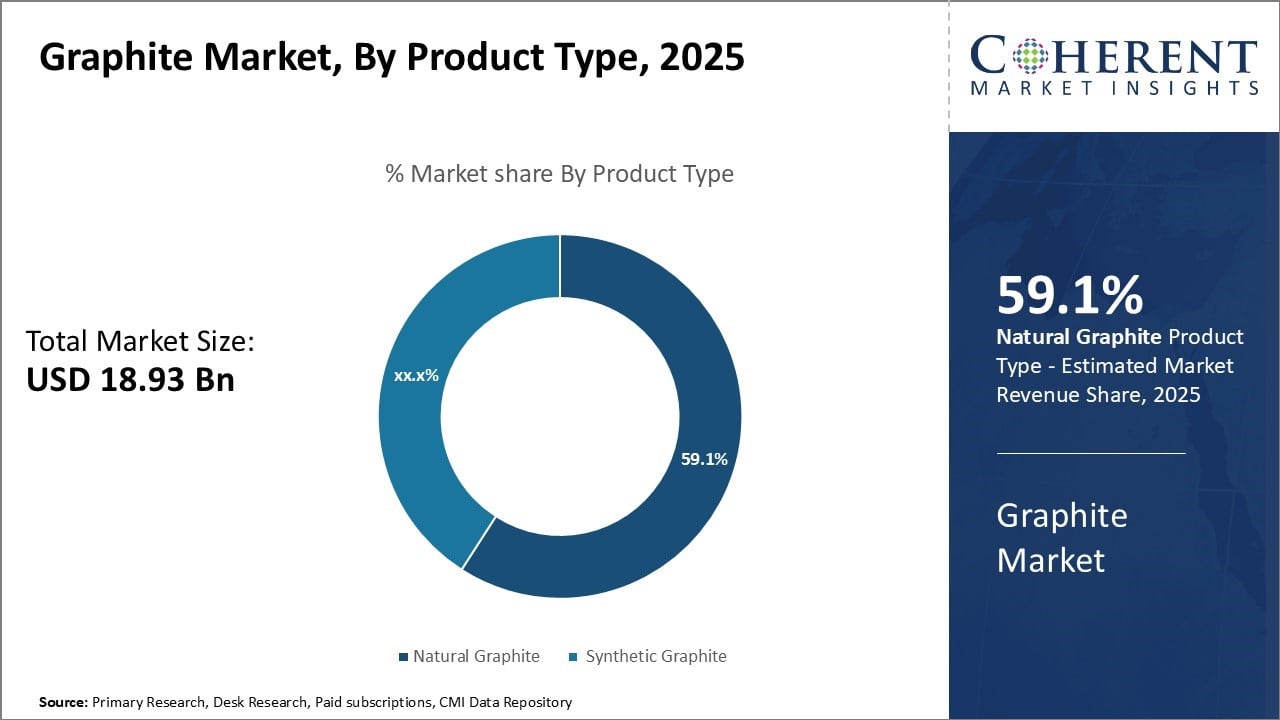
Graphite Market Insights, By Product Type: Natural Graphite contribute the highest share of the market
Natural graphite is expected to contribute 60.1% share of the market in 2026. Natural graphite contributes the largest share of the global graphite market due to its diverse industrial uses. It benefits from being easily available in nature and having properties suitable for many applications. One of the key drivers of natural graphite demand is its use in steel production. As the largest end-use sector, steel and metallurgy requires graphite as technical electrodes and refractory material. Natural graphite's high carbon content and heat resistance make it indispensable in steel-making processes like smelting and lactic oxygen furnaces. additionally, natural graphite powder finds wide utilization in the manufacture of brake linings, gaskets, and other sheet metal products. Its low friction characteristics help improve the functioning and lifespan of components in the automotive and aerospace industries. For instance, in March 2025, Vianode introduced its first high-performance solution using recycled graphite, as part of its next-generation material series. Developed from recycled battery-grade graphite, the product is designed to address the rising demand for sustainable solutions in electric vehicle (EV) and battery manufacturing. Such innovations are accelerating the graphite market demand.
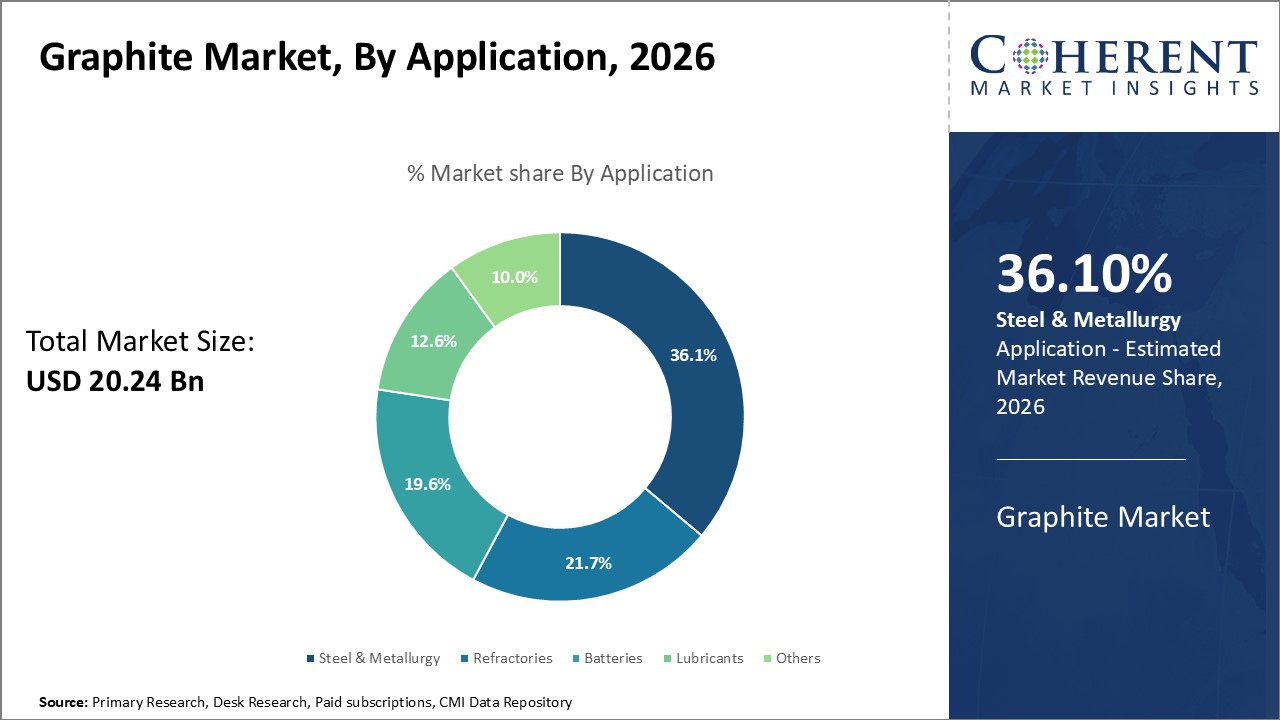
Graphite Market Insights, By Application: Steel & Metallurgy contribute the highest share of the market
Steel & metallurgy is expected to contribute 36.1% share of the market in 2026. The steel and metallurgy sector consumes more graphite than any other end-use industry globally. Steelmaking heavily relies on graphite additions at various processing stages to improve efficiency, yield, and alloy quality. graphite acts as a lubricating agent that helps control friction within blast furnaces and oxygen furnaces. It coats the interior surfaces and facilitates the smooth sliding of hot slags and metals. Graphite additions as lining materials in furnace walls also enhance heat resistance and service life. During steel melting and ladle refining, graphite is used as a deoxidizing agent to control carbon and reduce impurities.
As a neutral element, graphite captures oxygen and prevents unwanted oxidation within the melt. This improves metal purity and ensures consistent properties in the final products. According to an article by Metal Zenith, in steel metallurgy, graphite mainly acts as a source of carbon, affecting the microstructure and characteristics of the steel.
Regional Insights
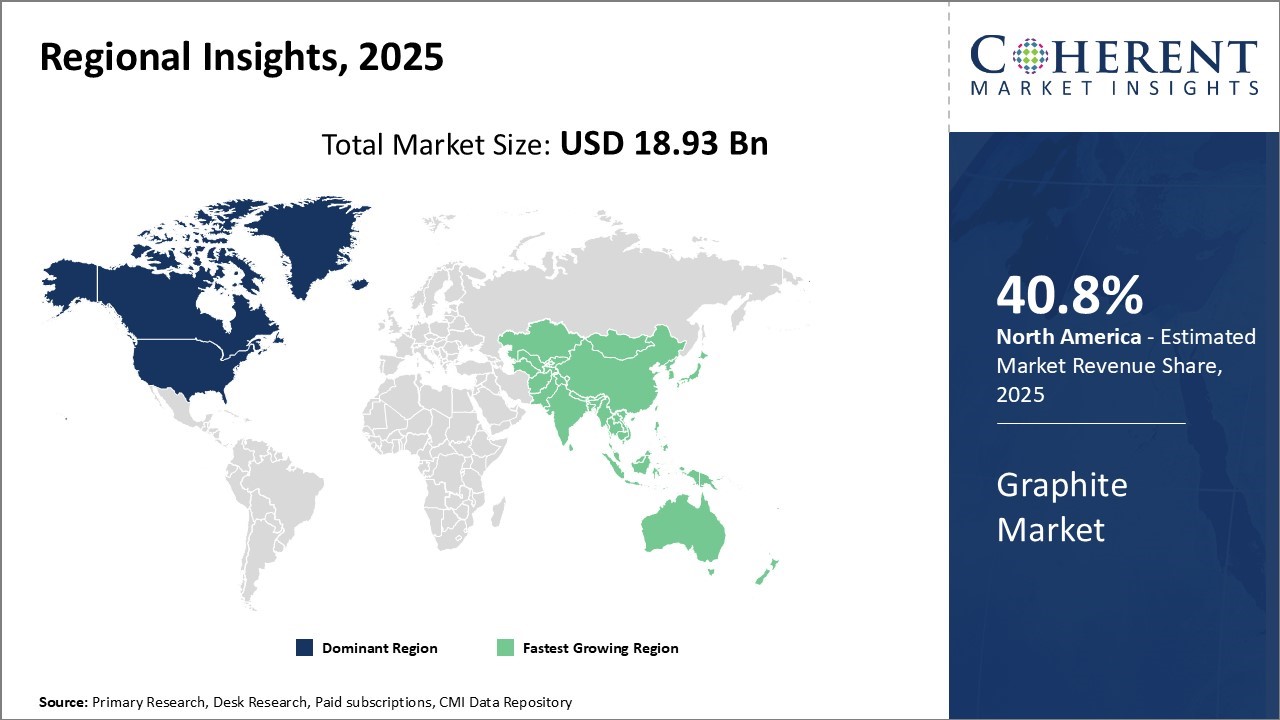
North America Graphite Market Trends
North America acquires the dominant share of 40.8%. North America is expanding synthetic graphite production to cut reliance on imports, with major funding support from the U.S. Department of Energy. Companies such as Novonix are constructing large facilities in Tennessee, while Graphite One, Westwater, and others are developing natural graphite supply networks across the U.S. and Canada. Automakers like GM are forming local partnerships to secure graphite for EV battery anodes. Policymakers are enforcing tariffs and critical minerals strategies to boost regional supply chain stability and independence.
In July 2026, Lucid Motors launched the Minerals for National Automotive Competitiveness Collaboration (MINAC). Speaking at the Alaska Sustainable Energy Conference, Winterhoff emphasized that securing reliable and affordable supplies of cobalt, graphite, manganese, nickel, and rare earths is absolutely essential to achieving Lucid’s goal of producing fully American-made EV batteries, motors, and related components.
Asia Pacific Graphite Market Trends
Asia-Pacific governments and automakers are actively promoting electric vehicles and renewable energy storage, driving strong demand for high-purity graphite in lithium-ion battery anodes across China, Japan, South Korea, and India. Battery producers are rapidly increasing capacity to meet growing needs. Industrial growth and expanding electronics manufacturing in India, Japan, South Korea, and Southeast Asia further boost graphite use in refractories, lubricants, conductive materials, and semiconductors.
In February 2026, Mobec Innovation, a provider of customizable B2B mobile EV charging and energy storage solutions, launched its first advanced lithium battery recycling plant in Noida, Uttar Pradesh. The facility is designed to recover lithium, cobalt, nickel, graphite, copper, and manganese from end-of-life batteries, ensuring complete material recovery with zero waste.
India Graphite Market Trends
India is rapidly developing its lithium-ion battery capacity to advance electric vehicle adoption and renewable energy goals. Manufacturers and policymakers are actively promoting the use of high-purity natural and synthetic graphite through local sourcing, processing, and value-added production. As infrastructure and manufacturing expand, domestic graphite supply chains are rising to meet growing demand in steelmaking and thermal industries. For instance, in July 2024, Coal India Limited (CIL) expanded beyond its traditional coal mining activities by launching a new graphite mining project. This strategic initiative represents a major step in diversifying the state-owned company’s portfolio as it seeks to capitalize on the rising demand for non-coal minerals.
China Graphite Market Trends
Chinese companies are rapidly expanding their upstream and midstream operations, from mining graphite in Heilongjiang and Inner Mongolia to processing spherical and synthetic graphite at large scale. Leading firms such as BTR New Material and Ningbo Shanshan are boosting output to meet soaring EV anode demand. Meanwhile, export license restrictions and global trade challenges are weakening the competitiveness of natural graphite both domestically and internationally. For instance, in August 2024, Chinese anode battery materials giant BTR launched its manufacturing plant in Kendal, Central Java, moving Indonesia closer to realizing its electric vehicle (EV) ecosystem goals.
Market Report Scope
Graphite Market Report Coverage
| Report Coverage | Details | ||
|---|---|---|---|
| Base Year: | 2025 | Market Size in 2026: | USD 20.24 Bn |
| Historical Data for: | 2020 To 2024 | Forecast Period: | 2026 To 2033 |
| Forecast Period 2026 to 2033 CAGR: | 6.9% | 2033 Value Projection: | USD 32.28 Bn |
| Geographies covered: |
| ||
| Segments covered: |
| ||
| Companies covered: | Asbury Carbons, BTR New Material Group Co.,Ltd., Imerys, Eagle Graphite, Mason Graphite Inc, Nippon Kokuen Group, Northern Graphite Corp., SGL Carbon, EPM Group, Shenzhen Xiangfenghua Technology Co., Ltd., Showa Denko K.k., Syrah Resources Limited, Tokai Carbon Co. Ltd., Triton Minerals, Betterui New Materials Group Co. Ltd, GrafTech International Ltd., Linyi Yanjun Carbon Material Co., Ltd., Jilin Carbon New Material Co., Ltd., Hebei Hang Carbon, and Graphite India Limited | ||
| Growth Drivers: |
| ||
| Restraints & Challenges: |
| ||
Graphite Market Trend
- Booming Demand from Battery Applications
The rapid growth of electric vehicles and renewable energy storage has made graphite a critical material for lithium-ion batteries, especially in anode production. Battery manufacturers are expanding capacity globally, pushing demand for both natural and synthetic graphite. This trend has triggered investment in purification and spherical processing technologies, along with long-term supply agreements. End-users are prioritizing stable, high-purity graphite sources as performance standards rise and battery innovation continues to accelerate across automotive and grid applications.
- Global Supply Chain Diversification
With China’s dominance in graphite mining and processing facing scrutiny, governments and manufacturers are diversifying sourcing strategies. Export controls, geopolitical tensions, and environmental concerns have prompted increased investment in graphite projects across North America, Africa, and Australia. Countries are establishing local processing and recycling facilities to reduce reliance on imports. This shift is reshaping trade flows and encouraging vertical integration, as downstream users seek secure, transparent, and ethical supply chains to meet growing demand across industries.
Graphite Market Opportunity
- Expansion in EV and Energy Storage
The growing adoption of electric vehicles and renewable energy storage systems creates a major opportunity for graphite producers. Graphite is essential for lithium-ion battery anodes, and increasing battery manufacturing capacity worldwide is driving sustained demand. Manufacturers need secure, high-quality graphite sources to meet long-term supply requirements. This opens opportunities for new mining projects, advanced processing technologies, and vertical integration to serve the expanding EV and energy grid markets with consistent, high-purity graphite materials.
Graphite Market News
- In July 2025, Iondrive Limited partnered with CSIRO to launch a new project that converts waste graphite from used lithium-ion batteries into anode-grade material, advancing its strategy to commercialize battery recycling technologies.
- In May 2025, UAE-based Falcon Energy Materials plc, a battery anode materials supplier, partnered with Fluoralpha S.A., a subsidiary of InnovX, to develop two major facilities for producing coated spherical purified graphite (CSPG) in Jorf Lasfar.
- In March 2025, HeatMate, backed by Japan’s Sengoku company, unveiled its official U.S. website, unveiling a full range of graphite-based cooking and heating appliances. The new online platform offers an interactive shopping experience, highlighting energy-efficient space heaters, patio heaters, and the SET-G16A Graphite Toaster Oven, known for reaching 550°F instantly and cooking 40% faster.
Analyst Opinion (Expert Opinion)
- The graphite market is at a tipping point—more geopolitical than geological. Despite being abundant, graphite is rapidly becoming a bottleneck in the global energy transition. The issue isn’t availability; it’s processing power and strategic control. China currently processes over 90% of the world’s graphite anode materials, and with its recent export restrictions on three key graphite products (October 2023), it has demonstrated an ability—and willingness—to weaponize its dominance in this critical mineral.
- Despite this, North American producers such as Graphite One (Alaska) and Westwater Resources (Alabama) remain years away from meaningful volume. The U.S. Inflation Reduction Act allows Chinese graphite in batteries until 2026, offering a short window to build a parallel supply chain. If this domestic capacity fails to materialize in time, automakers will either violate sourcing rules or face production bottlenecks. Neither outcome is acceptable.
- Synthetic graphite presents an industrial workaround. It's more consistent and easier to scale, which is why companies like Anovion are building 40,000-ton facilities in Georgia with $117 million in U.S. government support. However, synthetic graphite’s energy footprint is up to five times higher than that of purified natural graphite, making it ESG-toxic in an era of climate scrutiny. This contradiction—scale vs. sustainability—is the central tension in graphite sourcing strategies today.
Speak to the analyst
Want personalized insights?
Take the findings above to one of our principal consultants, or have the report rebuilt around the segments, geographies and competitors you actually track.
Market Segmentation
- Product Type Insights (Revenue, USD Bn, 2021 - 2033)
- Natural Graphite
- Synthetic Graphite
- Application Insights (Revenue, USD Bn, 2021 - 2033)
- Steel & Metallurgy
- Refractories
- Batteries
- Lubricants
- Others
- Regional Insights (Revenue, USD Bn, 2021 - 2033)
- North America
- U.S.
- Canada
- Latin America
- Brazil
- Argentina
- Mexico
- Rest of Latin America
- Europe
- Germany
- U.K.
- Spain
- France
- Italy
- Russia
- Rest of Europe
- Asia Pacific
- China
- India
- Japan
- Australia
- South Korea
- ASEAN
- Rest of Asia Pacific
- Middle East
- GCC Countries
- Israel
- Rest of Middle East
- Africa
- South Africa
- North Africa
- Central Africa
- Key Players Insights
- Asbury Carbons
- BTR New Material Group Co.,Ltd.
- Imerys
- Eagle Graphite
- Mason Graphite Inc.
- Nippon Kokuen Group
- Northern Graphite Corp.
- SGL Carbon
- EPM Group
- Shenzhen Xiangfenghua Technology Co., Ltd.
- Showa Denko K.k.
- Syrah Resources Limited
- Tokai Carbon Co. Ltd.
- Triton Minerals
- Betterui New Materials Group Co. Ltd.
- GrafTech International Ltd.
- Linyi Yanjun Carbon Material Co., Ltd.
- Jilin Carbon New Material Co., Ltd.
- Hebei Hang Carbon
- Graphite India Limited
Sources
Primary Research Interviews
- Senior procurement managers at battery manufacturing firms in Asia and North America
- Executives from graphite mining companies in India, Canada, and Australia
- R&D heads at synthetic graphite processing plants in China and the U.S.
- Government officials involved in critical minerals policy and export regulation
- Sustainability officers from electric vehicle OEMs and energy storage companies
Databases
- UN Comtrade Database (International graphite trade flow statistics)
- USGS Mineral Commodity Summaries
- China Customs Export/Import Statistical Reports
- IEA Global EV Outlook
- International Energy Agency (IEA) Battery Material Tracker
- India Ministry of Mines & Geological Survey data
Magazines
- Industrial Minerals
- The Graphite Journal
- Battery Technology International
- Metal Bulletin
- Chemical & Engineering News (C&EN)
Journals
- Journal of Power Sources
- Carbon
- Advanced Energy Materials
- Electrochimica Acta
- Materials Today Energy
Newspapers
- Financial Times
- The Wall Street Journal
- The Economic Times
- South China Morning Post
- The Australian Business Review
Associations
- International Graphite Association
- The Graphene Council
- Battery Materials Association of North America (BMAN)
- Indian Bureau of Mines
- China Nonferrous Metals Industry Association
Public Domain Sources
- Official policy documents from U.S. Department of Energy and DOE Loan Program Office
- Government of Canada Critical Minerals Strategy
- Indian Ministry of Mines auction and exploration reports
- Chinese Ministry of Commerce (MOFCOM) export guidelines
- European Raw Materials Alliance (ERMA) publications
Proprietary Elements
- CMI Data Analytics Tool, and Proprietary CMI Existing Repository of Information for Last 8 Years
Get access to 250+ pages report
Every segment, forecast, competitor profile and data table behind the analysis above — available for instant download.
- ESOMAR Member
- ISO 9001:2015 Certified
- D-U-N-S Registered
- GDPR & CCPA Compliant
Missing comfort of reading report in your local language? Find your preferred language:
Transform your Strategy with Exclusive Trending Reports
Frequently Asked Questions
The Graphite Market is estimated to be valued at USD 20.24 Bn in 2026, and is expected to reach USD 32.28 Bn by 2033.
The CAGR of the Graphite Market is projected to be 6.9% from 2026 to 2033.
Growth in steel industry and development of aluminum-graphite composites are the major factors driving the growth of the global graphite market.
Volatility in raw material prices and presence of substitutes are the major factors hampering the growth of the global graphite market.
In terms of product type, natural graphite is estimated to dominate the market revenue share in 2026.
Asbury Carbons, BTR New Material Group Co.,Ltd., Imerys, Eagle Graphite, Mason Graphite Inc, Nippon Kokuen Group, Northern Graphite Corp., SGL Carbon, EPM Group, Shenzhen Xiangfenghua Technology Co., Ltd., Showa Denko K.k., Syrah Resources Limited, Tokai Carbon Co. Ltd., Triton Minerals, Betterui New Materials Group Co. Ltd, GrafTech International Ltd., Linyi Yanjun Carbon Material Co., Ltd., Jilin Carbon New Material Co., Ltd., Hebei Hang Carbon, and Graphite India Limited are the major players.
North America is expected to lead the global graphite market in 2026.