

Packaging Adhesives Market Size and Share Analysis: (2026 - 2033)
The packaging adhesives market is anticipated to grow at a CAGR of 5.85% with USD 21.91 Bn in 2026 and is expected to reach USD 32.61 Bn in 2033. The packaging adhesives market is experiencing significant growth due to the increasing demand from consumer goods, food and beverage (Food prices in March 2026 were 2.7 percent higher than in March 2025), as well as e-commerce sectors. Moreover, innovations in eco-friendly as well as sustainable adhesives are further boosting growth, with manufacturers increasingly emphasizing improving safety, regulatory adherence, and performance in packaging applications worldwide.
Key Takeaways:
- Water-based is expected to account the largest share of 45% in 2026, water-based adhesives are widely used in corrugated boxes, flexible packaging, and folding cartons, especially in food and beverage. The U.S. bought more flexible packaging than it sold, with USD 6.5 billion in imports and USD3.9 billion in exports, making a USD2.6 billion trade deficit, up 25% from 2025.
- Corrugated packaging will dominate with 30% in 2026, growth of e-commerce as well as consumer goods shipping drives huge demand for corrugated boxes. India stands as the third-largest consumer as well as producer of corrugated paper boxes in the world, with volumes reaching 12 million tons.
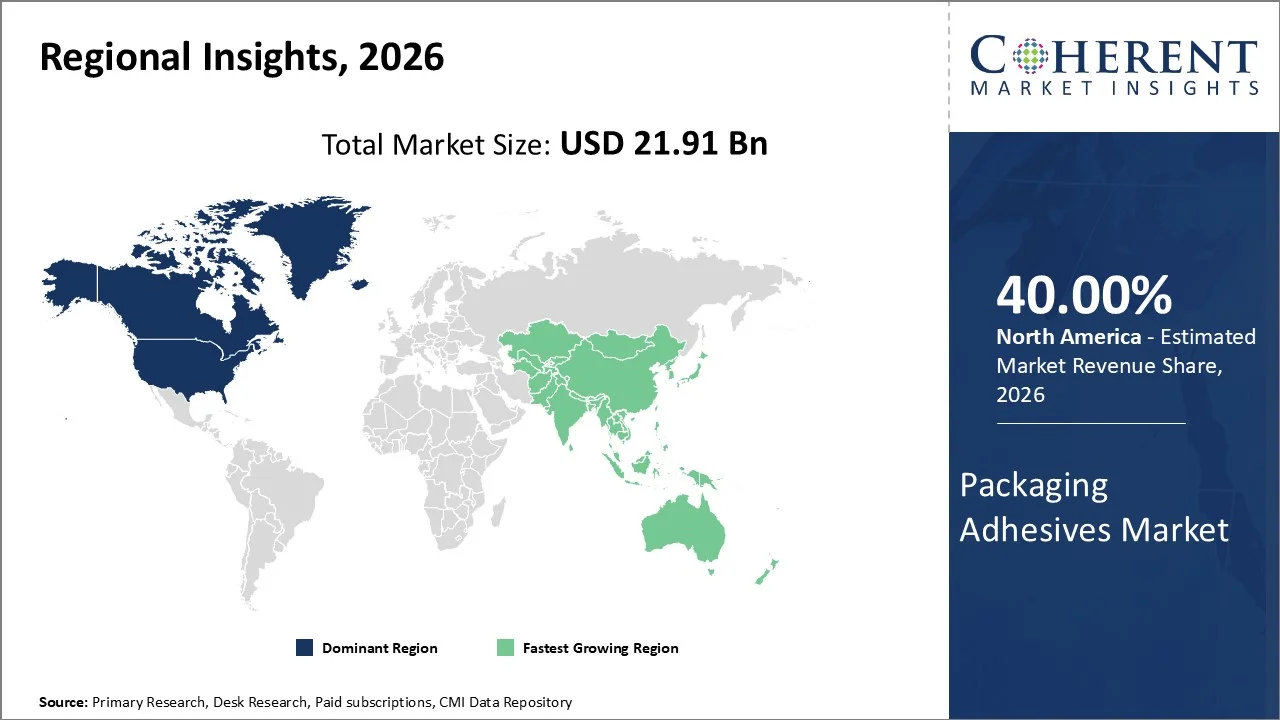
- North America is expected to acquire the dominant share of 40% in 2026, mature market with strong demand for sustainable adhesives, especially in food & beverage and e-commerce. Total e-commerce sales for 2025 were estimated at 1,233.7 billion, an increase of 5.4 percent (±1.2%) from 2024.
Bio-based and Sustainable Adhesive Technologies is transforming the Packaging Adhesives Industry
Bio-based adhesives utilize renewable materials like plant proteins, starch, cellulose, as well as natural polymers instead of petroleum. They aid lower carbon footprints while still performing well. Key technologies include protein-based, starch-based, cellulose-derived adhesives, bio-polyamides or bio-polyesters, etc.
Companies are adopting these solutions to accomplish sustainability goals. For example, Henkel’s LOCTITE LIOFOL eco glue uses up to 85% natural ingredients, reducing CO₂ by 30–40%. 3M’s Scotch tape uses plant-based materials with 40% renewable content. Bostik’s VITEL glue also uses bio-based materials while staying strong and eco-friendly. The bio-based adhesive segment is escalating fast at 12–15%, supported by regulations as well as willingness to pay more for eco-friendly products.
Smart and Functional Adhesive Technologies: A major breakthrough in Packaging Adhesives
Smart adhesives have advanced features such as temperature sensing, antimicrobial action, barrier protection, as well as responses to environmental fluctuation. Major technologies include thermochromic adhesives for temperature monitoring, antimicrobial adhesives with silver or biocides, barrier-enhancing adhesives for better shelf life, as well as pH-responsive adhesives for freshness indication.
Companies are adopting these adhesives in order to improve safety and efficiency. Avery Dennison’s temperature-sensitive adhesives helped PET bottle recycling as well as cold chain monitoring, boosting recycling efficiency by 85%. UPM Raflatac’s barrier adhesives extended product shelf life by 25–40%, and CCL Industries’ color-changing adhesives reduced food waste by 15%.
- Current Industry Events of 2026
- Market Size Estimation
- Regional Breakdown
- Competitive Landscape
- Customer Intelligence
- Segmental Analysis
- Pricing Analysis
- Key Market Drivers, Challenges & Future Trends
- Customized Insights Section
Current Events and Their Impact on the Packaging Adhesives Market
Current Event | Description and its Impact |
EU Single-Use Plastics Directive Enforcement |
|
US FDA Food Contact Regulations Update |
|
Segmental Insights
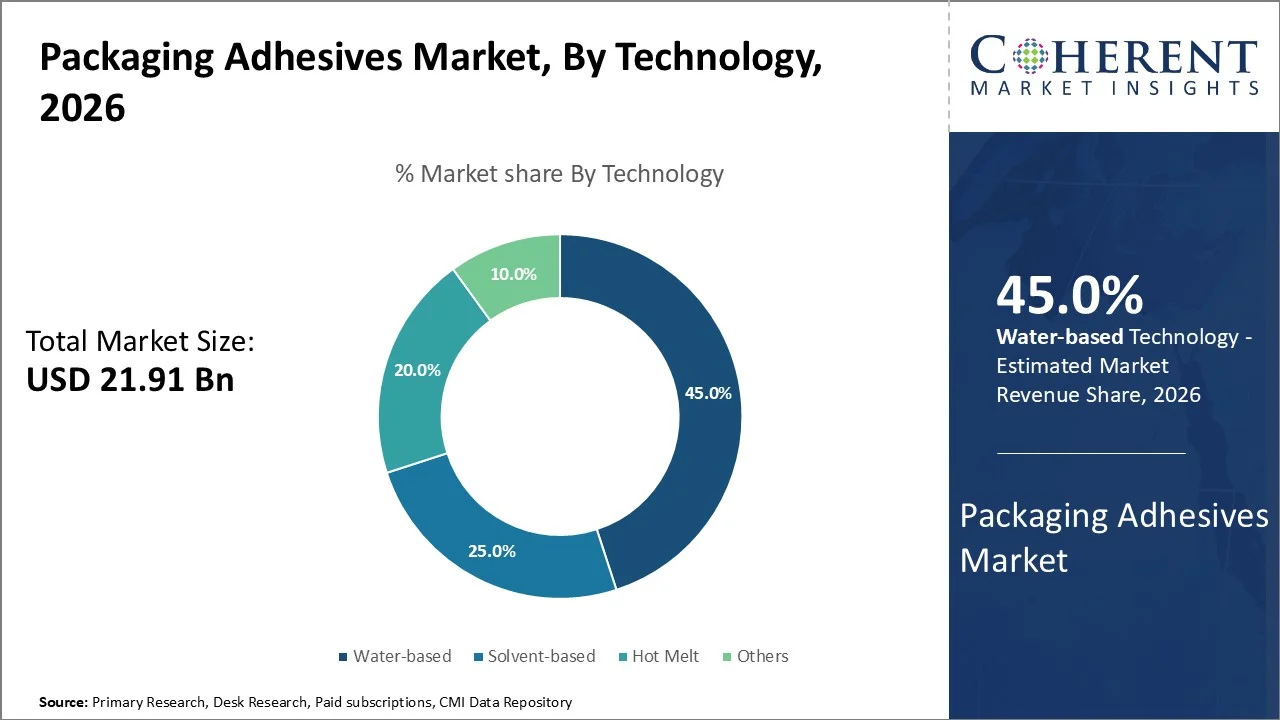
Why is Water-based Acquiring the Largest Market Share?
Water-based is projected to account for the largest share of technology in 2026, representing approximately 45% of the total volume. The stringent environmental regulations implemented by government bodies worldwide and the growing consumer preference for sustainable packaging solutions are the factors propelling the segmental growth.
In 2024, the behemoth made news by open-sourcing its plastic-free guide and sharing their learnings as well as products with peer companies at SPC Advance. The company is already 99% of the way to its goal, and the redesigns have catalyzed other sustainability wins, packaging weight and volume have been reduced by at least 50%.
Their inherently low volatile organic compound (VOC) emissions, in line with the Environmental Protection Agency's regulations in the United States as well as similar environmental standards set by the European Environment Agency is fueling the growth.
Big packaging companies like Tetra Pak are using water-based glues for making drink cartons, showing that these glues work well for large-scale production.
Corrugated Packaging holds the Largest Market Share
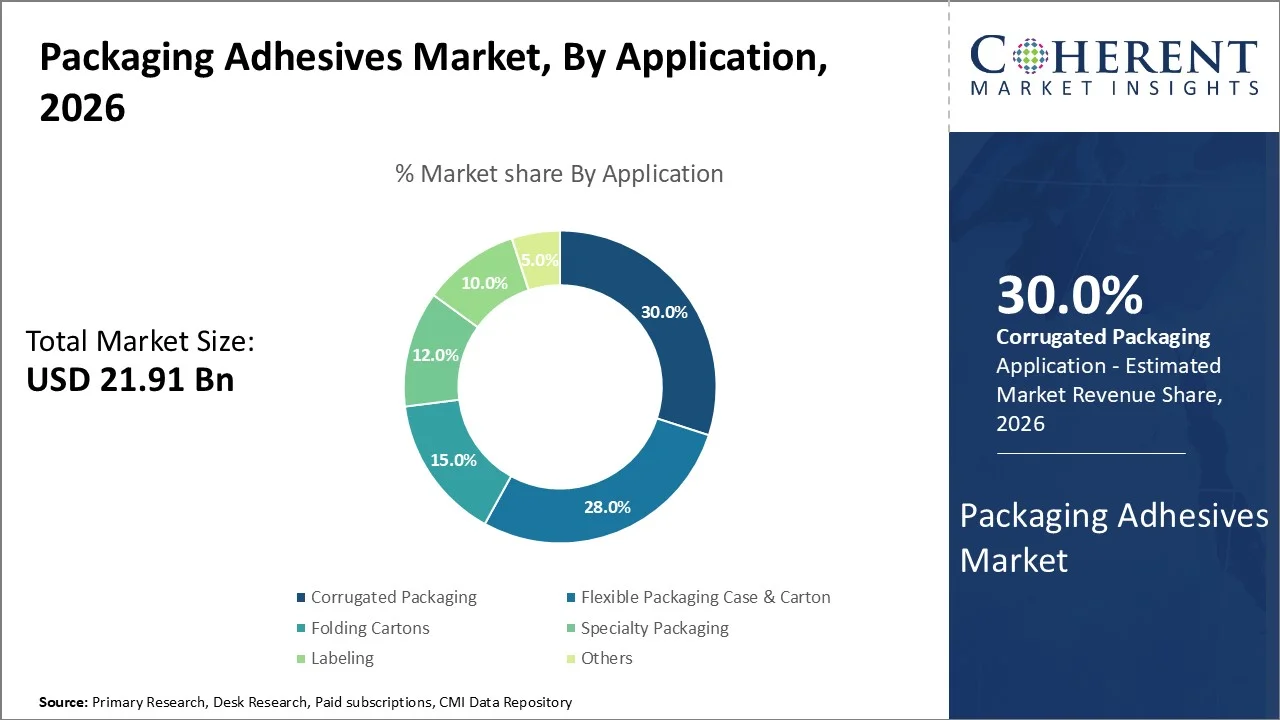
Based on applications, corrugated packaging dominates the market, accounting for a significant 30% share in 2026, the segment is propelling due to fundamental role in global logistics and e-commerce supply chains, which have experienced unprecedented expansion in recent years. Global eCommerce sales were projected to reach USD 6.4–USD 8.3 trillion in 2025, accounting for 20–21% of all retail purchases.
The material's inherent advantages including cost-effectiveness, recyclability, and superior protective properties that make it indispensable for shipping and storage applications across virtually every industry sector is further augmenting the segmental growth.
Packaging Adhesives Market Trends
- Roll out of sustainability revolution, accelerating shift toward bio-based, recyclable, and compostable adhesive formulations as brands prioritize circular economy principles. Current forecasts indicate that global biobased plastics production capacity will double from 2.31 million tonnes in 2025 to about 4.69 million tonnes by 2030 reflecting rising demand and emergence of ever more advanced applications and products.
- Adoption of smart packaging is growing the adoption of intelligent adhesives that enable temperature-sensitive, tamper-evident, and interactive packaging solutions. In April 2025, Henkel launches AI-generated virtual adhesives, Mica replacement safety coatings, structural adhesive debonding and cutting-edge electrode coating.
- Advanced formulations providing superior bonding strength, faster curing times, as well as multi-substrate compatibility
- Escalating focus on food-safe, migration-resistant adhesives meeting FDA, EU, as well as other international safety standards
Regional Insights
North America dominates owing to the advanced manufacturing capabilities
North America account 40% market share in 2026, owing to its robust industrial infrastructure and advanced manufacturing capabilities that have positioned it as the dominant force in the packaging adhesives sector. Manufacturing accounted for 9.5% of US GDP in Q3 2025, employed 12.69 million workers in December 2025, represented about 8.0% of the total nonfarm workforce, and included 239,265 manufacturing companies.
The presence of major multinational corporations such as 3M, Henkel, H.B. Fuller, etc., which have established extensive research and development facilities across the United States and Canada, is further propelling the growth of the region. These companies are spending a lot on eco-friendly adhesives to follow strict rules from the EPA and Health Canada.
The market grows thanks to a strong supply chain that links raw material suppliers with users in food, medicine, and online shopping packaging.
Asia Pacific Packaging Adhesives Market Trends
The Asia-Pacific region is poised to be the fastest-growing region through 2026-2033, expanding at a CAGR of approximately 6.5%. Driven by unprecedented industrialization as well as the fast expansion of domestic manufacturing capabilities across emerging economies. Since 2015, the region has consistently contributed more than half of the world's manufacturing value added (MVA), reaching 57.2 per cent in 2024. Its role in trade is highly important, with exports of manufactured goods accounting for 47.2 per cent of the global total in the same year, showing the region’s central position in international production networks.
Its massive infrastructure development projects and the proliferation of local packaging companies that are highly adopting advanced adhesive technologies are some of the other factors stimulating the market. Countries like Vietnam, Thailand, and Indonesia are experiencing remarkable growth in their packaging industries, with local manufacturers investing heavily in modern adhesive application systems.
The robust manufacturing ecosystem is Accelerating the Packaging Adhesives Market Demand in United States
The U.S. contributes the highest share in the packaging adhesives market in North America owing to its robust manufacturing ecosystem and extensive industrial infrastructure. The United States maintains its leadership position through its diversified packaging industry, which spans food and beverage, pharmaceuticals, consumer goods, as well as e-commerce sectors.
The advanced manufacturing capabilities of the country are exemplified by major adhesive manufacturers like 3M, Henkel Americas, H.B. Fuller Company, etc., which have established overall production facilities across multiple states. According to the U.S. Environmental Protection Agency's recent industrial emissions data, the adhesives and sealants manufacturing sector has shown significant operational expansion, with over 200 registered facilities nationwide producing packaging-grade adhesives.
China Packaging Adhesives Market Trends
China contributes the highest share in the market in the Asia Pacific due to its robust manufacturing ecosystem along with comprehensive industrial infrastructure that supports extensive packaging adhesive production as well as consumption across multiple sectors. The position of the country as the world's manufacturing hub, where countless factories require sophisticated packaging solutions for export-oriented production is another growth inducing factor propelling the growth.
Moreover, the thriving e-commerce sector of the country, led by giants like Alibaba and JD.com, has made unprecedented demand for reliable packaging adhesives to ensure product integrity during transportation as well as storage.
Recent developments from the China Adhesives and Tape Industry Association indicate that Chinese manufacturers have significantly invested in advanced adhesive technologies, particularly water-based and hot-melt adhesives that cater to food and pharmaceutical packaging requirements.
Who are the Major Companies in Packaging Adhesives Industry
Some of the major key players in packaging adhesives market include, Henkel AG & Company KGaA, 3M Company, Paramelt B.V., H.B. Fuller Company, Bostik SA, Avery Dennison Corporation, Sika AG, Wacker Chemie AG, Ashland Inc., Dymax Corporation, DowDuPont Inc., and Huntsman Corporation.
Key News
- In March 2026, Henkel a leading global manufacturer of adhesives, sealants and functional coatings launched new tinplate can packaging for adhesive solutions based on CO2-reduced steel.
- In January 2026, Sun Chemical announced the launch of a new SunLam solvent-free ultra-low monomer (ULM) adhesive, designed for packaging producers in search of high-performance applications that offer a sustainable alternative to existing solvent-based adhesives.
- In April 2026, Warsaw Pack 2026 | Tex Year showcased bio-based hot melt adhesives for sustainable packaging solutions.
Market Report Scope
Packaging Adhesives Market Report Coverage
| Report Coverage | Details | ||
|---|---|---|---|
| Base Year: | 2025 | Market Size in 2026: | USD 21.91 Bn |
| Historical Data for: | 2020 To 2024 | Forecast Period: | 2026 To 2033 |
| Forecast Period 2026 to 2033 CAGR: | 5.85% | 2033 Value Projection: | USD 32.61 Bn |
| Geographies covered: |
| ||
| Segments covered: |
| ||
| Companies covered: | Henkel AG & Company KGaA, 3M Company, Paramelt B.V., H.B. Fuller Company, Bostik SA, Avery Dennison Corporation, Sika AG, Wacker Chemie AG, Ashland Inc., Dymax Corporation, DowDuPont Inc., and Huntsman Corporation. | ||
| Growth Drivers: |
| ||
| Restraints & Challenges: |
| ||
Analyst Opinion
- High demand from food and beverage sector is inclining consumer preference for portable, convenient packaging drives growth. Global food packaging is projected to reach USD 450 billion by 2026, supporting higher adoption of adhesives that offer durability, tamper-evidence, as well as improved shelf life.
- Moreover, expansion of E-commerce is acting as another growth driver with rapid online retail growth necessitating stronger packaging solutions. In Asia-Pacific, online shopping is expected to pass USD 3 trillion by 2026, increasing the need for glue in boxes, cartons, and flexible packaging to keep products safe during shipping.
- Firms are using plant-based or recyclable adhesives to meet the sustainable goals. In Asia-Pacific, half of the adhesives market is water-based to meet eco rules.
- Oil-based ingredients usually experience changes in price. In 2025, costs went up 15–20%, affecting profits and product prices.
- Stricter rules for food packaging and the environment need careful testing, especially in North America and Europe. New companies may struggle to follow these rules without strong R&D.
Speak to the analyst
Want personalized insights?
Take the findings above to one of our principal consultants, or have the report rebuilt around the segments, geographies and competitors you actually track.
Market Segmentation
- By Technology (Revenue, USD Bn, 2021-2033)
- Water-based
- Solvent-based
- Hot Melt
- Others
- By Application (Revenue, USD Bn, 2021-2033)
- Corrugated Packaging
- Labeling
- Flexible Packaging Case & Carton
- Folding Cartons
- Specialty Packaging
- Others
- By Region (Revenue, USD Bn, 2021-2033)
- North America
- U.S.
- Canada
- Latin America
- Brazil
- Mexico
- Argentina
- Rest of Latin America
- Europe
- Germany
- U.K.
- France
- Italy
- Spain
- Russia
- Rest of Europe
- Asia Pacific
- China
- India
- Japan
- Australia
- South Korea
- ASEAN
- Rest of Asia Pacific
- Middle East
- GCC
- Israel
- Rest of Middle East
- Africa
- South Africa
- Central Africa
- North Africa
- North America
- Key Players
- Henkel AG & Company KGaA
- 3M Company
- Paramelt B.V.
- B. Fuller Company
- Bostik SA
- Avery Dennison Corporation
- Sika AG
- Wacker Chemie AG
- Ashland Inc
- Dymax Corporation
- DowDuPont Inc
- Huntsman Corporation
Sources
Primary Research Interviews
- Packaging adhesive manufacturers and suppliers
- Converting equipment manufacturers
- Packaging industry end-users (food & beverage, pharmaceuticals, consumer goods)
- Raw material suppliers (polymer and chemical companies)
- Others
Databases
- Chemical Market Analytics International (CMAI)
- ICIS Supply & Demand Database
- Euromonitor Packaging Database
- Others
Magazines
- Packaging World Magazine
- Adhesives & Sealants Industry Magazine
- Converting Magazine
- Flexible Packaging Magazine
- Others
Journals
- International Journal of Adhesion and Adhesives
- Journal of Applied Polymer Science
- Packaging Technology and Science
- Others
Newspapers
- Chemical Week
- Plastics News
- Packaging News
- European Plastics News
- Others
Associations
- Adhesive and Sealant Council (ASC)
- Flexible Packaging Association (FPA)
- European Adhesive & Sealant Industry Association (FEICA)
- Packaging Machinery Manufacturers Institute (PMMI)
- Others
Public Domain Sources
- U.S. Census Bureau - Manufacturing Statistics
- European Commission Trade Statistics
- World Trade Organization (WTO) Trade Data
- National Statistical Offices of Various Countries
- Others
Proprietary Elements
- CMI Data Analytics Tool
- Proprietary CMI Existing Repository of information for last 10 years
Get access to 250+ pages report
Every segment, forecast, competitor profile and data table behind the analysis above — available for instant download.
- ESOMAR Member
- ISO 9001:2015 Certified
- D-U-N-S Registered
- GDPR & CCPA Compliant
Missing comfort of reading report in your local language? Find your preferred language:
Transform your Strategy with Exclusive Trending Reports
Frequently Asked Questions
The packaging adhesives market is expected to reach USD 32.61 Bn in 2033.
Major players operating in the global packaging adhesives market include Henkel AG & Company KGaA, 3M Company, Paramelt B.V., H.B. Fuller Company, Bostik SA, Avery Dennison Corporation, Sika AG, Wacker Chemie AG, Ashland Inc., Dymax Corporation, DowDuPont Inc., and Huntsman Corporation.
Growing demand for packaging is one of the major factors that is expected to propel growth of the market over the forecast period.
Packaging adhesives have rising demand in the food industry is driving growth of the global Packaging Adhesives market.
The packaging adhesives market is anticipated to grow at a CAGR of 5.85% between 2026 and 2033.
Among regions, North America is expected to account for a largest market share in the global packaging adhesives market over the forecast period.