
Osmium Market Size and Forecast – 2026 to 2033
The Osmium Market is anticipated to grow at a CAGR of 4.6% with USD 1.1 Bn in 2026 and is expected to reach USD 1.9 Bn in 2033. Key drivers of the osmium market include growing demand for high-performance alloys, electrical contacts, specialized catalysts, fountain pens, precision instruments, and scientific research applications. Global fountain pen production exceeds 80 million units annually.
Key Takeaways
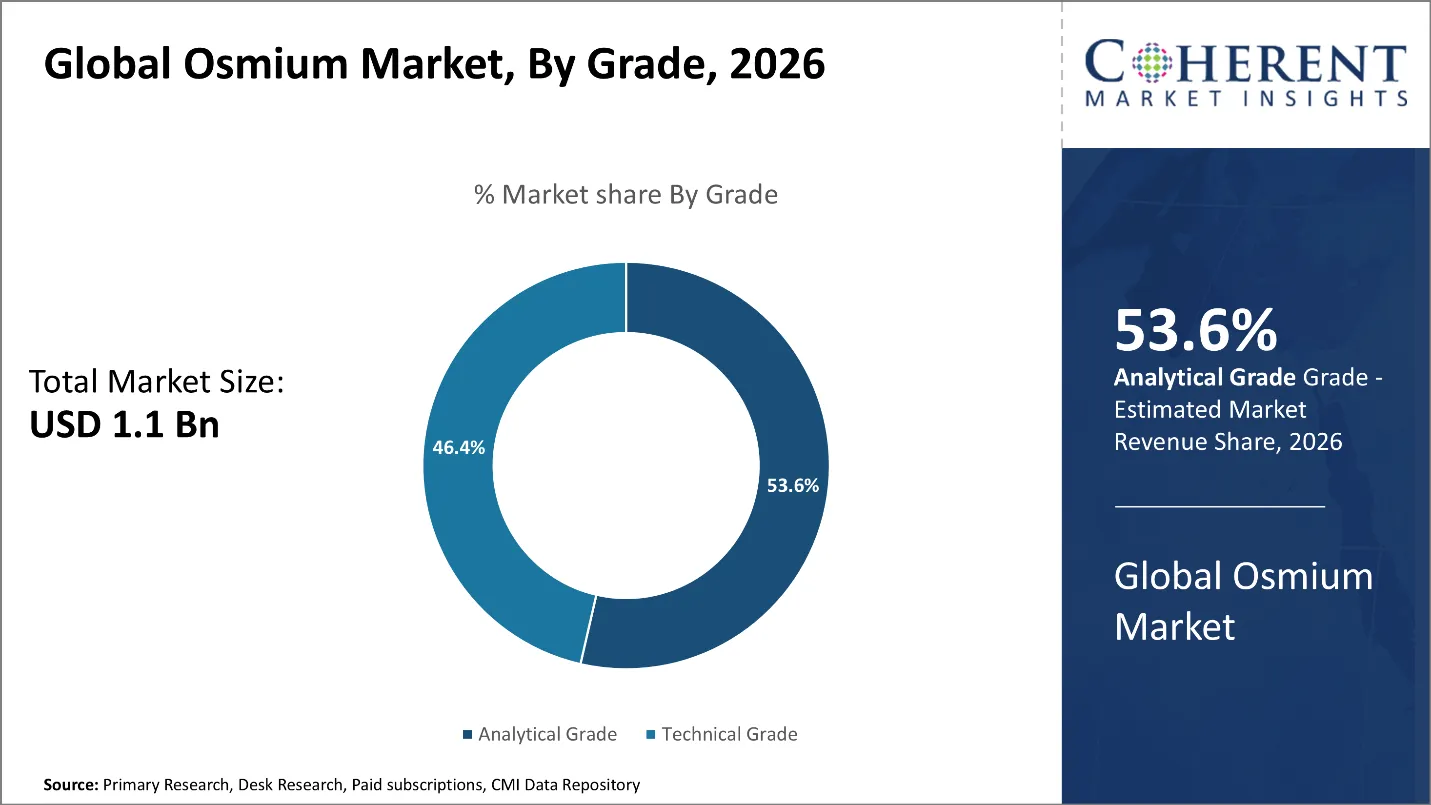
- Analytical Grade holds the largest market share of 53.6% in 2026 owing to the growth in analytical and research applications. According to Stanford Advanced Materials, osmium tetroxide is used in specialized microscopy staining techniques to enhance the visualization of fine cellular structures in biological samples.
- Granules expected to hold largest market share of 43.7% in 2026 owing to its demand for high-purity osmium materials. With a density of approximately 22.59 g/cm³, pure osmium is the densest naturally occurring element.
- Instrumental Pivots acquired the prominent market share of 45.8% in 2026 owing to the growth in precision instrumentation.
- North America is expected to acquire the dominant share of 39.2% in 2026 owing to its strong R&D infrastructure.
Current Events and Their Impact on the Osmium Market
Current Event | Description and its Impact |
South Africa’s 2025 Critical Minerals and Metals Strategy |
|
Expansion of Global Export Restrictions on Osmium and Other PGMs |
|
Segmental Insights
- Current Industry Events of 2026
- Market Size Estimation
- Regional Breakdown
- Competitive Landscape
- Customer Intelligence
- Segmental Analysis
- Pricing Analysis
- Key Market Drivers, Challenges & Future Trends
- Customized Insights Section
Why is Analytical Grade Acquiring the Largest Market Share?
Analytical Grade holds the largest market share of 53.6% in 2026. Growing pharmaceutical research, chemical synthesis, microscopy, and advanced materials applications are increasing demand for high-purity analytical-grade osmium. Research institutions and laboratories are investing more in reliable, traceable, and contamination-controlled osmium products to meet stringent quality requirements. Expanding electron microscopy and specialized analytical techniques also drives consumption. In addition, advances in catalysis, nanotechnology, and materials science are creating new niche applications, encouraging research institutions and specialized industrial laboratories to adopt analytical-grade osmium for precise and high-performance research activities. For instance, Moody’s Corporation launched its first AI skills—platform-agnostic instruction kits that apply Moody’s analytical frameworks and connect AI agents to its proprietary ratings, research, and risk intelligence. Customers can use these skills to execute complex analytical workflows through natural-language requests.
Granules expected to hold largest market share
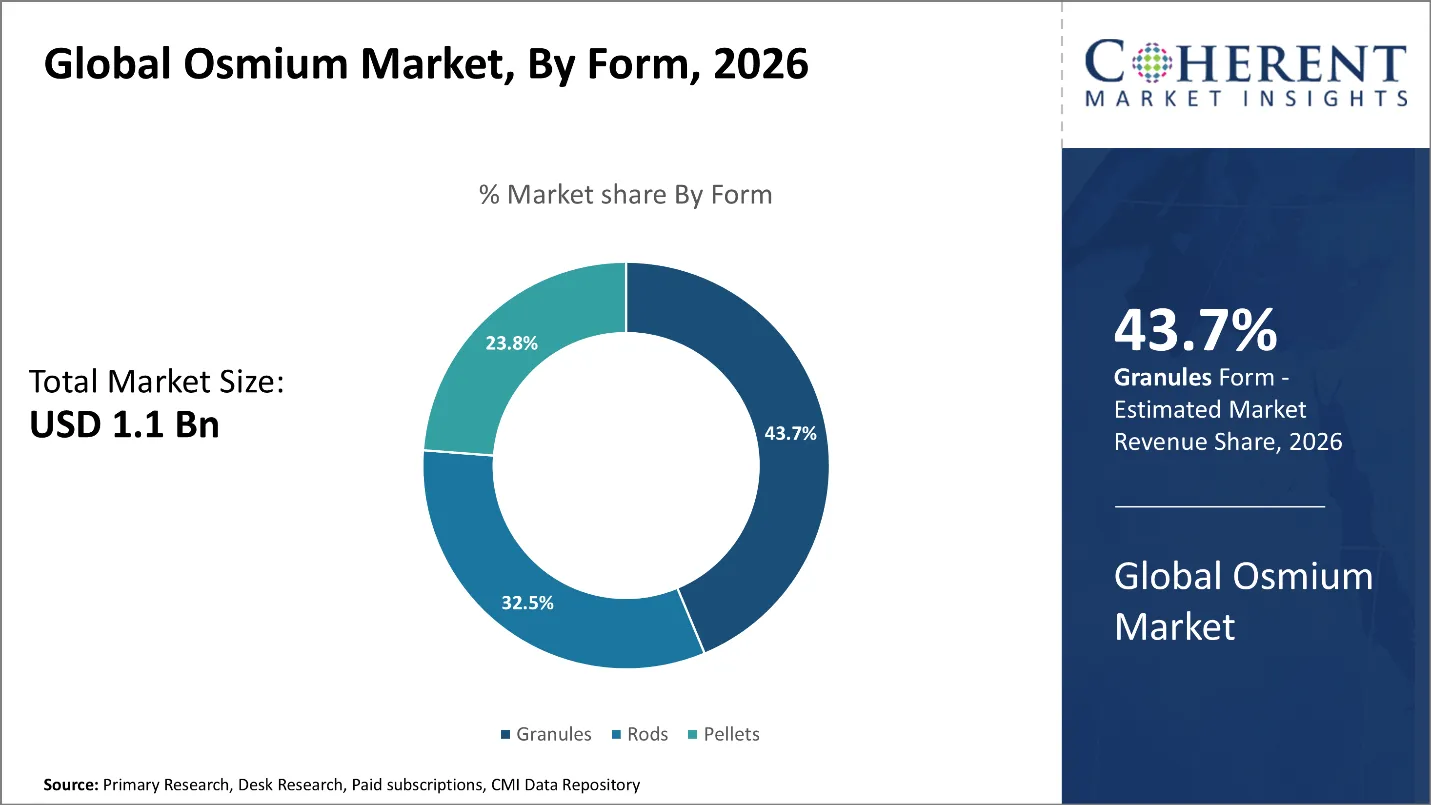
Granules expected to hold largest market share of 43.7% in 2026 owing to its demand for platinum-group metals (PGMs). Rising demand for high-purity osmium across research, laboratory, and specialty material applications supports the granules segment. Manufacturers and research organizations use osmium granules in alloy development, thin-film deposition, coatings, and advanced material studies. According to Patsnap Eureka, osmium coatings offer strong corrosion resistance in aggressive environments, although their protective performance varies with temperature. Researchers and production teams value granules because they enable convenient handling, accurate measurement, and controlled material feeding.
Which Application segment dominates the market?
Instrumental Pivots acquired the prominent market share of 45.8% in 2026. Demand for specialized scientific and precision instruments drives the use of osmium in instrumental pivots. Manufacturers use osmium for components that require exceptional hardness, wear resistance, durability, and dimensional stability. Growing laboratory, medical, and analytical equipment applications further support demand for reliable precision components. Advances in microscopy, materials research, and high-performance instrumentation are expanding opportunities for osmium-based parts. In addition, the need for long-lasting components in demanding operating environments encourages manufacturers to adopt osmium where conventional materials may not provide adequate performance.
Osmium Market Trends
- Specialized applications remain the core of osmium demand. Osmium has a density of 22.5872 g/cm³, making it the densest element, and its hardness and corrosion resistance support its use in specialized alloys, instrument pivots, electrical contacts, and other wear-resistant components.
- Electron microscopy continues to support demand for osmium compounds. PubChem identifies osmium tetroxide (OsO₄) as being used primarily for staining biological and pathological tissues for microscopic examination. Its use in electron-microscopy laboratories makes biological research an established application area for osmium compounds.
- Osmium-based catalysis remains an important research application. The Royal Society of Chemistry documents osmium catalysts for reactions including olefin oxidation, C–H functionalization, hydrogenation, and other organic transformations. Research has also examined osmium catalysts for pharmaceutical intermediates and biologically relevant compounds.
- High toxicity of osmium tetroxide limits some applications and increases handling requirements. PubChem describes OsO₄ as a highly oxidizing and corrosive compound used in microscopy and biological staining. Consequently, applications involving OsO₄ require controlled laboratory handling and appropriate safety procedures, which can affect the practical cost and accessibility of osmium-based applications.
Regional Insights
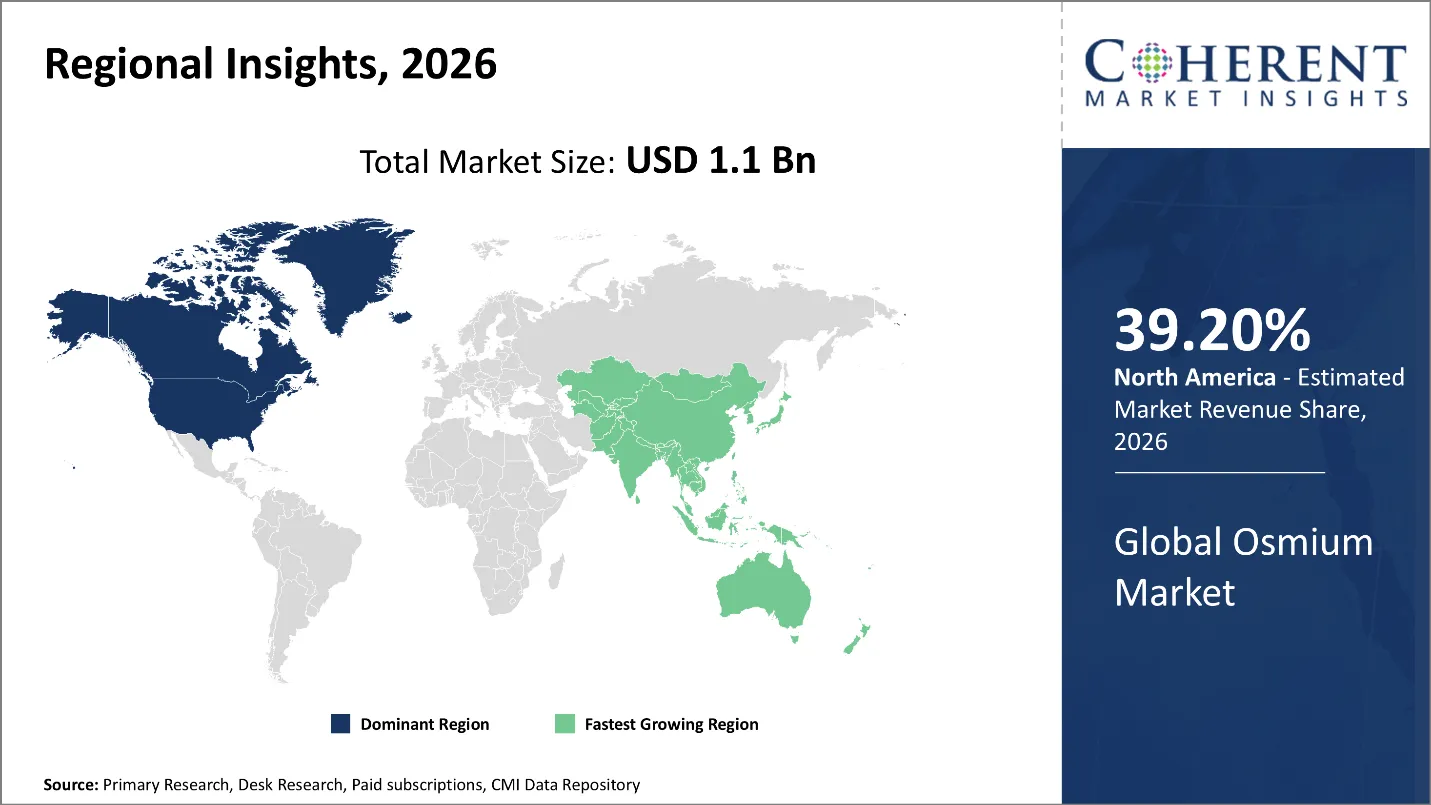
North America dominates owing to expansion of advanced materials research
North America is expected to acquire the dominant share of 39.20% in 2026. North America’s osmium market grows as universities, research institutions, and industries expand scientific research across pharmaceuticals, biotechnology, materials science, and nanotechnology. These organizations increasingly use high-purity osmium and its compounds in electron microscopy, analytical chemistry, semiconductor research, and precision instrumentation. Advances in specialized coatings and advanced materials also create new applications. Furthermore, established laboratory supply networks help users access specialized osmium products, while strict quality standards encourage manufacturers and research organizations to purchase certified, traceable, and high-quality materials for demanding applications.
Asia Pacific Osmium Market Trends
Expanding electronics and semiconductor manufacturing drives Asia Pacific’s osmium market, particularly in China, Japan, South Korea, and Taiwan, where manufacturers use osmium in specialized contacts, precision components, and advanced microscopy. Growing pharmaceutical and chemical industries in China and India also increase demand for osmium-based catalysts and analytical compounds. Rising investments in biotechnology, nanotechnology, materials science, and medical research create additional applications. According to Invest India, India’s bioeconomy expanded from USD 10 billion in 2014 to USD 165.7 billion in 2024, representing a compound annual growth rate (CAGR) of approximately 32.4%. Furthermore, expanding automotive production, precision engineering, and recycling capabilities across the region continue to strengthen demand for this scarce platinum-group metal.
United States Osmium Market Trends
The United States osmium market continues to expand as industries increase their use of high-performance materials in electronics, electrical contacts, scientific instruments, specialty alloys, medical devices, and aerospace equipment. Manufacturers use osmium’s high hardness, density, corrosion resistance, and durability to produce precise, long-lasting components. Osmium diboride exhibits a Vickers hardness of approximately 2,500–3,500 kg/mm², making it an exceptionally hard material. Ongoing research into advanced materials and specialized chemical applications also creates new niche opportunities. Furthermore, limited refined osmium supplies and dependence on platinum-group-metal processing drive companies to secure reliable sources for essential applications.
China Osmium Market Trends
China’s osmium market benefits from rising demand across advanced industrial applications, including catalysts, specialty alloys, electrical contacts, and high-performance components. China’s expanding chemical, electronics, automotive, and precision manufacturing industries drive the use of osmium and osmium-based materials. In 2025, China’s chemical industry reached approximately 980 million tonnes of refining capacity, marking a record level and indicating continued capacity expansion. Increased research and development investment supports new specialized applications. China also improves metal recovery and recycling processes, strengthening domestic supply. Furthermore, ongoing industrial modernization and the need for durable, high-performance materials continue to stimulate osmium market development.
Who are the Major Companies in Osmium Industry
Some of the major key players in Osmium are Ceimig Limited, American Elements, Reade International Corp, Cleantech, and others.
Key News
- In June 2026, DP World San Antonio welcomed the CMA CGM Osmium, a 13,136-TEU dual-fuel methanol vessel launched in March 2026. The ship will handle 3,500 container movements before sailing to Chancay, Peru, on the ACSA1 route.
Market Report Scope
Osmium Market Report Coverage
Report Coverage | Details | ||
Base Year: | 2025 | Market Size in 2026: | USD 1.1 Bn |
Historical Data for: | 2020 to 2024 | Forecast Period: | 2026 to 2033 |
Forecast Period 2026 to 2033 CAGR: | 4.6% | 2033 Value Projection: | USD 1.9 Bn |
Geographies covered: |
| ||
Segments covered: |
| ||
Companies covered: | Ceimig Limited, American Elements, Reade International Corp, Cleantech, and others. | ||
Analyst Opinion
- Osmium demand is fundamentally constrained by supply scarcity, making availability a more important market driver than broad industrial consumption. The Royal Society of Chemistry reports osmium’s crustal abundance at just 0.000037 ppm and identifies South Africa, Russia, and Zimbabwe as the top three producers. This extreme resource concentration gives supply disruptions an outsized influence on purchasing decisions, particularly for specialized applications where manufacturers cannot easily secure equivalent material.
- The strongest commercial opportunity lies in high-value applications rather than mass-volume consumption. Osmium’s exceptional hardness and catalytic properties support its use in specialized catalysts and hard alloys, while research is also examining its role in hydrogen-related technologies. The U.S. Geological Survey classifies osmium among the six platinum-group metals and highlights the outstanding catalytic properties of PGMs. This positions osmium as a strategic specialty material whose value is tied more to performance requirements than to bulk industrial demand.
- Recycling and recovery will increasingly shape osmium availability because primary production does not occur independently of broader platinum-group-metal mining. Global PGM production is heavily concentrated geographically: a 2024 assessment places South Africa’s proven PGM reserves at about 63,000 tonnes, compared with 16,000 tonnes in Russia. The Royal Society of Chemistry also reports an osmium recycling rate above 30%. Improved recovery from PGM processing and industrial residues represents one of the few practical ways to improve supply resilience without relying entirely on new mining capacity.
- China’s position should be viewed primarily through processing, downstream manufacturing, and import dependence rather than domestic mine supply. World Bank trade data show that South Africa exported 2,439 kg of combined unwrought or powdered iridium, osmium, and ruthenium to China in 2024. Because the trade classification combines three metals, this figure should not be interpreted as China’s osmium consumption; however, it demonstrates China’s participation in the international supply chain for these scarce PGMs.
Speak to the analyst
Want personalized insights?
Take the findings above to one of our principal consultants, or have the report rebuilt around the segments, geographies and competitors you actually track.
Market Segmentation
- By grade (Revenue, USD Bn, 2021-2033)
- Analytical Grade
- Technical Grade
- By Form (Revenue, USD Bn, 2021-2033)
- Rods
- Pellets
- Granules
- By Application (Revenue, USD Bn, 2021-2033)
- Instrumental Pivots
- Electrical Contacts
- Fountain Pen Nibs
- Others
- By Region (Revenue, USD Bn, 2021-2033)
- North America
- U.S.
- Canada
- Latin America
- Brazil
- Mexico
- Argentina
- Rest of Latin America
- Europe
- Germany
- U.K.
- France
- Italy
- Spain
- Russia
- Rest of Europe
- Asia Pacific
- China
- India
- Japan
- Australia
- South Korea
- ASEAN
- Rest of Asia Pacific
- Middle East
- GCC
- Israel
- Rest of Middle East
- Africa
- South Africa
- Central Africa
- North Africa
- North America
Sources
Primary Research interviews
- Interviews with osmium producers, refiners, processors, and distributors.
- Discussions with precious-metal traders, bullion dealers, and specialty-metal suppliers.
- Interviews with manufacturers and end users of osmium-based products and compounds.
- Conversations with procurement managers, sourcing professionals, and technical specialists.
- Inputs from industry experts involved in precious metals, specialty chemicals, catalysts, and advanced materials.
- Interviews with representatives of mining, refining, recycling, and metal recovery companies.
Databases
- U.S. Geological Survey (USGS) mineral commodity and minerals information databases.
- United Nations Comtrade Database.
- World Integrated Trade Solution (WITS).
- International Trade Centre (ITC) Trade Map.
- World Bank commodity and economic databases.
- Eurostat statistical databases.
- National statistical and customs databases of major osmium-producing, importing, and consuming countries.
- Government mining, trade, production, and industrial databases.
Magazines
- Mining Journal.
- Engineering & Mining Journal.
- International Mining.
- Mining Magazine.
- Metal Bulletin / Fastmarkets publications.
- Precious Metals News and other specialty publications covering precious and platinum-group metals.
- Trade publications covering advanced materials, catalysts, specialty chemicals, and metallurgy.
Journals
- Journal of Alloys and Compounds.
- Journal of Catalysis.
- Applied Catalysis A: General.
- Catalysis Today.
- Hydrometallurgy.
- Minerals Engineering.
- Metallurgical and Materials Transactions.
- Materials Chemistry and Physics.
- Journal of Materials Research.
- Peer-reviewed publications covering platinum-group metals, osmium chemistry, metallurgy, catalysis, and advanced materials.
Newspapers
- Reuters.
- Financial Times.
- The Wall Street Journal.
- The Economic Times.
- The Hindu BusinessLine.
- Mint.
- The Times of India.
- Leading national newspapers and business publications covering mining, metals, commodities, manufacturing, and international trade.
Associations
- International Platinum Group Metals Association (IPA).
- International Precious Metals Institute (IPMI).
- London Bullion Market Association (LBMA).
- World Platinum Investment Council (WPIC).
- International Mining Association and relevant national mining associations.
- National geological surveys and mining associations.
- Metallurgical, materials-science, and chemical-engineering professional associations.
- Trade associations representing precious metals, specialty metals, catalysts, and advanced materials.
Public Domain sources
- U.S. Geological Survey (USGS) publications and mineral commodity information.
- United Nations trade and statistical publications.
- World Bank open datasets and commodity reports.
- International Trade Centre trade statistics.
- European Commission and Eurostat publications.
- Government mining ministry and geological survey reports.
- National customs and trade statistics.
- Publicly available company filings and regulatory disclosures.
- Academic publications and publicly accessible research papers.
- Patent databases and publicly available technical documentation.
- Government regulations, environmental assessments, and industrial reports related to platinum-group metals.
Proprietary Elements
- CMI Data Analytics Tool
- Proprietary CMI Existing Repository of information for last 10 years
Get access to 250+ pages report
Every segment, forecast, competitor profile and data table behind the analysis above — available for instant download.
- ESOMAR Member
- ISO 9001:2015 Certified
- D-U-N-S Registered
- GDPR & CCPA Compliant
Missing comfort of reading report in your local language? Find your preferred language:
Transform your Strategy with Exclusive Trending Reports
Frequently Asked Questions
The Osmium Market is anticipated to grow at a CAGR of 4.6% with USD 1.1 Bn in 2026 and is expected to reach USD 1.9 Bn in 2033.
The Osmium Market is driven by demand for high-performance materials used in specialized applications, including precision instrumentation, specialty alloys, catalysts, and fountain pen nibs.
Analytical Grade is projected to hold the largest share of the market in 2026.
Analytical Grade osmium benefits from expanding laboratory research and applications requiring controlled purity and reliable material performance.
Granules are expected to account for the largest share among the covered forms in 2026.
Instrumental Pivots represent the leading application segment in the provided market assessment.