

Global Maleic Anhydride Market Size and Forecast – 2026 - 2033
The global maleic anhydride market is estimated to be valued at USD 5.10 Bn in 2026. The market is expected to reach USD 7.68 Bn by 2033, exhibiting a compound annual growth rate (CAGR) of 6.0% from 2026 to 2033.
Key Takeaways of the Global Maleic Anhydride Market
- The n-butane segment is projected to represent 56.8% of the global maleic anhydride market share in 2026.
- The unsaturated polyester resins (UPR) segment is expected to account for 37.1% of the global maleic anhydride market share in 2026.
- Asia Pacific is expected to top the market with 54.3% share in 2026.
- The North America region is expected to exhibit the fastest growth, contributing 24% of the market share in 2026.
Market Overview
The market growth is primarily driven by the increasing applications of maleic anhydride in several end-use industries such as construction, automotive, and agriculture. This is attributed to the growing demand from end-use industries such as construction and automotive. Additionally, the demand for unsaturated polyester resins from emerging economies is also contributing to the market growth. Market players are investing in capacity expansion to cater to the rising product demand.
Global Production Landscape and Capacity Expansion
- China dominates global capacity with about 33% and plans to add over 2.5 million tons/year, including a 200,000-ton/year plant in 2025, often integrated with 1,4-butanediol (BDO) production for efficiency.
- North America maintains robust production with significant export volumes (44,001 tons in 2023), while India, as the top importer (95,001 tons in 2024), adding a new 50,000-ton/year plant to address growing demand.
- Globally, most facilities produce standard-grade maleic anhydride for resins and coatings, with Asia Pacific leading UPR-focused output (52.2% share) and North America specializing in high-purity grades; bio-based variants are also under development.
Emerging Applications
- Maleic anhydride is increasingly used in adhesion promoters for coatings and composites in automotive and construction, and as a precursor for agricultural chemicals like pesticides, driven by sector expansion.
- A significant emerging trend is bio-based maleic anhydride from renewable feedstocks, targeting eco-conscious industries such as green packaging to align with circular economy goals.
- Future applications include intelligent composites e.g., self-healing materials for aerospace and EVs, roles in green infrastructure like carbon-capture concrete, and derivatives for advanced electronics such as next-gen batteries.
- Current Industry Events of 2026
- Market Size Estimation
- Regional Breakdown
- Competitive Landscape
- Customer Intelligence
- Segmental Analysis
- Pricing Analysis
- Key Market Drivers, Challenges & Future Trends
- Customized Insights Section
Market Trends
Growing Demand from End-use Industries
The maleic anhydride market is primarily propelled by the increasing demand from key end-use industries, particularly construction and automotive. Maleic anhydride is a crucial raw material in the production of unsaturated polyester resins (UPR), which are extensively used in fiberglass-reinforced plastics for applications like automotive components e.g., body panels, fenders, construction products e.g., sinks, countertops, and marine applications. The ongoing infrastructure development globally and the continuous innovation in the automotive sector, focusing on lightweight and durable materials, are directly fueling this demand.
For instance, the building and construction sector currently accounts for the largest share of maleic anhydride consumption, leveraging UPR for its excellent mechanical properties, durability, and chemical resistance in various structural and aesthetic components.
Shift Towards Sustainable and Bio-based Solutions
There is a growing trend in the maleic anhydride market towards sustainable and bio-based production methods. Driven by increasing environmental awareness and stricter regulations concerning toxic compounds like benzene a traditional feedstock for maleic anhydride, manufacturers are exploring and investing in alternative, renewable sources. This shift aligns with global sustainability goals and consumer preferences for eco-friendly products.
For instance, the commercialization of bio-based maleic anhydride, which can be produced from renewable feedstock through fermentation processes, represents a significant opportunity. This not only addresses environmental concerns but also offers a pathway to reduce reliance on limited fossil fuel resources and potentially lower manufacturing costs in the long run.
Current Events and Its Impact
Current Events | Description and its impact |
Production Capacity Expansions and Supply-Demand Imbalances |
|
Sustainability Initiatives and Technological Shifts |
|
Segment Insights
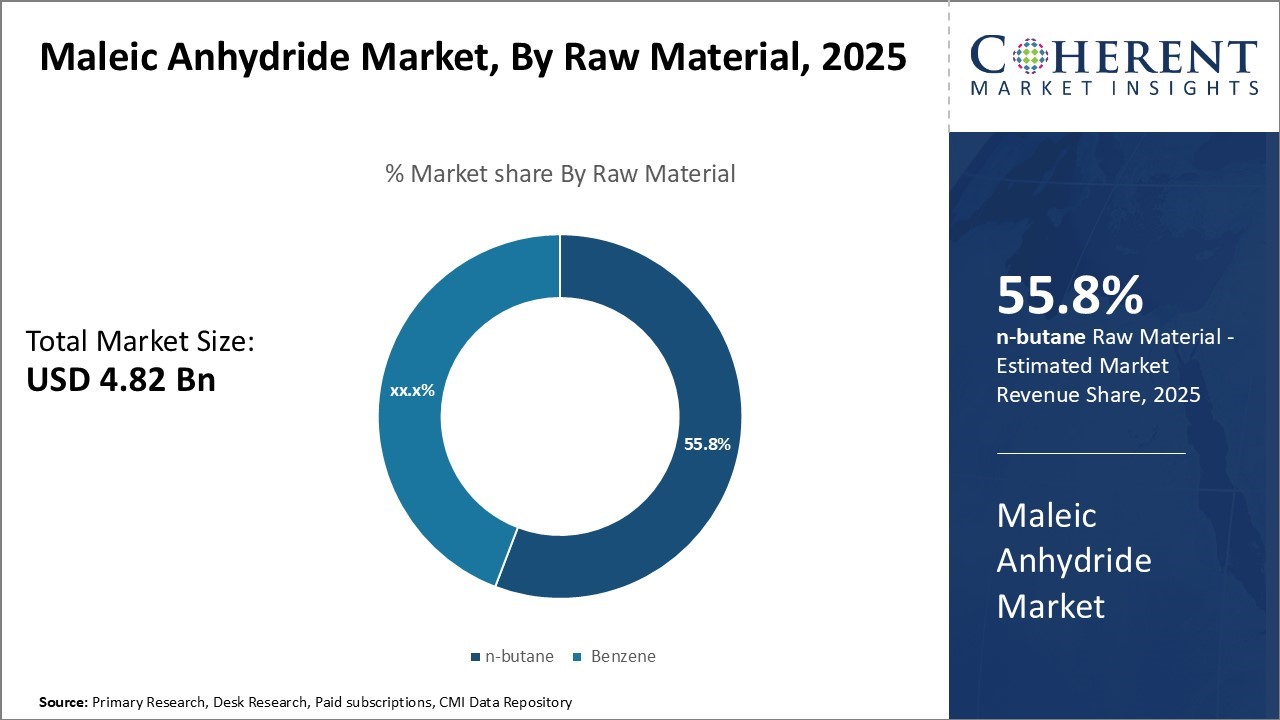
Global Maleic Anhydride Market Insights, by Raw Material - The n-butane segment leads driven by rising demand across various industries, including infrastructure development
In terms of raw material, the n-butane segment is expected to dominate the market by 56.8% of the global maleic anhydride market in 2026, dominating the raw material category. Its prominence stems from the highly efficient conversion process it offers. Maleic anhydride production using n-butane is often integrated into petrochemical complexes, where refineries transform n-butane into maleic anhydride alongside other valuable by-products. This integrated approach enables producers to optimize resource utilization and enhance profitability from n-butane feedstock.
For instance, BASF's continuous development of advanced trilobe-shaped catalysts for n-butane oxidation has been a significant factor. These catalysts offer 1-2 percentage points higher maleic anhydride yield and enhanced mechanical/chemical stability, leading to increased profitability and reduced plant shutdowns for producers utilizing this feedstock.
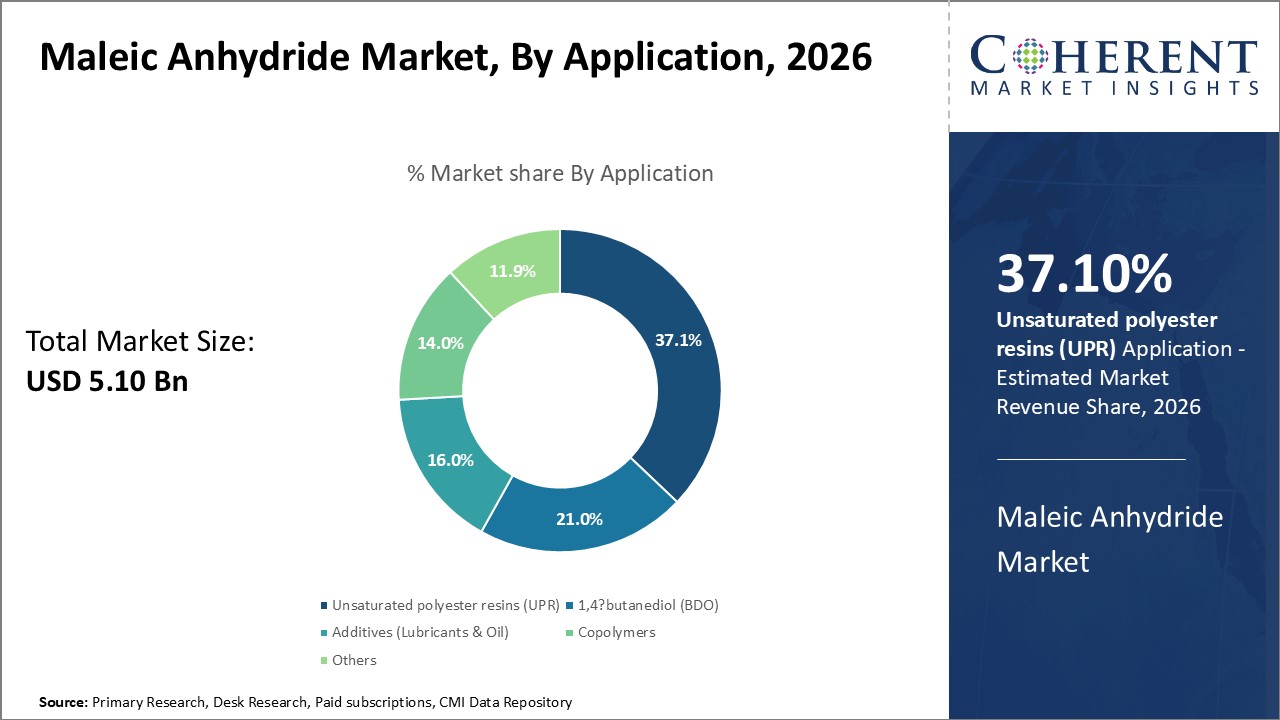
Global Maleic Anhydride Market Insights, by Application - Unsaturated polyester resins lead application
In terms of application, the unsaturated polyester resins (UPR) segment is expected to hold 37.1% share of the global maleic anhydride market in 2026.
Maleic anhydride serves as a critical co-monomer and chemical building block in polyester resin production. These resins offer diverse properties, making them suitable for applications in construction, transportation, industrial machinery, and others. Rising infrastructure development in emerging markets, coupled with maintenance and repair activities in developed regions, continues to drive the demand for polyester resins.
Regional Insights
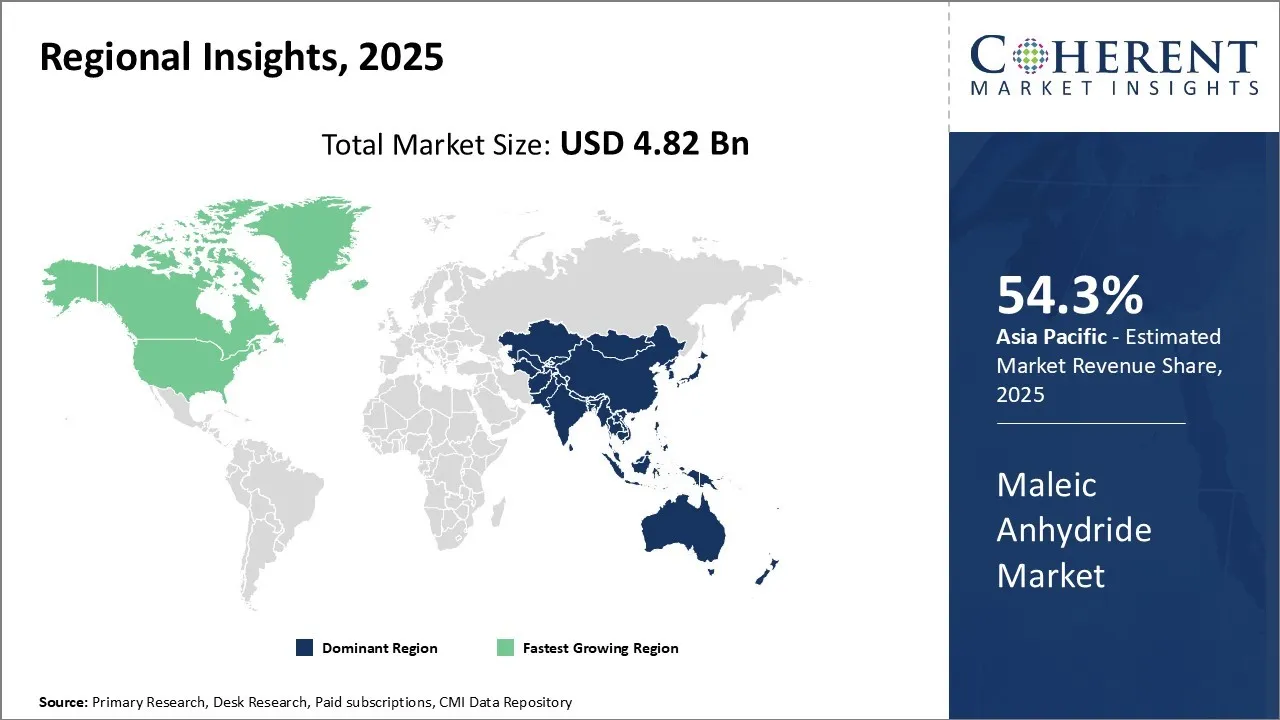
Asia Pacific Maleic Anhydride Market Trends
Asia Pacific continues to dominate the global maleic anhydride market, and is projected to hold 54.3% of the global volume in 2026, primarily due to rapid industrialization, expansion of the chemical sector, and robust demand in key applications such as unsaturated polyester resins (UPR) and 1,4-butanediol.
North America Maleic Anhydride Market Trends
The North America region is expected to exhibit the fastest growth, contributing 24% of the market share in 2026. This growth is fueled by a robust chemical industry and increasing demand for maleic anhydride in applications such as unsaturated polyester resins and 1,4-butanediol. The presence of leading manufacturers such as Huntsman Corporation and advancements in production technologies further strengthen North America's position as the fastest-growing market.
For instance, the U.S. maleic anhydride market in 2026 is experiencing price fluctuation but remained generally stable, with a recovery in February and March after a January slowdown. This was supported by steady raw material costs and improving sentiment in the construction and automotive sectors, indicating a resilience in demand despite macroeconomic factors.
Maleic Anhydride Market Outlook for Key Countries
U.S. Maleic Anhydride Market Trends
The U.S. maleic anhydride market benefits from sizable demand from domestic end-use industries and exports. Key industry participants in the country play an influential role. This dominance is driven by growth in the agricultural, automotive, and construction industries.
According to data published by TST Europe in February 2024, U.S. construction spending reached USD 1.98 trillion in 2023, a 7.9% increase from 2022. Non-residential construction grew significantly by 18.1%, while residential spending declined by 3.5% due to inflation and higher interest rates. Annually, the U.S. builds structures worth over USD 1.8 trillion, bolstering product demand.
India Maleic Anhydride Market Trends and Analysis
The expanding pharmaceutical industry in India is driving the demand for maleic anhydride. In 2023, according to the India Brand Equity Foundation (IBEF), India is the third-largest pharmaceutical producer globally and supplies over 50.5% of the world's vaccine demand. This robust production capacity, coupled with ongoing investments in pharmaceutical manufacturing and research, underscores the growing importance of maleic anhydride in pharmaceutical applications, including the synthesis of active pharmaceutical ingredients (APIs).
For instance, Indian Oil Corporation (IOC) is actively investing in the domestic production of maleic anhydride with its first mega-scale plant at the Panipat Refinery and Petroleum Complex.
Germany Maleic Anhydride Market Trends and Analysis
Germany is a leading exporter of maleic anhydride, with exports totalling USD 131 million in 2022, making it the second-largest exporter globally by the Observatory of Economic Complexity (OEC). This strong export position is driven by the country's robust automotive and construction sectors, which are significant consumers of maleic anhydride for producing unsaturated polyester resins used in various applications.
In early 2026, maleic anhydride prices in Germany remained stable, supported by a balanced supply-demand situation. Industrial production, particularly in the automotive and construction sectors, continued at a steady pace, and efficient production capacities coupled with stable inventory levels ensured supply met demand without significant price movements.
Saudi Arabia Maleic Anhydride Market Trends and Analysis
Fluctuations in crude oil prices significantly impact the maleic anhydride market, as crude oil is a primary raw material for its production. A key instance is the continuous operation of International Diol Company (IDC), an affiliate of Sipchem, which has been producing maleic anhydride since 2005, serving these growing domestic industries.
Japan Maleic Anhydride Market Trends and Analysis
Japan maleic anhydride market is driven by its advanced automotive sector, which emphasizes lightweight materials for fuel efficiency. The country is witnessing a shift towards sustainable practices, with increasing adoption of bio-based maleic anhydride. This trend is supported by technological advancements in production processes, enhancing the competitiveness of Japanese manufacturers in the global market.
Market Players and Key Developments
Key Developments
- In February 2025, Thirumalai Chemicals’ U.S. subsidiary planned to commission Phase I of its West Virginia petrochemical plant in Q4 2025, aiming to boost production capacity and strengthen its presence in the U.S. market.
- In September 2024, MAIRE (via its NEXTCHEM subsidiary) and its technology licensor CONSER was awarded the contract for maleic anhydride plant in Oman by Al Baleed Petrochemical.
- In August 2024, BASF signed an MoU with UPC Technology Corporation to strengthen strategic cooperation on the supply of plasticizer alcohol and catalysts for maleic anhydride (MA) and phthalic anhydride (PA).
- In November 2023, Clariant announced its acquisition of Jiangsu Shenghong Petrochemical Co., Ltd., a prominent Chinese petrochemical company known for its advanced production capabilities and strong presence in the chemical industry. As part of this agreement, Clariant's SynDane 3142 LA catalyst will be utilized in the development of a new maleic anhydride (MA) production facility located in Lianyungang, China further enhancing the company's foothold in the market.
- In October 2023, Huntsman resumed maleic anhydride production at its Moers facility in Germany, following an unexpected maintenance shutdown that had temporarily halted operations. The Moers plant is recognized for its notable annual production capacity of 105,000 tons of maleic anhydride.
- In June 2023, PETRONAS Chemicals Group Berhad (PCG), a leading integrated chemicals producer in Southeast Asia known for its diversified portfolio and strong market presence, announced the acquisition of a 113-kilotonne-per-annum (ktpa) maleic anhydride (MAn) plant located in Gebeng, Malaysia. The facility was acquired from BASF PETRONAS Chemicals Sdn. Bhd. (BPC), a joint venture between BASF, a global chemical company renowned for its innovation, and PETRONAS, Malaysia’s national oil and gas corporation. This acquisition strengthens PCG's position in the maleic anhydride market and expands its production capabilities.
Market Report Scope
Maleic Anhydride Market Report Coverage
| Report Coverage | Details | ||
|---|---|---|---|
| Base Year: | 2025 | Market Size in 2026: | USD 5.10 Bn |
| Historical Data for: | 2020 To 2024 | Forecast Period: | 2026 To 2033 |
| Forecast Period 2026 to 2033 CAGR: | 6.0% | 2033 Value Projection: | USD 7.68 Bn |
| Geographies covered: |
| ||
| Segments covered: |
| ||
| Companies covered: | Huntsman Corporation, Ashland Global Holdings Inc., BASF SE, Mitsubishi Chemical Corporation, LyondellBasell Industries N.V., DIC Corporation, Kraton Corporation, LANXESS AG, Polynt S.p.A., Koninklijke DSM N.V., Wacker Chemie AG, Eni S.p.A., Godavari Biorefineries Ltd., Nizhnekamskneftekhim, and GAIL (India) Limited. | ||
| Growth Drivers: |
| ||
| Restraints & Challenges: |
| ||
Maleic Anhydride Market Growth Factors
Increasing Demand for Unsaturated Polyester Resins in Construction and Automotive Industries
Maleic Anhydride plays a key role in the production of unsaturated polyester resins that are extensively used in the construction and automotive industries for making fiberglass parts, sheet molding compounds, and gel coats due to their outstanding corrosion resistance, high strength, and durability.
The increasing demand for vehicles all over the world has significantly driven the expansion of the global automotive industry in recent years. Unsaturated polyester resins impart rigidity, durability, and excellent surface finishes to fiberglass vehicles, making them ideal for automotive applications. As a result, their consumption has sharply increased in the manufacturing of car bodies, bumpers, and other auto components.
Global Maleic Anhydride Market Opportunity - Expansion of the Automotive and Construction Industries in Emerging Markets
The growing automotive and construction sectors in emerging markets like India, Indonesia, Brazil, and Mexico present significant opportunities for this market. Rising incomes, urbanization, and supportive government policies drive infrastructure and automobile investments, boosting demand for maleic anhydride-based resins and coatings. Producers can capitalize on this growth by establishing local production facilities or increasing exports to these regions.
Analyst Opinion (Expert Opinion)
- The maleic anhydride market is expected to witness steady growth over the forecast period, driven by increasing demand from the construction and automotive industries. Growing infrastructure development activities across major economies will boost the consumption of unsaturated polyester resins, where maleic anhydride is utilized. Additionally, the recovery in automotive production post-pandemic is anticipated to further propel product demand.
- Asia Pacific currently dominates the market and is likely to maintain its leadership, fueled by thriving end-use industries in China and India. The presence of emerging economies with expanding construction spending is expected to drive regional market growth. However, fluctuations in crude oil prices can adversely impact the market, while stringent environmental regulations regarding emissions may restrain it to some extent.
- Companies operating in the market are focusing on capacity expansions and strategic partnerships to cater to growing product demand. Developing bio-based routes for maleic anhydride production can provide new market opportunities. Moreover, the growing penetration of lightweight materials in automotive applications, where maleic anhydride-based polymers are used, is anticipated to boost market growth.
Speak to the analyst
Want personalized insights?
Take the findings above to one of our principal consultants, or have the report rebuilt around the segments, geographies and competitors you actually track.
Market Segmentation
- Raw Material Insights (Revenue, USD Bn, 2021 - 2033)
- n-butane
- Benzene
- Application Insights (Revenue, USD Bn, 2021 - 2033)
- Unsaturated polyester resins (UPR)
- 1,4-butanediol (BDO)
- Additives (Lubricants and Oil)
- Copolymers
- Others
- Regional Insights (Revenue, USD Bn, 2021 - 2033)
- North America
- U.S.
- Canada
- Latin America
- Brazil
- Argentina
- Mexico
- Rest of Latin America
- Europe
- Germany
- U.K.
- Spain
- France
- Italy
- Russia
- Rest of Europe
- Asia Pacific
- China
- India
- Japan
- Australia
- South Korea
- ASEAN
- Rest of Asia Pacific
- Middle East
- GCC Countries
- Israel
- Rest of Middle East
- Africa
- South Africa
- North Africa
- Central Africa
- Key Players Insights
- Huntsman Corporation
- Ashland Global Holdings Inc.
- BASF SE
- Mitsubishi Chemical Corporation
- LyondellBasell Industries N.V.
- DIC Corporation
- Kraton Corporation
- LANXESS AG
- Polynt S.p.A.
- Koninklijke DSM N.V.
- Wacker Chemie AG
- Eni S.p.A.
- Godavari Biorefineries Ltd.
- Nizhnekamskneftekhim
- GAIL (India) Limited
Sources
Stakeholders
- Industry Experts from Maleic Anhydride Producing Companies
- Chemical Raw Material Suppliers
- Distributors and Traders in Maleic Anhydride Market
- End-use Industry Representatives (e.g., Automotive, Agriculture)
- Others
Magazines
- Chemical & Engineering News
- Industrial Chemicals Review
- Chemical Market Reporter
- Others
Journals
- Journal of Chemical Technology & Biotechnology
- Industrial & Engineering Chemistry Research
- Journal of Applied Polymer Science
- Others
Newspapers
- The Chemical Daily
- The Financial Times (Commodities Section)
- Reuters (Chemicals & Materials News)
- Others
Associations
- American Chemical Society (ACS)
- European Chemical Industry Council (Cefic)
- The Plastics Industry Association
- Others
Public Domain sources
- Market Research Reports published by Government Agencies (e.g., U.S. Energy Information Administration)
- World Trade Organization (WTO) Trade Statistics
- United Nations COMTRADE Database
- Others
Proprietary Elements
- CMI Data Analytics Tool
- Proprietary CMI Existing Repository of information for last 8 years
Get access to 250+ pages report
Every segment, forecast, competitor profile and data table behind the analysis above — available for instant download.
- ESOMAR Member
- ISO 9001:2015 Certified
- D-U-N-S Registered
- GDPR & CCPA Compliant
Missing comfort of reading report in your local language? Find your preferred language:
Transform your Strategy with Exclusive Trending Reports
Frequently Asked Questions
The maleic anhydride market is estimated to be valued at USD 5.10 Bn in 2026, and is expected to reach USD 7.68 Bn by 2033.
The CAGR of the maleic anhydride market is projected to be 6.0% from 2026 to 2033.
Increasing demand for unsaturated polyester resins in construction and automotive industries and growing applications in the agricultural sector for crop protection chemicals are the major factors driving the market growth of maleic anhydride.
Fluctuating raw material prices impacting production costs and environmental regulations concerning the production and use of maleic anhydride are the major factors hampering the market growth of maleic anhydride.
In terms of raw material, n-butane is estimated to dominate the market revenue share in 2026.
Huntsman Corporation, Ashland Global Holdings Inc., BASF SE, Mitsubishi Chemical Corporation, LyondellBasell Industries N.V., DIC Corporation, Kraton Corporation, LANXESS AG, Polynt S.p.A., Koninklijke DSM N.V., Wacker Chemie AG, Eni S.p.A., Godavari Biorefineries Ltd., Nizhnekamskneftekhim, and GAIL (India) Limited are the major players in the maleic anhydride market.
Asia Pacific is expected to lead the global maleic anhydride market in 2026.