

Hydroxypropyl Methylcellulose Market Size and Forecast — 2026-2033
The Global Hydroxypropyl Methylcellulose Market size is estimated to be valued at USD 3.04 billion in 2026 and is expected to reach USD 4.20 billion by 2033, exhibiting a compound annual growth rate (CAGR) of 6.5% from 2026 to 2033.
Overview
Hydroxypropyl Methylcellulose (HPMC) is a multifunctional cellulose ether widely used as a thickener, stabilizer, film former, binder, and controlled-release agent across pharmaceuticals, food, and construction materials. In pharmaceuticals, HPMC is essential for tablet coatings, sustained-release formulations, and capsule shells due to its biocompatibility and moisture control. In construction, it improves workability, water retention, and adhesion in tile adhesives, plaster, and cement mortars. HPMC is also used in personal care products as a viscosity enhancer and stabilizing polymer. Its thermal gelation properties, excellent solubility, and ability to improve rheology make it a key additive in high-performance formulations.
Key Takeaways
The pharmaceutical application segment dominates the market, accounting for over 43% industry share due to drug delivery system advancements.
The food-grade subsegment is witnessing the fastest growth, influenced by stringent food safety regulations and consumer preference for natural additives.
Powder form remains the primary choice in the market given its ease of handling and stability across applications.
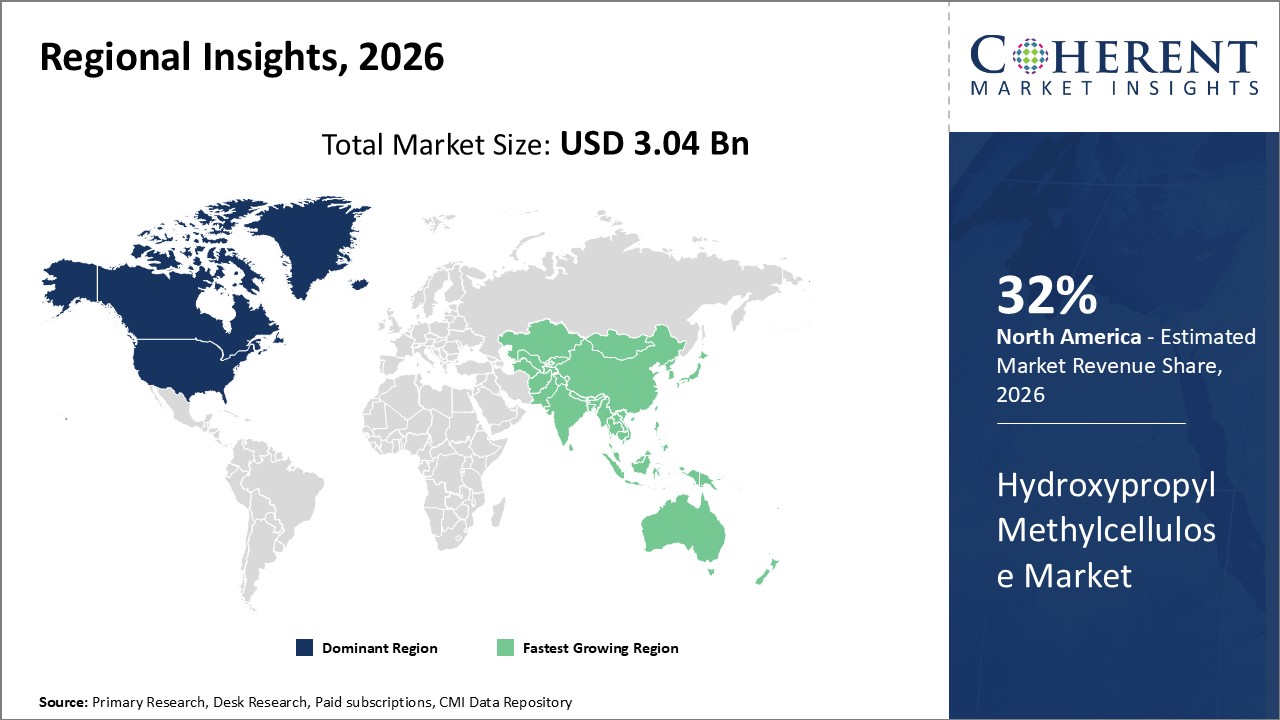
Regionally, North America commands the largest Hydroxypropyl Methylcellulose market share at 32% backed by robust pharmaceutical manufacturing and innovation hubs.
Asia Pacific exhibits the fastest growth due to escalating construction activity and increasing adoption in the cosmetics and food industries.
Meanwhile, Europe’s market momentum is driven by stringent environmental regulations and a burgeoning trend toward bio-based product solutions.
Hydroxypropyl Methylcellulose Market Segmentation Analysis
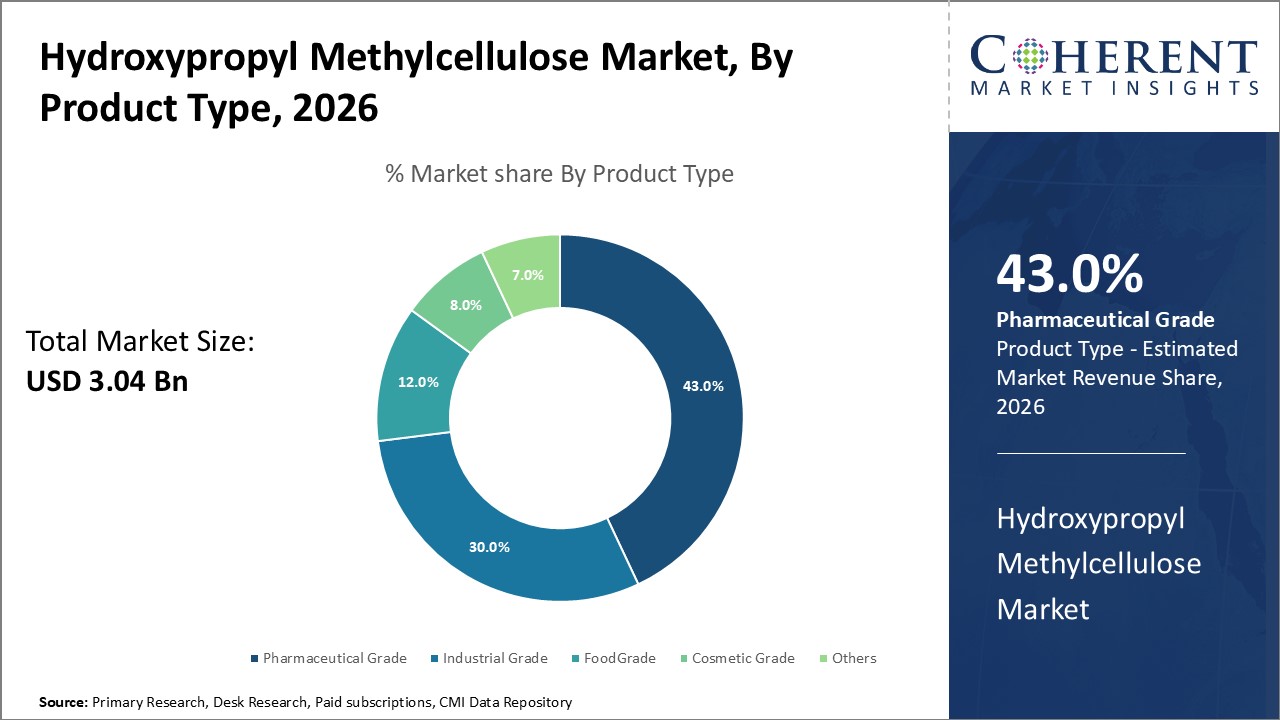
Hydroxypropyl Methylcellulose Market Insights, By Product Type
Pharmaceutical Grade dominates the market share due to its extensive application in controlled-release drug formulations and film coatings, accounting for approximately 43% of the market share. The pharma sector’s consistent R&D activity fosters continuous demand for pharmaceutical-grade variants offering customized viscosity and dissolution profiles. The fastest growing segment here is Food Grade, driven by increasing demand for natural food additives and clean-label products, which has witnessed double-digit revenue growth. Industrial Grade is widely used in construction and paints, offering thickening and water-retention properties. Cosmetic Grade is increasingly employed in personal care formulations to enhance texture and moisture retention. Others include specialty grades tailored for niche applications.
Hydroxypropyl Methylcellulose Market Insights, By Application
Pharmaceuticals are the dominating subsegment, holding the largest market share due to the polymer's indispensable role in modified-release oral drugs, coating technologies, and excipient formulations. Construction & Paints represent the fastest-growing subsegment, supported by rising global infrastructure projects and urban development policies enhancing demand for thickening agents. Food & Beverages use is expanding, fueled by consumer demand for clean-label and natural additives, while Personal Care & Cosmetics integrate Hydroxypropyl Methylcellulose for moisture retention and stabilization. The Oil & Gas segment also contributes by improving drilling fluid properties.
Hydroxypropyl Methylcellulose Market Insights, By Form
Powder dominates the market owing to its stability, ease of transport, and versatile dosing in various industries, sustaining a commanding share. This makes it preferred in large-scale pharmaceutical manufacturing and construction applications. The fastest growing subsegment is Liquid form, gaining preference due to ease of incorporation in cosmetic and food processes and ability to provide uniform consistency, reflecting increased sales in recent years. Granules maintain niche applications, offering better dissolution profiles and are employed chiefly in specialized pharmaceutical and food segments. Each form serves unique process advantages, aligning with market demand dynamics.
Hydroxypropyl Methylcellulose Market Trends
The market exhibits a trend towards increased green chemistry adoption, with manufacturers investing heavily in sustainable production processes to meet climate goals.
For example, several European manufacturers committed substantial capital post-2023 to green manufacturing that curtails volatile organic compound (VOC) emissions, enhancing product acceptability globally.
Another significant trend is the growing incorporation of Hydroxypropyl Methylcellulose in specialty food and cosmetic formulations, driven by consumer demand for natural and safe ingredients, which aligns with rising clean-label regulations worldwide.
Digitalization of manufacturing, through IoT-enabled process monitoring, is improving product consistency and reducing wastage, translating into improved market revenue streams.
Hydroxypropyl Methylcellulose Market Insights, By Geography
North America Hydroxypropyl Methylcellulose Market Analysis and Trends
In North America, the dominance in the Hydroxypropyl Methylcellulose market is underpinned by the extensive pharmaceutical manufacturing ecosystem, advanced R&D infrastructure, and strong regulatory frameworks fostering product safety and innovation. The U.S., specifically, accounts for a substantial share of industry revenue, supported by heavy investments from key market players developing novel Hydroxypropyl Methylcellulose-based drug delivery solutions.
Asia Pacific Hydroxypropyl Methylcellulose Market Analysis and Trends
Meanwhile, the Asia Pacific exhibits the fastest growth with a CAGR surpassing 7%, fueled by rapid urbanization, infrastructure development, and the expanding personal care and food sectors. Government initiatives promoting sustainable chemical production and increased export opportunities have augmented market expansion significantly. Notable companies like Luoyang Jiuyuan Chemical and Fufeng Group actively contribute to ecosystem development, reinforcing the region’s market position.
Hydroxypropyl Methylcellulose Market Outlook for Key Countries
USA Hydroxypropyl Methylcellulose Market Analysis and Trends
The USA’s Hydroxypropyl Methylcellulose market benefits from a mature pharmaceutical industry that recorded a 12% increment in controlled-release formulations consuming polymer excipients in 2025. Leading companies like Ashland Global Holdings and Dow Chemical maintain a dominant presence through continuous product innovation and strategic partnerships with pharmaceutical firms, boosting business growth despite stringent regulatory pressures. The presence of multiple FDA-approved formulations utilizing Hydroxypropyl Methylcellulose underpins demand sustainability with expanding applications in cosmetics and food sectors further contributing to market revenue.
China Hydroxypropyl Methylcellulose Market Analysis and Trends
China’s market is characterized by rapid industrial growth and rising end-user diversification. Construction sector expansion drove a 15% increase in market volume in 2025, supported by governmental infrastructure investments and urbanization. Domestic manufacturers such as Luoyang Jiuyuan Chemical leverage cost advantages and scale to fulfill burgeoning domestic demand and export markets. Increasing regulatory emphasis on green chemical manufacturing has also encouraged sustainable product variants gain traction, positioning China as a critical market driver in Asia Pacific.
Analyst Opinion
The sustained industrial expansion has propelled demand for Hydroxypropyl Methylcellulose, with recent data showing that pharmaceutical usage alone accounted for over 34% of total market share in 2025, reflecting its importance in controlled-release tablets and coating technologies. This is supported by a 10% year-over-year increase in pharmaceutical application revenues in North America.
Pricing dynamics have shown moderate stability despite raw material inflation, with Hydroxypropyl Methylcellulose prices increasing by only 3% on average globally in 2025. This stability is attributed to enhanced production capacities, particularly in Asia Pacific where manufacturers expanded output by 8% to meet growing domestic infrastructure requirements.
Demand diversification is notable, especially within the food and beverage sector, which saw a 13% surge in Hydroxypropyl Methylcellulose use for emulsifying and thickening agents during 2025 and early 2026, driven by clean-label trend adoption and stringent regulatory frameworks mandating food safety.
Export volumes from primary producers in Asia to Europe and Latin America increased by 15% in the fiscal year 2025, signaling robust cross-regional trade flows that are reinforcing market footprint while balancing supply-demand gaps globally.
- Current Industry Events of 2026
- Market Size Estimation
- Regional Breakdown
- Competitive Landscape
- Customer Intelligence
- Segmental Analysis
- Pricing Analysis
- Key Market Drivers, Challenges & Future Trends
- Customized Insights Section
Market Scope
| Report Coverage | Details | ||
|---|---|---|---|
| Base Year: | 2025 | Market Size in 2026: | USD 3.04 billion |
| Historical Data for: | 2020 To 2024 | Forecast Period: | 2026 To 2033 |
| Forecast Period 2026 to 2033 CAGR: | 6.5% | 2033 Value Projection: | USD 4.20 billion |
| Geographies covered: |
| ||
| Segments covered: |
| ||
| Companies covered: | Ashapura Group, Luoyang Jiuyuan Chemical Co. Ltd., SE Tylose GmbH & Co KG, Akzo Nobel N.V., Shandong Focus Chemistry Co., Ltd., DKS Co., Ltd., Chongqing Guotai Huarong Chemical Co., Ltd., Fufeng Group, Sigma-Aldrich Corporation, CP Kelc | ||
| Growth Drivers: |
| ||
Hydroxypropyl Methylcellulose Market Growth Factors
The growth of the market is primarily propelled by increasing pharmaceutical demand, especially for oral drug delivery systems where controlled-release formulations are gaining traction. The pharmaceutical sector’s expansion accounted for a revenue growth surge of 12% in 2025. Furthermore, expanding construction activities worldwide, particularly in Asia Pacific and North America, foster the demand for construction-grade Hydroxypropyl Methylcellulose used as a thickener and water retention agent in cement and plaster, registering a 10% annual growth in market uptake.
Another key growth driver is the rising trend of clean-label and natural ingredients in food processing applications, pushing food-grade Hydroxypropyl Methylcellulose volumes by 12% in 2025 due to regulatory mandates for healthier product formulations. Apart from this, environmental regulations promoting sustainable chemicals are accelerating the replacement of synthetic polymers with Hydroxypropyl Methylcellulose in personal care and cosmetic formulations, which exhibited a 7% growth rate last year.
Hydroxypropyl Methylcellulose Market Development
In May 2026, Pharcos Specialty Ltd. launched Pharcocel, India’s first domestically manufactured Hydroxypropyl Methylcellulose (HPMC), aiming to reduce import dependence and strengthen the local pharmaceutical excipient supply chain.
In April 2026, ACG Capsules introduced fully vegan printed HPMC capsules, engineered to meet strict global vegan and clean-label standards while enabling high-precision printing for enhanced product identification and branding.
In April 2026, IFF Pharma Solutions unveiled its Low Nitrite METHOCEL™, a next-generation HPMC excipient formulated to significantly minimize nitrosamine formation in drug products, supporting enhanced safety and regulatory compliance.
Key Players
Leading Companies of the Market
Ashapura Group
Luoyang Jiuyuan Chemical Co. Ltd.
SE Tylose GmbH & Co KG
Akzo Nobel N.V.
Shandong Focus Chemistry Co., Ltd
DKS Co., Ltd.
Chongqing Guotai Huarong Chemical Co., Ltd.
Fufeng Group
Sigma-Aldrich Corporation
CP Kelco
Several leading market players have aggressively adopted advanced R&D initiatives; for instance, Ashland Global Holdings launched a novel hydroxypropyl methylcellulose grade in 2025 that optimizes film strength and moisture resistance, increasing adoption in pharmaceutical coatings by 15% within six months post-launch. Another example includes Dow Chemical's strategic acquisition of regional specialty chemical firms in Asia Pacific to widen the product portfolio, driving a 20% revenue increase in emerging markets in 2025. Furthermore, partnerships between manufacturers and construction companies have expedited product customization, enhancing competitive positioning for key market players.
Hydroxypropyl Methylcellulose Market Future Outlook
Future expansion of the HPMC market will be driven by increasing demand for high-performance dry-mix construction materials, growth in generic pharmaceutical manufacturing, and rising consumption of personal care products. Trends toward clean-label excipients and plant-based formulations are expected to further boost adoption. Innovations in low-viscosity and modified-release HPMC grades will support broader pharmaceutical applications, while expanding urbanization in emerging markets will increase consumption in building materials. Environmental concerns and the push for sustainable, biodegradable polymers are likely to further strengthen HPMC’s role in multiple industries.
Hydroxypropyl Methylcellulose Market Historical Analysis
The HPMC market has historically grown alongside the pharmaceutical, construction, and personal care industries. Initially adopted as an excipient in tablet formulations due to its excellent binding, coating, and controlled-release properties, HPMC later expanded into construction materials such as tile adhesives, mortars, and putties, where it enhances water retention and workability. Demand increased significantly with the boom in urban infrastructure across Asia, leading to higher consumption in dry-mix mortar applications. In cosmetics, HPMC became widely used as a thickener and film-former in skincare and haircare products. The market benefited from a shift toward plant-derived cellulose polymers, supporting long-term stability and reduced dependency on synthetic binders.
Sources
Primary Research Interviews:
Pharmaceutical Formulation Scientists
Construction Material Technologists
Personal Care Chemists
Polymer Researchers
Building Contractors
Databases:
IQVIA Pharmaceutical Excipients Data
UN Comtrade Cellulose Derivatives
ICIS Polymers
Magazines:
Pharmaceutical Technology
Construction Week
Personal Care Magazine
Chemical & Engineering News
Coatings World
Journals:
International Journal of Pharmaceutics
Journal of Applied Polymer Science
Construction and Building Materials
Materials Today
Journal of Cosmetic Science
Newspapers:
The Hindu Business Line (Industry)
The Economic Times (Pharma)
Reuters (Global Markets)
Financial Times (Chemicals)
Nikkei Asia (Manufacturing)
Associations:
International Pharmaceutical Excipients Council (IPEC)
American Chemical Society (ACS)
CEFIC
ASTM International
Society of Cosmetic Chemists (SCC)
Get access to 250+ pages report
Every segment, forecast, competitor profile and data table behind the analysis above — available for instant download.
- ESOMAR Member
- ISO 9001:2015 Certified
- D-U-N-S Registered
- GDPR & CCPA Compliant
Missing comfort of reading report in your local language? Find your preferred language:
Transform your Strategy with Exclusive Trending Reports
Frequently Asked Questions
The market is dominated by key companies such as Ashland Global Holdings Inc., Dow Chemical Company, and Shin-Etsu Chemical Co. Ltd., known for their innovation and diversified product portfolios.
The Hydroxypropyl Methylcellulose market size is slated to grow from USD 3.04 billion in 2026 to USD 4.20 billion by 2033, marking a steady CAGR of 6.5%.
Pharmaceuticals hold the largest growth opportunity, attributed to rising demand for controlled-release formulations and film coatings.
Market trends point toward sustainable manufacturing, digitization, and increased adoption in niche sectors like enhanced oil recovery, influencing positive growth trajectories.
Competition is intense with players focusing on product innovation and cost-efficiency; however, market restraints include raw material availability and regulatory compliance challenges.
Strategies involve strategic partnerships, acquisitions to expand geographic reach, and R&D-led product differentiation focused on application-specific solutions.