

Australia Ammonia Market Size and Share Analysis 2026 - 2033
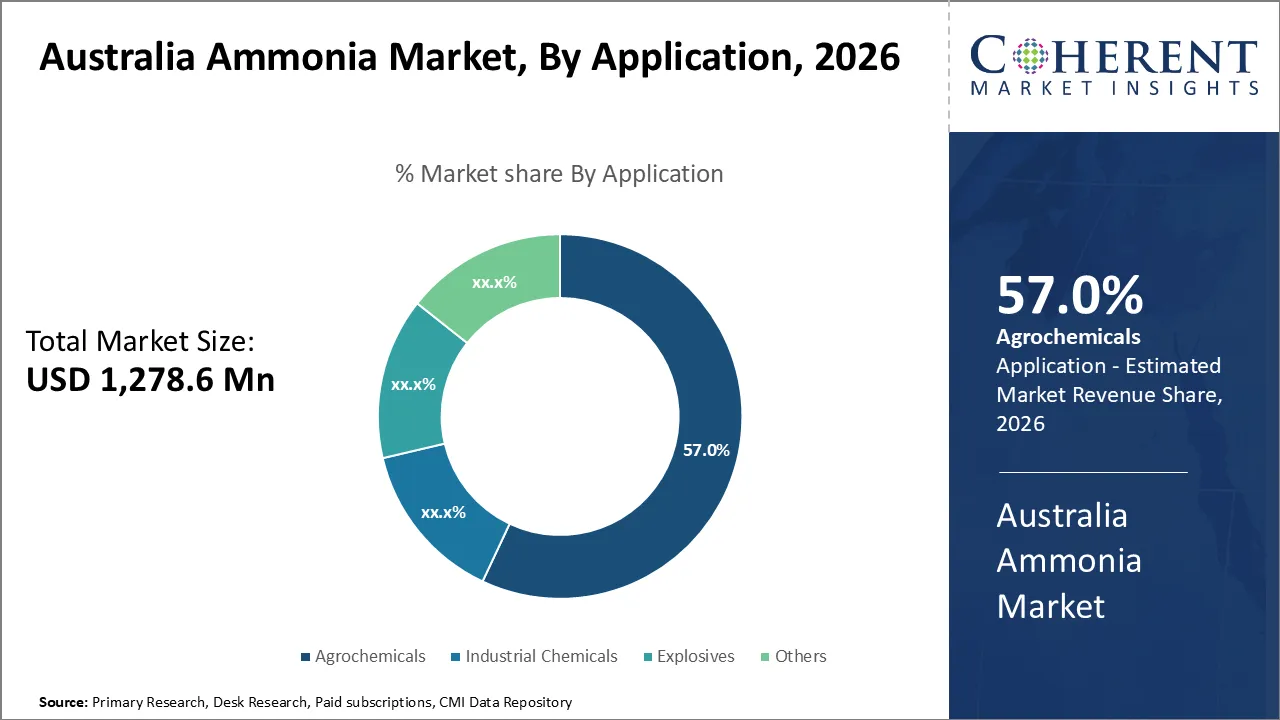
The Australia ammonia market was valued at USD 1,278.6 Mn in 2026 and is forecast to reach a value of USD 1,973.5 Mn by 2033 at a CAGR of 6.4% between 2026 and 2033.
Key Takeaways
- Based on Product Type, the anhydrous ammonia segment is expected to lead 68% share of the market in 2026.
- Based on Application, the urea segment is expected to lead 43% share of the market in 2026.
- Based on End User, the agrochemicals segment is projected to account for 57% share of the market in 2026.
Market Overview
The ammonia market in Australia is growing steadily due to the need for fertilizers, industrial chemicals, and explosives for mining. A greater sum is going into green ammonia, and the government is backing low-carbon technologies, which is increasing capacity. Growth is expected to continue through 2033 through to export opportunities in Asia and efforts to be more environmentally friendly.
Ammonia is one of the most abundant nitrogen-containing compounds with formula NH3. It is a colorless gas with a distinct pungent odor and occurs naturally in the environment in the air, plant, soil, and animals including humans. In humans, the synthesis of ammonia takes place when the body breaks down food especially protein into amino acid and then converting the ammonia into urea. Household ammonia is commonly called ammonium hydroxide; it is an ingredient that is mainly used in various cleaning products for breaking down stains such as cooking grease and other stains.
Current Events and their Impacts on the Australia Ammonia Market
Current Event | Description and its Impact |
Global Energy Transition and Green Hydrogen Development |
|
Australian Government Policy and Regulatory Changes |
|
Is Australias National Hydrogen Strategy the Catalyst for a Global Green Ammonia Export Boom?
AU National Hydrogen Strategy (2024)
- Vision: Position Australia as a global leader in clean hydrogen and derivatives, including green ammonia.
- Key Objectives
- Supply: Scale up hydrogen and ammonia production to achieve global cost competitiveness.
- Demand Activation: Prioritize sectors like shipping, power generation, and heavy industry where ammonia can replace fossil fuels.
- Trade & Investment: Foster international partnerships and infrastructure for large-scale ammonia exports.
- Community & Jobs: Ensure local communities benefit from hydrogen and ammonia industry growth.
State-Level Clean Energy Roadmaps
- Western Australia: Supports projects like the Yara-ENGIE Pilbara Renewable Ammonia Project and the Western Green Energy Hub, offering land access, permitting support, and infrastructure planning.
- Queensland: Backs Fortescues Gladstone Green Ammonia Project, with incentives for renewable hydrogen and ammonia production.
- South Australia: Promotes hydrogen and ammonia export corridors, including port upgrades and renewable energy zones.
- Current Industry Events of 2026
- Market Size Estimation
- Regional Breakdown
- Competitive Landscape
- Customer Intelligence
- Segmental Analysis
- Pricing Analysis
- Key Market Drivers, Challenges & Future Trends
- Customized Insights Section
Segmental Insights
Australia Ammonia Market Insights, By Product Type: Anhydrous driven by its efficiency in fertilizer production and industrial chemical applications
In terms of product type, the anhydrous ammonia segment is expected to lead 68% share of the market in 2026, due to its extensive use in making fertilizer and industrial application. Since it has high content of nitrogen, it is the best source of nutrients for crops, especially in Australia's large-scale farming. It is also used in the chemical synthesis process in the industrial sector, which makes it even more important than aqueous ammonia.
Australia Ammonia Market Insights, By Application: Urea is dominating as Australia's most widely consumed nitrogen fertilizer
In terms of application, the urea segment is expected to lead 43% share of the market in 2026. Urea is the most widely used nitrogen fertilizer in Australian agriculture. It is necessary because it is cost-effective, has a high nutrient concentration, and can be used on a wide range of crops. Urea continues to be more popular than other derivatives like ammonium nitrate or DAP due to more people demand food security and productivity.
For instance, in October 2025, Fertiglobe has grown its business in Australia by acquiring Wengfu Australia's distribution assets and setting up a new unit to improve its fertilizer supply chain. The deal gives Fertiglobe access to about 600,000 tons of urea each year and improves the distribution of ammonia. This makes Fertiglobe a major player in Australia's agricultural and fertilizer markets.
Australia Ammonia Market Insights, By End User: Agrochemicals is reflecting agriculture's central role in ammonia demand across the country
In terms of end user, the agrochemicals segment is projected to account for 57% share of the market in 2026, driven by Australia's dependency on fertilizers to keep crop yields up in difficult soil conditions. Ammonia is the main ingredient in making urea, ammonium nitrate, and phosphates, which are all important for farming. This sector always beats industrial chemicals and explosives, which shows the significance agriculture is for ammonia demand.
Market Report Scope
Australia Ammonia Market Report Coverage
| Report Coverage | Details | ||
|---|---|---|---|
| Base Year: | 2025 | Market Size in 2026: | USD 1,278.6 Mn |
| Historical Data for: | 2020 To 2024 | Forecast Period: | 2026 To 2033 |
| Forecast Period 2026 to 2033 CAGR: | 6.4% | 2033 Value Projection: | USD 1,973.5 Mn |
| Segments covered: |
| ||
| Companies covered: | Incitec Pivot Limited, Yara International ASA, Orica Limited, and Wesfarmers Chemicals, Energy & Fertilisers | ||
| Growth Drivers: |
| ||
| Restraints & Challenges: |
| ||
Australia Ammonia Market Driver
Fertilizer Production
Ammonia is essential in Australia for making nitrogen-based fertilizers like urea, ammonium nitrate, DAP, and MAP. These fertilizers are highly significant for making the soil more fertile and increasing crop yields, which directly helps the country's large agricultural sector. As the need for food grows and sustainable farming practices become more important, the use of ammonia keeps going up. This trend has a big impact on the Australia Ammonia Market share because agriculture is still one of the most prominent consumers of ammonia in the country.
Industrial Chemicals
Ammonia is also an important part of making industrial chemicals like ammonium sulfate and nitric acid. These compounds are crucial for making things, cleaning water, and other industrial uses. As Australia's industrial base grows, the need for chemicals made from ammonia keeps going up. The growing Australia ammonia market demand shows the necessity it is not only for farming but also for supporting a wide range of industries, which helps the national market grow steadily and stay strong.
Australia Ammonia Market Opportunity
Government Support for Decarbonization
The Australian government's policies that support renewable energy and low-carbon technologies are speeding up investment in green ammonia projects. Incentives, funding programs, and strategic partnerships are all helping to boost both domestic production and international cooperation. These programs not only cut down on emissions, but they also make Australia's industrial base stronger. The Australia ammonia market forecast points to strong growth, caused by strong policy support. Projects that focus on sustainability are changing the market and bringing in global investors seeking clean energy solutions.
Analyst Opinion (Expert Opinion)
Strong domestic production, changing consumption patterns, and active participation in export markets all play a role in shaping the ammonia market in Australia. In 2024, domestic production of anhydrous ammonia stayed at about 2.1 million tonnes, which was stable compared to previous years. This is because output has been slowly rising over the past ten years. After reaching a peak last year, consumption in Australia fell slightly to about 1.8 million tonnes, indicating demand is returning to normal after earlier growth trends.
Australia is a net exporter of anhydrous ammonia, and the amount it exports is going up while the amount it imports is going down quickly. In 2024, exports went to many Asian markets, such as Korea, Japan, Indonesia, and China. This shows the significance Australia is to the flow of chemicals in the region.
Agricultural uses are still a major factor ammonia is used, since it is an important source of nitrogen for making fertilizers. Industrial demand includes chemicals processing and mining inputs, which continue to support domestic use. Structural factors like the availability of natural gas, which is highly significant for traditional ammonia synthesis, help production capacity in important areas like Western Australia, where existing facilities make up a large part of the country's output.
A growing interest in ammonia technologies that produce less carbon and infrastructure development that focuses on exports could be a strategic shift in Australia's ammonia landscape, even though traditional production methods are still the most common.
Speak to the analyst
Want personalized insights?
Take the findings above to one of our principal consultants, or have the report rebuilt around the segments, geographies and competitors you actually track.
Recent Developments
- In October 2025, Mitsui O.S.K. Lines (MOL) signed an MoU with NH3 Clean Energy and Oceania Marine Energy to build clean ammonia bunkering in the Pilbara region of Western Australia. This project, which is the first of its kind in the world, aims to use low-carbon ammonia to power iron ore carriers, which will help make shipping more environmentally friendly by 2030.
- In June 2025, Three Australian businesses have teamed up to start ammonia bunkering operations in Western Australia's Pilbara region by 2030. The goal of the project is to provide clean ammonia as a marine fuel, which will help bulk carriers become less carbon-intensive and make Australia a world leader in low-carbon energy infrastructure and sustainable shipping.
Market Segmentation
- By Product Type
- Anhydrous Ammonia
- Aqueous Ammonia
- By End-Use
- Ammonium Nitrate
- Nitric Acid
- Ammonium Sulphate
- Urea
- Diammonium Phosphate (DAP)
- Mono Ammonium Phosphate (MAP)
- Others
- By Application
- Agrochemicals
- Industrial Chemicals
- Explosives
- Others
- Key Players
- Incitec Pivot Limited
- Yara International ASA
- Orica Limited
- Wesfarmers Chemicals
- Energy & Fertilisers
Sources
Primary Research Interviews
- Ammonia Producers and Manufacturers in Australia
- Fertilizer and Chemical Distributors
- Industrial Gas and Energy Solution Providers
- Renewable Hydrogen and Ammonia Project Developers
- Industrial Process Engineers
- Others
Databases
- Bloomberg Terminal
- Thomson Reuters Eikon
- IHS Markit
- Others
Magazines
- Chemical Engineering Magazine
- Fertilizer International
- Ammonia Industry Magazine
- Hydrocarbon Processing
- Others
Journals
- International Journal of Hydrogen Energy
- Energy & Environmental Science
- Journal of Cleaner Production
- Industrial & Engineering Chemistry Research
- Others
Newspapers
- Financial Times
- The Wall Street Journal
- The Australian
- Reuters
- Bloomberg News
- Others
Associations
- Fertilizer Australia
- International Fertilizer Association (IFA)
- Australian Hydrogen Council
- International Energy Agency (IEA) - Hydrogen Initiative
- Others
Public Domain Sources
- Australian Government - Department of Industry, Science and Resources
- International Energy Agency (IEA)
- Australian Bureau of Statistics (ABS)
- World Bank Open Data
- CSIRO – Renewable Energy Research
- Others
Proprietary Elements
- CMI Data Analytics Tool
- Proprietary CMI Existing Repository of Information for the Last 8 Years
Get access to 250+ pages report
Every segment, forecast, competitor profile and data table behind the analysis above — available for instant download.
- ESOMAR Member
- ISO 9001:2015 Certified
- D-U-N-S Registered
- GDPR & CCPA Compliant
Missing comfort of reading report in your local language? Find your preferred language:
Transform your Strategy with Exclusive Trending Reports
Frequently Asked Questions
The global Australia ammonia market size was valued at USD 1,278.6 Mn in 2026 and is expected to reach USD 1,973.5 Mn in 2033.
Fertilizer production and industrial chemicals are expected to drive the market growth.
Government support for decarbonization is expected to offer potential growth opportunities for the market.
High production costs and environmental concerns are expected to restrain the market growth.
Major players operating in the market include Incitec Pivot Limited, Yara International ASA, Orica Limited, and Wesfarmers Chemicals, Energy & Fertilisers.
The market is expected to grow at around 6.4% CAGR during the forecast period (2026-2033).