

Ethyl Acetate Market Size and Forecast — 2026-2033
Global ethyl acetate market is estimated to be valued at USD 7.17 Bn in 2026 and is expected to reach USD 11.67 Bn by 2033, exhibiting a compound annual growth rate (CAGR) of 7.2% from 2026 to 2033.
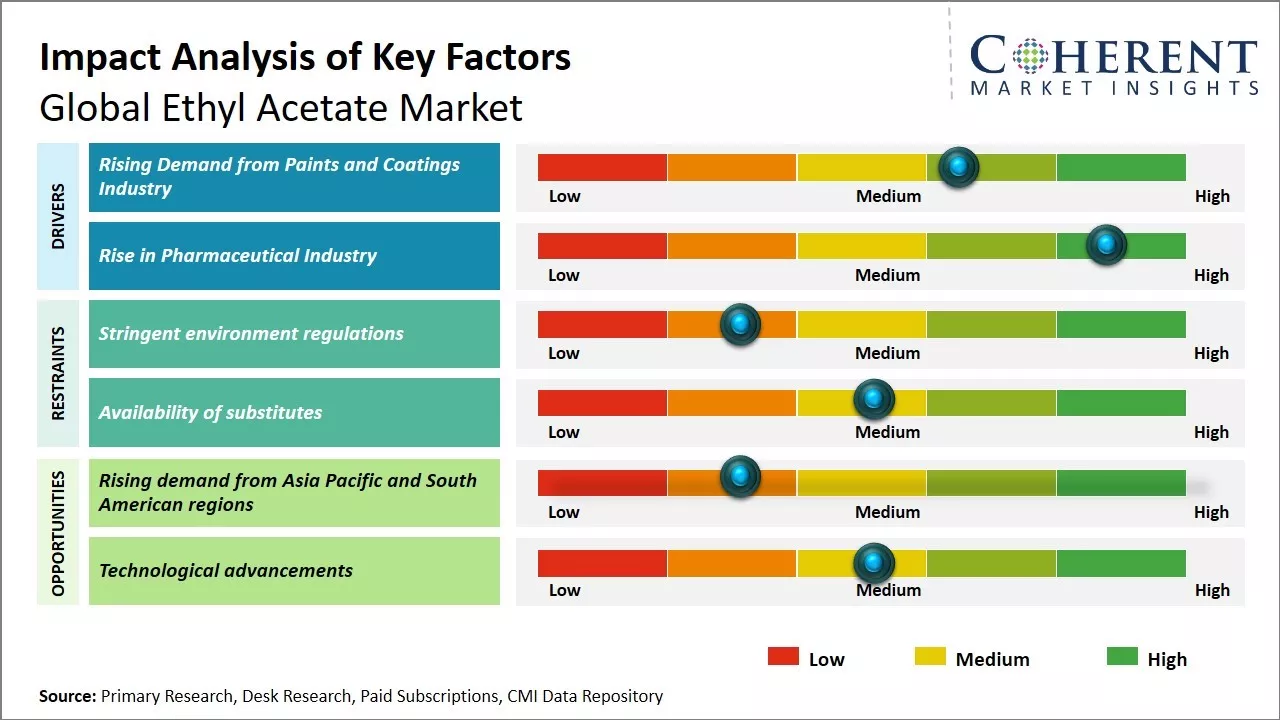 Global ethyl acetate market is expected to witness moderate growth over the forecast period. Ethyl acetate is used as a solvent in industries such as paints and coatings, adhesives and sealants among others. Growth in end-use industries such as construction and automotive is expected to boost demand for ethyl acetate. Increasing preference for eco-friendly solvents over toxic organic compounds is further expected to support the market growth. However, availability of alternative solvents may hinder the market growth. Product innovation and geographical expansion by key players could provide new opportunities for market growth in the near future.
Rising Demand from Paints and Coatings Industry
Global paints and coatings industry has witnessed tremendous growth over the past few years owing to increasing infrastructure development and construction activities worldwide. Rapid urbanization along with growing population has boosted construction of residential and commercial spaces, and this has boosted demand for paints and coatings for both interior and exterior applications. Ethyl acetate is a crucial component that is widely used as a solvent in paints and coatings formulation. It helps in providing the desired texture, viscosity and flow properties to various paints and coating products. The paints and coatings industry consumes over 20% of the total ethyl acetate produced globally each year. With infrastructure spending and real estate development showing no signs of slowing down across major economies, the demand from paints and coatings segment is expected to continue rising at a healthy pace over the coming years. This sustained growth in paints and coatings consumption will translate into increased necessity for ethyl acetate and support the market revenues.
Insights, By Application
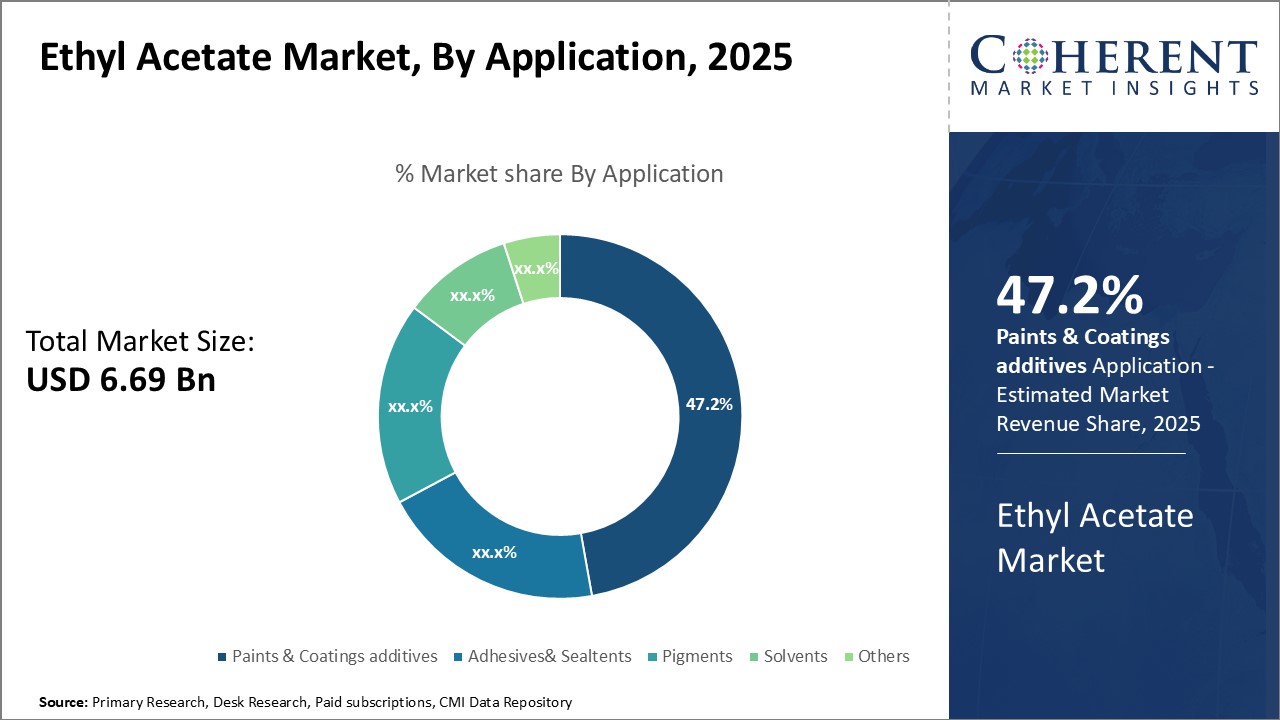 Insights, By Application: Technological advancements boosts demand for paints & coatings additives
In terms of application, paints & coating additives segment is estimated to contribute the 48.2% share of the market in 2026, owing to constant technological developments in the coatings industry. Manufacturers are consistently innovating to develop newer varieties of paints and coatings that offer superior performance and durability. Ethyl acetate plays a key role as a solvent in the formulation of various paints and coating additives. Its excellent solvent properties makes it ideal for dissolving both inorganic and organic substances. This allows for the creation of high-quality paints and coatings with even pigment dispersions and enhanced adhesion to surfaces. As the automotive industry transitions towards more advanced automotive coatings, the demand for ethyl acetate increases. Next-generation automotive coatings need to withstand extremes of weather, remain scratch resistant, and offer aesthetically pleasing gloss retention for longer durations. These also need to comply with stringent environmental norms. Ethyl acetate allows formulators to develop coatings that meet these exacting requirements. Its versatility as a solvent supports production of both conventional and non-conventional coatings such as powder coatings for the automotive industry. Rowing infrastructure activities worldwide is another factor driving the need for different types of construction coatings.
Insights, By End-use Industry
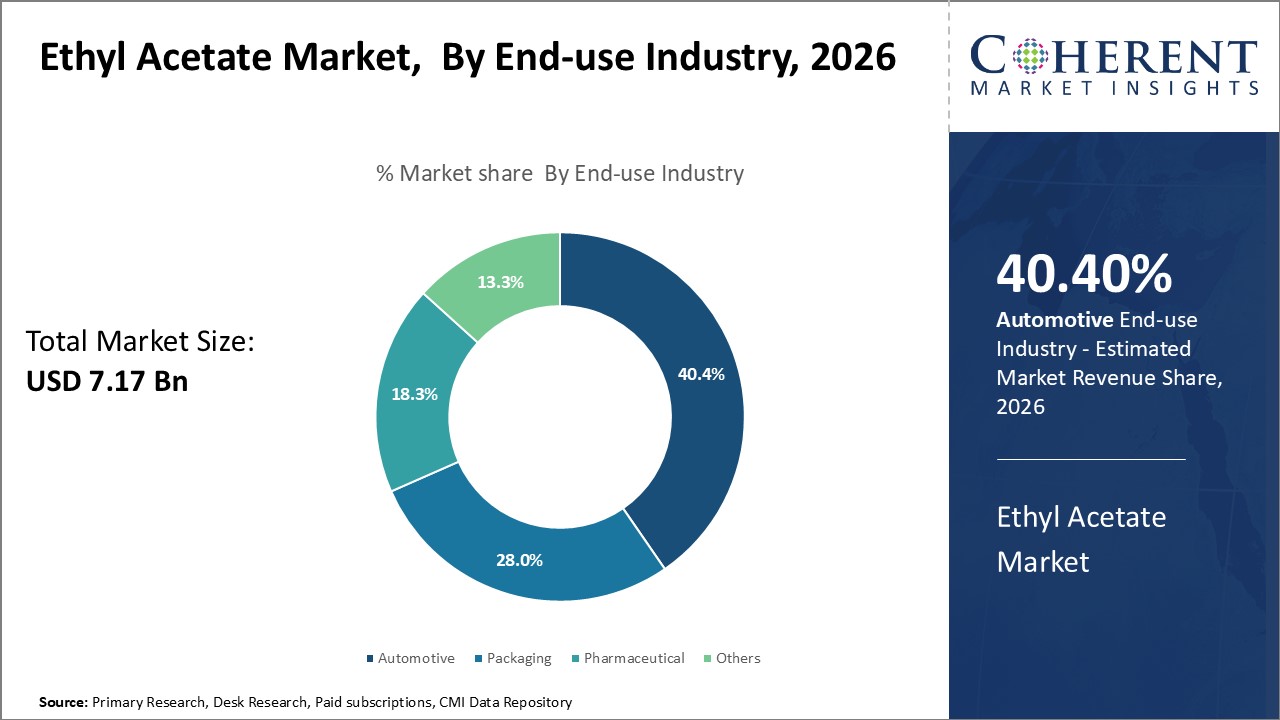
Insights, By End-use Industry: Automotive manufacturing boosts demand in key end-use industry
In terms of end-use industry, the automotive segment is estimated to contribute the 40.4% share in 2026 of the global ethyl acetate market. As a solvent and processing agent, ethyl acetate plays an indispensable role in automobile manufacturing. It is integral to production processes of auto components like car interior panels, door linings, dashboards and more. Its non-toxic nature and outstanding solvency power make it well-suited for dissolving resins, binders, and other materials used in manufacturing these auto parts. This has prompted increased utilization of lightweight composite materials in vehicles. Ethyl acetate emerges as a excellent solvent for adhesives, coatings and cleaning agents used while processing such novel composites in automotive manufacturing. Likewise, demand for premium and luxury vehicles featuring high-grade leathers, plastics and other exclusive interior trims has been rising. Ethyl acetate with its superior dissolving capacity supports consistent quality production of these specialized auto components. Its role remains pivotal in post-production applications as well, as a cleaning solvent during vehicle refurbishment and maintenance procedures.
Insights, By Distribution Channel
Insights, By Distribution Channel: Offline distribution dominates global supply chain
In terms of distribution channel, the offline segment is estimated to contribute the 39.1% share in 2026 of the global ethyl acetate market. This can be attributed to established supply chain networks and dealer relationships aiding offline distribution worldwide. Many key ethyl acetate producers maintain extensive networks of distributors and resellers who source bulk volumes of the chemical from manufacturing plants and storage terminals for onward domestic sale. This offline channel primarily involves B2B transactions between chemical producers/suppliers and end-use industries where ethyl acetate finds applications as an industrial feedstock or solvent. Presence of numerous small and medium industrial set-ups in regions like Asia Pacific and Latin America relying on local dealers perpetuates the prominence of physical distribution networks. Although online sales are rising, complexities in e-commerce for chemicals sector limit its potential. Requirements for special packaging, transportation under controlled conditions and safety compliance create obstacles. However, manufacturers are exploring technologies like block chains and advanced track-and-trace to develop more sophisticated online distribution models for the future. Nonetheless, the extensive reach and reliability of conventional offline supply chains will likely sustain their dominance.
Regional Insights
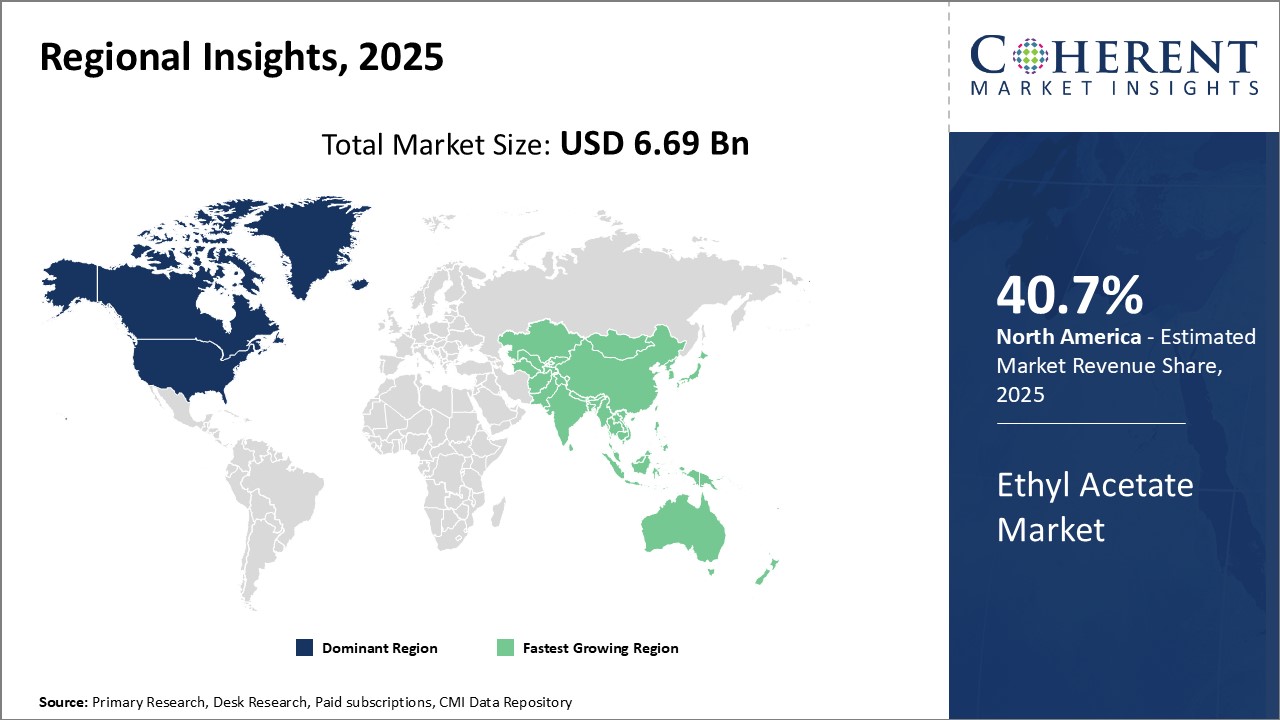 North America currently dominates the global ethyl acetate market owing to robust industrial presence and established end-use industries with 40.7% share in 2026. Countries like the U.S. and Canada have strong chemicals and pharmaceutical industries, which are the major consumers of ethyl acetate. The region is also one of the leading producers of ethyl acetate globally. It has some of the largest players operating production facilities, catering to domestic as well as international markets.
The Asia Pacific region is witnessing the fastest growth in the global ethyl acetate market in 2026. Rapid industrialization and emerging economies like China and India driving the demand ethyl acetate. Countries in Asia Pacific are fast expanding their chemicals industry which requires ethyl acetate as a solvent. The presence of affordable labour and resources has attracted many manufacturers to setup production bases. This not only cater to the domestic needs but also position Asia Pacific as an export hub. Countries like China and South Korea are also major exporters of ethyl acetate worldwide. The thriving pharmaceutical sector especially in countries like India, is spurring the consumption of ethyl acetate. Ease of raw material sourcing from within the region as well as cost competitiveness gives Asia Pacific an advantage over other regions.
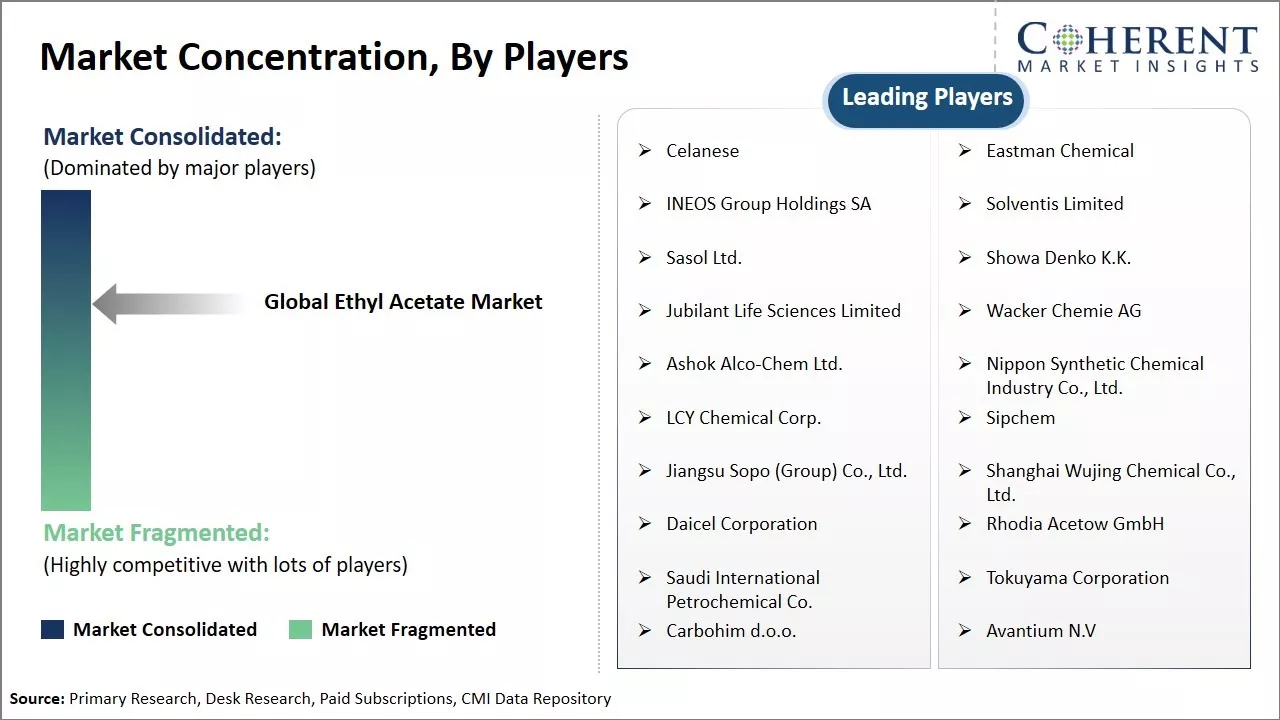
Market Players, Key Development, and Competitive Intelligence
 Rise in Pharmaceutical Industry
Another key end-use sector augmenting the global ethyl acetate market growth is pharmaceuticals. Ethyl acetate finds wide application as an important excipient and solvent in manufacturing of various pharmaceutical drugs and medicines. It is primarily used as an extraction solvent in pharmaceutical manufacturing processes, owing to its low toxicity. It helps in improving the bioavailability of active pharmaceutical ingredients (APIs). With rising prevalence of chronic diseases and increasing healthcare expenditure worldwide, the pharmaceutical industry has been witnessing sizeable growth over the past few decades. Many nations are dedicating higher budgets to improve access to healthcare while countries like India, China and Brazil are emerging as global pharmaceutical hubs. This expansion of the pharmaceutical industry has positively impacted the consumption of ethyl acetate. Furthermore, short product lifecycles in pharmaceuticals has led to growing demand for new drug formulation development which involves ethyl acetate as a major solvent, thus, driving the market growth, therefore growing pharmaceutical sector is expected to drive the market growth, For instance, according to data by Incest India in 2022, The pharmaceutical industry in India is expected to reach USD 65 Bn by 2024 and to USD 130 Bn by 2030.
Key Developments
- In April 2024, Turkey initiates a safeguard investigation concerning ethyl acetate
- In the year 2022, Viridis Chemical made a significant announcement by successfully achieving the first-ever production of renewable ethyl acetate.
- In January 2021, Ineos Group Ltd., a prominent chemicals company headquartered in the United Kingdom, completed a substantial acquisition deal worth USD 5 billion. The acquisition involved the purchase of BP plc's Aromatics & Acetyls business, a company operating in the petrochemical sector. This strategic move by Ineos was aimed at bolstering its existing product portfolio in the areas of petrochemicals, aromatics, and acetyls, while also expanding its market presence.
- In March 2021, Celanese Corporation made an exciting announcement regarding its chemical production facility located in Clear Lake, Texas. The company revealed its plans to adopt a more sustainable approach by utilizing recycled carbon dioxide (CO2) as an alternative feedstock for the production of methanol.
*Definition: The global ethyl acetate market is a sizable bulk chemicals marketplace for the production and distribution of ethyl acetate. Ethyl acetate is an ester compound with wide industrial uses such as a common solvent for nail polish removers, glue ingredients, paints & coatings, pharmaceuticals, fragrances production, and other chemical processes. Major players in the global ethyl acetate market produce and trade large volumes of this price-sensitive commodity chemical around the world.
- Current Industry Events of 2026
- Market Size Estimation
- Regional Breakdown
- Competitive Landscape
- Customer Intelligence
- Segmental Analysis
- Pricing Analysis
- Key Market Drivers, Challenges & Future Trends
- Customized Insights Section
Market Report Scope
Ethyl Acetate Market Report Coverage
| Report Coverage | Details | ||
|---|---|---|---|
| Base Year: | 2025 | Market Size in 2026: | USD 7.17 Bn |
| Historical Data for: | 2020 To 2024 | Forecast Period: | 2026 To 2033 |
| Forecast Period 2026 to 2033 CAGR: | 7.2% | 2033 Value Projection: | USD 11.67 Bn |
| Geographies covered: |
| ||
| Segments covered: |
| ||
| Companies covered: | Celanese, Eastman Chemical, INEOS Group Holdings SA, Solventis Limited, Sasol Ltd., Showa Denko K.K., Jubilant Life Sciences Limited, Wacker Chemie AG, Ashok Alco-Chem Ltd., Nippon Synthetic Chemical Industry Co., Ltd., LCY Chemical Corp., Sipchem, Jiangsu Sopo (Group) Co., Ltd., Shanghai Wujing Chemical Co., Ltd., Daicel Corporation, Rhodia Acetow GmbH, Saudi International Petrochemical Co., Tokuyama Corporation, Carbohim d.o.o., Avantium N.V | ||
| Growth Drivers: |
| ||
| Restraints & Challenges: |
| ||
Analyst Opinion (Expert Opinion)
 Challenges: Stringent environment regulations
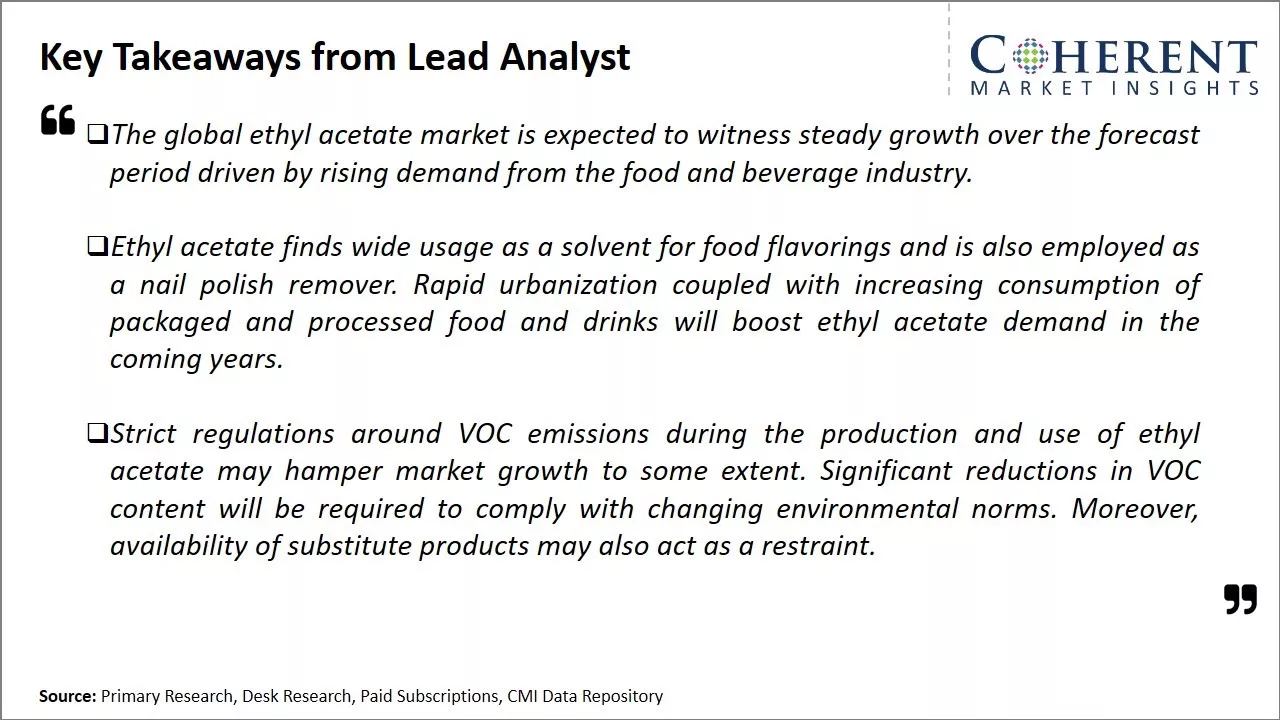
Stringent environment regulations around the world can hamper the market growth as ethyl acetate is toxic in high amounts. Furthermore, availability of cheaper substitute products can affect demand for ethyl acetate. Fluctuations in raw material prices also impact the market growth. Due to high dependence on few end-use industries, any downturn in those sectors creates a challenging business environment for ethyl acetate producers and suppliers.
Opportunities: Rising demand from Asia Pacific and South American regions
With rising demand from Asia Pacific and South American regions, international players can focus on market expansion plans. Developing innovative products for application in new industries like pharmaceuticals and food processing can boost the market growth prospects. Furthermore, technological advancements enabling cost-efficient production processes present attractive opportunities.
Speak to the analyst
Want personalized insights?
Take the findings above to one of our principal consultants, or have the report rebuilt around the segments, geographies and competitors you actually track.
Market Segmentation
- Application Insights (Revenue, USD Bn & KT, 2021 - 2033)
- Paints & Coating additives
- Adhesives & Sealants
- Pigments
- Solvents
- Others
- End-use Industry Insights (Revenue, USD Bn & KT, 2021 - 2033)
- Automotive
- Packaging
- Pharmaceutical
- Others
- Distribution Channel Insights (Revenue, USD Bn & KT, 2021 - 2033)
- Offline
- Online
- Regional Insights (Revenue, USD Bn & KT, 2021 - 2033)
- North America
- U.S.
- Canada
- Latin America
- Brazil
- Argentina
- Mexico
- Rest of Latin America
- Europe
- Germany
- U.K.
- Spain
- France
- Italy
- Russia
- Rest of Europe
- Asia Pacific
- China
- India
- Japan
- Australia
- South Korea
- ASEAN
- Rest of Asia Pacific
- Middle East & Africa
- GCC Countries
- Israel
- Rest of Middle East & Africa
- North America
- Key Players Insights
- Celanese
- Eastman Chemical
- INEOS Group Holdings SA
- Solventis Limited
- Sasol Ltd.
- Showa Denko K.K.
- Jubilant Life Sciences Limited
- Wacker Chemie AG
- Ashok Alco-Chem Ltd.
- Nippon Synthetic Chemical Industry Co., Ltd.
- LCY Chemical Corp.
- Sipchem
- Jiangsu Sopo (Group) Co., Ltd.
- Shanghai Wujing Chemical Co., Ltd.
- Daicel Corporation
- Rhodia Acetow GmbH
- Saudi International Petrochemical Co.
- Tokuyama Corporation
- Carbohim d.o.o.
- Avantium N.V
Get access to 250+ pages report
Every segment, forecast, competitor profile and data table behind the analysis above — available for instant download.
- ESOMAR Member
- ISO 9001:2015 Certified
- D-U-N-S Registered
- GDPR & CCPA Compliant
Missing comfort of reading report in your local language? Find your preferred language:
Transform your Strategy with Exclusive Trending Reports
Frequently Asked Questions
The Ethyl Acetate Market is estimated to be valued at USD 7.17 Bn in 2026, and is expected to reach USD 11.67 Bn by 2033.
The CAGR of the Ethyl Acetate Market is projected to be 7.2% from 2026 to 2033.
Rising demand from paints and coatings industry and rise in pharmaceutical industry are the major factors driving the growth of global ethyl acetate market.
Stringent environment regulations and availability of substitutes are the major factors hampering the growth of global ethyl acetate market.
In terms of application, paints & coating additives segment is estimated to dominate the market in 2026.
Celanese, Eastman Chemical, INEOS Group Holdings SA, Solventis Limited, Sasol Ltd., Showa Denko K.K., Jubilant Life Sciences Limited, Wacker Chemie AG, Ashok Alco-Chem Ltd., Nippon Synthetic Chemical Industry Co., Ltd., LCY Chemical Corp., Sipchem, Jiangsu Sopo (Group) Co., Ltd., Shanghai Wujing Chemical Co., Ltd., Daicel Corporation, Rhodia Acetow GmbH, Saudi International Petrochemical Co., Tokuyama Corporation, Carbohim d.o.o., Avantium N.V are the major players.
North America is expected to lead the global ethyl acetate market.