

Green Ammonia Market Size and Forecast
Global green ammonia market is estimated to be valued at USD 4.30 Bn in 2026 and is expected to reach USD 181.66 Bn by 2033, exhibiting a compound annual growth rate (CAGR) of 70.7% from 2026 to 2033.
Key Takeaways
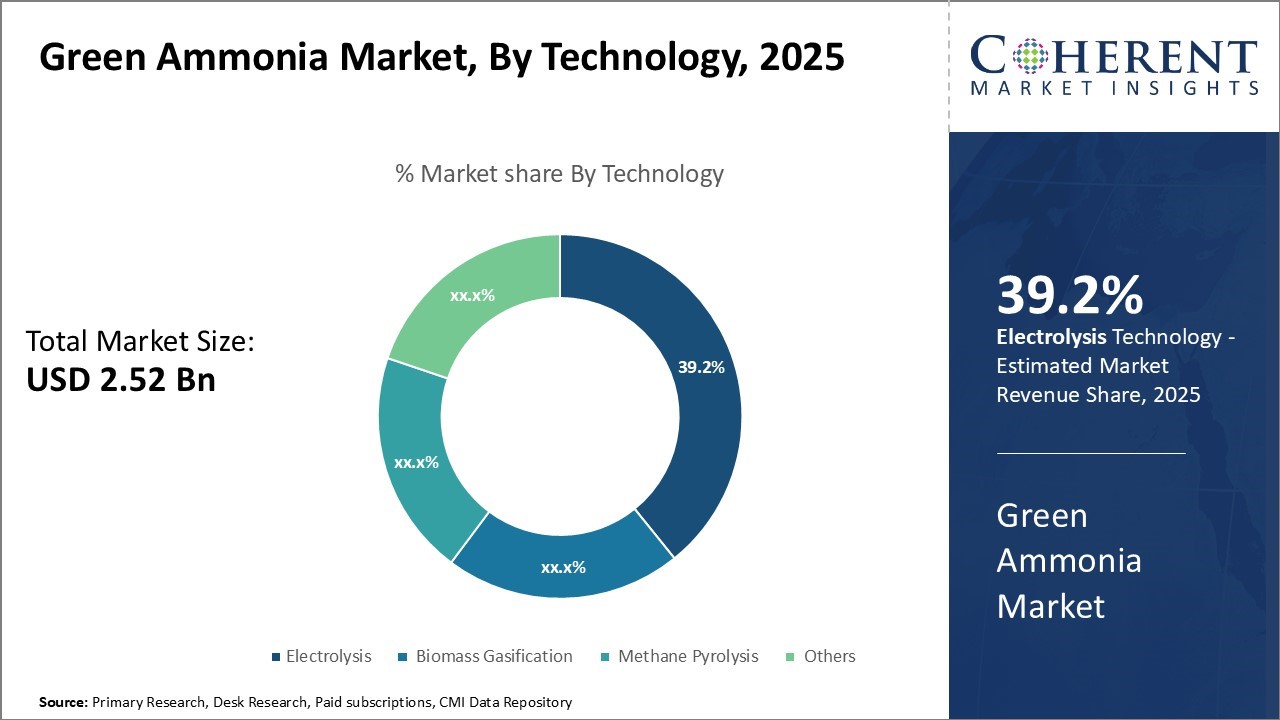
- By Technology, Electrolysis acquires the prominent market share of 40.2% in 2026 as advantages over the technologies.
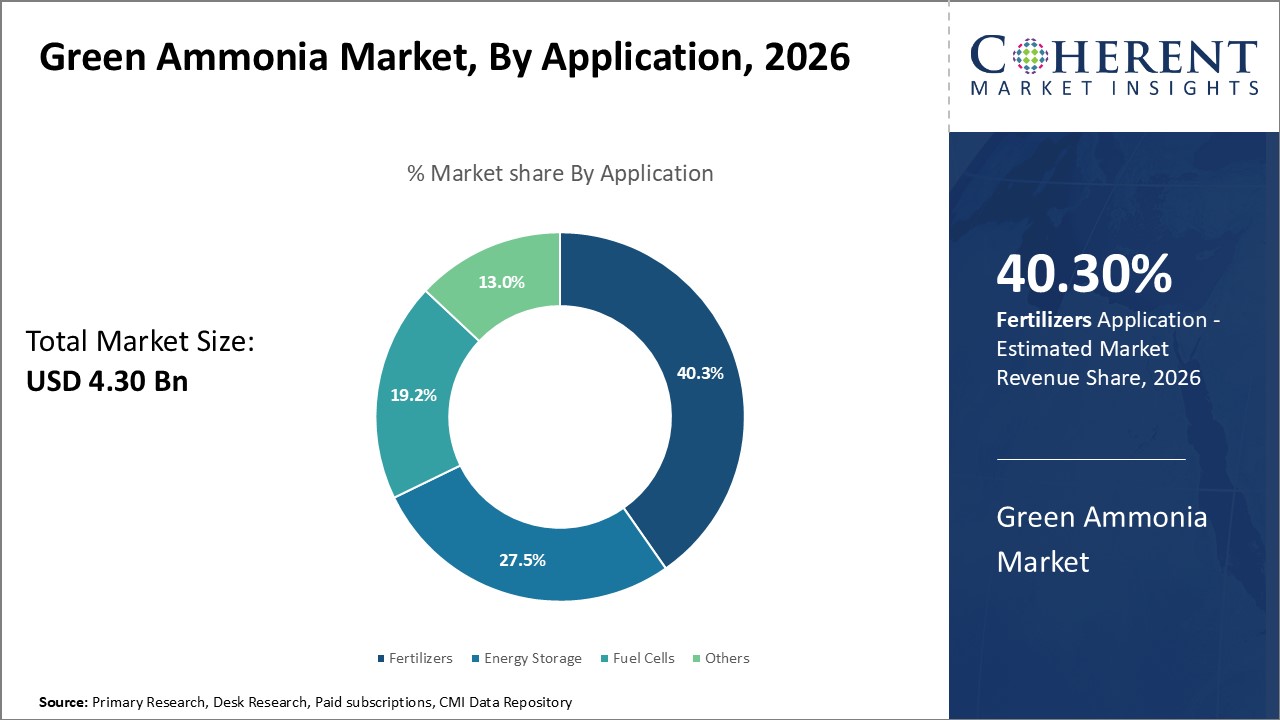
- By Application, Fertilizers hold the largest market share of 40.3% in 2026 as growing demand from the agriculture industry.
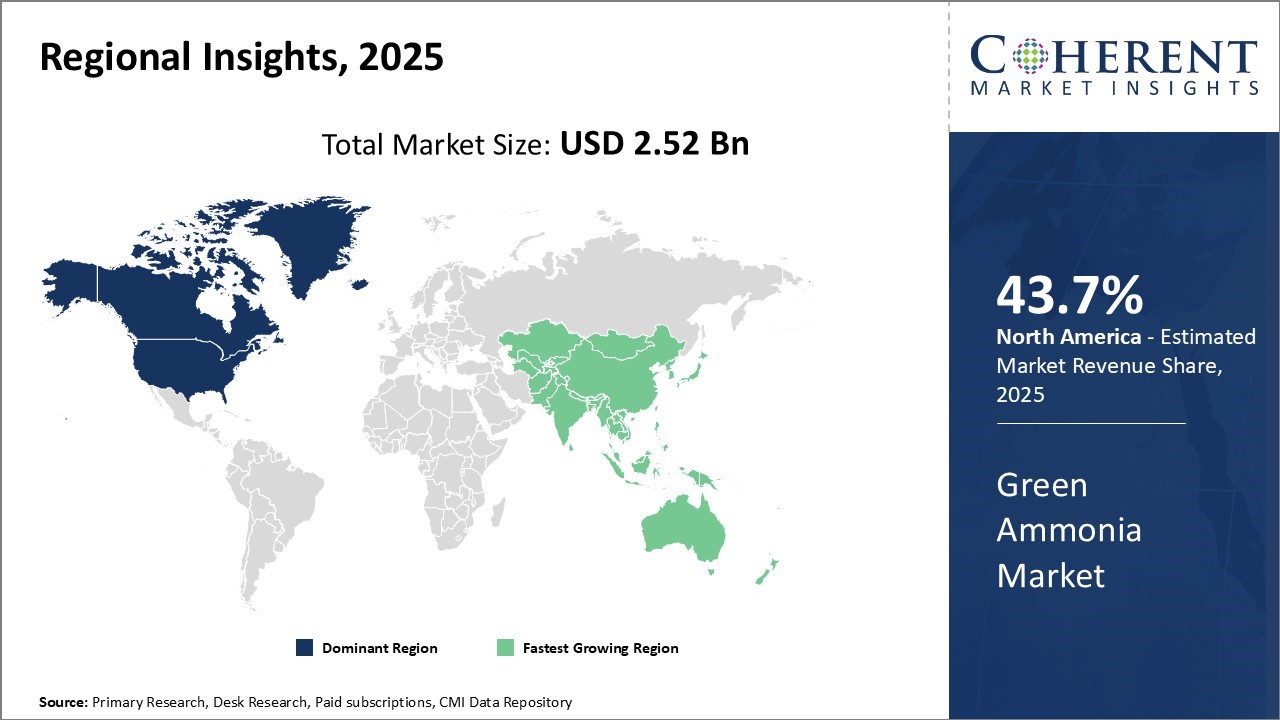
- By Region, North America dominates the overall market with an estimated share of 43.7% in 2026 owing to the advances in electrolyzer and synthesis technology.
Market Overview
Global green ammonia market is witnessing significant growth and is driven by rising environmental concerns and focus on developing carbon-free sources of energy globally. The green ammonia market is expected to witness substantial growth on account of increasing focus on developing carbon-free energy and fuel. Many countries and regions, such as India, China, and others, have rolled out supportive policies and initiatives to boost the production and use of green ammonia to meet their decarbonization targets. Large investments are being made in building production facilities and distribution infrastructure for green ammonia.
Current Events and their Impact on the Green Ammonia Market
Current Events | Description and its impact |
Geopolitical & Trade Realignments |
|
Market Economics & Competitive Dynamics |
|
Sectoral Demand Expansion |
|
End user Feedback and Unmet Needs in the Green Ammonia Market
End user Feedback and Unmet Needs
- High Production Costs Remain a Barrier: End-users in agriculture and energy sectors cite high green ammonia prices compared to conventional ammonia as a major hurdle. They express the need for subsidies, tax relief, or carbon pricing reforms to improve affordability and make long-term offtake agreements more feasible for large-scale adoption.
- Limited Infrastructure and Storage Capacity: Many industrial users report inadequate transport, storage, and handling infrastructure for green ammonia. They call for investment in ammonia-ready ports, pipelines, and bunkering terminals, along with standardized safety and operational protocols to support consistent supply and global trade.
- Inconsistent Supply and Energy Input Volatility: Fertilizer and shipping end-users highlight concerns about unstable supply chains and hydrogen feedstock availability. Intermittent renewable energy input makes production unpredictable. Users seek improved electrolyzer efficiency, integrated energy storage, and hybrid systems to stabilize output and reduce operational risk.
- Current Industry Events of 2026
- Market Size Estimation
- Regional Breakdown
- Competitive Landscape
- Customer Intelligence
- Segmental Analysis
- Pricing Analysis
- Key Market Drivers, Challenges & Future Trends
- Customized Insights Section
Green Ammonia Production Capacity
Current & Under-Construction Projects
- Unigel (Brazil – Bahia): Under construction; by 2025, expected to ramp up to ~240,000 t/year of green ammonia (plus 40,000 t of green hydrogen).
- OCI/Woodside (Beaumont, Texas): Blue/low-carbon ammonia facility producing 1.1 Mt/year from 2025, with carbon capture starting 2026.
Large Planned Facilities (2025–2026)
- Hive Energy / Linde (Nelson Mandela Bay, RSA): “World’s largest green ammonia export plant” targeting 800,000–900,000 t/year, with phase 1 online in 2025, full operation by late 2026.
- Saudi NEOM (Air Products + ACWA Power): 4 GW renewables feeding electrolysis, to produce ~1.2 Mt/year of green ammonia from 2026.
Segmental Insights
Green Ammonia Market Insights, By Technology
Electrolysis contributes the highest share of the market owing to its decarbonization mandates
The electrolysis segment is estimated to contribute the highest market share of 40.2% in 2026. The technology segment of the global green ammonia market is led by electrolysis. Electrolysis uses renewable energy sources like solar and wind to split water into hydrogen and oxygen through an electrochemical reaction. This hydrogen can then be combined with nitrogen through the widely used Haber-Bosch process to produce carbon-free ammonia. Electrolysis has seen growing adoption over other technologies due its inherent advantages. It offers a more environmentally friendly way to produce hydrogen without emitting greenhouse gases. As renewable energy costs decline worldwide, electrolysis is proving more economical than fossil fuel-based ammonia production. Manufacturers are ramping up large scale electrolysis projects to capitalize on rising green ammonia demand. For instance, in May 2025, Sweden's Metacon AB secured a €1.82 million contract to deliver a 1MW pressurized alkaline electrolyzer to a wind-powered coastal site in Morocco, marking its bold entry into North Africa's green hydrogen industry.
Green Ammonia Market Insights, By Application
Fertilizers contribute the highest share of the market owing to its food security & population growth
the fertilizers segment is estimated to contribute the highest market share of 40.3% in 2026. Ammonia is a key ingredient used to produce nitrogen fertilizers that are essential for maximizing agricultural yields to feed the world's growing population. Currently the fertilizer industry relies heavily on fossil fuel-based greenhouse gas emitting ammonia. However, green ammonia produced without carbon emissions is increasingly seen as a natural replacement. As demand for fertilizers rises in tandem with global food needs, the agriculture sector is under pressure to adopt more sustainable practices. Green ammonia offers the fertilizer industry a clean solution to decarbonize without sacrificing output. Manufacturers are actively developing carbon neutral fertilizers using renewable energy generated ammonia.
For instance, in May 2025, UEG, a global leader in renewable energy solutions, signed a memorandum of understanding with Alexandria Fertilizers Co., one of Egypt’s leading nitrogen-based fertilizer producers, to collaborate on a project focused on converting green hydrogen into green ammonia.
Regional Insights
North America Green Ammonia Market Trends
North America dominates the overall market with a share of 43.7%. In North America, rapid innovation in electrolyzers, increased use of renewable energy, and regulatory support like hydrogen hubs and U.S. tax credits are fueling green ammonia market growth. Fertilizer remains the fastest-growing end-use, supported by sustainable agriculture programs. Companies such as EverWind in Nova Scotia and CF Industries in Louisiana are boosting production through major investments. Shipping, industrial, and energy firms are actively forming alliances to develop infrastructure and supply chains. Despite high costs and limited storage, the region is quickly scaling up green ammonia to meet industrial, agricultural, and export needs. For instance, in February 2026, TalusAg, an agricultural technology company, and Landus, an Iowa-based agricultural solutions provider, have successfully launched North America's first and only modular systems for commercial green ammonia production.
Asia Pacific Green Ammonia Market Trends
Australia, Japan, South Korea, China, and India are rapidly expanding their green ammonia production by harnessing abundant solar, wind, and hydropower resources. Governments are driving large-scale plant development through subsidies and advances in electrolyzer technology, which help reduce costs. In the Asia-Pacific region, rising demand for sustainable fertilizer and low-carbon feedstock from agriculture and industry fuels the green ammonia market demand. Growing environmental regulations and food security concerns in countries like China, India, Malaysia, and Vietnam are accelerating the adoption of green ammonia solutions. For instance, in June 2026, To revolutionize India's fertilizer industry, the Solar Energy Corporation of India (SECI), a Navratna central public sector enterprise under the Ministry of New and Renewable Energy, issued a landmark green ammonia tender. SECI aims to supply 724,000 tons of green ammonia annually to 13 fertilizer plants through this initiative.
Canada Green Ammonia Market Trends
Fertilizer manufacturers in Canada are actively increasing their demand for green ammonia to reduce carbon emissions. At the same time, energy providers are incorporating green ammonia into power generation and hydrogen carrier applications to meet national decarbonization targets and the need for cleaner industrial and agricultural solutions. Provinces like British Columbia and Quebec are leveraging renewable electricity to cut input costs and support more sustainable, cost-effective ammonia production across diverse industrial sectors. For instance, in June 2026, To reduce agricultural emissions, Stantec and FuelPositive collaborated to develop Canada’s first farmer-owned green ammonia system. Based on this initiative, FuelPositive is rolling out the FP1500—its next-generation system built to support farms spanning roughly 10,000 acres. In response to rising demand, they are also constructing a state-of-the-art production facility.
Europe Green Ammonia Market Trends
European industries are actively adopting green ammonia across power generation, sustainable fertilizers, and transportation sectors such as shipping and marine fuel. Fertilizer demand is rising rapidly, alongside the rollout of industrial and transport fuel pilot projects. Countries like France, the Netherlands, and Germany are building ammonia crack-down terminals and storage hubs to support import/export needs. Strategic partnerships are establishing cross-border supply chains for broader European deployment. Industry leaders like Siemens, Ørsted, Thyssenkrupp, and ITM Power are collaborating to develop advanced electrolyzers and modular production facilities. In May 2026, BASF, the German chemical giant, produced its first batch of green ammonia at its Verbund site in Ludwigshafen, Central Europe, using certified renewable hydrogen.
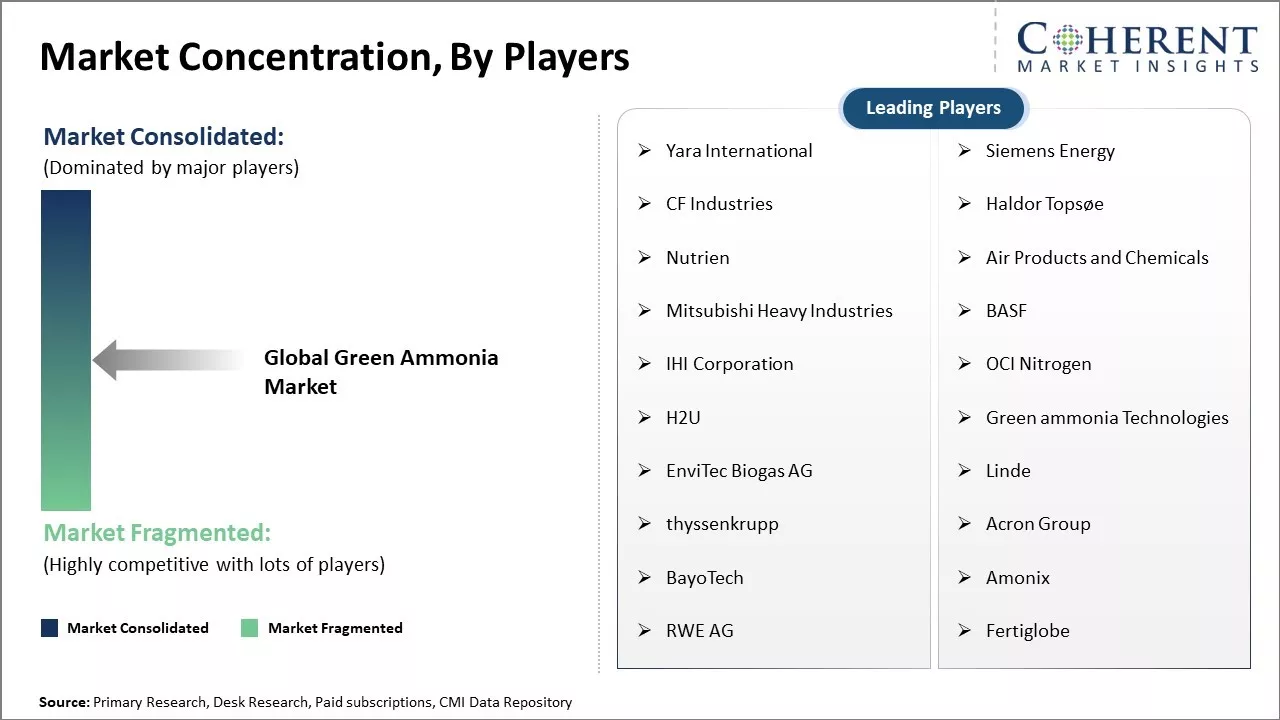
Market Concentration and Competitive Landscape
Green Ammonia Market News
- In May 2025, India's Ministry of New and Renewable Energy (MNRE) launched the Green Hydrogen Certification Scheme of India (GHCI), enabling manufacturers to prove their compliance with the country's renewable hydrogen standards. Under this scheme, manufacturers must obtain certificates from third-party verification agencies accredited by the Indian Bureau of Energy Efficiency.
- In December 2024, the German Federal Ministry for Economic Affairs and Climate Action (BMWK) partnered with GIZ and RP Global to develop a 3GW green hydrogen and ammonia facility in southern Argentina. Through the "Gaucho Wind to Hydrogen & Green Ammonia" project, funded by BMWK’s International Hydrogen Ramp-Up Programme (H2Uppp), the partners aim to produce green hydrogen-based ammonia for export to the European market.
- In November 2024, Samsung Heavy Industries (SHI) and Lloyd's Register (LR) signed a Memorandum of Understanding to collaboratively develop a floating production, storage, and offloading (FPSO) system for green ammonia.
- In October 2024, Hygenco Green Energies Pvt Ltd, a leading producer of affordable green hydrogen, invited bids for over 1125 Megawatt (MW)/1.1 Gigawatt (GW) of renewable energy to support its upcoming Green Ammonia Project. By launching India’s largest renewable power procurement tender for a green ammonia initiative, Hygenco reinforces its strong commitment to sustainability.
Market Report Scope
Green Ammonia Market Report Coverage
| Report Coverage | Details | ||
|---|---|---|---|
| Base Year: | 2025 | Market Size in 2026: | USD 4.30 Bn |
| Historical Data for: | 2020 To 2024 | Forecast Period: | 2026 To 2033 |
| Forecast Period 2026 to 2033 CAGR: | 70.7% | 2033 Value Projection: | USD 181.66 Bn |
| Geographies covered: |
| ||
| Segments covered: |
| ||
| Companies covered: | Yara International, Siemens Energy, CF Industries, Haldor Topsøe, Nutrien, Air Products and Chemicals, Mitsubishi Heavy Industries, BASF, IHI Corporation, OCI Nitrogen, H2U, Green ammonia Technologies, EnviTec Biogas AG, Linde, thyssenkrupp, Acron Group, BayoTech, Amonix, RWE AG, and Fertiglobe | ||
| Growth Drivers: |
| ||
| Restraints & Challenges: |
| ||
Green Ammonia Market Trend
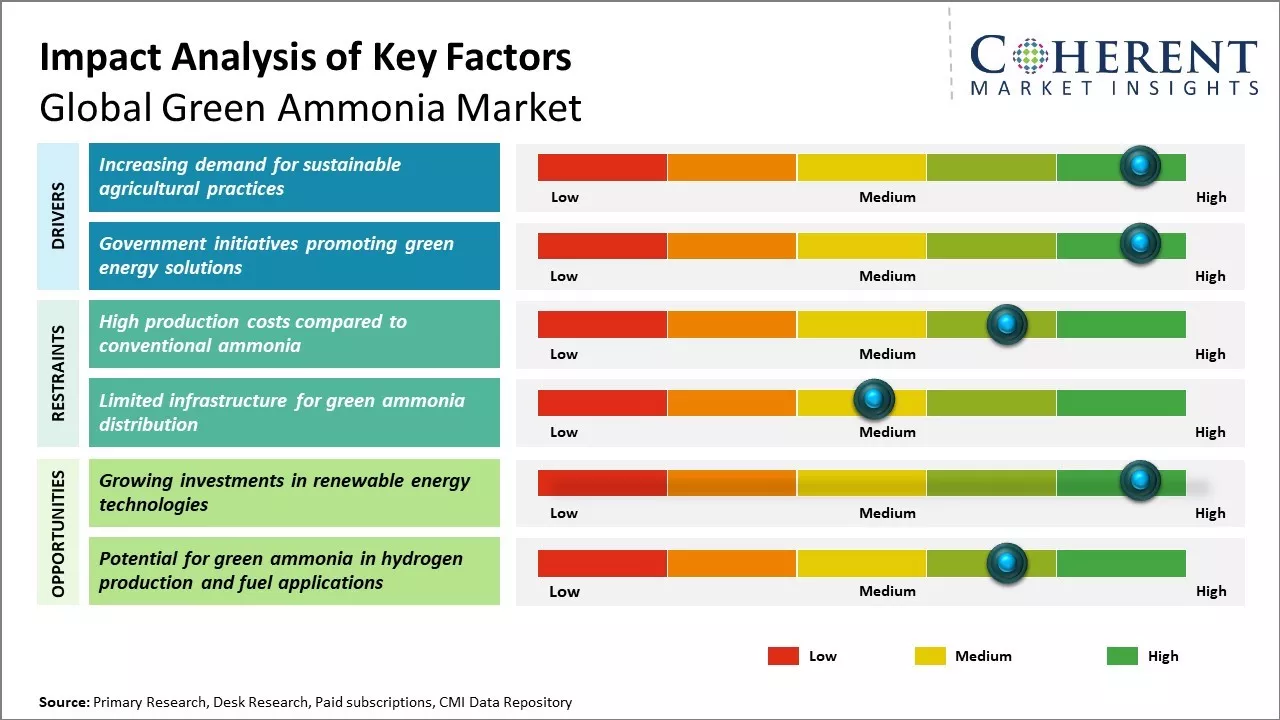
Increasing demand for sustainable agricultural practices
The agricultural industry is coming under increasing pressure to adopt more sustainable practices in order to reduce pollution and environmental degradation. Conventional methods of producing nitrogen fertilizers are highly energy and carbon intensive, relying on natural gas as the primary feedstock. The production of ammonia from natural gas generates significant greenhouse gas emissions. At the same time, demand for nitrogen fertilizers is expected to rise in the coming years to support the growing global population and need for food security. This is putting pressure on farmers to maximize crop yields while minimizing environmental impact.
Government initiatives promoting green energy solutions
Governments around the world are increasingly recognizing both the economic and environmental imperative to prioritize renewable energy and decarbonization strategies. For instance, according to data from Invest India released in July 2024, India has set an ambitious goal to achieve 500 GW of installed capacity from non-fossil fuel sources by 2030. This initiative is part of a comprehensive strategy aimed at reducing carbon intensity and ultimately reaching net-zero emissions by 2070. By investing in renewable energy and transitioning away from fossil fuels, India seeks to play a significant role in global efforts to combat climate change while promoting sustainable development. Many countries have committed to net-zero emissions targets by 2050 through their Nationally Determined Contributions under the Paris Agreement.
Green Ammonia Market Opportunity
Growing investments in renewable energy technologies
The steadily growing investments and advancement in renewable energy technologies across the globe present a major opportunity for the green ammonia market. Solar and wind power capacity additions have been increasing year-on-year due to supportive government policies and declining technology costs. This has made renewable energy resources more accessible and cost-effective for both large-scale energy generation as well as decentralized off-grid production.
As the costs of solar panels and wind turbines continue to reduce backed by significant Research and Development R&D investments, the renewable power required for green ammonia production is also expected to become cheaper over time. The entry of major energy companies such as ExxonMobil and other is also directing more capital into innovative clean energy technologies.
Analyst Opinion (Expert Opinion)
- The green ammonia market is no longer a theoretical promise—it’s entering a make-or-break execution phase. While hype has surrounded hydrogen and ammonia for years, we’re finally seeing large-scale traction, driven not by idealism, but by policy compulsion and real industrial pivoting.
- One of the clearest indicators: CF Industries’ USD 4 billion investment in a low-carbon ammonia plant in Louisiana. This isn't speculative spending—it's a strategic hedge against tightening EU carbon border taxes and mounting customer pressure for cleaner supply chains. Likewise, Yara’s partnership with Linde and ENGIE to build a green ammonia facility in Western Australia shows that producers are shifting from pilot rhetoric to commercial action.
- From an analyst perspective, fertilizer remains the low-hanging fruit, but it’s marine fuel and energy storage where the market will prove its scalability. Japan’s JERA has already begun ammonia co-firing in thermal power plants, and Samsung Heavy Industries is designing ammonia-powered vessels. These aren’t prototypes—they’re procurement-backed initiatives meant to anchor supply chains.
- However, the economics still don’t work without policy intervention. The U.S. Inflation Reduction Act, with its $3/kg hydrogen production credit, creates a rare subsidy arbitrage, making the U.S. Gulf Coast a global cost leader. In contrast, EU producers are suffocating under inconsistent state aid and red tape under RED III and CBAM, even though they were first movers.
- As of mid-2025, less than 5% of global ports are ammonia-ready, and the absence of a unified carbon-intensity standard makes “green” a subjective label. Until offtakers, shippers, and regulators agree on what qualifies as green ammonia, project bankability will remain shaky.
- In short, the green ammonia market is shifting from hype to hard reality. The winners won’t be those with the best technology, but those who align first with buyers, ports, and governments. If current momentum holds—and policy inconsistency doesn’t derail investor confidence—green ammonia could become the anchor commodity of the global hydrogen economy.
Speak to the analyst
Want personalized insights?
Take the findings above to one of our principal consultants, or have the report rebuilt around the segments, geographies and competitors you actually track.
Market Segmentation
- By Technology Insights (Revenue, USD Bn, 2021 - 2033)
- Electrolysis
- Biomass Gasification
- Methane Pyrolysis
- Others
- By Application Insights (Revenue, USD Bn, 2021 - 2033)
- Fertilizers
- Energy Storage
- Fuel Cells
- Others
- Regional Insights (Revenue, USD Bn, 2021 - 2033)
- North America
- U.S.
- Canada
- Latin America
- Brazil
- Argentina
- Mexico
- Rest of Latin America
- Europe
- Germany
- U.K.
- Spain
- France
- Italy
- Russia
- Rest of Europe
- Asia Pacific
- China
- India
- Japan
- Australia
- South Korea
- ASEAN
- Rest of Asia Pacific
- Middle East
- GCC Countries
- Israel
- Rest of Middle East
- Africa
- South Africa
- North Africa
- Central Africa
- Key Players Insights
- Yara International
- Siemens Energy
- CF Industries
- Haldor Topsøe
- Nutrien
- Air Products and Chemicals
- Mitsubishi Heavy Industries
- BASF
- IHI Corporation
- OCI Nitrogen
- H2U
- Green ammonia Technologies
- EnviTec Biogas AG
- Linde
- thyssenkrupp
- Acron Group
- BayoTech
- Amonix
- RWE AG
- Fertiglobe
Sources
Primary Research interviews
- Industry professionals from fertilizer manufacturing firms (e.g., Yara, CF Industries)
- Project engineers from green hydrogen and ammonia plants
- Energy policy advisors from national hydrogen programs
- Executives in marine fuel and shipping sectors
Databases
- IEA Hydrogen Projects Database
- UN Comtrade Database
- Eurostat Energy Database
- U.S. Energy Information Administration (EIA)
- International Renewable Energy Agency (IRENA) Statistics
Magazines
- H2 View
- Chemical Engineering Magazine
- The Chemical Engineer
- Renewable Energy Focus
- Energy & Power
Journals’
- International Journal of Hydrogen Energy
- Renewable and Sustainable Energy Reviews
- Journal of Cleaner Production
- Energy Policy
- Green Chemistry
Newspapers
- Reuters
- Financial Times
- Nikkei Asia
- The Guardian (Energy Section)
- The Australian Business Review
Associations
- Ammonia Energy Association
- International Energy Agency (IEA)
- Hydrogen Council
- International Fertilizer Association (IFA)
- World Energy Council
Public Domain sources
- U.S. Department of Energy (Hydrogen Shot, LPO Reports)
- National Hydrogen Strategies (e.g., Germany, Canada, Australia, India)
- European Commission – Climate and Energy Frameworks
- Clean Fuels Fund (Canada)
- Port authority publications (e.g., Port of Rotterdam, Port of Nova Scotia)
- COP28 and UNFCCC energy transition documents
Proprietary Elements
- CMI Data Analytics Tool, and Proprietary CMI Existing Repository of information for last 8 years
Get access to 250+ pages report
Every segment, forecast, competitor profile and data table behind the analysis above — available for instant download.
- ESOMAR Member
- ISO 9001:2015 Certified
- D-U-N-S Registered
- GDPR & CCPA Compliant
Missing comfort of reading report in your local language? Find your preferred language:
Transform your Strategy with Exclusive Trending Reports
Frequently Asked Questions
The Green Ammonia Market is estimated to be valued at USD 4.30 Bn in 2026, and is expected to reach USD 181.66 Bn by 2033.
The CAGR of the Green Ammonia Market is projected to be 70.7% from 2026 to 2033.
Increasing demand for sustainable agricultural practices and government initiatives promoting green energy solutions are the major factors driving the growth of the global green ammonia market.
High production costs compared to conventional ammonia and limited infrastructure for green ammonia distribution are the major factors hampering the growth of the global green ammonia market.
In terms of technology, electrolysis is estimated to dominate the market revenue share in 2026.
Yara International, Siemens Energy, CF Industries, Haldor Topsøe, Nutrien, Air Products and Chemicals, Mitsubishi Heavy Industries, BASF, IHI Corporation, OCI Nitrogen, H2U, Green ammonia Technologies, EnviTec Biogas AG, Linde, thyssenkrupp, Acron Group, BayoTech, Amonix, RWE AG, and Fertiglobe are the major players.
North America is expected to lead the global green ammonia market in 2026.