

Amines Market Analysis & Forecast: 2026-2033
Amines Market is estimated to be valued at USD 22,239.6 Mn in 2026 and is expected to reach USD 33,884.2 Mn in 2033, exhibiting a compound annual growth rate (CAGR) of 6.2% from 2026 to 2033.
Key Takeaways
- Based on Type, the Primary Amines segment dominated the market with a share of 41.1% in 2026, driven by applications in crop protection, personal care, and chemical synthesis.
- Based on Function, the Corrosion Inhibitor segment is expected to hold the largest share of the global amines market in 2026, due to their strong ability to form protective films on metal surfaces and neutralize acidic environments that accelerate corrosion.
- Based on End-Use Industry, the Agrochemicals segment is expected to dominate the market with the highest share in 2026, as they play a critical role as building blocks for active ingredients in herbicides, fungicides, and insecticides.
- Based on Region, North America held a 25.4% market share in 2026, driven by demand in agrochemicals and water treatment, whereas Europe exceeded USD 3.5 billion, led by strong adoption in pharmaceuticals, coatings, and agrochemicals, particularly in Germany, France, and the UK.
Market Overview
The amines market is witnessing robust growth, driven by rising demand in crop protection, water treatment, personal care, and surfactants. Increasing adoption across pharmaceuticals, agrochemicals, and coatings further supports expansion. North America accounts for a notable share with strong applications in agriculture and industrial use, while Europe exceeds USD 3.5 billion, led by Germany, France, and the UK. Technological advancements and sustainability trends are expected to accelerate global amines market demand.
Current Events and Its Impact on Amines Market
Current Events | Description and its impact |
Green Manufacturing & Sustainable Process Technologies |
|
AI-Enabled Process Optimization in Amines Manufacturing |
|
Pricing Analysis of Amines Market
The pricing of amines is influenced by feedstock costs (such as ammonia, ethanol, and petrochemicals), production technology, and end-use application. Primary amines, widely used in pharmaceuticals, agrochemicals, and personal care, are moderately priced at USD 1,200–1,800 per metric ton, supported by large-scale industrial demand. Ethanolamine’s, commonly applied in gas treatment, detergents, and coatings, range from USD 1,500–2,200 per metric ton, depending on purity and formulation. Alkyl amines, critical in agrochemicals and rubber processing, are priced between USD 2,300–3,200 per metric ton due to specialized manufacturing. Premium fatty amines, used in water treatment, flotation agents, and oilfield chemicals, command higher prices of USD 3,500–5,000 per metric ton. Regionally, Europe and North America maintain premium pricing driven by stringent quality standards, while Asia Pacific remains cost-competitive through economies of scale and integrated petrochemical supply chains.
- Current Industry Events of 2026
- Market Size Estimation
- Regional Breakdown
- Competitive Landscape
- Customer Intelligence
- Segmental Analysis
- Pricing Analysis
- Key Market Drivers, Challenges & Future Trends
- Customized Insights Section
Segmental Insights
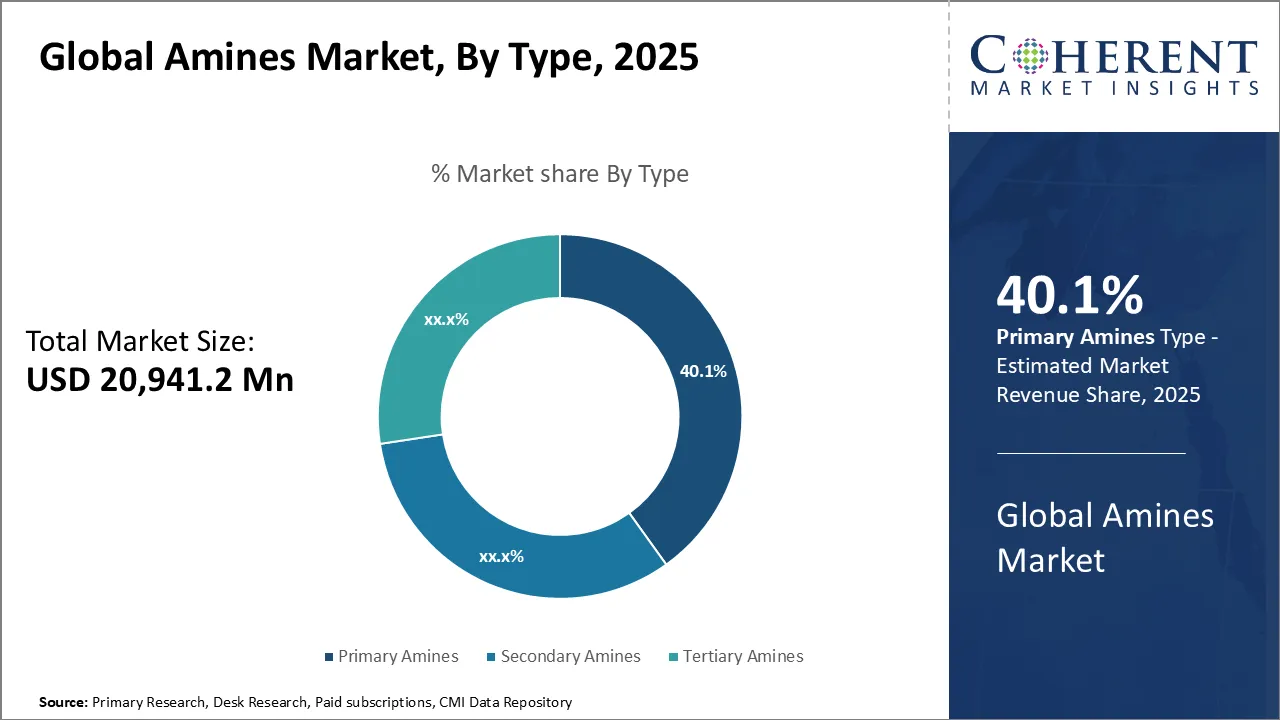
Amines Market Insights, By Type: Primary Amines Dominate Owing to Versatile Applications in Crop Protection, Personal Care, and Chemical Synthesis
In terms of type, primary amines accounted for 41.1% of the market share in 2026, supported by their widespread use in crop protection, personal care, and chemical synthesis. Their role as intermediates in agrochemicals and pharmaceuticals continues to drive strong adoption across industries. Additionally, primary amines’ compatibility in formulating dyes, lubricants, and resins positions them as essential raw materials in multiple sectors. Rising demand for eco-friendly agrochemical formulations is expected to further strengthen growth in this segment. In March 2025, BASF and Sika introduced a novel amine building block under the Baxxodur® EC 151 brand, aimed at curing epoxy resins ideal for sustainable flooring applications in industrial and commercial environments.
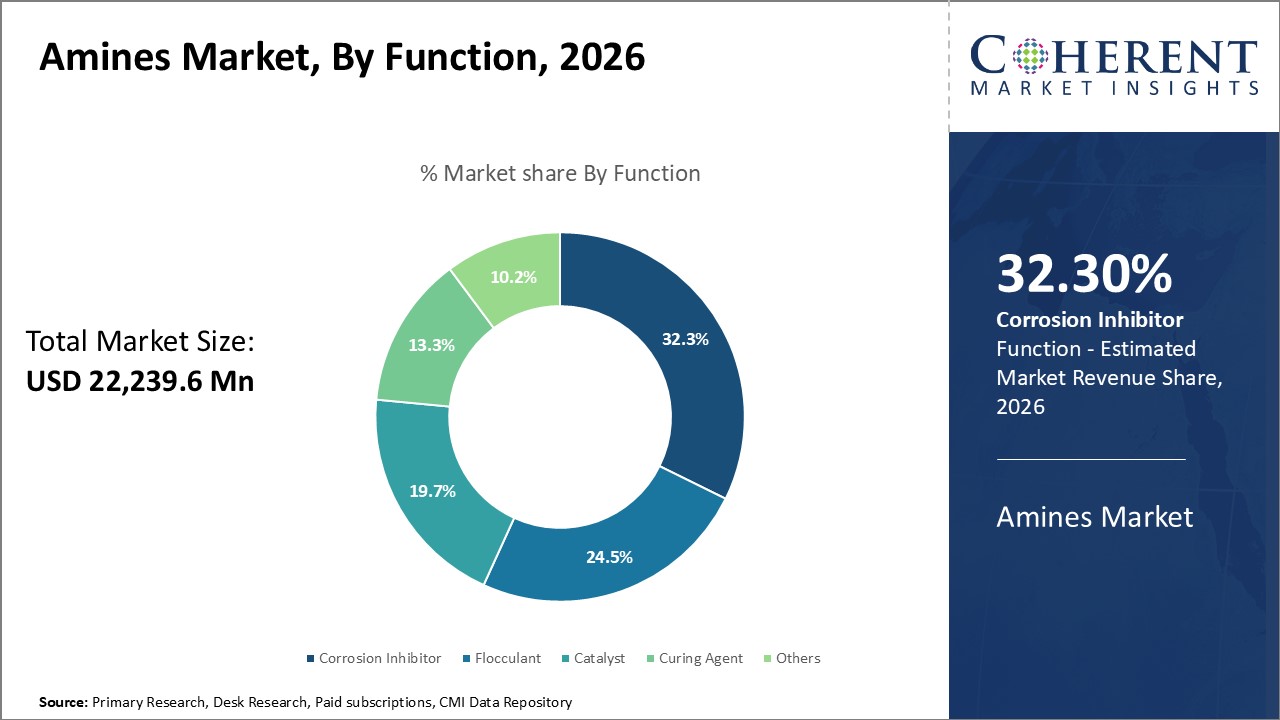
Amines Market Insights, By Function: Dominance Of Corrosion Inhibitor Is Driven by Its Ability to Form Protective Films on Metal Surfaces and Neutralize Acidic Environments
In terms of function, the corrosion inhibitor segment in expected to contribute the largest share of the market in 2026, due to their strong ability to form protective films on metal surfaces and neutralize acidic environments that accelerate corrosion. Their chemical structure allows them to adsorb onto metal substrates, creating a barrier that reduces direct contact between the metal and corrosive agents like oxygen, water, or salts.
In industries such as oil & gas, petrochemicals, water treatment, and power generation, amines are widely used to protect pipelines, boilers, and storage tanks from deterioration.
For instance, in February 2025, A growing array of U.S. industries from power plants and refineries to hospitals, faced critical water-related challenges like corrosion and scaling that drive up costs and threaten infrastructure longevity. ODYSSEE Environnement champions uses filming amines, organic compounds that form a protective hydrophobic film on metal surfaces. This method improves heat transfer, reduces energy consumption, and is more environmentally sustainable owing to lower dosages and fewer by-products.
Amines Market Insights, By End Use Industry: Prominent Role of Agrochemical is Fueled by its Ability in Building Blocks for Active Ingredients
In terms of end-use industry, the agrochemical segment is projected to command the highest share of the market in 2026, as they play a critical role as building blocks for active ingredients in herbicides, fungicides, and insecticides. They act as intermediates in synthesizing compounds like glyphosate, 2,4-D, and atrazine, which are widely used for weed and pest control. The rising need to increase crop productivity in limited arable land, coupled with population growth and food security concerns, is fueling demand for efficient crop protection solutions. Additionally, amines are used in the formulation of emulsifiers and surfactants that improve the stability and application efficiency of agrochemicals.
For instance, in February 2025, Indo Amines Ltd announced plans to invest INR 60 crore to establish a new specialty chemicals manufacturing facility. The move underscores the firm’s commitment to strengthening its portfolio in value-added chemicals such as fine and specialty reagents and amines, aimed at catering to growing industrial demand. Additionally, Indo Amines is exploring strategic acquisitions, seeking partners to acquire an agrochemical or pharmaceutical API company to complement its expansion.
Regional Insights
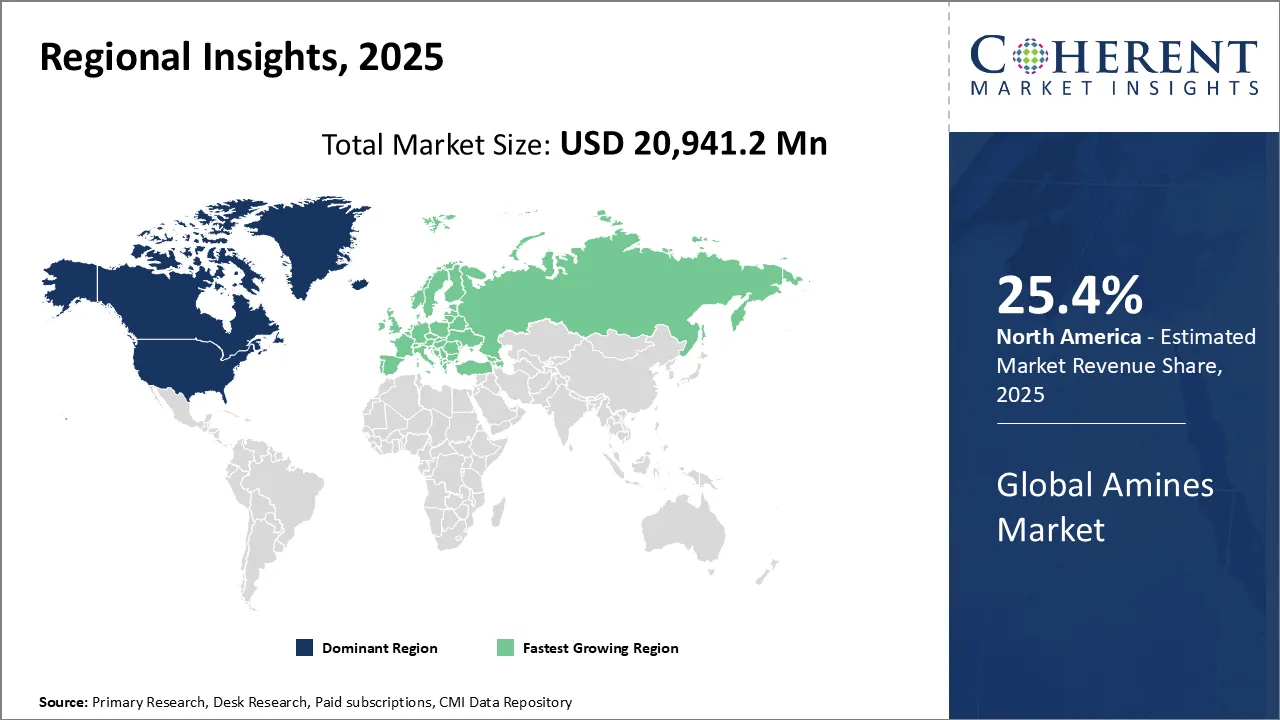
North America Amines Market Trends
North America accounted for 25.4% of the global amines market in 2026, with the United States leading regional consumption. The market is strongly driven by demand in agrochemicals and water treatment, supported by robust agricultural activity and environmental regulations promoting sustainable practices. The U.S. plays a dominant role in utilizing amines for herbicides, fungicides, and wastewater treatment solutions, while Canada is showing growth potential in oilfield chemicals and personal care formulations. Expanding investments in clean water infrastructure and advanced agrochemicals are expected to further accelerate regional adoption. In May 2026, Huntsman Corporation expanded its Conroe, Texas facility with the addition of the E-GRADE® purification and packaging unit to produce ultra-high-purity amines (including quaternary amines and amine oxides) essential for semiconductor-grade applications in chip fabrication.
Europe Amines Market Trends
The amines market in 2026, reflecting rising global agricultural productivity needs and increasing focus on clean water and sanitation. Amines are widely used in herbicides, fungicides, and pesticides to ensure food security, while their role in wastewater treatment supports industrial and municipal demand.
The region benefits from advanced R&D in specialty chemicals, stringent environmental standards, and the rising demand for sustainable raw materials in healthcare and industrial applications. German manufacturers are heavily engaged in producing high-purity amines for pharmaceuticals, while France and the UK are key markets for crop protection chemicals and specialty coatings. The growing emphasis on green chemistry initiatives and circular economy practices positions Europe as a leading hub for innovation in the amines market.
For instance, in January 2024, BASF reinforced its partnership with OQEMA, a top European chemical distributor, to expand the distribution of BASF’s standard amines portfolio across the UK and Ireland. The collaboration aims to enhance supply chain efficiency and broaden access to specialist amine products in multiple industries.
Amines Market Dominating Countries
United States Amines Market Analysis and Trend
The United States holds a significant position in the global amines market share, supported by strong demand from the agrochemical, water treatment, and personal care industries. Rising agricultural productivity requirements and growing emphasis on clean water solutions are major drivers for amine adoption. U.S. chemical manufacturers continue to innovate in the production of ethanolamine’s, alkyl amines, and fatty amines, ensuring broad applications across pharmaceuticals, detergents, and coatings. With a robust regulatory framework, advanced R&D infrastructure, and strong end-user demand, the U.S. remains a dominant force in shaping global amines market dynamics.
Germany Amines Market Analysis and Trend
Germany dominates the European amines market, supported by its strong pharmaceutical, coatings, and chemical industries. The country’s advanced R&D capabilities and high-quality production standards drive significant adoption of ethanolamine’s, fatty amines, and alkyl amines. Germany also plays a crucial role in developing sustainable and bio-based amine solutions, aligning with the EU’s green chemistry and carbon reduction initiatives. With robust demand from pharmaceuticals, agrochemicals, and specialty coatings, Germany remains a key hub for innovation and export within the global amines industry. In May 2026, BASF announced that it would convert its entire European amines portfolio to 100% renewable electricity. This transition, starting in May 2026, applies to all amines produced at BASF's European production sites in Ludwigshafen, Germany, and Antwerp, Belgium. The move aligns with BASF's sustainability goals and reflects the growing emphasis on eco-friendly production processes in the chemical industry.
Market Report Scope
Amines Market Report Coverage
| Report Coverage | Details | ||
|---|---|---|---|
| Base Year: | 2025 | Market Size in 2026: | USD 22,239.6 Mn |
| Historical Data for: | 2020 To 2024 | Forecast Period: | 2026 To 2033 |
| Forecast Period 2026 to 2033 CAGR: | 6.2% | 2033 Value Projection: | USD 33,884.2 Mn |
| Geographies covered: |
| ||
| Segments covered: |
| ||
| Companies covered: | Arkema, Akzo Nobel N.V., BASF SE, Dow, Huntsman International LLC | ||
| Growth Drivers: |
| ||
| Restraints & Challenges: |
| ||
Global Amines Market: Growth Drivers
- Increasing Demand for the agriculture chemicals
High demand for agricultural chemicals, such as herbicides and pesticides, is expected to augment the market growth. Ethanolamine and ethylenediamine are widely used in the production of agricultural chemicals. The growing need for crop protection and high yield crops in order to meet the rising demand for food due to the increasing population is expected to foster the global amines market growth.
The demand for surfactants is increasing in various applications such as agricultural formulations, softeners, biocides, detergents, and emulsifiers. The growth of the textile industry is also a key factor driving the demand for surfactants. Surfactants are also used in the manufacture of various agrochemical products. All these factors are expected to drive the growth of the global amine market during the forecast period. In March 2025, Institute of Chemical Research of Catalonia (ICIQ) developed a novel method using light and a nickel catalyst to efficiently create complex amine-containing structures. This approach addresses a common challenge in pharmaceutical chemistry: producing amine-containing molecules with the correct 3D structure. The method starts with widely available materials, making it more practical and accessible for drug development.
Market Opportunity
- Rapidly increasing pharmaceutical industry
The growing demand for amines from the pharmaceutical industry, particularly for the manufacturing of painkillers such as Morphine and Demerol, is expected to offer immense growth opportunities for the global market. With the rising geriatric population and increasing prevalence of chronic diseases, healthcare needs are surging, thereby boosting the use of amines in drug formulations. This trend highlights a strong outlook for the amines market forecast, supported by the expanding pharmaceutical sector.
In addition, the personal care industry is becoming another major growth driver, where amines are widely used in toiletries, skincare, hair care, cosmetics, and fragrances. Changing consumer lifestyles and higher disposable incomes are fueling spending on personal care and hygiene products. Furthermore, the growing influence of online retail channels is accelerating product accessibility and sales, further contributing to the expansion of the global amines market.
Key Developments
- In November 2024, Alkyl Amines Chemicals Ltd. has received approval from its Board of Directors to invest between ₹115 crore and ₹150 crore in establishing a new specialty chemicals plant at its existing facility in Dahej, Gujarat. The move will boost annual production capacity from 3,000 MT to 4,000 MT over an estimated period of 15 to 50 months. This expansion aims to cater to growing demand in both domestic and global markets while gradually reducing reliance on imports.
- In May 2024, Dow announced plans to expand its amines capacity in the U.S. and Europe. This expansion includes the restart of an ethylene oxide plant in Plaquemine, Louisiana, and new alkoxylation capacity in Terneuzen and Seadrift, Texas.
Analyst Opinion
The Amines Market is undergoing a strategic transformation, driven less by cyclical demand fluctuations and more by structural advancements in synthesis technologies, green manufacturing processes, and specialty chemical applications. The current trajectory reflects a clear pivot toward high-purity, energy-efficient, and environmentally sustainable amines, qualities increasingly demanded across pharmaceuticals, agrochemicals, water treatment, and specialty coatings sectors.
A notable trend is the pharmaceutical industry’s intensified reliance on specialty amines as intermediates for APIs and formulation chemicals. For instance, the adoption of high-purity ethanolamines in drug synthesis has grown over 25% in Europe and North America between 2020–2025. Agrochemical applications are also expanding rapidly, with primary amines increasingly deployed in herbicides, fungicides, and crop protection chemicals, particularly in the U.S., Germany, and India.
In the coatings and water treatment industries, amines are replacing conventional solvents and surfactants, not purely for cost savings but for performance and regulatory compliance. The shift toward bio-based and green-certified amines underscores the market’s preference for functional and sustainable solutions, reflecting increasing ESG pressures from downstream industries.
Furthermore, the market is witnessing accelerated digital adoption, with AI-driven process optimization and predictive analytics enhancing reaction efficiency, reducing downtime, and improving batch consistency. This not only ensures supply reliability but also aligns with global sustainability mandates by minimizing energy use and emissions.
Speak to the analyst
Want personalized insights?
Take the findings above to one of our principal consultants, or have the report rebuilt around the segments, geographies and competitors you actually track.
Market Segmentation
- Global Amines Market, By Product Type (Revenue, USD Mn, 2021 - 2033)
- Ethanolamines
- Alkylamines
- Fatty amines
- Others
- Global Amines Market, By Application (Revenue, USD Mn, 2021 - 2033)
- Crop Protection Chemicals
- Water Treatment
- Personal Care
- Surfactants
- Others
- Global Amines Market, By Region (Revenue, USD Mn, 2021 - 2033)
- North America
- U.S.
- Canada
- Latin America
- Brazil
- Argentina
- Mexico
- Rest of Latin America
- Europe
- Germany
- U.K.
- Spain
- France
- Italy
- Russia
- Rest of Europe
- Asia Pacific
- China
- India
- Japan
- Australia
- South Korea
- ASEAN
- Rest of Asia Pacific
- Middle East
- GCC Countries
- Israel
- Rest of Middle East
- Africa
- South Africa
- North Africa
- Central Africa
- North America
- Company Profiles
- Arkema
- Akzo Nobel N.V
- BASF SE
- Dow
- Huntsman International LLC
Sources
The Stakeholders Consulted
- Industrial plant managers and chemical process engineers
- Manufacturers and suppliers of amines and related chemical intermediates
- Utility and energy efficiency consultants
- Regulatory bodies and environmental compliance advisors
- Research institutions focused on chemical processes, sustainable chemistry, and industrial energy use
- Government agencies overseeing infrastructure, chemical, and industrial development
- End-users across sectors such as agrochemicals, pharmaceuticals, water treatment, personal care, coatings, and industrial chemicals
Databases Accessed
- U.S. Department of Energy (DOE) – Industrial Chemical & Energy Systems Database
- International Energy Agency (IEA) – Industrial Efficiency and Chemical Data
- Eurostat – Energy Use and Chemical Industry Statistics
- Ministry of Chemicals & Fertilizers (India) – Industrial and Agrochemical Data
- World Bank Open Data – Industrial Chemicals & Infrastructure Metrics
- UNIDO (United Nations Industrial Development Organization) – Industrial Chemicals and Manufacturing Statistics
- Science Direct, Springer Link – Journals on Chemical Engineering and Industrial Processes
Magazines & Trade Publications
- Chemical Engineering Magazine
- ICIS Chemical Business
- Manufacturing Chemist
- Energy Manager Today
- Industry Week – Chemical & Industrial Section
Scientific and Industry Journals
- Journal of Chemical Technology & Biotechnology
- Applied Chemical Engineering
- Industrial & Engineering Chemistry Research
- Journal of Process Mechanical Engineering
- Energy Conversion and Management
Newspapers & Media Outlets
- The Wall Street Journal – Chemicals & Industry
- Bloomberg – Chemicals & Industrial Markets
- Reuters – Global Chemical Industry
- The Economic Times – Chemicals & Infrastructure
- Business Standard – Industrial Chemicals & Technology
Associations and Regulatory Bodies
- International Energy Agency (IEA)
- U.S. Environmental Protection Agency (EPA) – Chemical Industry Guidelines
- American Chemical Society (ACS)
- International Society of Automation (ISA)
- Bureau of Energy Efficiency (BEE), India
Public Domain Sources
- U.S. Energy Information Administration (EIA) – Chemical Industry Reports
- European Commission – Industrial Emissions and Chemical Efficiency Reports
- World Bank – Chemical Industry and Energy Use Reports
- International Renewable Energy Agency (IRENA) – Industrial Energy Integration
Proprietary Research Elements
- Proprietary Market Data Repository (covering past 8 years), Expert Interviews and Transcripts (focused on chemical production, industrial applications, and process efficiency improvements).
Get access to 250+ pages report
Every segment, forecast, competitor profile and data table behind the analysis above — available for instant download.
- ESOMAR Member
- ISO 9001:2015 Certified
- D-U-N-S Registered
- GDPR & CCPA Compliant
Missing comfort of reading report in your local language? Find your preferred language:
Transform your Strategy with Exclusive Trending Reports
Frequently Asked Questions
The Amines Market size is estimated to be valued at USD 22,239.6 Mn in 2026, and is expected to reach USD 33,884.2 Mn by 2033.
Yes, some amines pose environmental risks due to their potential toxicity, volatility, and contribution to water and air pollution during production and use.
Pricing in the amines market varies based on type (e.g., ethanolamine’s, alkylamines), feedstock costs, purity levels, and end-use applications, with specialty amines commanding higher prices.
The growing demand for surfactants from various applications, such as agricultural formulations, fabric softeners, biocides, detergents, and emulsifiers, is boosting the market growth. Growth in the textile industry is another major factor fuelling demand for surfactants. Surfactants are also used in the production of various agricultural chemical products. All these factors are expected to augment the market growth over the forecast period.
The CAGR of the Amines industry is projected to be 6.2% from 2026 to 2033.