

Agrochemicals Market Size and Forecast – 2026 to 2033
Agrochemicals Market is estimated to be valued at USD 97.53 Bn in 2026 and is expected to reach USD 150.56 Bn in 2033, exhibiting a compound annual growth rate (CAGR) of 6.4% from 2026 to 2033.
Key Takeaways
- By Origin, Synthetic hold the largest market share in 2026 owing to the rising global food demand & population growth.
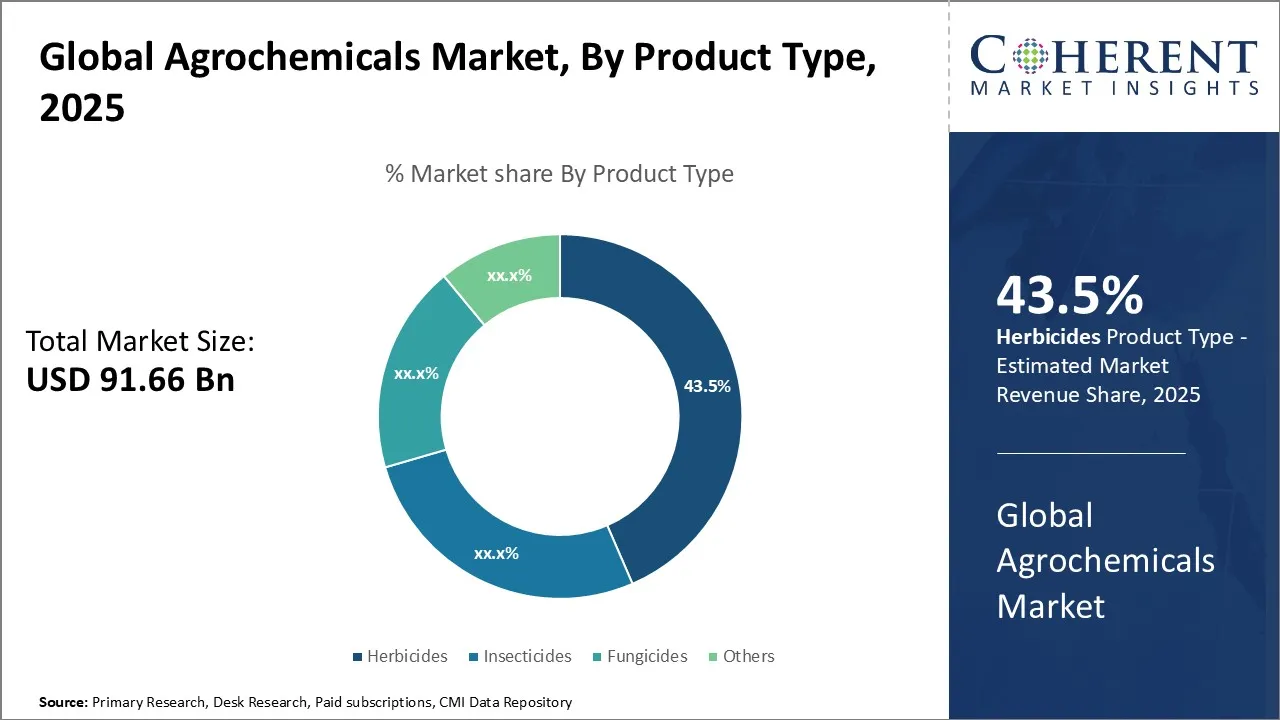
- By Product Type, Herbicides expected to hold largest market share of 44.5% in 2026 owing to its rising global food demand & need for higher crop productivity.
- By Crop Type, Cereals & Grains acquired the prominent market share in 2026 owing to its central role in global food security.
- By Application, Soil Treatment dominates the overall market share in 2026 owing to the soil degradation & loss of fertility.
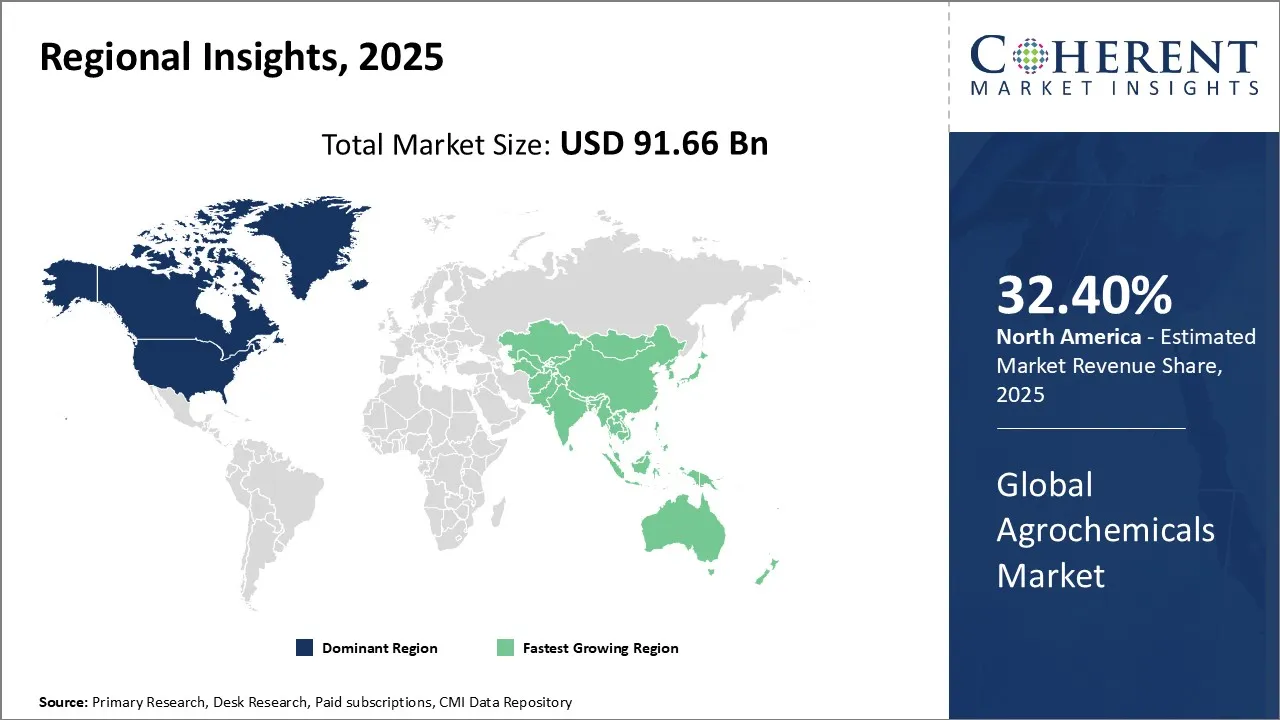
- By Region, North America dominates the overall market with an estimated share of 32.4% in 2026 owing to the increasing demand for food production.
Market Overview
The agrochemicals market actively supports modern agriculture by improving crop productivity, maintaining yield stability, and strengthening food security. It covers fertilizers, herbicides, insecticides, fungicides, and soil treatment products applied across key crops such as cereals, grains, fruits, and vegetables. Rising food demand, shrinking arable land, growing pest and weed pressure, and the adoption of advanced farming practices drive market expansion. Manufacturers continue to innovate by developing more efficient, sustainable, and environmentally safer formulations.
Current Events and Its Impact on the Agrochemicals Market
Current Events | Description and its impact |
Geopolitical Tensions in Key Agrochemical Producing Regions |
|
Rapid Advancement in Nano-Encapsulation Technologies |
|
Economic Volatility and Supply Chain Disruptions |
|
Segmental Insights
- Current Industry Events of 2026
- Market Size Estimation
- Regional Breakdown
- Competitive Landscape
- Customer Intelligence
- Segmental Analysis
- Pricing Analysis
- Key Market Drivers, Challenges & Future Trends
- Customized Insights Section
Agrochemicals Market Insights, By Product Type - Herbicides contribute the highest share of the market owing to its weed pressure & loss prevention
Herbicides expected to hold largest market share of 44.5% in 2026. Herbicides actively support the agrochemicals market by enabling farmers to manage weeds that compete with crops for nutrients, water, and sunlight. Farmers increasingly turn to chemical weed control as labor shortages and rising wages make manual weeding less practical. The growth of large-scale farming and the need for efficient field management further boost herbicide use. Moreover, climate conditions that encourage rapid weed proliferation and ongoing innovations in herbicide formulations continue to drive strong demand. For instance, in May 2025, Dhanuka Agritech Limited unveiled DINKAR, a next-generation herbicide designed for transplanted paddy to promote weed-free rice cultivation.
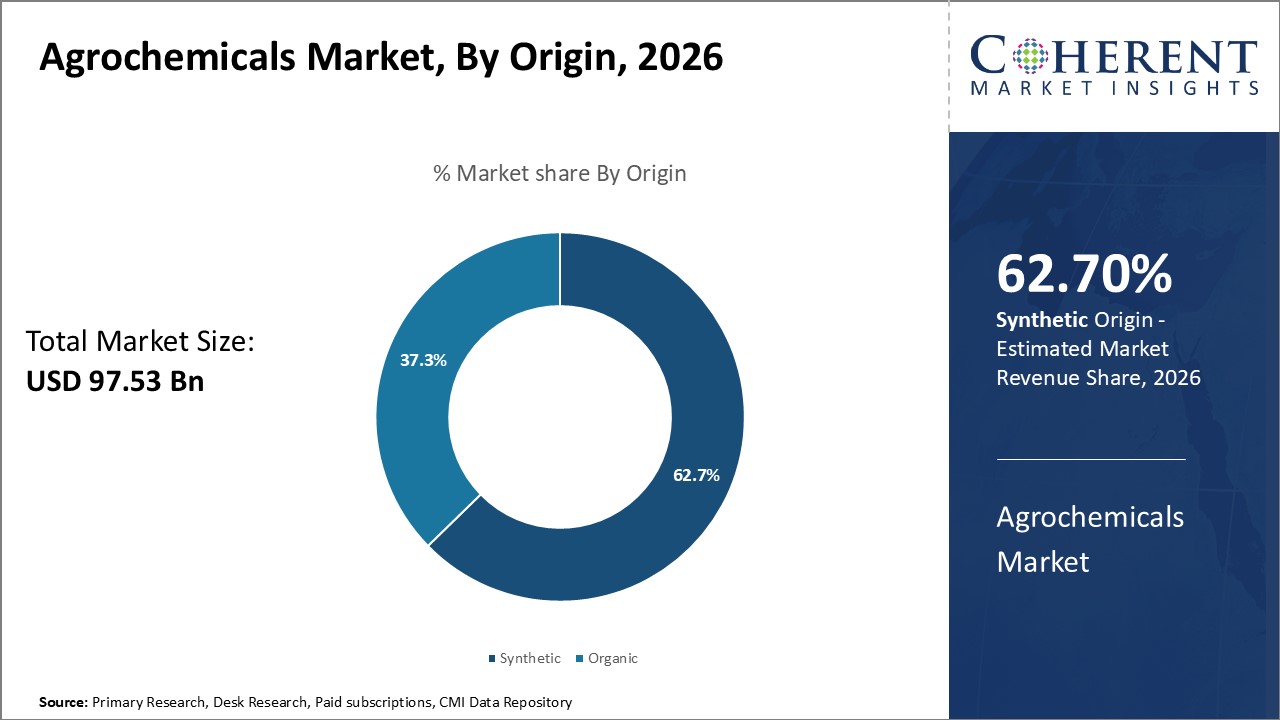
Agrochemicals Market Insights, By Origin - Synthetic contribute the highest share of the market owing to its need for higher crop yields & crop protection
Synthetic agrochemicals actively drive the agrochemicals market by supporting uniform and large-scale crop production across various farming systems. Farmers use synthetic fertilizers and crop protection chemicals for their quick results, dependable effectiveness, and ability to manage nutrient gaps, weeds, pests, and diseases efficiently. The growth of commercial farming, the need to boost yields from limited land, and demand for economical solutions continue to fuel adoption. Ongoing improvements in formulations and application techniques further encourage the use of synthetic agrochemical products. For instance, FMC India launched Entazia biofungicide, formulated with Bacillus subtilis, for integrated use with its biostimulants and synthetic fungicides.
Agrochemicals Market Insights, By Crop Type - Cereals & Grains contribute the highest share of the market owing to its intensive use of fertilizers
Cereals and grains actively drive agrochemical demand as farmers apply extensive crop protection and nutrient management to secure healthy yields. They use fertilizers, herbicides, insecticides, and fungicides to protect staple crops like wheat, rice, and maize from pests, diseases, and weeds. Expanding cultivation areas, the pursuit of higher productivity, and the focus on food security further boost agrochemical use. Moreover, modern farming techniques, mechanization, and high-yield crop varieties increase farmers’ dependence on agrochemicals in cereals and grains production.
Agrochemicals Market Insights, By Application - Soil Treatment contribute the highest share of the market owing to its focus on soil health & sustainable agriculture
Soil treatment actively drives agrochemical demand by enhancing soil fertility, structure, and overall health to support optimal crop growth. Farmers use soil amendments, conditioners, and soil-applied pesticides to address nutrient deficiencies, pests, and root-zone diseases. Rising soil degradation, intensive farming, and the need to boost crop productivity further promote the use of these solutions. Additionally, innovations in bio-based treatments, precision application methods, and sustainable soil management practices encourage wider adoption across diverse agricultural regions. For instance, Syngenta Crop Protection’s Seedcare business introduced EQUENTO, a seed treatment that controls soil pests and helps farmers improve farming sustainability.
Regional Insights
North America Agrochemicals Market Trends
North America dominates the overall market with an estimated share of 32.4% in 2026. Technological innovation and sustainability actively shape trends in the North America agrochemicals market. Farmers adopt precision agriculture tools such as GPS-guided sprayers, drones, and data analytics to optimize chemical use and minimize environmental impact. They increasingly demand bio-based and eco-friendly agrochemicals alongside traditional crop protection products. Large-scale commercial farming, cultivation of high-value crops, and climate-driven pest and weed pressures further influence market strategies. Meanwhile, companies develop advanced formulations to enhance efficiency, effectiveness, and adherence to environmental standards.
Asia Pacific Agrochemicals Market Trends
Trends in the Asia Pacific agrochemicals market actively focus on modernization and boosting crop productivity. Farmers implement advanced practices such as precision agriculture, mechanization, and smart irrigation to increase efficiency and optimize agrochemical use. Rising demand for staple and high-value crops drives consistent application of fertilizers, herbicides, and pesticides. Growing awareness of sustainable and eco-friendly solutions encourages farmers to adopt bio-based agrochemicals. Meanwhile, companies develop improved formulations to enhance crop yields while meeting environmental and regulatory requirements. For instance, Insecticides (India) Ltd. launched Hachiman, a post-emergence herbicide that controls broadleaf and narrowleaf weeds in soybean and pulse crops during the Kharif season.
United States Agrochemicals Market Trends
Trends in the United States agrochemicals market actively emphasize technology adoption and sustainable farming practices. Farmers use precision agriculture tools such as drones, sensors, and data analytics to optimize the application of fertilizers, herbicides, and pesticides. The focus on high-value crops and large-scale commercial farming drives steady agrochemical use. Environmental regulations and consumer demand for eco-friendly products encourage farmers to adopt bio-based solutions, while companies develop advanced formulations that improve efficiency, crop protection, and compliance across diverse agricultural operations.
India Agrochemicals Market Trends
Trends in the India agrochemicals market actively focus on boosting crop productivity and modernizing farming practices. Farmers adopt mechanization, precision agriculture, and efficient irrigation to optimize the use of fertilizers, herbicides, and pesticides. Rising demand for staple crops and horticultural products drives consistent agrochemical application. Growing awareness of sustainable and eco-friendly farming encourages farmers to use bio-based solutions, while companies develop innovative formulations and delivery methods that enhance crop protection, increase yields, and ensure compliance with regulatory and environmental standards. For instance, Crystal Crop Protection launched Hola, a post-emergent herbicide to protect sugarcane from weeds and boost farmer incomes, especially in Uttar Pradesh and Maharashtra
End-user Feedback and Unmet Needs in the Agrochemicals Market
- Demand for Eco-Friendly Solutions: Farmers increasingly seek agrochemicals that are environmentally safe and reduce soil or water contamination. Many end-users report limited availability of bio-based or low-toxicity products, highlighting a gap in offerings that balance efficacy with sustainability. Greater innovation in eco-friendly formulations is needed to meet these expectations.
- Precision Application and Ease of Use: End-users emphasize the need for products compatible with modern equipment like drones, smart sprayers, and automated irrigation. Many formulations are not optimized for precision application, leading to inefficiency or wastage. There is an unmet demand for agrochemicals that are user-friendly, compatible with technology, and reduce labor intensity in large-scale farming.
- Crop-Specific and Regional Adaptability: Farmers report that many agrochemicals do not perform consistently across different soil types, climates, or crop varieties. They need formulations tailored to specific crops, regional conditions, and pest pressures. End-users seek localized solutions that maximize yield while minimizing environmental impact and chemical overuse, addressing gaps in current market offerings
Agrochemicals Market Trend
Adoption of Precision Agriculture
Farmers increasingly rely on precision agriculture tools such as drones, sensors, and satellite imaging to optimize agrochemical application. These technologies allow accurate targeting of fertilizers, herbicides, and pesticides, reducing waste and environmental impact. The trend promotes data-driven decision-making, helping farmers increase efficiency, monitor crop health, and improve yields while minimizing input costs. Companies are responding by developing formulations compatible with precision equipment, fostering a shift toward smarter, technology-integrated farming practices globally.
Agrochemicals Market Opportunity
Growing Demand for Sustainable Farming Solutions
The rising focus on eco-friendly agriculture offers opportunities for bio-based fertilizers, herbicides, and pesticides. Farmers and consumers increasingly prefer products that reduce environmental impact while maintaining crop productivity. Companies can innovate by developing biodegradable formulations, microbial-based inputs, and organic crop protection solutions. This trend provides opportunities for differentiation, brand positioning, and expansion in markets where sustainability drives purchasing decisions, while also aligning with regulatory and environmental standards.
Market Report Scope
Agrochemicals Market Report Coverage
| Report Coverage | Details | ||
|---|---|---|---|
| Base Year: | 2025 | Market Size in 2026: | USD 97.53 Bn |
| Historical Data for: | 2020 To 2024 | Forecast Period: | 2026 To 2033 |
| Forecast Period 2026 to 2033 CAGR: | 6.4% | 2033 Value Projection: | USD 150.56 Bn |
| Geographies covered: |
| ||
| Segments covered: |
| ||
| Companies covered: | ADAMA Ltd., Arysta Life Science, Bayer AG, Isagro Spa, K+S Aktiengesellschaft, Nufarm, Nutrien Ltd, OCI Nitrogen, Sociedad Quimica Y Minera De Chile, and The Mosaic Company among others | ||
| Growth Drivers: |
| ||
| Restraints & Challenges: |
| ||
Agrochemicals Market News
- In January 2025, the Federal Government and Ogun State inaugurated the $12 million Springfield Agro Crop Protection Chemical Plant in Sagamu.
- In June 2025, Crystal Crop Protection Limited launched RICEACT herbicide and JIVORA insecticide, targeting India’s expanding agrochemicals market.
Analyst Opinion (Expert Opinion)
- The agrochemicals market is at a strategic inflection point where decades of dependency on broad‑spectrum synthetic inputs are colliding with urgent sustainability imperatives. Despite persistent use of traditional pesticides and fertilizers to mitigate the 25 % crop losses caused by pests, diseases, and weeds globally, biological alternatives are no longer peripheral; microbials and botanicals grew at nearly 15 % recently, illustrating a deliberate shift toward integrated pest management that combines chemical and biological tools.
- Regulatory pressures in North America and Europe, including bans on several synthetic active ingredients, have already driven about a 25 % reduction in synthetic pesticide use in key crop regions, forcing legacy players to reallocate substantial R&D toward low‑residue, eco‑aligned chemistries. This dynamic catalyzes formulation innovation but also introduces complexity: farmers must balance efficacy, cost, and compliance amid volatile input costs (for instance, natural gas price swings have historically caused >30 % fertilizer pricing fluctuations).
- Examples such as Corteva’s multi‑mode herbicide premixes and collaborations for fossil‑free fertilizers underscore the competitive imperative to diversify beyond commoditized products and anchor offerings in precision, sustainability, and resistance management. In this environment, market leadership increasingly depends on technological integration and the ability to deliver demonstrable, differentiated agronomic value rather than volume alone.
Speak to the analyst
Want personalized insights?
Take the findings above to one of our principal consultants, or have the report rebuilt around the segments, geographies and competitors you actually track.
Market Segmentation
- By Origin
- Synthetic
- Organic
- By Product Type
- Insecticides
- Fungicides
- Herbicides
- Others (Rodenticides, etc)
- By Crop Type
- Cereals & Grains
- Oilseeds & Pulses
- Fruits & Vegetables
- Others (Ornamental, etc.)
- By Application
- Foliar Treatment
- Soil Treatment
- Seed Treatment
- Others (Hydroponics, etc.)
- Regional Insights (Revenue, USD Bn, 2021 - 2033)
- North America
- U.S.
- Canada
- Latin America
- Brazil
- Argentina
- Mexico
- Rest of Latin America
- Europe
- Germany
- U.K.
- Spain
- France
- Italy
- Russia
- Rest of Europe
- Asia Pacific
- China
- India
- Japan
- Australia
- South Korea
- ASEAN
- Rest of Asia Pacific
- Middle East
- GCC Countries
- Israel
- Rest of Middle East
- Africa
- South Africa
- North Africa
- Central Africa
- North America
- Key Players Insights
- ADAMA Ltd.
- Arysta Life Science
- Bayer AG
- Isagro Spa
- K+S Aktiengesellschaft
- Nufarm
- Nutrien Ltd
- OCI Nitrogen
- Sociedad Quimica Y Minera De Chile
- The Mosaic Company
Sources
Primary Research interviews
- Interviews with agrochemical manufacturers, distributors, and retailers
- Discussions with agronomists, farmers, and industry experts
- Insights from government agriculture officials and regulatory authorities
Databases
- FAOSTAT (Food and Agriculture Organization of the United Nations)
- World Bank Agriculture & Rural Development Database
- USDA (United States Department of Agriculture) National Agricultural Statistics
- International Trade Centre (ITC) Trade Map
Magazines
- AgriBusiness Global
- CropLife International
- AgriMagazine
- The Pesticide & Fertilizer Industry Journal
Journals
- Pest Management Science
- Journal of Agricultural and Food Chemistry
- Crop Protection
- Journal of Pesticide Science
Newspapers
- The Hindu – Agriculture Section
- The Economic Times – Agriculture & Chemicals
- Financial Times – Agri-business Coverage
- The Times of India – Agriculture News
Associations
- International Fertilizer Association (IFA)
- CropLife International
- American Chemical Society (ACS) – Agrochemical Division
- Indian Society of Pesticide Chemistry (ISPC)
Public Domain sources
- United Nations Environment Programme (UNEP) reports
- World Health Organization (WHO) – Pesticides & Chemicals data
- National agricultural reports and policy documents
- Government websites on crop protection and fertilizers
Proprietary Elements
- CMI Data Analytics Tool
- Proprietary CMI Existing Repository of information for last 8 years
Get access to 250+ pages report
Every segment, forecast, competitor profile and data table behind the analysis above — available for instant download.
- ESOMAR Member
- ISO 9001:2015 Certified
- D-U-N-S Registered
- GDPR & CCPA Compliant
Missing comfort of reading report in your local language? Find your preferred language:
Transform your Strategy with Exclusive Trending Reports
Frequently Asked Questions
The Agrochemicals Market is estimated to be valued at USD 97.53 Bn in 2026, and is expected to reach USD 150.56 Bn by 2033.
The CAGR of the Agrochemicals Market is projected to be 6.4% from 2026 to 2033.
Need for improving agricultural efficiency & crop protection and rising global population & increasing food demand are fueling the growth of the market.
Herbicides segment is the leading product type t segment in the market.
Stringent regulations governing the production and marketing of agrochemical products is the major factor restraining growth of the market.
Major players operating in the market are ADAMA Ltd., Arysta Life Science, Bayer AG, Isagro Spa, K+S Aktiengesellschaft, Nufarm, Nutrien Ltd, OCI Nitrogen, Sociedad Quimica Y Minera De Chile, and The Mosaic Company, among others.