

Global Valves Market Size and Forecast – 2026 To 2033
The global valves market is expected to grow from USD 95,174.1 Mn in 2026 to USD 146,462.7 Mn by 2033, registering a compound annual growth rate (CAGR) of 6.4% from 2026 to 2033. The global valves market is primarily driven by the increasing development of the power generation industry.
For instance, on May 5, 2026, AEP announced that it increased its five-year capital plan to USD 78 billion, up from USD 72 billion, driven by newly approved transmission investments in PJM and SPP and new natural gas-fired generation in Indiana that are expected to come online later in the five-year period ending in 2030. (Source: AEP)
Key Takeaways of the Global Valves Market
- The ball valves segment is expected to account for 29.4% of the global valves market share in 2026. The natural quality of ball valves in fast-acting flow control and high sealing ability is a major driver for the segment. On February 5, 2026, Trillium Flow Technologies announced that it has entered into a definitive agreement to sell select valves businesses to Flowserve Corporation, a leading provider of flow control products and services. (Source: Trillium)
- The ferrous materials segment is estimated to capture 67.9% of the market share in 2026. The exceptional strength and durability of ferrous materials is a key growth factor. In July 2025, KSB SE & Co. KGaA launched the new BOA-Systronic ePIC in the market. The intelligent control valve is designed for automated operation in building services and industrial heating and cooling systems. (Source: KSB)
- The manual segment is projected to hold 46.2% of the global valves market share in 2026. A major factor is the increasing need for industrial wastewater treatment. On July 31, 2024, as part of its GreenUp strategic plan, Veolia expanded its leading Hubgrade portfolio by launching Hubgrade Water Footprint, an innovative digital solution designed to help industries reduce its water footprint, water-related energy use, and greenhouse gas emissions. (Source: Veolia)
- Asia Pacific is expected to dominate the global valves market in 2026 with a market share of 36.4%. The growing problem of water scarcity is a major driver for the regional market. On May 4, 2026, an article by Times of India highlighted a severe drinking water shortage in Kazhakkoottam and Technopark has disrupted daily life for residents and IT professionals, with many now relying on tanker supply for survival. With the onset of summer, around 50 tanker lorries are currently deployed to meet the needs of Technopark, which houses nearly 490 companies. (Source: Times of India)
- North America is expected to account for 23.3% share in 2026 and is projected to record the fastest growth over the forecast period. The growing focus on energy-efficient systems is a major factor for the growth of valves market in North America. On January 15, 2026, Emerson upgraded its mobile device-accessible DeltaV SaaS supervisory control and data acquisition (SCADA) software, adding enhanced cloud-based data access and a more intuitive interface. (Source: Emerson)
- Upgradation of LNG (Liquefied Natural Gas) Infrastructure: The LNG sector is a key growth area for the valves market due to the rising global shift toward cleaner fuels. LNG plants, storage terminals, and regasification facilities require highly reliable cryogenic valves to control extremely low-temperature gas flow.
- Development of Smart Water Distribution Networks: Smart water distribution systems are rapidly emerging as a major opportunity area for valves. These systems use sensors and automated valves to regulate water flow, detect leaks, and improve efficiency in urban water supply networks.
Segmental Insights
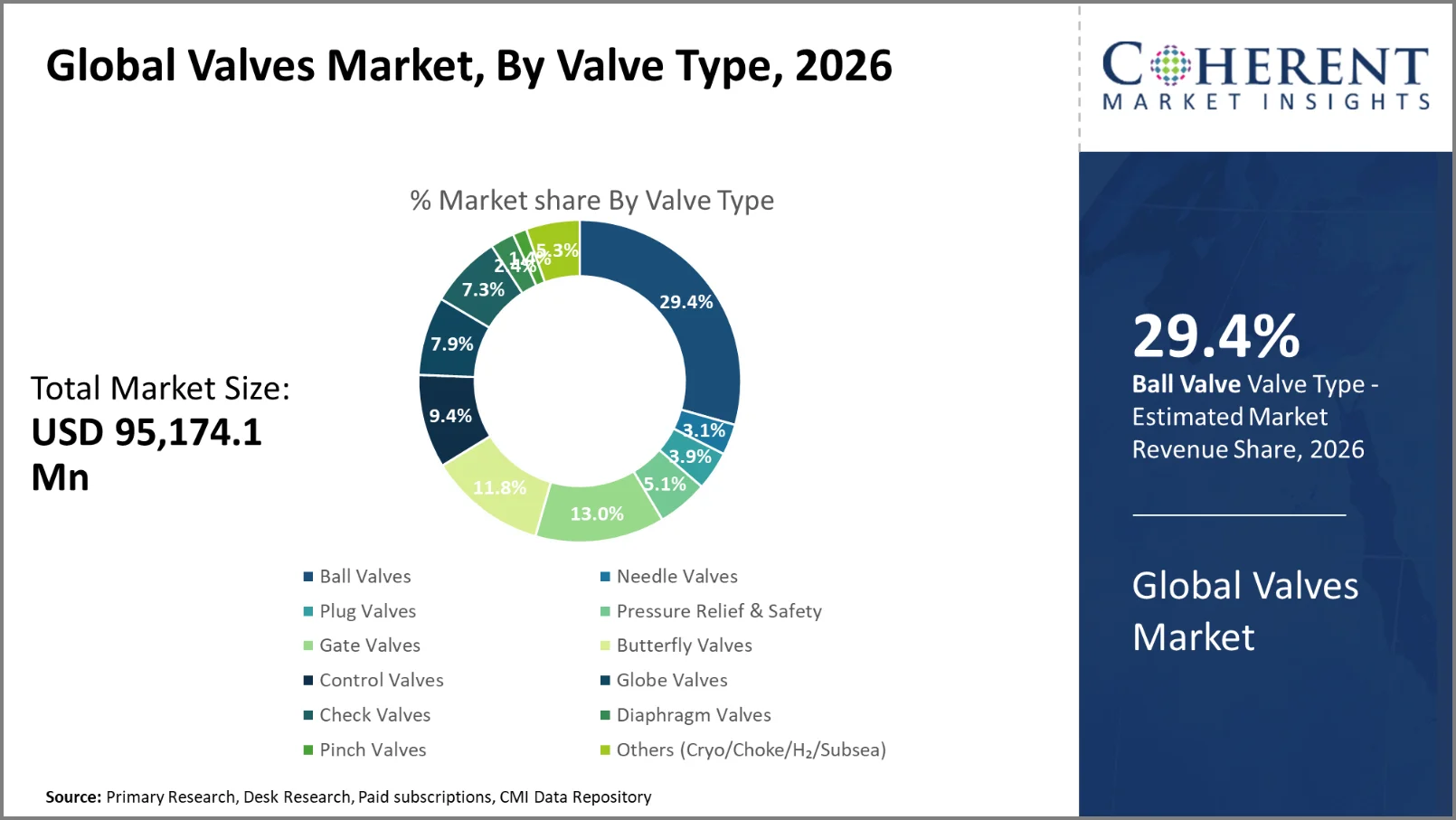
Why Does the Ball Valves Segment Dominate the Global Valves Market?
The ball valves segment is expected to account for 29.4% of the global valves market share in 2026 owing to its versatility, reliability, and efficiency in controlling fluid flow across various industries. They are particularly favored for applications involving hazardous materials, where their tight seals and quick shut-off capabilities ensure safety and minimize leakage. Their versatility in design also makes them an affordable choice. Ball valves are worth the investment as they remain durable and functional for a considerable amount of time.
On February 5, 2024, Valmet introduced the Neles XH ball valve, the latest addition to its X-series, designed for demanding industrial applications such as chemical processing, petrochemicals, oil and gas refining, and power generation. This trunnion-mounted, metal-seated valve complies with ASME Class 600 standards and ISO 15848 fugitive emissions requirements, ensuring robust performance and environmental compliance. (Source: Valmet)
- Current Industry Events of 2026
- Market Size Estimation
- Regional Breakdown
- Competitive Landscape
- Customer Intelligence
- Segmental Analysis
- Pricing Analysis
- Key Market Drivers, Challenges & Future Trends
- Customized Insights Section
Why are Ferrous Materials the Most Preferred Material Type?
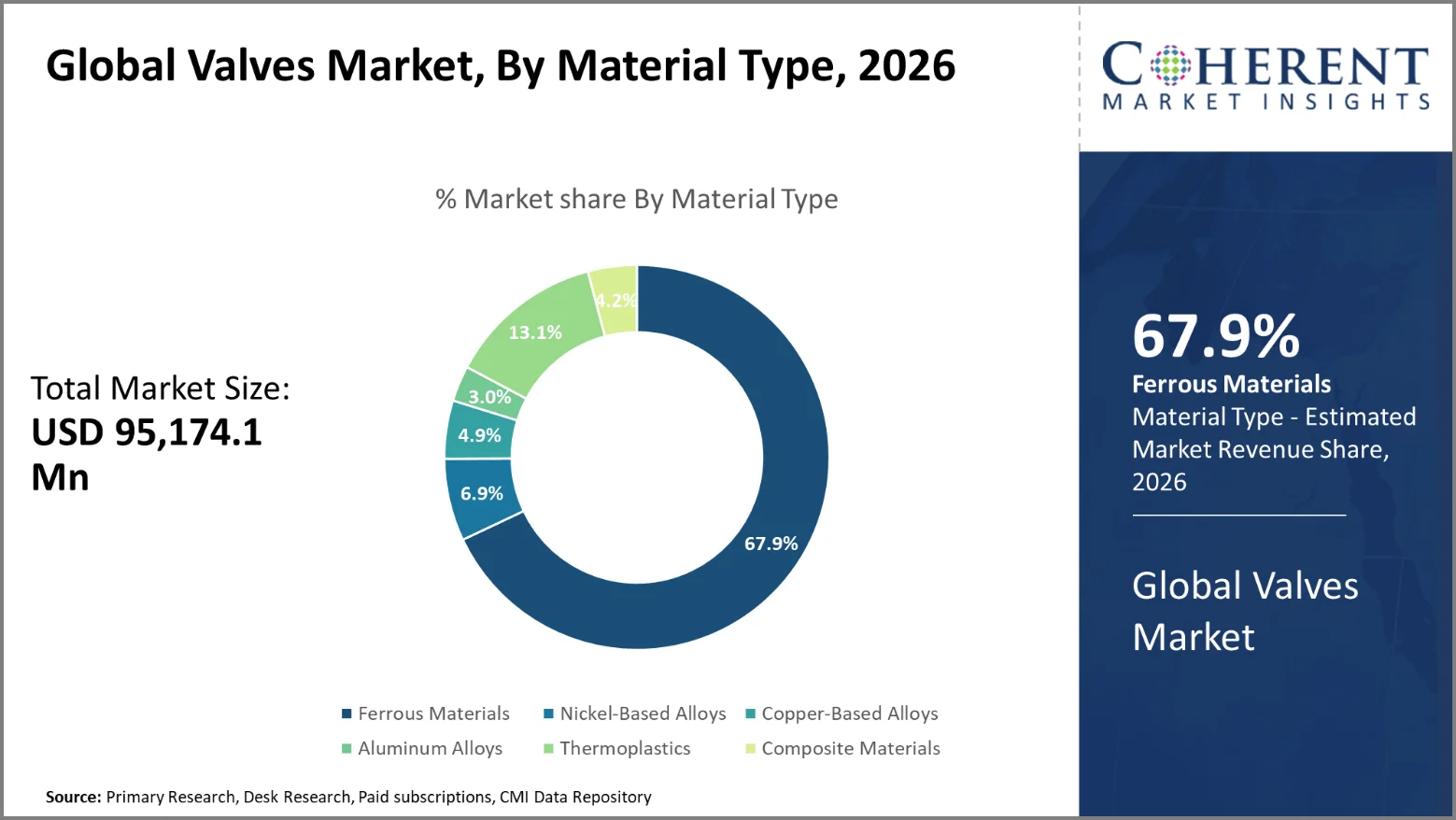
The ferrous materials segment is expected to account for 67.9% of the global valves market share in 2026. The strength and durability provided by ferrous materials has catapulted their demand globally. On April 9, 2026, Emerson announced the introduction of the Fisher SVX Steam Conditioning Valve, expanding its portfolio of advanced flow control solutions for power generation and industrial applications. The new valve is designed to deliver accurate pressure and temperature control in demanding environments such as combined cycle power plants. The Fisher SVX valve has been developed to address the operational needs of facilities requiring high performance, durability, and efficiency. It provides operators with greater flexibility by complementing the broader Fisher portfolio, enabling tailored solutions across a range of applications and budget considerations. (Source: Emerson)
Manual Segment Dominates the Global Valves Market
The manual segment is expected to account for 46.2% of the global valves market share in 2026. The increasing development of industrial wastewater treatment systems and networks are driving the demand for manual valves. Most industries are investing in water treatment to meet strict regulatory standards and mandates. Not only industrial, but rising need of water treatment for health security in general is a major factor overall. For instance, on April 21, 2026, legal action was initiated by the U.S. Justice Department toward Washington, D.C., alongside its water and sewer authority, due to an incident involving a pipeline failure. Resulting from this breach, vast quantities of untreated waste entered the Potomac River. Financial sanctions are now being pursued as part of the response. The complaint stems from a massive leak in a 72-inch pipeline, called the Potomac Interceptor. (Source: APNews)
Currents Events and Their Impact
Current Events | Description and its Impact |
EU Industrial Emissions Directive (IED) Revision (2024) |
|
U.S. EPA Methane Emissions Reduction Rule (2024) |
|
(Source: European Commission, EPA)
Global Valves Market Dynamics
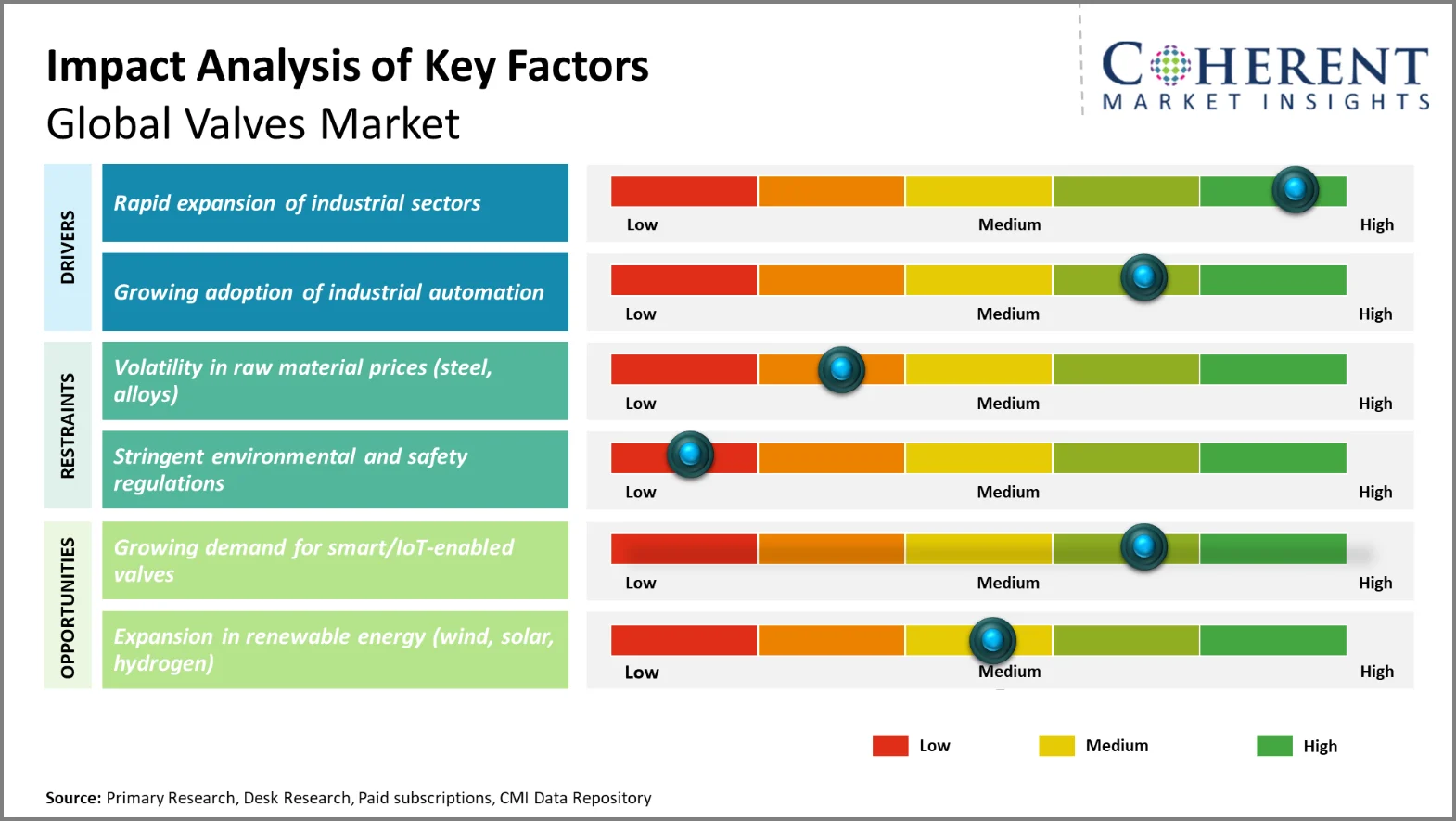
Market Drivers
- Rapid expansion of industrial sectors: Growth in factory-based activities across developing nations shapes demand for valve systems. Where production rises, so does need, fluid control becomes essential in fields like energy extraction and plant operations. Instead of simple connections, precise regulation matters when moving liquids or gases through pipelines. Equipment that manages flow under pressure finds steady use wherever industrial activity expands. On March 9, 2026, ABB announced that it will invest a further USD 75 million in India during 2026 to significantly expand its manufacturing footprint and research and development (R&D) capabilities. This investment, combined with its 2025 spend of over USD 35 million, reflects ABB's commitment to scaling its local-for-local strategy in India. (Source: ABB)
- Growing adoption of industrial automation: Beginning with smarter designs, modern valves reflect progress through embedded electronics that deliver instant feedback during operation. Instead of manual checks, information flows continuously from sensors built into these updated systems. From a distance, oversight becomes possible owing to linked networks watching function patterns without physical presence. Efficiency rises when alerts precede failures, guiding timely interventions before disruptions occur. On April 21, 2026, Siemens announced significant expansions to its Industrial Edge ecosystem, accelerating data and AI integration and releasing enhanced cybersecurity functionalities. These enable a seamless integration of IT and Operational Technology (OT) environments, optimize processes and reduce operational disruptions. (Source: Siemens)
Emerging Trends
- Rise of Smart Valves: The integration of industrial IoT technology and digital connectivity into valves has given rise to smart valves. These valves can provide real-time data, remote monitoring, and automated control, enabling more efficient and predictive maintenance, reducing downtime, and optimizing industrial processes.
- Sustainable and Eco-Friendly Valves: With increasing environmental concerns, there was a trend towards the development of more sustainable and energy-efficient valves. Manufacturers were focusing on eco-friendly materials and designs to reduce emissions and minimize environmental impact.
Regional Insights
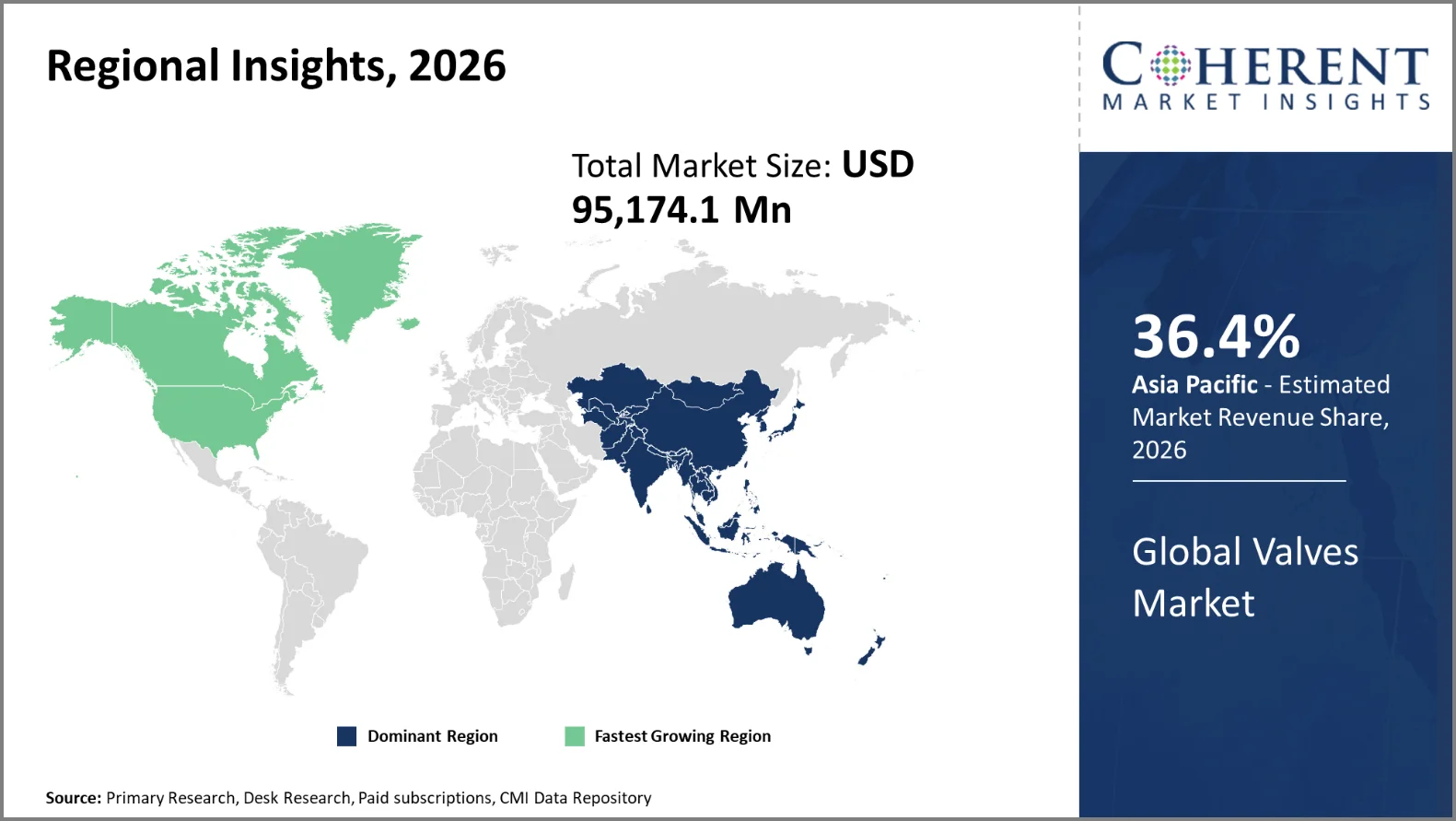
Why is Asia Pacific a Strong Market for Valves?
Asia Pacific is expected to account for a market share of 36.4% in 2026. The growth can be attribute to rapid industrialization of multiple emerging economies in the region. China, India and Japan are experiencing a steady growth in the industrial sector and are expected to do the same over the next few years. Besides this, the industry is also benefiting from the growing demand for technologically advanced plumbing solutions that offer high quality, functionality, and affordable pricing. On April 22, 2024, Sloan Valve Company, the forefront leader in plumbing solutions since 1906, launched its flagship facility in Gurugram recently through its wholly-owned subsidiary, Sloan India Private Limited. This milestone marks Sloan's commitment in India to provide advanced and sustainable restroom solutions to residential, commercial, industrial, and institutional sectors. (Source: Sloan Valve Company)
Why Does North America Valves Market Exhibit High Growth?
North America is expected to hold a market share of 23.3% and exhibit the fastest growth in the valves market in 2026. The region showcases expansion in market growth due to industrial expansion and infrastructure development across key sectors like oil and gas, power generation, and manufacturing. Increasing automation, safety regulations, and advancements in fluid control technology also contribute to this demand. In 2026, U.S. industrial production increased by 1.50% year-over-year, with utilities leading the growth. For instance, in April 2026, John Deere announced a USD 20 billion investment over the next decade to expand its U.S. manufacturing capabilities, including new factories and facility upgrades across multiple states, reflecting a significant growth towards industrial and infrastructure development. (Source: John Deere)
Why is China Emerging as a Major Hub in the Valves Market?
China is emerging as a major hub in the valves market due to its rapid expansion of petrochemical megaprojects, LNG import terminals, and ultra-large industrial clusters such as Zhejiang and Guangdong refining hubs, which require continuous high-volume valve procurement. Companies like CNPC and Sinopec are driving large-scale deployment of automated and corrosion-resistant steel valves for new pipeline and refinery expansions, while domestic manufacturers such as Neway Valve and Yuanda Valve Group are scaling up exports of API-certified industrial valves. This combination of massive internal infrastructure build-out and globally competitive manufacturing capacity is positioning China as both a key demand center and a dominant global supplier in the valves industry.
Is U.S. the Next Growth Engine for the Valves Market?
The U.S. valves market is experiencing significant growth, driven by several key factors shaping industry demand. One major driver is ongoing infrastructure development across the country. Large-scale projects in sectors such as water treatment, oil and gas pipelines, and renewable energy facilities require reliable and efficient valve systems to ensure safe and continuous operations. For example, expanding pipeline networks in Texas and California are fueling valve demand. Another crucial growth factor is the booming energy sector, particularly shale gas and oil production, which depends heavily on advanced valves for precise fluid control and safety under harsh conditions.
Germany Valves Market Analysis and Trends
The Germany valves market is currently shaped by strong demand from chemical, hydrogen, and energy-transition industries, where companies such as KSB SE & Co. KGaA and Flowserve Corporation (German operations) are increasingly supplying smart and automated valve systems for high-pressure industrial applications. At the same time, manufacturers are rapidly shifting toward digital, energy-efficient, and leak-tight valve technologies to comply with stricter EU emission rules and support hydrogen, carbon-capture, and process automation projects in industrial sectors.
India’s valves market is being driven by large-scale pipeline expansion under GAIL, refinery upgrades by Indian Oil Corporation Limited and Bharat Petroleum Corporation Limited , and rapid city gas distribution (CGD) rollout, which are increasing demand for API 6D-certified steel and automated ball valves. Recent capacity additions in petrochemicals at Dahej and Paradip, along with LNG terminal expansions at Mundra and Jaigarh, are accelerating adoption of high-pressure, corrosion-resistant ferrous valves, while domestic manufacturers such as L&T Valves and Kirloskar Brothers are scaling production for both domestic projects and exports. At the same time, stricter Petroleum and Natural Gas Regulatory Board pipeline safety norms and rising automation in water and industrial sectors are pushing a clear shift toward smart, remotely operated valve systems across infrastructure projects.
Global Valves Market - Leakage & Emission Compliance Requirements
Regulation | Regulatory Authority/Region | Focus Area |
EU Industrial Emissions Directive (IED – 2024 revision) | European Union | Industrial emissions control |
EU F-Gas Regulation Update (2024) | European Union | Greenhouse gas leakage reduction |
U.S. EPA Methane Emissions Rule (2024) | United States | Methane leakage from oil & gas systems |
API 624 (Valve Fugitive Emission Testing) | Global (Oil & Gas Standard) | Valve stem leakage control |
API 641 (Quarter Turn Valve Testing Standard) | Global | Fugitive emissions in ball valves |
How is the Growing Demand for Smart/IoT-Enabled Valves Creating New Growth Opportunities in the Global Valves Market?
Growing demand for smart/IoT-enabled valves are creating new growth opportunities by enabling real-time flow monitoring, predictive maintenance, and remote operation in high-value installations such as LNG terminals, refinery pipelines, and data center cooling systems, where companies like Emerson (Fisher digital valve systems) and Flowserve (Logix smart positioners) are deploying connected valve solutions to reduce unplanned shutdowns and energy losses. Recent industrial projects in North America and Asia Pacific are increasingly specifying sensor-integrated ball and control valves that feed operational data into SCADA and DCS platforms, allowing operators to optimize pressure and flow efficiency continuously. On October 31, 2025, Brabant Water announced a partnership with global water technology company Xylem to create one of Europe’s largest digital water networks, serving 2.6 million residents and businesses. To meet rising demand and strengthen resilience, Brabant Water is deploying a digital twin of its network and rolling out smart metering. (Source: H2O)
Market Players, Key Development, and Competitive Intelligence
Key Developments
- On April 17, 2025, Helios Technologies, through its operating company Sun Hydraulics, expanded its electro-proportional cartridge valve offerings. The new RPEP and RPEN series are designed for industrial press and mobile equipment applications, rated up to 5,000 psi. These valves enhance operational performance and are compatible with the XMD Mobile Driver, co-developed with Enovation Controls.
- On February 6, 2025, Emerson unveiled the Anderson Greenwood Type 84 Pressure Relief Valve (PRV), designed to protect tanks and vessels in hydrogen and other high-pressure gas applications. The valve offers leak-tight performance up to 21,756 psig, utilizing Arlon 3000XT thermoplastic seating and ASME SA-479 Type S21800 stainless steel spindle material.
- In January 2025, Inflow Control introduced the Gas Autonomous Inflow Control Valve (Gas AICV), marking a significant advancement in gas reservoir management. This technology enables efficient gas production by autonomously managing water breakthrough, maintaining reliable and stable production while improving profitability for operators.
Competitive Landscape
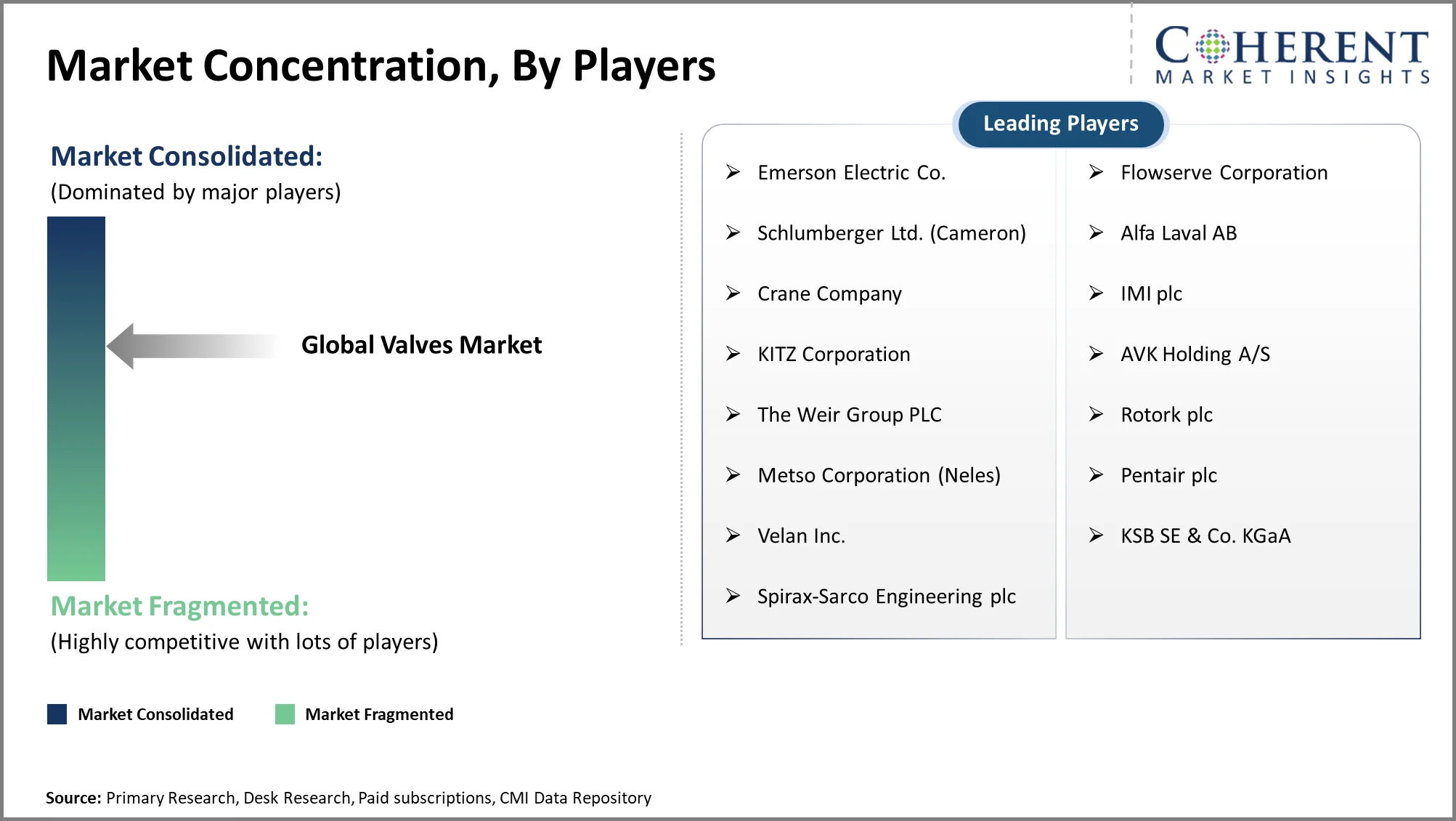
The global valves market is highly competitive and moderately consolidated, with major multinational players such as Emerson Electric, Flowserve Corporation, IMI plc, KSB SE & Co. KGaA, and Schlumberger (Cameron) dominating high-value segments like oil & gas, power, and process industries through advanced automated and high-performance valve systems. At the same time, strong regional manufacturers in China (e.g., Neway Valve) and India (e.g., L&T Valves, Kirloskar Brothers) compete aggressively on cost and project-based supply, especially in infrastructure and water projects. Competition is increasingly shifting toward smart valve technologies, digital integration, and energy-efficient designs, with companies investing heavily in IoT-enabled and predictive maintenance solutions to differentiate beyond price.
Market Report Scope
Valves Market Report Coverage
| Report Coverage | Details | ||
|---|---|---|---|
| Base Year: | 2025 | Market Size in 2026: | USD 95,174.1 Mn |
| Historical Data for: | 2020 To 2024 | Forecast Period: | 2026 To 2033 |
| Forecast Period 2026 to 2033 CAGR: | 6.4% | 2033 Value Projection: | USD 146,462.7 Mn |
| Geographies covered: |
| ||
| Segments covered: |
| ||
| Companies covered: | Emerson Electric Co., Flowserve Corporation, Schlumberger Ltd. (Cameron), Alfa Laval AB, Crane Company, IMI plc, KITZ Corporation, AVK Holding A/S, The Weir Group PLC, Rotork plc, Metso Corporation (Neles), Pentair plc, Velan Inc., KSB SE & Co. KGaA, and Spirax-Sarco Engineering plc | ||
| Growth Drivers: |
| ||
| Restraints & Challenges: |
| ||
Analyst Opinion (Expert Opinion)
- The valves market is undergoing a strategic realignment, not just a technological evolution. What was once a commoditized component in industrial systems are now a frontline enabler of automation, emissions control, and energy efficiency. The transition from mechanical to intelligent valve systems is not a trend; it’s an inevitability.
- Companies like Emerson and Flowserve are already deploying IoT-enabled valves in refineries where a single unplanned shutdown can cost upwards of USD 1 million per day. In such environments, a valve that talks back, predicting leaks or signaling wear, is not a luxury but a line-item ROI driver.
- Chinese manufacturers have flooded the market with low-cost industrial valves, with price points often 25–40% below international averages. While they’ve captured significant volume, especially across Southeast Asia and Africa, their penetration into high-integrity markets like pharmaceutical, nuclear, and aerospace remains minimal. The reason is simple: inconsistency in metallurgy standards and failure to comply with ASME, PED, and ISO 15848 norms.
- Multinational OEMs continue to rely on German, Japanese, and U.S. valve manufacturers for critical applications, despite the upfront cost, because lifecycle cost remains the differentiator. A valve failure in LNG transfer can have environmental and reputational consequences far beyond hardware replacement costs.
- Most “green hydrogen” pilot plants today are under 100 MW, but scalability to gigawatt, levels over the next decade will fundamentally alter the valves market’s metallurgy profile. Hydrogen embrittlement is a real issue, and traditional carbon steel valves are fundamentally unfit for purpose in this domain. High-performance alloys like Hastelloy, Inconel, and duplex stainless steel are expected to see a sharp spike in demand, especially for high-pressure (>700 bar) applications.
Speak to the analyst
Want personalized insights?
Take the findings above to one of our principal consultants, or have the report rebuilt around the segments, geographies and competitors you actually track.
Market Segmentation
- Valve Type Insights (Revenue, USD Million, 2021 - 2033)
- Ball Valves
- By Support Mechanism
- Floating Ball
- Trunnion-Mounted Ball
- By Port / Flow Geometry
- Full Bore (Full Port)
- Reduced Bore (Standard Port)
- V-Port / Segmented Ball
- Three-Way — L-Port
- Three-Way — T-Port
- Four-Way Ball
- By Support Mechanism
- Needle Valves
- Straight (Inline) Needle Valve
- Angle Needle Valve (90°)
- Multi-Turn Metering Needle Valve
- Plug Valves
- Cylindrical (Standard) Plug
- Eccentric Plug (Cam-Action)
- Expanding Plug
- Spherical Plug
- Pressure Relief & Safety
- Safety Valve (Pop-Action / Spring-Loaded)
- Relief Valve (Proportional-Lift / Liquid)
- Pilot-Operated Safety Relief (POSRV)
- Vacuum Relief / Conservation Vent
- Gate Valves
- Butterfly Valves
- Control Valves
- Globe Valves
- Check Valves
- Diaphragm Valves
- Pinch Valves
- Others (Cryo/Choke/H₂/Subsea)
- Ball Valves
- Material Type Insights (Revenue, USD Million, 2021 - 2033)
- Ferrous Materials
- Carbon Steel
- Low Alloy Steel
- High Alloy Steel
- Stainless Steel (304, 316, Duplex, Super Duplex)
- Nickel-Based Alloys
- Inconel
- Monel
- Hastelloy
- Copper-Based Alloys
- Aluminum Alloys
- Thermoplastics
- PVC
- CPVC
- PP
- PVDF
- PTFE
- Composite Materials
- Fiber-Reinforced Plastic (FRP)
- Glass Reinforced Plastic
- Ferrous Materials
- Operation Mode Insights (Revenue, USD Million, 2021 - 2033)
- Manual
- Pneumatic
- Electric
- Hydraulic
- Distribution Channel Insights (Revenue, USD Million, 2021 - 2033)
- Direct Sales
- Distributors
- EPC Contractors
- System Integrators
- Online / E-Procurement Platforms
- End User Insights (Revenue, USD Million, 2021 - 2033)
- Oil & Gas
- Upstream (Onshore / Offshore)
- Midstream (Pipelines, LNG)
- Downstream (Refining, Petrochemical)
- Chemical
- Power Generation
- Fossil Fuel
- Nuclear
- Renewable
- Water & Wastewater
- Mining & Metals
- General Industrial Manufacturing
- Food & Beverage
- Pharmaceuticals & Biotechnology
- Buildings & Infrastructure
- Others (Defense, Marine, etc.)
- Oil & Gas
- Regional Insights (Revenue, USD Million, 2021 – 2033)
- North America
- U.S.
- Canada
- Latin America
- Brazil
- Argentina
- Mexico
- Rest of Latin America
- Europe
- Germany
- U.K.
- Spain
- France
- Italy
- Russia
- Rest of Europe
- Asia Pacific
- China
- India
- Japan
- Australia
- South Korea
- ASEAN
- Rest of Asia Pacific
- Middle East
- GCC Countries
- Israel
- Rest of Middle East
- Africa
- South Africa
- North Africa
- Central Africa
- North America
Sources
Primary Research Interviews
- Valve Manufacturers and OEMs
- Industrial End-users and Plant Operators
- Distributors and Channel Partners
- Technology Providers and Component Suppliers
Magazines
- Flow Control Magazine
- Valve World Magazine
- Process Engineering Magazine
- Industrial Valve Summit & Expo Publications
Journals
- Journal of Fluids Engineering
- International Journal of Pressure Vessels and Piping
- Flow Measurement and Instrumentation Journal
Associations
- Valve Manufacturers Association (VMA)
- American Petroleum Institute (API)
- International Society of Automation (ISA)
- Fluid Controls Institute (FCI)
Public Domain Sources
- U.S. Census Bureau Manufacturing Statistics
- European Commission Industrial Reports
- International Trade Administration Data
- World Bank Industrial Statistics
Proprietary Elements
- CMI Data Analytics Tool
- Proprietary CMI Existing Repository of information for last 10 years
Get access to 250+ pages report
Every segment, forecast, competitor profile and data table behind the analysis above — available for instant download.
- ESOMAR Member
- ISO 9001:2015 Certified
- D-U-N-S Registered
- GDPR & CCPA Compliant
Missing comfort of reading report in your local language? Find your preferred language:
Transform your Strategy with Exclusive Trending Reports
Frequently Asked Questions
The global valves market is expected to stand at USD 95,174.1 Mn in 2026 and is expected to reach USD 146,462.7 Mn by 2033.
The CAGR of the global valves market is projected to be 6.4% from 2026 to 2033.
Rapid expansion of industrial sectors and growing adoption of industrial automation are the major factors driving the growth of the global valves market.
Volatility in raw material prices (steel, alloys) and stringent environmental and safety regulations are the major factors hampering the growth of the global valves market.
In terms of valve type, ball valves are estimated to dominate the market revenue share in 2026.
It requires high-pressure, durable valves for exploration, refining, and pipeline transportation.
They regulate and control water flow in distribution, purification, and wastewater systems