

U.S., Europe And Asia Industrial Hydrogen Market Size and Forecast – 2026 to 2033
The U.S., Europe And Asia Industrial Hydrogen Market is anticipated to grow at a CAGR of 7.2% with USD 21.6 Bn share in 2026 and is expected to reach USD 31.8 Bn in 2033. Decarbonization targets, expanding demand from refineries and chemical industries, and broader industrial use in ammonia, methanol, and manufacturing drive the growth of the U.S., Europe, and Asia industrial hydrogen markets. Indian refiners are expected to export approximately 1.4 million barrels of refined products per day in July.
Key Takeaways
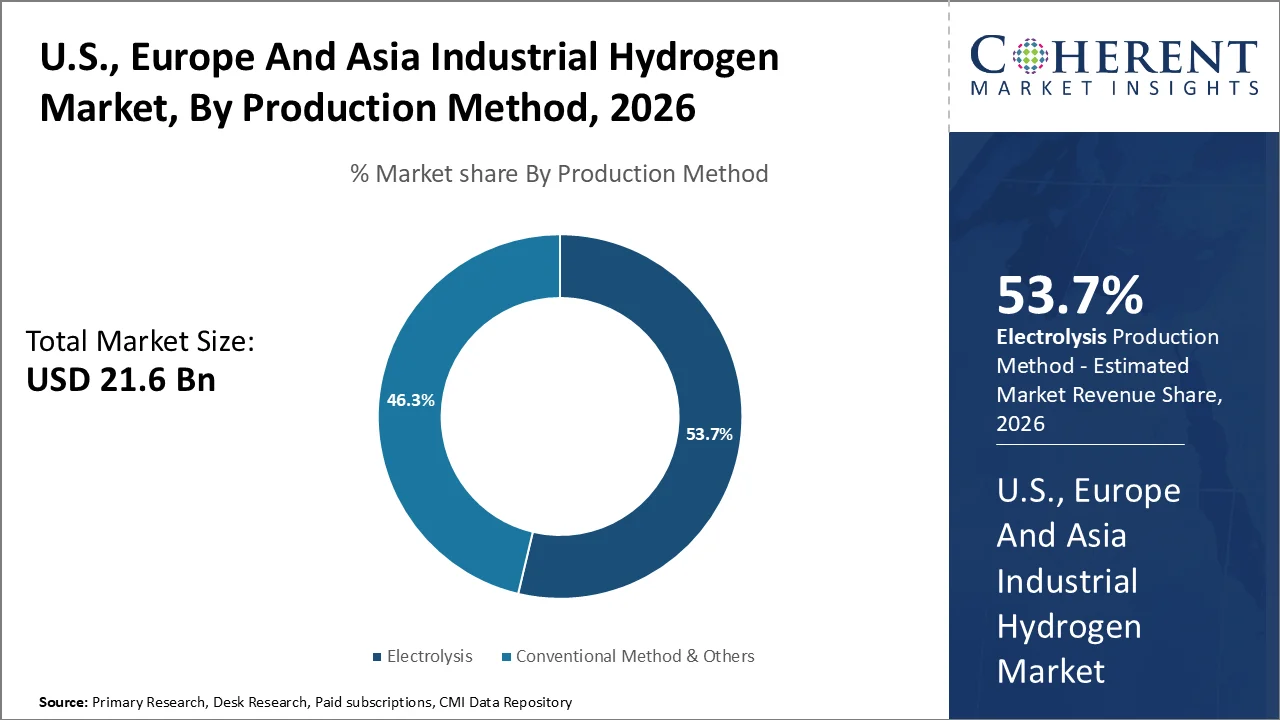
- Electrolysis holds the largest market share of 53.7% in 2026 owing to its federal tax credits and funding. Hydrogen production reached 97 million tonnes (Mt) in 2023, with less than 1% from low-emissions sources. Based on announced projects, low-emissions hydrogen production could reach 49 Mt per year by 2030.
- Pharmaceutical & Biotechnology expected to hold largest market share of 36.8% in 2026 owing to the expanding biopharmaceutical manufacturing.
- U.S. is expected to acquire the dominant share of 39.2% in 2026 owing to the strong petroleum refining industry. The U.S. is the world's largest crude oil refining hub, with 130 operable refineries processing over 17.1 million barrels of crude oil per day and a total atmospheric distillation capacity of 18.1 million barrels per calendar day.
Current Events and Their Impact on the U.S., Europe And Asia Industrial Hydrogen Market
Current Event | Description and its Impact |
United States – DOE Advances Regional Clean Hydrogen Hubs (H2Hubs) |
|
European Union – European Hydrogen Bank Funding Mechanism |
|
Segmental Insights
- Current Industry Events of 2026
- Market Size Estimation
- Regional Breakdown
- Competitive Landscape
- Customer Intelligence
- Segmental Analysis
- Pricing Analysis
- Key Market Drivers, Challenges & Future Trends
- Customized Insights Section
Why is Electrolysis Acquiring the Largest Market Share?
Electrolysis holds the largest market share of 53.7% in 2026. The U.S., Europe, and Asia are driving the industrial hydrogen market by increasing investments in clean hydrogen production, expanding renewable energy capacity, and accelerating the decarbonization of hard-to-abate industries such as steel, chemicals, refining, and fertilizers. India added 13.9 GW of renewable energy capacity in Q1 FY2026–27, increasing its total installed renewable energy capacity to 288.59 GW. Governments are promoting electrolyzer deployment through supportive policies, incentives, and energy security initiatives. At the same time, companies are improving electrolyzer efficiency, lowering renewable electricity costs through greater deployment, expanding hydrogen infrastructure, and increasing the use of green hydrogen in industrial applications, thereby advancing the transition toward more sustainable hydrogen production. For instance, in June 2026, Syntholene Energy Corp has launched operations at its geothermally integrated high-temperature electrolysis demonstration facility in Husavik, Iceland. The Chicago-based company completed construction six months ahead of schedule and below budget, marking a successful milestone in its hydrogen technology development efforts.
Which End Use segment dominates the market?
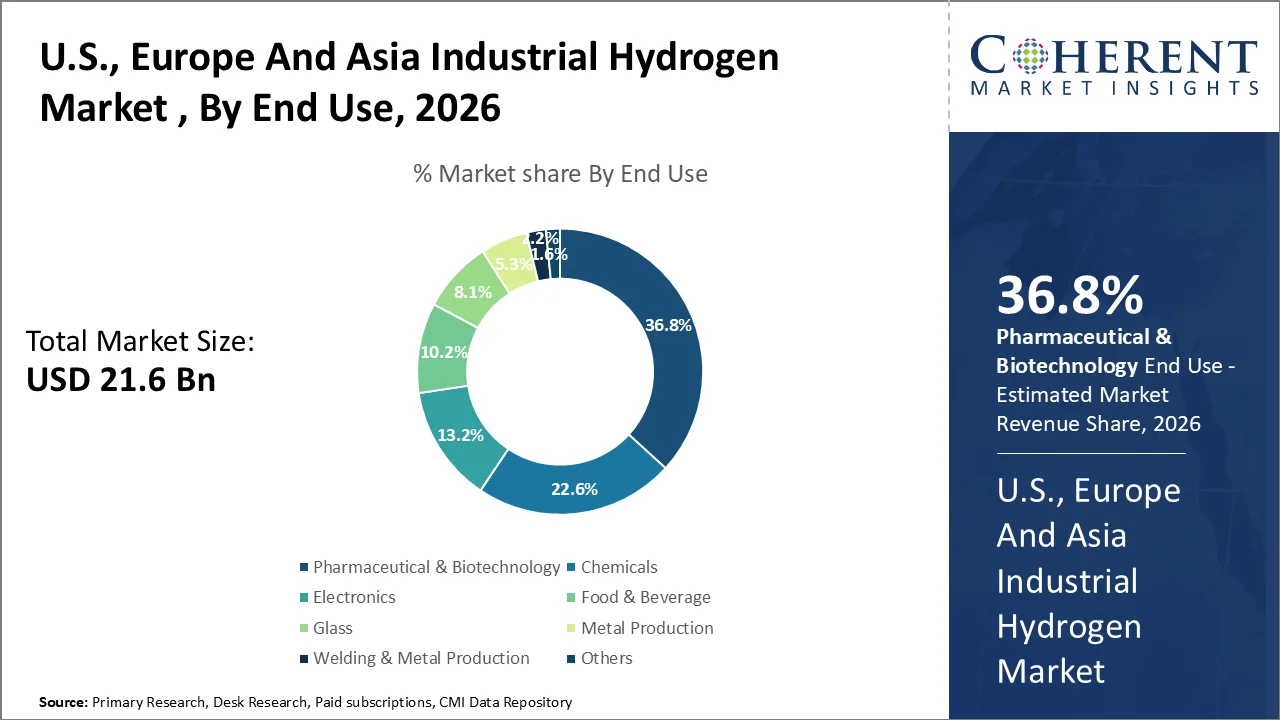
Pharmaceutical & Biotechnology expected to hold largest market share of 36.8% in 2026. Pharmaceutical and biotechnology companies across the U.S., Europe, and Asia are driving the industrial hydrogen market by expanding the production of active pharmaceutical ingredients (APIs), biologics, vaccines, and specialty chemicals. These manufacturers use high-purity hydrogen for hydrogenation, chemical synthesis, and analytical processes. They are also increasing investments in biotechnology research, contract manufacturing, and advanced drug development, which is boosting hydrogen demand. Additionally, companies are adopting cleaner production technologies, modernizing manufacturing facilities, and integrating low-carbon hydrogen to enhance sustainability, meet regulatory requirements, and improve operational efficiency.
U.S., Europe And Asia Industrial Hydrogen Market Trends
- Rising investments in green hydrogen production through electrolysis are accelerating the transition from fossil fuel-based hydrogen to low-carbon alternatives, supported by expanding renewable energy capacity and industrial decarbonization initiatives. According to the U.S. Energy Information Administration (EIA), planned U.S. electrolyzer capacity could increase from approximately 116 MW currently installed to about 4,524 MW if all announced projects are completed.
- Growing adoption of low-carbon hydrogen in steel, refining, chemical, and fertilizer industries is helping manufacturers reduce emissions while meeting increasingly stringent environmental regulations and corporate sustainability goals. The European Union's REPowerEU Plan sets a target to produce 10 million tonnes of renewable hydrogen domestically and import an additional 10 million tonnes annually by 2030 to support industrial decarbonization.
- Expansion of hydrogen infrastructure, including production facilities, pipelines, storage systems, liquefaction plants, and export terminals, is improving supply reliability and enabling broader industrial adoption across key markets. In the United States, the Infrastructure Investment and Jobs Act allocates USD 9.5 billion for clean hydrogen initiatives, including USD 8 billion for Regional Clean Hydrogen Hubs, US$1 billion for electrolyzer R&D, and USD 500 million for hydrogen manufacturing and recycling research.
- Increasing government support through hydrogen strategies, financial incentives, carbon pricing mechanisms, and clean energy policies is encouraging investments in hydrogen production, electrolyzers, and large-scale demonstration projects across the U.S., Europe, and Asia. Japan has committed approximately ¥3 trillion (around US$19–20 billion) over 15 years to support the development of clean hydrogen supply chains and stimulate demand.
Regional Insights
United States dominates owing to rising demand for clean fuels
U.S. is expected to acquire the dominant share of 39.2% in 2026. The United States drives the industrial hydrogen market by leveraging its extensive petroleum refining and chemical manufacturing industries, which use hydrogen for hydroprocessing, ammonia production, methanol synthesis, and specialty chemical manufacturing. The government promotes clean hydrogen through supportive policies, while companies expand renewable energy projects and invest in hydrogen hubs to increase low-carbon hydrogen production. Industries are adopting hydrogen to decarbonize steel, chemicals, and other energy-intensive operations. Additionally, ongoing advances in electrolysis, carbon capture, hydrogen storage, and distribution infrastructure continue to strengthen market growth and industrial adoption. For instance, in May 2026, CHARBONE Corporation opened its third industrial gases hub and first U.S. facility in Albany, New York, expanding its clean ultra-high purity hydrogen production, distribution, and storage operations.
Japan Industrial Hydrogen Market Trends
Japan is advancing its industrial hydrogen market through strong government initiatives, energy security strategies, and efforts to reduce reliance on imported fossil fuels. The country is increasing hydrogen adoption across refining, chemicals, steel, power generation, transportation, and fuel cell applications. Companies and government agencies are investing in hydrogen supply chains, green hydrogen projects, ammonia co-firing technologies, and advanced fuel cell solutions to accelerate market development. Japan continues to promote carbon neutrality, technological innovation, and international hydrogen collaborations, which further drive industrial hydrogen demand. For instance, Kawasaki Heavy Industries and Kobe Steel launched a hydrogen fuel supply system for power generation, advancing cleaner energy solutions and more efficient hydrogen use in electricity production.
Who are the Major Companies in U.S., Europe And Asia Industrial Hydrogen Industry
Some of the major key players in U.S., Europe And Asia Industrial Hydrogen are Air Liquide, Air Products & Chemicals Inc., Praxair Inc., Linde Plc., and Messer Group GmbH
Key News
- In June 2026, India launched the Green Hydrogen Certification Portal to strengthen its green hydrogen ecosystem by improving transparency, accountability, and regulatory clarity across the sector.
Market Report Scope
U.S., Europe And Asia Industrial Hydrogen Market Report Coverage
| Report Coverage | Details | ||
|---|---|---|---|
| Base Year: | 2025 | Market Size in 2026: | USD 21.6 Bn |
| Historical Data for: | 2020 To 2024 | Forecast Period: | 2026 To 2033 |
| Forecast Period 2026 to 2033 CAGR: | 7.2% | 2033 Value Projection: | USD 31.8 Bn |
| Geographies covered: |
| ||
| Segments covered: |
| ||
| Companies covered: | Air Liquide, Air Products & Chemicals Inc., Praxair Inc., Linde Plc., and Messer Group GmbH | ||
Analyst Opinion
- The industrial hydrogen market is entering a structural transformation phase, driven less by short-term energy trends and more by the necessity to decarbonize industries that cannot easily switch to direct electrification. The U.S., Europe, and Asia are prioritizing hydrogen for sectors such as refining, ammonia, chemicals, and steel, where hydrogen remains a critical industrial input. The International Energy Agency estimates that global hydrogen demand is already concentrated in refining and industrial applications, highlighting that future growth will depend on replacing conventional hydrogen production with cleaner alternatives rather than creating entirely new demand.
- The United States industrial hydrogen market will remain heavily influenced by its existing refining and chemical infrastructure, but the market’s long-term direction will depend on how quickly clean hydrogen projects achieve commercial scale. The U.S. has more than 100 million metric tons of annual hydrogen production capacity potential across announced projects, supported by federal initiatives such as the Regional Clean Hydrogen Hubs program and clean hydrogen incentives under the Inflation Reduction Act. The U.S. has a competitive advantage because it can develop both blue hydrogen using abundant natural gas resources and green hydrogen using expanding renewable power capacity, creating a diversified supply pathway.
- Europe’s industrial hydrogen market is primarily policy-driven and will continue to lead in regulatory-backed hydrogen adoption. The region’s strict carbon reduction framework, including the EU Emissions Trading System, is making fossil-based hydrogen increasingly challenging for energy-intensive industries. Europe’s steel sector provides the clearest example, with companies such as SSAB and thyssenkrupp developing hydrogen-based steel production pathways. From an analyst perspective, Europe’s biggest opportunity is not simply producing hydrogen but using it as a strategic tool to preserve industrial competitiveness while meeting aggressive climate targets.
- Asia represents the largest industrial hydrogen opportunity due to manufacturing scale, especially in China, Japan, South Korea, and India. China dominates electrolyzer manufacturing and is rapidly expanding hydrogen applications across chemicals, refining, transportation, and steel. Japan and South Korea are taking a different approach by focusing on hydrogen imports, ammonia utilization, and fuel cell technologies due to limited domestic energy resources. India is emerging as a key market because of its low-cost renewable energy potential and large fertilizer and refining industries. The analyst view is that Asia will likely shape the global hydrogen supply chain because it combines industrial demand, manufacturing capability, and government-backed energy transition strategies.
- Overall, the U.S., Europe, and Asia will follow different hydrogen development models: the U.S. will leverage resources and incentives, Europe will rely on regulation and industrial decarbonization mandates, and Asia will benefit from manufacturing scale and energy transition strategies. The analyst perspective is that the winning regions will not be those producing the cheapest hydrogen alone, but those that successfully integrate production, infrastructure, and industrial consumption into a complete hydrogen ecosystem.
Speak to the analyst
Want personalized insights?
Take the findings above to one of our principal consultants, or have the report rebuilt around the segments, geographies and competitors you actually track.
Market Segmentation
- By Production Method (Revenue, USD Bn, 2021-2033)
- Electrolysis
- Conventional Method & Others
- By End Use (Revenue, USD Bn, 2021-2033)
- Chemicals
- Electronics
- Food & Beverage
- Glass
- Metal Production
- Pharmaceutical & Biotechnology
- Welding & Metal Production
- Others
- By Region (Revenue, USD Bn, 2021-2033)
- U.S.
- Europe
- Germany
- U.K.
- Spain
- France
- Italy
- Russia
- Rest of Europe
- Asia
- China
- India
- Japan
- Australia
- South Korea
- Rest of Asia
Sources
Primary Research interviews
- Hydrogen producers, electrolyzer manufacturers, industrial gas suppliers, refinery operators, chemical manufacturers, steel producers, and industrial end users across the U.S., Europe, and Asia.
- Industry experts, technology providers, government stakeholders, and hydrogen project developers involved in clean hydrogen production and infrastructure development.
Databases
- International Energy Agency (IEA) hydrogen and energy transition databases
- International Renewable Energy Agency (IRENA) renewable hydrogen databases
- U.S. Department of Energy (DOE) hydrogen project and technology databases
- European Commission hydrogen strategy and clean energy databases
- Hydrogen Council industry databases
- National energy and industrial statistics databases from the U.S., Europe, China, Japan, South Korea, and India
Magazines
- Hydrogen Insight
- Hydrogen Economist
- Chemical & Engineering News
- Power Technology
- Energy Monitor
- Industrial gas and energy sector publications
Journals
- International Journal of Hydrogen Energy
- Renewable and Sustainable Energy Reviews
- Energy Policy
- Applied Energy
- Journal of Cleaner Production
- Hydrogen-related publications from academic and industrial research institutions.
Newspapers
- Reuters Energy and Climate Coverage.
- Bloomberg Energy and Industry Coverage.
- Financial Times Energy Transition Coverage.
- The Wall Street Journal Energy Section.
- Regional business and energy publications covering hydrogen projects and industrial decarbonization.
Associations
- Hydrogen Council
- International Partnership for Hydrogen and Fuel Cells in the Economy (IPHE)
- European Clean Hydrogen Alliance
- American Clean Power Association
- Fuel Cell and Hydrogen Energy Association (FCHEA)
- Japan Hydrogen Association
- Hydrogen Energy Association of Asia-Pacific
- National hydrogen industry associations and clean energy organizations across key markets
Public Domain sources
- U.S. Department of Energy hydrogen programs and reports
- European Commission hydrogen strategy, regulations, and policy documents
- IEA Global Hydrogen Review reports
- IRENA renewable hydrogen technology reports
- Government hydrogen roadmaps from China, Japan, South Korea, and India
- National energy ministry publications, regulatory filings, and industrial decarbonization reports
Proprietary Elements
- CMI Data Analytics Tool
- Proprietary CMI Existing Repository of information for last 10 years
Get access to 250+ pages report
Every segment, forecast, competitor profile and data table behind the analysis above — available for instant download.
- ESOMAR Member
- ISO 9001:2015 Certified
- D-U-N-S Registered
- GDPR & CCPA Compliant
Missing comfort of reading report in your local language? Find your preferred language:
Transform your Strategy with Exclusive Trending Reports
Frequently Asked Questions
The U.S., Europe and Asia industrial hydrogen market is estimated to reach USD 31.8 Bn by the end of 2033, in terms of revenue.
Major players operating in the U.S., Europe and Asia industrial hydrogen market include Air Liquide, Air Products & Chemicals Inc., Praxair Inc., Linde Plc., and Messer Group GmbH.
High production cost of hydrogen is one of the major factors that is expected to hamper growth of the market over the forecast period.
The increasing application of hydrogen across the LED and semiconductor industry is one of the major factors that is expected to propel growth of the market over the forecast period.
The U.S., Europe and Asia industrial hydrogen market is estimated to exhibit a CAGR of 7.2% over the forecast period.