

Granular Urea Market Analysis & Forecast: 2026-2033
Granular Urea Market size is estimated to be valued at USD 47.37 Bn in 2026 and is expected to reach USD 67.10 Bn in 2033, exhibiting a compound annual growth rate (CAGR) of 5.1% from 2026 to 2033.
Key Takeaways
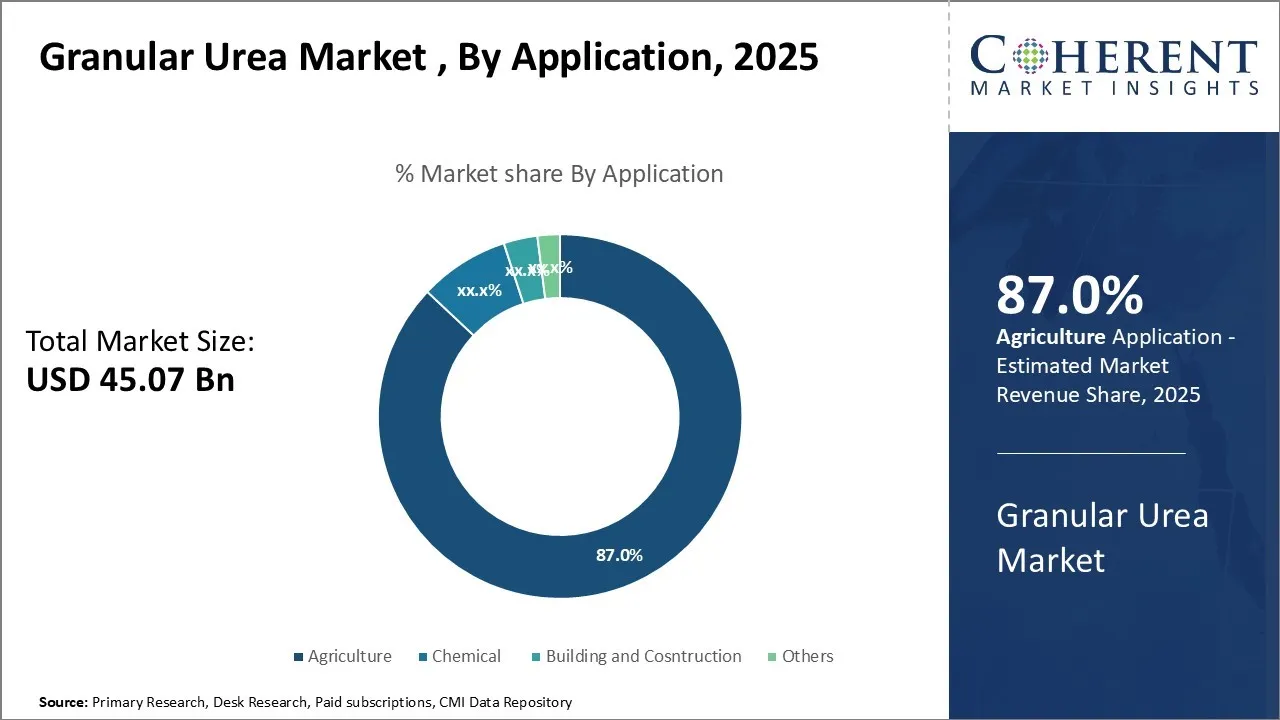
- By Application, the Agriculture segment is projected to dominate the Granular Urea Market value with an 88% share in 2026.Due to increasing crop production across the globe.
- By Product Type, the fertilizer grade segment is expected to dominate the global granular urea market in 2026, driven by increasing adoption in large-scale agriculture and crop production.
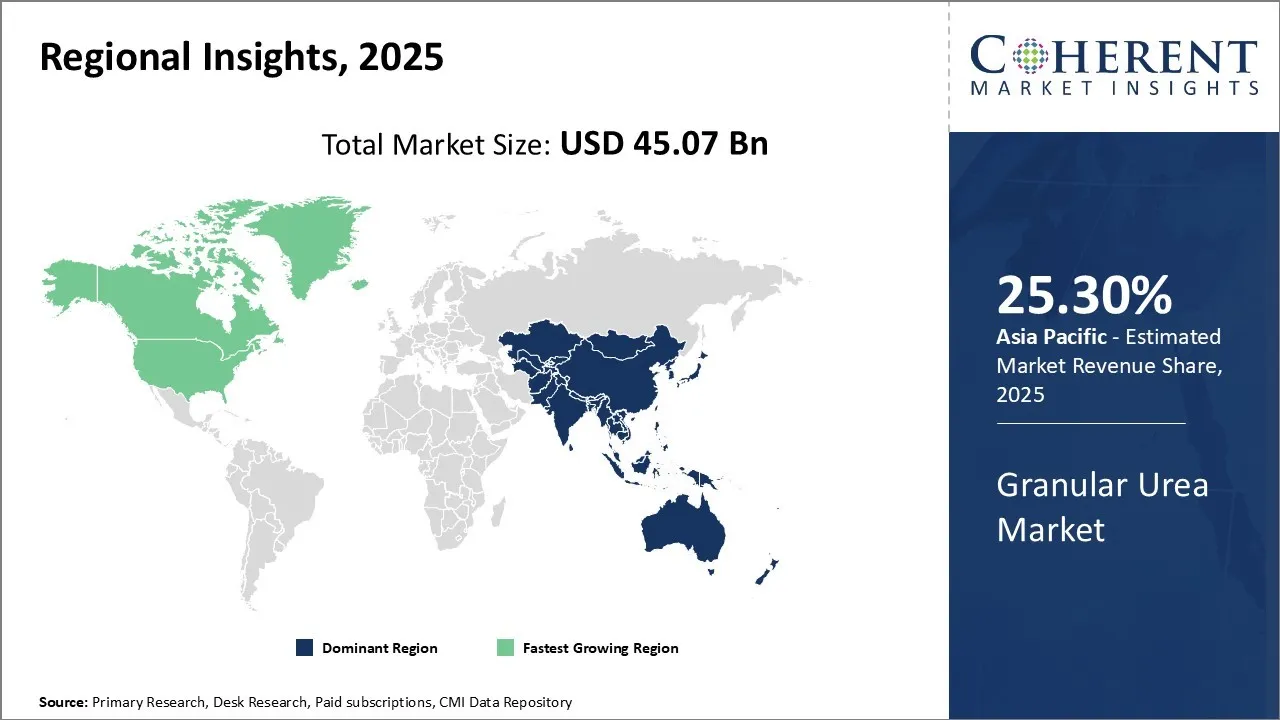
- Regionally, Asia Pacific is expected to lead the granular urea market with a 25.3% share, propelled by expanding agricultural activities, favorable government initiatives, and growing emphasis on food security.
Market overview
The Granular Urea Market demand is driven by rising global demand for high-efficiency nitrogen fertilizers to boost crop yields amid expanding agricultural activities. Increasing adoption of precision farming techniques and government subsidies for sustainable agriculture further propel market expansion. For instance, India’s 2026 fertilizer subsidy reforms have accelerated granular urea distribution, enhancing affordability.
Current Events and Its Impact on the Granular Urea Market
Event | Description and Impact |
Global Fertilizer Supply Chain Disruptions |
|
Environmental Regulations and Policies |
|
Technological Advancements in Fertilizer Industry |
|
Emerging Applications in Granular Urea Market
Primarily utilized in agriculture as a nitrogen-based fertilizer, granular urea is now slowly beginning to find applications outside its conventional use. These areas are largely unexploited, and therefore, offer great opportunities for market players seeking diversification.
- De-Icing Agent in Transportation Infrastructure
Perhaps the most promising new application of granular urea is as a nonpolluting de-icing agent. Unlike conventional chloride-based salts, which have corrosive properties towards infrastructure and surrounding nature, granular urea is much less corrosive and biodegradable. Its usage is, however, quite limited at this point; but some cold-weather airports and municipalities have started using it during trials. For example, Helsinki-Vantaa Airport in Finland and Denver International Airport in the United States have researched using granular urea to enhance environmental protections and cut back corrosion of metals on airplanes, runway maintenance, and protective measures for the environment.
- Feedstock for Biodegradable Polymers
Apart from de-icing, the use of granular urea in the manufacturing of biodegradable polymers is particularly gaining traction. Leading chemical companies like DSM, BASF, and Covestro are looking into formulations of urea-based packaging, adhesives, coatings, and bioplastics to sustain them. This is part of the increasing shift towards circular materials as well as bio-compatible substitutes for conventional plastics derived from petrochemicals.
- Current Industry Events of 2026
- Market Size Estimation
- Regional Breakdown
- Competitive Landscape
- Customer Intelligence
- Segmental Analysis
- Pricing Analysis
- Key Market Drivers, Challenges & Future Trends
- Customized Insights Section
Segmental Insights
Granular Urea Market Insight, By Application
Among Application, in 2026, Agriculture Segment accounted for the largest Granular Urea Market share of 88%, in terms of revenue in the global granular urea market. This is attributed to increasing crop production across the globe, which is expected to drive demand for fertilizers, and this is further expected to drive demand for granular urea over the forecast period. This strong position is driven by the rising need to increase crop production worldwide.
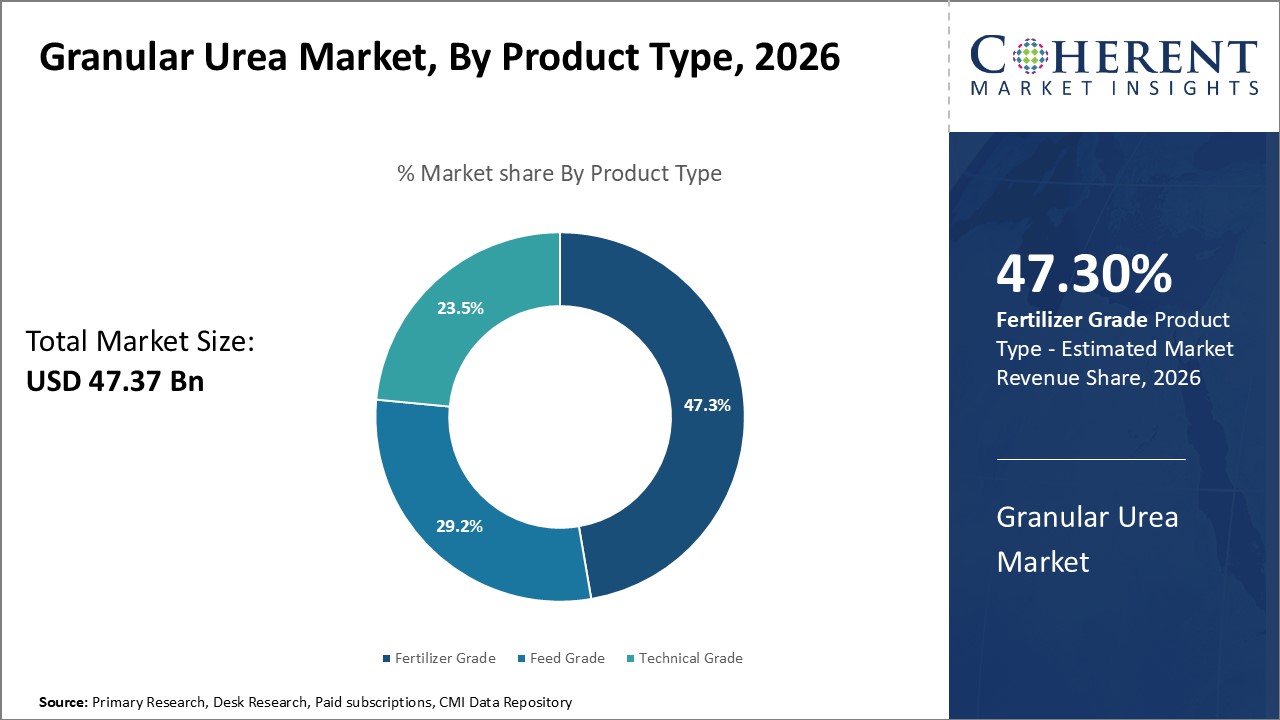
Granular Urea Market Insights, By Product Type: Fertilizer Grade Urea Leads the Market Driven by Agricultural Demand and Efficiency
In terms of product type, the fertilizer grade segment is expected to dominate the global granular urea market in 2026, driven by increasing adoption in large-scale agriculture and crop production. Fertilizer-grade urea is highly effective in delivering nitrogen efficiently to crops, improving yield and soil fertility, which makes it a preferred choice among farmers worldwide.
For instance, in major cereal-producing regions such as India and China, precision application of granular urea has enhanced crop productivity by over 20% while reducing nutrient losses. Technological developments in controlled-release formulations and blending with other nutrients are further improving efficiency and sustainability. Companies are investing in advanced granulation plants and distribution networks to ensure year-round availability and cost-effectiveness for end-users.
In 2025, several leading fertilizer manufacturers, including Yara International and Nutrien, announced expansions in production capacity and supply chain optimization to meet growing demand for high-quality granular urea, reflecting its critical role in global food security and agricultural growth.
Regional Insights
Asia Pacific Granular Urea Market Analysis and Trends
Asia Pacific is projected to hold the largest share of 25.3% in the global granular urea market demand by 2026, driven primarily by increasing fertilizer demand from the region’s expanding agriculture sector. Countries like China and India are major contributors, with rising crop production to meet food security needs fueling fertilizer consumption. For example, China’s Ministry of Agriculture reported a significant increase in fertilizer use to support staple crops in 2024.
North America Granular Urea Market Analysis and Trends
North America is expected to be the second-largest Granular Urea Market trend, owing to advanced agricultural practices and steady demand for crop enhancement products. The U.S. dominates the region with its strong focus on high-yield farming and government subsidies for fertilizer use. According to the U.S. Department of Agriculture (USDA), fertilizer consumption remained robust in 2024, supported by efforts to boost domestic food production amid global supply uncertainties.
Dominating Countries in Granular Urea Market Insights
China Granular Urea Market Analysis and Trends
China leads the Asia Pacific granular urea market due to its vast agricultural sector and strong government support for fertilizer use. Policies promoting sustainable farming and food security drive high fertilizer consumption. The government’s focus on modernizing agriculture and increasing crop yields further boosts demand for granular urea, solidifying China’s position as a key market player.
U.S. Granular Urea Market Analysis and Trends
The U.S. dominates the North American granular urea market, supported by its large-scale farming operations and consistent fertilizer demand. Government programs like USDA fertilizer assistance help stabilize supply and encourage fertilizer adoption. Advanced agricultural practices and a focus on high crop productivity further propel the market, making the U.S. a major contributor in the region.
Market Report Scope
Granular Urea Market Report Coverage
| Report Coverage | Details | ||
|---|---|---|---|
| Base Year: | 2025 | Market Size in 2026: | USD 47.37 Bn |
| Historical Data for: | 2020 To 2024 | Forecast Period: | 2026 To 2033 |
| Forecast Period 2026 to 2033 CAGR: | 5.1% | 2033 Value Projection: | USD 67.10 Bn |
| Geographies covered: |
| ||
| Segments covered: |
| ||
| Companies covered: | CF Industries Holdings, Inc., Yara International ASA, Saudi Arabian Fertilizer Company, Nutrien Ltd., Ostchem Holding, EuroChem Group, Bunge Limited, CVR Partners LP, Luxi Chemical Group Co.,Ltd., and Coromandel International Ltd. | ||
| Growth Drivers: |
| ||
| Restraints & Challenges: |
| ||
Growing Industrial Demand Drive the Market Growth
Recently there has been huge demand in carbamide from the industrial sector owing to its wide range of industrial application. It has the ability to trap the different organic compound due to its property forming interpenetrating helices by forming hydrogen bond. This property make suitable product for the separation of the mixture and to be used in the production aviation fuels and lubricating oil. It also used in separation of paraffin.
In June 2021, the commercial manufacture of nano urea liquid was established by the Indian Farmers Fertilizer Cooperative Ltd (IFFCO). The company's unique technology, created at its Gujarat Nano Biotechnology Research Center, is used in production.
Granular Urea Market: Growth Drivers
- Agriculture segment to dominate the growth and consumption of Urea market owing to the high demand for nitrogen-based fertilizer
The agricultural industry is anticipated to account for the largest portion of the Granular urea market. The agriculture sector has grown significantly in recent years, and it is anticipated that this trend will continue in the years to come. It is mainly because of the rising demand for food and other agricultural products brought on by the expansion of the world's population.
In June 2021, The EuroChem Group committed to invest US$ 1.06 billion in the construction of a new ammonia and urea factory in northwest Russia. Additionally, the facility is anticipated to produce 1.4 million tons of urea annually, with commercial production beginning in 2025.
Granular Urea Market: Recent Developments
- March 2025: Nutrien Ltd. reported significant growth in sales of its ESN Smart Nitrogen product across North America. The company attributed this increase to heightened demand for environmentally friendly fertilizers and its innovative marketing strategies, including the introduction of the 'Nitro' mascot to engage a broader customer base.
- February 2025: Indonesia's Kaltim, a major granular urea producer, announced plans to retender its urea sales due to shifting market dynamics. This move reflects the company's strategy to adapt to changing demand patterns and optimize its sales approach in the global market.
- February 2025 ICL Group commenced shipments of its biodegradable controlled-release fertilizer, eqo.x, to European markets, including the Netherlands and Switzerland. This product, designed to meet the EU's 2026 fertilizer standards, aims to enhance nutrient use efficiency and reduce environmental impact.
- September 2024: QatarEnergy unveiled a significant expansion plan to double its annual urea production capacity from 6 million tons to over 12.4 million tons. The initiative involves constructing four new production lines, aiming to meet the anticipated rise in global urea demand driven by population growth and increased food production needs.
Granular Urea Market: Key Companies
Major players operating in the global granular urea market include CF Industries Holdings, Inc., Yara International ASA, Saudi Arabian Fertilizer Company, Nutrien Ltd., Ostchem Holding, EuroChem Group, Bunge Limited, CVR Partners LP, Luxi Chemical Group Co.,Ltd., and Coromandel International Ltd.
Market Segmentation
- Global Granular Urea Market, By Product Type (Revenue, USD Bn, 2021 - 2033)
- Fertilizer Grade
- Feed Grade
- Technical Grade
- Global Granular Urea Market, By Application (Revenue, USD Bn, 2021 - 2033)
- Agriculture
- Chemical
- Building and Construction
- Others
- Global Granular Urea Market, By Region (Revenue, USD Bn, 2021 - 2033)
- North America
- U.S.
- Canada
- Europe
- U.K.
- Germany
- France
- Italy
- Spain
- Russia
- Rest of Europe
- Asia Pacific
- China
- India
- Japan
- ASEAN
- Australia
- South Korea
- Rest of Asia Pacific
- Latin America
- Brazil
- Mexico
- Rest of Latin America
- Middle East
- GCC
- Israel
- Rest of Middle East
- Africa
- North Africa
- Central Africa
- South Africa
- North America
- Company Profiles
- CF Industries Holdings, Inc.
- Yara International ASA
- Saudi Arabian Fertilizer Company
- Nutrien Ltd.
- Ostchem Holding
- EuroChem Group
- Bunge Limited
- CVR Partners LP
- Luxi Chemical Group Co., Ltd.
- Coromandel International Ltd.
Sources
Primary Research interviews
- Fertilizer Industry Experts
- Agricultural Economists
- Farmers and Agricultural Cooperatives
- Agrochemical Distributors
- Others
Databases
- Food and Agriculture Organization (FAO) Database
- International Fertilizer Association (IFA) Database
- United States Department of Agriculture (USDA) Database
- Others
Magazines
- Fertilizer Focus
- Ag Professional
- CropLife
- Farm Chemicals International
- Others
Journals
- Journal of Agricultural Science
- Nutrient Cycling in Agroecosystems
- Soil Science Society of America Journal
- Others
Newspapers
- Farmers Weekly
- AgWeb
- The Western Producer
- Farm Progress
- Others
Associations
- International Fertilizer Industry Association (IFA)
- The Fertilizer Institute (TFI)
- European Fertilizer Manufacturers Association (EFMA)
- International Plant Nutrition Institute (IPNI)
- Others
Public Domain sources
- World Bank Open Data
- United Nations Comtrade Database
- International Trade Centre (ITC) Trade Map
- US Geological Survey (USGS) Mineral Commodity Summaries
- Others
Proprietary Elements
- CMI Data Analytics Tool
- Proprietary CMI Existing Repository of information for last 8 years
*Definition: Urea is produced from ammonia and carbon dioxide and is an important chemical in agriculture and chemical industries. Urea is the most commonly used nitrogen fertilizer and cheapest form of nitrogen fertilizer. Urea is white crystalline solid organic compound and is manufactured in granular and prilled form. Granules of urea are manufactured by passing liquid urea through a fluid bed granulation system, which creates a hard and evenly sized granule.
Get access to 250+ pages report
Every segment, forecast, competitor profile and data table behind the analysis above — available for instant download.
- ESOMAR Member
- ISO 9001:2015 Certified
- D-U-N-S Registered
- GDPR & CCPA Compliant
Missing comfort of reading report in your local language? Find your preferred language:
Transform your Strategy with Exclusive Trending Reports
Frequently Asked Questions
The Granular Urea Market size is estimated to be valued at USD 47.37 Bn in 2026, and is expected to reach USD 67.10 Bn by 2033.
The CAGR of the Granular Urea Market is projected to be 5.1% from 2026 to 2033.
Agriculture segment to dominate the growth and consumption of Urea market owing to the high demand for nitrogen-based fertilizer and Growing Industrial Demand Drive the Market Growth
The granular urea market has been segmented by product type and application across 6 major regions.
Major players operating in the market include CF Industries Holdings, Inc., Yara International ASA, Saudi Arabian Fertilizer Company, Nutrien Ltd., Ostchem Holding, EuroChem Group, Bunge Limited, CVR Partners LP, Luxi Chemical Group Co.,Ltd., and Coromandel International Ltd.