

E-commerce of Agricultural Products Market Size and Forecast — 2026-2033
The Global E-commerce of Agricultural Products Market size is estimated to be valued at USD 50.70 billion in 2026 and is expected to reach USD 103.29 billion by 2033, exhibiting a compound annual growth rate (CAGR) of 10.7% from 2026 to 2033.
Overview
E-commerce platforms for agricultural products are digital marketplaces that connect farmers, suppliers, and consumers, enabling the online trading of produce, seeds, fertilizers, and farm equipment. These systems integrate inventory management, digital payments, logistics coordination, and real-time pricing tools to streamline supply chains. Many platforms use blockchain and AI for traceability, quality verification, and demand forecasting, ensuring transparency and reducing wastage.
Mobile applications tailored for rural users facilitate direct farmer-to-consumer and business-to-business transactions. Some solutions also offer weather data integration, agronomic advisories, and input financing options. The shift toward digital agriculture has turned these platforms into key enablers of efficiency, sustainability, and equitable access in the global agri-trade ecosystem.
Key Takeaways
The fresh produce segment dominates the E-commerce of Agricultural Products market, contributing over 57% market share, led by increasing consumer demand for farm-fresh quality and traceability.
B2B platforms are experiencing the fastest growth within platform types, driven by institutional procurement digitization and agribusiness supply chain optimization.
North America holds a dominant industry share due to advanced e-commerce infrastructure and consumer willingness to pay for convenience and quality, with market companies investing heavily in last-mile delivery innovations.
Asia Pacific exhibits the fastest market growth propelled by expanding digital access in rural regions and strong governmental backing for agri-tech adoption, indicating high market potential.
E-commerce of Agricultural Products Market Segmentation Analysis
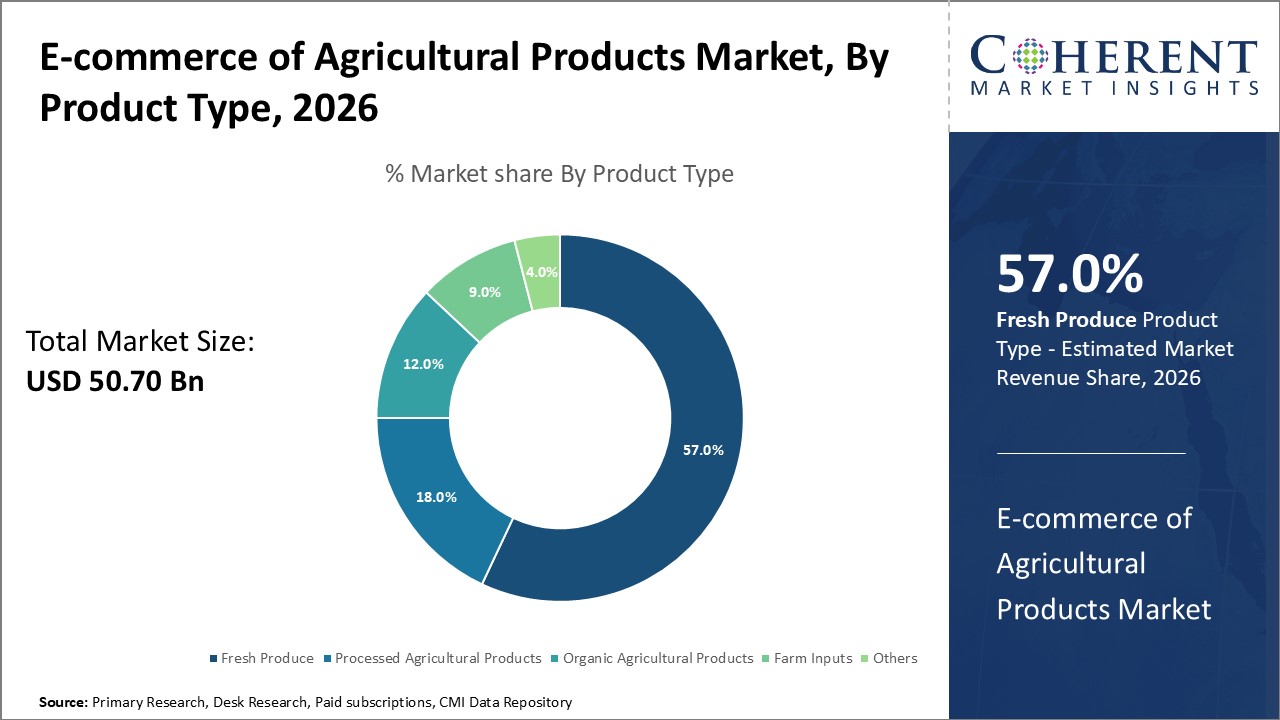
E-commerce of Agricultural Products Market Insights, By Product Type
Fresh Produce dominates the market share. The Fresh Produce subsegment commands the largest revenue share due to increasing consumer preference for quality-assured farm-fresh vegetables and fruits, supported by the rise in health-conscious consumption patterns globally. The fastest growing subsegment here is Organic Agricultural Products, witnessing accelerated adoption driven by rising awareness about sustainable farming practices and food safety, especially in developed economies where organic product sales grew by 28% in 2026.
E-commerce of Agricultural Products Market Insights, By Platform Type
The Business-to-Business segment commands the largest industry share as it supports large-scale institutional buyers such as food processors and retailers, driving high-volume transactions. This segment's dominance relates closely to the digitalization of supply chains, enabling better procurement and cost management. The fastest-growing subsegment is C2C, fueled by increased peer-to-peer trading on digital platforms among farmers and local vendors, contributing to niche market expansion and product diversification.
E-commerce of Agricultural Products Market Insights, By End-User Industry
In terms of end-user industry, the Retail segment dominates the market share. The Retail subsegment leads as it directly addresses widespread consumer demand for convenient access to quality agricultural products through digital storefronts, accounting for a major portion of market revenue. Institutional users, including hotels, restaurants, and food services, form the fastest-growing segment due to increasing digital procurement to streamline supply chains, supporting bulk buying and contract agreements. Food Processing retains a significant revenue share attributable to the demand for processed inputs and consistent supply needs.
E-commerce of Agricultural Products Market Trends
Market trends in the E-commerce of Agricultural Products market reveal a growing emphasis on sustainable practices and direct-to-consumer sales models.
In 2026, platforms facilitating organic and farm-to-table products increased market revenues by over 26%, reflecting consumer shifts towards sustainable sourcing.
Additionally, embedded fintech solutions expanding credit availability to rural farmers have enhanced purchasing power, fostering inclusive business growth.
The incorporation of AI-based demand prediction and dynamic pricing models is optimizing supply-demand equilibrium, reducing waste, and improving profit margins significantly.
E-commerce of Agricultural Products Market Insights, By Geography
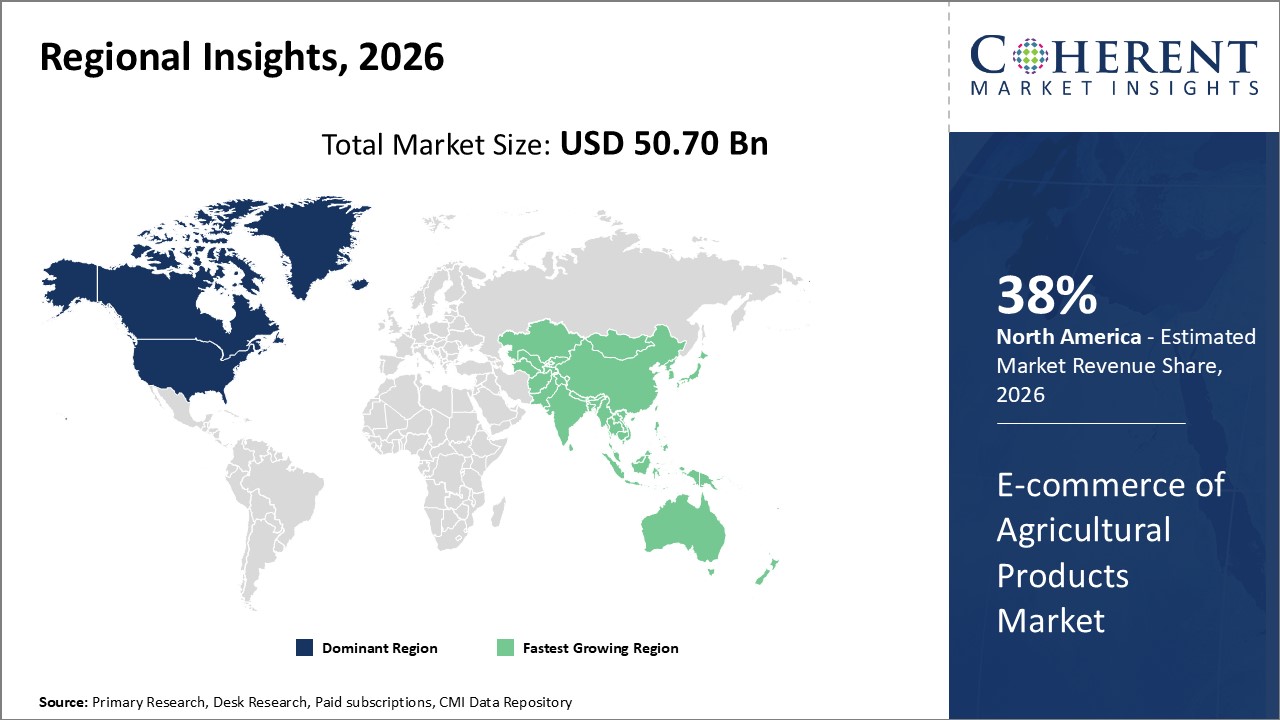
North America E-commerce of Agricultural Products Market Analysis and Trends
In North America, the dominance of the E-commerce of Agricultural Products market is underscored by mature digital infrastructure, high consumer spending power, and well-established logistics. The region accounted for over 38% market share in 2026, bolstered by companies like Amazon and Walmart investing heavily in agri-ecommerce platforms. Government policies promoting food safety and digital innovation further solidify market dominance.
Asia Pacific E-commerce of Agricultural Products Market Analysis and Trends
Meanwhile, the Asia Pacific exhibits the fastest growth with a CAGR surpassing 12% from 2026 to 2033. Expanding internet connectivity, rural digitization programs, and increasing smartphone penetration are principal drivers. China and India lead this surge with localized agri-tech startups enhancing market reach and logistics. Significant governmental initiatives aimed at digital agriculture adoption further amplify this trend.
E-commerce of Agricultural Products Market Outlook for Key Countries
USA E-commerce of Agricultural Products Market Analysis and Trends
The USA’s market is characterized by advanced supply chain networks and high consumer demand for organic and locally sourced agricultural products. In 2026, the US e-commerce agricultural produce sector captured a significant revenue share with market players like Amazon Fresh and Walmart Grocery ramping up their fresh produce offerings. Strategic investments in cold chain logistics and AI-based inventory management have enhanced product freshness and delivery precision. The country’s regulatory environment encouraging food traceability and safety standards further drives business growth and customer trust.
India E-commerce of Agricultural Products Market Analysis and Trends
India’s agricultural e-commerce market is transitioning swiftly due to extensive rural digital inclusion, rising smartphone adoption, and evolving payment infrastructures. In 2025, the country witnessed a 35% increase in online agricultural transactions, primarily in fresh produce and organic products via platforms like AgroStar and Ninjacart. Government initiatives such as “Digital India” and subsidies for rural e-commerce infrastructure have accelerated ecosystem development. Localized delivery models and farmer-to-consumer platforms continue to underpin market expansion, despite logistical challenges in remote areas.
Analyst Opinion
The surge in mobile internet accessibility across emerging economies is a critical demand-side indicator directly impacting market size. For instance, in 2025, India’s rural broadband subscriber base expanded by 29%, driving e-commerce penetration significantly in the agricultural sectors, contributing past 13% to the overall market revenue increase. This trend suggests growing market opportunities for digital agricultural commodities exchange platforms adopting mobile-first strategies.
Supply chain digitization remains a fundamental supply-side indicator facilitating market scalability. For example, China’s integration of blockchain traceability in agricultural e-commerce reportedly reduced logistics inefficiencies by 19% in 2026, enhancing product authenticity and boosting consumer trust. Such technological adoptions directly amplify market share for players prioritizing supply transparency.
Diverse application across various agricultural categories, including fresh produce, processed foods, and organic farming products, underpins substantial market growth. The fresh produce segment alone drove approximately 57% of the total market revenue in 2026, with consumer willingness to pay a premium for quality and freshness being a major contributing factor. These use cases define a dynamic market scope influenced by end-user preferences.
Micro-indicators like localized payment solutions and last-mile delivery innovations have fueled regional demand. For instance, Brazil’s expansion in UPI-based digital payments led to a 23% rise in online agricultural transactions in rural zones during early 2026, demonstrating ecosystem enablers pivotal for growth strategies. Robust regional adoption of such technologies underpins the competitive dynamics shaping market share distribution.
- Current Industry Events of 2026
- Market Size Estimation
- Regional Breakdown
- Competitive Landscape
- Customer Intelligence
- Segmental Analysis
- Pricing Analysis
- Key Market Drivers, Challenges & Future Trends
- Customized Insights Section
Market Scope
| Report Coverage | Details | ||
|---|---|---|---|
| Base Year: | 2025 | Market Size in 2026: | USD 50.70 billion |
| Historical Data for: | 2020 To 2024 | Forecast Period: | 2026 To 2033 |
| Forecast Period 2026 to 2033 CAGR: | 10.7% | 2033 Value Projection: | USD 103.29 billion |
| Geographies covered: |
| ||
| Segments covered: |
| ||
| Companies covered: | Alibaba Group, Amazon Inc., JD.com Inc., Coupang Corp., Chowberry, BigBasket, RuralBasket, AgroStar, Ninjacart, Grow Markets, Walmart Inc. | ||
| Growth Drivers: |
| ||
E-commerce of Agricultural Products Market Growth Factors
Rising demand for transparency and traceability in the agricultural supply chain is the foremost growth driver, with over 60% of consumers in 2025 preferring digitally verified farm-to-fork products. Technological advancements, including AI, blockchain, and IoT-enabled logistics, have optimized inventory management and delivery, reducing spoilage rates by as much as 20% in 2026. The expansion of digital payment infrastructure, particularly in low- and middle-income countries, underpins transaction growth, with rural digital transaction volumes increasing by 30% in 2025. Lastly, government initiatives focused on rural digitization and agri-tech incubation, such as India’s “Digital Agriculture” program, have enhanced infrastructure and adoption, accelerating business growth in e-commerce platforms.
E-commerce of Agricultural Products Market Development
In October 2026, Global AgXelerate was launched as a dedicated platform aimed at connecting Indian agricultural innovators with global markets. The initiative facilitates international collaborations, export opportunities, and access to advanced agri-technologies, empowering Indian agri-startups and producers to expand their global footprint and enhance value chain integration.
In 2023, the eNAM Platform of Platforms was introduced to mark the sixth anniversary of the National Agriculture Market (eNAM). This initiative brings together multiple agriculture service providers—covering logistics, warehousing, finance, and input suppliers—onto a single digital ecosystem, enabling farmers, traders, and agri-entrepreneurs to conduct seamless transactions and access end-to-end agri-business solutions.
Key Players
Leading Companies of the Market
Alibaba Group
Amazon Inc.
JD.com Inc.
Coupang Corp.
Chowberry
RuralBasket
AgroStar
Ninjacart
Grow Markets
Walmart Inc.
Several leading companies have adopted aggressive digital expansion and strategic partnerships to consolidate their industry share. For example, Alibaba Group’s collaboration with Chinese agricultural cooperatives led to a 16% volume increase in organic product sales in 2026. Amazon’s strategic acquisition of local agri-tech startups facilitated its entry into fresh produce delivery in North America, contributing to a 13% hike in its market share. JD.com has deployed AI-driven demand forecasting, which reduced product wastage by 15%, optimizing cost structures and customer satisfaction.
E-commerce of Agricultural Products Market Future Outlook
Future e-commerce platforms in agriculture will incorporate IoT-based farm data integration, allowing real-time tracking of crop yields, soil health, and weather patterns. Blockchain and digital certification will ensure authenticity and traceability from farm to table. AI-driven forecasting and dynamic pricing engines will optimize supply-demand balance, while embedded fintech services will expand access to insurance and credit for smallholders. Cross-border trade functionality and digital warehousing solutions will enhance global connectivity. As governments promote agri-digitalization, these platforms will evolve into full-service ecosystems supporting sustainable agriculture and inclusive rural development.
E-commerce of Agricultural Products Market Historical Analysis
E-commerce platforms for agricultural products began as simple online marketplaces connecting farmers with buyers but rapidly evolved into sophisticated ecosystems integrating logistics, payments, and inventory management. Early solutions focused on bulk trading of grains and fertilizers, while newer platforms introduced direct farmer-to-consumer models for fresh produce. The adoption of mobile applications enabled rural participation, and integration with financial services facilitated input financing and credit access. The use of AI and blockchain enhanced transparency in pricing, traceability, and quality assurance, transforming agricultural trade into a data-driven, efficient supply network.
Sources
Primary Research Interviews:
Agritech Entrepreneurs
Supply Chain Managers
Agricultural Economists
E-commerce Platform Developers
Farmer-Producer Organization (FPO) Leader
Databases:
World Bank AgriTech Data
FAO Agri-Market Statistics
GlobalData AgriTech Reports
UNCTAD E-commerce Data
Magazines:
AgFunder News
Digital Agriculture
The Packer
Farm Journal
Journals:
Agricultural Economics
Journal of Agribusiness
Food Policy
Information Processing in Agriculture
Newspapers:
The Economic Times (Agri-Tech)
The Hindu Business Line (Rural Economy)
The Guardian (Sustainability)
The Wall Street Journal (Technology)
Associations:
World Farmers’ Organization (WFO)
International Food Policy Research Institute (IFPRI)
Agri-Tech India Association
E-commerce Europe
Get access to 250+ pages report
Every segment, forecast, competitor profile and data table behind the analysis above — available for instant download.
- ESOMAR Member
- ISO 9001:2015 Certified
- D-U-N-S Registered
- GDPR & CCPA Compliant
Missing comfort of reading report in your local language? Find your preferred language:
Transform your Strategy with Exclusive Trending Reports
Frequently Asked Questions
The leading companies include Alibaba Group, Amazon Inc., JD.com Inc., Chowberry, and RuralBasket, which have significant market share due to their strategic expansion, technological innovations, and diversified product portfolios.
The market size is projected to reach USD 103.29 billion by 2033, reflecting a CAGR of 10.7% from 2026 to 2033, driven by rising digital penetration and demand for traceable agricultural products.
The retail subsegment, particularly fresh produce sales through B2C platforms, holds the largest growth potential due to urban consumer preferences for convenience and quality transparency.
Market development will increasingly lean toward hyperlocal sourcing, AI integration for personalized shopping experiences, and subscription-based delivery models, significantly shifting market revenue channels.
Competition is marked by rapid technological adoption and platform diversification; challenges include logistics inefficiencies in last-mile delivery and varying regulatory frameworks across regions.
Companies leverage partnerships with local farmers, use AI for demand forecasting, optimize supply chain transparency using blockchain, and adopt mobile-first approaches targeting rural consumers to accelerate market penetration.