

Data Integration Market Size and Forecast – 2026 to 2033
The global data integration market is estimated to be valued at USD 18.80 Bn in 2026 and is expected to reach USD 46.80 Bn by 2033, exhibiting a compound annual growth rate (CAGR) of 13.9% from 2026 to 2033.
Key Takeaways
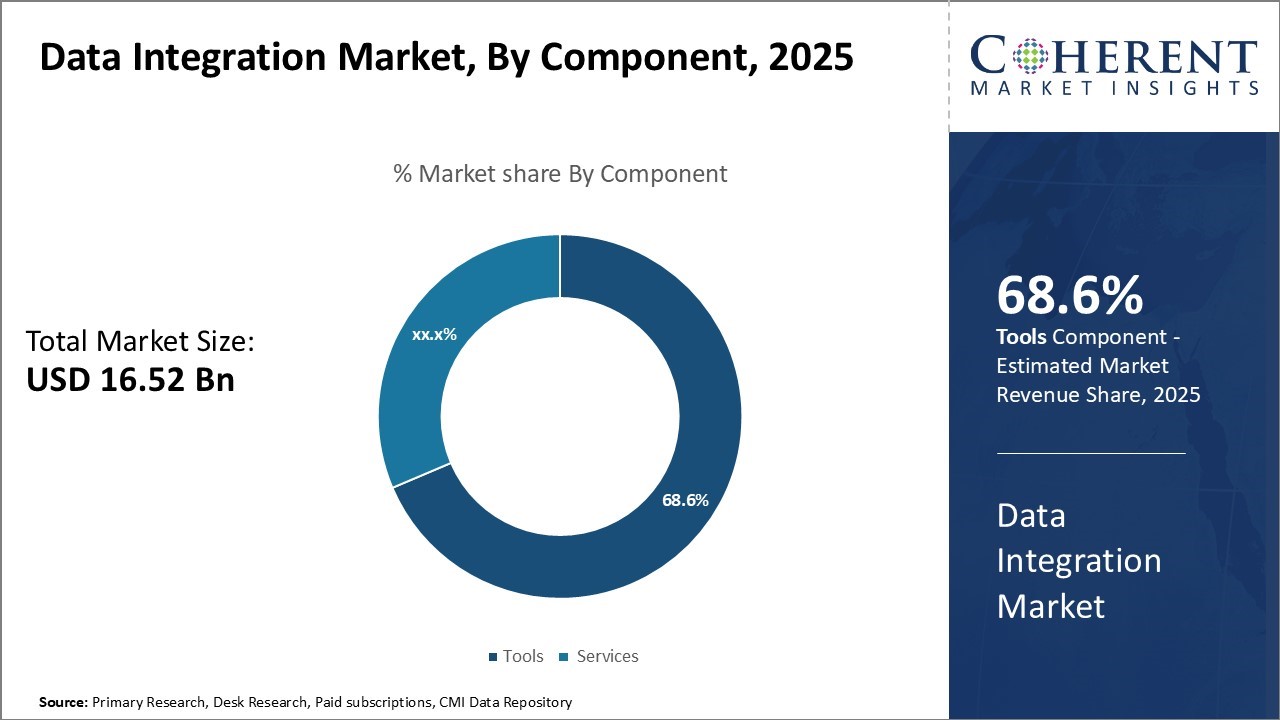
- Based on Component, Tools segment is projected to account for 69.6 % of the global market in 2026, owing to growing demand for advanced tools.
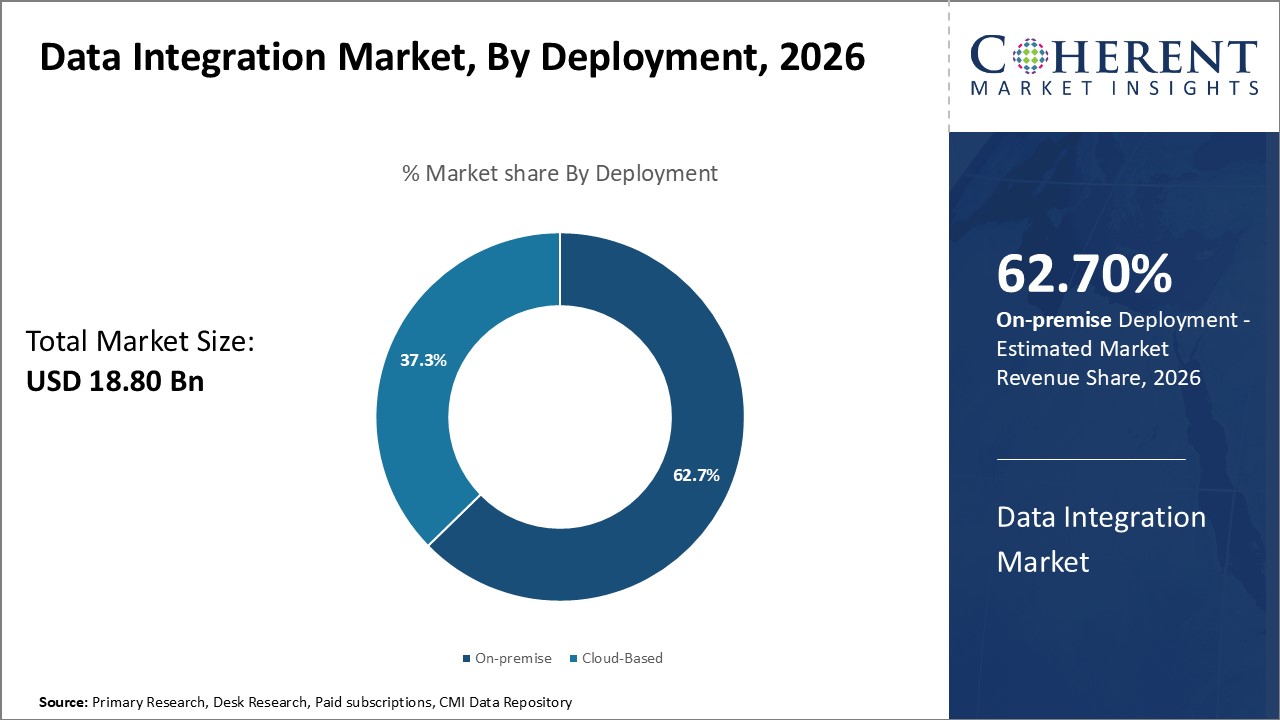
- Based on Deployment, On-premise segment is expected to capture 62.7% share of the market in 2026, due to growing understanding of cancer biology.
- Based on End Use Industry, IT & Telecom segment is projected to command 37.6% share of the market in 2026, due the sector undergoing rapid digital transformation
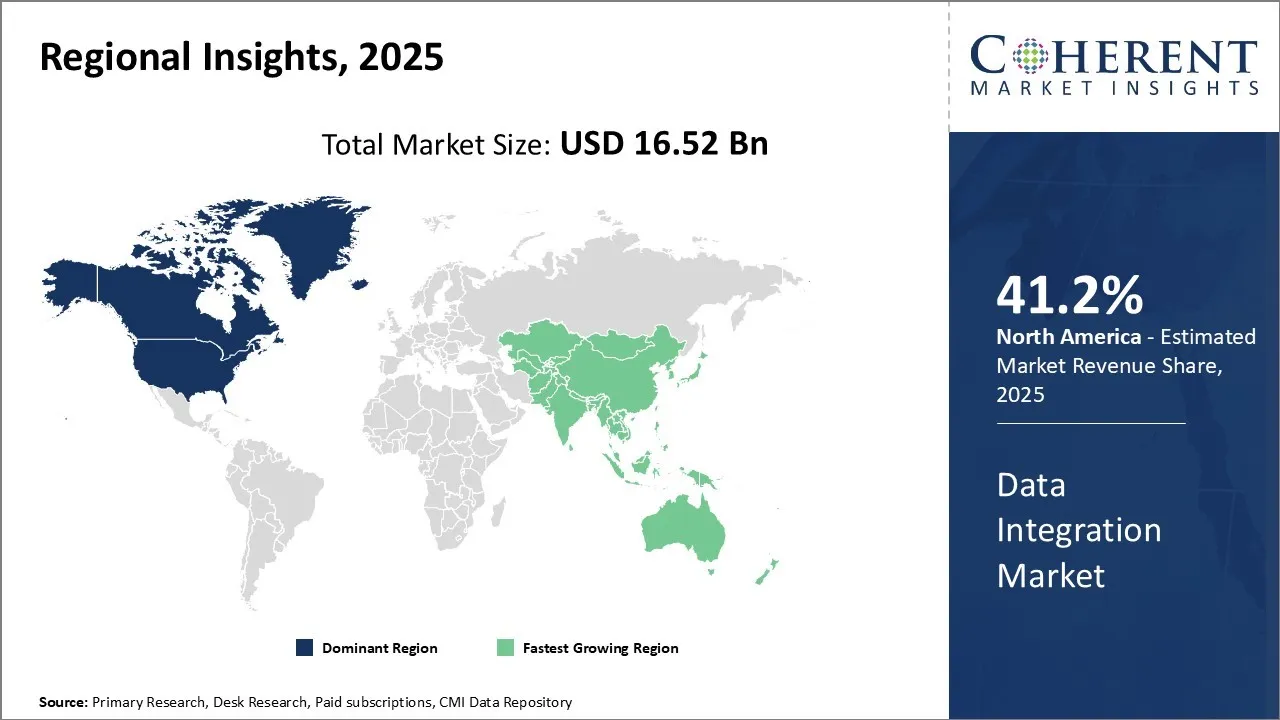
- Based on Region, North America is set to dominate the global market with a 41.2 % share in 2026.
Market Overview
The data integration market demand is witnessing significant growth in the forecast period owing to the growing demand for data integration tools from end-use verticals like BFSI, healthcare, manufacturing, etc. The surge in demand for data integration solutions is anticipated due to critical requirements to derive meaningful insights from vast datasets, the escalating uptake of cloud technologies, an increase in collaborations and agreements between vendors of data integration and their clients, along with the expanding volume of data. On the other hand, the market's expansion might be restrained by the presence of open-source data integration frameworks and a deficiency in standardized methodologies and expertise throughout the projected time frame.
Current Events and Its Impact
Current Event | Description and its Impact |
AI and Machine Learning Revolution |
|
Global Data Privacy and Regulatory Compliance |
|
Role of AI (Artificial Intelligence) in Data Integration Industry
The data integration market is experiencing a revolutionary transformation as artificial intelligence reshapes how organizations consolidate, process, and analyze information from disparate sources. With businesses generating unprecedented volumes of data across multiple platforms, AI-powered solutions are becoming essential for creating seamless, intelligent data ecosystems.
Major technology companies are embedding AI capabilities directly into their data integration platforms, fundamentally changing how businesses approach data consolidation. Microsoft exemplifies this trend through its Azure Data Factory, which now incorporates machine learning algorithms to automatically detect data patterns, suggest optimal transformation strategies, and predict integration performance.
For instance, in June 2025, Quantiphi, an AI-first digital engineering firm, announced its partnership with Snowflake to support the launch of Snowflake Openflow — a multi-modal data ingestion service designed to simplify data connectivity and accelerate AI-driven enterprise data integration.
- Current Industry Events of 2026
- Market Size Estimation
- Regional Breakdown
- Competitive Landscape
- Customer Intelligence
- Segmental Analysis
- Pricing Analysis
- Key Market Drivers, Challenges & Future Trends
- Customized Insights Section
Market Trends
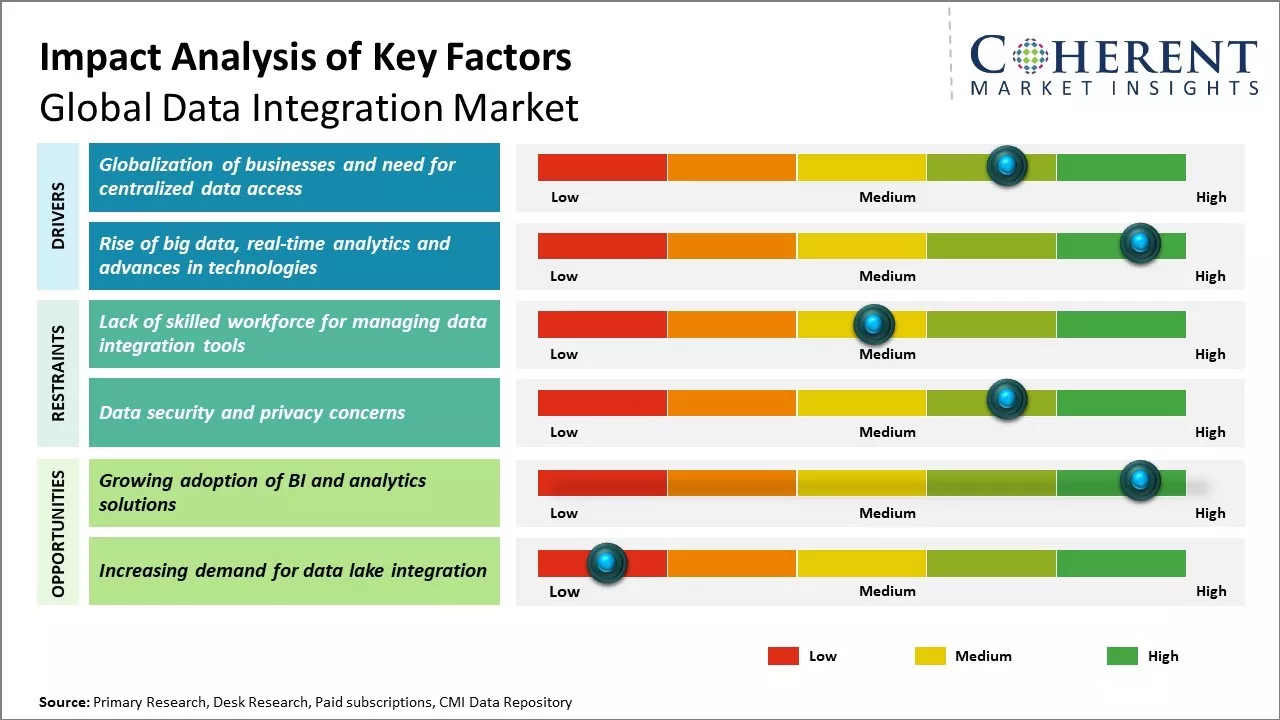
Globalization of businesses and need for centralized data access
With globalization accelerating in recent years, many businesses have expanded internationally to take advantage of opportunities in new markets and operate on a truly global scale. However, expanding operations globally often means maintaining disparate offices, warehouses, manufacturing facilities, and others across multiple countries with varying IT infrastructures and internal systems.
As a result, critical business data pertaining to activities like finance, sales, inventory, and customers can end up fragmented across different databases located in different geographic regions. This poses major challenges for businesses trying to get a consolidated, enterprise-wide view of key performance metrics and KPIs.
Segmental Insights
Data Integration Market Insights, by Component - Adoption of Advanced Tools Enables Higher Integration
In terms of component, tools are expected to contribute 69.6% share of the market in 2026 owing to the growing demand for advanced tools that enables organizations to handle higher volumes of data from various sources in a seamless manner. Data integration tools have evolved significantly over the years with capabilities to handle structured as well as unstructured data in near real-time.
Tools offer advanced features such as data governance, analytics, self-service data preparation, and automated workflows for ingesting and transforming data. These capabilities enable organizations to gain meaningful insights faster from their data assets across disparate systems. Furthermore, tools with low-code/no-code interfaces are simplifying the data integration process for business users, removing dependency on IT teams. This has boosted adoption across various industry verticals.
The advanced toolsets offered by leading vendors also provide capabilities to integrate event-driven data streams, enabling real-time analytics and actions. Event processing platforms integrated with data integration tools allow enterprises to detect anomalies, patterns, or opportunities in real-time from IoT, sensor or web-based data.
In March 2025, IgniteData announced a collaboration with AstraZeneca and Cambridge University Hospitals NHS Foundation Trust (CUH) to deploy its Archer tool for clinical data integration in an ongoing Phase 3 AstraZeneca-sponsored study. This partnership represents a key step in IgniteData’s mission to modernize clinical trials through automation and digital innovation.
Data Integration Market Insights, by Deployment - On-Premises Deployments Ensure Data Security and Compliance
In terms of deployment, on-premise is expected to contribute 62.7% share of the market in 2026 due to enterprises prioritizing data security, governance, and regulatory compliance over public cloud flexibility. Several industries such as healthcare, government, BFSI and manufacturing prefer to host critical data platforms and workloads within their internal infrastructure mainly due to regulations like HIPAA (Health Insurance Portability and Accountability Act), General Data Protection Regulation (GDPR), etc.
On-premise deployment allows enterprises to maintain complete control over their data environment and ensure the highest levels of security and privacy. This is a vital consideration given the sensitivity of data belonging to these verticals. Furthermore, enterprises can avoid concerns around public cloud security vulnerabilities and dependence on third party providers' service levels when handling critical data on-premise.
For instance, in May 2025, Cloudera introduced Cloudera Data Visualization, expanding its artificial intelligence capabilities to customers using on-premises data environments.
Data Integration Market Insights, By End-use Industry - Higher Digital Transformation Focus in IT & Telecom Drives Adoption
In terms of end-use industry, IT & telecom is expected to contribute 37.6% share of the market in 2026 owing to the sector undergoing rapid digital transformation. Telecommunication and IT service providers recognized the value of integrating siloed customer data sources early on to gain unified 360-degree views of subscribers and enhance personalized interactions.
As 5G networks and edge computing becomes pervasive, Telecommunication are collecting troves of data from various touch-points that needs to be integrated to realize the full range of use-cases around IoT, AI/ML, immersive multimedia and smart cities. Similarly, IT companies are adopting data integration solutions to amalgamate structured and unstructured data from diverse systems supporting their digital offerings and create monetization opportunities.
For instance, Xtelify, launched a sovereign, telco-grade cloud platform – ‘Airtel Cloud’. Tailored to handle 140 crore transactions per minute for Airtel’s own use in India, this sovereign cloud platform is now being extended to meet the ever-evolving needs of businesses in India.
Regional Insights
North America Data Integration Market Analysis & Trends
North America has dominated the global data integration market. The region is expected to account for 41.2% of the market share in 2026. This can be attributed mainly to the strong presence of industry leaders as well as extensive adoption across verticals in this region. With major data integration vendors and solution providers establishing their headquarters in countries like the U.S. and Canada, North America enjoys early access to innovative offerings.
Moreover, the growing dependency on data-driven insights for enhanced decision making among enterprises has propelled investments towards integrating diverse data sources. Several large corporations operate on a regional or global scale and rely on consolidated data integration platforms to gain a unified view. This has established North America as the largest regional market.
For instance, in January 2026, Qlik® announced a strategic partnership with TD SYNNEX, a leading global distributor and solutions aggregator for the IT ecosystem. This partnership will enable Qlik to scale its solutions for AI-driven data integration and analytics across North America and Europe, empowering a broader network of partners to accelerate their customers’ AI adoption journeys.
Asia Pacific Data Integration Market Analysis & Trends
Another region that has emerged as an important market for data integration solutions is Asia Pacific. Rapid digital transformation initiatives unfolding across developing economies like China, India, and Southeast Asian nations are stimulating the market growth. Governments are promoting initiatives that depend on accessing and combining fragmented data held by various agencies.
Similarly, enterprises recognize the need to integrate disparate legacy systems and newer cloud platforms for efficient operations. This use case is creating opportunities for service providers. Furthermore, Asian countries have also become major manufacturing and IT hubs. Need to streamline supply chain operations and extract useful insights from production data has prompted widespread integration deployments.
For instance, FPT announced the launch of the FPT Data & AI Integration Center in Japan, a strategic move to boost investments in technology infrastructure and foster stronger partnerships with leading Japanese and global partners.
Data Integration Market Outlook Country-Wise
The U.K. Data Integration Market Trends
The U.K. data integration market share is growing steadily, key drivers include strong adoption of cloud, hybrid and multi‑cloud architectures, demand for real‑time data flow between applications, data analytics, AI, IoT, and regulatory/compliance pressures around data sovereignty (e.g. GDPR).
For instance, in June 2026, Patients Know Best (PKB) launched GP data integration across England within its single patient record platform
Japan Data Integration Market Trends
Japan's data integration market is experiencing strong growth, driven by the rapid adoption of cloud technologies, increased demand for real-time data processing, and government-led digital transformation initiatives like Society 5.0. Businesses are investing in integration platforms to connect legacy systems with modern cloud and IoT environments, while prioritizing data security and compliance with regulations such as the APPI.
For instance, in March 2023, Fivetran adds AWS hosting in Japan to support businesses that require local data residency.
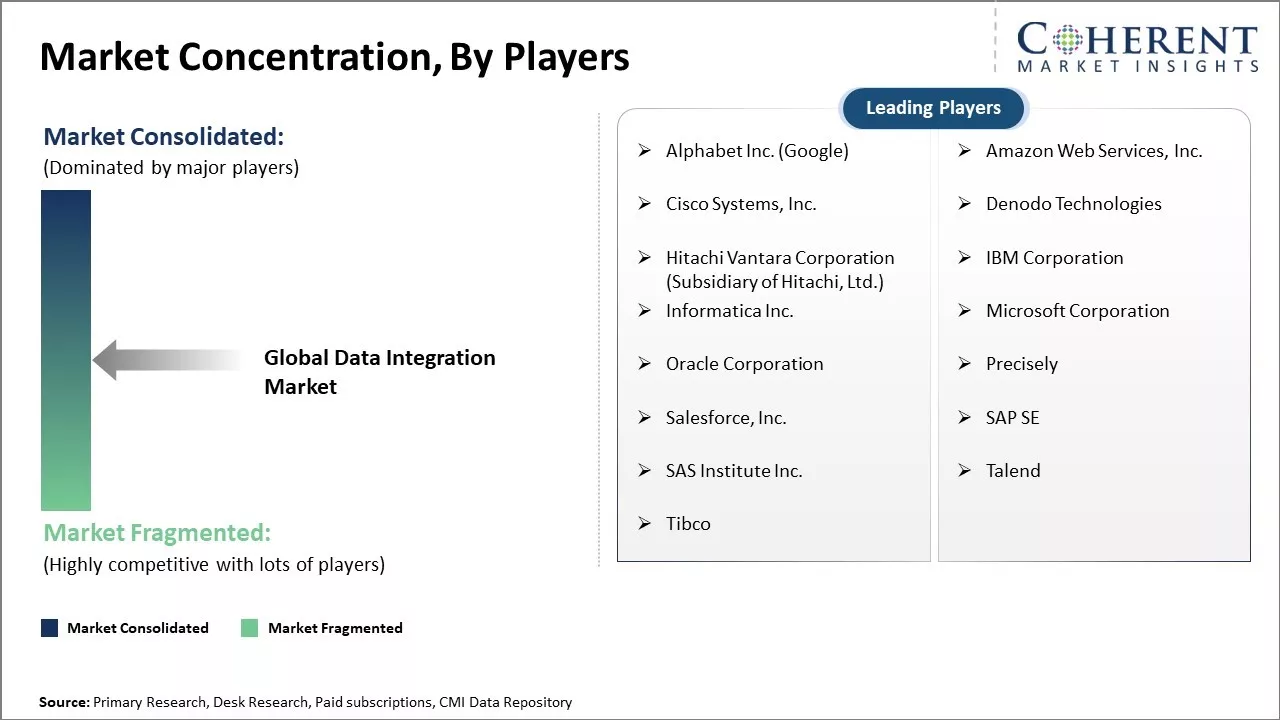
Market Concentration and Competitive Landscape
Analyst Opinion (Expert Opinion)
The global data integration market remains an area of strong growth potential, driven by the ever-increasing volumes of data being generated across organizations globally. As more companies recognize data as a valuable asset, the need for aggregating and deriving insights from both internal and external data sources will continue propelling spending on data integration tools and services. North America currently dominates due to early adoption; however, Asia Pacific is expected to emerge as the fastest growing regional market.
The lack of skilled professionals familiar with complex data integration tasks poses a challenge for wider adoption. Additionally, integrating legacy systems with modern tools and platforms introduces technological hurdles. Security also remains a key concern, especially with growing requirements around privacy and cross-border data transfer policies. However, the demand for unified views, real-time analytics, and data-driven personalization across industries also open significant opportunities for data integration vendors.
The push for digital transformation across industry verticals will be a major tailwind. Successful integration of both structured and unstructured data sources is vital for applications such as AI, IoT, and predictive maintenance. Further impetus is expected from trends like cloud migration and demand for consolidated multi-cloud data platforms. Going forward, the development of user-friendly no-code/low-code tools and pre-built integration modules can help expand the addressable market significantly.
Speak to the analyst
Want personalized insights?
Take the findings above to one of our principal consultants, or have the report rebuilt around the segments, geographies and competitors you actually track.
Data Integration Industry News
- In July 2025, Boomi™, announced the local availability of Boomi Data Integration from within an Australian data center, enabling local enterprises to move data faster, more securely, and in compliance with national regulations.
- In March 2025, Matillion announced the availability of its Data Productivity Cloud platform natively on Snowflake Marketplace.
- In September 2024, Razorpay launched DataSync, a no-code data integration platform that aims to redefine the way businesses have been traditionally accessing and utilizing critical payment, transaction, refund, chargebacks and settlement data.
Market Report Scope
Data Integration Market Report Coverage
| Report Coverage | Details | ||
|---|---|---|---|
| Base Year: | 2025 | Market Size in 2026: | USD 18.80 Bn |
| Historical Data for: | 2020 To 2024 | Forecast Period: | 2026 To 2033 |
| Forecast Period 2026 to 2033 CAGR: | 13.9% | 2033 Value Projection: | USD 46.80 Bn |
| Geographies covered: |
| ||
| Segments covered: |
| ||
| Companies covered: | Alphabet Inc. (Google), Amazon Web Services, Inc., Cisco Systems, Inc., Denodo Technologies, Hitachi Vantara Corporation (Subsidiary of Hitachi, Ltd.), IBM Corporation, Informatica Inc., Microsoft Corporation, Oracle Corporation, Precisely, Salesforce, Inc., SAP SE, SAS Institute Inc., Talend, and Tibco | ||
| Growth Drivers: |
| ||
| Restraints & Challenges: |
| ||
Market Opportunities: Growing adoption of BI and analytics solutions
The growing adoption of business intelligence (BI) and analytics solutions is one of the great opportunities in the global data integration market. As organizations across industries recognize the importance and business value of data-driven decision making, there is immense focus on bringing various data sources together for a unified analytics view. This is propelling the need for robust data integration platforms that can collect, cleanse, transform and deliver trusted data to various analytics and business applications seamlessly.
BI and analytics have moved from being nice-to-have initiatives to critical priorities, and businesses want to leverage every data point available internally as well as externally to gain valuable insights.
Market Segmentation
- Component Insights (Revenue, US$ Bn, 2021 - 2033)
- Tools
- Services
- Deployment Insights (Revenue, US$ Bn, 2021 - 2033)
- Cloud-based
- On-premise
- End-use Industry Insights (Revenue, US$ Bn, 2021 - 2033)
- IT & Telecom
- BFSI
- Healthcare
- Manufacturing
- Retail & E-commerce
- Government & Defense
- Others
- Regional Insights (Revenue, US$ Bn, 2021 - 2033)
- North America
- U.S.
- Canada
- Latin America
- Brazil
- Argentina
- Mexico
- Rest of Latin America
- Europe
- Germany
- U.K.
- Spain
- France
- Italy
- Russia
- Rest of Europe
- Asia Pacific
- China
- India
- Japan
- Australia
- South Korea
- ASEAN
- Rest of Asia Pacific
- Middle East & Africa
- GCC Countries
- Israel
- South Africa
- Rest of Middle East & Africa
- Key Players Insights
- Alphabet Inc. (Google)
- Amazon Web Services, Inc.
- Cisco Systems, Inc.
- Denodo Technologies
- Hitachi Vantara Corporation (Subsidiary of Hitachi, Ltd.)
- IBM Corporation
- Informatica Inc.
- Microsoft Corporation
- Oracle Corporation
- Precisely
- Salesforce, Inc.
- SAP SE
- SAS Institute Inc.
- Talend
- Tibco
Source
Primary Research Interviews
- Chief Technology Officers (CTOs) of data integration platform providers
- Data architects and integration specialists from enterprise organizations
- IT directors from mid-market companies implementing data integration solutions
- Business intelligence managers from various industry verticals
- Others
Databases
- IDC Technology Market Intelligence Database
- Forrester Research Database
- Bloomberg Terminal Database
- Others
Magazines
- Information Week
- CIO Magazine
- Data Management Magazine
- Integration Developer News
- Others
Journals
- Journal of Database Management
- International Journal of Information Management
- IEEE Transactions on Knowledge and Data Engineering
- Others
Newspapers
- The Wall Street Journal (Technology Section)
- Financial Times (Digital Business Section)
- TechCrunch
- VentureBeat
- Others
Associations
- Data Management Association International (DAMA)
- International Association for Information and Data Quality (IAIDQ)
- Cloud Security Alliance (CSA)
- Enterprise Data Management Council (EDM Council)
- Others
Public Domain Sources
- U.S. Securities and Exchange Commission (SEC) filings
- European Commission Digital Strategy reports
- International Data Corporation (IDC) public research
- McKinsey Global Institute reports
- Others
Proprietary Elements
- CMI Data Analytics Tool
- Proprietary CMI Existing Repository of information for last 8 years
*Definition: The global data integration market refers to the growing market for solutions, tools, and services that help integrate data from multiple internal and external sources across organizations worldwide. As data volumes, sources and use cases continue to proliferate, the global data integration market provides ways to combine, transform, and move data between different applications, systems, databases, and business partners throughout a company's global operations. This ensures a unified view of critical business information to enable real-time analytics, improve decision making, and gain insights from all enterprise data.
Get access to 250+ pages report
Every segment, forecast, competitor profile and data table behind the analysis above — available for instant download.
- ESOMAR Member
- ISO 9001:2015 Certified
- D-U-N-S Registered
- GDPR & CCPA Compliant
Missing comfort of reading report in your local language? Find your preferred language:
Transform your Strategy with Exclusive Trending Reports
Frequently Asked Questions
The Data Integration Market is estimated to be valued at USD 18.80 Bn in 2026, and is expected to reach USD 46.80 Bn by 2033.
The CAGR of the Data Integration Market is projected to be 13.9% from 2026 to 2033.
Globalization of businesses and need for centralized data access and rise of big data, real-time analytics and advances in technologies are the major factors driving the growth of the global data integration market.
Lack of skilled workforce for managing data integration tools and data security and privacy concerns are the major factors hampering the growth of the global data integration market.
In terms of component, tools is estimated to dominate the market revenue share in 2026.
Alphabet Inc. (Google), Amazon Web Services, Inc., Cisco Systems, Inc., Denodo Technologies, Hitachi Vantara Corporation (Subsidiary of Hitachi, Ltd.), IBM Corporation, Informatica Inc., Microsoft Corporation, Oracle Corporation, Precisely, Salesforce, Inc., SAP SE, SAS Institute Inc., Talend, and Tibco are the major players.
North America is expected to lead the global data integration market in 2026.