

Industrial IoT Market Analysis & Forecast: 2026-2033
Industrial IoT Market is estimated to be valued at USD 214.25 Bn in 2026 and is expected to reach USD 799.62 Bn in 2033, exhibiting a compound annual growth rate (CAGR) of 20.7% from 2026 to 2033.
Key Takeaways
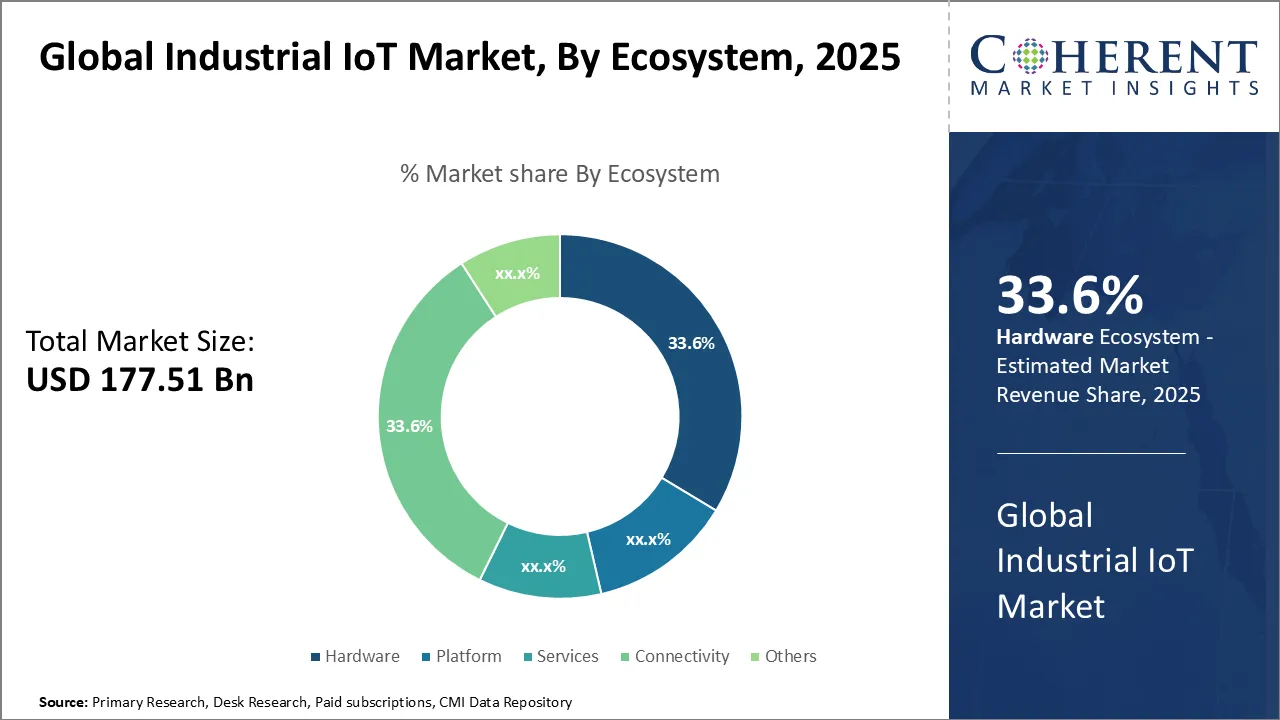
- Based on Ecosystem, the Hardware segment is expected to lead the market with 34.6% share in 2026, driving automation and precision through connected industrial equipment.
- Based on Technology, the Sensor segment is expected to hold the highest share of the market in 2026, converting physical parameters into measurable signals for smarter operations.
- Based on Application, the Predictive Maintenance segment is projected to account for the greatest share of the market in 2026, using AI and edge computing to cut downtime and costs.
- Based on Industry, the Manufacturing segment is projected to capture the largest share of the market in 2026, driven by smart factories, robotics, automation, and real-time analytics.
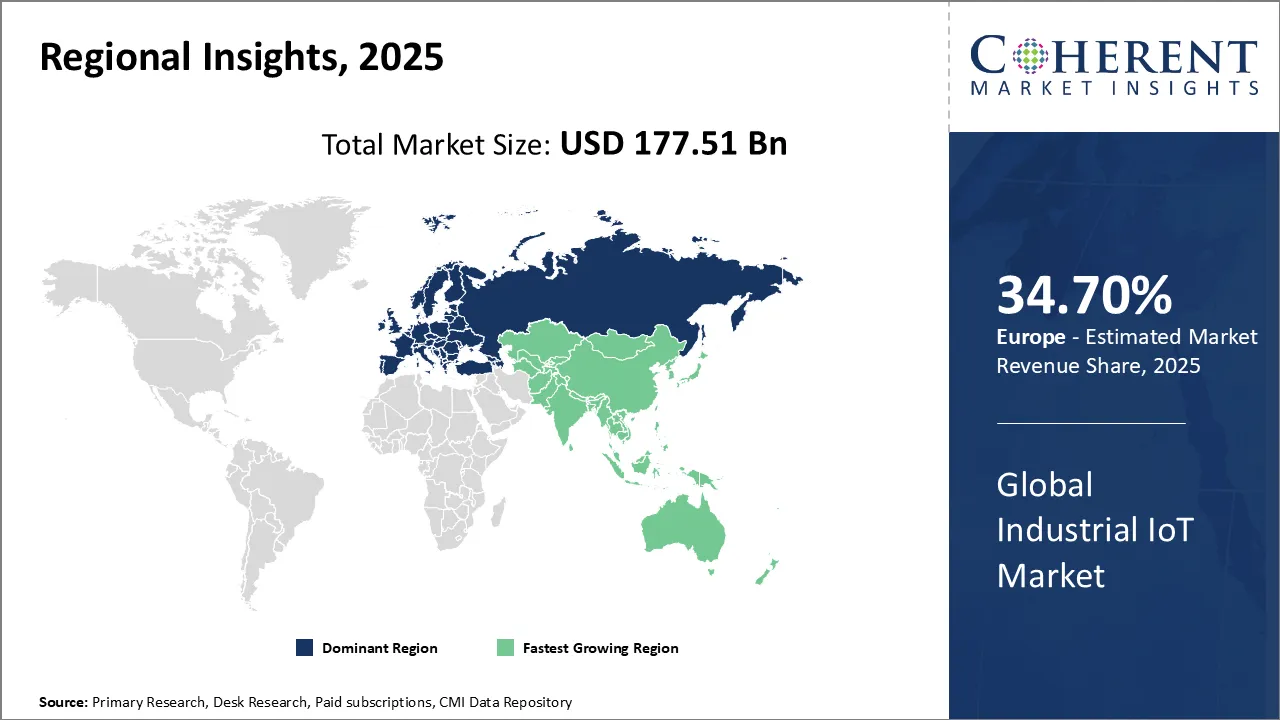
- Based on Region, Europe is set to lead the industrial IoT market with 34.7% share in 2026. While, Asia Pacific is projected to be the fastest growing region, holing 25.9% share in 2026.
Market Overview
The market is driven by the growing demand for advanced industrial automation solutions. These solutions help enterprises to cut maintenance costs and avoid unplanned downtime, thereby increasing profitability. The market is also propelled by the rising investments in IoT devices across various industries, owing to their increasing applications and a growing number of benefits.
Current Events and Its Impacts on the Industrial IoT Market
Current Event | Description and its Impact |
European Union Digital Regulations and Data Governance |
|
Advanced Manufacturing Technology Convergence |
|
Segmental Insights
- Current Industry Events of 2026
- Market Size Estimation
- Regional Breakdown
- Competitive Landscape
- Customer Intelligence
- Segmental Analysis
- Pricing Analysis
- Key Market Drivers, Challenges & Future Trends
- Customized Insights Section
Global Industrial IoT Market Insights, By Ecosystem: Hardware Dominates, Driving Automation and Precision Through Connected Industrial Equipment
In terms of ecosystem, the hardware segment is expected to dominate the global market over the forecast period and this is attributed to the increasing demand for hardware equipment of IoT in various industries. In the ecosystem of an industrial IoT, hardware is the equipment, with which automation, trend detection as well as sending and receiving with high accuracy and precision becomes possible. Thus, the demand for this segment is increasing rapidly, which in turn is expected to support the market growth.
For instance, in November 2025, ASUS IoT teamed up with Algorized to make edge AI solutions better for use in factories. The partnership brings together Algorized's perception software and ASUS's PE1100N industrial-grade hardware, which is powered by NVIDIA Jetson Orin. This partnership's goal is to create AIoT systems that can grow to meet the needs of smart factories, logistics, healthcare, and the automotive industry. These systems are going to boost automation, efficiency, and real-time analytics.
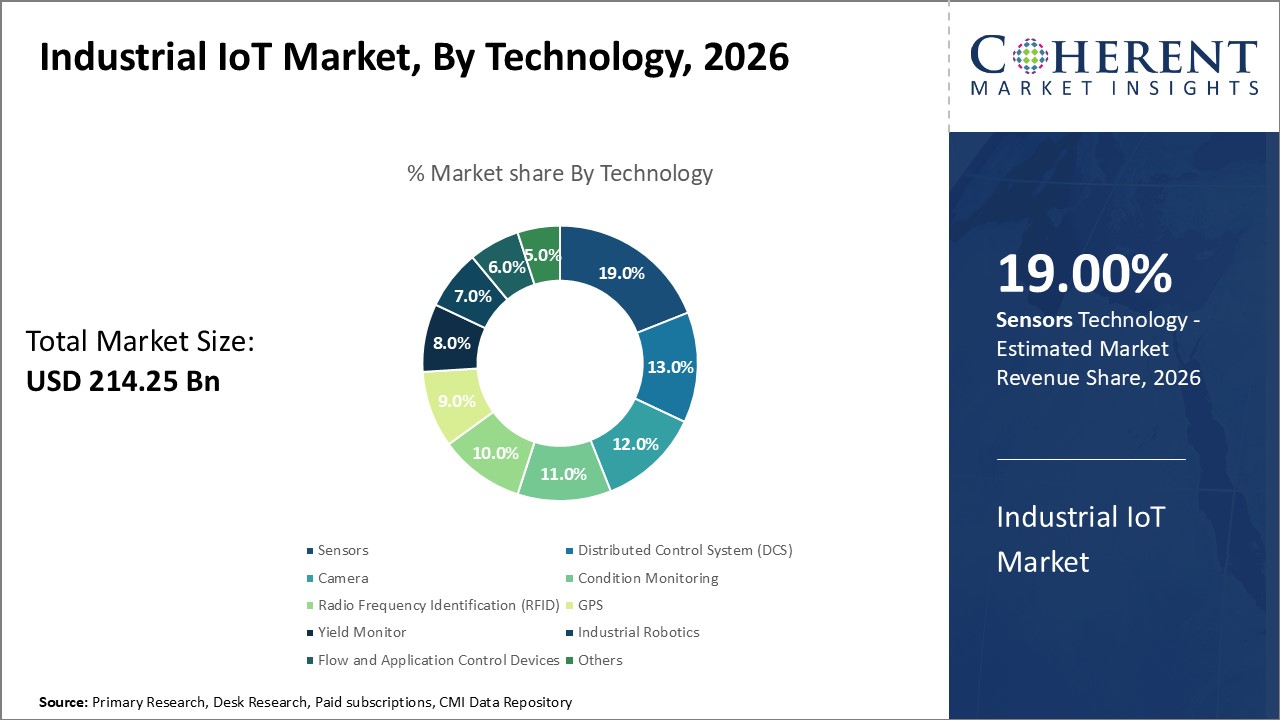
Global Industrial IoT Market Insights, By Technology: Sensors Dominate, Converting Physical Parameters into Measurable Signals for Smarter Operations
In terms of technology, the sensors segment is expected to dominate the global market over the forecast period and this is attributed to increasing technological developments in sensor technology used in conventional machining techniques. Sensors are used to detect and respond to any type of optical and electrical signals. An electronic sensor can convert physical parameter such as humidity, temperature, and pressure into a signal that can be measured electrically. Due to various advantages of using sensors, the demand for this segment is likely to growing in the coming years.
For instance, in December 2025, ROHM released a VCSEL optical sensor that works at high speeds and with high accuracy. It is meant to improve detection accuracy in industrial settings. The sensor converts things like humidity, temperature, and pressure into electrical signals that are able to measured. This makes automation and real-time monitoring possible. This new technology makes the sensor part of Industrial IoT stronger, which increases the need for smarter, more efficient industrial operations.
Global Industrial IoT Market Insights, By Application: Predictive Maintenance Dominates, Leveraging AI And Edge Computing to Cut Downtime and Boost Efficiency
In terms of application, the predictive maintenance segment is expected to lead the market with the largest share in 2026. It uses AI, machine learning, and edge computing to monitor on the health of equipment in real time, which reduces down on downtime and repair costs. Companies put it at the top of their lists to get the most out of their assets, work more efficiently, and get an edge over their competitors.
For instance, in December 2026, third-party logistics companies are going to be putting greater resources into IoT-enabled predictive maintenance. The technology uses sensors, AI, and real-time analytics to keep an eye on the health of equipment, reduce downtime, and lower repair costs. This strategic move makes operations more efficient, makes better use of assets, and makes warehouses, fleets, and supply chain operations more competitive.
Global Industrial IoT Market Insights, By Industry: Manufacturing Lead Is Driven by Smart Factories, Robotics, Automation, And Real-Time Analytics
In terms of industry, the manufacturing segment is expected to hold the highest share of the market in 2026. Smart factories, robotics, and automation are driving adoption, and real-time analytics and connected devices are helping. Manufacturers spend plenty of capital on IIoT to make their operations more efficient, boost productivity, and eliminate waste. Manufacturing continues to be the main driver, even though energy and automotive are growing.
For instance, in July 2026, with $4 million in funding, Napino and Teksun released Rapidise to speed up AIoT innovation in manufacturing. The project combines AI and the Internet of Things (IoT) to move smart factories, automation, and connected industrial solutions forward. This launch shows how manufacturing is leading the way in Industrial IoT, making production environments more efficient, using predictive analytics, and keeping an eye on things in real time.
Regional Insights
Europe Industrial IoT Market Analysis & Trends
Europe is expected to show major growth in the global industrial IoT market with 34.7% share in 2026, owing to widespread awareness regarding IoT among manufacturers and their collective collaboration and partnerships. Moreover, the adoption of Wi-Fi-enabled sensors across industries is increasing to assist in management of inventory, and traditional machines are being replaced by connected machines. Thus, the region is likely to show robust growth in the global industrial IoT market in the coming future.
For instance, in October 2026, Sateliot teamed up with the European Space Agency on a project to make satellite-based IoT connectivity more reliable so that people no longer depend on GPS as much. The project improves global coverage and positioning accuracy, which helps Industrial IoT applications in logistics, manufacturing, agriculture, and energy. This breakthrough makes the connectivity part of the Industrial IoT market stronger, which leads to more resilience and efficiency.
Asia Pacific Industrial IoT Market Analysis & Trends
Asia Pacific is anticipated to be the fastest growing region, holding 25.9% share in 2026, owing to fast industrialization, strong government programs like "Made in China 2026," and more companies using smart manufacturing. Countries such as China, India, and Japan are putting a lot of money into AIoT, automation, and robotics. This is making people want connected devices, sensors, and real-time analytics.
For instance, in June 2026, Singtel teamed up with a better way to connect businesses that want to grow their IoT networks around the world. The offer makes global networks more reliable, allowing for smooth data transfer and monitoring across borders in real time. The solution improves automation, predictive maintenance, and operational efficiency in industries such as manufacturing, logistics, and energy. This strengthens Singtel's position as a leader in the Industrial IoT market.
Industrial IoT Market Outlook Country-Wise
China Industrial IoT Market Trends
In 2026, China's Industrial IoT market is projected to be highly competitive as of the country's rapid industrialization, government programs like "Made in China 2026," and a lot of capital going into smart factories and automation. China is a world leader in IIoT growth because robotics, AIoT, and predictive analytics are widely used in the manufacturing, automotive, and electronics industries. These technologies improve efficiency, connectivity, and competitiveness.
For instance, in November 2026, China started a commercial trial of satellite IoT services to make satellite communications more diverse and less dependent on GPS. The European Space Agency supports this two-year project, which helps industries like aerospace, logistics, energy, and the low-altitude economy. This trial makes the Industrial IoT market stronger by allowing real-time monitoring, predictive analytics, and automation in important areas.
Germany Industrial IoT Market Trends
Germany's Industrial IoT market is expected to be extremely competitive in 2026 owing to its strong Industry 4.0 initiatives, advanced manufacturing base, and leadership in automation technologies. Heavy investment in smart factories, robotics, and predictive analytics makes businesses more efficient and competitive. Germany is a key hub for Industrial IoT adoption in Europe because the government and private sector work together to speed up digital transformation.
For instance, in October 2026, Germany's In-Hub raised a seven-figure amount of funds to grow its industrial digitalization services across Europe. The investment will speed up the use of smart factory solutions, automation, and analytics based on the Internet of Things (IoT), which anticipates making manufacturing and engineering more efficient and competitive. This move strengthens Europe's position as a leader in the Industrial IoT market and helps with other Industry 4.0 projects.
Market Report Scope
Industrial IoT Market Report Coverage
| Report Coverage | Details | ||
|---|---|---|---|
| Base Year: | 2025 | Market Size in 2026: | USD 214.25 Bn |
| Historical Data for: | 2020 To 2024 | Forecast Period: | 2026 To 2033 |
| Forecast Period 2026 to 2033 CAGR: | 20.7% | 2033 Value Projection: | USD 799.62 Bn |
| Geographies covered: |
| ||
| Segments covered: |
| ||
| Companies covered: | ABB Ltd., GE Digital, PTC Inc., Robert Bosch GmbH, Siemens AG, Accenture plc., Capgemini, and HCL Technologies Limited | ||
| Growth Drivers: |
| ||
| Restraints & Challenges: |
| ||
Global Industrial IoT Market Drivers
Growing demand for IIoT applications in smart industries to boost market growth
Industrial IoT (IIoT) has offers various features such as production integration, asset optimization, remote diagnosis, and smart monitoring, which allows improved operational efficiency, utmost performance of equipment, and high productivity. Moreover, it potentially impacts manufacturing industry, which promotes modernized maintenance and asset monitoring. Smart manufacturing is a specific application of IIoT and operates using IIoT enabled machinery for keeping a check on the production. The use of IIoT in smart industries promotes automation in operations. Thus, the demand for IIoT applications continues to increase in smart industries, which is expected to augment growth of the global industrial IoT market over the forecast period.
Low cost of sensors and advanced sensor technology to propel market pace
The use of digital infrastructure is growing, which in turn has promoted IIoT in various industries. Designers are planning integration of IIoT into all the possible segments due to the scalability of the technology. With this technology, line managers can supervise all the individual components and machineries in their production lines to gain complete transparency. The use of sensors is growing across these industries for various purposes, as their cost is low and the advancements in sensor technologies are growing. Thus, the global Industrial IoT market is expected to gain major growth over the forecast future.
Global Industrial IoT Market Opportunities
Growing integration of Machine Learning, AI, and Big Data to bring business opportunities in the global Industrial IoT market over the forecast period. As digital transformation has become a lucrative initiative across several industries, the demand for various technologies such as mobile robotics, Software-as-a-service, and virtual reality is increasing rapidly. Artificial Intelligence is one of the key technologies being used to accelerate digital transformation. This technology helps develop intelligent machines that can perform reasoning, learning, and problem solving among others. As a result, the adoption of Industrial IoT is expected to increase creating lucrative opportunities in the market.
Increasing use of IoT in healthcare sector to create growth opportunities in the global industrial IoT market over the forecast period. The implementation of IoT network can allow monitoring of patient health, which further allows healthcare institutes to track variances in order to offer rapid actions in case of the declining health of a patient. The use of blockchain technology is increasing in this industry for security of the patient data and to share real-time and trusted patient data to insurance companies. Thus, the global Industrial IoT market is expected to witness growth opportunities in the coming future.
Global Industrial IoT Market Trends
Growing adoption of digital twin is a recent trend
Digital twin is a virtual replication of physical components available in the real world. With the use of recorded data gathered from cameras, sensors, and other data collecting devices, a virtual copy of a particular asset, and individual product, or a whole facility can be made. There are various advantages of digital twin including higher dependability of manufacturing lines, greater productivity, reduced machine downtime, and improved performance among others. Thus, adoption of this technology is increasing across several industry, and this trend is expected to drive growth of the global industrial IoT market over the forecast period.
Increased popularity of 3D printing is another trend
The manufacturing processes are continuously advancing. These processes are of four types, which are additive manufacturing, casing manufacturing, molding manufacturing, and subtractive manufacturing. 3D printing is a part of additive manufacturing, and it is a process of making three-dimensional objects using a digital image. This technology has become advantageous in various industries, due to which its adoption continues to grow with time. This trend is likely to continue in the global industrial IoT market in the coming future.
Analyst Opinion (Expert Opinion)
The Industrial IoT market continues to expand as businesses move from using isolated automation to handling their operations in a fully connected, data-driven way. The rapid rise in the number of sensors in use, the growing number of connected machines, and the wider use of analytics, digital twins, and device-management platforms all support growth. The number of IoT devices around the world is steadily rising each year. This is due to there is a larger ecosystem that sends operational data to industrial systems. Cellular IoT connections are also growing quickly, caused by technologies like NB-IoT, LTE-M, and private 5G, which improve coverage, reliability, and scalability in industrial settings.
Manufacturing remains the most common user, followed by energy, utilities, logistics, and process industries. Predictive maintenance and asset-performance management are always named as the most valuable applications. Increasingly, vibration, temperature, acoustic, and flow-monitoring sensors are being used to cut down on unplanned downtime. Companies are putting more emphasis on edge analytics, data orchestration, and unified device management capabilities, which is changing the overall value mix toward software layers.
Cybersecurity risks, the difficulty of integrating with older OT systems, and a lack of skilled IIoT engineers are some of the most pressing issues. These problems often make projects take longer and cost more to deploy. Even with these limits, the momentum for adoption continues to be strong, thanks to measurable improvements in operational visibility, equipment reliability, and overall productivity in industries that rely heavily on assets.
Speak to the analyst
Want personalized insights?
Take the findings above to one of our principal consultants, or have the report rebuilt around the segments, geographies and competitors you actually track.
Global Industrial IoT Market: Key Developments
- In December 2205, Myriota released Hyperpulse, the first commercial 5G Non-Terrestrial Network (NTN) for IoT in the world. The service connects IoT devices to satellite-based coverage, which makes it possible to communicate reliably in remote and hard-to-reach areas. The first rollout includes the U.S., Mexico, Brazil, Australia, and Saudi Arabia. In 2026, the rollout will expand to Europe and Asia-Pacific.
- In November 2025, Qualcomm launched the Dragonwing IQ-X Series, which is the company's first line of industrial-grade processors for PCs, PLCs, and edge controllers. The platform is built to work in tough conditions and offers high-performance computing, AI integration, and wide compatibility to speed up smart manufacturing. The IQ-X Series makes the Industrial IoT market stronger by offering predictive maintenance, automation, and intelligent edge solutions. It has been adopted by major OEMs.
- In October 2025, AT&T and Ericsson started a cloud-based IoT marketplace that they hope to transform how businesses around the world use IoT. The platform lets businesses use solutions in more than one industry, like manufacturing, logistics, and energy, with better automation and real-time monitoring. This project makes the Industrial IoT market stronger by making it easier to set up, improving connectivity, and making industrial digital transformation more efficient.
Market Segmentation
- Global Industrial IoT Market, By Ecosystem (Revenue, USD Bn, 2021 - 2033)
- Hardware
- Platform
- Services
- Connectivity
- Wired Technologies
- Ethernet
- Modbus
- PROFINET
- FOUNDATION Fieldbus
- Wireless Technologies
- Wi-Fi
- ZigBee
- Bluetooth and Bluetooth Low Energy
- Cellular Technology
- LPWAN Technology
- Wired Technologies
- Global Industrial IoT Market, By Technology (Revenue, USD Bn, 2021 - 2033)
- Sensors
- Distributed Control System (DCS)
- Camera
- Condition Monitoring
- Radio Frequency Identification (RFID)
- GPS
- Yield Monitor
- Industrial Robotics
- Flow and Application Control Devices
- Others
- Global Industrial IoT Market, By Application (Revenue, USD Bn, 2021 - 2033)
- Data Management Solutions for Analytics
- Distribution Management System
- Manufacturing Execution System (MES)
- Outage Management System
- Product Lifecycle Management
- Remote Monitoring
- Retail Management System
- Predictive Maintenance
- Others
- Global Industrial IoT Market, By Industry (Revenue, USD Bn, 2021 - 2033)
- Energy and Utilities
- Automotive
- Manufacturing
- Retail
- Agriculture
- Healthcare
- Metal and Mining
- Others
- Global Industrial IoT Market, By Region (Revenue, USD Bn, 2021 - 2033)
- North America
- U.S.
- Canada
- Latin America
- Brazil
- Argentina
- Mexico
- Rest of Latin America
- Europe
- Germany
- U.K.
- Spain
- France
- Italy
- Russia
- Rest of Europe
- Asia Pacific
- China
- India
- Japan
- Australia
- South Korea
- ASEAN
- Rest of Asia Pacific
- Middle East & Africa
- GCC Countries
- Israel
- Rest of Middle East & Africa
- North America
- Global Industrial IoT Market: Key Companies Insights (Revenue, USD Bn, 2021 - 2033)
- ABB Ltd.
- GE Digital
- PTC Inc.
- Robert Bosch GmbH
- Siemens AG
- Accenture plc.
- Capgemini
- HCL Technologies Limited
Sources
Primary Research Interviews
- Industrial IoT Solution Providers
- Industrial Sensor & Connectivity Manufacturers
- Factory Automation Engineers
- Predictive Maintenance & Asset Management Specialists
- Smart Manufacturing Consultants
- Others
Databases
- Bloomberg Terminal
- Thomson Reuters Eikon
- Others
Magazines
- Automation World
- Control Engineering Magazine
- IoT Now Magazine
- Industrial Automation Asia
- Manufacturing Automation Magazine
- Others
Journals
- IEEE Internet of Things Journal
- Journal of Industrial Information Integration
- Sensors Journal
- International Journal of Advanced Manufacturing Technology
- Automation in Construction
- Others
Newspapers
- Financial Times
- The Wall Street Journal
- Reuters
- Bloomberg News
- Others
Associations
- Industrial Internet Consortium (IIC)
- International Society of Automation (ISA)
- Institute of Electrical and Electronics Engineers (IEEE)
- OPC Foundation
- MESA International (Manufacturing Enterprise Solutions Association)
- Others
Public Domain Sources
- U.S. Department of Commerce – NIST Smart Manufacturing Programs
- International Energy Agency (IEA) – Digitalization in Industry
- European Commission – Industry 4.0 Initiatives
- World Bank Open Data
- OECD Digital Economy Reports
- Others
Proprietary Elements
- CMI Data Analytics Tool
- Proprietary CMI Existing Repository of Information for the Last 8 Years
Definition: The Internet of Things is a network of devices and sensors that are interconnected to gather data. It connects to the cloud and transforms that data into useful information. Industrial IoT is a form of the Internet of Things that’s used in industrial settings to optimize production, increase quality control, and more.
Get access to 250+ pages report
Every segment, forecast, competitor profile and data table behind the analysis above — available for instant download.
- ESOMAR Member
- ISO 9001:2015 Certified
- D-U-N-S Registered
- GDPR & CCPA Compliant
Missing comfort of reading report in your local language? Find your preferred language:
Transform your Strategy with Exclusive Trending Reports
Frequently Asked Questions
The Industrial IoT Market is estimated to be valued at USD 214.25 Bn in 2026, and is expected to reach USD 799.62 Bn by 2033.
The CAGR of the Industrial IoT Market is projected to be 20.7% from 2026 to 2033.
Growing demand for IIoT applications in smart industries and Low cost of sensors and advanced sensor technology are fuelling the market.
The Ecosystem segment is the leading segment in the market.
Integration of IIoT into existing technology and security concerns regarding IIoT are the major factors restraining growth of the market
ABB Ltd., GE Digital, PTC Inc., Robert Bosch GmbH, Siemens AG, Accenture plc., Capgemini, and HCL Technologies Limited