

Global Manufacturing Market Size and Forecast – 2026-2033
The Global Manufacturing Market is estimated to be valued at USD 15.6 Tn in 2026 and is expected to reach USD 22.11 Tn by 2033, exhibiting a compound annual growth rate (CAGR) of 5.1% from 2026 to 2033.
Key Takeaways of the Global Manufacturing Market:
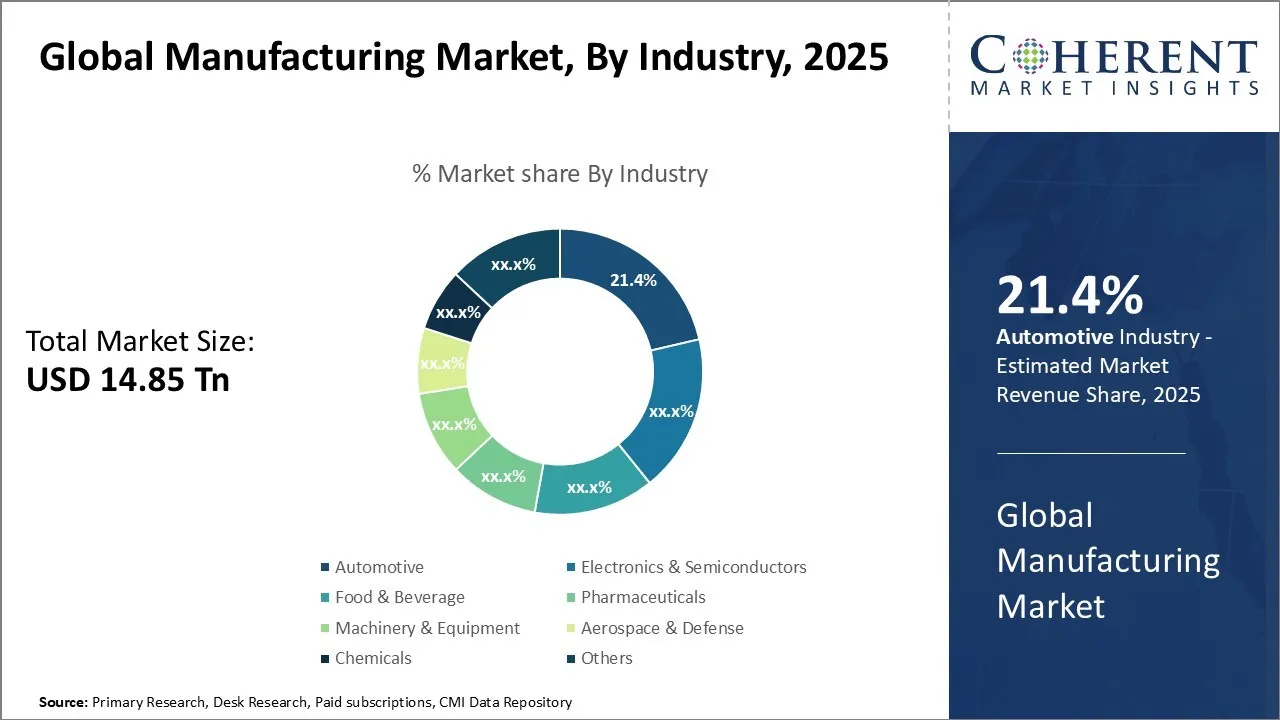
- The automotive segment is expected to lead the market holding an estimated share of 22.4 % in 2026.
- The traditional manufacturing segment is projected to dominate with a share of 43.3 % in 2026.
- Asia Pacific is estimated to lead the market with a share of 42.7 % in 2026. North America, holding a share of 26.5% in 2026, is projected to be the fastest growing region.
Market Overview:
The manufacturing market is experiencing several key trends, including the increasing adoption of Industry 4.0 technologies such as artificial intelligence, robotics, and the Internet of Things (IoT). These technologies are driving automation, increasing efficiency, and making possible more flexible and customizable production processes. Also, the market is seeing a shift towards sustainable and eco-friendly manufacturing methods, as companies focus on decreasing their carbon footprint and adopting circular economy principles.
Current Events and Its Impact
Current Events | Description and its impact |
U.S.-China Trade War Escalation |
|
EU Carbon Border Adjustment Mechanism (CBAM) Implementation |
|
Segmental Insights
- Current Industry Events of 2026
- Market Size Estimation
- Regional Breakdown
- Competitive Landscape
- Customer Intelligence
- Segmental Analysis
- Pricing Analysis
- Key Market Drivers, Challenges & Future Trends
- Customized Insights Section
Global Manufacturing Market Insights, by Industry – Automotive Manufacturing is Experiencing Innovation and Growth
In terms of industry, the automotive segment is expected to contribute the highest share of 22.4% in the market in 2026. The automotive industry is leading the adoption of advanced manufacturing technologies, such as robotics, automation, and Industry 4.0 solutions, to improve productivity, efficiency, and quality control. This is because of the increasing demand for vehicles globally, resulting in the need for cost-effective and scalable production methods to fulfil this demand.
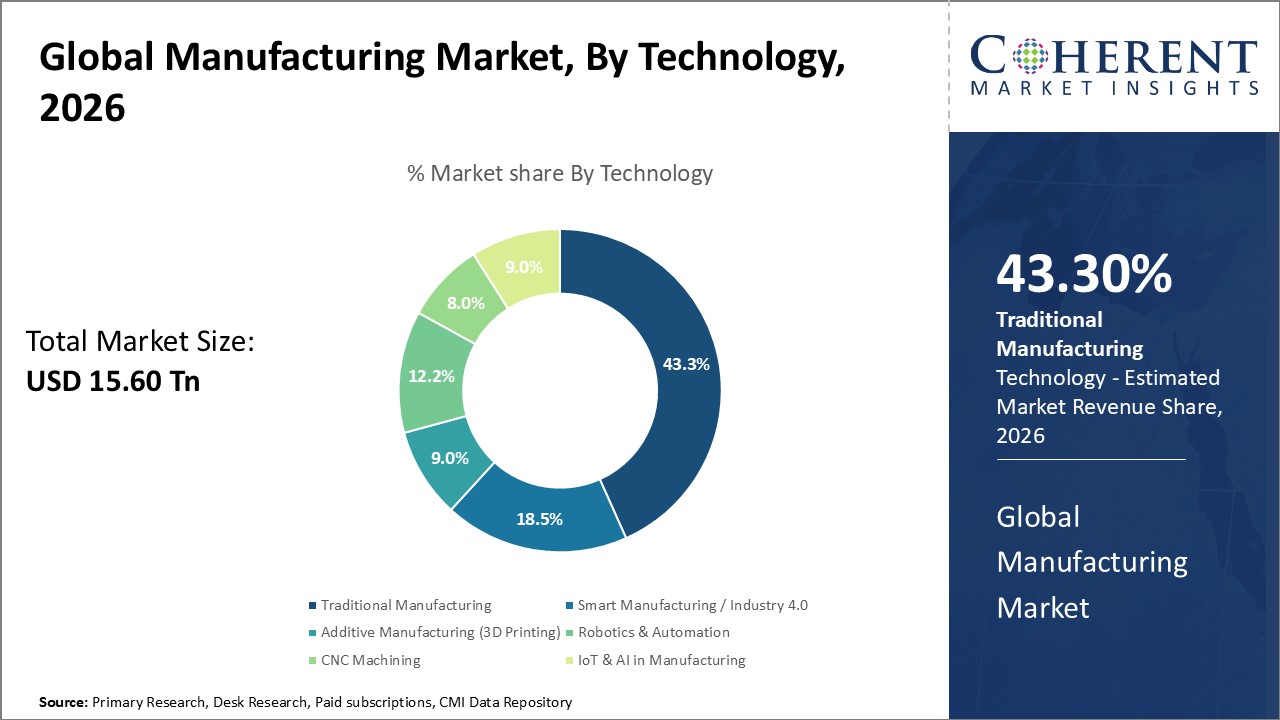
Global Manufacturing Market Insights by Technology - Traditional Manufacturing Acts as the Backbone of the Market
In terms of technology, the traditional manufacturing segment is expected to contribute the highest share of 43.3% in the market in 2026. Traditional manufacturing includes a wide range of processes, such as casting, forging, machining, and forming, which have been refined and optimized over a long time to produce high-quality products efficiently and cost-effectively.
Traditional manufacturing is versatile and adaptable. These methods can be used with many materials, including metals, plastics, and composites, and can produce parts with varying complexity and precision. This versatility allows manufacturers to fulfil different customer requirements and make products for different industries, from automotive and aerospace to consumer goods and medical devices.
The Role of Artificial Intelligence (AI) in the Manufacturing Market:
Artificial Intelligence (AI) highly influences manufacturing operations, enabling intelligent features such as predictive analytics to autonomous systems. AI-powered machine learning algorithms analyze equipment data in real time to predict mechanical failures before they occur. This helps manufacturers perform predictive maintenance, decreasing unplanned downtime and increasing machinery lifespan. For instance, global manufacturers like Bosch and Siemens use AI to monitor machine health and optimize service schedules across smart factories.
AI improves process control by continuously analyzing production variables and adjusting operations to maximize the output and quality. In high-precision industries such as semiconductor or pharmaceutical manufacturing, quality control systems powered by AI can detect defects that human eyes or traditional systems might miss, resulting in higher product consistency and reduced waste.
Regional Insights:
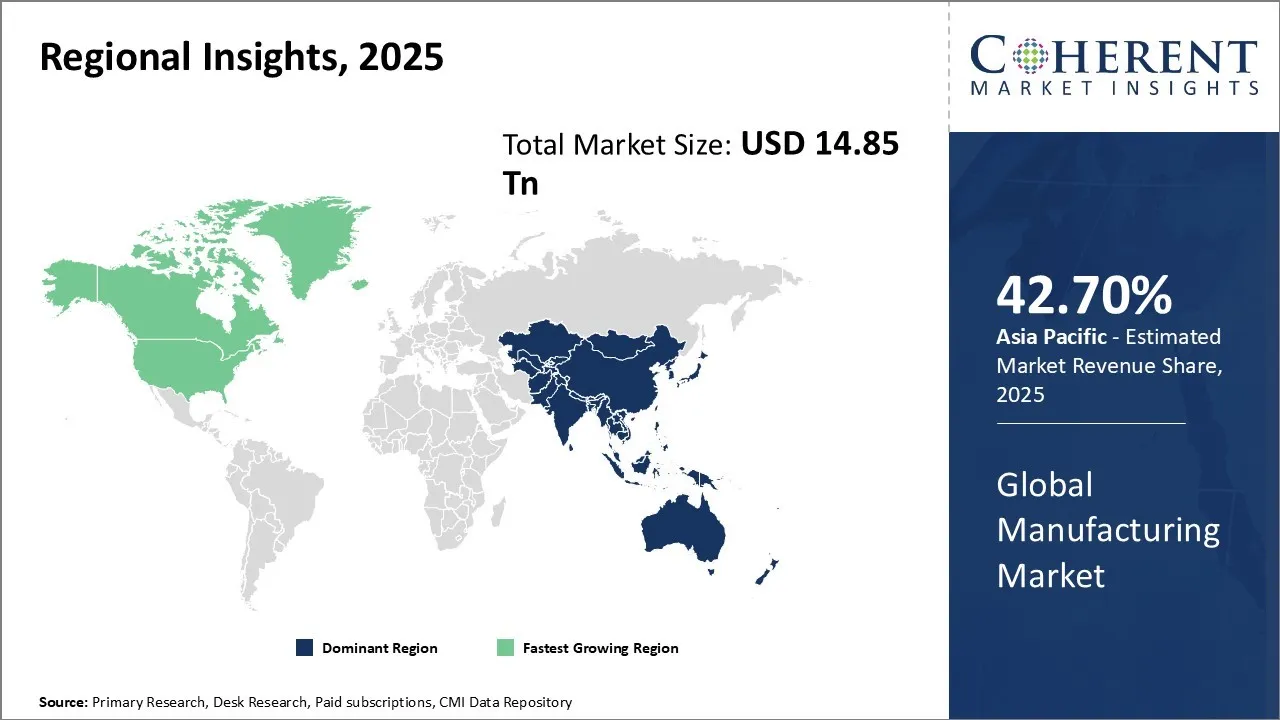
Asia Pacific Manufacturing Market Analysis and Trends
Asia Pacific, holding a share of 42.7% in 2026, is expected to dominate the global manufacturing market. The region boasts a robust market ecosystem, characterized by a large and growing consumer base, rapid industrialization, and favorable government policies that promote manufacturing and infrastructure development.
Countries like China, Japan, and South Korea have established themselves as manufacturing powerhouses, leveraging their skilled workforce, advanced technologies, and efficient supply chains. The presence of numerous industry giants, such as Foxconn, Samsung, and Toyota, further strengthens the region's position in the global market. Additionally, the increasing focus on innovation, research and development, and the adoption of Industry 4.0 technologies have propelled the growth of the manufacturing sector in Asia Pacific.
North America Manufacturing Market Analysis and Trends
North America, holding a share of 26.5% in 2026, is expected to exhibit the fastest growth in the global manufacturing market, driven by its technological leadership, advanced industrial infrastructure, and innovation ecosystem. The U.S., in particular, leads the region with a strong base of high-value manufacturing across sectors such as aerospace, automotive, semiconductors, pharmaceuticals, and industrial machinery.
The region’s emphasis on Industry 4.0 adoption—including robotics, IoT, AI, and additive manufacturing—has positioned it at the forefront of smart and precision manufacturing. Additionally, the U.S. government has introduced substantial incentives for reshoring production, particularly in strategic sectors like electronics, defense, and critical raw materials, to reduce dependency on global supply chains.
Global Manufacturing Market Outlook for Key Countries:
China Manufacturing Market Analysis and Trends
China manufacturing market continues to dominate the global manufacturing landscape, driven by its vast industrial base, advanced infrastructure, and supportive government policies. The country's "Made in China 2026" initiative aims to upgrade its manufacturing sector, focusing on high-tech industries such as robotics, aerospace, and electric vehicles. Chinese companies like Huawei, DJI, and BYD have emerged as global leaders in their respective fields, showcasing the country's innovation capabilities. China's large domestic market, coupled with its expanding middle class, provides a strong foundation for the growth of its manufacturing sector.
U.S. Manufacturing Market Analysis and Trends
The U.S. remains a significant player in the global manufacturing market, despite the challenges posed by increasing competition and trade tensions. The country's advanced technology, skilled workforce, and robust intellectual property protection have enabled it to maintain its competitive edge in high-value manufacturing. American companies like Boeing, General Electric, and Apple have been at the forefront of innovation, driving technological advancements in the manufacturing sector. The United States has also been focusing on reshoring initiatives to bring manufacturing jobs back to the country, leveraging automation and advanced manufacturing techniques to offset higher labor costs.
Germany Manufacturing Market Analysis and Trends
Germany continues to lead the Europe manufacturing market, renowned for its precision engineering, quality craftsmanship, and technological prowess. The country's "Industrie 4.0" initiative has been a driving force behind the adoption of digital technologies and smart manufacturing processes. German companies like Siemens, Bosch, and BMW have been pioneers in integrating automation, artificial intelligence, and the Internet of Things into their manufacturing operations. Germany's strong emphasis on vocational training and apprenticeship programs ensures a steady supply of skilled workers, further strengthening its manufacturing capabilities.
India Manufacturing Market Analysis and Trends
India manufacturing market is driven by its large population, growing middle class, and government initiatives like "Make in India" and "Atmanirbhar Bharat" (Self-Reliant India). The country has been attracting foreign investments in manufacturing, particularly in sectors such as automotive, electronics, and pharmaceuticals. Indian companies like Tata, Mahindra, and Sun Pharmaceutical have established themselves as significant players in the global market. The Indian government has also been focusing on developing industrial corridors, improving infrastructure, and simplifying business regulations to create a more conducive environment for manufacturing growth.
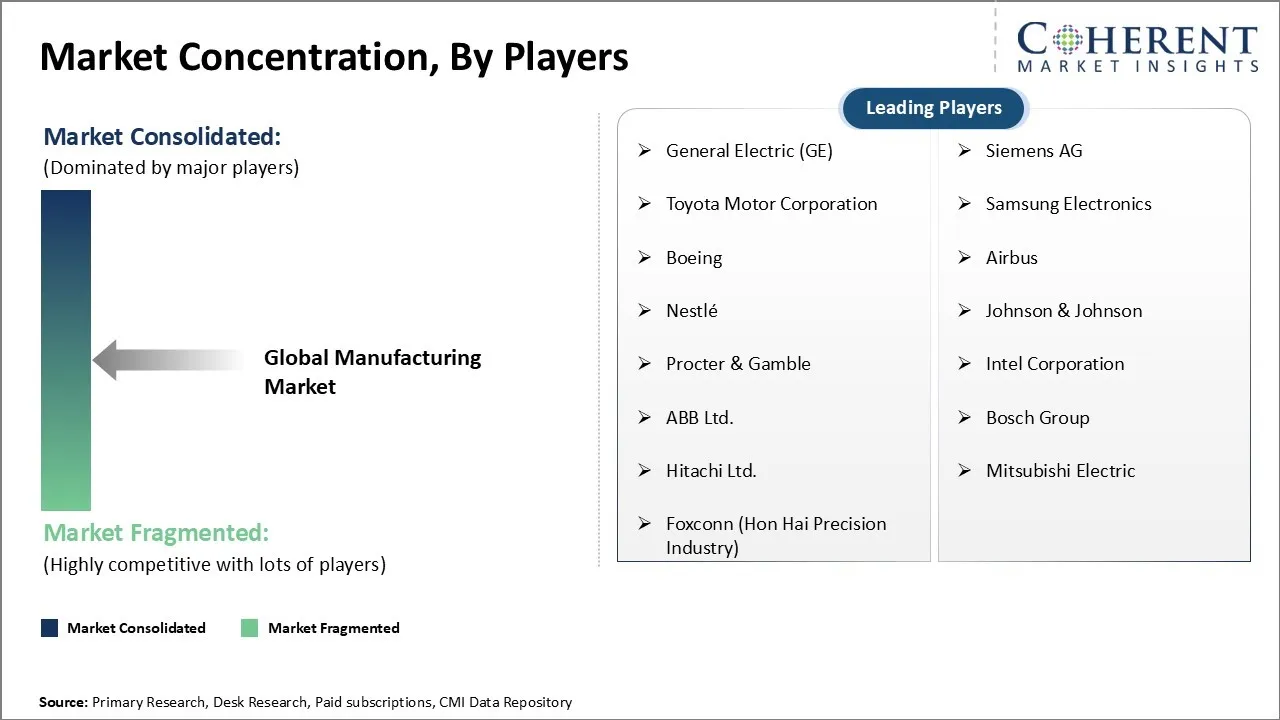
Market Players, Key Players, and Competitive Intelligence:
Key Developments:
- In March 2025, ABB announced an investment of USD 120 million in the U.S. to expand the production capacity of its low voltage electrification products. ABB aimed to create 50 new jobs at a new advanced manufacturing facility in Selmer, Tennessee, U.S. and double the size of its existing manufacturing site in Senatobia, Mississippi, U.S. creating 200 new jobs.
- In September 2024, Intel and Amazon Web Services (AWS) announced an expansion of their long-standing collaboration with a new, multi-year, multi-billion-dollar agreement focused on custom chip design and production. Under this strategic partnership, Intel will produce an advanced AI fabric chip for AWS using its state-of-the-art Intel 18A process node, aimed at enhancing AI and machine learning capabilities.
- In August 2024, Foxconn, a major electronics manufacturing giant made an investment of around USD 144 million (INR 1,200 crore) in its Indian subsidiary, Foxconn Hon Hai Technology India Mega Development Pvt Ltd, located in Karnataka.
- In June 2022, Siemens, a player in industrial automation and software, infrastructure, building technology and transportation, and NVIDIA, a company engaged in accelerated graphics and artificial intelligence (AI), expanded their partnership to enable the industrial metaverse and increase use of AI-driven digital twin technology in industrial automation.
Top Strategies Followed by Global Manufacturing Market Players
- Established players are heavily investing in research and development (R&D) to innovate high-performance products that cater to evolving customer needs.
- Siemens has consistently invested heavily in research and development, with an R&D expenditure of over USD 6.2 billion (€5.6 billion) in 2023 alone. One major outcome is the Siemens Xcelerator platform, which integrates digital twins, IoT, and AI to enhance smart manufacturing solutions.
- Mid-level players are prioritizing cost-effective solutions to attract price-sensitive consumers.
- Jabil, a mid-sized global manufacturing solutions provider, focuses on high-volume, cost-efficient manufacturing for clients across consumer electronics, automotive, and healthcare sectors. It achieves this through optimized supply chains, lean manufacturing principles, and geographic diversification of production facilities (e.g., in Mexico, Malaysia, and Eastern Europe).
- Small-scale players are focusing on specific market segments or developing unique product features to carve out a distinct identity and attract customers seeking specialized solutions.
- Protolabs, a digital manufacturing company specializing in on-demand, rapid prototyping, leverages its niche capabilities in 3D printing, CNC machining, and injection molding to serve customers needing low-volume, highly customized parts with fast turnaround.
Market Report Scope
Global Manufacturing Market Report Coverage
| Report Coverage | Details | ||
|---|---|---|---|
| Base Year: | 2025 | Market Size in 2026: | USD 15.6 Tn |
| Historical Data for: | 2020 To 2024 | Forecast Period: | 2026 To 2033 |
| Forecast Period 2026 to 2033 CAGR: | 5.1% | 2033 Value Projection: | USD 22.11 Tn |
| Geographies covered: |
| ||
| Segments covered: |
| ||
| Companies covered: | General Electric (GE), Siemens AG, Toyota Motor Corporation, Samsung Electronics, Boeing, Airbus, Nestlé, Johnson & Johnson, Procter & Gamble, Intel Corporation, ABB Ltd., Bosch Group, Hitachi Ltd., Mitsubishi Electric, and Foxconn (Hon Hai Precision Industry) | ||
| Growth Drivers: |
| ||
| Restraints & Challenges: |
| ||
Market Dynamics
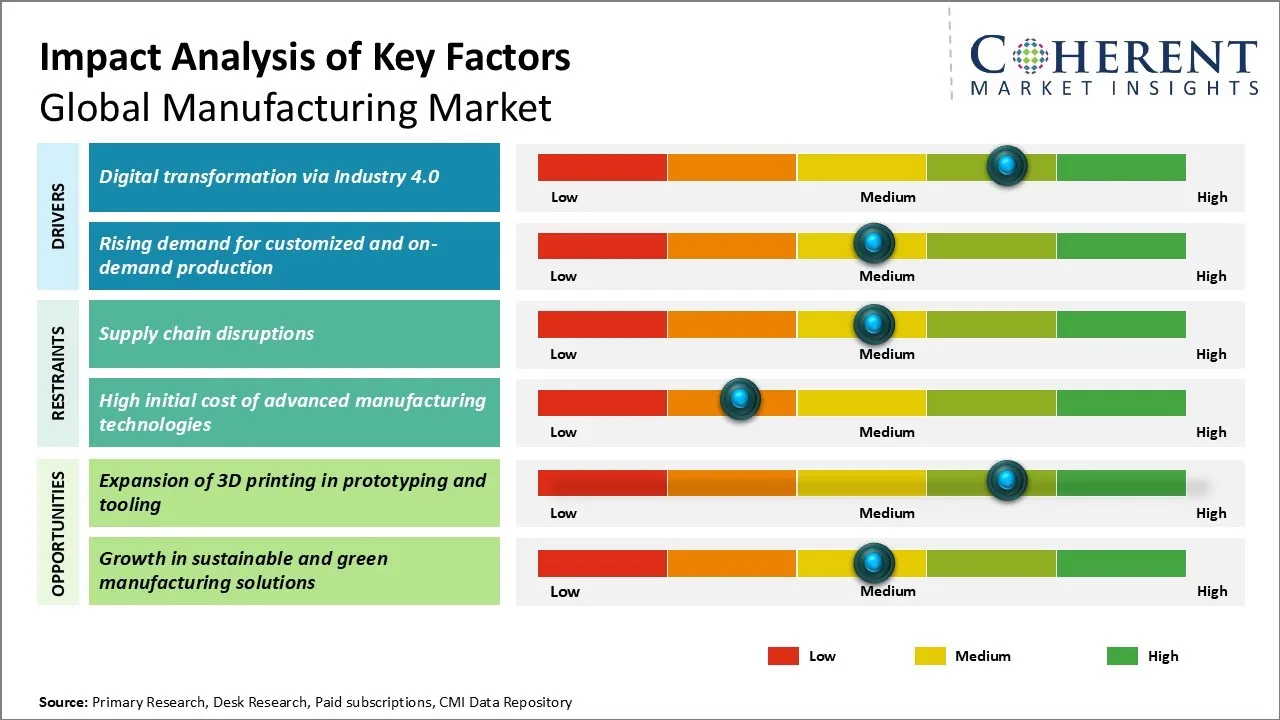
Global Manufacturing Market Driver - Digital transformation via Industry 4.0
The global manufacturing market is undergoing a significant shift towards digitalization, driven by the rapid adoption of Industry 4.0 technologies. This digital transformation is enabling manufacturers to optimize processes, enhance efficiency, and improve product quality. The integration of advanced technologies such as the Internet of Things (IoT), artificial intelligence (AI), robotics, and cloud computing is transforming traditional manufacturing processes into smart, interconnected systems.
Additionally, the implementation of digital twins and simulation tools enables manufacturers to virtually design, test, and optimize products and processes before physical production, saving time and resources. For instance, at its Amberg Electronics Plant in Germany, Siemens has integrated IoT, AI, and digital twin technology to create a fully connected and automated production system.
Global Manufacturing Market Opportunity - Expansion of 3D Printing in Prototyping and Tooling
The global manufacturing market has a significant opportunity in the expansion of 3D printing technology, particularly in the areas of prototyping and tooling. 3D printing, also known as additive manufacturing, enables manufacturers to create complex geometries and customized parts rapidly and cost-effectively. This technology is particularly valuable in the prototyping phase, where manufacturers can iterate designs quickly and test multiple versions without the need for expensive tooling.
As the capabilities of 3D printing technology continue to advance, manufacturers can leverage this opportunity to streamline their product development processes, reduce costs, and bring innovative products to market faster. For instance, GE uses metal 3D printing to produce fuel nozzles for the LEAP jet engine. Traditionally, a nozzle would consist of 20 separate parts, but 3D printing allows it to be manufactured as a single part, reducing assembly time and increasing durability.
Analyst Opinion (Expert Opinion):
- Geopolitical tensions—particularly U.S.-China trade disputes, the Russia-Ukraine war, and rising protectionism—have fractured global supply chains. Manufacturers are increasingly shifting from globalized networks to regional or local sourcing models to mitigate risk.
- This shift has accelerated nearshoring and friend-shoring strategies, especially in North America and Europe, leading to new investments in domestic manufacturing but also raising operational costs and complexity.
- Heightened global instability makes long-term capital investment decisions riskier. Uncertainty surrounding trade tariffs, sanctions, and regulatory barriers discourages expansion in politically unstable regions. As a result, multinationals are reallocating capital away from high-risk markets like China and Eastern Europe, and focusing more on stable economies with strong legal frameworks such as the U.S., India, and parts of Southeast Asia. This cautious posture may slow innovation cycles and shift competitive dynamics globally.
Speak to the analyst
Want personalized insights?
Take the findings above to one of our principal consultants, or have the report rebuilt around the segments, geographies and competitors you actually track.
Market Segmentation
- Industry Insights (Revenue, USD Tn, 2021 - 2033)
- Automotive
- Electronics & Semiconductors
- Food & Beverage
- Pharmaceuticals
- Machinery & Equipment
- Aerospace & Defense
- Chemicals
- Others
- Technology Insights (Revenue, USD Tn, 2021 - 2033)
- Traditional Manufacturing
- Smart Manufacturing / Industry 4.0
- Additive Manufacturing (3D Printing)
- Robotics & Automation
- CNC Machining
- IoT & AI in Manufacturing
- Regional Insights (Revenue, USD Tn, 2021 - 2033)
- North America
- U.S.
- Canada
- Latin America
- Brazil
- Argentina
- Mexico
- Rest of Latin America
- Europe
- Germany
- U.K.
- Spain
- France
- Italy
- Russia
- Rest of Europe
- Asia Pacific
- China
- India
- Japan
- Australia
- South Korea
- ASEAN
- Rest of Asia Pacific
- Middle East
- GCC Countries
- Israel
- Rest of Middle East
- Africa
- South Africa
- North Africa
- Central Africa
- North America
- Key Players Insights (Revenue, USD Tn, 2021 - 2033)
- General Electric (GE)
- Siemens AG
- Toyota Motor Corporation
- Samsung Electronics
- Boeing
- Airbus
- Nestlé
- Johnson & Johnson
- Procter & Gamble
- Intel Corporation
- ABB Ltd.
- Bosch Group
- Hitachi Ltd.
- Mitsubishi Electric
- Foxconn (Hon Hai Precision Industry)
Sources
Primary Research Interviews:
Stakeholders:
- OEM Manufacturers and Tier 1 Suppliers (e.g., Plant Managers, Operations Heads)
- Automation System Integrators and Equipment Vendors (e.g., robotics integrators, control system providers)
- Technology Consultants for Industry 4.0 Transformation Projects
- Industrial Engineers and Digital Manufacturing Consultants
- Factory Equipment Leasing Firms
- ESG Analysts focusing on Sustainable and Circular Manufacturing Practices
Databases:
- Global Trade Observatory
- International Industry Statistics Bureau (IISB)
- Industrial Outlook Register
- Economic Manufacturing Board (EMB)
Magazines:
- Manufacturing Today Global
- Smart Factory Digest
- Production & Operations Weekly
- NextGen Manufacturing Review
Journals:
- Journal of Advanced Manufacturing Systems
- Global Industrial Engineering Review
- Smart Manufacturing & Automation Journal
- Journal of Applied Production Science
Newspapers:
- The Global Industry Herald
- Manufacturing Business Daily
- The Financial Chronicle (Global Edition)
- Asia-Pacific Industry News
Associations:
- World Federation of Industrial Manufacturers (WFIM)
- Global Automation and Robotics Alliance (GARA)
- Smart Manufacturing Council (SMC)
- Industrial Technology Advancement Association (ITAA)
- Sustainable Manufacturing International (SMI)
Public Domain Sources:
- U.S. Census Bureau
- EUROSTAT
- World Bank
- United Nations Industrial Development Organization (UNIDO)
- ResearchGate
Proprietary Elements:
- CMI Data Analytics Tool, Proprietary CMI Existing Repository of information for last 8 years
Get access to 250+ pages report
Every segment, forecast, competitor profile and data table behind the analysis above — available for instant download.
- ESOMAR Member
- ISO 9001:2015 Certified
- D-U-N-S Registered
- GDPR & CCPA Compliant
Missing comfort of reading report in your local language? Find your preferred language:
Transform your Strategy with Exclusive Trending Reports
Frequently Asked Questions
The global manufacturing market is estimated to be valued at USD 14.85 trillion in 2025 and is expected to reach USD 20.76 trillion by 2032.
The CAGR of the global manufacturing market is projected to be 4.9% from 2025 to 2032.
Digital transformation via Industry 4.0 and rising demand for customized and on-demand production are the major factors driving the growth of the global manufacturing market.
Supply chain disruptions and high initial cost of advanced manufacturing technologies are the major factors hampering the growth of the global manufacturing market.
In terms of industry, the automotive segment is estimated to dominate the market revenue share in 2025.
General Electric (GE), Siemens AG, Toyota Motor Corporation, Samsung Electronics, Boeing, Airbus, Nestlé, Johnson & Johnson, Procter & Gamble, Intel Corporation, ABB Ltd., Bosch Group, Hitachi Ltd., Mitsubishi Electric, and Foxconn (Hon Hai Precision Industry) are the major players.
Asia Pacific is expected to lead the global manufacturing market in 2025.