

E-commerce Analytics Market Size and Forecast — 2026-2033
The Global E-commerce Analytics Market is expected to be valued at USD 30.32 Billion in 2026 and reach USD 81.45 Billion by 2033, exhibiting a compound annual growth rate (CAGR) of 17.9% from 2026 to 2033.
Key Takeaways of the E-commerce Analytics Market:
- The basic analytics segment is expected to lead the market holding a share of 45.3% in 2026.
- North America is expected to lead the market with a share of 34.7% in 2026.
- Asia Pacific, holding a share of 29. 4% in 2026, is projected to be the fastest growing region.
Market Overview:
The global e-commerce analytics market is witnessing significant growth. Factors, such as the rising penetration of internet and smartphone across the world, increasing online transactions, growing preference for online shopping among consumers due to offer of discounts, cashbacks, and doorstep delivery, are propelling the market growth. Various retailers and e-commerce companies are investing extensively in analytics solution to understand consumer behavior, optimize inventory, enhance customer experience, and improve sales. Analytics help companies generate valuable insights from data to make strategic business decisions and gain competitive advantage. Increasing spending on digital marketing by organizations will further fuel the demand for e-commerce analytics in the coming years.
Type Insights
Type Insights – Basic Analytics Lead Due to Convenience and Affordability
The basic analytics segment, holding a share of 45.3% in 2026, is expected to dominate the market. Basic analytics tools cater to the core needs of e-commerce businesses with simple yet effective solutions. They offer data-driven insights on key metrics like traffic, sales, customer behavior, and segmentation in an easy-to-use format. With features focused on descriptive and diagnostic analysis rather than predictive functions, basic analytics solutions serve the purpose of most small and mid-sized e-commerce companies.
With minimal technology requirements and easier learning curves, basic analytics tools empower users to gather actionable findings from their digital sales channels without extensive data science skills or large budget outlays. Their straightforward, often spreadsheet-like interfaces can be navigated intuitively to analyze past performance and surface key drivers of success. This makes basic analytics the preferred starting point for e-commerce owners seeking to incorporate data-based decision making.
Basic tools also have competitive pricing structures tailored to fit modest budgets. Most offer affordable subscription plans or free limited-feature versions to encourage wide adoption. With their low barriers to entry, convenience of plug-and-play deployment, and capability to address core measurement needs, basic analytics command the lead among e-commerce analytics types. Their ease of use and value for cost have cemented basic tools as the mainstream choice, contributing to this segment’s predominance in the market.
Regional Insights
North America E-commerce Analytics Market Trends
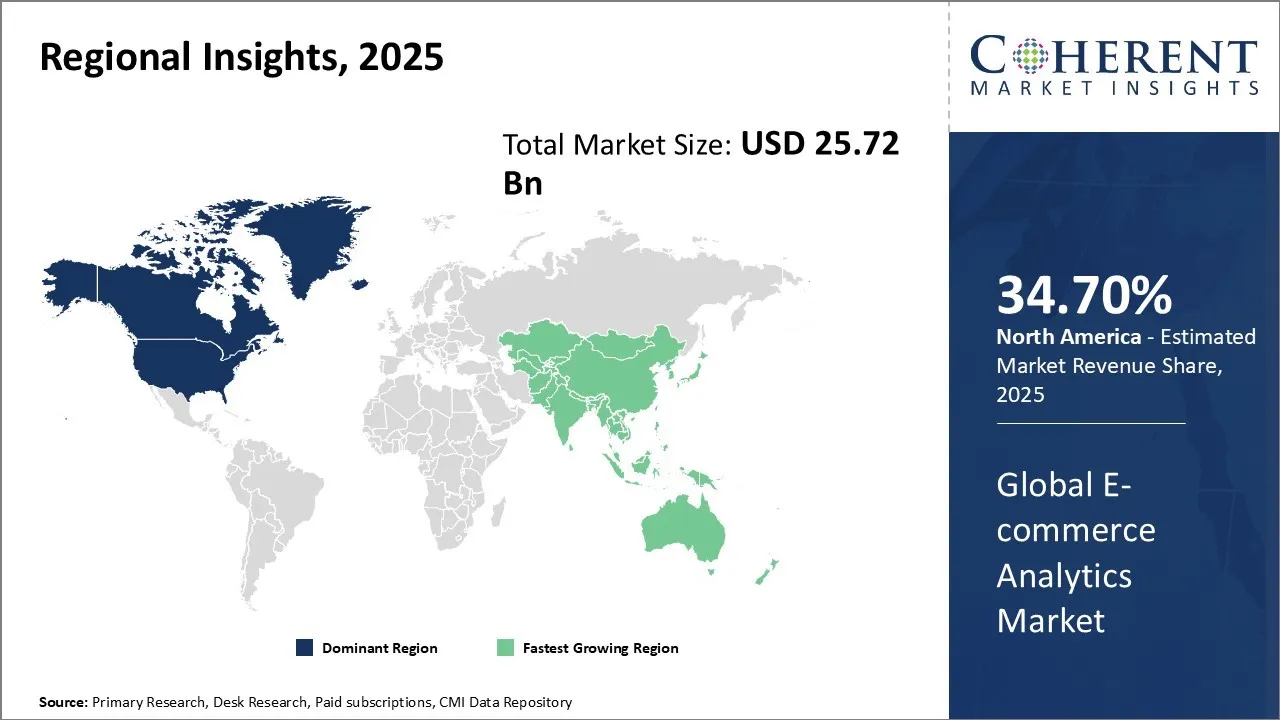
North America, holding a share of 34.7% in 2026, is expected to dominate the e-commerce analytics market. The region’s market dominance can be attributed to high internet penetration and strong technological infrastructure. E-commerce retailers in the region, such as Amazon, Walmart, and Target, have widely adopted analytics solutions across multiple functions, including supply chain and customer service, to gain customer insights and optimize online marketing strategies.
Asia Pacific E-commerce Analytics Market Trends
The Asia Pacific region, holding a share of 29.4% in 2026, is expected to exhibit the fastest growth in the e-commerce analytics market. Countries, such as China, India, and Japan, house a massive online shopper base that is increasingly adopting digital payment methods. Supportive government initiatives around digitalization are also propelling analytics adoption. For instance, China's "Internet Plus" project promotes analytics among Small and Medium-sized Business (SMB) e-commerce players.
E-commerce Analytics Market Outlook for Key Countries
U.S. E-commerce Analytics Market Trends
The U.S. e-commerce analytics market continues to be driven by competitiveness in the retail landscape. Omnichannel strategies require extensive user data capture and insights across multiple touchpoints. Key players like Adobe and Microsoft partner with major retailers to develop customized analytics capabilities.
China E-commerce Analytics Market Trends
China e-commerce analytics market is growing rapidly due to thriving online commerce. Domestic giants like Alibaba and JD.com have built expansive self-owned analytics platforms to manage their massive e-tail operations. This encourages other sellers on their marketplaces to leverage available analytics.
India E-commerce Analytics Market Trends
India continues to witness a surge in e-tailing and corresponding analytics demand. While Flipkart and Amazon dominate the retail analytics space, startups capitalize on opportunities in specific domains like marketing attribution. The government's Digital India campaign has fostered an environment conducive for analytics companies through access to public datasets and infrastructure development initiatives.
U.K. E-commerce Analytics Market Trends
The U.K. e-commerce analytics market exhibits growth on account of strong digital leadership at prominent retailers like Tesco and ASDA. Analytics vendors catering to omni-channel and last-mile delivery optimization find many takers. Meanwhile, local startups bring new analytics capabilities around AI-powered personalized experiences and in-store path analysis using computer vision.
Market Players, Key Development, and Competitive Intelligence
Key Developments:
- In December 2024, Interpublic Group, an advertising company, acquired the retail analytics firm, Intelligence Node. This move enhanced Interpublic’s commerce capabilities, providing clients with real-time product and market intelligence to understand shopper trends, drive sales growth, and optimize performance.
- In March 2021, Jungle Scout, an all-in-one platform for selling on Amazon, raised USD 110 million in growth capital, which in part supported the acquisition of advertising tech solution Downstream Impact, as well as team expansion and product development.
Top Strategies Followed by Global E-commerce Analytics Market Players
- Established Players: Market leaders focus on AI-enhanced data platforms, strategic acquisitions, and omnichannel integration to solidify their position. Companies like Adobe, Salesforce, and IBM invest in real-time personalization, predictive analytics, and seamless cross-platform insights to cater to large-scale enterprises.
- For example, Adobe enhanced its Adobe Experience Platform with AI-powered customer journey analytics and real-time Customer Data Platform (CDP) capabilities to offer deeper personalization across e-commerce platforms.
- Salesforce acquired Tableau to integrate advanced data visualization and analytics into its Commerce Cloud, helping retailers gain actionable insights from customer data.
- IBM collaborated with Shopify to integrate IBM’s Watson AI into Shopify’s data stack, delivering personalized product recommendations and demand forecasting features.
- Mid-level Players: Mid-tier companies prioritize regional expansion, ecosystem partnerships, and affordable, cloud-first solutions tailored for growing e-commerce businesses. Players like Qlik, SAS, and BloomReach aim to provide scalable analytics tools to mid-sized retailers and Direct-to-Consumer (DTC) brands.
- BloomReach partnered with BigCommerce to integrate AI-powered site search and product discovery features into the platform, helping mid-sized online stores improve customer engagement and conversion rates.
- Qlik expanded its presence in Southeast Asia by launching localized analytics solutions designed for regional e-commerce platforms with language and compliance customizations.
- SAS Institute rolled out a modular e-commerce analytics suite optimized for mid-sized enterprises, allowing flexibility in deploying customer behavior and marketing attribution analytics
- Small-scale Players: Smaller companies differentiate by focusing on hyper-niche sectors, plug-and-play solutions for SMEs, and privacy-first analytics. They emphasize agility, rapid deployment, and sector-specific insights.
- Conversific targets Shopify users with affordable analytics dashboards that highlight key growth metrics like SEO, traffic sources, and product profitability for small businesses.
- Metrilo delivers an all-in-one analytics and CRM tool tailored to boutique online stores, offering customer segmentation and retention tools without the need for complex implementation.
- Simple Analytics promotes privacy-first, cookie-less tracking tools for small online stores looking to comply with General Data Protection Regulation (GDPR) while still accessing visitor behavior data.
Emerging Startups - E-commerce Analytics Industry Ecosystem
- AI-Powered Personalization: Startups are utilizing artificial intelligence and machine learning to offer real-time personalization and predictive insights to optimize customer journeys.
- ai uses computer vision and machine learning to deliver personalized product recommendations, automated catalog management, and dynamic pricing for fashion e-commerce retailers. Similarly, Segmentify helps online stores increase conversions through AI-driven, individualized shopping experiences.
- Mobile-First Analytics Platforms: Many startups are developing mobile-optimized analytics tools that allow businesses to track user behavior, performance metrics, and marketing Return on Investment (ROI) in real time.
- Countly offers real-time analytics and push notifications on mobile apps, helping e-commerce businesses monitor user actions across devices. Another example is Mixpanel, which provides detailed behavioral data insights specifically optimized for mobile-first commerce platforms.
- Plug-and-Play Integrations: Startups are focusing on ease of implementation by building platforms that seamlessly integrate with major e-commerce platforms like Shopify, WooCommerce, and Magento.
- Conversific offers easy Shopify integration and presents actionable insights on store performance, SEO, and customer behavior. Likewise, Metrilo provides plug-and-play e-commerce analytics with built-in Customer Relationship Management (CRM) and email marketing features for smaller stores.
- Current Industry Events of 2026
- Market Size Estimation
- Regional Breakdown
- Competitive Landscape
- Customer Intelligence
- Segmental Analysis
- Pricing Analysis
- Key Market Drivers, Challenges & Future Trends
- Customized Insights Section
Market Report Scope
E-commerce Analytics Market Report Coverage
| Report Coverage | Details | ||
|---|---|---|---|
| Base Year: | 2025 | Market Size in 2026: | USD 30.32 Bn |
| Historical Data for: | 2020 To 2024 | Forecast Period: | 2026 To 2033 |
| Forecast Period 2026 to 2033 CAGR: | 17.9% | 2033 Value Projection: | USD 81.45 Bn |
| Geographies covered: |
| ||
| Segments covered: |
| ||
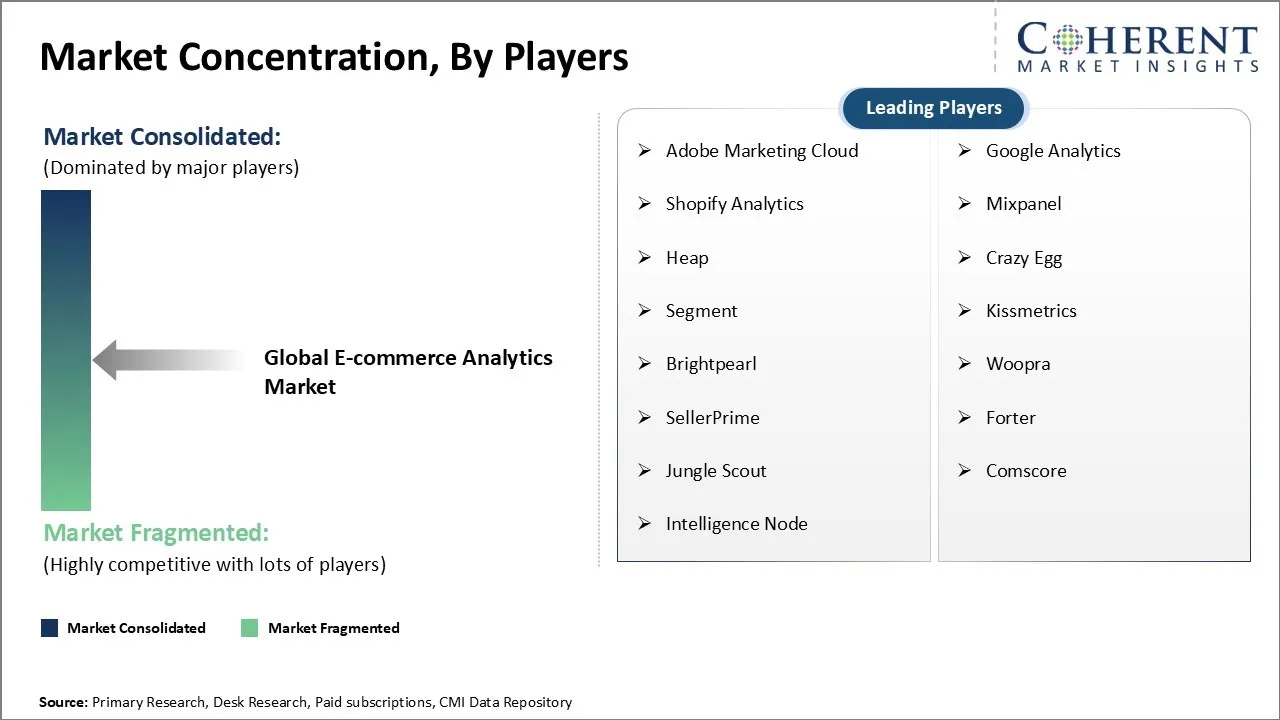
| Companies covered: | Adobe Marketing Cloud, Google Analytics, Shopify Analytics, Mixpanel, Heap, Crazy Egg, Segment, Kissmetrics, Brightpearl, Woopra, SellerPrime, Forter, Jungle Scout, Comscore, and Intelligence Node | ||
| Growth Drivers: |
| ||
| Restraints & Challenges: |
| ||
Market Dynamics
Global E-commerce Analytics Market Driver - Increasing volume of online transactions necessitating data analysis
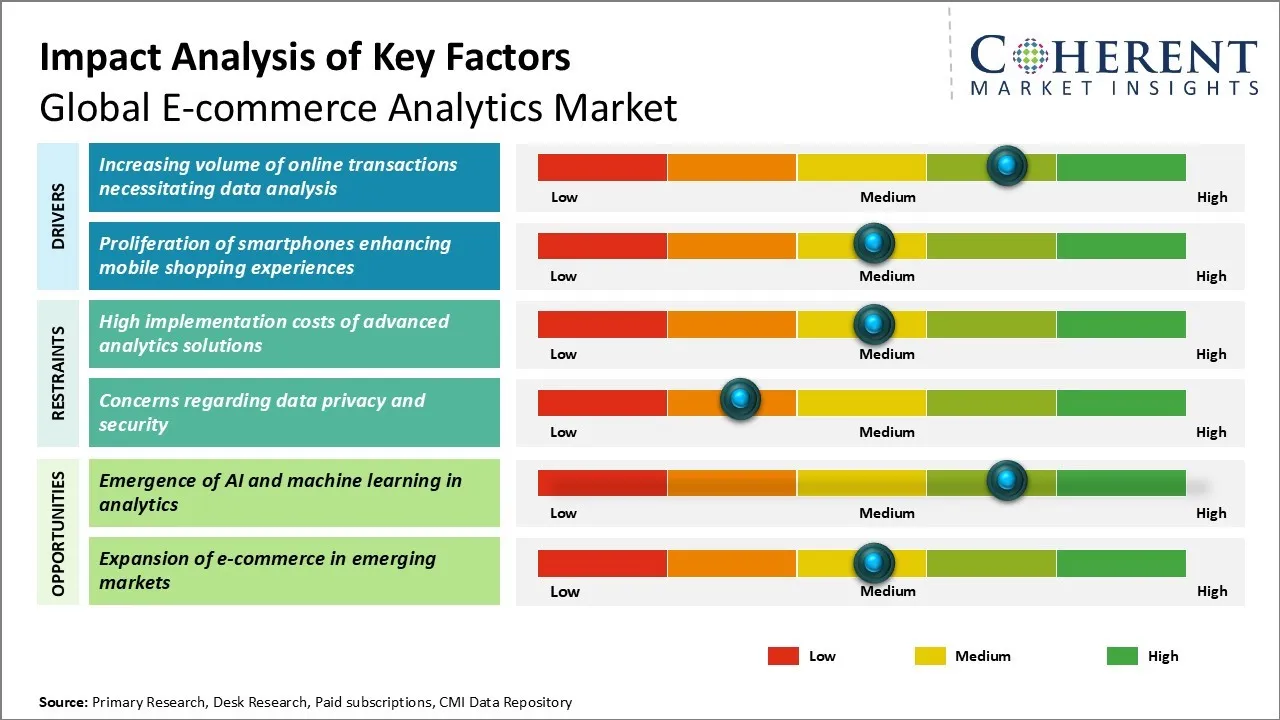
With the growing adoption of e-commerce across industries and geographies, the volume of online transactions has increased tremendously over the past few years. As businesses are witnessing high volumes of data being generated from their websites and mobile applications on a daily basis, there is a rising need to analyze this data to extract valuable insights. E-commerce analytics solutions help organizations to better understand customer purchase patterns and behavior, identify opportunities for improvement, enhance customer experience, optimize conversion rates and increase online sales. As the transaction volumes continue to rise, the need for robust data analytics capabilities is becoming imperative for e-commerce businesses to stay ahead of competition. This growing demand is boosting the adoption of e-commerce analytics solutions globally and driving the overall market growth.
Global E-commerce Analytics Market Challenge - High implementation costs of advanced analytics solutions
One of the major challenges faced by the global e-commerce analytics market is the high implementation costs of advanced analytics solutions. Traditionally, implementing advanced analytics solutions like predictive analytics requires heavy investment in high-end server infrastructure, data storage, skilled resources, and specialized software. This makes such solutions financially unviable for small and medium e-commerce businesses. Even large retailers hesitate to adopt newest advanced solutions due to the high capital expenditure required. The complex nature of these solutions also means that considerable time and resources have to spent in integration and ensuring seamless performance. High maintenance costs further add to the total cost of ownership. While advanced solutions promise significant benefits in terms of improved marketing and business decision making, their steep price tags prevent widespread adoption in the industry. For the market to realize its true growth potential, solution providers will need to innovate new pricing and deployment models that make advanced analytics more affordable and cost-effective for all business segments.
Global E-commerce Analytics Market Opportunity - Emergence of AI and machine learning in analytics
One significant opportunity for the global e-commerce analytics market is the emergence of artificial intelligence and machine learning based solutions. AI and machine learning have the potential to make advanced analytics highly affordable and accessible for ecommerce businesses of all sizes. AI-powered predictive analytics packages integrated with machine learning algorithms can automate complex data processing and derive meaningful insights without much manual effort or expertise. This helps lower the implementation and maintenance costs significantly. Cloud-based deployment and consumption-based pricing of AI analytics tools further improves their ease of adoption. As businesses across segments increasingly collect and generate massive online data through their digital operations, AI-driven self-learning solutions will be crucial to extract optimized value from these data assets. Their ability to continuously refine output based on evolving business environments also ensures lasting relevance. If developed and marketed properly, AI-powered analytics can become the driving force behind the next phase of growth for the global e-commerce analytics industry.
Analyst Opinion (Expert Opinion)
- The global e-commerce analytics market is poised for robust growth over the coming years, driven by the rapid expansion of digital commerce and the increasing need for businesses to gain actionable insights into consumer behavior, marketing effectiveness, and operational efficiency. The integration of AI, machine learning, and real-time analytics tools is enhancing the precision and value of data-driven decisions across the e-commerce ecosystem.
- A key challenge for the market remains the growing concern over consumer data privacy and regulatory compliance, especially with the enforcement of General Data Protection Regulation (GDPR), California Consumer Privacy Act (CCPA), and other data protection laws. Businesses must balance personalization with ethical data use to sustain consumer trust.
- North America is expected to maintain its lead in the market, supported by mature digital infrastructure, a high concentration of analytics solution providers, and an innovation-driven retail sector. Meanwhile, Asia Pacific is emerging as the fastest-growing region due to its rapidly expanding online shopper base, rising mobile commerce penetration, and increasing digitalization of businesses.
Speak to the analyst
Want personalized insights?
Take the findings above to one of our principal consultants, or have the report rebuilt around the segments, geographies and competitors you actually track.
Market Segmentation
- Type Insights (Revenue, USD Bn, 2021 - 2033)
- Basic Analytics
- Advanced Analytics
- Others
- Regional Insights (Revenue, USD Bn, 2021 - 2033)
- North America
- U.S.
- Canada
- Latin America
- Brazil
- Argentina
- Mexico
- Rest of Latin America
- Europe
- Germany
- U.K.
- Spain
- France
- Italy
- Russia
- Rest of Europe
- Asia Pacific
- China
- India
- Japan
- Australia
- South Korea
- ASEAN
- Rest of Asia Pacific
- Middle East
- GCC Countries
- Israel
- Rest of Middle East
- Africa
- South Africa
- North Africa
- Central Africa
- North America
- Key Players Insights
- Adobe Marketing Cloud
- Google Analytics
- Shopify Analytics
- Mixpanel
- Heap
- Crazy Egg
- Segment
- Kissmetrics
- Brightpearl
- Woopra
- SellerPrime
- Forter
- Jungle Scout
- Comscore
- Intelligence Node
Get access to 250+ pages report
Every segment, forecast, competitor profile and data table behind the analysis above — available for instant download.
- ESOMAR Member
- ISO 9001:2015 Certified
- D-U-N-S Registered
- GDPR & CCPA Compliant
Missing comfort of reading report in your local language? Find your preferred language:
Transform your Strategy with Exclusive Trending Reports
Frequently Asked Questions
The global e-commerce analytics market is expected to be valued at USD 30.32 Billion in 2026 and reach USD 81.45 Billion by 2033.
The CAGR of the global e-commerce analytics market is projected to be 17.9% from 2026 to 2033.
Increasing volume of online transactions necessitating data analysis and proliferation of smartphones enhancing mobile shopping experiences are the major factors driving the growth of the global e-commerce analytics market.
High implementation costs of advanced analytics solutions and concerns regarding data privacy and security are the major factors hampering the growth of the global e-commerce analytics market.
In terms of type, the basic analytics segment is estimated to dominate the market revenue share in 2026.
Adobe Marketing Cloud, Google Analytics, Shopify Analytics, Mixpanel, Heap, Crazy Egg, Segment, Kissmetrics, Brightpearl, Woopra, SellerPrime, Forter, Jungle Scout, Comscore, and Intelligence Node are the major players.
North America is expected to lead the global e-commerce analytics market in 2026, holding a share of 34.7%.