

Smart Manufacturing Market Analysis & Forecast: 2026-2033
Smart Manufacturing Market is estimated to be valued at USD 238.2 Mn in 2026 and is expected to reach USD 367.2 Mn in 2033, exhibiting a compound annual growth rate (CAGR) of 6.4% from 2026 to 2033.
Key Takeaways
- Based on Technology, the Manufacturing Execution System (MES) segment is expected to lead the market with 27.5% share in 2026, driving Industry 4.0 through real-time integration and efficiency.
- Based on Component, the Control Devices segment is expected to hold the largest share of the market in 2026, driving automation and making hardware the top revenue contributor.
- Based on End-use Industry, the Automotive segment is projected to account for 32% share of the market in 2026, fueled by EVs, robotics, IoT, and digital twin integration.
- Based on Region, Asia Pacific is set to lead the smart manufacturing market with 46.1% share in 2026. While, North America is anticipated to be the fastest growing region.
Market Overview
Increasing investment by leading companies will contribute to the growth of the smart manufacturing market over the next several years. The rising need to reduce downtime and costs is expected to fuel the market. Increased automation has been a major factor driving the market. This market is also expected to expand rapidly due to the demand for software solutions.
Current Events and its Impacts on the Smart Manufacturing Market
Current Event | Description and its Impact |
European Union's Digital and Green Transition Policies |
|
Industrial Internet of Things (IIoT) Cybersecurity Threats |
|
What is the role of artificial intelligence in smart manufacturing market?
Smart manufacturing is changing due to artificial intelligence, which makes predictive maintenance, intelligent automation, and real-time optimization possible. AI looks at data from sensors and machines to cut down on downtime, improve quality, and make things work better. It supports robotics, digital twins, and adaptive production systems, which help businesses stay competitive and environmentally friendly. AI is a key driver of Industry 4.0 adoption around the world considering it helps manufacturers make decisions faster, save money, and be more flexible.
For instance, in August 2025, Intel and LG Innotek are working together to build a smart factory in South Korea that uses AI. The partnership combines AI, IoT, and advanced analytics to improve production, allowing for predictive maintenance, quality control in real time, and automation. This project makes it easier for companies to adopt Industry 4.0, which will make semiconductor and electronics manufacturing around the world more efficient.
- Current Industry Events of 2026
- Market Size Estimation
- Regional Breakdown
- Competitive Landscape
- Customer Intelligence
- Segmental Analysis
- Pricing Analysis
- Key Market Drivers, Challenges & Future Trends
- Customized Insights Section
Segmental Insights
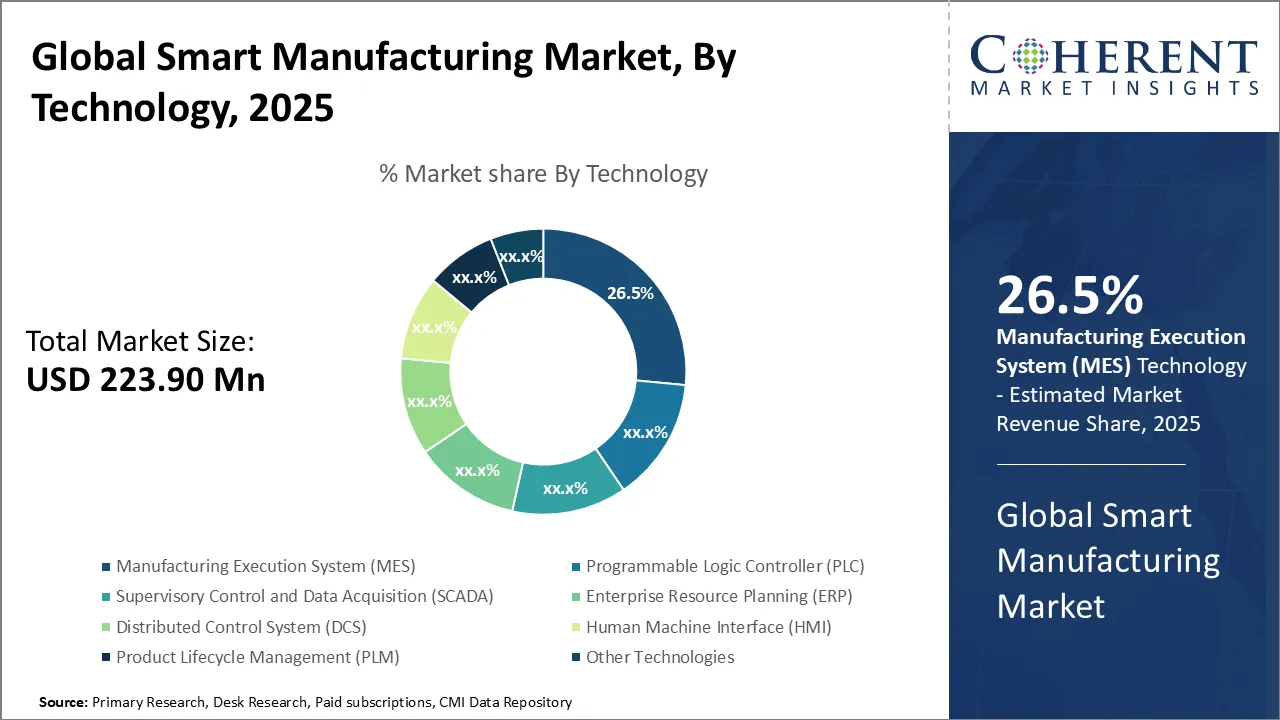
How does MES drive Industry 4.0 with real-time integration and efficiency?
In terms of technology, the manufacturing execution system (MES) segment is expected to lead the market with 27.5% share in 2025 by enabling real-time monitoring, production scheduling, and integration with IoT and AI. It bridges shop-floor operations with enterprise systems, ensuring efficiency, predictive maintenance, and quality control. Its role in digital transformation makes it the backbone of Industry 4.0 adoption worldwide.
For instance, in May 2025, Rockwell Automation released FactoryTalk PharmaSuite 12.00, a new manufacturing execution system (MES) for the pharmaceutical and biopharmaceutical industries. The solution improves real-time monitoring, scalability, and compliance by combining IoT and AI to make production easier. Its modular, cloud-ready design helps with the shift to Industry 4.0, which boosts efficiency and digital innovation in smart manufacturing.
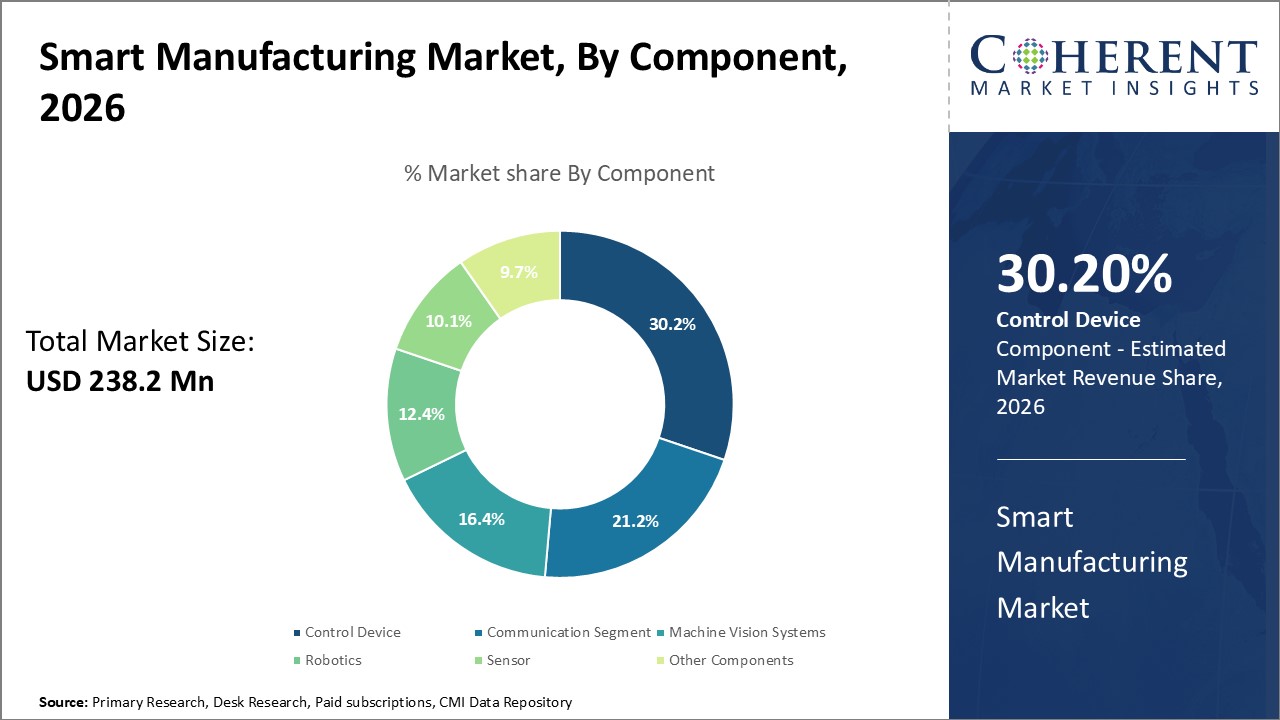
How do control devices drive automation and make hardware the top revenue contributor?
In terms of component, the control devices segment is expected to hold the highest share of the market in 2025. Control devices, including PLCs, sensors, robotics, and machine vision systems, lead the component segment in 2025. They form the foundation of automation, enabling precise control, monitoring, and connectivity across manufacturing processes. Their indispensable role in smart factories drives widespread adoption, making hardware the largest revenue contributor in smart manufacturing.
For instance, in October 2025, OMRON opened its Automation Center in Bengaluru, India. They showcased advanced control devices like PLCs, sensors, robotics, and machine vision systems. The facility helps with the adoption of Industry 4.0 and India's "Make in India" initiative. It does this by encouraging automation, efficiency, and innovation in smart manufacturing in the automotive, food, packaging, and semiconductor industries.
How are EVs, robotics, IoT, and digital twin integration fueling smart manufacturing market?
In terms of end-use industry, the automotive segment is projected to account for 32% share of the market in 2026, driven by electric vehicle production, autonomous technologies, and digital twin integration. Heavy investments in robotics, IoT, and AI-powered assembly lines enhance efficiency and flexibility. Automotive manufacturers lead Industry 4.0 transformation, making this sector the largest consumer of smart manufacturing solutions.
For instance, in February 2025, Hyundai Motor and Samsung have launched private 5G RedCap technology that will assist with smart manufacturing in the automotive industry. The new technology provides secure, low-latency connections for IoT devices, robots, and digital twins, which improves real-time monitoring and predictive maintenance. This partnership makes it easier for companies to adopt Industry 4.0, which helps with the production of electric vehicles and the assembly of next-generation cars.
Regional Insights
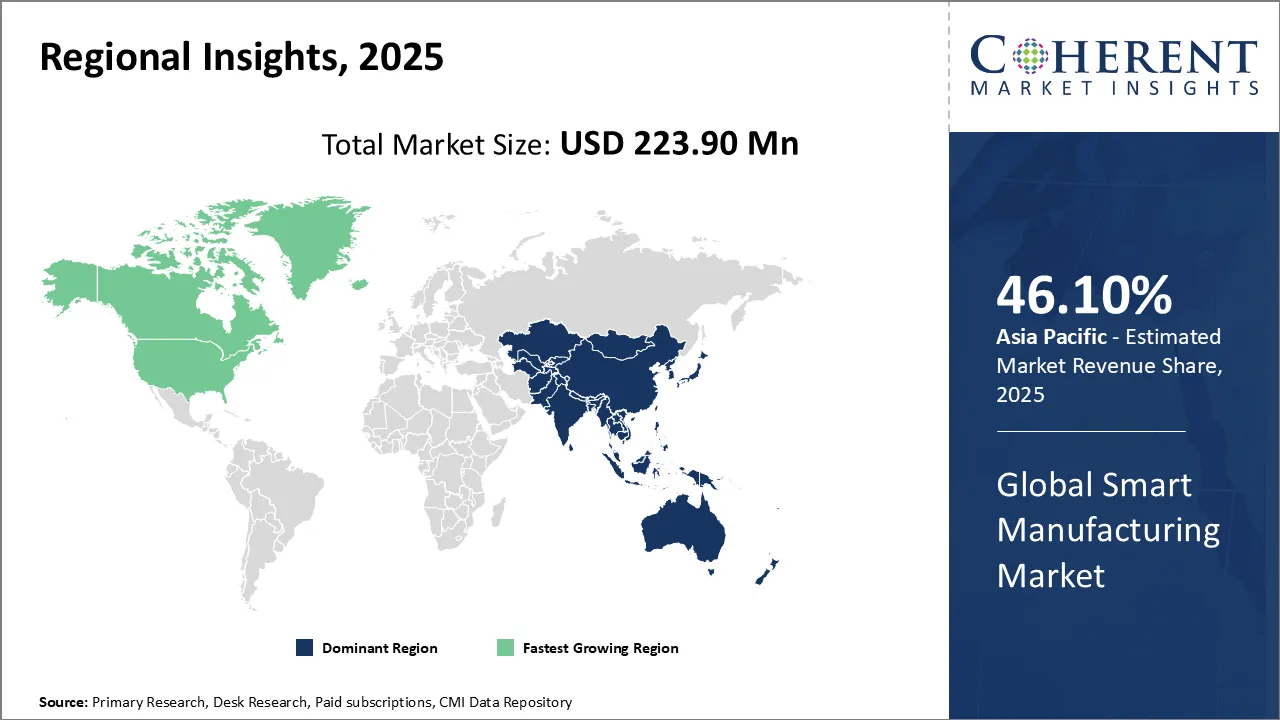
Asia Pacific Smart Manufacturing Market Analysis & Trends
Asia Pacific dominates the smart manufacturing market with 46.1% share in 2026, due to rapid growth of manufacturing industry in countries such as China and India across the region. Manufacturing is one of the major features of China’s economy, which continues to grow. Furthermore, with increasing government initiatives, the manufacturing sector among these countries are witnessing strong growth. Thus, the region is expected to gain substantial growth in the global smart manufacturing market over the forecast period.
For instance, in September 2026, At Electronica India 2026 in Bengaluru, Kyocera unveiled high-tech electronic parts, fine ceramics, sensors, and tools for the industrial sector. These new technologies make smart manufacturing possible by making automation, the Internet of Things (IoT), electric vehicles (EVs), aerospace, and 5G infrastructure possible. The company's high-reliability materials and precision technologies help more businesses adopt Industry 4.0, which leads to more efficiency and digital transformation in all fields.
North America Smart Manufacturing Market Analysis & Trends
North America is expected to exhibit the fastest growing in the global smart manufacturing market over the forecast period. This can be attributed to industrial revolution, in which data is used on a large scale for production, while the data is integrated with a variety of manufacturing systems in the supply chain in the U.S. Moreover, the growing automotive markets in the country, along with increasing economy of Canada with constant growth in past few years are also expected to drive growth of the market in the region.
For instance, in September 2026, In Hagerstown, Maryland, USA, Hitachi Rail opened a $100 million digital smart factory. The facility uses AI, IoT, digital twins, and 3D printing to make 20 railcars every month. It drives the adoption of Industry 4.0 by operating with no carbon emissions and no waste going to landfills. This creates 460 jobs and helps the economy grow in the region.
Smart Manufacturing Market Outlook Country-Wise
China Smart Manufacturing Market Trends
The "Made in China 2026" plan, along with the rise of robotics, industrial automation, and electric vehicle production, will drive demand for smart manufacturing in China in 2026. China is the world leader in Industry 4.0, with more than 54% of new industrial robot installations and the most clean-energy vehicles. It does this by using AI, IoT, and green technologies.
For instance, in November 2026, At the 2026 World Intelligent Manufacturing Conference, China stated it has built more than 7,000 smart factories, including 500 that are at the "excellence" level and 15 that are "pioneer" companies. The industry is now worth 4.5 trillion yuan, making China the world's largest intelligent manufacturing hub and giving the country more power in Industry 4.0.
The U.S. Smart Manufacturing Market Trends
Industry 4.0 adoption, digital twins, AI, IoT, and robotics are going to fuel demand for smart manufacturing in the U.S. in 2026. Investing in sustainability, cybersecurity, and workforce development by the federal government makes businesses more competitive. Advanced automation in the automotive, aerospace, and electronics industries makes things run more smoothly. At the same time, carbon-neutral factories and predictive analytics speed up the digital transformation across the country.
For instance, in November 2026, the National Smart Manufacturing Research Center is scheduled to be built in California, USA, with the support of $7.5 million from Cal Poly Pomona. The center will help Industry 4.0 technologies like AI, IoT, robotics, and digital twins move forward. It will focus on sustainability, workforce development, and innovation to make U.S. smart manufacturing more competitive around the world.
Market Report Scope
Smart Manufacturing Market Report Coverage
| Report Coverage | Details | ||
|---|---|---|---|
| Base Year: | 2025 | Market Size in 2026: | USD 238.2 Mn |
| Historical Data for: | 2020 To 2024 | Forecast Period: | 2026 To 2033 |
| Forecast Period 2026 to 2033 CAGR: | 6.4% | 2033 Value Projection: | USD 367.2 Mn |
| Geographies covered: |
| ||
| Segments covered: |
| ||
| Companies covered: | Yokogawa Electric Corporation, ABB Ltd., Texas Instruments Incorporated, Emerson Electric Company, Siemens AG, Fanuc Corp., Schneider Electric SE, General Electric Co., Rockwell Automation Inc., Honeywell International Inc., Robert Bosch GmbH, and Mitsubishi Electric Corporation | ||
| Growth Drivers: |
| ||
| Restraints & Challenges: |
| ||
Global Smart Manufacturing Market Drivers
Rise in demand for automation to augment growth of the market
Automation has become highly accessible to manufacturers due to development of novel technologies, and this is changing the way of operations among several companies. The demand for automation is increasing all over the world in order to gain efficiency and quality. The adoption of automation has increased in manufacturing sector through smart technologies, as it helps achieve enhanced productivity with efficiency to operate in more protective and advanced environment. Thus, increasing demand for automation is expected to propel growth of the global smart manufacturing market over the forecast period.
Growing requirement for compliance and government support for digitization to boost the market pace
Due to digitization in industries, efficiency and optimum resource management has improved in recent years. Digitization of industrial sector is different in every industry depending on whether the focus is on automation or connected systems. Processing and Manufacturing industries are realizing the potential of using advanced technologies and deploying smart and connected systems, as it enables end-to-end visibility of industrial supply chain. Thus, need for digitization has increased in several sectors including manufacturing, and as a result, it is creating need for compliance and support from government. These factors are anticipated to fuel growth of the global smart manufacturing market over the forecast period.
Global Smart Manufacturing Market Opportunities
Industrial revolution in manufacturing industries is expected to offer several growth opportunities in the global smart manufacturing market over the forecast period. Manufacturing industries around the world are undergoing a revolution, which is also being termed as Industry 4.0 or the fourth industrial revolution. This revolution is being driven by technologies such as IoT, Artificial Intelligence, Cognitive Technologies, Automation, and Machine Learning. Thus, smart factories have now adopted such technologies and have integrated them in their lines of production. These factors thus, are expected to offer multiple opportunities in the market.
Growing industrial automation to create lucrative environment for growth opportunities in the global smart manufacturing market over the forecast period. Along with increasing global inclination towards cost-effective and better-quality control, automation of industrial processes is likely to grow significantly in the coming future. In this, machine learning is anticipated to pay a crucial role in the future in regards with automating complicated operations. Thus, the market will several business opportunities in the coming future.
Global Smart Manufacturing Market Trends
Increasing data monetization is a growing trend in the market
Data monetization is anticipated to play an important role in smart manufacturing in the future. There will be more customization in factories facilitated by demand identifying data, minimizing the downtime required for reset and retool. Along with this, augmented reality is also expected to be a significant feature in the smart manufacturing in the future, specifically in highly complex lines of assembly. Thus, the growing trend of data monetization is expected to propel growth of the market during the forecast period.
Analyst Opinion (Expert Opinion)
The smart manufacturing market is a vital component of modernizing industry, and it is driven by the use of digital technologies in all parts of production. Data from the industry show that most large and medium-sized manufacturers have at least one smart manufacturing solution. Estimates say that about 70% of manufacturers are using technologies like industrial IoT, advanced analytics, artificial intelligence, or automation to make their operations more efficient and make better use of their assets. An increasing number of these systems are being used in discrete, process, and hybrid manufacturing facilities.
Regional deployment trends indicate that Asia Pacific is a major implementation hub. This is due to there are plenty of electronics, automotive, and machinery manufacturing facilities there, and companies are investing in automation. North America continues to leverage cloud-connected manufacturing execution systems and predictive maintenance platforms a lot. In Europe, on the other hand, the focus is on optimizing energy use, creating digital twins, and monitoring processes that are required by law. Surveys show that more than 60% of smart factories use edge computing to make decisions in real time, which reduction down on latency and makes production more responsive.
Digital twins, industrial robotics, and AI-enabled quality inspection are three areas where technology is really taking off. More than two-thirds of advanced manufacturing sites now use digital twins, which help with simulation-based optimization and less downtime. Automotive and electronics manufacturing are still the most important end-use segments due to their supply chains are complicated and they need to be very precise. In general, smart manufacturing is moving from pilot projects to full-scale use in businesses. This could result in more productivity, less unplanned downtime, and better traceability, all of which will contribute to helping the market grow over time.
Speak to the analyst
Want personalized insights?
Take the findings above to one of our principal consultants, or have the report rebuilt around the segments, geographies and competitors you actually track.
Global Smart Manufacturing Market: Key Developments
- In December 2025, LG Innotek released the world's first next-generation smart IC substrate in South Korea. The breakthrough improves the performance of semiconductors, which helps AI, IoT, robotics, and high-performance computing. The innovation makes chips faster and more reliable, which helps Industry 4.0 and smart manufacturing become more popular. This improves efficiency in the automotive, electronics, and industrial sectors.
- In November 2025, In India, Schneider Electric and the Vellore Institute of Technology opened a Smart City and Smart Factory Innovation Center. The facility's main focus is on Industry 4.0 technologies like AI, IoT, robotics, and digital twins. It wants to promote sustainable manufacturing, support research, and prepare future engineers for smart factory ecosystems around the world.
- In July 2025, Delta Electronics opened its Smart Manufacturing Innovation Center at Plant 6 in Zhongli, Taiwan. The facility uses AI, digital twins, and NVIDIA Omniverse to speed up the adoption of Industry 4.0. It provides equipment validation, trial production, and training for workers, making it possible for electronics and semiconductor industries around the world to use smart factory solutions that can grow.
Market Segmentation
- Global Smart Manufacturing Market, By Technology (Revenue, USD Mn, 2021 - 2033)
- Programmable Logic Controller (PLC)
- Supervisory Controller and Data Acquisition (SCADA)
- Enterprise Resource and Planning (ERP)
- Distributed Control System (DCS)
- Human Machine Interface (HMI)
- Product Lifecycle Management (PLM)
- Manufacturing Execution System (MES)
- Other Technologies
- Global Smart Manufacturing Market, By Components (Revenue, USD Mn, 2021 - 2033)
- Communication Segment
- Control Device
- Machine Vision Systems
- Robotics
- Sensor
- Other Components
- Global Smart Manufacturing Market, By End-use Industry (Revenue, USD Mn, 2021 - 2033)
- Automotive
- Semiconductors
- Mining
- Oil & Gas
- Chemicals & Petrochemicals
- Pharmaceuticals
- Aerospace & Defense
- Food & Beverages
- Other End-user Industries
- Global Smart Manufacturing Market, By Geography (Revenue, USD Mn, 2021 - 2033)
- North America
- U.S.
- Canada
- Latin America
- Brazil
- Argentina
- Mexico
- Rest of Latin America
- Europe
- Germany
- U.K.
- France
- Italy
- Russia
- Rest of Europe
- Asia Pacific
- China
- India
- Japan
- Australia
- South Korea
- ASEAN
- Rest of Asia Pacific
- Middle East & Africa
- GCC Countries
- South Africa
- Rest of Middle East & Africa
- North America
- Global Smart Manufacturing Market: Key Companies Insights (Revenue, USD Mn, 2021 - 2033)
- Yokogawa Electric Corporation
- ABB Ltd.
- Texas Instruments Incorporated
- Emerson Electric Company
- Siemens AG
- Fanuc Corp.
- Schneider Electric SE
- General Electric Co.
- Rockwell Automation Inc.
- Honeywell International Inc.
- Robert Bosch GmbH
- Mitsubishi Electric Corporation
Sources
Primary Research Interviews
- Smart Factory Solution Providers
- Industrial Automation & Robotics Manufacturers
- Manufacturing Execution System (MES) Providers
- Industrial IoT (IIoT) Platform Developers
- AI & Advanced Analytics Solution Providers for Manufacturing
- Plant Managers & Operations Heads (Discrete & Process Industries)
- Digital Transformation Consultants
- Others
Databases
- Bloomberg Terminal
- Thomson Reuters Eikon
- IHS Markit
- Euromonitor International
- S&P Global Market Intelligence
- FactSet
- Others
Magazines
- IndustryWeek
- Automation World
- Manufacturing Today
- Control Engineering Magazine
- Robotics Business Review
- Smart Industry Magazine
- Others
Journals
- Journal of Manufacturing Systems
- International Journal of Advanced Manufacturing Technology
- Journal of Intelligent Manufacturing
- IEEE Transactions on Industrial Informatics
- Computers & Industrial Engineering
- Others
Newspapers
- Financial Times
- The Wall Street Journal
- Reuters
- Bloomberg News
- Nikkei Asia
- Others
Associations
- International Society of Automation (ISA)
- Manufacturing Enterprise Solutions Association (MESA International)
- World Economic Forum – Advanced Manufacturing & Production Initiative
- Association for Manufacturing Technology (AMT)
- Industrial Internet Consortium (IIC)
- Others
Public Domain Sources
- U.S. Department of Commerce – National Institute of Standards and Technology (NIST)
- U.S. Department of Energy – Advanced Manufacturing Office
- European Commission – Industry 4.0 & Digital Manufacturing Programs
- World Economic Forum (WEF) Reports
- OECD – Digital Transformation of Manufacturing
- Others
Proprietary Elements
- CMI Data Analytics Tool
- Proprietary CMI Existing Repository of Information for the Last 8 Years
Definition: Smart manufacturing is a technology-driven revolution in the manufacturing industry that uses connected robotics and artificial intelligence. It improves productivity and agility, reduces costs and complexity, and helps businesses prepare for unexpected events.
Get access to 250+ pages report
Every segment, forecast, competitor profile and data table behind the analysis above — available for instant download.
- ESOMAR Member
- ISO 9001:2015 Certified
- D-U-N-S Registered
- GDPR & CCPA Compliant
Missing comfort of reading report in your local language? Find your preferred language:
Transform your Strategy with Exclusive Trending Reports
Frequently Asked Questions
The Smart Manufacturing Market is estimated to be valued at USD 238.2 Mn in 2026, and is expected to reach USD 367.2 Mn by 2033.
The CAGR of the Smart Manufacturing Market is projected to be 6.4% from 2026 to 2033.
Rise in demand for automation and growing requirement for compliance and government support for digitization are fuelling the market.
The Pharmaceutical segment is the leading component segment in the market.
Data security related concerns and high cost of installation are the major factors restraining the market.
Yokogawa Electric Corporation, ABB Ltd., Texas Instruments Incorporated, Emerson Electric Company, Siemens AG, Fanuc Corp., Schneider Electric SE, General Electric Co., Rockwell Automation Inc., Honeywell International Inc., Robert Bosch GmbH, and Mitsubishi Electric Corporation