

Artificial Intelligence in Sports Market Size and Forecast – 2026 to 2033
The Global Artificial Intelligence in Sports Market is estimated to be valued at USD 9.80 Bn in 2026 and is expected to reach USD 50.69 Bn by 2033, exhibiting a compound annual growth rate (CAGR) of 26.5% from 2026 to 2033.
Key Takeaways
- By Component, Software holds the largest market share of 59.8% in 2026 owing to the data-driven decision making.
- By Deployment, Cloud-based acquired the prominent market share of 56.6% in 2026 on account of its scalability & elastic resource utilization.
- By Application, Data Interpretation & Analysis expected to hold largest market share of 41.6% in 2026 owing to the explosion in data volume & variety.
- By Region, North America dominates the overall market with an estimated share of 36.2% in 2026 owing to the presence of major professional leagues & heavy investment.
Market Overview
Sports organizations are rapidly driving the Artificial Intelligence in Sports market growth by increasingly adopting data-driven decision-making. AI technologies actively enhance player performance analysis, injury prevention, tactical planning, and fan interaction. The use of wearables, computer vision, and real-time analytics boosts both on-field efficiency and audience engagement. Major stakeholders—such as professional leagues, tech firms, and startups—are investing in AI-powered solutions, fueling innovation and making the market more dynamic across key regions like North America, Europe, and Asia-Pacific.
Current Events and Its Impact
Current Events | Description and its impact |
Technological Advancements in AI and Sports Analytics |
|
Economic Trends and Investment Flows |
|
Ethical and Social Considerations Influencing Market Acceptance |
|
End-user Feedback and Unmet Needs in the Artificial Intelligence in Sports Market
- Need for Sport-Specific AI Solutions: End-users report that many AI tools are too generic and not tailored to specific sports. Coaches and analysts seek sport-specific models that understand game rules, roles, and metrics. Customization for sports like cricket, tennis, or rugby remains limited, leaving teams to adapt general tools rather than receive dedicated solutions.
- Demand for Real-Time, Actionable Insights: Coaches and teams often find AI insights too delayed or overly complex to act on during live games or training sessions. There’s growing demand for simplified, real-time analytics that provide clear decisions or alerts—especially during tactical adjustments, substitution timing, or injury risk detection—rather than post-match reviews alone.
- Concerns Over Data Accuracy and Consistency: End-users frequently highlight issues with inconsistent data from wearables, video feeds, or tracking systems. Small inaccuracies in speed, distance, or player positioning can skew outcomes. Many teams want more reliable data collection methods and improved calibration of AI models to avoid misleading insights that can impact performance decisions.
- Current Industry Events of 2026
- Market Size Estimation
- Regional Breakdown
- Competitive Landscape
- Customer Intelligence
- Segmental Analysis
- Pricing Analysis
- Key Market Drivers, Challenges & Future Trends
- Customized Insights Section
Segmental Insights
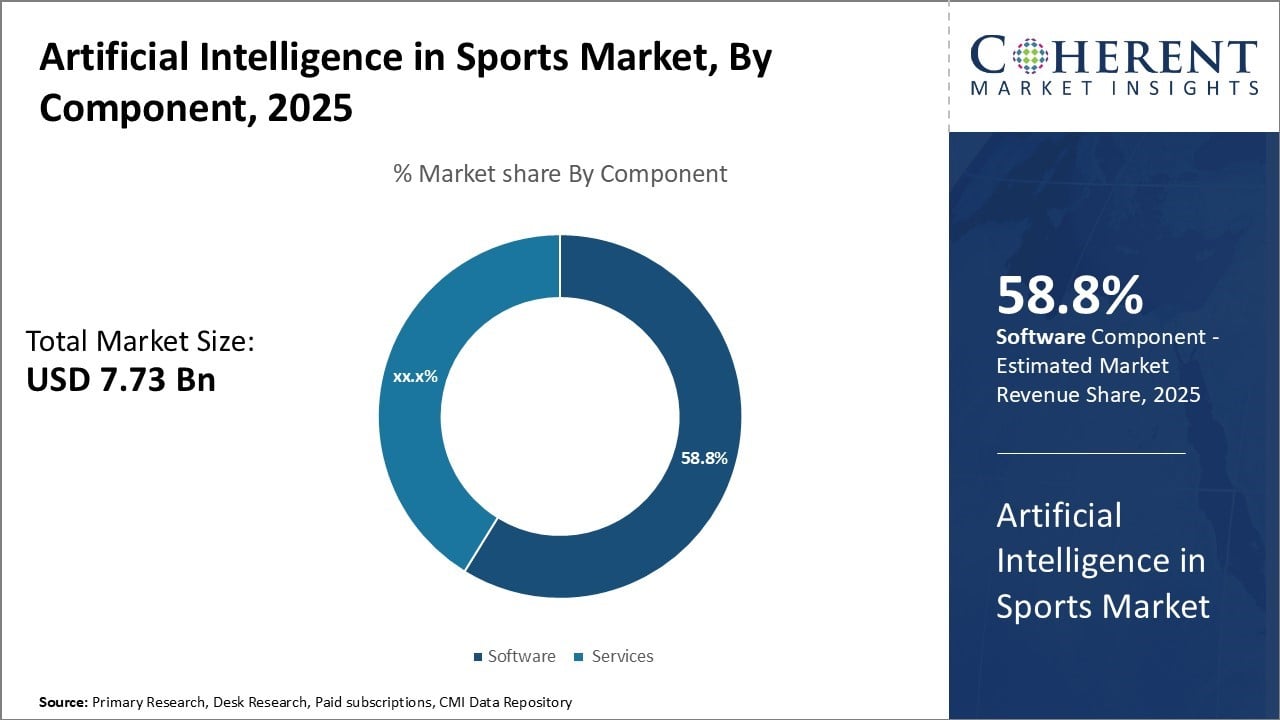
Artificial Intelligence in Sports Market Insights, by Component - Software contributes the highest share of the market owing to its fan engagement & personalized experience
Software holds the largest market share of 59.8% in 2026. Software tools leverage sophisticated algorithms and machine learning models to process extensive data streams from diverse sources, including sports video footage, sensor data from venues and equipment, and social media. This capability facilitates in-depth statistical analysis of players, teams, and matches, enabling accurate outcome predictions and performance enhancement. Additionally, software solutions support simulation and virtual reality training for athletes, while providing coaching staff with advanced tactical analysis. With cloud-based deployment, these tools can be easily updated and scaled to meet the evolving demands of the sports industry.
In June 2025, Fastbreak AI, a top sports operations software company, launched its new AI Schedule Engine within the Fastbreak Compete platform. Designed for large, complex amateur sports tournaments, the tool lets organizers quickly create complete, ready-to-use schedules in minutes—even for events with hundreds of teams and multiple venues.
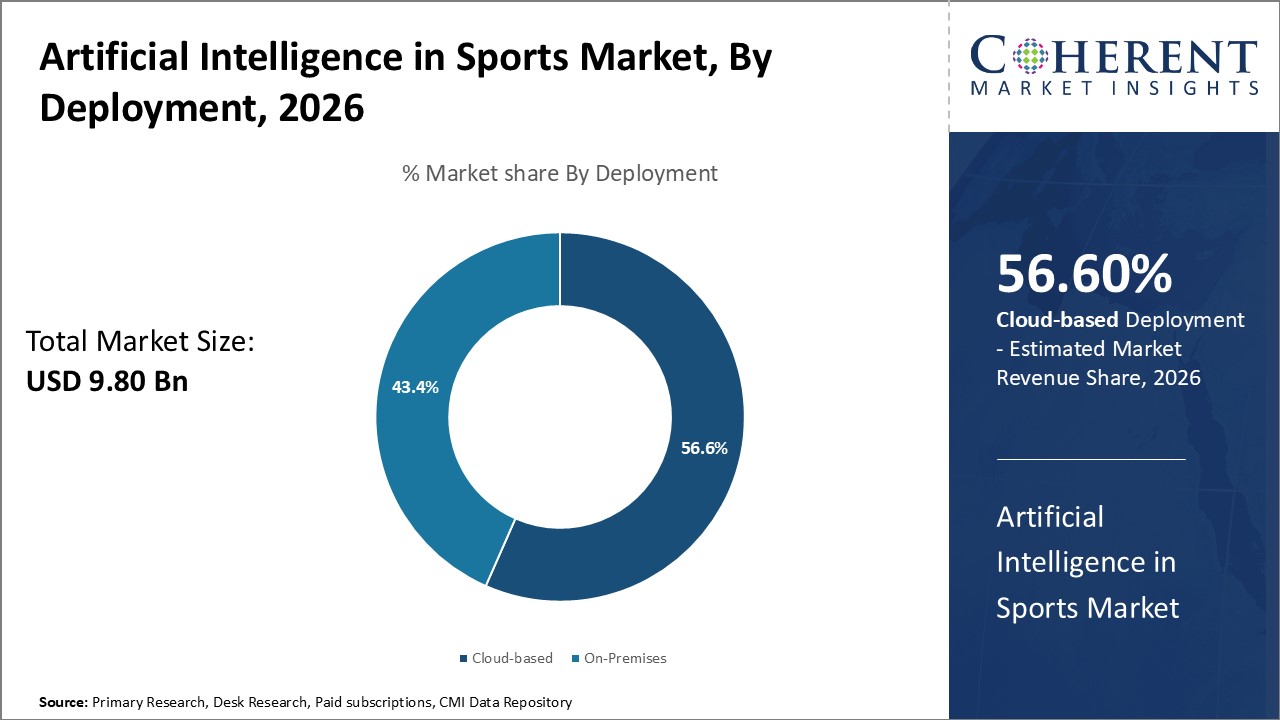
Artificial Intelligence in Sports Market Insights, by Deployment - Cloud-Based contribute the highest share of the market owing to its global access & collaboration
Cloud-based acquired the prominent market share of 56.6% in 2026. Cloud models allow artificial intelligence solutions in sports to harness massive amounts of computing power on-demand based on real-time needs. This helps sporting organizations avoid hefty and recurrent infrastructure and maintenance costs of on-premise servers. Cloud technology facilitates continuous upgrades of AI tools through the latest algorithm and model enhancements provided by vendors. Its pay-as-you-go pricing model is particularly advantageous for budget-constrained sports teams and leagues, offering a more flexible alternative to the lengthy procurement processes associated with on-premise licenses. Additionally, cloud solutions enable 24/7 global access to AI capabilities via web and mobile platforms, supporting remote coaching and training initiatives.
For instance, in September 2025, Vizrt, a live production technology provider for broadcast and sports, launched Viz Arena 6, its latest AR graphics and virtual advertising solution for live sports, which can run on-premises or in the cloud.
Artificial Intelligence in Sports Market Insights, by Application - Data Interpretation & Analysis contribute the highest share of the market owing to its increase in sensor‑based & wearable tech
Data Interpretation & Analysis expected to hold largest market share of 41.6% in 2026. Sports AI tools evaluating massive historical and real-time data sources can recognize intricate patterns to predict individual player and team performance with greater accuracy. Coaching staff leverage these insights to develop strategic recruitment, training, and tactical plans. Concurrently, comprehensive data analysis enables teams and leagues to enhance fan engagement through targeted marketing strategies, customized ticket pricing, and tailored merchandise designs. Moreover, data analytics tools are increasingly employed to adjudicate close finishes in matches by analyzing high-frame-rate video data. These objective assessments have improved transparency and resolved disputes in numerous instances. In June 2025, Gaming and esports data company GRID Esports has introduced GRID Insights, an artificial intelligence (AI)-powered analytics product designed to enhance the viewing experience for esports broadcasts and betting applications. This development signifies a notable advancement in leveraging AI for data-driven insights within the rapidly evolving esports commercial ecosystem.
Regional Insights
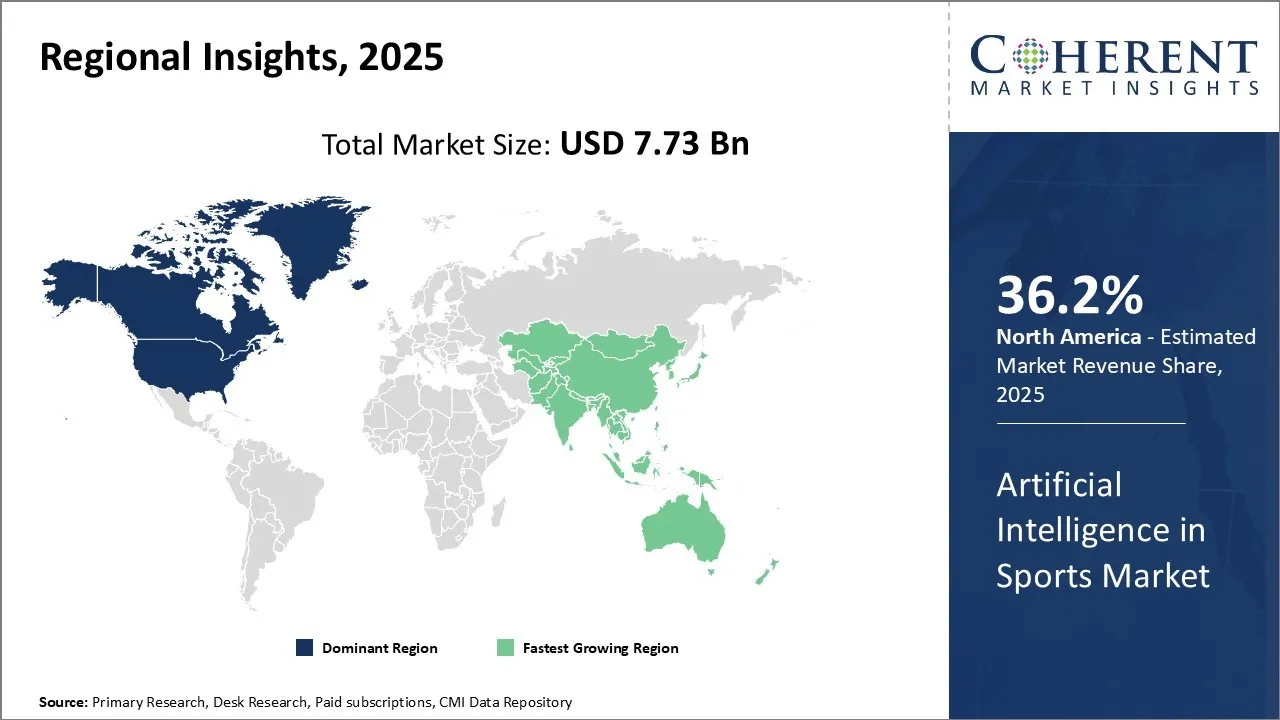
North America Artificial Intelligence in Sports Market Trends
North America dominates the overall market with an estimated share of 36.2% in 2026. North America's Artificial Intelligence in Sports market is advancing quickly as professional sports leagues and teams actively integrate AI to enhance performance, strategy, and fan engagement. Organizations across the region utilize cutting-edge technology, including wearables and cloud-based platforms, to gather and analyze data in real time. Tech giants and sports franchises are forming strategic partnerships to accelerate AI adoption. Meanwhile, media companies apply AI to improve broadcasting and personalized content delivery, and startups drive innovation with tailored solutions for athletes and audiences alike. For instance, in June 2026, Affinity Interactive’s Daily Racing Form collaborated with Horseshoe Indianapolis to launch “A.I. Alan,” the industry’s first virtual AI handicapper, enhancing analytics and fan engagement.
Europe Artificial Intelligence in Sports Market Trends
Sports organizations across Europe are actively driving the growth of the Artificial Intelligence in Sports market by focusing on data analytics to improve training, performance, and game strategy. Football clubs are at the forefront, using AI for scouting, injury prevention, and tactical decisions. Academic institutions, technology companies, and sports bodies are collaborating to fuel innovation. Broadcasters and digital platforms are adopting AI to deliver personalized and interactive experiences, while supportive regulations and investment efforts promote broader adoption across the region.
United States Artificial Intelligence in Sports Market Trends
Teams, leagues, and media companies in the United States are actively driving the growth of the Artificial Intelligence in Sports market by integrating AI to enhance competitiveness. Professional sports franchises are using AI for player tracking, performance analysis, and injury prevention. Tech companies are partnering with sports organizations to create tailored AI solutions. AI-powered tools are transforming fan engagement through real-time data, automated highlight reels, and personalized content. Meanwhile, universities and startups are pushing innovation through dedicated research and development efforts. For instance, in August 2024, ESPN planned to add local broadcasts to its upcoming DTC service and explore AI to deliver personalized versions of its iconic SportsCenter show.
United Kingdom Artificial Intelligence in Sports Market Trends
Clubs, broadcasters, and training institutions in the United Kingdom are actively driving the growth of the Artificial Intelligence in Sports market by adopting AI to boost performance and fan engagement. Football clubs are using AI for tactical planning, player fitness tracking, and talent identification. Broadcasters apply AI to automate commentary, deliver insights, and enrich the viewing experience. Sports science centers and universities are developing innovative AI applications, while tech startups collaborate with established sports bodies to strengthen the overall ecosystem. For instance, in February 2026, UK-based FairPlay Sports Media has strengthened its presence in artificial intelligence by launching FairPlay AI, a new business arm that combines its AI technology services with the deep-learning neural network Quarter4.
Market Dynamics
Artificial Intelligence in Sports Market Trend
Personalized Fan Engagement Experiences
AI is revolutionizing how sports franchises interact with fans by enabling hyper-personalized experiences. From content recommendations and real-time statistics to customized merchandise offers and chatbots, AI tailors engagement to individual preferences. Sports apps and digital platforms are integrating machine learning to keep fans engaged beyond match time. This trend enhances loyalty, increases monetization opportunities, and transforms spectators into long-term digital consumers. Teams and media platforms are leveraging these insights to build stronger emotional connections and brand loyalty.
Artificial Intelligence in Sports Market Opportunity
Integration of Augmented and Virtual Reality with AI
Combining AI with AR and VR technologies opens new avenues for immersive fan experiences and athlete training. Virtual simulations enhanced by AI can improve tactical understanding and skill development without physical strain. Fans can enjoy personalized, interactive viewing through augmented overlays, real-time stats, and immersive broadcasts. This intersection creates opportunities for sports organizations and tech developers to redefine engagement and training paradigms, offering differentiated experiences that merge data insights with immersive technology.
In September 2025, Vizrt launched Viz Arena 6, the latest version of its live AR graphics and virtual advertising tool for sports. The update includes built-in AI that simplifies calibration, keying, and masking, making it much easier for broadcasters to add AR graphics to live sports events.
Market Report Scope
Report Coverage
| Report Coverage | Details | ||
|---|---|---|---|
| Base Year: | 2025 | Market Size in 2026: | USD 9.80 Bn |
| Historical Data for: | 2020 To 2024 | Forecast Period: | 2026 To 2033 |
| Forecast Period 2026 to 2033 CAGR: | 26.5% | 2033 Value Projection: | USD 50.69 Bn |
| Geographies covered: |
| ||
| Segments covered: |
| ||
| Companies covered: | Amazon Web Services, Inc., Apple Inc., Catapult Group International Ltd, Fujitsu Limited, Google LLC, IBM Corporation, Intel Corporation, Microsoft Corporation, Movella Holdings Inc., NEC Corporation, Oracle Corporation, Perform Group, Qualcomm Technologies, Inc., Salesforce.com Inc., and SAS Institute, Inc. | ||
| Growth Drivers: |
| ||
| Restraints & Challenges: |
| ||
Artificial Intelligence in Sports Market News
- In June 2025, Meta partnered with Oakley to launch AI-powered glasses, expanding its wearable tech line following the success of Ray-Ban Meta glasses and strengthening ties with EssilorLuxottica.
- In December 2024, Global sports company PUMA and Manchester City have launched the PUMA AI Creator tool, powered by DEEPOBJECTS, enabling fans to design their own PUMA Manchester City kits using generative AI.
Analyst Opinion (Expert Opinion)
- The Artificial Intelligence in Sports market merely evolving the way athletic performance and fan engagement are approached. The real game-changer lies in AI’s ability to process and interpret vast, complex datasets in real-time, which was impossible even five years ago. For instance, teams like the NBA’s Golden State Warriors leverage AI-driven player tracking systems from Second Spectrum to gain granular insights into player positioning and movement patterns, translating directly into strategic advantages on the court.
- Moreover, AI’s impact on injury prevention is revolutionary. Studies show that over 50% of injuries in professional football (soccer) are preventable through early detection of fatigue and stress patterns—a domain where AI-powered wearables and machine learning algorithms excel. Clubs like Manchester United employ AI-driven monitoring to fine-tune player workloads, reducing downtime and safeguarding player value.
- In the broadcasting arena, AI-powered automated highlight generation is accelerating content delivery speeds. ESPN’s use of AI to create instant game summaries demonstrates how media companies can maintain viewer engagement in a digital-first era, adapting to shrinking attention spans. However, it’s critical to acknowledge that the technology’s full potential is constrained by data quality and integration challenges, particularly in smaller leagues lacking standardized data collection.
Speak to the analyst
Want personalized insights?
Take the findings above to one of our principal consultants, or have the report rebuilt around the segments, geographies and competitors you actually track.
Market Segmentation
- Component Insights (Revenue, US$ Bn, 2021 - 2033)
- Software
- Services
- Deployment Insights (Revenue, US$ Bn, 2021 - 2033)
- Cloud-based
- On-Premises
- Application Insights (Revenue, US$ Bn, 2021 - 2033)
- Player Analysis
- Fan Engagement
- Data Interpretation & Analysis
- Others
- Regional Insights (Revenue, US$ Bn, 2021 - 2033)
- North America
- U.S.
- Canada
- Latin America
- Brazil
- Argentina
- Mexico
- Rest of Latin America
- Europe
- Germany
- U.K.
- Spain
- France
- Italy
- Russia
- Rest of Europe
- Asia Pacific
- China
- India
- Japan
- Australia
- South Korea
- ASEAN
- Rest of Asia Pacific
- Middle East & Africa
- GCC Countries
- Israel
- South Africa
- Rest of Middle East & Africa
- Key Players Insights
- Amazon Web Services, Inc.
- Apple Inc.
- Catapult Group International Ltd
- Fujitsu Limited
- Google LLC
- IBM Corporation
- Intel Corporation
- Microsoft Corporation
- Movella Holdings Inc.
- NEC Corporation
- Oracle Corporation
- Perform Group
- Qualcomm Technologies, Inc.
- Salesforce.com Inc.
- SAS Institute, Inc.
Sources
Primary Research interviews
- Industry experts from leading sports technology companies
- Professional athletes and coaches
- Sports analytics professionals
- AI developers specializing in sports applications
Databases
- IEEE Xplore Digital Library
- PubMed Central
- Sports Reference databases
- FIFA and IOC official statistics portals
Magazines
- Sports Illustrated
- Wired (Technology section)
- MIT Technology Review (Sports & AI segments)
- AI Magazine
Journals
- Journal of Sports Analytics
- IEEE Transactions on Neural Networks and Learning Systems
- Journal of Artificial Intelligence Research
- International Journal of Computer Science in Sport
Newspapers
- The New York Times (Sports & Technology sections)
- The Guardian (Sports and Tech news)
- The Wall Street Journal (Technology & Sports)
- ESPN News
Associations
- International Society of Sports Nutrition
- Association for the Advancement of Artificial Intelligence (AAAI)
- International Association of Sports Sciences
- Sports Technology Association
Public Domain sources
- Government reports on sports technology initiatives
- Open datasets from Kaggle related to sports and AI
- Research papers available on arXiv
- Official sports event data released by governing bodies
Proprietary Elements
- CMI Data Analytics Tool, and Proprietary CMI Existing Repository of information for last 8 years
Get access to 250+ pages report
Every segment, forecast, competitor profile and data table behind the analysis above — available for instant download.
- ESOMAR Member
- ISO 9001:2015 Certified
- D-U-N-S Registered
- GDPR & CCPA Compliant
Missing comfort of reading report in your local language? Find your preferred language:
Transform your Strategy with Exclusive Trending Reports
Frequently Asked Questions
The Artificial Intelligence in Sports Market is estimated to be valued at USD 9.80 Bn in 2026, and is expected to reach USD 50.69 Bn by 2033.
The CAGR of the Artificial Intelligence in Sports Market is projected to be 26.5% from 2026 to 2033.
Expanding use of analytics and data science and increasing adoption of smart wearable devices are the major factors driving the growth of the global artificial intelligence in sports market.
High costs of AI solutions and data privacy and security concerns are the major factors hampering the growth of the global artificial intelligence in sports market.
In terms of Component, Software is estimated to dominate the market in 2026.
Amazon Web Services, Inc., Apple Inc., Catapult Group International Ltd, Fujitsu Limited, Google LLC, IBM Corporation, Intel Corporation, Microsoft Corporation, Movella Holdings Inc., NEC Corporation, Oracle Corporation, Perform Group, Qualcomm Technologies, Inc., Salesforce.com Inc., and SAS Institute, Inc. are the major players.
North America is expected to lead the global artificial intelligence in sports market.