

Managed Mobility Services Market Size and Trends - 2026 to 2033
The managed mobility services market is estimated to be valued at USD 38.81 Bn in 2026 and is expected to reach USD 237.05 Bn by 2033, growing at a compound annual growth rate (CAGR) of 29.5% from 2026 to 2033.
Key Takeaways
- Based on Function, the Device Management segment is expected to lead the market with 36.2% share in 2026, driven by rising mobile device adoption and the need for secure, streamlined enterprise mobility.
- Based on Organization Size, the Large Organization segment is expected to capture 69% share of the market in 2026, driven by high device volumes and growing reliance on scalable, cloud-based mobility solutions.
- Based on Industry Vertical, the Telecom and IT segment is projected to account for 31.11% share of the market in 2026, driven by mobile-centric operations and demand for lifecycle management.
- Based on Region, North America is set to lead the managed mobility services market with 39.1% share in 2026. While, Asia Pacific is anticipated to be the fastest growing region.
Market Overview
The managed mobility services market is witnessing prominent growth trends such as increasing adoption of BYOD policies across enterprises and growing importance of mobility in business operations. Many organizations are opting for managed mobility services to empower their mobile workforce, gain visibility, and control over mobile assets, strengthen security posture, and optimize IT operations. This trend is expected to continue as mobile workforces grow and the need to manage associated endpoints and networks remotely increases. Growth in enterprise mobility, coupled with demand for managed services is expected to drive the managed mobility services market demand during the forecast period.
Current Events and Its Impacts on the Managed Mobility Services Market
Current Event | Description and Its Impact |
5G Network Global Rollout and Infrastructure Development |
|
Regulatory Compliance Evolution and Privacy Legislation |
|
Micro And Macro Economical Factors Affecting the Managed Mobility Services Market
Micro economic Factors
These are internal, company-level, or industry-specific factors that have a direct effect on the supply and demand for MMS
- IT Spending by Businesses
- Businesses that spend more on IT are more likely to hire outside help to manage and support mobile devices.
- The need for MMS to lower in-house IT costs is driven by pressures to cut costs.
- Trends in BYOD and Workforce Mobility
- The growth of remote and hybrid workforces makes the need for secure, scalable mobile management even greater.
- Bring Your Own Device (BYOD) policies need strong MMS platforms to handle a wide range of endpoints.
- Competition and Innovation Among Vendors
- MMS providers compete on the range of services they offer, their security features, and their ability to integrate with other systems.
- New ideas in AI-driven analytics, Zero Trust security, and unified endpoint management (UEM) make value propositions stronger.
- Customer Preferences and Service Customization
- Businesses want MMS solutions that are tailored to their compliance, scalability, and support needs.
- More and more people want bundled services, like TEM, MDM, and support.
Macro economic Factors
These are greater, outside forces that affect the whole MMS market
- Digital Transformation and Government Policy
- National and regional programs like India's Digital India and the EU's Digital Decade speed up the adoption of enterprise mobility.
- The modernization of the public sector increases the need for secure MMS in the military and government.
- Global Labor Trends
- As more people work from home and in the gig economy, mobile-first infrastructure becomes more important.
- Businesses need MMS to safely hire, manage, and support remote workers.
- Rules about cybersecurity and data privacy
- Laws like GDPR, HIPAA, and India's DPDP Act require strict mobile data governance.
- MMS platforms help businesses make sure their employees follow the rules and lower the risks of mobile security.
- Economic Uncertainty and Cost Pressures
- When the economy slows down, companies may hire someone else to handle mobility management to save money.
- On the other hand, budget limits can slow down the adoption of MMS in sectors that are sensitive to costs.
- Technology Infrastructure and 5G Rollout
- The growth of 5G networks makes mobile experiences more immersive and allows for IoT integration, which makes MMS more complicated and in higher demand.
- The need for centralized mobile management is also growing due to cloud adoption and edge computing.
- Current Industry Events of 2026
- Market Size Estimation
- Regional Breakdown
- Competitive Landscape
- Customer Intelligence
- Segmental Analysis
- Pricing Analysis
- Key Market Drivers, Challenges & Future Trends
- Customized Insights Section
Segmental Insights
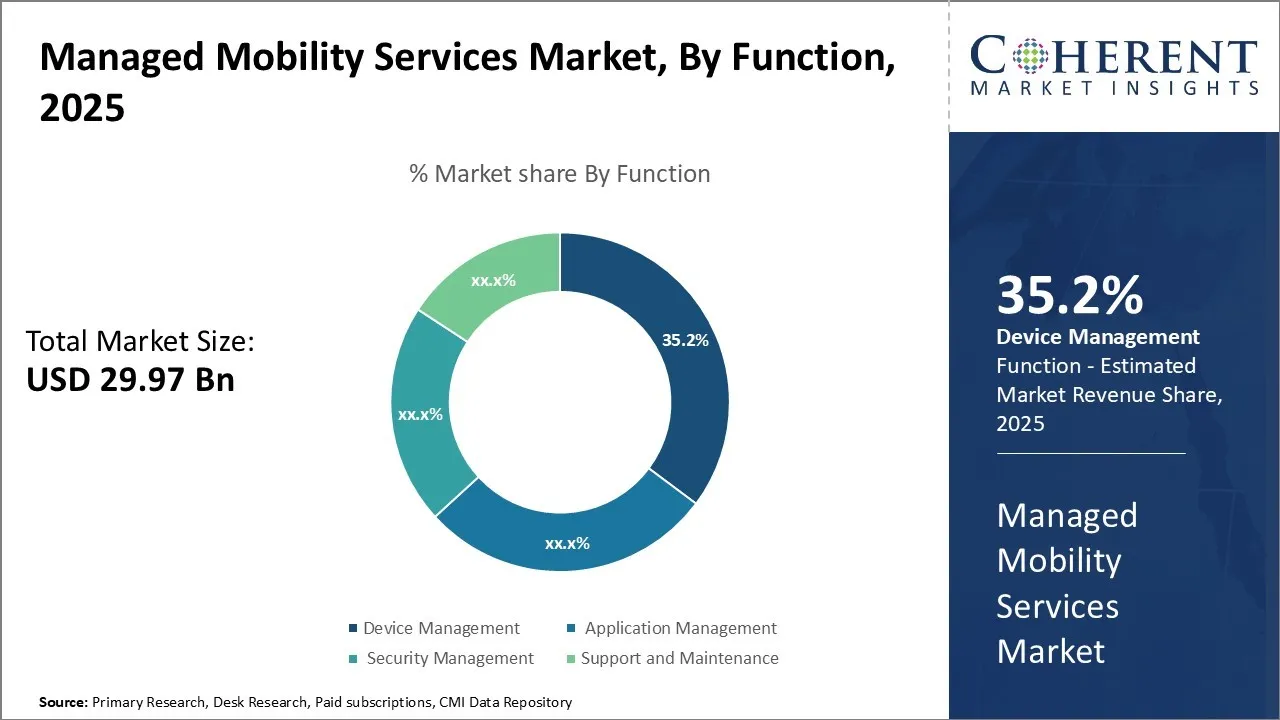
Managed Mobility Services Market Insights, By Function: Device Management Lead Is Driven by Rising Mobile Device Adoption and The Need for Secure, Streamlined Enterprise Mobility
In terms of function, device management segment is expected to contribute the highest share of 36.2% in 2026, owing to the massive proliferation of connected mobile devices such as smartphones, tablets, and laptops among enterprises. As businesses increasingly adopt mobile technologies to boost workforce productivity, the complexities of managing a diverse fleet of employee-owned and company-provided devices have significantly increased.
Device management solutions help IT teams gain total visibility and control over these devices, allowing them to configure security settings, provision user profiles, install apps, enforce compliance policies, and remotely wipe or lock devices if lost or stolen.
For instance, in September 2025, The DeKalb County School District chose Stratix Corporation to handle more than 110,000 Chromebooks and laptops. Stratix's itrac360 platform is used for device lifecycle management, repairs, logistics, and mobile asset tracking as part of the partnership. This project shows that Stratix is a leader in Managed Mobility Services, especially when it comes to managing a great deal of devices for schools.
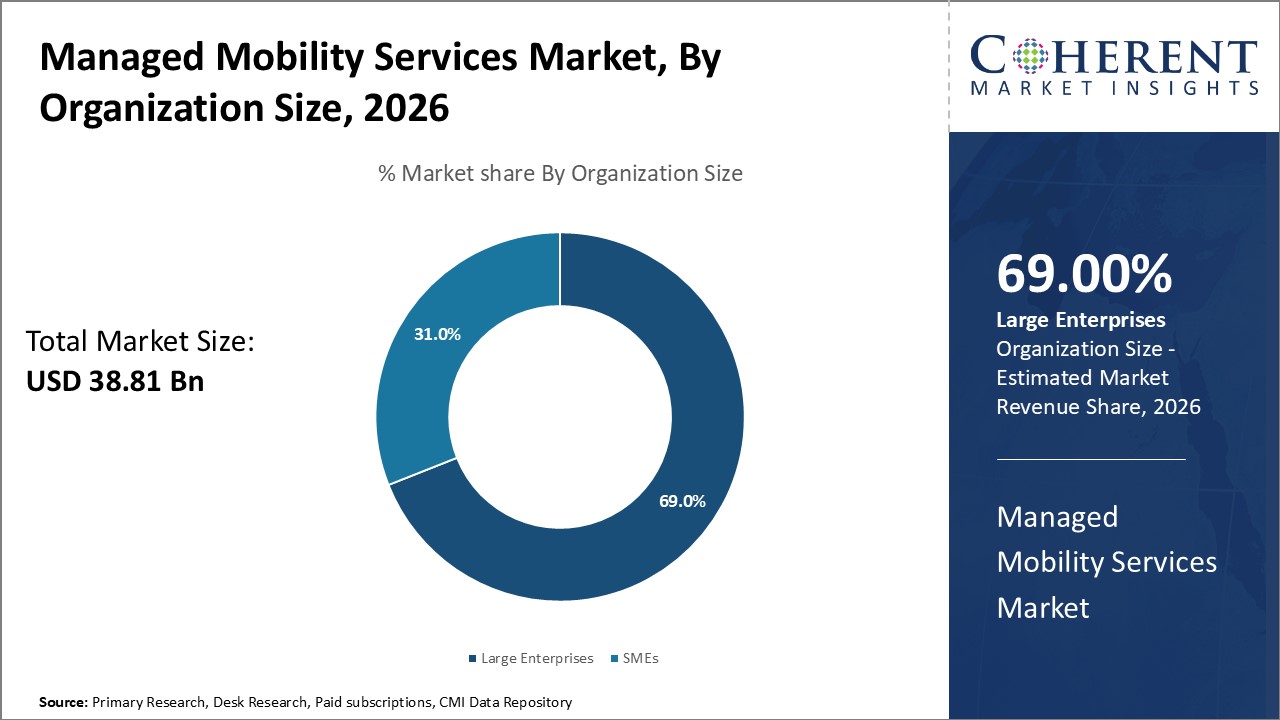
Managed Mobility Services Market Insights, By Organization Size: Large Enterprises Dominance Is Driven by High Device Volumes and Growing Reliance on Scalable, Cloud-Based Mobility Solutions
In terms of organization size, large enterprises segment is expected to contribute the highest share of 69% in 2026. Large enterprises have much higher mobile device deployments compared to SMEs. They are also under pressure to enhance business productivity across dispersed workforces. However, managing thousands of mobile devices poses several operational challenges for in-house IT teams of large enterprises. This has pushed them to outsource non-core tasks like managing, monitoring and securing devices to MMS providers.
For instance, in April 2025, Deloitte and Equus Software teamed up to change the way businesses manage global mobility. The goal of the partnership is to make it easier for multinational companies to deal with complicated cross-border talent mobility issues by combining Equus's mobility technology with Deloitte's consulting skills. This will make mobile workforce operations run more smoothly, improve compliance, and make the user experience better.
Managed Mobility Services Market Insights, By Industry Vertical: Telecom and IT Lead Is Driven by Mobile-Centric Operations and Demand for Lifecycle Management
In terms of industry vertical, telecom and IT expected to contribute the highest share of 31.11% in 2026. The intense mobilization of work environments has made managing and securing mobile endpoints an essential function for telecom operators and IT companies. As leading digital enablers serving high mobile user bases, the success of their own business models partly depends on effective mobile lifecycle management.
Telecom operators, in particular, have a significant opportunity to grow by delivering value-added mobility management services to their enterprise customers. It strengthens customer stickiness while opening up a new subscription and transaction-based revenue stream.
IT companies also recognize mobility as a pivotal technology for elevating client experiences. Adopting managed services helps telecom and IT firms ensure their hosted applications and networks are accessible across all types of mobile endpoints.
Overall, mobility forms the core of digital transformation and addressing management challenges around it holds strategic importance for telecom and IT verticals.
For instance, in October 2025, Tata Communications and BSNL teamed up to bring eSIM services to every corner of India. This means that people can connect to the internet on their phones without having to use physical SIM cards. This program helps businesses manage and set up mobile devices from a distance, which makes them more mobile. The partnership is a big step forward for the telecom industry in terms of improving digital infrastructure and managed mobility capabilities.
Regional Insights
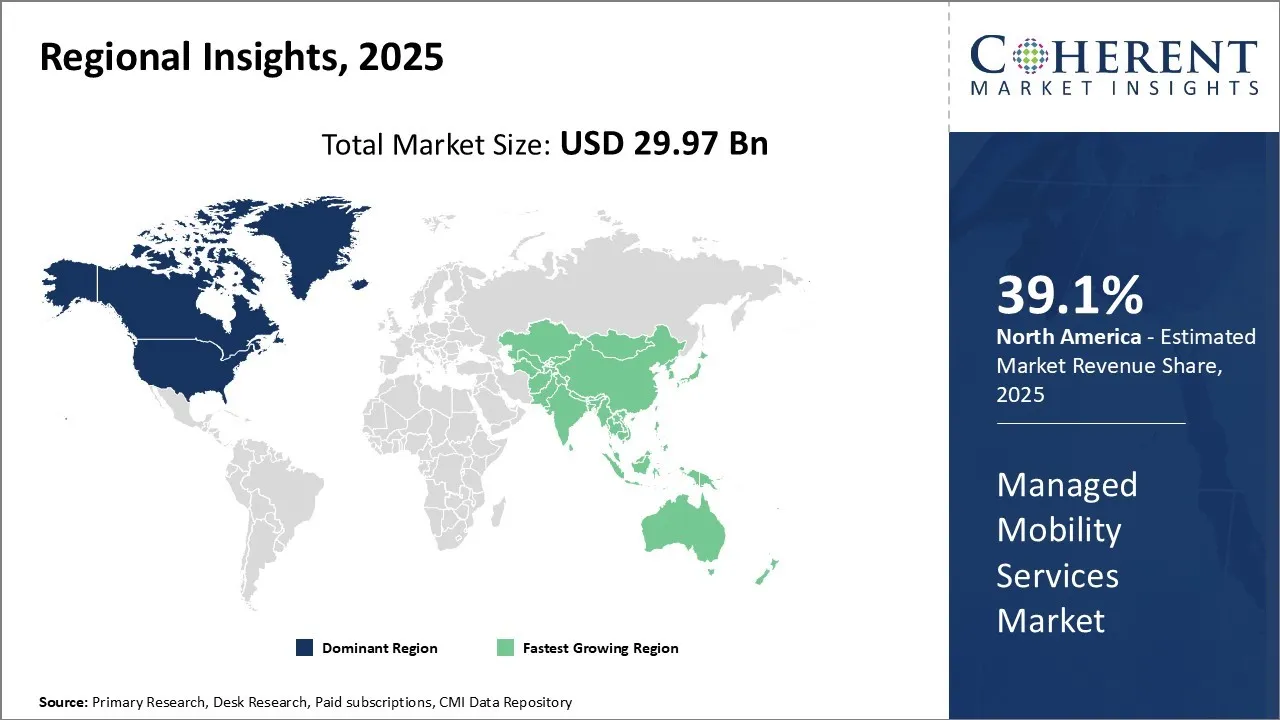
North America Managed Mobility Services Market Analysis & Trends
North America has been the dominant region in the managed mobility services market for the past decade. The region is expected to account for 39.1% of the global market share in 2026, due to strong demand from large enterprises across sectors such as banking, retail, healthcare, and manufacturing.
Many advanced digital solutions pioneers are headquartered in the U.S. and have substantial operations across the region. This has boosted the adoption of managed mobility services for securely managing and supporting an increasingly mobile workforce.
For instance, in November 2026, Stratix Corporation acquired Mobility CG to grow its Managed Mobility Services business across North America. The merger gives Stratix more power in managing the lifecycle of devices, integrating carriers, and supporting businesses. The new company wants to provide large organizations and public-sector clients with scalable, end-to-end mobility solutions that can be used in sectors like healthcare, retail, and government.
Asia Pacific Managed Mobility Services Market Analysis & Trends
Asia Pacific has emerged as the fastest growing market with 34.18% CAGR for managed mobility services in 2026. The growth can be attributed to rapid digital transformation initiatives undertaken by companies to improve productivity amid growing regional economies. Countries like China, India and others present a compelling opportunity due to growing industries, rapid urbanization and increasing spend on advanced technologies.
For instance, in October 2026, Asia Mobiliti and Theoremus came together to bring AI-powered mobility solutions to Asia and Eastern Europe. The goal of the partnership is to improve transportation in cities by using real-time data, predictive analytics, and smart infrastructure. This project helps cities become smarter and makes it easier for businesses and governments to manage mobility in evolving mobility ecosystems.
Managed Mobility Services Market Outlook Country-Wise
The U.S. Managed Mobility Services Market Trends
The U.S. Managed Mobility Services market is growing rapidly as many businesses are using mobile devices, more individuals are using the cloud, and there is a need for safe device management. Increasingly, large businesses are hiring MMS providers to handle mobile lifecycle tasks for them. This helps them lighten their IT load, boost productivity, and support workers who work from home. This trend is causing strong growth in fields like healthcare, retail, and logistics.
For instance, in October 2026, Tangoe obtained MOBI to make its position as a global leader in Managed Mobility Services even stronger. The merger makes Tangoe better at managing the mobile lifecycle, keeping telecom costs down, and providing cloud services. The new company will focus on business clients, especially in North America, and will offer scalable, end-to-end mobility solutions in markets around the world.
Australia Managed Mobility Services Market Trends
The Managed Mobility Services (MMS) market in Australia is growing as more businesses are going digital, more people are working from home, and there are strict rules about data sovereignty. Companies in fields like government, healthcare, and finance need mobile solutions that are safe and can grow with them. Localized support, compliance needs, and the move toward Zero Trust architectures are all making the need for strong MMS offerings in the area even stronger.
For instance, in October 2026, Mobilise IT teamed up with Samsung SDS to offer on-premise Enterprise Mobility Management (EMM) solutions in Australia and New Zealand. The partnership offers secure, locally hosted mobility services with advanced features like Zero Trust architecture, kiosk mode, and 24/7 support to meet the strict compliance and data sovereignty needs of sectors like government, defense, and healthcare.
Market Report Scope
Managed Mobility Services Market Report Coverage
| Report Coverage | Details | ||
|---|---|---|---|
| Base Year: | 2025 | Market Size in 2026: | USD 38.81 Bn |
| Historical Data for: | 2020 To 2024 | Forecast Period: | 2026 To 2033 |
| Forecast Period 2026 to 2033 CAGR: | 29.5% | 2033 Value Projection: | USD 237.05 Bn |
| Geographies covered: |
| ||
| Segments covered: |
| ||
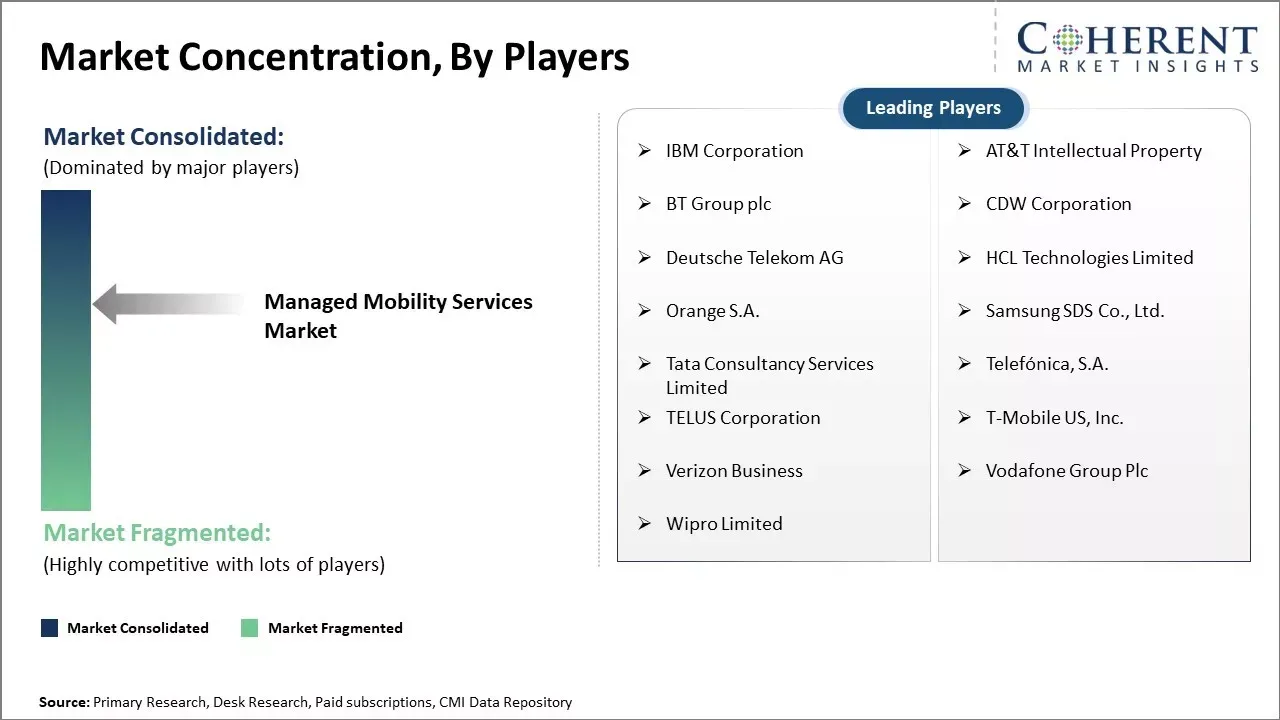
| Companies covered: | IBM Corporation, AT&T Intellectual Property, BT Group plc, CDW Corporation, Deutsche Telekom AG, HCL Technologies Limited, Orange S.A., Samsung SDS Co., Ltd., Tata Consultancy Services Limited, Telefónica, S.A., TELUS Corporation, T-Mobile US, Inc., Verizon Business, Vodafone Group Plc, and Wipro Limited | ||
| Growth Drivers: |
| ||
| Restraints & Challenges: |
| ||
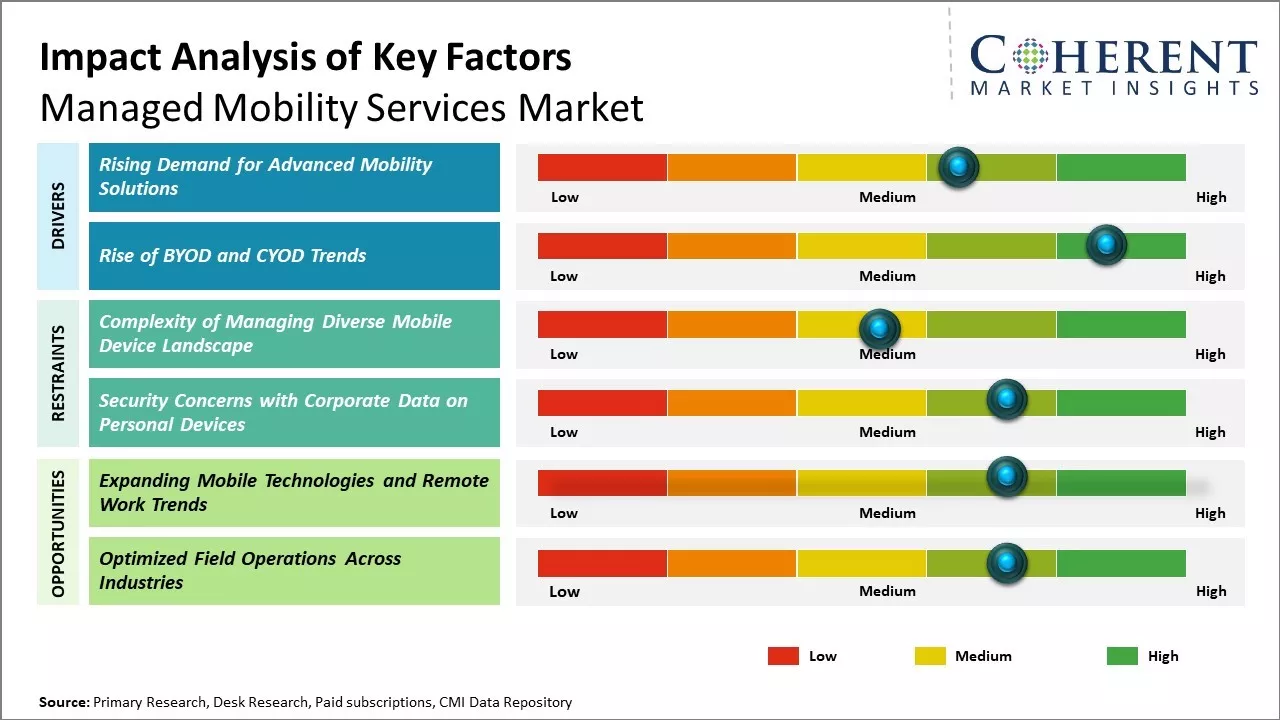
Managed Mobility Services Market Driver
Rising Demand for Advanced Mobility Solutions
With the ever-changing business needs and transformation towards digital workspace, the demand for advanced mobility solutions has increased tremendously among organizations. Enterprises are looking for innovative ways to empower their mobile workforce with cutting edge technologies and deliver seamless work experience for remote and flexible working models. Managed mobility services market growth has emerged as a cost-effective solution for organizations to stay ahead of the curve by providing comprehensive end to end management of complex mobility infrastructure.
These services offer enterprises a single point of contact to centrally manage different aspects of employee mobility like procurement and distribution of devices, applications and connectivity solutions. Organizations no longer have to deal with device pilferage, software licensing compliance and security updates individually. Managed service providers take care of all these aspects using advanced tools and processes, freeing up internal IT teams to focus on core business initiatives.
Managed Mobility Services Market Opportunities
Expanding Mobile Technologies and Remote Work Trends
Growth of mobile technologies and work-from-anywhere trends present many opportunities. More industries require optimized field operations through mobile tools. As mobility becomes critical to job functions and customer service, demand will rise for managed solutions that ensure adoption without straining IT resources or security. New capabilities around tracking assets, monitoring remote work productivity, and supporting innovative mobile applications also create possibilities for service providers to develop value-added offerings.
Market Concentration and Competitive Landscape
Analyst Opinion (Expert Opinion)
As more businesses use mobile-first operations and hybrid work models, the Managed Mobility Services market value is growing. Today, companies manage about 68–120 mobile devices per 100 employees, which is an increase of almost 35–40% in three years. This makes it even more important to have centralized lifecycle and security management. BYOD policies are now in place at 55–70% of businesses, which makes things even more complicated by adding more types of devices and stricter compliance requirements.
Security problems with mobile devices are shooting up by 22–27% every year, mostly linked to misconfigured settings, apps that should not be there, and weak points on the devices themselves. This has sped up the process of adding threat analytics, identity governance, and zero-trust frameworks to MMS platforms. Companies also care about saving money. For example, switching from internal mobility support to managed services can save businesses 15–28% on operations and cut down on the time it takes to set up new devices by 40–55% through automation.
Changes in technology, like the quick growth of eSIM and the first private 5G networks, are changing how businesses deal with mobility. North America and Western Europe are the most advanced in terms of adoption, while Asia Pacific is growing the fastest because of its high mobile workforce penetration. MMS is changing from managing devices to managing all aspects of mobility with a focus on security, efficiency, and enabling the workforce.
Speak to the analyst
Want personalized insights?
Take the findings above to one of our principal consultants, or have the report rebuilt around the segments, geographies and competitors you actually track.
Managed Mobility Services Industry News
- In October 2025, Tech Mahindra and Crosscall partnered to deliver AI-powered mobility solutions across India and Europe. The collaboration targets rugged enterprise environments in sectors like defense and logistics, offering durable mobile devices integrated with intelligent software. This initiative enhances managed mobility capabilities, supporting secure, scalable, and efficient operations for large organizations in demanding field conditions.
- In June 2025, Targa Telematics and Volvo Cars announced that are working together to handle vehicle data and create new connected mobility services. The partnership makes it possible to safely and in real time access vehicle information, which helps with advanced fleet management, car sharing, and subscription models. This project makes Targa stronger in the connected mobility ecosystem and improves Volvo's digital service capabilities.
- In April 2025, Cass Information Systems sold its Telecom Expense Management (TEM) business, which is an important part of enterprise mobility services. The U.S.-based company used to offer telecom cost tracking, invoice auditing, and vendor management, but this sale marks a change in strategy. Many major businesses use Managed Mobility Services (MMS) platforms that include TEM.
Market Segmentation
- Function Insights (Revenue, USD Bn, 2026 - 2033)
- Device Management
- Application Management
- Security Management
- Support and Maintenance
- Organization Size Insights (Revenue, USD Bn, 2026 - 2033)
- SMEs
- Large Enterprises
- Industry Vertical Insights (Revenue, USD Bn, 2026 - 2033)
- Healthcare
- Manufacturing
- Telecom and IT
- Financial Services
- Retail
- Others
- Regional Insights (Revenue, USD Bn, 2026 - 2033)
- North America
- U.S.
- Canada
- Latin America
- Brazil
- Argentina
- Mexico
- Rest of Latin America
- Europe
- Germany
- U.K.
- Spain
- France
- Italy
- Russia
- Rest of Europe
- Asia Pacific
- China
- India
- Japan
- Australia
- South Korea
- ASEAN
- Rest of Asia Pacific
- Middle East & Africa
- South Africa
- GCC Countries
- Israel
- Rest of Middle East & Africa
- Key Players Insights (Revenue, USD Bn, 2021 - 2033)
- IBM Corporation
- AT&T Intellectual Property
- BT Group plc
- CDW Corporation
- Deutsche Telekom AG
- HCL Technologies Limited
- Orange S.A.
- Samsung SDS Co., Ltd.
- Tata Consultancy Services Limited
- Telefónica, S.A.
- TELUS Corporation
- T-Mobile US, Inc.
- Verizon Business
- Vodafone Group Plc
- Wipro Limited
Sources
Primary Research Interviews
- Managed Mobility Services Providers
- Enterprise Mobility Managers
- IT Infrastructure & Operations Directors
- Telecom Service Providers
- Mobility Solution Architects
- Others
Databases
- Bloomberg Terminal
- Thomson Reuters Eikon
- IDC Subscription Database
- Euromonitor International
- Others
Magazines
- CIO Magazine
- Computerworld
- Mobility Management Magazine
- InformationWeek
- Network World
- Others
Journals
- IEEE Transactions on Mobile Computing
- Journal of Network and Computer Applications
- International Journal of Mobile Communications
- Journal of Information Technology
- Others
Newspapers
- Financial Times
- The Wall Street Journal
- Reuters
- Bloomberg News
- The Economic Times
- Others
Associations
- GSMA (Global System for Mobile Communications Association)
- IT Service Management Forum (itSMF)
- International Telecommunication Union (ITU)
- Telecommunications Industry Association (TIA)
- Others
Public Domain Sources
- U.S. Federal Communications Commission (FCC)
- International Telecommunication Union (ITU)
- World Bank Open Data
- Organization for Economic Co-operation and Development (OECD)
- Government Statistical Offices
- Others
Proprietary Elements
- CMI Data Analytics Tool
- Proprietary CMI Existing Repository of Information (Last 8 Years)
Definition: Managed mobility services market provides comprehensive services for business mobility needs. It offers services like secure device and application management, technical support, IT asset management, and software development. These services enable businesses to focus on their core operations while allowing mobility vendors to manage mobile devices, apps and associated infrastructure. It offers cost-effective and secure mobile solutions to businesses of all sizes to improve workforce productivity and boost operational efficiency.
Get access to 250+ pages report
Every segment, forecast, competitor profile and data table behind the analysis above — available for instant download.
- ESOMAR Member
- ISO 9001:2015 Certified
- D-U-N-S Registered
- GDPR & CCPA Compliant
Missing comfort of reading report in your local language? Find your preferred language:
Transform your Strategy with Exclusive Trending Reports
Frequently Asked Questions
The Managed Mobility Services Market is estimated to be valued at USD 38.81 Bn in 2026, and is expected to reach USD 237.05 Bn by 2033.
The CAGR of the Managed Mobility Services Market is projected to be 29.5% from 2026 to 2033.
Rising demand for advanced mobility solutions and rise of BYOD and CYOD trends are the major factors driving the growth of the managed mobility services market.
Complexity of managing diverse mobile device landscape and security concerns with corporate data on personal devices are the major factors hampering the growth of the managed mobility services market.
In terms of function, device management is estimated to dominate the market revenue share in 2026.
IBM Corporation, AT&T Intellectual Property, BT Group plc, CDW Corporation, Deutsche Telekom AG, HCL Technologies Limited, Orange S.A., Samsung SDS Co., Ltd., Tata Consultancy Services Limited, Telefónica, S.A., TELUS Corporation, T-Mobile US, Inc., Verizon Business, Vodafone Group Plc, and Wipro Limited are the major players.
North America is expected to lead the managed mobility services market in 2026.