

Crop Protection Chemicals Market Analysis & Forecast: 2026-2033
Crop Protection Chemicals Market is estimated to be valued at USD 80.86 Bn in 2026 and is expected to reach USD 129.00 Bn in 2033, exhibiting a compound annual growth rate (CAGR) of 6.9% from 2026 to 2033.
Key Takeaways
- Based on Origin, the Synthetic segment is expected to dominate the market with 76% share in 2026, due to their broad-spectrum effectiveness and affordability in large-scale farming.
- Based on Type, the Herbicides segment is projected to capture the largest share of the market in 2026, as the primary solution for weed control in staple crop cultivation.
- Based on Application, the Grains and Cereals segment is expected to hold the highest share of the market in 2026, owing to their global cultivation and vulnerability.
- Based on Region, North America is set to lead the crop protection chemicals market with 45% share in 2026. While, Asia Pacific is anticipated to be the fastest growing region.
Market Overview
Globally, there are over 800 different registered crop protection chemicals. Companies are highly involved in the research and development of new products. The chemicals undergo rigorous safety tests and other processes to ensure their safety. The global crop protection chemicals market is expected to grow at a healthy rate during the next five years. The growing population worldwide is a major driver of the market.
Current Events and Its Impacts on the Global Crop Protection Chemicals Market
Current Event | Description and its Impact |
EU Regulatory Tightening and Green Deal Implementation |
|
Technological Disruption and Digital Agriculture Adoption |
|
Effectiveness Of Crop Protection Chemicals
- Pest Control Success Rate
- Measured by reduction in pest population or disease incidence after application.
- Most synthetic chemicals show 80–95% control when applied correctly.
- Yield Improvement
- Effective use can increase crop yields by 20–50%, depending on pest pressure and crop type.
- Residual Activity
- Duration of protection varies:
- Herbicides: 2–6 weeks
- Insecticides: 7–21 days
- Fungicides: 10–14 days
- Longer residuals reduce the need for reapplication.
- Resistance Management
- Overuse of a single chemical class can lead to resistance.
- Rotating modes of action and integrating biologicals improves long-term effectiveness
- Current Industry Events of 2026
- Market Size Estimation
- Regional Breakdown
- Competitive Landscape
- Customer Intelligence
- Segmental Analysis
- Pricing Analysis
- Key Market Drivers, Challenges & Future Trends
- Customized Insights Section
Segmental Insights
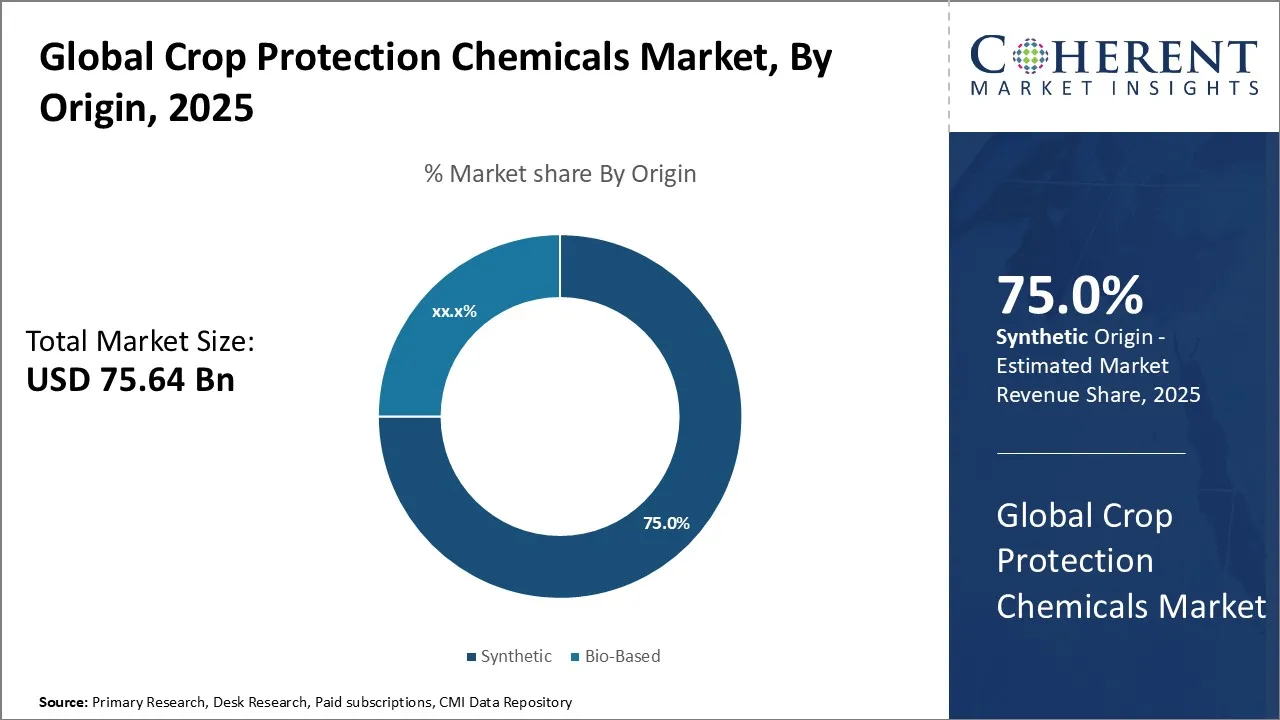
Global Crop Protection Chemicals Market Insights, By Origin - Synthetic Chemicals Lead Due To Their Broad-Spectrum Effectiveness and Affordability in Large-Scale Farming
In terms of origin, the synthetic segment is expected dominate the market with 76% share in 2026. These products are favored for their broad-spectrum efficacy, cost-effectiveness, and well-established manufacturing and distribution networks. Farmers rely heavily on synthetic herbicides, insecticides, and fungicides to manage pests and diseases efficiently across large-scale agricultural operations. While bio-based alternatives are gaining traction due to environmental concerns and regulatory support, they remain a niche segment, primarily used in organic farming and specialty crops.
For instance, in June 2024, Bayer unveiled plans to launch ten blockbuster products over the next decade, with a strong focus on synthetic crop protection. Highlights include Icafolin, a novel herbicide targeting resistant weeds, and new fungicides and insecticides developed through its CropKey technology. These innovations aim to address global agricultural challenges and drive sustainable farming solutions.
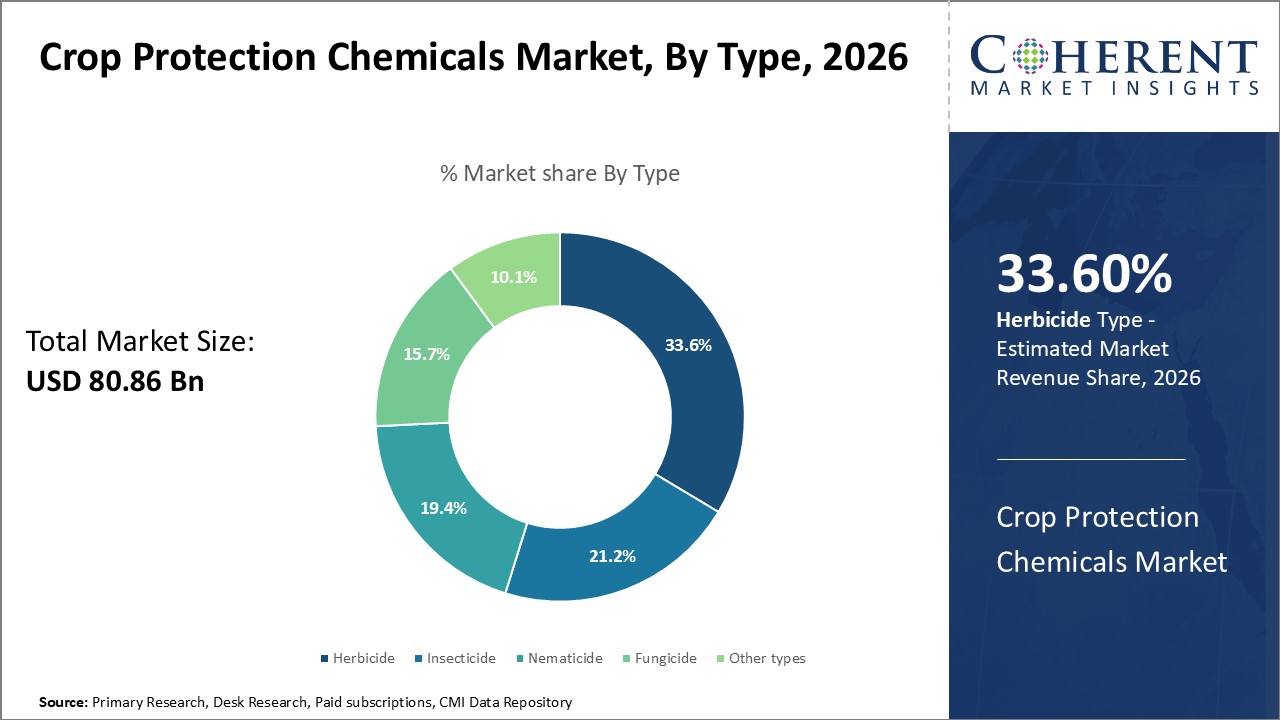
Global Crop Protection Chemicals Market Insights, By Type - Herbicides Dominate as the Primary Solution for Weed Control in Staple Crop Cultivation
In terms of type, the herbicides segment is expected to lead the market with the largest share in 2026. Their dominance stems from the critical role they play in controlling weed growth, which can significantly impact crop yields. Herbicides are especially vital in the cultivation of grains and cereals, where weed competition is intense. The rise of conservation agriculture and no-till farming practices has further boosted herbicide demand. Insecticides and fungicides follow in importance, with targeted applications in fruits, vegetables, and high-value commercial crops. Nematicides and other types occupy smaller shares due to their specialized use cases.
For instance, in August 2025, Godrej Agrovet released Ashitaka, a new herbicide for maize crops that kills broadleaf and grassy weeds after they have already grown. Ashitaka is meant to fight resistant species like Echinochloa and Commelina. It promises to keep weeds under control for a long time and help crops grow better. This new product makes Godrej's crop protection line stronger and helps farmers in India grow corn in a way that is both efficient and environmentally friendly.
Global Crop Protection Chemicals Market Insights, By Application - Grains and Cereals Dominates Owing to Their Global Cultivation and Vulnerability
in terms of application, the grains and cereals segment is projected to account for the highest share of the market in 2026. These staple crops, such as wheat, rice, and corn, cover vast agricultural areas and are highly susceptible to weeds, pests, and fungal infections. As a result, they require consistent and intensive chemical protection to ensure food security and maintain yield levels. Fruits and vegetables follow closely, driven by their high market value and vulnerability to a wide range of pests. Commercial crops like cotton and sugarcane also contribute significantly, while pulses, oilseeds, and other crop types represent smaller but growing segments.
For instance, in November 2025, the Ministry of Agrarian Policy in Ukraine approved the use of crop protection chemicals on grains and cereals. The goal is to increase agricultural productivity and protect harvests. The program helps farmers fight pests and diseases with modern methods, which leads to better yields and food security. This step fits in with Ukraine's larger plan for long-term growth in agriculture.
Regional Insights
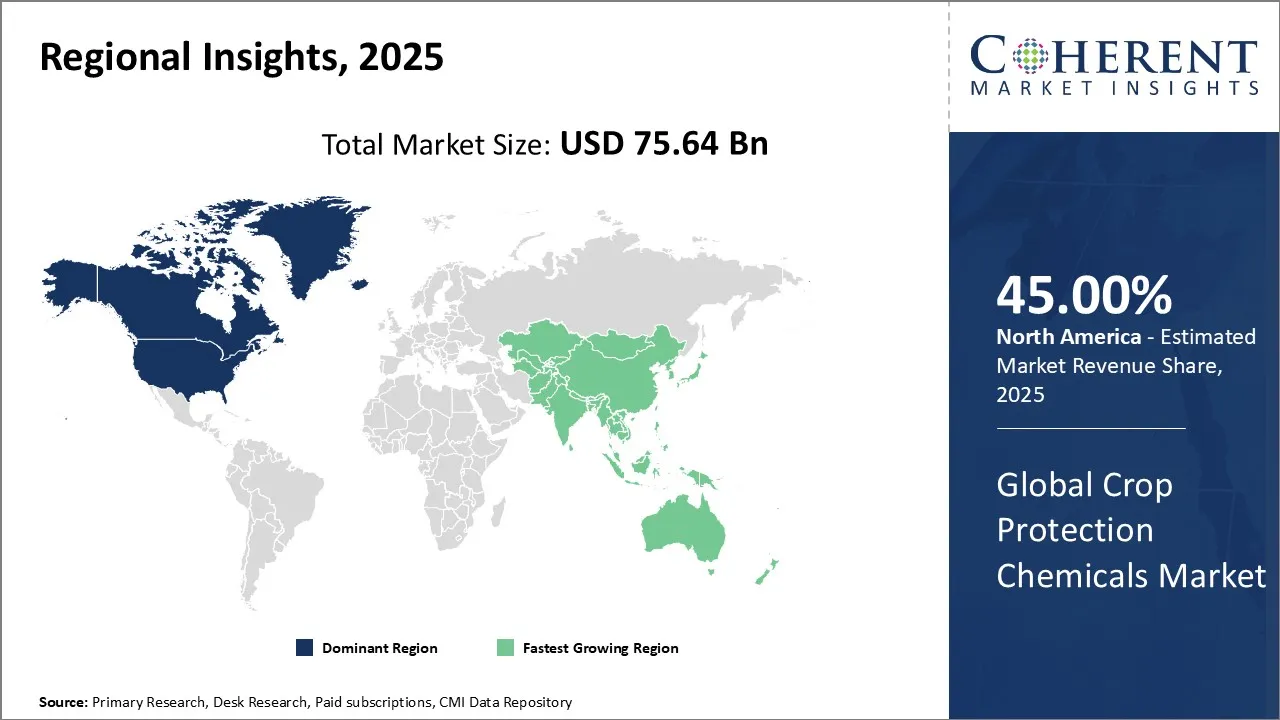
North America Crop Protection Chemicals Market Analysis & Trends
North America, holding 45% share of the crop protection chemicals market is expected to dominate in 2026, due to rising pest resistance, climate-driven pest migration, and the need for higher agricultural productivity. Farmers are using increasing amounts of herbicides, fungicides, and insecticides to keep their grains, fruits, and vegetables safe. New technologies and government support are also driving up demand in the U.S., Canada, and Mexico.
For instance, in October 2026, Syngenta Crop Protection and Taranis teamed up to use AI to improve crop intelligence across the U.S. The partnership combines Taranis' leaf-level analytics with Syngenta's chemical solutions, making it possible to scout fields accurately and give targeted treatments. This strategic move makes crop protection more effective, helps conservation efforts, and gives retailers more advanced tools for making decisions.
Asia Pacific Crop Protection Chemicals Market Analysis & Trends
Asia Pacific is anticipated to be the fastest growing region in the crop protection chemicals market, due to rising pest infestations, expanding agricultural activity, and increasing demand for higher crop yields. Countries like India and China are growing by cultivating large quantities of cereals and vegetables. Technological progress and the use of synthetic and biological solutions also increase crop protection chemicals market demand.
For instance, in May 2026, BASF India come out with two new ways to protect rice crops: Valexio® Insecticide and Mibelya® Fungicide. Valexio® kills rice hoppers and keeps them from returning back, while Mibelya® fights sheath blight and dirty panicle with patented Revysol® and Xemium® ingredients. These new products make BASF's portfolio stronger and help rice farming in India's main agricultural areas stay sustainable.
Crop Protection Chemicals Market Outlook Country-Wise
The U.S. Crop Protection Chemicals Market Trends
The market for crop protection chemicals in the U.S. is doing well due to large-scale commercial farming, pests that are becoming more resistant, and the need for high-yield crops like corn and soybeans. Efficiency is driven by precision agriculture and advanced formulations, while growth is fueled by regulatory support and new ideas in synthetic and biological solutions. Changes in the weather also make people more dependent on protective treatments.
For instance, in October 2026, Summit Agro USA released its BioPowered™ line, which includes new biological solutions for protecting crops and keeping fields healthy. The portfolio includes biopesticides and plant health products that are meant to help farmers grow crops in a way that is good for the environment. The company is based in Durham, North Carolina. This action shows that the company is dedicated to environmentally friendly farming and promoting biological alternatives in the U.S. crop protection market.
China Crop Protection Chemicals Market Trends
China's market for crop protection chemicals is growing since the nation has a large agricultural sector, pests have grown more resistant, and there is a need to increase crop yields to ensure food security. The government supports sustainable farming and more individuals are using biopesticides. Rapid urbanization and climate change make pest problems worse, so chemicals are necessary for productivity.
For instance, in October 2026, China’s Ministry of Agriculture approved five new biopesticides to advance sustainable farming practices. These eco-friendly solutions aim to reduce chemical residues, enhance soil health, and support integrated pest management. The move strengthens China's market for crop protection chemicals, especially biologicals, and shows that the country is committed to environmentally friendly agricultural innovation.
Market Report Scope
Crop Protection Chemicals Market Report Coverage
| Report Coverage | Details | ||
|---|---|---|---|
| Base Year: | 2025 | Market Size in 2026: | USD 80.86 Bn |
| Historical Data for: | 2020 To 2024 | Forecast Period: | 2026 To 2033 |
| Forecast Period 2026 to 2033 CAGR: | 6.9% | 2033 Value Projection: | USD 129.00 Bn |
| Geographies covered: |
| ||
| Segments covered: |
| ||
| Companies covered: | Bayer CropScience, ChemChina Corporation, BASF SE, Corteva Agriscience, UPL Limited, FMC Corporation, Nufarm Ltd, Sumitomo Chemicals, American Vanguard Corporation, ISAGRO SpA, Bioworks Inc., Ishihara Sangyo Kaisha Ltd, Marrone Bio Innovations Inc., and Syngenta International AG | ||
| Growth Drivers: |
| ||
| Restraints & Challenges: |
| ||
Global Crop Protection Chemicals Market Drivers
- Growing demand for food due to increasing population: Growing demand for food due to an increasing population is primarily fueling growth of the Global Crop Protection Chemical Market. According to the Food and Agriculture Organization (FAO), the world population is expected to grow by over a third, or 2.3 billion, till 2050. At the same time, per capita income is also projected to grow across the world. With increasing per capita income and a growing population, the demand for food is also estimated to grow globally. For instance, as per the FAO, food demand in the U.S is expected to increase by 50% to 90% by 2050.
- Growing organic farmland area: The global crop protection chemicals market is altering as a growing amount of land is being used for organic farming. As more farmers switch to organic methods, the need for crop protection products that are bio-based and good for the environment is growing. This trend is pushing the development of new biopesticides, biofungicides, and other natural alternatives, which are opening up the market to more than just synthetic chemicals. Support from the government and consumers' desire for produce without residues speed up this change even more. As a result, the Global Crop Protection Chemicals Market size is expanding to include more sustainable products. This is a sign of a wider shift toward eco-friendly farming and integrated pest management strategies in important farming areas around the world.
Global Crop Protection Chemicals Market Opportunities
- Increased use of genetically modified (GM) crops: The increasing adoption of genetically modified (GM) crops is projected to offer significant growth opportunities over the forecast period. The growing use of these crops with pesticide resistance to augment the production of crop protection chemicals is again propelling market growth. Genetically modified (GM) crops were first introduced in the U.S. Moreover, advancements in biotechnology continue to increase the development of a wide range of herbicide-tolerant, insect-protected, stress-tolerant, and nutritionally improved genetically modified (GM) crops.
- A growing number of pests are becoming resistant: A growing number of resistant pests is expected to provide potential growth opportunities in the near future. For instance, the United States Environmental Protection Agency (EPA) is working on slowing and combating pests’ resistance to pesticides. These pests have caused enormous losses in many economically important crops and have forced farmers to rely more on the use of chemicals.
Global Crop Protection Chemicals Market Trends
- Growing demand for organically grown crops: The growing demand for organic-based crop protection products is a growing trend in the market. For instance, the imposition of stringent regulations by countries in the European Union and North America has accelerated the demand for bio-based products. The increased usage of bio-based crop protection products in the global arena will lead the market in the future.
- Companies are adopting partnerships and agreements: Companies in the global crop protection chemicals market are increasingly using strategic partnerships and agreements to reach more people, improve their product lines, and speed up innovation. Agrochemical companies and tech companies can work together to combine AI, precision farming, and environmentally friendly solutions. These partnerships help deal with changing pest problems and regulatory requirements while also helping the company reach more customers. Joint ventures and licensing agreements also make it easier to get into new markets and make distribution networks more efficient. Because of this, these kinds of strategic moves are having a big effect on the crop protection chemicals market share, which lets companies get a better edge over their competitors and meet the growing need for better crop protection solutions.
Analyst Opinion (Expert Opinion)
The global crop protection chemicals market value is changing owing to stricter rules, fluctuating input costs, and farmers' need for safer, more effective solutions. For large-acre crops, traditional synthetic herbicides, fungicides, and insecticides are still essential, but their volume growth in mature markets is starting to level off. On the other hand, biologicals, bio-based formulations, and seed treatments are growing much faster because agricultural cooperatives and exporters are asking for inputs with less residue more and more often.
The average price of products has risen up considering the cost of feedstock and formulation has increased. This is especially true for multi-step synthetic actives that rely on petrochemical intermediates. At the same time, the costs of following the rules for registration, residue testing, and label updates keep going up. This is good for companies with a lot of different products as they can spread out the costs of following the rules.
Regulatory actions like bans, restrictions, and new MRL changes are speeding up the cycles of product substitution and encouraging the use of biological alternatives. At the same time, resistance to established chemistries is making combination products and integrated pest-management programs more popular. Digital agronomy solutions and precision-application tools are changing how people buy things. They are lowering the amount of product used per hectare but raising the value per hectare for high-efficacy formulations.
The strongest growth in conventional chemistry volumes is happening in new agricultural areas, while developed markets are moving rapidly toward portfolios with less risk. In general, the market's performance now depends on new low-dose actives, advanced formulations, biological platforms, and agronomic services that use data.
Speak to the analyst
Want personalized insights?
Take the findings above to one of our principal consultants, or have the report rebuilt around the segments, geographies and competitors you actually track.
Global Crop Protection Chemicals Market: Key Developments
- In August 2025, Insecticides India teamed up with Corteva Agriscience to create Sparcle, a new insecticide that kills brown planthopper in rice crops. The goal of this strategic partnership is to give Indian rice farmers better ways to control pests, which may enhance crop yield and sustainability. The launch strengthens both companies' positions in India's growing market for chemicals that protect crops.
- In July 2025, At the 464th Registration Committee meeting, India approved 27 new crop protection products under Section 93. The goal of this move is to make farming more productive and give farmers better tools to fight pests and diseases. The approvals show that India is serious about making its crop protection system stronger and promoting environmentally friendly farming practices across the country.
- In April 2025,
- In January 2025, UPL Corp released Atroforce, a bionematicide seed treatment for cotton that kills nematodes that hurt the roots of crops. The product is made for areas where cotton is grown, like India. It improves early-stage protection and helps plants grow better.
Market Segmentation
- By Origin (Revenue, USD Bn, 2021 - 2033)
- Synthetic
- Bio-Based
- By Type (Revenue, USD Bn, 2021 - 2033)
- Fungicide
- Insecticide
- Nematicide
- Herbicide
- Other types
- By Application (Revenue, USD Bn, 2021 - 2033)
- Grains and cereals
- Pulses and Oilseeds
- Fruits and Vegetables
- Commercial Crops
- Other crop types
- Other Samples
- By Region (Revenue, USD Bn, 2021 - 2033)
- North America
- U.S.
- Canada
- Latin America
- Brazil
- Argentina
- Mexico
- Rest of Latin America
- Europe
- Germany
- U.K.
- Spain
- France
- Italy
- Russia
- Rest of Europe
- Asia Pacific
- China
- India
- Japan
- Australia
- South Korea
- ASEAN
- Rest of Asia Pacific
- Middle East
- GCC Countries
- Israel
- Rest of Middle East
- Africa
- South Africa
- North Africa
- Central Africa
- North America
- Key Companies Insights (Revenue, USD Bn, 2021 - 2033)
- Bayer CropScience
- ChemChina Corporation
- BASF SE
- Corteva Agriscience
- UPL Limited
- FMC Corporation
- Nufarm Ltd
- Sumitomo Chemicals
- American Vanguard Corporation
- ISAGRO SpA
- Bioworks Inc.
- Ishihara Sangyo Kaisha Ltd
- Marrone Bio Innovations Inc.
- Syngenta International AG.
Sources
Primary Research Interviews
- Crop Protection Chemical Manufacturers
- Agrochemical Distributors & Dealers
- Agronomists & Crop Advisors
- Commercial Farmers & Plantation Owners
- Regulatory Compliance Officers (Pesticide Registration)
- Agricultural Extension Officers
- Others
Databases
- Bloomberg Terminal
- Thomson Reuters Eikon
- IHS Markit Agribusiness
- Euromonitor International
- Statista Agriculture Database
- Others
Magazines
- AgroPages Magazine
- CropLife Magazine
- Farm Chemicals International
- AgriBusiness Global
- The Western Producer
- Others
Journals
- Journal of Agricultural and Food Chemistry
- Pest Management Science (Wiley)
- Crop Protection (Elsevier)
- Journal of Pest Science (Springer)
- Others
Newspapers
- Financial Times
- The Wall Street Journal
- Reuters Agriculture
- Bloomberg News
- Agribusiness Global News
- Others
Associations
- CropLife International
- Food and Agriculture Organization (FAO)
- Organisation for Economic Co-operation and Development (OECD – Agriculture Directorate)
- Environmental Protection Agency (EPA – Pesticide Programs)
- European Food Safety Authority (EFSA)
- Others
Public Domain Sources
- United States Department of Agriculture (USDA)
- Food and Agriculture Organization (FAO)
- World Bank Open Data
- Organisation for Economic Co-operation and Development (OECD)
- Government Ministry of Agriculture Portals (India, China, Brazil, EU, U.S.)
- Others
Proprietary Elements
- CMI Data Analytics Tool
- Proprietary CMI Existing Repository of information for the last 8 years
Definition: As the world population grows, crop protection chemicals become increasingly important. They keep pests and weeds away from crops and help boost crop yields. These chemicals also help ensure food security for the world’s population. In addition, they reduce the costs of farming, allowing farmers to save more money. This means more food for the world.
Get access to 250+ pages report
Every segment, forecast, competitor profile and data table behind the analysis above — available for instant download.
- ESOMAR Member
- ISO 9001:2015 Certified
- D-U-N-S Registered
- GDPR & CCPA Compliant
Missing comfort of reading report in your local language? Find your preferred language:
Transform your Strategy with Exclusive Trending Reports
Frequently Asked Questions
The Crop Protection Chemicals Market is estimated to be valued at USD 80.86 Bn in 2026, and is expected to reach USD 129.00 Bn by 2033.
The CAGR of the Crop Protection Chemicals Market is projected to be 6.9% from 2026 to 2033.
Growing demand for food due to increasing population and growing organic farmland areas are fueling the growth of the market.
The synthetic origin segment is the leading component segment in the market.
Strict regulation regarding the usage of pesticides and high input costs are the major factors restraining growth of the market.
Bayer CropScience, ChemChina Corporation, BASF SE, Corteva Agriscience, UPL Limited, FMC Corporation, Nufarm Ltd, Sumitomo Chemicals, American Vanguard Corporation, ISAGRO SpA, Bioworks Inc., Ishihara Sangyo Kaisha Ltd, Marrone Bio Innovations Inc., and Syngenta International AG