

Earthworm Farming Market Size and Forecast — 2026-2033
The Global Earthworm Farming Market size is estimated to be valued at USD 1.33 billion in 2026 and is expected to reach USD 2.67 billion by 2033, exhibiting a compound annual growth rate (CAGR) of 10.5% from 2026 to 2033.
Overview
Earthworm farming (vermiculture) products include live earthworms of commercial species (e.g., Eisenia fetida, Lumbricus rubellus), vermicompost (worm castings), worm leachate/tea, and associated culture media and equipment (worm beds, trays, bedding, moisture control systems). Live worms are supplied for bait markets, soil remediation, and initiation of composting systems; vermicompost is a nutrient-rich organic soil amendment prized for high microbial activity, plant-available nutrients, and improved soil structure; worm leachate is marketed as a bio-stimulant/fertilizer for foliar feeding. Products vary by production scale—from small packaged vermicompost tubs and starter kits for home gardeners to bulk truckloads for agriculture—and often include quality metrics such as humic content, C: N ratio, moisture, and absence of pathogens.
Key Takeaways
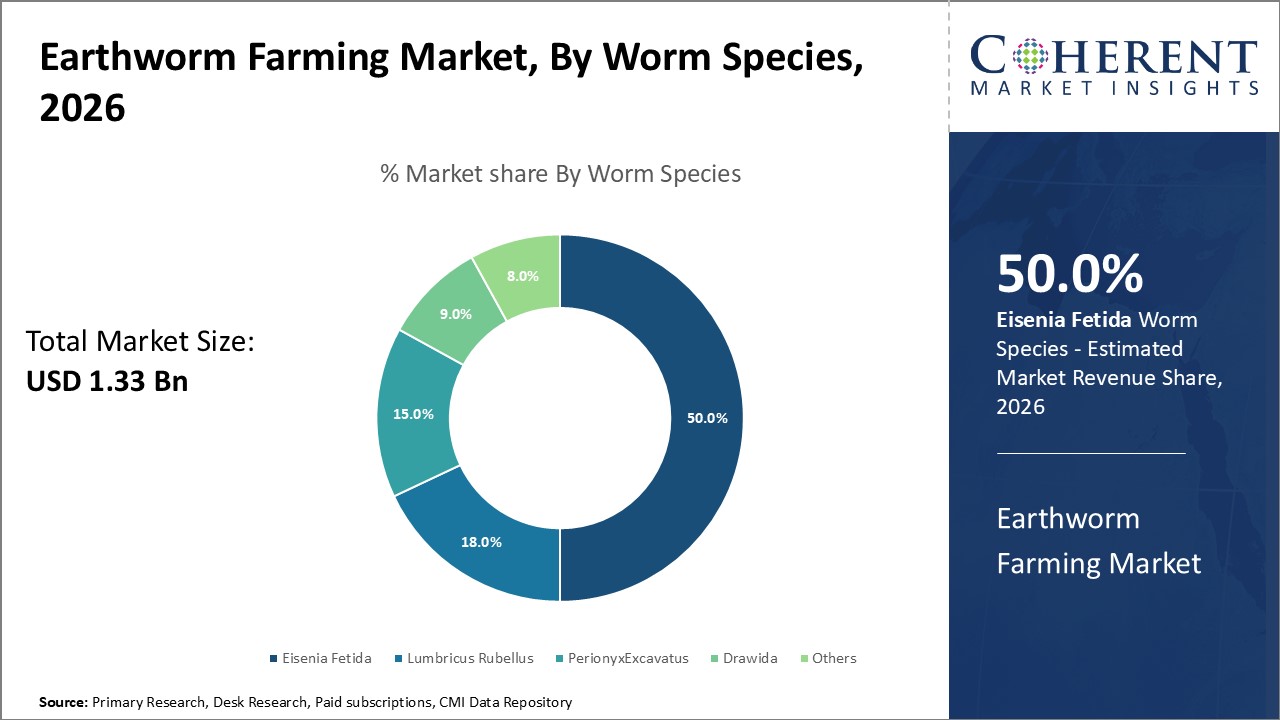
The Eisenia Fetida species dominates the earthworm farming market segment, holding a commanding 50% market share due to its adaptability and efficiency in vermicomposting applications.
The Agriculture application segment shows robust growth given its essential role in organic farming and soil health, driving significant market revenue.
Commercial farming as an end-use segment leads the market, fostering large-scale production and standardized supply chains.
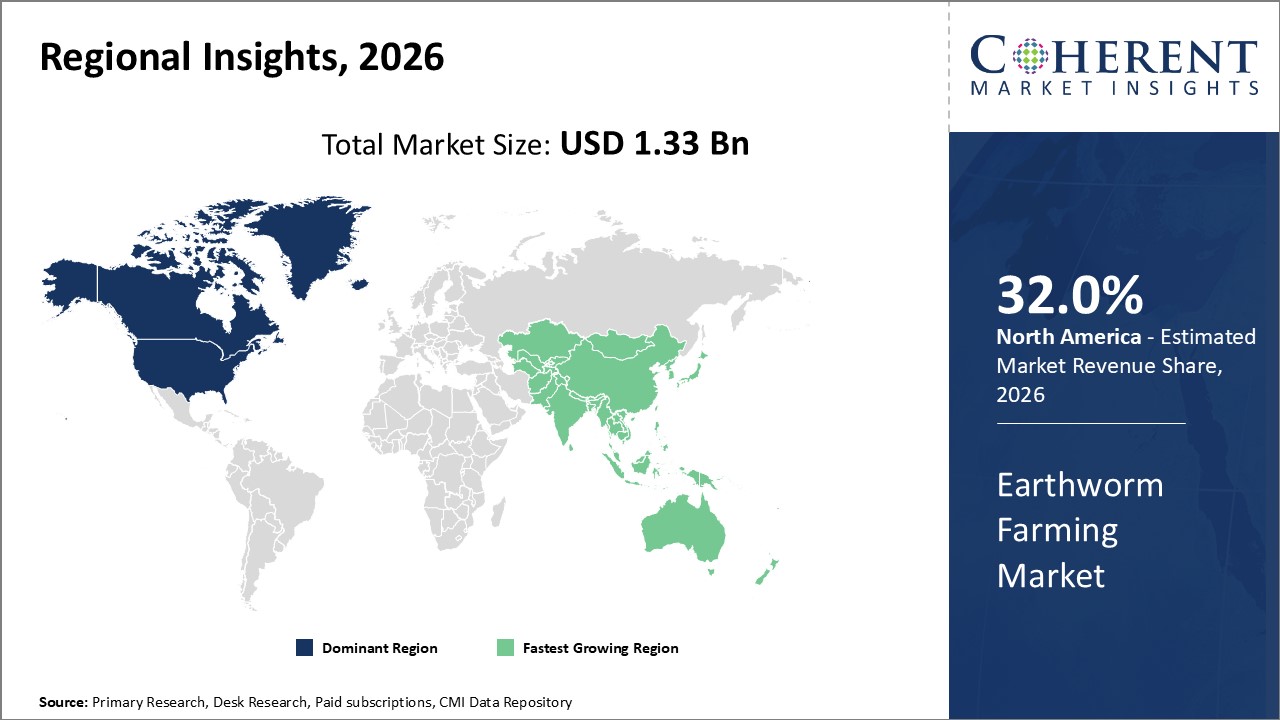
Regionally, North America dominates the Earthworm Farming Market share, leveraging its advanced agricultural ecosystem and government incentives aimed at sustainable farming.
Asia Pacific emerges as the fastest-growing region with a CAGR of over 12%, supported by increasing investment in organic agriculture and rising environmental awareness.
Europe’s market growth is propelled by stringent environmental regulations and consumer demand for organic products, securing its position as a significant market revenue contributor.
Earthworm Farming Market Segmentation Analysis
Earthworm Farming Market Insights, By Worm Species
Eisenia Fetida dominates the market share with 50% due to its adaptability and high reproduction rate, making it the most effective species for vermicomposting. Eisenia Fetida’s ability to thrive in diverse climatic conditions and provide superior compost quality underpins its leading position. Perionyx Excavatus is the fastest-growing subsegment, gaining traction in tropical and subtropical regions for its rapid growth cycle and efficiency in decomposing organic waste. Lumbricus Rubellus and Drawida serve niche applications with moderate growth driven by regional preferences and specific farming needs, while Others include emerging species being trialed for specialized bioremediation uses.
Earthworm Farming Market Insights, By Application
Agriculture is the dominating application, benefiting from global shifts toward organic farming and soil health restoration, accounting for the majority of market revenue. Vermicomposting, integral to this segment, is recognized for improving nutrient uptake and enhancing crop yields across multiple geographies. Bioremediation is the fastest-growing application, expanding due to increasing environmental pollution and government policies mandating sustainable waste management; earthworms efficiently breakdown organic pollutants, especially in industrial and municipal waste scenarios. Pharmaceutical application is emerging steadily, with research into earthworm bioactive compounds progressing, while animal feed applications remain niche but growing as sustainable feedstock options.
Earthworm Farming Market Insights, By End-Use
Commercial farming dominates market share, attributable to large-scale operations leveraging economies of scale and advanced vermiculture techniques to supply commercial organic input markets. These farms invest in technology and breed optimization for consistent quality and volume. Household use shows steady growth as more consumers embrace home gardening and organic waste recycling. Industrial use, particularly in wastewater treatment and bio-extraction facilities, is the fastest-growing subsegment, marked by rising adoption of earthworm-based organic waste treatment solutions. Research and development remain vital to market innovation, focusing on new earthworm species and applications, while Others encompass educational and pilot farming projects.
Earthworm Farming Market Trends
The market is increasingly aligning with eco-conscious consumer behavior and governmental support for sustainable agriculture, driving a rise in organic vermicomposting adoption.
A recent 2025 study noted a 15% annual growth in vermicompost sales in Europe linked to stringent pesticide regulations impacting chemical fertilizer use.
Another trend is the digitalization of earthworm farming with IoT-enabled moisture and temperature monitoring systems improving yield predictability, evidenced by a European pilot program, which improved efficiency by 22% within one year.
The pharma and cosmetics sectors, capitalizing on earthworm extract bioactive potential,s witnessed an innovation surge, particularly in Japan and South Korea, opening new market frontiers.
Earthworm Farming Market Insights, By Geography
North America Earthworm Farming Market Analysis and Trends
In North America, dominance in the Earthworm Farming Market share stems from well-established sustainable farming infrastructure, government subsidies promoting organic farming, and a large base of environmentally aware consumers. The U.S., representing more than 65% of this region’s market revenue share, leads technological advancements in worm breeding and vermicomposting processes, supported by companies like Evergreen Worm Farms and WormX Innovations that have significantly increased production efficiency and R&D capabilities.
Asia Pacific Earthworm Farming Market Analysis and Trends
Meanwhile, Asia Pacific exhibits the fastest growth with a CAGR exceeding 12%, fueled by the expansion of organic agriculture in India and China’s booming earthworm export sector. Government initiatives encourage waste-to-compost conversion, directly benefiting earthworm farming enterprises. Market companies such as BioCycle Earthworms Pvt. Ltd. and GreenVerm have played critical roles by pioneering large-scale vermicompost production facilities, making the region a hotbed for market development.
Earthworm Farming Market Outlook for Key Countries
USA Earthworm Farming Market Analysis and Trends
The U.S. market remains a powerhouse in earthworm farming, with increased adoption of sustainable agricultural practices promoted through federal environmental programs. Recent USDA data indicate that organic farmland increased by approximately 9% in 2025, amplifying demand for vermicompost products. Leading companies like Evergreen Worm Farms have introduced precision vermiculture technologies, enabling scalable production and higher product quality. Additionally, U.S.-based bioremediation projects are increasingly using earthworm farming to reduce industrial organic waste, expanding market scope and revenue.
India Earthworm Farming Market Analysis and Trends
India's market is rapidly emerging, driven by supportive government schemes for organic farming and extensive rural adoption of sustainable agricultural methods. Growing awareness among smallholder farmers, who constitute over 70% of total farming communities, has significantly propelled vermicompost use, with a 20% increase reported in 2025 over the previous year. Companies such as BioCycle Earthworms Pvt. Ltd. have scaled operations, introducing low-cost hatcheries and composting systems tailored for the Indian climate. India's dominance in earthworm product exports also improves regional market share and reinforces its global supply chain position.
Analyst Opinion
The surge in organic farming has been a pivotal demand-side driver for the market, especially given the 2025 global organic farming acreage increase by over 9% compared to the previous year. This trend has propelled earthworm-derived vermicomposting solutions, enhancing soil microbiota and nutrient bioavailability. For instance, India’s vermicompost adoption in smallholder farms rose by 21% in 2025 alone, highlighting market penetration fueled by sustainable farming policies.
Supply-side dynamics reveal that production capacities in earthworm hatcheries have grown significantly, with North American producers scaling operations by 15% in 2025 to meet rising demand for premium compost products. Pricing trends have remained stable despite increased raw material costs, indicating strong market elasticity and value perception among end users, especially in Europe, where eco-conscious consumers prioritize quality over cost.
Cross-industry utilization of earthworms beyond agriculture, such as in pharmaceutical applications for producing bioactive compounds and in wastewater treatment bioremediation, demonstrates market diversification. For example, pharmaceutical companies in Japan reported a 13% increase in research funding towards earthworm-derived bioactive molecules in 2026, expanding the market scope.
The import-export balance in major regions like Europe and Asia-Pacific has shifted with China increasing earthworm product exports by 18% in 2025 due to improved breeding techniques and export-friendly policies. This export surge underlines market globalization trends influencing competitive strategies among top players.
- Current Industry Events of 2026
- Market Size Estimation
- Regional Breakdown
- Competitive Landscape
- Customer Intelligence
- Segmental Analysis
- Pricing Analysis
- Key Market Drivers, Challenges & Future Trends
- Customized Insights Section
Market Scope
| Report Coverage | Details | ||
|---|---|---|---|
| Base Year: | 2025 | Market Size in 2026: | USD 1.33 billion |
| Historical Data for: | 2020 To 2024 | Forecast Period: | 2026 To 2033 |
| Forecast Period 2026 to 2033 CAGR: | 10.5% | 2033 Value Projection: | USD 2.67 billion |
| Geographies covered: |
| ||
| Segments covered: |
| ||
| Companies covered: | WormX Innovations, Red Wigglers LLC, SubTerra Worm Breeders, Global Worm Dynamics, EarthSmart Fertilizers, TerraRise Worm Farming, NutriWorm Organics, VermiTech Inc., AgriEarthworm Co., OrganicHarvest Worm Farms. | ||
| Growth Drivers: |
| ||
Earthworm Farming Market Growth Factors
The growing preference for organic and sustainable agriculture is accelerating market growth, as vermicompost serves as a high-quality organic fertilizer, improving crop yield and soil health, with adoption rates rising 14% in Asia Pacific regions in 2025. Technological advancements in earthworm breeding and vermicompost production processes have lowered operational costs and optimized yield, contributing to a 10% annual productivity improvement seen in specialized farms globally. Additionally, increasing regulatory mandates favoring eco-friendly waste management methods are encouraging industries such as pharmaceuticals and wastewater treatment to integrate earthworm-based bioremediation solutions. Growing consumer awareness about the environmental benefits of earthworm farming further supports market growth, especially in Europe, where consumer willingness to pay premium prices for eco-products rose by 11% in 2025.
Earthworm Farming Market Development
In May 2025, WormPower Organic introduced a certified organic earthworm meal product, targeting sustainable protein applications in animal nutrition, soil health, and specialty feed markets. The launch responded to rising demand for alternative, eco-friendly protein sources with high digestibility and nutrient density.
In July 2025, EcoWorms launched its “EcoWorms Protein Meal” for aquaculture and pet food applications, offering a novel insect- and worm-based protein alternative designed to improve feed efficiency while reducing reliance on traditional fishmeal and soy-based proteins.
Key Players
Leading Companies of the Market
WormX Innovations
Red Wigglers LLC
SubTerra Worm Breeders
Global Worm Dynamics
EarthSmart Fertilizers
TerraRise Worm Farming
NutriWorm Organics
VermiTech Inc.
AgriEarthworm Co.
OrganicHarvest Worm Farms
Leading companies focus heavily on product innovation and supply chain optimization. For example, Worm World Ltd. expanded its automated composting solutions in 2025, resulting in a 22% increase in production efficiency. Meanwhile, BioCycle Earthworms Pvt. Ltd. adopted strategic partnerships in Southeast Asia, boosting regional market presence and increasing export revenue by 16% in 2026.
Earthworm Farming Market Future Outlook
Future growth is expected as governments, agritech firms, and global sustainability frameworks promote regenerative agriculture. Earthworm-based soil inputs will benefit from rising demand for non-synthetic fertilizers, carbon-sequestering farming methods, and eco-friendly waste conversion. Commercial vermiculture operations are projected to scale up with automation, controlled-environment worm beds, and standardized nutrient profiling of worm castings. Demand from urban gardening, hydroponics, landscaping, and premium organic produce sectors will expand the customer base significantly.
Earthworm Farming Market Historical Analysis
The earthworm farming market has evolved from a niche organic farming activity into a recognized component of sustainable farming. Historically, adoption was driven by small growers and gardening enthusiasts seeking natural soil enhancers. Over the 2000s and 2010s, emphasis on soil health, reduced chemical fertilizer use, and organic certification programs significantly boosted demand for vermicompost and worm-based soil conditioners. Large-scale farming communities, especially in Asia and Africa, began integrating vermiculture to improve soil structure and nutrient availability, making the market more industrialized.
Sources
Primary Research Interviews:
Vermicompost Farmers
Horticulture Experts
Organic Farming Cooperatives
Databases:
FAOSTAT
USDA Soil Health Data
World Bank Agriculture
National Horticulture Board Data
Magazines:
AgriBusiness Global
Organic Farming Magazine,
HortiDaily
Journals:
Journal of Soil Biology
Compost Science & Utilization
Agricultural Science Journal
Newspapers:
The Guardian (Environment)
Reuters Agriculture
The Hindu BusinessLine (Agri)
Associations:
Organic Farming Association of India
Vermiculture Association
Soil Association
Get access to 250+ pages report
Every segment, forecast, competitor profile and data table behind the analysis above — available for instant download.
- ESOMAR Member
- ISO 9001:2015 Certified
- D-U-N-S Registered
- GDPR & CCPA Compliant
Missing comfort of reading report in your local language? Find your preferred language:
Transform your Strategy with Exclusive Trending Reports
Frequently Asked Questions
The dominant market players include HooLaa Worm Farm, Worm World Ltd., ILKOS Organics, Lumbricus Technologies, and BioCycle Earthworms Pvt. Ltd., each adopting innovative breeding methods and expanding their geographic presence.
The market is projected to reach USD 2.67 billion by 2033, with a steady CAGR of 10.5% from 2026 to 2033 driven by rising demand for organic vermicompost and bioremediation applications.
The agriculture segment, particularly commercial farming focused on organic vermicompost, presents the largest growth opportunity due to increasing organic food demand worldwide.
Market trends will reflect greater integration of smart farming technologies, expansion into pharmaceutical and cosmetic applications, and a shift towards sustainable waste management supported by regulatory mandates.
The competitive landscape is characterized by innovation-led differentiation and regional expansions. Challenges include maintaining worm health at scale and addressing market restraints such as price sensitivity and climatic dependency.
Strategies include partnerships with agricultural cooperatives, investment in R&D for advanced vermiculture techniques, and developing direct-to-consumer sales channels to enhance market reach and revenue.