

Global Sustainable Farming Market Size and Forecast: 2026-2033
The global sustainable farming market is estimated to be valued at USD 2.04 Bn in 2026 and is expected to reach USD 2.98 Bn by 2033, exhibiting a compound annual growth rate (CAGR) of 5.6% from 2026 to 2033.
Key Takeaways of the Global Sustainable Farming Market
- The precision farming systems segment leads the market holding an estimated share of 40.3% in 2026.
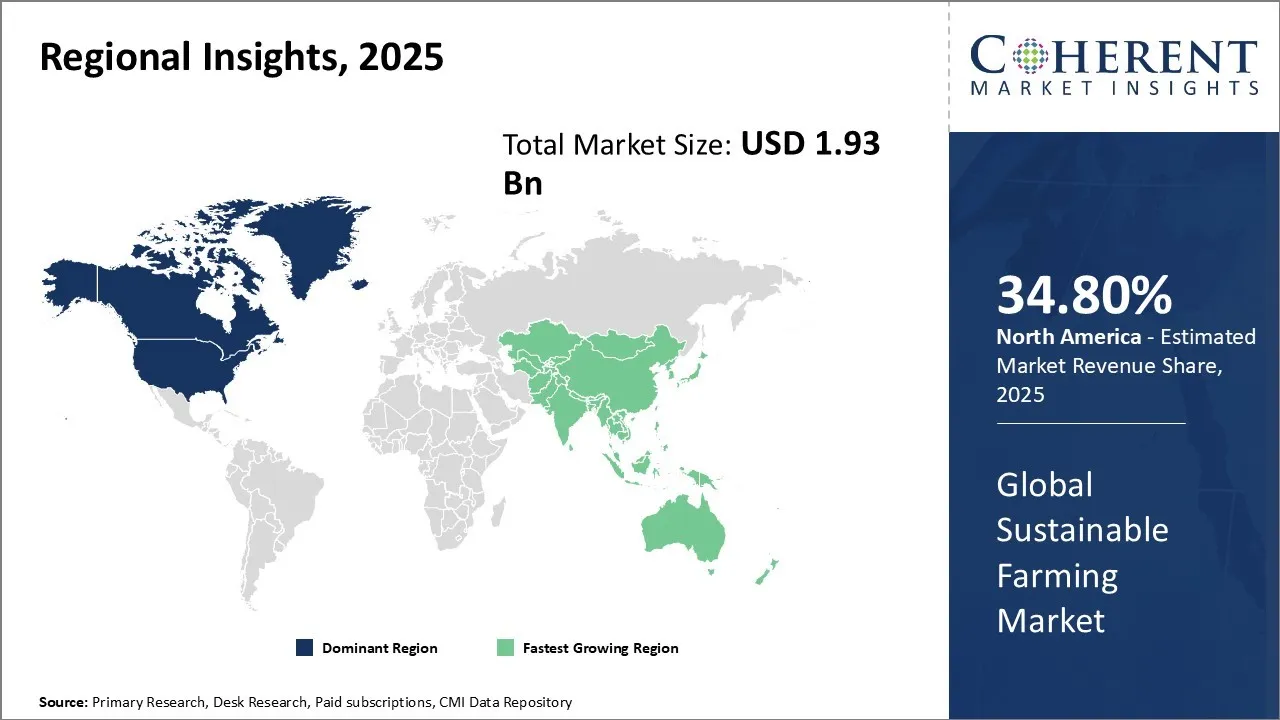
- North America is estimated to lead the market with a share of 34.8% in 2026.
- Asia Pacific, holding an estimated share of 20.2% in 2026 is projected to be the fastest growing region.
Market Overview
The current trends in the sustainable farming market emphasize precision agriculture, use of IoT and AI-driven tools, and adoption of regenerative practices that restore soil health. Consumers’ growing awareness about food safety and environmental conservation fuels the demand for sustainably farmed products. Additionally, policy incentives encouraging reduced chemical inputs and water conservation are accelerating the shift toward sustainable models. The focus on sustainability throughout the supply chain, coupled with advancements in biotechnology and renewable energy use, continues to drive market dynamics and shape future growth.
Current Events and their Impact
Current Events | Description and its Impact |
Geopolitical and Trade Developments |
|
Economic and Infrastructure Trends |
|
Segmental Insights
- Current Industry Events of 2026
- Market Size Estimation
- Regional Breakdown
- Competitive Landscape
- Customer Intelligence
- Segmental Analysis
- Pricing Analysis
- Key Market Drivers, Challenges & Future Trends
- Customized Insights Section
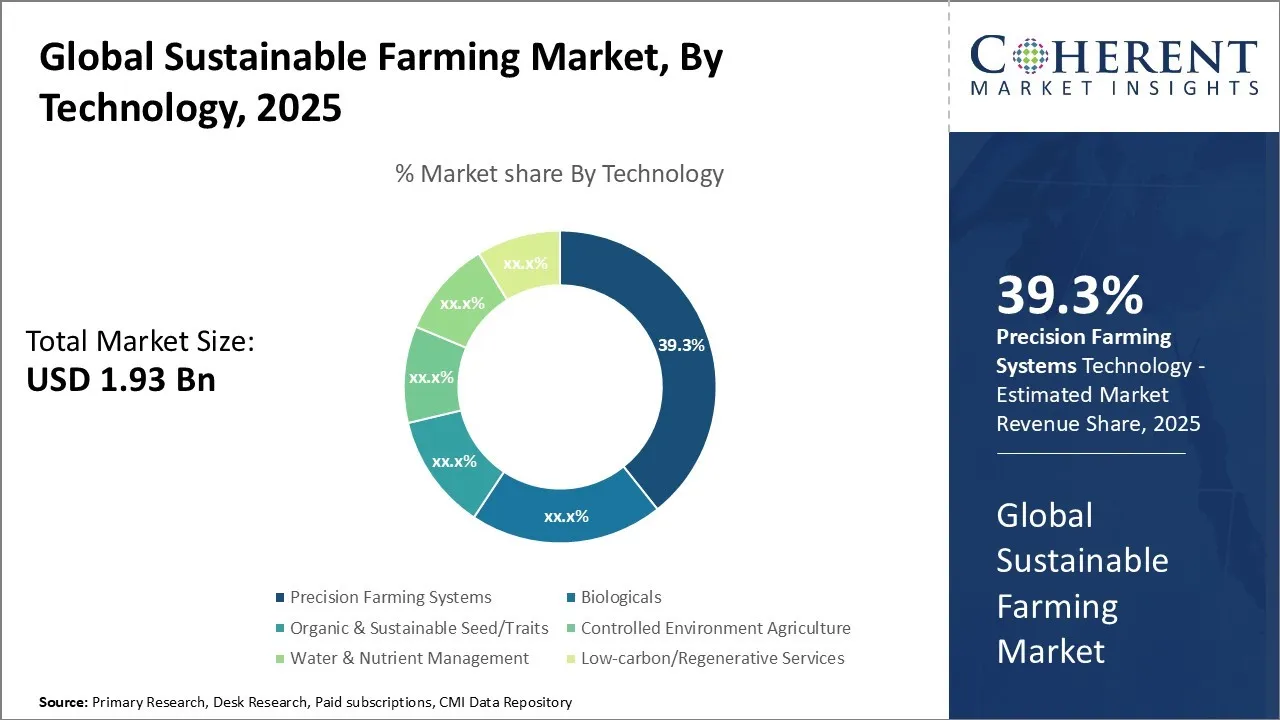
Global Sustainable Farming Market Insights, By Technology – Precision Farming Systems Segment Lead Owing to its Ability to Enhance Resource Efficiency and Crop Productivity
The precision farming systems segment is projected to account for 40.3% share in 2026. This segment’s growth is strongly supported by advancements in data-driven farming techniques that enable farmers to make informed decisions regarding planting, irrigation, fertilization, and pest control. One of the main drivers of precision farming systems is the integration of Geographic Information Systems (GIS), remote sensing, and Global Positioning Systems (GPS). These technologies allow for precise monitoring and management of field variability, enabling targeted application of water, fertilizers, and pesticides only where needed.
The rising adoption of Internet of Things (IoT) sensors and real-time monitoring devices further propels this segment. These tools collect critical data on soil moisture levels, crop health, and weather conditions, allowing farmers to respond promptly to environmental changes. For instance, in 2023, Deere & Company expanded its “See & Spray™” precision spraying technology across North America, which uses AI-driven computer vision to identify and target weeds with herbicides. Moreover, the growing global emphasis on sustainable agriculture and the reduction of carbon footprints boosts the demand for precision technologies. Governments and agricultural bodies are increasingly supporting the adoption of precision farming through subsidies and technical assistance programs, recognizing its potential to produce higher yields with fewer resources.
Impact of Artificial Intelligence (AI) on the Sustainable Farming Market
Artificial Intelligence (AI) is transforming sustainable farming by enabling data-driven decision-making, reducing input waste, and improving yields with lower environmental impact. AI-powered tools analyze vast datasets from sensors, drones, and satellites to optimize irrigation, fertilizer application, and pest management in real time. By integrating AI with farm management software, farmers can predict crop stress, monitor soil health, and streamline supply chain traceability, making agriculture more resilient to climate variability.
A real instance is John Deere’s See & Spray technology, which uses AI-driven computer vision to differentiate crops from weeds during field operations. This system allows herbicides to be sprayed only where needed, reducing chemical usage.
Regional Insights
North America Sustainable Farming Market Analysis and Trends
North America region is projected to lead the market with a 34.80% share in 2026, driven by a well-established agricultural ecosystem, advanced technological integration, and supportive government policies promoting sustainability. The U.S. and Canada have robust frameworks encouraging organic farming, precision agriculture, and renewable energy use in farming practices. Subsidies, tax incentives, and research grants stimulate innovation from companies like Deere & Company and Corteva Agriscience, which focus heavily on sustainable inputs, equipment, and digital tools to enhance farm productivity with environmental care.
Moreover, the strong presence of agritech startups accelerates adoption of IoT and AI-driven sustainable farming solutions. The region’s extensive trade networks and access to global trade further fuel its leadership by enabling export of sustainably produced crops and sharing of best practices internationally.
Asia Pacific Sustainable Farming Market Analysis and Trends
The Asia Pacific region, holding an estimated share of 20.2% in 2026, exhibits the fastest growth in the sustainable farming market. Countries such as China, India, and Australia have introduced programs promoting organic agriculture, water-efficient irrigation, and integrated pest management, supported by policies that aim to reduce chemical fertilizer and pesticide usage. Rapid urbanization and technological diffusion foster innovation, with companies like Chinese agri-tech giant New Hope Group and India’s UPL Limited innovating in biofertilizers and sustainable seed varieties.
The expanding middle-class consumer base prefers sustainably sourced products, encouraging farmers and companies to adopt sustainable practices. Trade liberalization and regional cooperation in Asia Pacific are bolstering knowledge exchange and supply chain improvements, further propelling the market expansion.
Global Sustainable Farming Market Outlook for Key Countries
U.S. Sustainable Farming Market Analysis and Trends
The U.S. is characterized by its technological advancement and strong sustainability mandates. Pioneers such as Deere & Company lead the development of precision agriculture machinery that optimizes resource use. Government initiatives like the U.S. Department of Agriculture (USDA)’s Sustainable Agriculture Research promote innovation in soil health, crop rotation, and integrated pest management. The presence of major agribusinesses including Archer Daniels Midland (ADM), which invests in sustainable sourcing, strengthens the market. Additionally, consumer demand for organic and sustainably grown products propels farmers towards adopting eco-friendly practices.
China Sustainable Farming Market Analysis and Trends
China sustainable farming market is rapidly evolving under the pressure of food security and environmental protection goals. Major corporations, including New Hope Group, focus on bio-based fertilizers and mechanized sustainable farming solutions. Government-backed programs aimed at reducing chemical inputs and improving water efficiency have stimulated widespread adoption of sustainable practices. The country’s strategic investments in agricultural R&D and digital farming solutions enhance productivity while conserving natural resources, supporting both domestic demand and export ambitions.
India Sustainable Farming Market Analysis and Trends
India continues to lead sustainable agriculture primarily through government-driven initiatives such as the Paramparagat Krishi Vikas Yojana promoting organic farming and soil health management. UPL Limited and Godrej Agrovet are key players innovating in biopesticides and sustainable inputs tailored for smallholder farmers. The diverse agro-climatic zones foster localized sustainable techniques, while growing awareness among farmers about reducing environmental impacts aids market penetration. Enhanced rural infrastructure and digital platforms improve access to sustainable farming technologies and the markets.
Australia Sustainable Farming Market Analysis and Trends
Australia’s growth in sustainable farming is propelled by stringent environmental regulations and a strong focus on water conservation and soil management. Companies like Incitec Pivot collaborate with farmers to deliver sustainable fertilizers and crop nutrition solutions adapted to local conditions. The government supports sustainable land use and carbon farming initiatives, which encourage adoption of reduced tillage and regenerative agriculture. The export-oriented farming and growing international demand for sustainably produced commodities drive continuous innovation and the market expansion.
Brazil Sustainable Farming Market Analysis and Trends
Brazil sustainable farming market is shaped by its vast agricultural lands and increasing focus on balancing production with conservation. Multinational corporations such as Bunge and local leaders like Embrapa invest heavily in sustainable crop varieties and integrated land management practices. Policies that incentivize reduced deforestation and encourage agroforestry models contribute to sustainable development goals. The country’s role as a major global exporter of agricultural commodities positions it to influence sustainable farming adoption through both domestic production and trade practices.
Market Players, Key Development, and Competitive Intelligence
Key Developments
- In July 2025, PepsiCo and Cargill announced a strategic collaboration to advance regenerative agriculture practices across 240,000 acres from 2025 through 2030. The collaboration will focus on the companies' shared corn supply chain in Iowa, where Cargill sources from local farmers to produce ingredients used in some of PepsiCo's most iconic products.
- In January 2025, Deere & Company announced the names of 6 companies chosen for its 2025 Startup Collaborator program. The John Deere Startup Collaborator program was launched in 2019 to enhance and deepen the company's interaction with startup companies whose technology could add value for ag and construction customers.
- In October 2024, John Deere and DeLaval launched the Milk Sustainability Center, an innovative digital ecosystem designed to enhance the efficiency and sustainability of dairy farming operations. With the dairy industry facing evolving sustainability standards and stricter regulations, the Milk Sustainability Center offers a solution by integrating data on crop and animal performance into one unified platform.
- In September 2024, Corteva, Inc., a global leader in agricultural technology and Pairwise, a technology company pioneering the application of gene editing in food and agriculture, announced a collaboration to accelerate the delivery of advanced gene editing solutions to farmers, ultimately benefitting both the environment and everyday consumers.
Top Strategies Followed by the Sustainable Farming Market Players
- Established industry leaders dominate through substantial investments in research and development (R&D), aiming to innovate and introduce high-performance products that meet evolving agricultural demands and sustainability standards.
- Bayer AG launched its Climate FieldView digital platform, investing significantly in R&D to integrate AI and data analytics for sustainable crop monitoring and yield optimization.
- Mid-level players in the sustainable farming market tend to emphasize cost-effective solutions that strike a balance between quality and affordability, catering primarily to price-sensitive consumers including small and medium-sized farmers.
- Trimble Inc. offers entry-level precision agriculture solutions, such as Guidance Displays and EZ-Steer systems, which provide affordable precision guidance for smaller farms.
- Small-scale players, often innovative startups or specialized niche firms, carve out a distinct position within the sustainable farming ecosystem by concentrating on specialized features and cutting-edge product innovations tailored to specific agricultural challenges.
- AeroFarms, a vertical farming startup, specializes in aeroponic indoor farming systems that use 95% less water than traditional agriculture.
Market Report Scope
Sustainable Farming Market Report Coverage
| Report Coverage | Details | ||
|---|---|---|---|
| Base Year: | 2025 | Market Size in 2026: | USD 2.04 Bn |
| Historical Data for: | 2020 To 2024 | Forecast Period: | 2026 To 2033 |
| Forecast Period 2026 to 2033 CAGR: | 5.6% | 2033 Value Projection: | USD 2.98 Bn |
| Geographies covered: |
| ||
| Segments covered: |
| ||
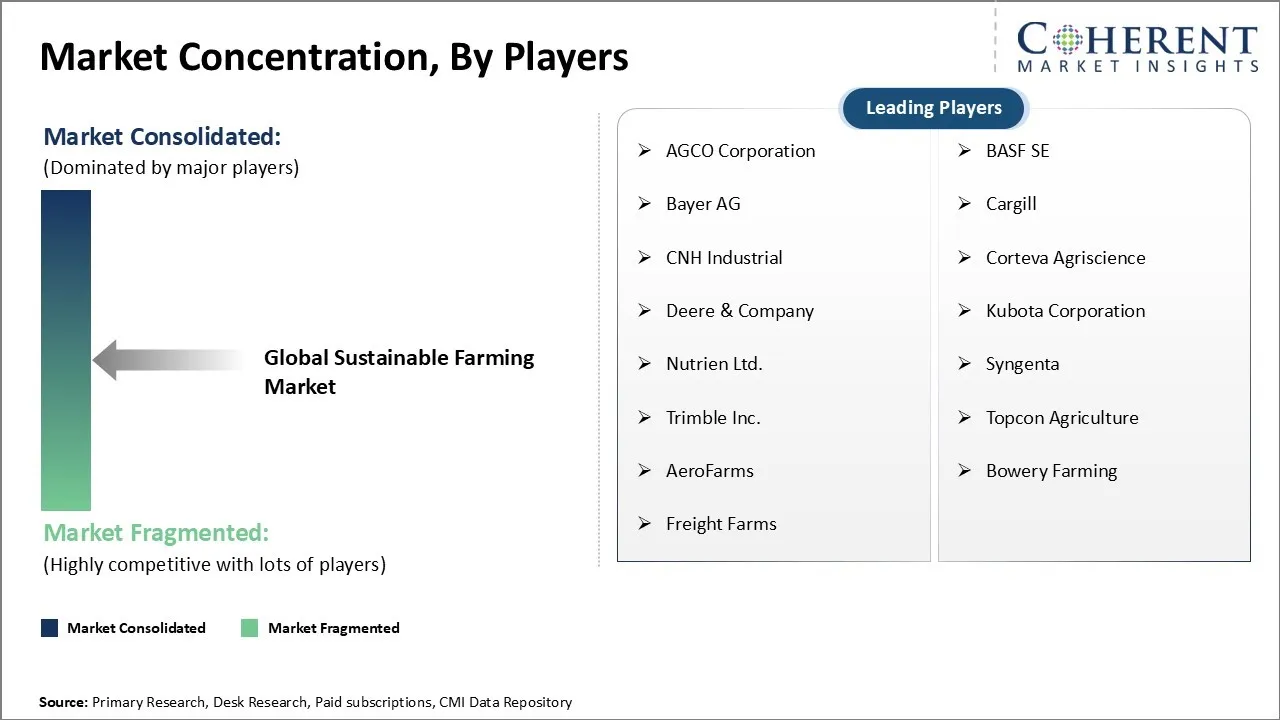
| Companies covered: | AGCO Corporation, BASF SE, Bayer AG, Cargill, CNH Industrial, Corteva Agriscience, Deere & Company, Kubota Corporation, Nutrien Ltd., Syngenta, Trimble Inc., Topcon Agriculture, AeroFarms, Bowery Farming, and Freight Farms | ||
| Growth Drivers: |
| ||
| Restraints & Challenges: |
| ||
Market Dynamics
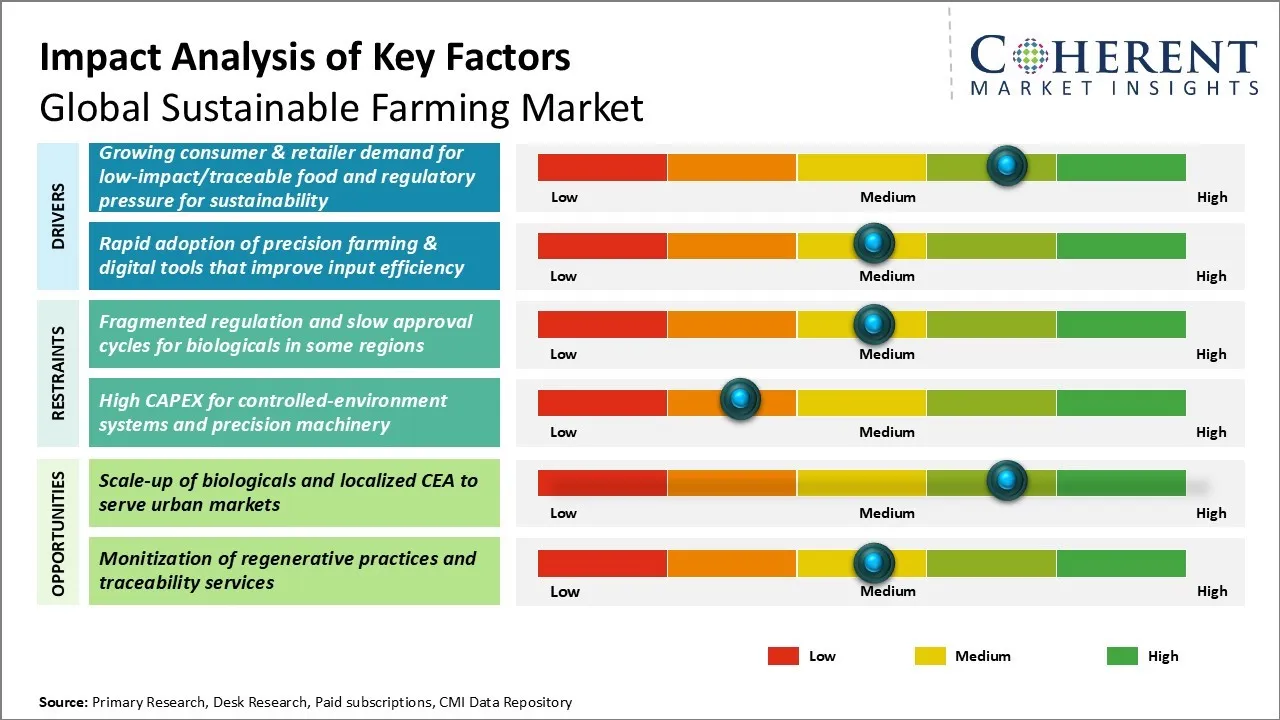
Global Sustainable Farming Market Driver – Growing Consumer & Retailer Demand for Low-Impact/Traceable Food and Regulatory Pressure for Sustainability
The global sustainable farming market is being significantly propelled by a pronounced shift in consumer and retailer preferences toward food products that are not only environmentally friendly but also transparent in their origins and production methods. Modern consumers are increasingly aware of the environmental footprint associated with conventional agriculture and prefer products that minimize soil degradation, water usage, and chemical inputs.
Retailers, responding to this shift, are prioritizing partnerships with suppliers who can demonstrate sustainable and traceable farming practices, thereby reinforce trust and aligning with evolving brand values centered around ethical sourcing. In North America, Walmart partnered with PepsiCo in 2023 on a USD 120 million regenerative agriculture initiative to improve soil health and reduce carbon emissions across millions of acres of farmland. Simultaneously, governments and regulatory bodies worldwide are strengthening sustainability directives, imposing stricter guidelines and compliance standards to reduce agricultural emissions, promote biodiversity, and ensure responsible land use.
Global Sustainable Farming Market Opportunity - Scale-up of Biologicals and Localized CEA to Serve Urban Markets
The global sustainable farming market stands to benefit significantly from the scale-up of biologicals and localized Controlled Environment Agriculture (CEA), particularly in addressing the rising the demand for fresh, sustainable produce within urban centers. Biologicals, including biofertilizers, biopesticides, and microbial inoculants, present an eco-friendly alternative to synthetic chemicals, improving soil health and crop yield while minimizing environmental impact. As urban populations grow, there is an increasing inclination toward sustainably produced food, driving adoption of these biological inputs in urban and peri-urban farming systems. In Asia Pacific, Plenty Unlimited and Walmart announced a partnership in 2022 to bring vertically farmed leafy greens grown in climate-controlled facilities to Walmart stores.
Complementing this trend, localized CEA technologies—such as vertical farming, hydroponics, and aeroponics—enable year-round cultivation in controlled settings, reducing dependency on traditional agricultural cycles and mitigating climate risks. These systems optimize resource use efficiency, notably water and nutrients, and reduce logistical costs and carbon footprints associated with food transportation. The integration of biologicals within CEA setups further enhances crop resilience and quality, making them highly attractive for urban retailers and health-conscious consumers. Technological advancements and declining costs in CEA infrastructure create scalable solutions accessible to both commercial enterprises and smaller urban farms.
Analyst Opinion (Expert Opinion)
- Artificial Intelligence and machine learning are rapidly becoming central to precision agriculture. From John Deere’s See & Spray to AI-driven farm management platforms in India, these technologies are reducing input waste, improving yield forecasts, and enabling real-time decision-making for sustainability.
- Advances in biopesticides, biofertilizers, and biostimulants are reshaping crop protection and soil health strategies. With major players like UPL and Corteva expanding biological portfolios, biologicals are emerging as a scalable alternative to synthetic agrochemicals in both developed and emerging markets.
- Vertical farms, hydroponics, and aeroponics integrated with IoT and robotics are revolutionizing urban food production. Startups like AeroFarms and Plenty are setting benchmarks in resource efficiency, showing how CEA can address food security challenges in densely populated regions.
Speak to the analyst
Want personalized insights?
Take the findings above to one of our principal consultants, or have the report rebuilt around the segments, geographies and competitors you actually track.
Market Segmentation
- Technology Insights (Revenue, USD Bn, 2021 - 2033)
- Precision Farming Systems
- Biologicals
- Organic & Sustainable Seed/Traits
- Controlled Environment Agriculture
- Water & Nutrient Management
- Low-carbon/Regenerative Services
- Regional Insights (Revenue, USD Bn, 2021 - 2033)
- North America
- U.S.
- Canada
- Latin America
- Brazil
- Argentina
- Mexico
- Rest of Latin America
- Europe
- Germany
- U.K.
- Spain
- France
- Italy
- Russia
- Rest of Europe
- Asia Pacific
- China
- India
- Japan
- Australia
- South Korea
- ASEAN
- Rest of Asia Pacific
- Middle East
- GCC Countries
- Israel
- Rest of Middle East
- Africa
- South Africa
- North Africa
- Central Africa
- North America
- Key Players Insights
- AGCO Corporation
- BASF SE
- Bayer AG
- Cargill
- CNH Industrial
- Corteva Agriscience
- Deere & Company
- Kubota Corporation
- Nutrien Ltd.
- Syngenta
- Trimble Inc.
- Topcon Agriculture
- AeroFarms
- Bowery Farming
- Freight Farms
Sources
Primary Research Interviews
Stakeholders
- Farmers and Farm Cooperatives
- Agri-Input Manufacturers and Suppliers
- Precision Agriculture Equipment Providers
- Vertical Farming & CEA Operators
- Food & Beverage Companies (sourcing sustainable supply chains)
- Retailers and Distributors focusing on organic & sustainable products
- Sustainability Consultants and Regenerative Agriculture Specialists
Databases
- Eurostat
- U.S. Department of Agriculture (USDA)
- FAOSTAT (Food and Agriculture Organization Database)
- OECD Agri-Environmental Indicators
- AgFunder AgriFoodTech Database
Magazines
- Modern Farmer
- Future Farming Magazine
- AgriBusiness Global
- Vertical Farm Daily
Journals
- Journal of Sustainable Agriculture
- Agricultural Systems Journal
- Frontiers in Sustainable Food Systems
- Journal of Cleaner Production
- Precision Agriculture Journal
Newspapers
- The Guardian (UK) – Environment Section
- The Economic Times (India) – Agriculture & Sustainability
- The New York Times – Climate & Food Systems
- China Daily – Agriculture & Rural Development
Associations
- International Federation of Organic Agriculture Movements (IFOAM)
- American Society of Agronomy (ASA)
- National Sustainable Agriculture Coalition (NSAC)
- International Fertilizer Association (IFA)
- Controlled Environment Agriculture Alliance (CEAA)
Public Domain Sources
- U.S. Department of Agriculture (USDA)
- EUROSTAT
- Food and Agriculture Organization of the United Nations (FAO)
- World Bank – Agriculture & Rural Development Reports
- ResearchGate
Proprietary Elements
- CMI Data Analytics Tool
- Proprietary CMI Existing Repository of information for last 8 years
Get access to 250+ pages report
Every segment, forecast, competitor profile and data table behind the analysis above — available for instant download.
- ESOMAR Member
- ISO 9001:2015 Certified
- D-U-N-S Registered
- GDPR & CCPA Compliant
Missing comfort of reading report in your local language? Find your preferred language:
Transform your Strategy with Exclusive Trending Reports
Frequently Asked Questions
The global sustainable farming market is estimated to be valued at USD 2.04 Bn in 2026 and is expected to reach USD 2.98Bn by 2033.
The CAGR of the global sustainable farming market is projected to be 5.6% from 2026 to 2033.
Growing consumer & retailer demand for low-impact/traceable food and regulatory pressure for sustainability and rapid adoption of precision farming & digital tools that improve input efficiency are the major factors driving the growth of the global sustainable farming market.
Fragmented regulation and slow approval cycles for biologicals in some regions and high CAPEX for controlled-environment systems and precision machinery are the major factors hampering the growth of the global sustainable farming market.
In terms of technology, the precision farming systems segment is estimated to dominate the market revenue share in 2026.
AGCO Corporation, BASF SE, Bayer AG, Cargill, CNH Industrial, Corteva Agriscience, Deere & Company, Kubota Corporation, Nutrien Ltd., Syngenta, Trimble Inc., Topcon Agriculture, AeroFarms, Bowery Farming, and Freight Farms are the major players.
North America is expected to lead the global sustainable farming market in 2026.