

Blockchain Based Solutions for Security Labels Market Analysis & Forecast (2026-2033)
The blockchain based solutions for security labels market size is anticipated to grow at a CAGR of 6.5% with USD 29.7 Bn in 2026 and is expected to reach USD 48.60 Bn in 2033. The primary drivers are largely defined by a global arms race against sophisticated counterfeiting (1 in 10 medicines), increasing regulatory pressure for product provenance, and a shift toward digital-first supply chain transparency.
Key Takeaways
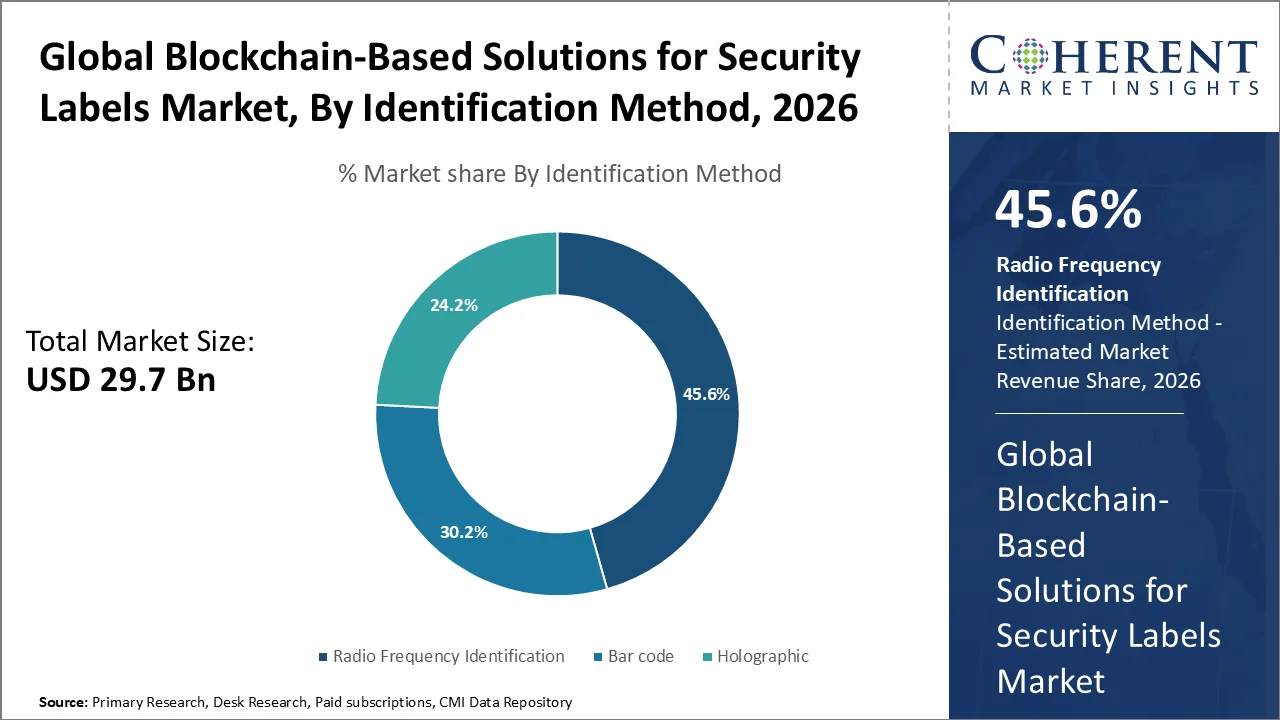
- Radio frequency identification is expected to account for the largest share of 45.6% in 2026. The growth is mainly owing to RFID’s ability to provide unique item-level identification, automated data capture, and real-time visibility. For instance, GS1 notes that RFID supports accurate capture of product identity across the supply chain. Also, RAIN Alliance projections indicate cumulative RAIN RFID tag shipments are set to surpass 300 Bn units during 2021–2026, thus highlighting the rapid scale-up of this technology.
- On the basis of end-use industry, FMCG is set to lead with 34.8% in 2026, backed by the high volume of packaged food, beverages, personal care, and household products that require stronger authentication, recall-readiness, and anti-counterfeit protection. According to the WHO, unsafe food causes 600 million illnesses and 420,000 deaths each year across the globe.
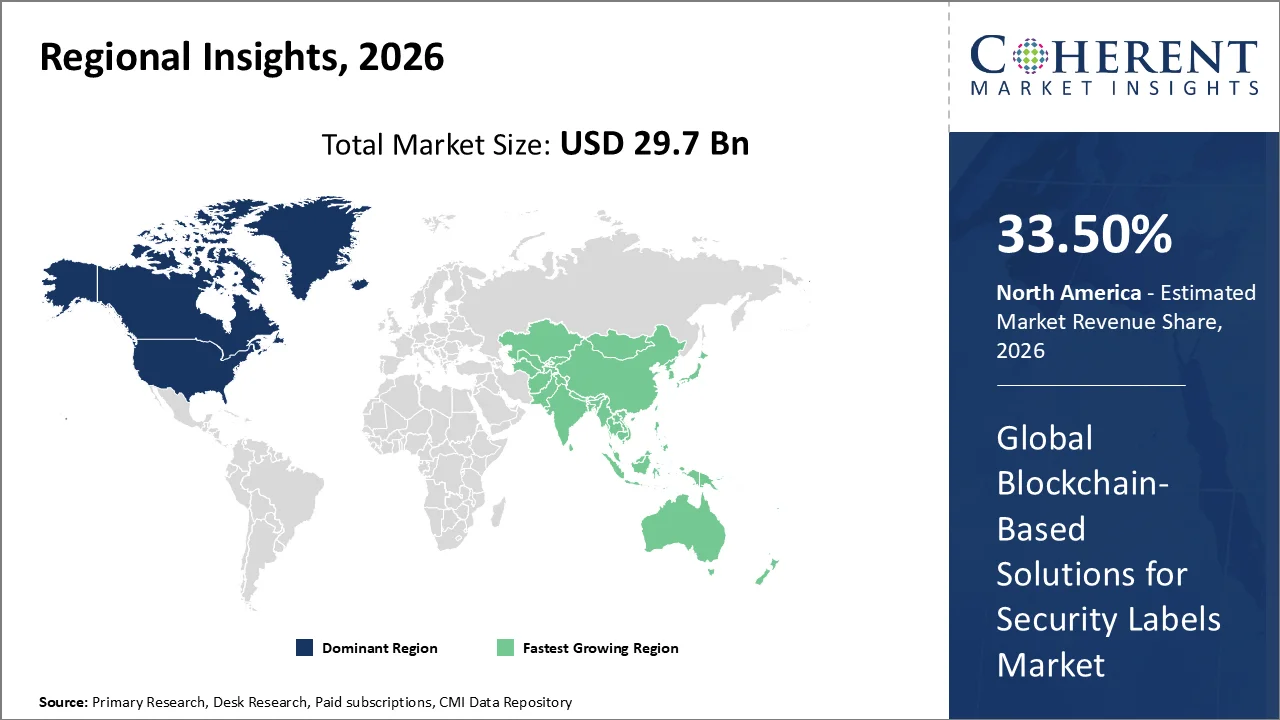
- North America is expected to acquire the prominent share of 33.5% in 2026. The growth is attributable to its strong anti-counterfeit enforcement framework, advanced traceability regulations, as well as mature standards ecosystem. The S. Customs and Border Protection reported that in fiscal year 2025 it seized nearly 79 million counterfeit items valued at more than USD 7.3 Bn had they been genuine.
Segmental Insights
Why is Radio Frequency Identification Acquiring the Largest Share?
Radio Frequency Identification (RFID) is projected to account for the largest blockchain based solutions for security labels market share of 45.6% in 2026. This is due to the fact that it allows for automated, non‑line‑of‑sight identification and data capture that enhances blockchain‑backed traceability and anti‑counterfeiting across complex supply chains. RFID tags are mainly used for tracking goods, managing inventory, and improving visibility. Thus, making them a preferred choice where secure labeling is critical. Radio Frequency Identification (RFID) , thereby reflecting rising demand for tracking technologies that can integrate with distributed ledgers for improved security.
The U.S. Drug Supply Chain Security Act (DSCSA) mandates an electronic, interoperable system to identify and trace prescription drugs at the unit level, thus propelling adoption of secure technologies. The FDA’s DSCSA pilot projects, including the MediLedger effort, demonstrated that blockchain‑based solutions can meet interoperability requirements and validate product authenticity throughout the supply chain.
- Current Industry Events of 2026
- Market Size Estimation
- Regional Breakdown
- Competitive Landscape
- Customer Intelligence
- Segmental Analysis
- Pricing Analysis
- Key Market Drivers, Challenges & Future Trends
- Customized Insights Section
FMCG holds the Largest Market Share
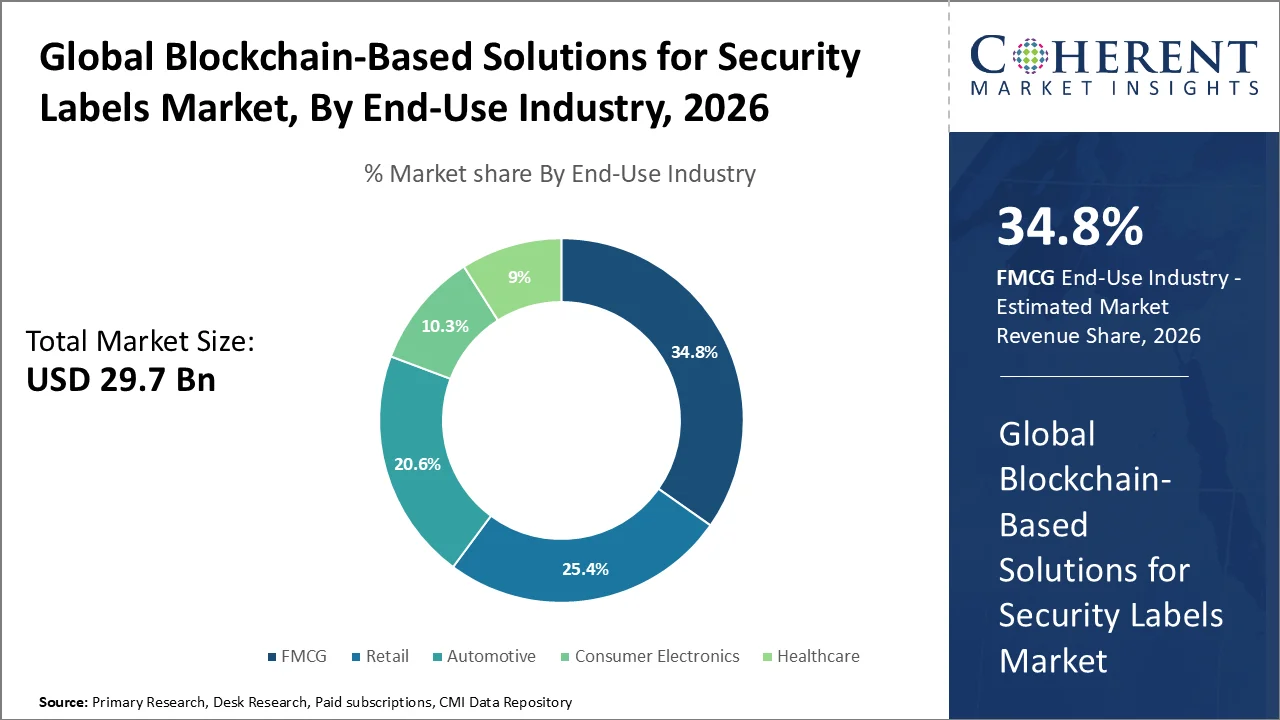
On the basis of end-use industry, FMCG leads with a major 34.8% share in 2026. The segment’s growth is due to its heavy dependence on fast, verifiable, and tamper-resistant labeling in food, beverage, personal care, and household product supply chains. The U.S. FDA’s Food Traceability Rule requires covered firms to maintain additional traceability records and provide requested data within 24 hours, thus boosting demand for secure digital label systems which can strengthen recall readiness and lot-level visibility.
The counterfeit pressure is also contributing to this adoption. OECD and EUIPO reported that global trade in counterfeit goods reached about USD 467 billion in 2021, equal to 2.3% of world imports, with food, cosmetics, and other everyday consumer goods among the affected categories. As FMCG companies manage high product volumes, short replenishment cycles, and rising compliance scrutiny, blockchain-enabled security labels are gaining traction for authenticity verification, traceability, and supply-chain transparency thereby accelerating blockchain based solutions for security labels market demand across global retail and distribution networks worldwide.
Blockchain Based Solutions for Security Labels Market Trends
- The increasing global adoption of blockchain technology for supply chain transparency is driving growth in the market. According to the U.S. National Institute of Standards and Technology (NIST), blockchain can enhance product traceability, thereby ensuring authenticity and improving the efficiency of security labels across industries. This is particularly impactful in sectors like pharmaceuticals, where counterfeit drugs account for up to 10% of the global market, as highlighted by the World Health Organization (WHO) in 2026.
- Regulatory frameworks worldwide are accelerating the demand for blockchain-integrated security labels. The FDA’s Digital Modernization Action Plan, released in 2026, emphasizes the need for enhanced serialization and tracking of drugs, paving the way for blockchain-based solutions to ensure compliance and authenticity.
- The growing prevalence of counterfeiting, particularly in high-risk sectors like electronics and luxury goods, is propelling investments in secure digital label solutions. A 2026 report by the European Commission revealed that blockchain could reduce counterfeiting by up to 30%, showcasing the technology’s potential to safeguard product integrity.
- Blockchain’s ability to secure the entire lifecycle of a product from manufacturing to the end user is one of the major trends. The U.S. Department of Commerce’s initiative, launched in 2026, emphasizes the integration of blockchain for secure digital product passports, directly enhancing the functionality of security labels.
Increased Adoption of Blockchain-Based Solutions for Security Labels Spurs Growth in the US
The rise in use of blockchain-based solutions for security labels is substantially contributing to the growth in the country. The blockchain technology provides secure and tamper-proof tracking tools to help pharmaceuticals, electronics, and luxury goods industries address the rising counterfeiting risks as well as improve supply chain transparency. The Drug Supply Chain Security Act (DSCSA) requires electronic tracking systems to identify and track prescription drugs, with rules to be followed by 2023.
According to the FDA, blockchain has been part of pilot projects testing interoperable and secure product traceability solutions. Notably, the MediLedger FDA Pilot Project tested blockchain’s potential in confirming product authenticity and ownership transparency. As regulations demand enhanced traceability and authenticity across critical sectors, blockchain-based solutions are set to drive the market due to the increasing demand for reliable and verifiable labels.
Immutable Digital Twins: A Major Breakthrough in Blockchain Based Solutions for Security Labels
Immutable digital twin frameworks are improving blockchain based solutions for security labels by turning each protected item into a persistent, tamper-evident digital record. These can be verified in logistics, manufacturing, retail, as well as after-sales stages. This is becoming more important as the UN Transparency Protocol notes counterfeit trade accounts for an estimated 2% to 5% of global trade value. Pharmaceuticals, electronics, apparel, and food are among the most affected sectors. In the U.S., FDA says DSCSA requires interoperable, electronic package-level tracing for certain prescription drugs, thus speeding up the demand for serialisation-linked blockchain records as well as secure label authentication.
In Europe, the European Blockchain Services Infrastructure announced in February 2026 that traceability features for digital product passports are being developed. The European Parliament in March 2026 stressed rapid Digital Product Passport rollout for critical products sold online. Together, these developments demonstrate how immutable digital twins can enhance provenance, automate compliance checks, and make advanced security labels more scalable, trusted, as well as commercially valuable. An EU Observatory report also notes blockchain can enhance digital product passports with secure, transparent, immutable lifecycle information, directly supporting anti-counterfeit label ecosystems.
Current Events and Their Impact on the Blockchain Based Solutions for Security Labels Market
Current Event | Description and its Impact |
India’s 2025 QR/Barcode Authentication Enforcement for Drug Packaging |
|
2025–2026 EU Digital Product Passport Consultation and ESPR Rollout |
|
Regional Insights
North America Dominates Owing to the Increasing Integration of Blockchain in Various Industries
The North America region accounts for 33.50% of the blockchain based solutions for security labels market share in 2026. The region’s growth is owing to robust regulatory backing and the expanding adoption of blockchain technology in industries in order to enhance traceability and security. The FDA's DSCSA pilot program, which evaluated blockchain solutions for product tracking, delivered promising results in improving product authenticity and counterfeit prevention within the healthcare sector. This initiative highlights blockchain’s potential to ensure secure supply chains and accurate product verification, thereby propelling further interest and integration in other industries as well.
In addition, GS1 US reports that nearly 300,000 businesses in 25 industries are dependent on its standards, thereby highlighting the growing acceptance of blockchain in the U.S. supply chains. The National Institute of Standards and Technology (NIST) also strengthened this momentum by publishing new traceability frameworks in 2025. This aims at enhancing product provenance and boosting confidence in the authenticity of goods.
These regulatory advancements, coupled with the rising demand for secure labeling solutions in sectors like pharmaceuticals and FMCG, are main drivers of the blockchain based solutions for security labels market in North America.
Asia Pacific Blockchain Based Solutions for Security Labels Market Trends
Asia Pacific is expected to witness strong growth in blockchain based solutions for security labels market over the forecast period. Rising counterfeit exposure across pharmaceuticals, cosmetics, food, and consumer goods is a major growth driver. The World Customs Organization reported that Asia Pacific was the most frequent departure region for medicine seizures, accounting for 30% of incidents, or 1,603 cases, involving 27 million items.
Enforcement activity is also intensifying across the region. Japan Customs recorded 33,019 IP-rights import seizures in 2024, its highest level in the published series, while South Korea announced stronger measures in March 2026 for counterfeit cosmetics, including recalls and disposal. Regional institutions are also advancing digital traceability.
In 2025, APEC moved a blockchain-based shrimp traceability project to strengthen Asia-Pacific seafood value chains. Combined with Singapore Customs updated IP border-enforcement framework in February 2026, these developments are accelerating adoption of blockchain-enabled security labels across Asia Pacific markets. This momentum supports export chains needing verifiable origin, serialization, and tamper-evident authentication.
Rising Threat of Counterfeiting is Accelerating the Blockchain Based Solutions for Security Labels Market Demand in United States
The U.S. is experiencing significant growth in blockchain based solutions for security labels market. The growth is mainly owing to the rising threat of counterfeiting and the need for supply chain transparency. As per the U.S. Customs and Border Protection (CBP) more over USD 5.4 billion worth of fake goods were seized in 2024, thus highlighting the increasing need for secure labeling technologies. In response, the FDA’s Drug Supply Chain Security Act (DSCSA) provides a structured approach to product traceability. This framework is likely to speed up the adoption of blockchain-based solutions for pharmaceutical labeling, thus ensuring enhanced security in the years ahead.
In addition, the U.S. Department of Homeland Security’s National Intellectual Property Rights Coordination Center (IPR Center) remains active in combating counterfeit goods, advocating for blockchain-based solutions to ensure digital provenance and tamper-evident labeling. These initiatives, coupled with increasing federal investments in supply chain security, are expected to accelerate the market growth for blockchain-based security labels across the U.S.
China Blockchain Based Solutions for Security Labels Market Trends
China blockchain based solutions for security labels market is advancing steadily, supported by the country’s stronger push toward traceability, anti-counterfeiting, and digital compliance. China’s national drug-safety plan calls for broader lifecycle digital management and gradual implementation of unique device identification, which directly strengthens demand for secure, serialized labels. The National Healthcare Security Administration said China had aggregated 15.806 billion drug traceability codes by January 2025, while Shanghai reported more than 50 live blockchain scenarios and 107 projects under development in April 2025.
Who are the Major Companies in Blockchain Based Solutions for Security Labels Industry
Some of the major key players in blockchain based solutions for security labels market are 3M Company, Avery Dennison Corporation, CCL Industries Inc., Honeywell International Inc., UPM Raflatac, Inc., OpSec Security, Inc., Tesa SE, Brady Corporation, Covectra, Inc., and Mega Fortris Sdn. Bhd.
Key News
- In January 2026, Axopar launched a Digital Product Passport for every vessel starting from spring 2026, accessed via a secure NFC chip embedded at the helm. The passport is positioned around authenticity, ownership, service, and warranty traceability.
- In May 2025, Identiv, Inc., a global company in RFID- and BLE-enabled Internet of Things (IoT) solutions, launched a new NFC-based anti-fake smart packaging solution for premium wine makers and collectors in collaboration with ZATAP and Genuine-Analytics.
- In November 2024, SBI Traceability, Co., Ltd. announced that its traceability service SHIMENAWA, which enables the strong linkage of physical assets and digital information by combining blockchain and IoT (NFC tag) technologies.
Market Report Scope
Blockchain Based Solutions for Security Labels Market Report Coverage
| Report Coverage | Details | ||
|---|---|---|---|
| Base Year: | 2025 | Market Size in 2026: | USD 29.7 Bn |
| Historical Data for: | 2020 To 2024 | Forecast Period: | 2026 To 2033 |
| Forecast Period 2026 to 2033 CAGR: | 6.5% | 2033 Value Projection: | USD 48.60 Bn |
| Geographies covered: |
| ||
| Segments covered: |
| ||
| Companies covered: | 3M Company, Avery Dennison Corporation, CCL Industries Inc., Honeywell International Inc., UPM Raflatac, Inc., OpSec Security, Inc., Tesa SE, Brady Corporation, Covectra, Inc., and Mega Fortris Sdn. Bhd. | ||
| Growth Drivers: |
| ||
| Restraints & Challenges: |
| ||
Analyst Opinion
- Blockchain based solutions for security labels market is driven by the need for anti-counterfeiting and product authentication. With counterfeit and pirated goods accounting for up to 2.3% of global trade, the market is growing not only because of digitalization trends but also because of traceability needs. In 2024, EU authorities intercepted 112 million counterfeit goods worth €3.8 billion, demonstrating the risk for brands and regulators globally.
- Blockchain-backed security labels remain relevant in sectors requiring traceability and provenance assurance. In the U.S., FDA’s DSCSA requires interoperable, electronic package-level tracing for prescription drugs. This regulatory emphasis positions verifiable labels as an essential layer for supply-chain security, compliance, and counterfeit mitigation.
- Public initiatives are increasing adoption momentum, with EU-backed EBSI projects showing how blockchain can make product information easier to verify and nearly impossible to fake. These advances, alongside QR, NFC, and RFID-linked smart labels, are strengthening transparency, trust, as well as market's growth.
Speak to the analyst
Want personalized insights?
Take the findings above to one of our principal consultants, or have the report rebuilt around the segments, geographies and competitors you actually track.
Market Segmentation
- By Identification Method
- Bar code
- Radio Frequency Identification
- Holographic
- By End-Use Industry
- FMCG
- Automotive
- Retail
- Consumer Electronics
- Healthcare
- By Region
- North America
- U.S.
- Canada
- Latin America
- Brazil
- Argentina
- Mexico
- Rest of Latin America
- Europe
- Germany
- U.K.
- Spain
- France
- Italy
- Russia
- Rest of Europe
- Asia Pacific
- China
- India
- Japan
- Australia
- South Korea
- ASEAN
- Rest of Asia Pacific
- Middle East
- GCC Countries
- Israel
- Rest of Middle East
- Africa
- South Africa
- North Africa
- Central Africa
- North America
Sources
Primary Research Interviews
- Blockchain Technology Providers
- Security Label Manufacturers
- Supply Chain and Logistics Providers
- Digital Labeling Technology Consultants
- Anti-Counterfeit Solutions Providers
- Others
Databases
- Bloomberg Terminal
- Thomson Reuters Eikon
- Euromonitor International
- Others
Magazines
- Security Technology Magazine
- Labeling & Packaging News
- Blockchain Journal
- Tech Security Magazine
- Others
Journals
- Journal of Blockchain Research
- International Journal of Information Security
- IEEE Access: Blockchain
- Journal of Applied Cryptography
- Others
Newspapers
- Financial Times
- The Wall Street Journal
- Reuters
- Blockchain News
- Others
Associations
- Blockchain in Transport Alliance (BiTA)
- International Association for Secure Technology (IAST)
- Anti-Counterfeit and Product Protection Forum (ACP2F)
- International Blockchain Council (IBC)
- Others
Public Domain Sources
- U.S. Department of Homeland Security (DHS) – Cybersecurity & Infrastructure Security Agency (CISA)
- European Union Blockchain Observatory and Forum
- National Institute of Standards and Technology (NIST) – Cybersecurity Framework
- World Intellectual Property Organization (WIPO) – Blockchain and IP Protection
- Others
Proprietary Elements
- CMI Data Analytics Tool
- Proprietary CMI Existing Repository of Information for the Last 8 Years
Get access to 250+ pages report
Every segment, forecast, competitor profile and data table behind the analysis above — available for instant download.
- ESOMAR Member
- ISO 9001:2015 Certified
- D-U-N-S Registered
- GDPR & CCPA Compliant
Missing comfort of reading report in your local language? Find your preferred language:
Transform your Strategy with Exclusive Trending Reports
Frequently Asked Questions
The Blockchain based solutions for security labels market is expected to reach USD 48.60 Bn in 2033.
Major players operating in the global Blockchain based solutions for security labels market include 3M Company, Avery Dennison Corporation, CCL Industries Inc., Honeywell International Inc., UPM Raflatac, Inc., OpSec Security, Inc., Tesa SE, Brady Corporation, Covectra, Inc., and Mega Fortris Sdn. Bhd.
The technical limitations and high costs to broader organizational and regulatory challenges are the key factors hampering growth of the Market.
The escalating need for supply chain integrity, consumer demand for authenticity, and technological convergence boost the demand for blockchain based solutions for security labels.
The blockchain based solutions for security labels market is anticipated to grow at a CAGR of 6.5% between 2026 and 2033.
Among regions, North America is expected to account for a largest market share in the global Blockchain based solutions for security labels market over the forecast period.
The industries that handle high-value goods, strictly regulated materials, and complex global supply chains benefit most from blockchain-based security labels.