

IP Multimedia Subsystem Market Size and Share Analysis- Growth Trends and Forecasts (2026-2033)
The IP Multimedia Subsystem Market size is anticipated to grow at a CAGR of 13.2% with USD 4.4 Bn in 2026 and is expected to reach USD 10.5 Bn in 2033. The primary drivers are defined by accelerating 5G standalone deployment, migration from circuit-switched networks to all-IP infrastructure, expanding Voice over LTE and Voice over New Radio adoption, and rising demand for converged communication services. According to the International Telecommunication Union, approximately 9.2 billion mobile-cellular subscriptions were active globally in 2025, while 5G networks covered around 55% of the global population. These developments are strengthening demand for cloud-native IMS platforms, session control, multimedia application servers, VoLTE, VoWi-Fi, VoNR, and carrier-grade communication services.
Key Takeaways
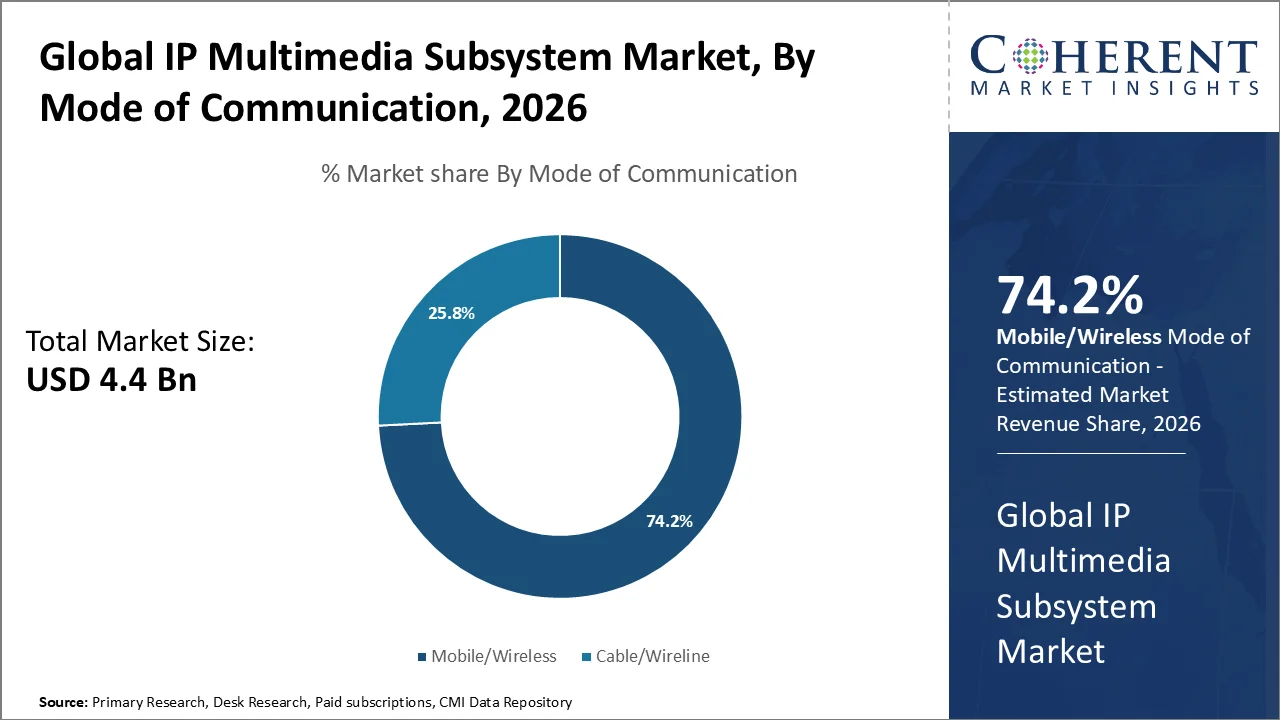
- The mobile/wireless segment is likely to dominate the market with 74.2% in 2026. The segment’s growth is owing to the rapid LTE and 5G coverage expansion and the need for uninterrupted voice continuity across radio technologies.
- The consumer segment is set to lead with 57.5% in 2026. The segment’s growth is owing to the high mobile subscription volumes, smartphone-based calling, Wi-Fi calling, messaging, video communication, and digital content consumption.
- The VoIP segment is set to lead with 34.3% in 2026. The segment’s growth is owing to the operator migration from circuit-switched voice to packet-based VoLTE, VoWi-Fi, and VoNR services.
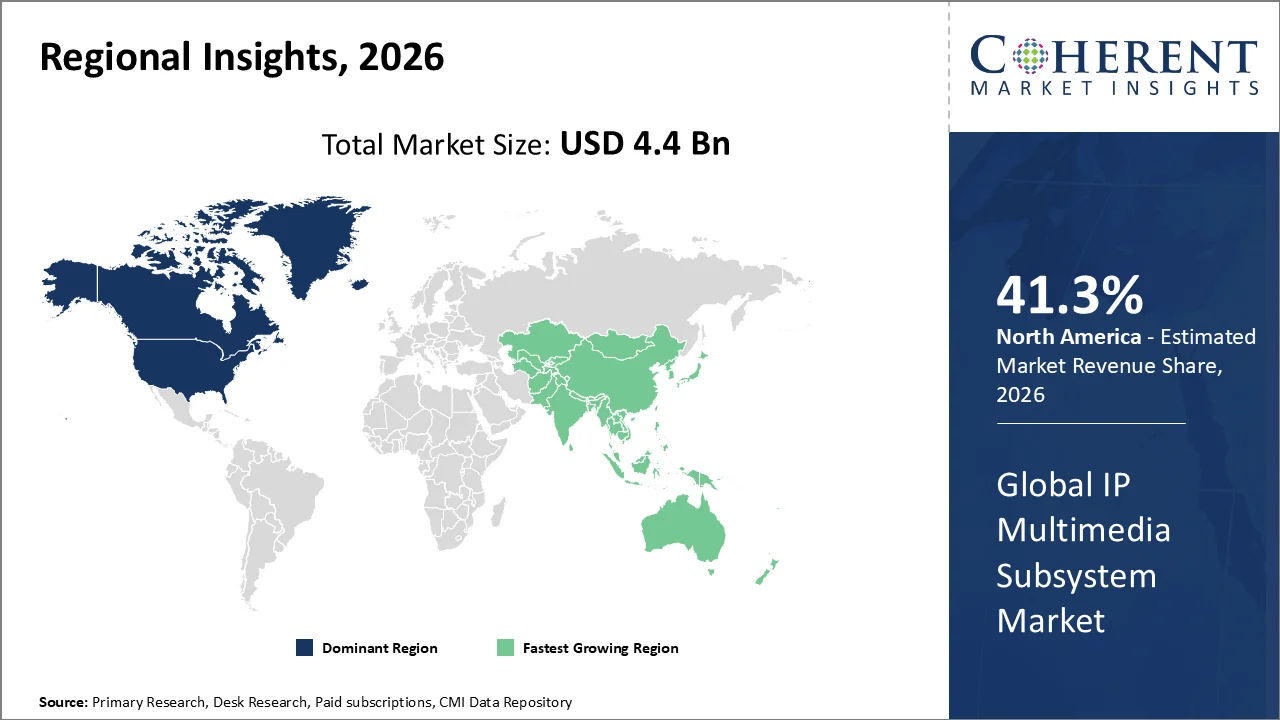
- North America is expected to acquire the prominent share of 41.3% in 2026. The region’s growth is owing to the mature LTE infrastructure, early 5G standalone deployment, voice-core modernization, and strong cloud adoption among communication service providers.
Segmental Insights
Why is Mobile/Wireless Segment Acquiring the Largest Share?
On the basis of mode of communication, the mobile/wireless segment is projected to account for the largest IP Multimedia Subsystem Market share of 74.2% in 2026. The segment’s growth is owing to the global installed base of mobile subscriptions, broad LTE availability, rapid 5G deployment, increased smartphone use, and continuing adoption of operator-controlled voice services.
IMS is essential to mobile communication because 3GPP identifies VoLTE and VoNR as communication services delivered by IMS over 4G and 5G networks. The same service platform can support communication over wireless local-area networks and other access technologies. This common architecture allows operators to provide consistent identities, call features, emergency access, supplementary services, and charging across LTE, 5G, and Wi-Fi.
India illustrates the scale of wireless-led demand. The Ministry of Communications reported that India had approximately 1.244 billion mobile subscriptions at the end of December 2025. The country also recorded 1.259 billion combined mobile and 5G fixed-wireless-access subscriptions.
- Current Industry Events of 2026
- Market Size Estimation
- Regional Breakdown
- Competitive Landscape
- Customer Intelligence
- Segmental Analysis
- Pricing Analysis
- Key Market Drivers, Challenges & Future Trends
- Customized Insights Section
Consumer hold the Largest Market Share
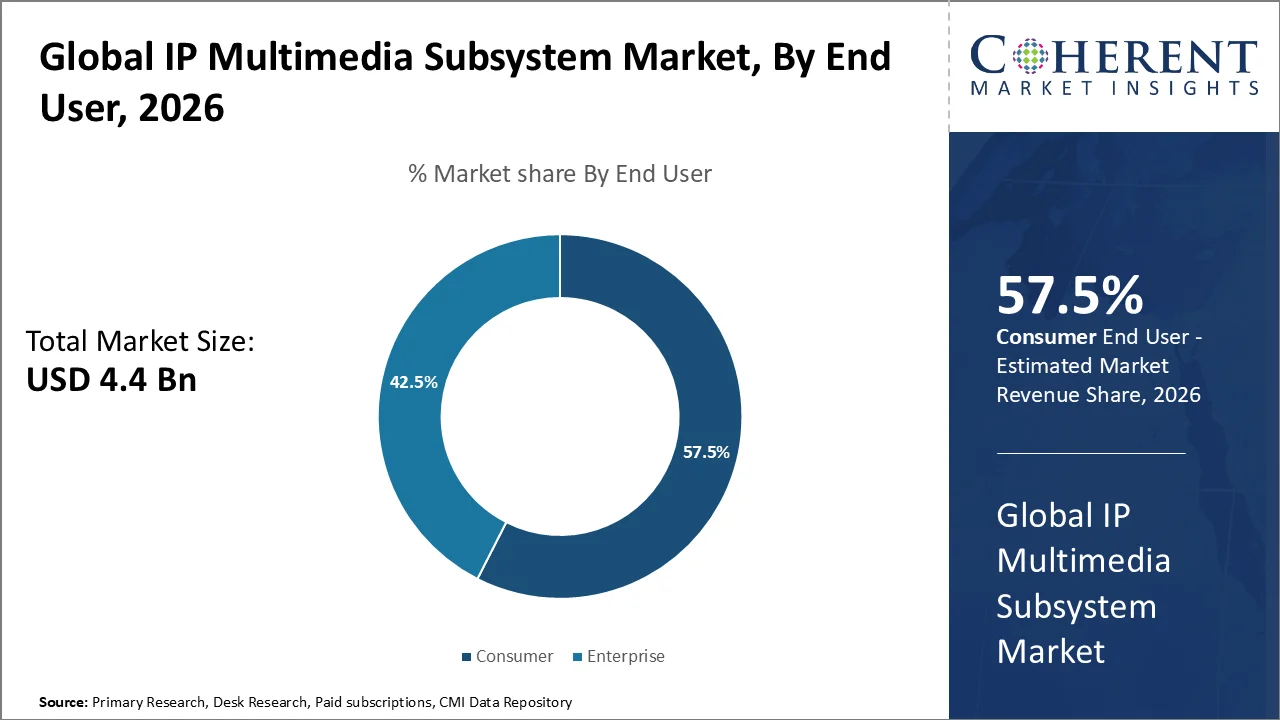
On the end user, the consumer segment lead with a major 57.5% share in 2026. The growth is owing to the rising use of IMS-supported VoLTE, VoWiFi, VoNR, video calling, and rich messaging across smartphones and connected devices.
The International Telecommunication Union reported 99 mobile-broadband subscriptions per 100 inhabitants worldwide in 2025, while mobile broadband represented 89% of all mobile subscriptions, indicating a large addressable consumer base for operator-managed multimedia services.
In February 2025, Mavenir and O2 Telefónica Germany signed a five-year extension to migrate fixed and mobile networks from virtualized IMS to cloud-native IMS. The platform supports VoLTE and VoNR, maintains 4G-to-5G voice continuity, and allows for scalable service innovation. These developments strengthen the consumer adoption by improving voice quality, network resilience, service availability, as well as multimedia experiences across operator networks globally.
Market Drivers
Rising Cloud-Native Voice Innovations are Transforming the IP Multimedia Subsystem Market
Germany is emerging as an important market for cloud-native IMS innovation. This is because the operators are replacing virtualized network functions with containerized platforms running across private and public cloud environments. The transition is supported by high LTE and 5G availability, extensive enterprise connectivity, and operator requirements for lower operating costs, automated software updates, elastic scaling, and faster service introduction.
The Bundesnetzagentur reported that 5G services were available across approximately 95% of Germany’s surface area by October 2025, increasing from around 93% a year earlier. Deutsche Telekom provided 5G coverage over approximately 87% of the country’s surface area, while Vodafone and Telefónica covered around 75% and 76%, respectively. This network footprint creates a substantial base for IMS-supported VoLTE, VoNR, VoWi-Fi, emergency calling, enterprise communications, and multimedia applications.
In May 2026, Mavenir announced that Telefónica Germany had migrated the first 100,000 mobile subscribers to 4G and 5G voice services on Mavenir’s cloud-native IMS platform running on Amazon Web Services. The milestone made Telefónica Germany the first European mobile operator identified by the companies as operating production mobile voice subscribers through this type of public-cloud deployment.
Current Events and Their Impact
Current Event | Description and its Impact |
2025 FCC Next Generation 911 Reliability and IP/SIP Transition in the U.S. |
|
EU Packet-Switched Emergency Communications and IMS-Based eCall Mandates |
|
IP Multimedia Subsystem Market Trends
- Rapid deployment of 5G standalone networks is increasing the demand for IMS-based Voice over New Radio, thereby allowing for high-quality voice, video, messaging, emergency calling, and real-time multimedia services across 5G infrastructure.
- Growing adoption of VoLTE, VoWiFi, and SMS over IP is encouraging the operators to consolidate communication services on a common IMS platform, thus improving interoperability, service continuity, and customer experience.
- Multi-access integration across LTE, 5G New Radio, and Wi-Fi expands IMS applications beyond traditional voice, supporting conversational video, rich messaging, enterprise communications, and connected-device services.
- Expansion of mobile broadband is strengthening the addressable market for IMS. Approximately 3 billion 5G subscriptions accounted for around one-third of the global mobile-broadband subscriptions.
- Cloud-native IMS and network function virtualization are gaining momentum as telecom operators replace hardware-centric infrastructure with software-based network functions. ETSI highlights the transition from conventional NFV toward cloud-native, microservices-based architectures supporting distributed 5G networks. This shift improves scalability, service automation, resource utilization, and deployment flexibility while lowering infrastructure and operational costs for communication service providers.
Regional Insights
North America Dominates Owing to the Mature Mobile and IP-Voice Infrastructure
The North America region accounts for 41.3% of the market share in 2026. The region’s growth is owing to the extensive LTE and 5G infrastructure, high smartphone penetration, a substantial interconnected VoIP base, mature cloud-computing ecosystems, and ongoing transition toward IP-based emergency services.
The U.S. had approximately 473 million retail voice connections in June 2025. This included 394.5 million mobile subscriptions, 63.4 million interconnected VoIP subscriptions, and 15 million switched access lines. Mobile subscriptions increased at a compound annual rate of approximately 2.5% between June 2022 and June 2025, while switched access lines declined by 17.9% annually. This installed base creates continuing demand for IMS capacity expansion, security, signaling, policy integration, service assurance, number management, emergency communication, and migration services.
In February 2025, ng-voice entered a partnership with U.S.-based Cirrus Core Networks to combine its cloud-native Hyperscale IMS with managed-network and systems-integration services. The partnership targets MVNOs, communication service providers, and industrial customers requiring VoLTE, VoNR, VoWi-Fi, mobile-core, and value-added services.
Asia Pacific IP Multimedia Subsystem Market Trends
Asia Pacificis expected to witness strong growth in market over the forecast period. The region’s growth is owing to the large mobile-subscriber populations, rapid 5G infrastructure deployment, increasing smartphone adoption, network modernization, and the retirement of legacy voice technologies.
The GSMA reported that Asia Pacific had approximately 1.5 billion mobile-Internet users in 2025 and projected that 5G would represent around 50% of the region’s mobile connections by 2030. India, China, Japan, Indonesia, Pakistan, and other emerging economies are expected to contribute a substantial proportion of new mobile-Internet subscribers.
In March 2026, Ericsson announced plans to modernize SoftBank’s Japanese core network, including migration of the operator’s IMS platform to Ericsson Cloud IMS. The deployment is intended to improve voice and multimedia service quality, automate operations, reduce infrastructure complexity, and accelerate service introduction.
Extensive Mobile Network are Accelerating the IP Multimedia Subsystem Market in United States
In the United States, the IP Multimedia Subsystem Market is influenced by the extensive mobile network, substantial VoIP base, early 5G adoption, and ongoing transition to NG911. The FCC reported approximately 395 million mobile voice subscriptions and 63 million interconnected VoIP subscriptions in June 2025.
In September 2025, Mavenir teamed up with Bristol Bay Cellular and RINA to deploy a cloud-native mobile core in Alaska. The platform supports IMS, VoLTE, VoWiFi, secure 4G connectivity, network redundancy, and a seamless upgrade path to standalone 5G services.
Japan IP Multimedia Subsystem Market Trends
Japan is emerging as a major growth market for IP Multimedia Subsystem. The growth is owing to the extensive 5G infrastructure and ongoing cloud-core modernization. Japan’s Digital Agency reported nationwide 5G population coverage of 98.1% as of March 2024, creating a broad foundation for IMS-enabled VoLTE, VoNR, multimedia messaging, and converged services. In
In March 2026, Rakuten Mobile deployed Nokia’s cloud-native IMS and Subscriber Data Management functions on Rakuten Cloud for commercial 4G and 5G operations. The deployment supports VoLTE, elastic scaling, automation, faster upgrades, improved resilience, and reduced network operational complexity.
Who are the Major Companies in IP Multimedia Subsystem Industry
Some of the major key players in IP Multimedia Subsystem Market are Ericsson Inc., Nokia Corporation, Emirates Integrated Telecommunications Company PJSC (DU), Cirpack SAS, Emirates Telecommunication Group Company PJSC (Etisalat), Huawei Technologies Co. Ltd, MTN Irancell telecommunications Service Company, Italtel S.p.A., Cisco Systems, Inc., ZTE Corporation, IBM Corporation, and Mitel Networks Corporation.
Key News
- In February 2026, Orange Wholesale International partnered with ng-voice to launch an IMS-as-a-service platform using containerized automation. The solution reduces ownership costs by up to 70%, simplifies operations, supports scalable VoLTE and VoNR deployments, and serves consumer and IoT applications.
- In February 2025, Norway-based full MVNO IXT selected ng-voice’s Hyperscale IMS to launch advanced voice services. The cloud-native, automated platform supports scalable VoLTE, VoNR, and VoWiFi deployment, reduces infrastructure costs, enables multi-vendor integration, and accelerates IXT’s planned global expansion strategy.
Market Report Scope
IP Multimedia Subsystem Market Report Coverage
| Report Coverage | Details | ||
|---|---|---|---|
| Base Year: | 2025 | Market Size in 2026: | USD 4.4 Bn |
| Historical Data for: | 2020 To 2024 | Forecast Period: | 2026 To 2033 |
| Forecast Period 2026 to 2033 CAGR: | 13.2% | 2033 Value Projection: | USD 10.5 Bn |
| Geographies covered: |
| ||
| Segments covered: |
| ||
| Companies covered: | Ericsson Inc., Nokia Corporation, Emirates Integrated Telecommunications Company PJSC (DU), Cirpack SAS, Emirates Telecommunication Group Company PJSC (Etisalat), Huawei Technologies Co. Ltd, MTN Irancell telecommunications Service Company, Italtel S.p.A., Cisco Systems, Inc., ZTE Corporation, IBM Corporation, and Mitel Networks Corporation. | ||
| Growth Drivers: |
| ||
| Restraints & Challenges: |
| ||
Analyst Opinion
- IP Multimedia Subsystem demand is supported by rapidly increasing mobile network usage. The global monthly mobile data traffic reached 210 exabytes in the first quarter of 2026, rising 22% year-on-year. This expansion is increasing the need for scalable IMS platforms that can manage voice, video, messaging, as well as other real-time communication services across both 4G and 5G networks.
- 5G deployment is expanding at a rapid pace. Around 390 networks have launched worldwide, and the global population coverage has reached 60% by end-2025, thereby increasing the operator demand for VoLTE, VoNR, Wi-Fi calling, and converged communication services.
- IMS is becoming increasingly valuable as operators migrate toward 5G Standalone and richer real-time services. 3GPP identifies VoLTE and VoNR as IMS-based communication services over 4G and 5G, while 5G SA subscriptions are forecast to reach 3.6 billion by 2030. This scale should speed up the cloud-native IMS upgrades, automation, network slicing integration, and enterprise communication offerings, thereby strengthening the adoption across both established and emerging telecom markets globally.
Speak to the analyst
Want personalized insights?
Take the findings above to one of our principal consultants, or have the report rebuilt around the segments, geographies and competitors you actually track.
Market Segmentation
- By Mode of Communication (Revenue, USD Bn, 2021-2033)
- Mobile/Wireless
- Cable/Wireline
- By End User (Revenue, USD Bn, 2021-2033)
- Consumer
- Enterprise
- By Application (Revenue, USD Bn, 2021-2033)
- Internet & Web Services
- VOIP
- SMS
- Video Conferencing
- Video on Demand
- Others
- Global IP Multimedia Subsystem Market, By Region (Revenue, USD Bn, 2021-2033)
- North America
- U.S.
- Canada
- Latin America
- Brazil
- Mexico
- Argentina
- Rest of Latin America
- Europe
- Germany
- U.K.
- France
- Italy
- Spain
- Russia
- Rest of Europe
- Asia Pacific
- China
- India
- Japan
- Australia
- South Korea
- ASEAN
- Rest of Asia Pacific
- Middle East
- GCC
- Israel
- Rest of Middle East
- Africa
- South Africa
- Central Africa
- North Africa
- North America
- Key Players
- Ericsson Inc.
- Nokia Corporation
- Emirates Integrated Telecommunications Company PJSC (DU)
- Cirpack SAS
- Emirates Telecommunication Group Company PJSC (Etisalat)
- Huawei Technologies Co. Ltd
- MTN Irancell telecommunications Service Company
- Italtel S.p.A.
- Cisco Systems, Inc.
- ZTE Corporation
- IBM Corporation
- Mitel Networks Corporation
Sources
Primary Research Interviews
- Telecom network architects and engineers
- Mobile network operator executives
- IP Multimedia Subsystem solution providers
- Voice over LTE and Voice over 5G specialists
- Telecom equipment manufacturers
- System integrators and managed service providers
- Regulatory experts and telecom industry key opinion leaders
Databases
- International Telecommunication Union (ITU)
- Federal Communications Commission (FCC)
- European Telecommunications Standards Institute (ETSI)
- GSMA Intelligence
- Organisation for Economic Co-operation and Development (OECD)
Magazines
- Light Reading
- com
- RCR Wireless News
- Mobile World Live
Journals
- IEEE Communications Magazine
- IEEE Network
- IEEE Transactions on Network and Service Management
- International Journal of Communication Systems
- Journal of Network and Computer Applications
Newspapers
- The Wall Street Journal
- Financial Times
- The Guardian
- The New York Times
Associations
- 3rd Generation Partnership Project (3GPP)
- GSM Association (GSMA)
- European Telecommunications Standards Institute (ETSI)
- TM Forum
- Telecommunications Industry Association (TIA)
Public Domain Sources
- Company annual reports and investor presentations
- National telecom regulator publications
- Government digital infrastructure and telecommunications reports
- Spectrum allocation and licensing databases
- Telecom operator network deployment announcements
- Technical standards and specifications published by 3GPP, ETSI, and ITU
Proprietary Elements
- CMI Data Analytics Tool, Proprietary CMI Existing Repository of Information for Last 10 Years
Get access to 250+ pages report
Every segment, forecast, competitor profile and data table behind the analysis above — available for instant download.
- ESOMAR Member
- ISO 9001:2015 Certified
- D-U-N-S Registered
- GDPR & CCPA Compliant
Missing comfort of reading report in your local language? Find your preferred language:
Transform your Strategy with Exclusive Trending Reports
Frequently Asked Questions
The IP Multimedia Subsystem Market is expected to reach USD 10.5 billion in 2033.
The integration complexities with legacy systems, high upfront implementation costs, and security concerns regarding cloud-native virtualization are the key factors hampering growth of the market.
The global rollout of 5G networks, rising consumer demand for advanced multimedia services like VoLTE and VoWiFi, and the shift toward cloud-native architectures that significantly reduce operational costs is boosting the demand for IP Multimedia Subsystem.
The IP Multimedia Subsystem Market is anticipated to grow at a CAGR of 13.2% between 2026 and 2033.
Among regions, North America is expected to account for a largest market share in the global IP Multimedia Subsystem Market over the forecast period.
The market outlook remains positive due to the global rollout of standalone 5G networks, the widespread adoption of Voice over LTE/5G (VoLTE/VoNR), and Rich Communication Services (RCS).
The IP Multimedia Subsystem (IMS) market comprises the hardware, software, and services used by telecom operators to deliver voice, video, and messaging services over standard IP networks.