

U.S., Japan & Germany Precision Connector Market Size and Share Analysis - 2026 To 2033
The U.S., Japan & Germany precision connector market is anticipated to grow at a CAGR of 9.6% with USD 1.33 Bn in 2026 and is expected to reach USD 2.81 Bn in 2033. The rising adoption of advanced internet and communication technology is driving the market growth. Precision connectors have huge demand in 5G computing (U.S. 59%) and networking modems. The increasing use of precision connectors in various sectors such as telecommunication, industrial, military, aerospace & defence, automotive, electronic, and others, where high performance is required and which is possible with the use of high speed, compact, and high-power connectors.
Key Takeaways
- 92 mm segment is expected to account the largest share of 35% in 2026, widely used in high-frequency applications (up to approximately 40 GHz), especially in aerospace, defense, and telecommunications. The U.S. 5G mmWave spectrum (24–40 GHz and above) is actively installing in prominent cities, with telecom operators targeting a number of metropolitan areas utilizing high-frequency bands for ultra-fast data transmission.
- Telecom segment will dominate with 45% in 2026, strong demand from 5G/6G infrastructure, data centers, as well as high-frequency communication systems. Asia-Pacific has 1,818 data centers with China, Australia, and Japan being the regional leaders.
- U.S. is expected to acquire the dominant share of 44% in 2026, the U.S. has high demand for precision connectors in military equipment, aircraft, satellites, and space programs. The U.S. Department of Defense requested a USD 842 Bn budget for FY2024, including USD170 Bn for procurement and USD 145 Bn for research and development.
Segmental Insights
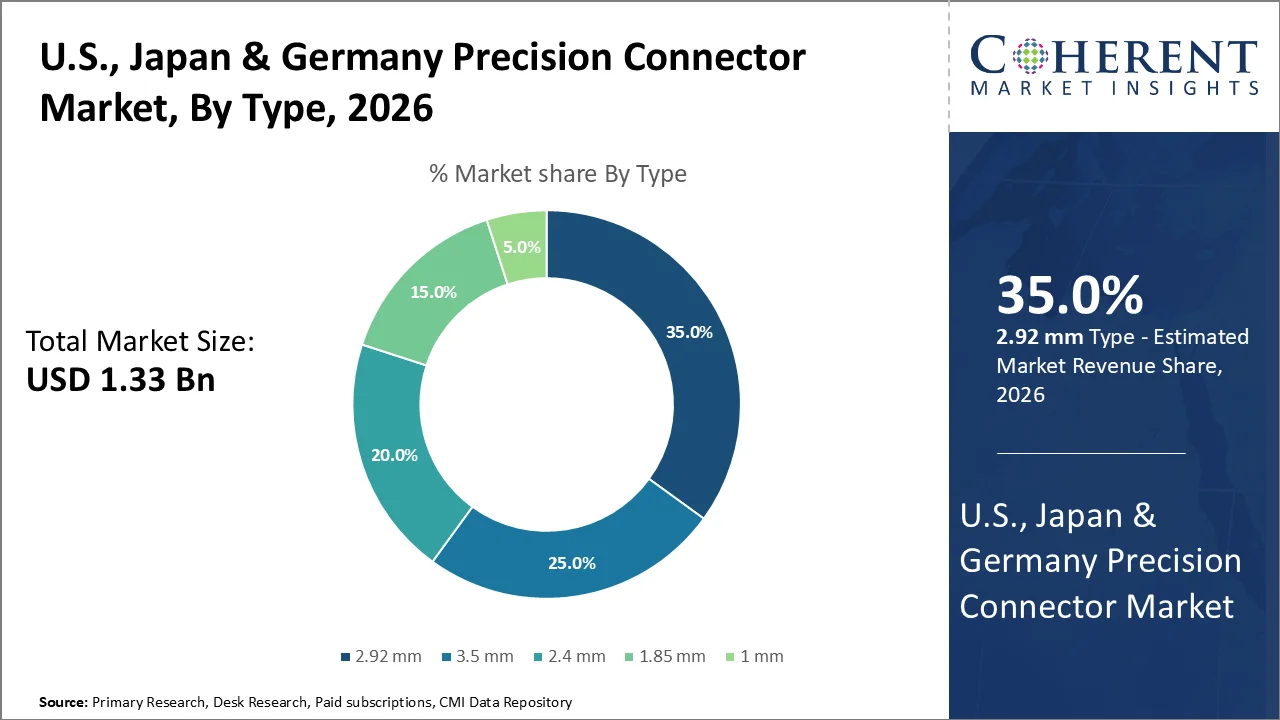
Why is 2.92 mm Acquiring the Largest Market Share?
2.92 mm segment is projected to account for the largest share of type in 2026, representing approximately 35% of the total volume. The superior performance characteristics, widespread industrial adoption, as well as robustness in high-frequency applications are the growth inducing factors. Business survey data from the Census Bureau shows that about 18% of companies were using AI by the end of 2025 in the U.S.
The 2.92 mm precision coaxial connector is known for its ability to operate efficiently at frequencies up to 40 GHz, making it highly relevant for demanding environments including aerospace, defense, advanced telecommunication infrastructures, etc., prevalent in these leading economies.
Institutions including the National Institute of Standards and Technology (NIST) in the U.S. have focused the importance of connectors operating at higher frequencies for calibration standards as well as measurement systems, which has helped bolster the adoption of the 2.92 mm connectors in both government and commercial applications.
- Current Industry Events of 2026
- Market Size Estimation
- Regional Breakdown
- Competitive Landscape
- Customer Intelligence
- Segmental Analysis
- Pricing Analysis
- Key Market Drivers, Challenges & Future Trends
- Customized Insights Section
Telecom holds the Largest Market Share
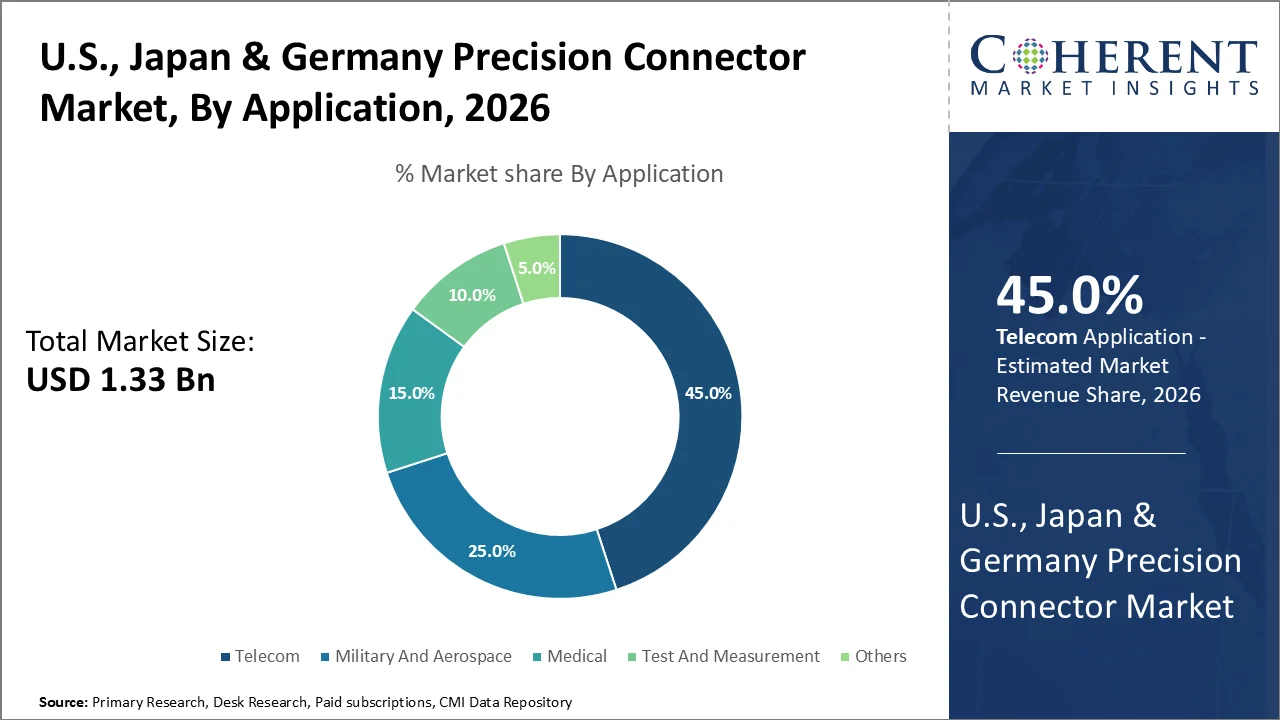
Based on application, telecom dominate the market, accounting for a significant 45% share in 2026, owing to its foundational role in enabling global digital communications infrastructure and the ongoing rapid advancements in network technologies. At the start of 2025, about 78.9 million people in Germany were using the internet. This means 93.5% of the population was online.
The insatiable demand of the telecom industry for high-performance, reliable, as well as miniaturized precision connectors directly drives this dominant share. Telecom networks, including 5G deployments and the expansion of fiber-optic networks, need connectors that can handle high-frequency signals, environmental stresses, as well as dense packaging demands, which are critical in ensuring seamless and uninterrupted communications.
For instance, the U.S. Federal Communications Commission (FCC) and Japan’s Ministry of Internal Affairs and Communications have aggressively promoted the rollout of 5G infrastructures, which has stimulated the need for sophisticated connectors capable of handling high data throughput with minimal signal loss.
Market Drivers
Micro-Miniaturization & High-Density Interconnects is transforming the U.S., Japan & Germany Precision Connector Industry
Micro-miniaturization and high-density connectors are very small connectors designed to fit into compact electronic devices. They aid increase connection points in a small space using technologies like micro-coaxial connectors, micro circular connectors, stacked board-to-board connectors, etc.
Companies in the U.S., Japan, and Germany are using these advanced connectors in aerospace, medical devices, consumer electronics, and industrial machines. This technology aid in making devices smaller and lighter while still keeping strong as well as reliable performance, which is important for wearables, drones, and self-driving vehicles.
Optical Fiber & Photonics Integration: A major breakthrough in U.S., Japan & Germany Precision Connector
Optical fiber and photonics integration combines electrical and optical connections in one connector to enable very fast data transmission. It uses technologies including hybrid fiber-optic/electrical connectors as well as expanded beam fiber systems.
Companies in the U.S., Japan, and Germany are developing these advanced connectors for 5G networks, data centers, automotive LiDAR, as well as industrial systems. This technology aid improve speed and reduce delay in communication, which is important for 5G, AI, and industrial IoT applications.
Current Events and Their Impact on the U.S., Japan & Germany Precision Connector Market
Current Event | Description and its Impact |
U.S. CHIPS and Science Act Driving Advanced Electronics Manufacturing (2025–2026) |
|
Japan Pushes 6G and Advanced Telecom Infrastructure Development (2025–2026) |
|
U.S., Japan & Germany Precision Connector Market Trends
- Escalating demand for smaller, lightweight devices in consumer electronics as well as medical equipment fuels the demand for miniaturized precision connectors with high contact density.
- Enhanced connector materials, including high-performance polymers and gold-plated contacts, are making better durability, conductivity, as well as resistance to harsh environments, particularly in automotive and aerospace applications.
- The surge of electric vehicles (EVs) as well as autonomous driving technology in the U.S., Germany, and Japan is augmenting the demand for connectors used in battery management, powertrains, and advanced driver-assistance systems (ADAS). In 2025, Germany saw a 43.2% increase in new battery-electric passenger vehicle registrations. A total of 545,142 all-electric cars were registered, which was a record high.
- Expansion of 5G networks across these countries necessitates high-frequency, robust connectors to support enhanced telecommunications infrastructure. By 2025, the company in Japan plans to invest more than USD4 billion to expand its network. This will help it cover about 93% of the country’s populated areas.
- Stricter environmental regulations and the push for eco-friendly manufacturing processes are influencing design and material choices in precision connectors.
Regional Insights
Its Deeply Entrenched Industrial Infrastructure Base is Accelerating the Precision Connector Market Demand in United States
The U.S. account 44% market share in 2026, owing to its deeply embedded industrial infrastructure, unparalleled defense procurement ecosystem, and an aggressively expanding semiconductor and advanced electronics manufacturing base. According to the North Atlantic Treaty Organization (NATO), the United States spent USD 935 Billion on defense in 2024, equal to 3.21% of its GDP.
The U.S. Department of Defense remains one of the most substantial institutional consumers of high-reliability precision connectors, particularly through programs administered under the Defense Advanced Research Projects Agency (DARPA) as well as the Office of the Under Secretary of Defense for Research and Engineering.
Furthermore, the CHIPS and Science Act, agreed for a law in 2022 and actively disbursing funds through the U.S. Department of Commerce's National Institute of Standards and Technology (NIST), has catalyzed domestic semiconductor fabrication investments exceeding tens of billions of dollars, with Intel, TSMC, and Samsung establishing or expanding fabrication facilities in Arizona, Ohio, and Texas respectively.
Japan Precision Connector Market Trends
The deeply entrenched manufacturing ecosystem, advanced electronics production capabilities, and a long-standing culture of engineering precision that is virtually unmatched across the region is propelling the growth in the region.
Japan's dominance in this segment is fundamentally rooted in its position as a global hub for high-performance electronics, automotive electronics, industrial automation, and telecommunications infrastructure all of which are heavy consumers of precision connectors. According to the Japan Automobile Dealers Association and Japan Light Motor Vehicle and Motorcycle Association, 59,736 new electric vehicles (EVs) were sold in Japan in 2024, down 32.5% compared with 2023.
For example, leading Japanese manufacturers including Hirose Electric, JST (Japan Solderless Terminal), Molex's Japan operations, etc., have established global benchmarks in miniaturized, high-density connector design, directly feeding demand for precision connectors in domestic as well as export markets.
Germany Precision Connector Market Trends
Germany's dominant position is fundamentally anchored in its world-renowned automotive sector, which serves as one of the largest consumers of precision connectors globally.
According to the German Association of the Automotive Industry (VDA), Germany remains Europe's largest automotive manufacturing hub, with major original equipment manufacturers such as Volkswagen, BMW, Mercedes-Benz, and their extensive Tier-1 and Tier-2 supplier networks consistently demanding high-performance, miniaturized precision connectors for advanced driver-assistance systems (ADAS), electric powertrains, and in-vehicle networking architectures.
The increasing electrification of vehicles across German OEM platforms necessitates precision connectors capable of withstanding high-voltage environments while maintaining signal integrity across complex electronic control units.
Who are the Major Companies in U.S., Japan & Germany Precision Connector Industry
Some of the major key players in U.S., Japan & Germany precision connector market include, Samtec, NorComp, Japan Aviation Electronics (JAE) Industry, Ltd., Sumitomo Electric Industries, Ltd., HIROSE ELECTRIC CO., LTD., TE Connectivity, Radiall, PHOENIX CONTACT, W. L. Gore & Associates, Inc., Molex, ROSENBERGER HOCHFREQUENZTECHNIK GmbH & Co. KG, Frontlynk Inc., HUBER+SUHNER, Amphenol Corporation, and EZconn Corporation
Key News
- In May 2026, Amphenol Corporation exapnded its high-speed connector manufacturing capacity in the United States to meet rising demand from hyperscale data centers and AI infrastructure providers. The new connectors are designed to support next-generation high-bandwidth computing systems used in artificial intelligence and cloud services.
- In June2026, Hirose Electric has announced the launch of its new “BK19” series, which is designed as one of the world’s smallest single-row FPC-to-board connectors. The new product focuses on delivering high reliability and stable connections in an extremely compact form factor.
Market Report Scope
U.S., Japan & Germany Precision Connector Market Report Coverage
| Report Coverage | Details | ||
|---|---|---|---|
| Base Year: | 2025 | Market Size in 2026: | USD 1.33 Bn |
| Historical Data for: | 2020 To 2024 | Forecast Period: | 2026 To 2033 |
| Forecast Period 2026 to 2033 CAGR: | 9.6% | 2033 Value Projection: | USD 2.81 Bn |
| Segments covered: |
| ||
| Companies covered: | Samtec, NorComp, Japan Aviation Electronics (JAE) Industry, Ltd., Sumitomo Electric Industries, Ltd., HIROSE ELECTRIC CO., LTD., TE Connectivity, Radiall, PHOENIX CONTACT, W. L. Gore & Associates, Inc., Molex, ROSENBERGER HOCHFREQUENZTECHNIK GmbH & Co. KG, Frontlynk Inc., HUBER+SUHNER, Amphenol Corporation, and EZconn Corporation | ||
| Growth Drivers: |
| ||
| Restraints & Challenges: |
| ||
Analyst Opinion
- The precision connector market in the U.S., Japan, and Germany is poised for dynamic growth driven by increasing demand for high-performance electronic applications across automotive, telecommunications, and industrial automation sectors.
- In the U.S., rapid advancements in 5G infrastructure as well as electric vehicle (EV) adoption are major factors stimulating the need for reliable, high-speed connectors capable of withstanding harsh environments. About 22% of light-duty vehicles sold in the United States in 2025 were hybrid, battery electric, or plug-in hybrid vehicles.
- Meanwhile, focus of the country on robotics and automation within its manufacturing landscape fuels demand for precision connectors that ensure seamless signal integrity as well as durability.
- Germany, as a leader in automotive engineering and Industry 4.0 initiatives, is experiencing robust adoption of precision connectors to enhance connectivity in smart factories and next-generation vehicles.
- However, supply chain disruptions and raw material price volatility can pose challenges, potentially impacting production timelines and cost structures.
- Overall, the convergence of technological advancements along with industrial modernization across these nations underscores a promising outlook for the precision connector market in the coming years.
Speak to the analyst
Want personalized insights?
Take the findings above to one of our principal consultants, or have the report rebuilt around the segments, geographies and competitors you actually track.
Market Segmentation
- By Type (Revenue, USD Bn, 2021-2033)
- 5 mm
- 92 mm
- 4 mm
- 85 mm
- 1 mm
- By Application (Revenue, USD Bn, 2021-2033)
- Telecom
- Military and Aerospace
- Medical
- Test and Measurement
- Others
Sources
Primary Research Interviews
- Procurement Managers, U.S. Electronics Manufacturers
- R&D Heads, Precision Connector Companies, Japan
- Supply Chain Experts, German Automotive Industry
- Industry Analysts, Precision Connectors Market
- Others
Databases
- IHS Markit
- Frost & Sullivan
- Others
Magazines
- Connector Supplier
- Electronic Design
- Japan Electronics Journal
- Elektronik Praxis (Germany)
- Others
Journals
- IEEE Transactions on Components, Packaging and Manufacturing Technology
- Journal of Electronic Materials
- Journal of Connector Technology
- Others
Newspapers
- The Wall Street Journal (U.S.)
- Nikkei Asian Review (Japan)
- Handelsblatt (Germany)
- Financial Times
- Others
Associations
- IPC - Association Connecting Electronics Industries (U.S.)
- Japan Electronics and Information Technology Industries Association (JEITA)
- German Electrical and Electronic Manufacturers’ Association (ZVEI)
- International Electrotechnical Commission (IEC)
- Others
Public Domain Sources
- U.S. Census Bureau
- Ministry of Economy, Trade and Industry (METI), Japan
- Statistisches Bundesamt (Destatis), Germany
- World Bank Open Data
- Others
Proprietary Elements
- CMI Data Analytics Tool
- Proprietary CMI Existing Repository of information for last 10 years
Get access to 250+ pages report
Every segment, forecast, competitor profile and data table behind the analysis above — available for instant download.
- ESOMAR Member
- ISO 9001:2015 Certified
- D-U-N-S Registered
- GDPR & CCPA Compliant
Missing comfort of reading report in your local language? Find your preferred language:
Transform your Strategy with Exclusive Trending Reports
Frequently Asked Questions
The U.S., Japan & Germany precision connector market is expected to reach USD 2.81 Bn in 2033.
Major players operating in the U.S., Japan & Germany precision connector market include Samtec, NorComp, Japan Aviation Electronics (JAE) Industry, Ltd., Sumitomo Electric Industries, Ltd., HIROSE ELECTRIC CO., LTD., TE Connectivity, Radiall, PHOENIX CONTACT, W. L. Gore & Associates, Inc., Molex, ROSENBERGER HOCHFREQUENZTECHNIK GmbH & Co. KG, Frontlynk Inc., HUBER+SUHNER, Amphenol Corporation, and EZconn Corporation
Stringent regulatory standards is expected to restrain the U.S., Japan & Germany precision connector market growth over the forecast period.
Growing demand for high performance connectors in various sectors is driving growth of the U.S., Japan & Germany Precision Connector market.
The U.S., Japan & Germany precision connector market is anticipated to grow at a CAGR of 9.6% between 2026 and 2033.
In electronics, connectors are primarily classified into three types based on what they physically join together: wire-to-board, board-to-board, and wire-to-wire.
Precision connectors are mainly used in measurement applications, or where exceedingly high performance is required. The precision connectors are typically intended for very high frequency RF, i.e. microwave interconnections. Precision connectors are widely used in the applications such as telecommunication, military and aerospace, medical, test and measurement, automotive, industrial, and others.