

Drip Irrigation Market Size and Forecast — 2026 - 2033
The global drip irrigation market size is estimated to be valued at USD 6.8 billion in 2026 and is expected to reach USD 11.9 billion by 2033, exhibiting a compound annual growth rate (CAGR) of 8.2% from 2026 to 2033.
Overview
The drip irrigation market is driven by increasing water scarcity and the need for efficient agricultural practices. This method, based on Micro Irrigation, minimizes water wastage while improving crop yield and quality. Rising adoption of precision farming, government subsidies for sustainable irrigation, and growing awareness among farmers are accelerating demand. Technological advancements such as automated systems and IoT-enabled monitoring are enhancing efficiency and ease of use. Additionally, expanding cultivation of high-value crops and the push for climate-resilient agriculture are further supporting market growth, particularly in water-stressed regions worldwide.
Key Takeaways
Surface drip irrigation dominates the system type segment, commanding nearly half of the market share due to its cost-effectiveness and ease of installation in diverse geographies.
The agriculture application segment remains the largest revenue contributor, driven by the extensive use of drip systems in staple crop and high-value horticulture farming.
In regional terms, North America holds the leading market share, underpinned by advanced adoption of efficient irrigation systems and strong government regulations promoting water conservation.
Asia Pacific is the fastest-growing region owing to increasing government subsidies, technological advancements, and a growing agricultural export market, fostering a CAGR above 9%.
Drip Irrigation Market Segmentation Analysis
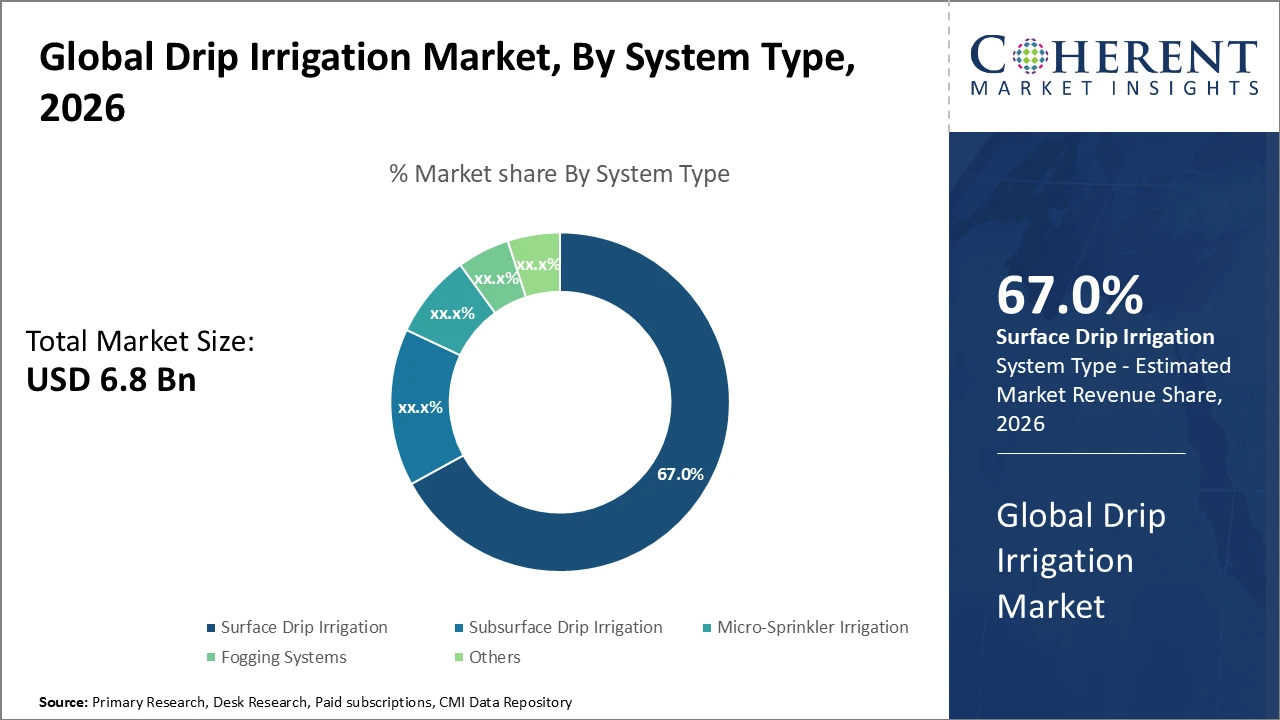
Drip Irrigation Market Insights, By System Type
Surface drip irrigation leads the market with a share of 67% due to its versatility and ease of integration into existing systems, providing cost-effective water delivery directly to the root zone with minimal evaporation. Subsurface drip irrigation is the fastest-growing segment, offering higher water efficiency and discreet installation, particularly for vineyards and high-value cash crops, supported by advancements in leak-proof tubing and durable emitters. Micro-sprinkler irrigation serves niche applications in horticulture and landscaping, ensuring uniform coverage for tree crops. Fogging systems cater to nurseries and greenhouses requiring precise microclimate control, while other specialty drip accessories support customized irrigation setups, enhancing efficiency and crop productivity across diverse agricultural practices.
Drip Irrigation Market Insights, By Application
Agriculture continues to dominate the drip irrigation market, accounting for the largest revenue share due to extensive use in staple crops and large-scale farmland irrigation. Growth is supported by government initiatives promoting water conservation and improving crop yields. Horticulture, especially fruit and vegetable cultivation, is the fastest-growing subsegment, as precision irrigation enhances quality and production, meeting export market demands. Landscaping applications, including urban areas and golf courses, benefit from water-efficient irrigation and aesthetic requirements. Greenhouses utilize drip systems for controlled environments, while other uses, such as sports turf and ornamental plants, contribute to niche market adoption, supporting overall market expansion.
Drip Irrigation Market Insights, By Crop Type
Fruits and vegetables lead the market share, driven by high irrigation needs and strong economic returns, especially in regions focused on export-oriented agriculture. Drip irrigation enhances productivity in these crops, often integrated with controlled environment farming for optimal results. Plantation crops, such as coffee and tea, account for a significant portion of the market, ensuring stable yields despite variable climatic conditions. Field crops adopt drip systems mainly in water-scarce areas but contribute less overall. Flowers and ornamental plants are emerging subsegments, fueled by growing floriculture exports and urban landscaping demand. Other crops include medicinal and specialty plants with specific irrigation requirements.
Drip Irrigation Market Trends
The integration of IoT and data analytics in drip irrigation systems is improving water efficiency and crop yields, with 2025 field trials in Israel and the U.S. showing 15-20% water savings.
Growing eco-conscious farming practices are driving demand for biodegradable drip tubing, supported by pilot programs in Europe between 2024 and 2026, indicating potential for wide-scale adoption.
The emergence of localized manufacturing hubs in countries like India and China is reducing costs and supply chain complexities while meeting both domestic and export demand.
Drip Irrigation Market Insights, By Geography
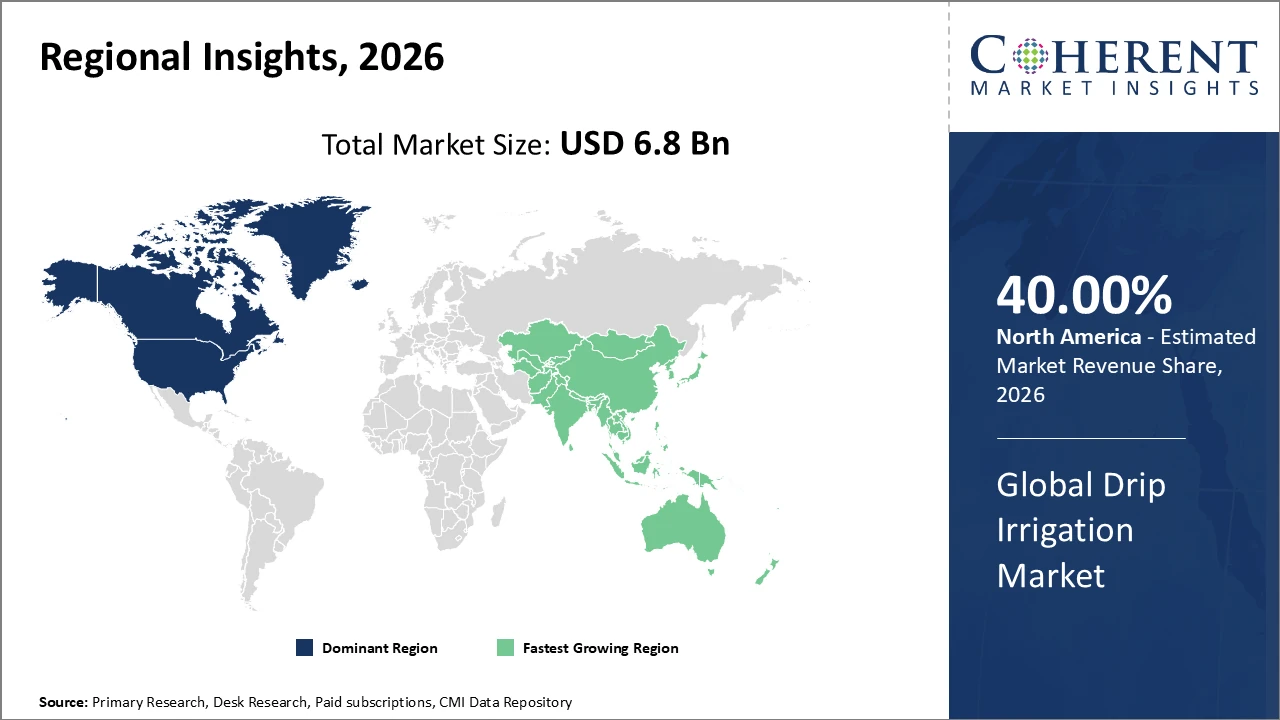
North America Drip Irrigation Market Analysis and Trends
In North America, the drip irrigation market is dominated by widespread adoption of advanced agricultural technologies, stringent water use regulations, and well-established infrastructure that facilitates efficient system deployment. Leading companies such as The Toro Company and Rain Bird Corporation play a significant role in providing technologically advanced solutions. Additionally, government incentives, water conservation programs, and sustainability initiatives encourage adoption, helping farmers optimize water usage, improve crop yields, and contribute to steady market growth in the region.
Asia Pacific Drip Irrigation Market Analysis and Trends
The Asia Pacific region is experiencing the fastest growth in the drip irrigation market, with a CAGR exceeding 9%. This growth is fueled by increasing agricultural exports, rising demand for water-efficient irrigation solutions due to frequent droughts, and significant government subsidies in countries such as India and China. Farmers are adopting advanced drip systems to improve crop yields while conserving water. Leading companies, including Jain Irrigation Systems, have strategically established manufacturing and distribution facilities in the region to meet rising demand and expand their market presence. The combination of supportive policies and technological adoption is driving sustained market expansion across Asia Pacific.
Drip Irrigation Market Outlook for Key Countries
USA Drip Irrigation Market Analysis and Trends
The U.S. drip irrigation market demonstrates strong adoption, particularly among commercial farms and vineyards, driven by technological advancements and strict environmental regulations. By 2025, more than 75% of specialty crop producers had implemented drip systems, improving water use efficiency and crop yields. Leading companies such as The Toro Company and Netafim play a pivotal role in shaping technology development and expanding distribution networks. Continuous investment in research and development supports innovations like automated controllers, precision emitters, and smart monitoring systems, ensuring compliance with regulatory standards. The combination of advanced technology, policy support, and market expertise underpins sustained growth in the U.S. drip irrigation sector.
Germany Drip Irrigation Market Analysis and Trends
The drip irrigation market in Germany is witnessing steady growth, driven by increasing focus on water conservation, sustainable agriculture, and precision farming technologies. Adoption is strongest in horticulture, greenhouse cultivation, and high-value crop farming, where efficient water management directly impacts productivity and quality. Government initiatives and EU subsidies supporting sustainable irrigation practices further encourage market expansion. Technological innovations, including smart controllers, automated systems, and advanced filtration solutions, are gaining traction among commercial farmers. Additionally, growing environmental awareness and demand for resource-efficient farming are prompting the integration of eco-friendly materials, such as biodegradable drip tapes, reinforcing long-term market trends in Germany.
Analyst Opinion
The rising adoption of precision agriculture techniques, supported by government initiatives promoting water conservation, significantly boosted market revenue. In 2025, drip irrigation adoption in arid regions increased by over 15%, with California and Maharashtra leading deployment.
Pricing optimization of drip irrigation components, driven by innovations in polyethylene film and emitter manufacturing, facilitated broader market penetration. For instance, a nearly 10% reduction in emitter costs in 2024 enabled smallholder farmers in India to shift from conventional irrigation, expanding market share.
Growing demand for high-value horticultural crops is driving market growth. In 2026, countries with major wine production, like France and Chile, increased drip installations by 20% to enhance grape quality.
Export volumes of drip irrigation kits from manufacturing hubs in Israel and Spain rose by around 12% in 2025, highlighting global adoption and the role of supply-side factors in market expansion.
- Current Industry Events of 2026
- Market Size Estimation
- Regional Breakdown
- Competitive Landscape
- Customer Intelligence
- Segmental Analysis
- Pricing Analysis
- Key Market Drivers, Challenges & Future Trends
- Customized Insights Section
Market Scope
| Report Coverage | Details | ||
|---|---|---|---|
| Base Year: | 2025 | Market Size in 2026: | USD 6.8 billion |
| Historical Data for: | 2020 To 2024 | Forecast Period: | 2026 To 2033 |
| Forecast Period 2026 to 2033 CAGR: | 8.2% | 2033 Value Projection: | USD 11.9 billion |
| Geographies covered: |
| ||
| Segments covered: |
| ||
| Companies covered: | Jain Irrigation Systems Ltd., Netafim Ltd., Baseline Inc., Hunter Industries, Budgit LLC, Glacon Ltd., The Toro Company, Rain Bird Corporation, Lindsay Corporation, Emitter International Ltd. | ||
| Growth Drivers: |
| ||
Drip Irrigation Market Growth Factors
Increasing water scarcity and stricter regulations on water use efficiency are key growth drivers for the drip irrigation market. FAO reports in 2024 indicate that agriculture consumes over 70% of global freshwater, accelerating the shift to drip systems that reduce runoff and evaporation. Rising demand for organic and high-value crops requires precise irrigation, contributing to a 14% CAGR in organic farming regions by 2025. Technological advances, including pressure-compensating emitters and automated scheduling, enhance scalability and ease of use, with adoption in Asia Pacific rising 20% in 2026. Government subsidies and rural financing in Brazil and India further lower entry barriers, driving market expansion.
Drip Irrigation Market Development
In August 2024, McCain Foods partnered with Orbia Netafim to deploy drip irrigation in potato farming, with field trials showing a 20% reduction in water use and a 4% to 23% increase in yields, depending on annual rainfall.
Key Players
Leading Companies of the Market
Jain Irrigation Systems Ltd.
Netafim Ltd.
Baseline Inc.
Hunter Industries
Budgit LLC
Glacon Ltd.
The Toro Company
Rain Bird Corporation
Lindsay Corporation
Emitter International Ltd.
Leading players in the drip irrigation market implement competitive strategies including product innovation, particularly in energy-efficient emitters, portfolio expansion through acquisitions, and entry into emerging markets. In 2025, Netafim collaborated with an Indian agri-tech firm, resulting in a 25% increase in penetration among small-scale farms by offering tailored solutions. Similarly, Jain Irrigation Systems leveraged strategic pricing alongside localized manufacturing in Latin America, boosting its regional market share by 18% in 2026. These approaches demonstrate how innovation, market-specific strategies, and operational localization are key drivers for maintaining competitiveness and expanding presence in the global drip irrigation market.
Drip Irrigation Market Future Outlook
The future of the drip irrigation market is expected to be driven by increasing water scarcity, rising agricultural demand, and technological advancements. Adoption of smart irrigation systems integrating IoT, AI, and remote monitoring will enable precise water management and reduce wastage. Biodegradable and eco-friendly products are likely to gain popularity as sustainability becomes a priority. Expansion in emerging economies, especially in Asia and Africa, will fuel market growth due to the need for efficient farming solutions. Additionally, government incentives and subsidies for water-efficient technologies will support wider adoption. Overall, the market is poised for steady growth with innovation and environmental focus.
Drip Irrigation Market Historical Analysis
The drip irrigation market has experienced steady growth over the past two decades, driven by the need for water-efficient agricultural practices and increasing global food demand. Initially concentrated in regions like Israel and the United States, the technology gradually expanded to Asia, Europe, and Latin America. Early adoption focused on high-value crops such as fruits, vegetables, and sugarcane, where water savings translated to higher profitability. Advancements in emitter design, filtration systems, and automation enhanced efficiency and reliability. Government initiatives and subsidies in water-scarce regions further accelerated adoption. Historical trends indicate a clear shift from manual to technologically integrated systems, laying the foundation for modern smart irrigation solutions.
Sources
Primary Research Interviews:
R&D managers, agronomists, and project leaders from companies developing drip irrigation systems, including surface, subsurface, and micro-sprinkler technologies.
Technical specialists from irrigation equipment manufacturers, focusing on production, quality control, and system efficiency optimization.
Industry experts from organizations involved in precision agriculture, water conservation initiatives, and large-scale agricultural operations.
Magazines:
Irrigation Today – Market trends, technological updates, and industry innovation news.
Agricultural Engineering International – Advances in irrigation systems, water management, and farm-level applications.
Water & Agriculture News – Updates on global irrigation adoption, policy initiatives, and sustainability practices.
Journals:
Agricultural Water Management – Research on drip irrigation efficiency, crop water use, and soil-water dynamics.
Irrigation Science – Studies on system performance, design improvements, and technological innovations.
Journal of Horticultural Science & Biotechnology – Insights on drip irrigation in horticulture, yield optimization, and crop-specific applications.
Newspapers:
The Wall Street Journal – Corporate developments, mergers, and investments in irrigation companies.
Financial Times – Market trends, regulatory policies, and global irrigation industry analysis.
Reuters – News on technology adoption, water management programs, and agricultural initiatives.
Bloomberg – Company strategies, revenue trends, and market forecasts for irrigation solutions.
Associations:
Food and Agriculture Organization (FAO) – Guidelines, water management strategies, and global irrigation statistics.
International Commission on Irrigation and Drainage (ICID) – Data on irrigation systems, best practices, and policy frameworks.
Global Water Partnership (GWP) – Research, policy updates, and initiatives promoting sustainable water use in agriculture.
Get access to 250+ pages report
Every segment, forecast, competitor profile and data table behind the analysis above — available for instant download.
- ESOMAR Member
- ISO 9001:2015 Certified
- D-U-N-S Registered
- GDPR & CCPA Compliant
Missing comfort of reading report in your local language? Find your preferred language:
Transform your Strategy with Exclusive Trending Reports
Frequently Asked Questions
Leading market players include Jain Irrigation Systems Ltd., Netafim Ltd., and The Toro Company, which collectively have made substantial innovations and expansions. Their competitive strategies, including localized manufacturing and advanced emitter technologies, have positioned them at the forefront.
The Drip Irrigation market size is forecasted to grow from USD 6.8 billion in 2026 to USD 11.9 billion by 2033, reflecting a robust CAGR of 8.2%, driven by increasing water scarcity and precision agricultural practices.
Agriculture segment, especially high-value fruits and vegetables, presents the most considerable growth opportunity, accounting for over 70% of the market revenue, owing to increasing efficiency demands and environmental policies.
Trends show increasing IoT integration, AI-based irrigation scheduling, and the adoption of eco-friendly biodegradable materials, pushing the market toward sustainable and precision irrigation ecosystems.
The market is competitive with players adopting product innovation and regional expansions, while challenges remain in affordability for smallholder farmers and installation complexity in certain geographies.
Collaborations with local agri-tech firms, government subsidy utilization, and development of region-specific products are prevalent strategies that drive penetration and market growth.