

Commercial Greenhouse Market Size and Forecast – 2026 to 2033
Commercial Greenhouse Market is estimated to be valued at USD 53.99 Bn in 2026 and is expected to reach USD 83.35 Bn in 2033, exhibiting a compound annual growth rate (CAGR) of 6.4% from 2026 to 2033.
Key Takeaways
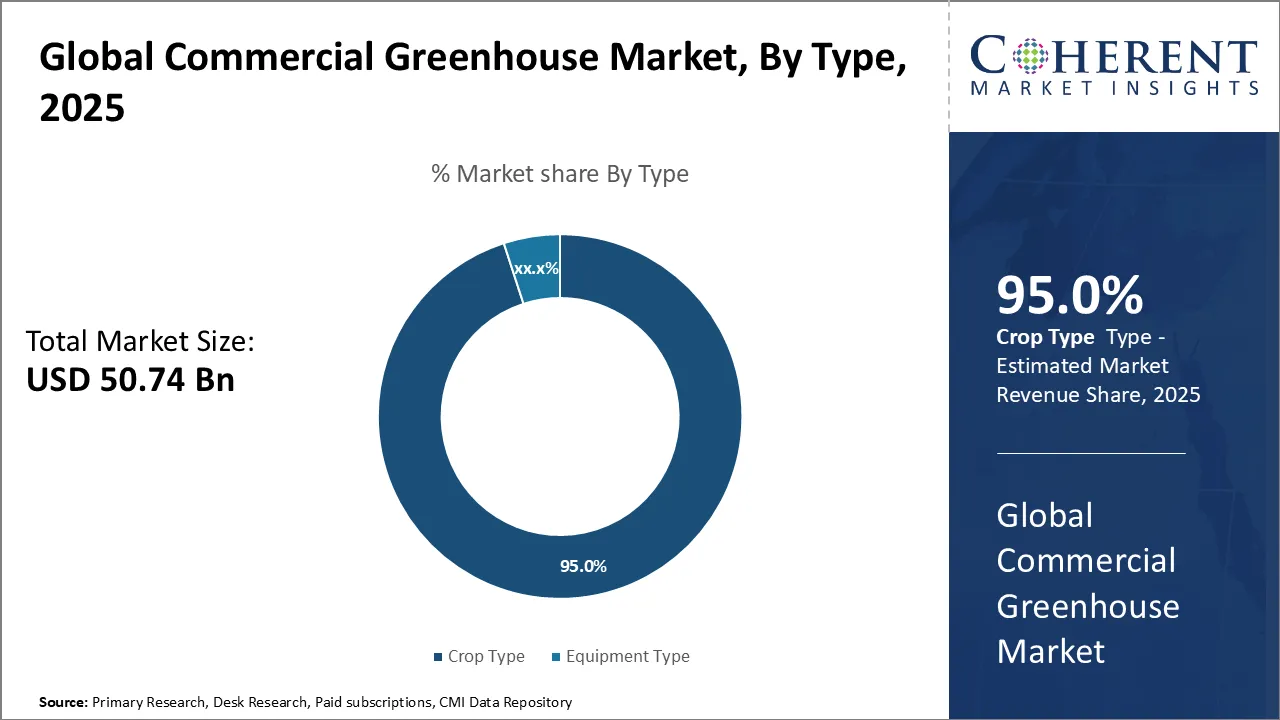
- By Type, Crop Type hold the largest market share of 96% in 2026 owing to the profitability & crop value.
- By Greenhouse Type, Glass Greenhouse expected to hold largest market share in 2026 owing to the controlled-environment agriculture (CEA) for higher yields.
- By Region, North America dominates the overall market with an estimated share of 36% in 2026 owing to the rising demand for fresh, local, & year-round produce.
Market Overview
The commercial greenhouse market is growing as producers respond to the rising need for year-round, dependable food production and stronger demand for fresh, high-quality produce. Commercial greenhouses provide controlled growing conditions that boost yields, enhance crop quality, and improve resource efficiency while limiting reliance on climate and seasonal factors. Ongoing advancements in greenhouse technologies, wider adoption of sustainable farming methods, and the expansion of urban and peri-urban agriculture continue to drive growth across vegetables, fruits, flowers, and specialty crops worldwide.
Current Events and Its Impact on the Commercial Greenhouse Market
Current Events | Description and its impact |
Global Climate Policy Shifts |
|
Technological Innovations in Controlled Environment Agriculture (CEA) |
|
Global Supply Chain Disruptions and Raw Material Costs |
|
Segmental Insights
- Current Industry Events of 2026
- Market Size Estimation
- Regional Breakdown
- Competitive Landscape
- Customer Intelligence
- Segmental Analysis
- Pricing Analysis
- Key Market Drivers, Challenges & Future Trends
- Customized Insights Section
Commercial Greenhouse Market Insights, By Type: Crop Type contribute the highest share of the market owing to its year-round production & season extension
Crop Type hold the largest market share of 96% in 2026. Growers select crop types in the commercial greenhouse market based on profitability, market reliability, and how well crops perform in controlled environments. They prioritize crops that offer stable yields, high quality, and steady demand, including vegetables, ornamentals, and specialty plants. By adjusting light, temperature, and nutrition, growers successfully cultivate high-value and sensitive crops that struggle in open-field conditions. Shifting consumer preferences, retail requirements, and demand for off-season and locally produced food further shape crop selection decisions. For instance, in August 2025, Dutch Heritage Gardens introduced its new Heritage Young Plants program for greenhouse growers, offering a carefully selected range of vegetative annuals and specialty crops, including both trusted staples and exclusive new genetics.
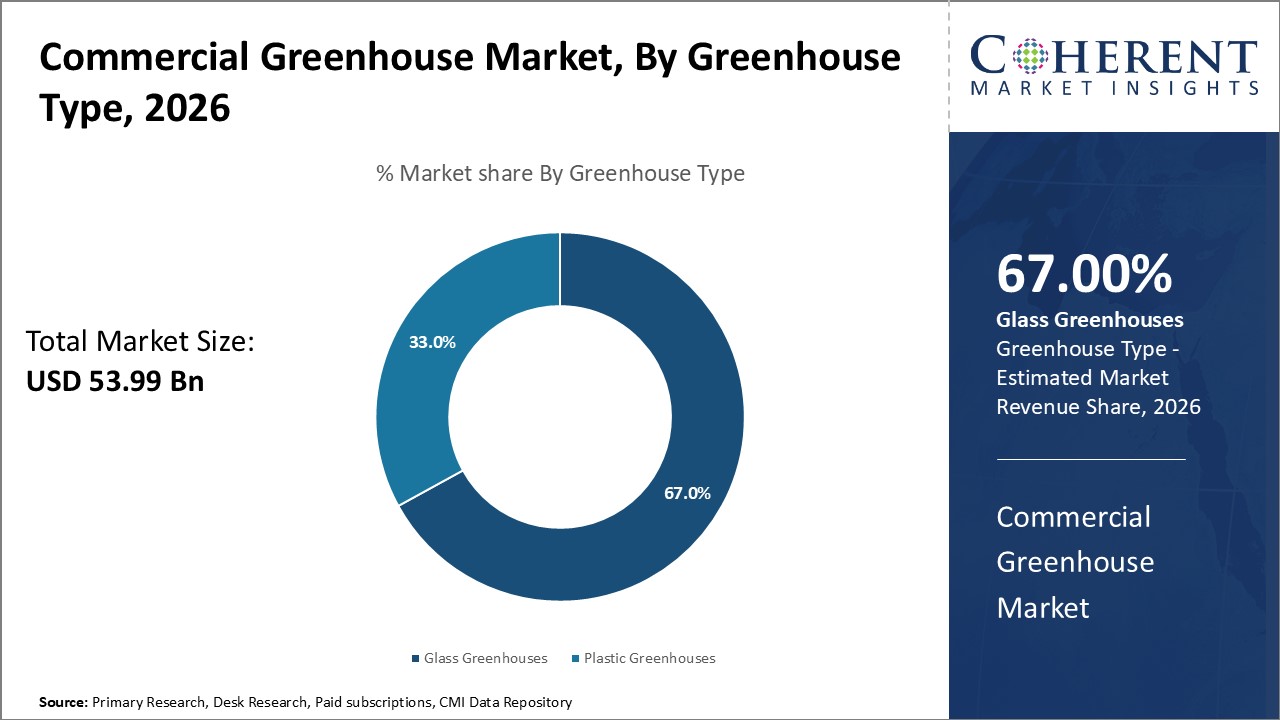
Commercial Greenhouse Market Insights, By Greenhouse Type: Glass Greenhouse contribute the highest share of the market owing to its demand for sustainable and eco-friendly farming practices.
Producers drive the glass greenhouse segment in the commercial greenhouse market by seeking durable structures that offer superior light transmission and long-term efficiency. Glass greenhouses allow growers to maintain precise climate control, supporting consistent, high-quality crop production throughout the year. By integrating advanced automation and energy-management systems, growers improve productivity and crop uniformity. Growing emphasis on sustainable farming, rising demand for premium produce, and increased investment in large-scale, high-tech operations continue to accelerate glass greenhouse adoption. For instance, India launched its first automated, soil-less glass greenhouse, where plants grow without soil and receive all essential minerals and nutrients directly through water.
Regional Insights
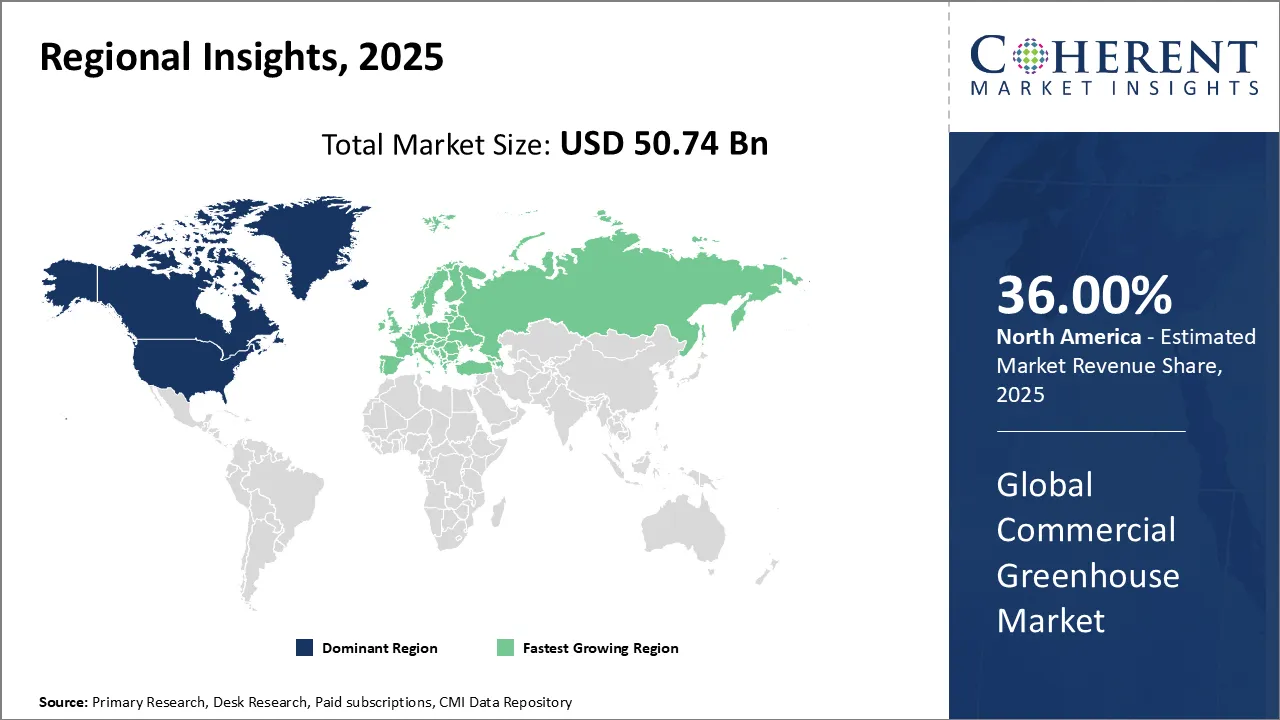
North America Commercial Greenhouse Market Trends
North America dominates the overall market with an estimated share of 36% in 2026. In North America, growers are driving commercial greenhouse trends by adopting controlled-environment technologies that support year-round production of vegetables, fruits, and ornamentals, using automation, hydroponics, and smart climate systems. They prioritize locally sourced produce to meet urban demand and optimize supply chains. Increased investment in energy-efficient, high-tech greenhouse infrastructure, combined with initiatives to promote sustainability and strengthen food security, continues to shape the development of the market across the U.S., Canada, and Mexico. For instance, in March 2024, Central Life Sciences added ClearLeaf Insecticide/Miticide to its greenhouse portfolio, using Tau-fluvalinate, Abamectin, and a synergist to control a broad range of insect and mite pests.
Europe Commercial Greenhouse Market Trends
In Europe, growers are driving commercial greenhouse trends by implementing advanced controlled-environment systems that ensure year-round production of vegetables, fruits, and ornamentals, widely using smart climate control and automation. They respond to growing consumer demand for fresh, locally produced food and sustainable farming, while incorporating renewable energy and precision irrigation to optimize resource use. Leading countries such as the Netherlands, Spain, Italy, and Germany operate technologically advanced, export-focused greenhouses that actively shape the dynamics of the regional market. For instance, in June 2026, Arugga AI Farming unveiled its autonomous plant-lowering robot, Louie, for greenhouse-grown tomatoes and cucumbers, introducing it to growers in the Netherlands, Belgium, and France.
United States Commercial Greenhouse Market Trends
In the United States, growers are shaping commercial greenhouse trends by expanding capacity to meet rising demand for fresh, locally produced fruits and vegetables in supermarkets and urban markets year-round. They are increasingly implementing advanced technologies, including automated climate control, hydroponics, and data-driven systems, to enhance productivity and resource efficiency. Growers prioritize sustainability by minimizing environmental impact and integrating energy-efficient systems, while supportive policies and investments actively promote innovation and wider adoption of controlled-environment agriculture.
United Kingdom Commercial Greenhouse Market Trends
In the United Kingdom, growers are driving commercial greenhouse trends by expanding year-round production of vegetables, fruits, and ornamentals in controlled environments to counter unpredictable weather and strengthen local food supply. They increasingly implement advanced automation, climate control, hydroponics, and precision irrigation to enhance yields and resource efficiency. Rising consumer demand for locally grown fresh produce and government support for sustainable, high-tech farming actively influence market activity, while ongoing innovation and export growth continue to shape the greenhouse sector. In December 2026, Bridge Greenhouses, experts in building and equipping commercial greenhouses, unveiled a drone spraying service to clean and tint greenhouse and polytunnel roofs. Such technological advancements are accelerating the commercial greenhouse market share.
End-User Feedback and Unmet Needs in the Commercial Greenhouse Market
- High Initial Investment Costs: End-users report that the upfront costs of building and equipping commercial greenhouses, especially glass or high-tech structures, are a major barrier. Many small and medium growers struggle to access financing, limiting adoption of advanced technologies and modern controlled-environment systems despite potential long-term efficiency and yield benefits.
- Complexity of Technology Management: Growers face challenges in managing sophisticated automation, climate control, and hydroponic systems. Lack of technical expertise or training results in underutilization of advanced equipment. End-users express the need for simpler, user-friendly interfaces, better training programs, and reliable technical support to maximize operational efficiency and reduce errors.
- Energy Consumption and Sustainability Concerns: Many greenhouse operators highlight the high energy requirements for lighting, heating, and climate control. They seek more energy-efficient solutions and renewable energy integration. Unmet needs include affordable technologies that reduce carbon footprint while maintaining optimal crop growth conditions, ensuring sustainability without compromising productivity.
Commercial Greenhouse Market Trend
Shift Toward Controlled-Environment Agriculture
Growers increasingly adopt controlled-environment technologies to optimize production year-round. Advanced climate control, automated irrigation, and LED lighting allow precise management of temperature, humidity, and light, enhancing yields and crop quality. This trend supports high-value vegetables, fruits, and ornamentals, reduces dependency on seasonal cycles, and ensures consistent supply. Producers are investing in smart monitoring systems and automation to improve efficiency, minimize human error, and adapt quickly to changing environmental conditions, making controlled-environment agriculture a central focus of modern greenhouse operations.
Integration of Sustainable and Energy-Efficient Practices
Sustainability is becoming a key driver in greenhouse development. Growers focus on reducing water usage, integrating renewable energy, and minimizing carbon emissions. Adoption of energy-efficient heating, cooling, and lighting systems, along with resource recycling and precision irrigation, addresses environmental concerns. This trend aligns with consumer demand for eco-friendly produce and regulatory requirements, allowing commercial greenhouses to combine productivity with environmental responsibility, enhance market reputation, and reduce operational costs while promoting long-term sustainability.
Commercial Greenhouse Market Opportunity
Expansion of Year-Round Fresh Produce Supply
Commercial greenhouses offer opportunities to produce fresh vegetables, fruits, and herbs throughout the year, overcoming seasonal and climatic limitations. Growers can tap into urban and regional markets by providing consistent, high-quality produce. This allows retailers, restaurants, and foodservice providers to maintain steady supply chains, meet consumer demand, and reduce dependency on imports. Year-round production also enables premium pricing for off-season crops, presenting a lucrative avenue for both established and new greenhouse operators.
Market Report Scope
Commercial Greenhouse Market Report Coverage
| Report Coverage | Details | ||
|---|---|---|---|
| Base Year: | 2025 | Market Size in 2026: | USD 53.99 Bn |
| Historical Data for: | 2020 To 2024 | Forecast Period: | 2026 To 2033 |
| Forecast Period 2026 to 2033 CAGR: | 6.4% | 2033 Value Projection: | USD 83.35 Bn |
| Geographies covered: |
| ||
| Segments covered: |
| ||
| Companies covered: | Richel Group, Argus Control Systems Ltd, Rough Brothers Inc., Certhon, Logiqs BV, Lumigrow Inc., Nexus Corporation, Hort Americas, Heliospectra AB, and Agra Tech Inc. | ||
| Growth Drivers: |
| ||
| Restraints & Challenges: |
| ||
Commercial Greenhouse Market News
- In December 2025, Greece launches its first 2-hectare hydroponic strawberry greenhouse to address water shortages, Phytophthora, and pests like thrips that challenge outdoor strawberry cultivation.
Analyst Opinion (Expert Opinion)
- The commercial greenhouse market is increasingly characterized by technology‑led transformation and structural transition, not merely demand growth. Controlled‑environment agriculture is no longer optional; precision automation and IoT systems have already boosted yields by double‑digit percentages in major regions, with AI‑optimized fertigation and climate control enabling up to 30% higher output in North American facilities compared to conventional methods. Hydroponic and smart lighting systems now comprise over half of installations globally, reflecting a shift from traditional structures to integrated high‑efficiency ecosystems.
- Evidence from leading European clusters shows that high‑tech glasshouses consistently outperform legacy designs, achieving yields many times above open‑field averages and underpinning export competitiveness in countries like the Netherlands and Spain. Meanwhile, greenhouse‑as‑a‑service models are emerging to democratize access for mid‑sized growers, converting prohibitive capital expenses into operating agreements that enhance adoption.
- Sustainability imperatives also distinguish the sector: operators who integrate energy‑efficient LED arrays and precision irrigation are reducing water use by substantial margins, reinforcing commercial greenhouses as critical infrastructure for resilient food systems amid climate volatility and shrinking arable land.
Speak to the analyst
Want personalized insights?
Take the findings above to one of our principal consultants, or have the report rebuilt around the segments, geographies and competitors you actually track.
Market Segmentation
- Global Commercial Greenhouse Market, By Type
- Equipment Type
- Heating systems
- Cooling systems
- Other Equipment Types
- Crop Type
- Fruits and Vegetables
- Flowers and Ornamentals
- Nursery Crops
- Other Crop Types
- Equipment Type
- Global Commercial Greenhouse Market, By Greenhouse Type
- Glass Greenhouses
- Plastic Greenhouses
- Regional Insights (Revenue, USD Mn, 2021 - 2033)
- North America
- U.S.
- Canada
- Latin America
- Brazil
- Argentina
- Mexico
- Rest of Latin America
- Europe
- Germany
- U.K.
- Spain
- France
- Italy
- Russia
- Rest of Europe
- Asia Pacific
- China
- India
- Japan
- Australia
- South Korea
- ASEAN
- Rest of Asia Pacific
- Middle East
- GCC Countries
- Israel
- Rest of Middle East
- Africa
- South Africa
- North Africa
- Central Africa
- North America
- Key Players Insights
- Richel Group
- Argus Control Systems Ltd
- Rough Brothers Inc.
- Certhon
- Logiqs BV
- Lumigrow Inc.
- Nexus Corporation
- Hort Americas
- Heliospectra AB
- Agra Tech Inc.
Sources
Primary Research interviews
- Interviews with greenhouse operators and commercial farmers in North America, Europe, and Asia
- Discussions with agronomists and horticulture specialists
- Conversations with greenhouse technology suppliers and automation experts
Databases
- FAO (Food and Agriculture Organization) Statistics Database
- USDA National Agricultural Statistics Service (NASS)
- Eurostat Agriculture Database
- UN Comtrade for agricultural trade data
Magazines
- Greenhouse Grower
- Greenhouse Management
- Modern Farmer
- Hortidaily
Journals
- Journal of Controlled Environment Agriculture
- Scientia Horticulturae
- Horticultural Science Journal
- Frontiers in Plant Science
Newspapers
- The Guardian – Agriculture Section
- The New York Times – Food & Agriculture
- Financial Times – Agribusiness Coverage
- The Telegraph – Farming News
Associations
- American Horticultural Society
- National Greenhouse Manufacturers Association (NGMA)
- International Society for Horticultural Science (ISHS)
- European Greenhouse Horticulture Association
Public Domain sources
- Government agriculture ministry reports from the U.S., UK, Netherlands, and Canada
- FAO and UN agricultural publications
- Open-access scientific articles on greenhouse production
- National statistical offices’ crop production reports
Proprietary Elements
- CMI Data Analytics Tool
- Proprietary CMI Existing Repository of information for last 8 years
Get access to 250+ pages report
Every segment, forecast, competitor profile and data table behind the analysis above — available for instant download.
- ESOMAR Member
- ISO 9001:2015 Certified
- D-U-N-S Registered
- GDPR & CCPA Compliant
Missing comfort of reading report in your local language? Find your preferred language:
Transform your Strategy with Exclusive Trending Reports
Frequently Asked Questions
The Commercial Greenhouse Market is estimated to be valued at USD 53.99 Bn in 2026, and is expected to reach USD 83.35 Bn by 2033.
The CAGR of the Commercial Greenhouse Market is projected to be 6.4% from 2026 to 2033.
Decreasing arable land and growing demand for food are fuelling the growth of market.
The Crop Type segment is the leading component segment in the market.
High initial investment is the major factors restraining growth of the market.
Richel Group, Argus Control Systems Ltd, Rough Brothers Inc., Certhon, Logiqs BV, Lumigrow Inc., Nexus Corporation, Hort Americas, Heliospectra AB, and Agra Tech Inc.