

Agricultural Testing Market is estimated to be valued at USD 7.34 Bn in 2026 and is expected to reach USD 11.40 Bn in 2033, exhibiting a compound annual growth rate (CAGR) of 6.5% from 2026 to 2033.
Key Takeaways
- Based on sample, the soil testing segment is expected to lead the market holding a share of 41% in 2026, due to the rising demand to optimize the crop production.
- Based region, North America is estimated to lead the market with a share of 45% in 2026, owing to its stringent regulations. While Asia Pacific if considered to be the fastest growing region during the forecast period due to the increasing agricultural exports.
Market Overview
The market for agricultural testing is witnessing strong growth on account of growing concern over food safety and sustainable practices. The increasing population and rapid urbanization are raising awareness regarding food safety. Moreover, contamination of agricultural resources such as water and land is further creating demand for testing services to evaluate pollutants present in agricultural products. All these factors are projected to accelerate market growth.
Current Events and Its Impact
Current Events | Description and its Impact |
Geopolitical Tensions and Trade Policy Shifts |
|
Climate-Driven Agricultural Pressures |
|
Role of Artificial Intelligence in Agricultural Testing Market
Integration of artificial intelligence and Internet of Things (IoT) is transforming the manufacturing and retail industry. AI and IoT embedded in an android app help in conducting 12 key soil parameters tests, within 30 minutes the results showcase the soil health. AI has the potential to promote cultivation of healthier crop, manage pesticides and soil conditions and analyses essentials of farmers, which ultimately improves the management of food distribution network. AI also tests the quality of seeds, offering an effective and non-destructive solution. AI ensures higher seen quality and supports greater yield stability. This approves improves the efficiency and precision, contributing to enhance food security on a worldwide level. In March 2024, the International Rice Research Institute (IRRI) unveiled a new AI-driven digital platform designed to enhance and speed up hybrid rice breeding and parental selection globally. This innovation aims to improve food security and promote sustainable agriculture by advancing the development of high-yielding, climate-resilient rice hybrids.
- Current Industry Events of 2026
- Market Size Estimation
- Regional Breakdown
- Competitive Landscape
- Customer Intelligence
- Segmental Analysis
- Pricing Analysis
- Key Market Drivers, Challenges & Future Trends
- Customized Insights Section
End-User Feedback and Unmet Needs in Agriculture Testing Market
End User Feedback:
Increased Demand for Accurate and Real-Time Data
Feedback: Users across the agriculture sector, particularly farmers and agronomists, emphasize the need for more accurate, timely, and real-time data to make informed decisions. They seek testing tools and platforms that provide quick insights into soil health, pest infestations, and nutrient levels.
Example: Farmers have shown a preference for soil testing kits that offer immediate results, enabling them to adjust farming practices in real-time and avoid delays caused by lengthy laboratory tests.
Ease of Use and Accessibility
Feedback: Many end users, particularly smallholder farmers in developing regions, report a demand for simpler, user-friendly testing tools that don’t require expert knowledge to operate. Solutions that are affordable, portable, and easy to understand are in high demand.
Example: Mobile-based platforms that allow farmers to easily test soil pH, nutrient content, and moisture levels using their smartphones have gained popularity.
Unmet Needs:
High-Throughput Testing Capabilities
Unmet Need: While testing solutions for individual parameters (soil, water, plant) are widely available, high-throughput testing that can analyze multiple variables simultaneously is still lacking. Larger agricultural enterprises and research institutions need more automated and efficient testing methods to handle large volumes of samples quickly.
Example: A need exists for solutions that allow testing of soil health, pest levels, and crop diseases all in one process, especially for large-scale agricultural operations.
Affordable and Accessible Testing Solutions for Smallholders
Unmet Need: While testing technologies are advancing, many solutions remain cost-prohibitive for smallholder farmers. There is an ongoing need for affordable and scalable testing services to cater to low-income farmers, particularly in developing regions.
Example: Low-cost soil health kits or mobile apps that allow farmers to run essential tests without the need for expensive lab equipment could dramatically increase accessibility.
Segmental Insights
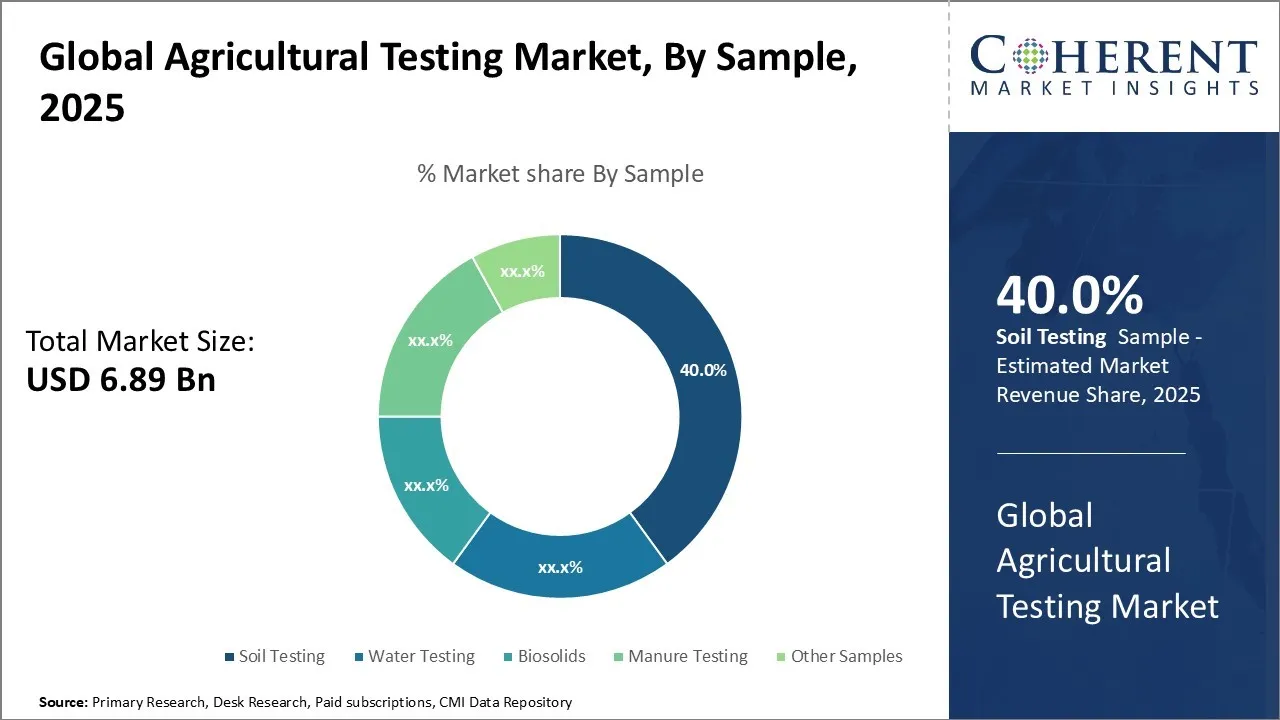
Agricultural Testing Market Insights, By Sample
Rising Demand for Crop Production is Driving the Soil Testing Segment Growth
The soil testing segment is expected to contribute the highest market share of 41% in 2026. The market is primarily driven by the increasing demand for a better soil health and to optimize plant growth. A soil testing helps in determining the nutrient levels, pH, and other factors that impact crop production and environmental health. When the specific soil deficiency is identified, the farmer can make needed decision about fertilizer application, soil amendments and overall management practices.
In January 2025, Dr Reddy’s DRF (Dr. Reddy’s Laboratories Limited), launched soil testing resource centre in Hyderabad to boost agro-productivity and sustainability. The centre provides fast, accurate, and affordable soil testing service to farmers, agronomists, agricultural, researchers, and institutions which help in enhancing productivity while promoting sustainable agricultural practices.
Regional Insights
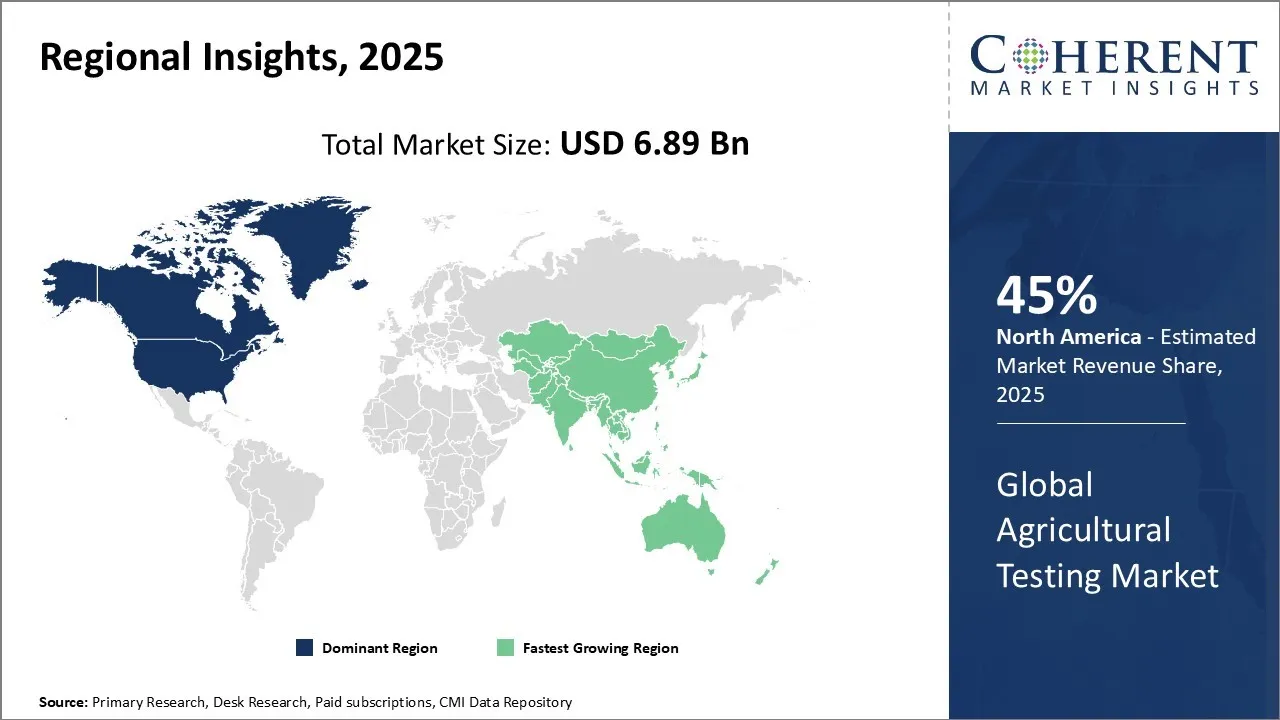
North America Agricultural Testing Market Analysis & Trends
North America is expected to dominate the global agricultural testing market revenue over the forecast period owing to the stringent food safety regulation, technological advancements and strong emphasis on seed certification and consumer awareness. The Science and Technology Program’s Seed Regulatory and Testing Division (SRTD) is responsible for enforcing the Federal Seed Act (FSA) and enabling domestic and international seed trade through a variety of industry. The north America facilitates with remote sensing, advanced technology which enhances the efficiency of testing processes and improves the accuracy and reliability of the result.
Asia Pacific Agricultural Testing Market Analysis & Trends
Asia Pacific is also expected to witness the fastest growth over the forecast period, and this is attributed to increasing government initiatives to expand laboratories for seed testing. Another factors that drive the market in Asia Pacific region is the large population, increasing demanding for agricultural exports and growing consumers awareness regarding food safety. The Government of Asia Pacific region is focusing on improving the quality and safety of agricultural machinery and inputs, promoting a sustainable agricultural and enhancing plant health. For instance, the Asian and pacific network for testing of Agricultural Machinery (ANTAM) initiative, aims in developing harmonized standard for testing agricultural machinery.
Agricultural Testing Market Outlook Country-wise
United States Agricultural Testing Market Trends
The United States is the leading country is global agricultural testing market. The agricultural testing market in the U.S. was valued at US$ 1,053.3 million in 2020, and it is projected to reach US$ 1,551.1 million by 2026, registering a CAGR of 6.8% during the forecast period. Also, the presence of the Seed Regulatory and Testing Division (SRTD), which tests agricultural and vegetable seeds to ensure the efficient marketing of seeds, is further anticipated to foster regional market growth.
India Agricultural Testing Market Trends
The agricultural testing market in India was valued at US$ 256.6 million in 2020 and is projected to reach US$ 387.0 million by 2026, recording a CAGR of 7.3% during the forecast period. Schemes such as PM-Kisan in India which aims to supplement the financial needs of small and marginal farmers to procure necessary inputs for crop health and yields, is acting as one of the major factor propelling the agriculture testing industry in India.
Global Agricultural Testing Market Trends
- Small-scale laboratories are becoming increasingly popular: There is a growing trend for small-scale laboratories to perform soil testing activities on agricultural land around the world. Moreover, these activities are projected to be commercialized over the course of time. Also, it is expected that small-scale players were projected to emerge in the market in the coming years, which will increase competition among these small ventures as well as the established soil testing companies. Mainly, users and farmers will benefit from this, as they will have a wide range of companies and prices to choose from.
- Serological and electrophoretic: The rise in the trend of following electrophoretic and serological methods in seed testing especially in the North America region will further favor market growth.
Global Agricultural Testing Market Drivers
- Growing concern over food safety and sustainable practices: Growing concern over food safety and sustainable practices is driving growth of the agricultural testing market. The world is witnessing unparalleled challenges such as resource depletion, drought, water scarcity, land degradation, pollution, loss of biodiversity, and climate change. All these factors are affecting the sustainability of food and agriculture systems and the livelihoods of smallholders and farmers. In order to combat these challenges, proper testing is important to improve human lives.
- Increasing regulations and frameworks related to agricultural and environmental safety: Increasing regulations and frameworks related to agricultural and environmental safety are again fostering market growth. The Federal Seed Act (FSA), 2020, outlines seed requirements, such as germination, seed purity, details of treated seeds, etc., for instance shipments of agricultural and vegetable seeds. In the United States, regulations related to pesticide registration, production, and distribution under the authority of the Federal Insecticide, Fungicide, and Rodenticide Act (FIFRA) are governed by the Environmental Protection Agency (EPA).
Global Agricultural Testing Market Opportunities
- Increase number of regulations related to protection of soil: The growing number of regulations related to the protection of soil in the European region is projected to support the soil testing market, especially in the U.K. This is expected to provide lucrative growth opportunities. The country has made soil testing mandatory every five years.
- The focus of key players is on the introduction of new technology: Key players are focusing on introducing new technology in agricultural testing. This is projected to provide major growth opportunities for the key players. For instance, in January 2022, Bayer is a German multinational pharmaceutical and biotechnological company which announced the launch of Testing4Ag, a new program that allows research scientists from around the world to submit novel chemistries to Bayer for testing in hopes of identifying potential new modes of action to control fungal diseases, insect pests, or weeds.
Market Report Scope
Agricultural Testing Market Report Coverage
| Report Coverage | Details | ||
|---|---|---|---|
| Base Year: | 2025 | Market Size in 2026: | USD 7.34 Bn |
| Historical Data for: | 2020 To 2024 | Forecast Period: | 2026 To 2033 |
| Forecast Period 2026 to 2033 CAGR: | 6.5% | 2033 Value Projection: | USD 11.40 Bn |
| Geographies covered: |
| ||
| Segments covered: |
| ||
| Companies covered: | Eurofins Scientific, Agilent Technologies Inc., SCS Global Services, Bureau Veritas SA, ALS Limited, Element Materials Technology (EXOVA), TUV Nord Group, Apal Agricultural Laboratory, and Intertek Group PLC | ||
| Growth Drivers: |
| ||
| Restraints & Challenges: |
| ||
Key Developments
- In May 2025, EarthOptics, a leader in soil intelligence technologies launched a commercial mid-infrared (MIR) carbon testing solution. It is designed to provide registry-quality soil carbo measurement at scale. This innovation aims to support carbon market, Scope 3 reporting and sustainability programs by combining MIR spectroscopy with soil texture analysis for improved data precision and efficiency.
- In May 2025, the Uttar Pradesh government launched a large-scale soil samples collection drive which targets to collect 11.56 lakh soil samples for upcoming kharif season as a part of the Soil Health Card Scheme. According to the Agriculture Department, the scheme sims to saturate 16,520-gram panchayats across the state by 2025.
- In March 2025, Farmers Edge™, a premier agricultural technology provider, announced the expansion of its soil laboratory services to the public, offering agribusinesses, retailers, and farmers access to high-quality, technology-driven soil and plant tissue testing. With the help of state-of-the-art labs in the U.S. and Canada, Farmers Edge Laboratories has conducted over 7 million soil tests for its customers now, retailers and agricultural professionals can access those same accurate, high-speed, and insight-driven services to maximize their business offerings.
- In April 2025, India launched a significant move to combat micronutrients malnutrition through a new online portal providing access to X-ray Fluorescence (XRF) testing services for assessing the nutritional quality of crops.
Analyst Opinion (Expert Opinion)
- EU’s “Farm to Fork” Biodiversity Targets to push EU biodiversity in farming is expected to drive demand for ecosystem health testing. If biodiversity impact assessments become mandatory, farmland operators will likely invest more in testing services that monitor soil, water, and overall ecosystem quality to meet compliance standards.
- Global Harmonization of Organic Certification in countries that are moving toward unified standards for organic certification, testing requirements will become stricter and more consistent. This will likely boost demand for multiparametric testing services to verify organic claims across borders, making lab capabilities a key differentiator.
- The recent 9% increase in urea prices from February 2025, which will likely push farmers to be more strategic with fertilizer use. Precision soil nutrient mapping is expected to gain traction as a cost-control measure, allowing farmers to apply fertilizers more efficiently and avoid unnecessary input costs.
- S. Carbon Sequestration Incentives (IRA Funding), a government incentive for carbon sequestration is likely to accelerate adoption of soil carbon testing. As regulatory frameworks around carbon credits strengthen, farmers engaged in regenerative practices will need to validate their carbon capture efforts—fueling growth in carbon testing services.
Speak to the analyst
Want personalized insights?
Take the findings above to one of our principal consultants, or have the report rebuilt around the segments, geographies and competitors you actually track.
Market Segmentation
- Global Agricultural Testing Market, By Sample (Revenue, USD Bn, 2021 - 2033)
- Water Testing
- Soil Testing
- Seed Testing
- Biosolids Testing
- Manure Testing
- Other Samples
- Global Agricultural Testing Market, By Region (Revenue, USD Bn, 2021 - 2033)
- North America
- U.S.
- Canada
- Latin America
- Brazil
- Argentina
- Mexico
- Rest of Latin America
- Europe
- Germany
- U.K.
- Spain
- France
- Italy
- Russia
- Rest of Europe
- Asia Pacific
- China
- India
- Japan
- Australia
- South Korea
- ASEAN
- Rest of Asia Pacific
- Middle East
- GCC Countries
- Israel
- Rest of Middle East
- Africa
- South Africa
- North Africa
- Central Africa
- North America
- Key Companies Insights (Revenue, USD Bn, 2021 - 2033)
- Eurofins Scientific
- Agilent Technologies Inc.
- SCS Global Services
- Bureau Veritas SA
- ALS Limited
- Element Materials Technology (EXOVA)
- TUV Nord Group
- Apal Agricultural Laboratory
- Intertek Group PLC
Sources
Primary Research Interviews from the following stakeholders
Stakeholders
- Interviews with agronomists, soil scientists, laboratory technicians, quality assurance managers, crop advisors, farm owners, agricultural input suppliers, food safety officers, and sustainability experts across major agricultural economies.
Specific stakeholders
- Laboratory managers at accredited soil and water testing labs
- QA/QC heads at food processing and export companies
- Sustainability and compliance leads at large agri-exporters
- Farm input procurement managers at agri-input companies
- Government soil health mission officers
- Agronomy leads and extension officers in farmer producer organizations
- Food safety regulators and inspection officers at national and regional levels
Databases
- Food and Agriculture Organization (FAO) Statistical Databases (FAOSTAT)
- United States Department of Agriculture (USDA) – Economic Research Service
- Indian Council of Agricultural Research (ICAR)
- European Food Safety Authority (EFSA)
- World Bank – Agriculture and Rural Development Indicators
- Eurostat – Agriculture and Environment
- International Fertilizer Association (IFA)
- Agricultural & Processed Food Products Export Development Authority (APEDA), India
- Environmental Protection Agency (EPA) – Water and Soil Contamination Data
Magazines
- AgriBusiness Global
- The Crop Site
- PrecisionAg Alliance
- Progressive Farmer
- Modern Farmer
- Agri-Tech Tomorrow
- The Analytical Scientist (Agriculture & Food section)
- Soil & Water Conservation News
Journals
- Journal of Agricultural and Food Chemistry
- Agronomy Journal
- Soil Science Society of America Journal
- Journal of Environmental Quality
- Crop Protection (Elsevier)
- Food Control (Elsevier)
- International Journal of Agricultural Science and Research
- Agricultural Systems (Elsevier)
Newspapers
- The Economic Times – Agriculture & Rural Economy
- The Hindu – Agriculture and Environment
- Business Standard – AgriBusiness
- Financial Times – Global Food and Agriculture
- The Guardian – Global Development: Agriculture
- The Times of India – Agritech and Policy
- The Wall Street Journal – Commodities & Agricultural Markets
Associations
- International Fertilizer Development Center (IFDC)
- Soil Science Society of America (SSSA)
- International Union of Soil Sciences (IUSS)
- Federation of Indian Chambers of Commerce and Industry (FICCI) – Agriculture Division
- Global Alliance for Climate-Smart Agriculture (GACSA)
- National Association of Testing Authorities (NATA)
- International Food Protection Training Institute (IFPTI)
- Confederation of Indian Industry (CII) – Agritech & Food Processing Panel
Public Domain Sources
- Ministry of Agriculture & Farmers Welfare (India)
- Ministry of Food Processing Industries (India)
- NITI Aayog – Agriculture and Allied Sectors Reports
- U.S. Environmental Protection Agency (EPA) – Agri Testing and Compliance
- EU Commission – Agri-Food Chain Regulations
- Australian Government Department of Agriculture, Fisheries and Forestry
- National Institute of Agricultural Extension Management (MANAGE)
- Indian Soil Health Portal – SHC Program
- Agriculture and Horticulture Development Board (AHDB), UK
Proprietary Elements
- CMI Data Analytics Tool, and Proprietary CMI Existing Repository of information for last 8 years
*Definition: Agricultural testing is an integral part of precision agriculture. The accuracy of measurements can be improved with the help of the right tools. The latest tools in agricultural testing allow researchers to perform numerous tasks, including monitoring and auditing the quality of agricultural products.
Get access to 250+ pages report
Every segment, forecast, competitor profile and data table behind the analysis above — available for instant download.
- ESOMAR Member
- ISO 9001:2015 Certified
- D-U-N-S Registered
- GDPR & CCPA Compliant
Missing comfort of reading report in your local language? Find your preferred language:
Transform your Strategy with Exclusive Trending Reports
Frequently Asked Questions
The Agricultural Testing Market is estimated to be valued at USD 7.34 Bn in 2026, and is expected to reach USD 11.40 Bn by 2033.
The CAGR of the Agricultural Testing Market is projected to be 6.5% from 2026 to 2033.
Growing concern over food safety and sustainable practices are fueling the growth of the market.
The soil testing segment is the leading component segment in the market.
The high cost and time involved are the major factors restraining growth of the market.
Eurofins Scientific, Agilent Technologies Inc., SCS Global Services, Bureau Veritas SA, ALS Limited, Element Materials Technology (EXOVA), TUV Nord Group, Apal Agricultural Laboratory, and Intertek Group PLC.