

Biological Seed Treatment Market Analysis & Forecast: 2026 to 2033
Biological Seed Treatment Market is estimated to be valued at USD 1,502.0 Mn in 2026 and is expected to reach USD 2,624.7 Mn in 2033, exhibiting a compound annual growth rate (CAGR) of 8.3% from 2026 to 2033.
Key Takeaways
- Based on Function, the seed protection segment is expected to lead the market with 68.6% share in 2026, driven by biocontrol adoption and eco-friendly demand.
- Based on Crop Type, Grains and Cereal segment is projected to account for the largest share of the market in 2026, driven by staple crop importance and rising demand for sustainable farming.
- Based on Region, North America is set o lead the biological seed treatment market with 43.5% share in 2026. While, Asia Pacific is anticipated to be the fastest growing region.
Market Overview
The global biological seed treatment market is anticipated to grow at a significant pace. The growth of the global biological seed treatment market is driven by the increasing demand for bio-based products, rising concerns about chemical residues, and the increasing inclination towards organic farming practices. The major players are focused on launching new and innovative products to maintain their position in the market. They are also focusing on developing new technologies and establishing manufacturing facilities in emerging markets which is further projected to augment market growth.
Current Events and Its Impact on the Biological Seed Treatment Market
Current Event | Description and its Impact |
Regulatory Policy Transformation and Chemical Phase-Outs |
|
Climate Change and Emerging Agricultural Threats |
|
Adoption Trends in Biological Seed Treatment Market
- Over 40% of new seed treatment R&D globally now focuses on biologicals.
- Farmers in Asia and Africa are adopting biological seed protection faster due to affordability and sustainability needs.
- By 2030, biologicals are expected to account for one in every three seed treatments worldwide.
- Current Industry Events of 2026
- Market Size Estimation
- Regional Breakdown
- Competitive Landscape
- Customer Intelligence
- Segmental Analysis
- Pricing Analysis
- Key Market Drivers, Challenges & Future Trends
- Customized Insights Section
Segmental Insights
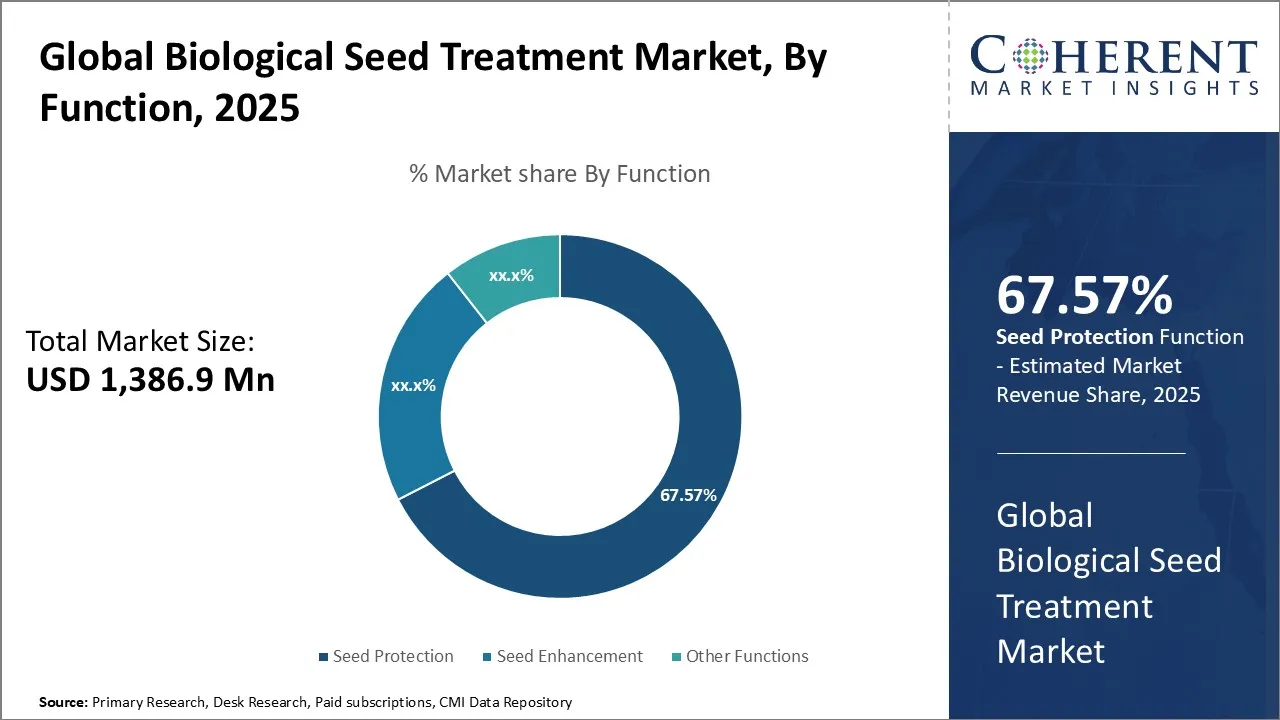
Global Biological Seed Treatment Market Insights, By Function - Seed Protection Leads Is Driven by Biocontrol Use and Eco-Friendly Demand
Based on function, the Seed Protection is expected to dominate the global market with 68.6% share in 2026, and this is attributed to the growing trend of biocontrol ingredients used in biological seed treatment product. This leadership comes from the fact that biological treatments are very important for protecting seeds from diseases, pathogens, and pests that live in the soil. Farmers put protection first because it has a direct effect on germination rates, seedling vigor, and the overall survival of their crops. The growing restrictions on chemical seed treatments and the rising demand for eco-friendly, long-lasting alternatives have made biological protection solutions even more popular.
For instance, in October 2025, the Assam Central Government's seed treatment campaign at Boko shows the significance it is to keep seeds safe from diseases, pests, and pathogens that live in the soil. The program promotes seed treatment in general, but it also fits with the goals of biological seed protection by encouraging eco-friendly alternatives to chemicals. These kinds of efforts are meant to help seeds sprout, crops stay alive, and farming practices that don't harm the environment.
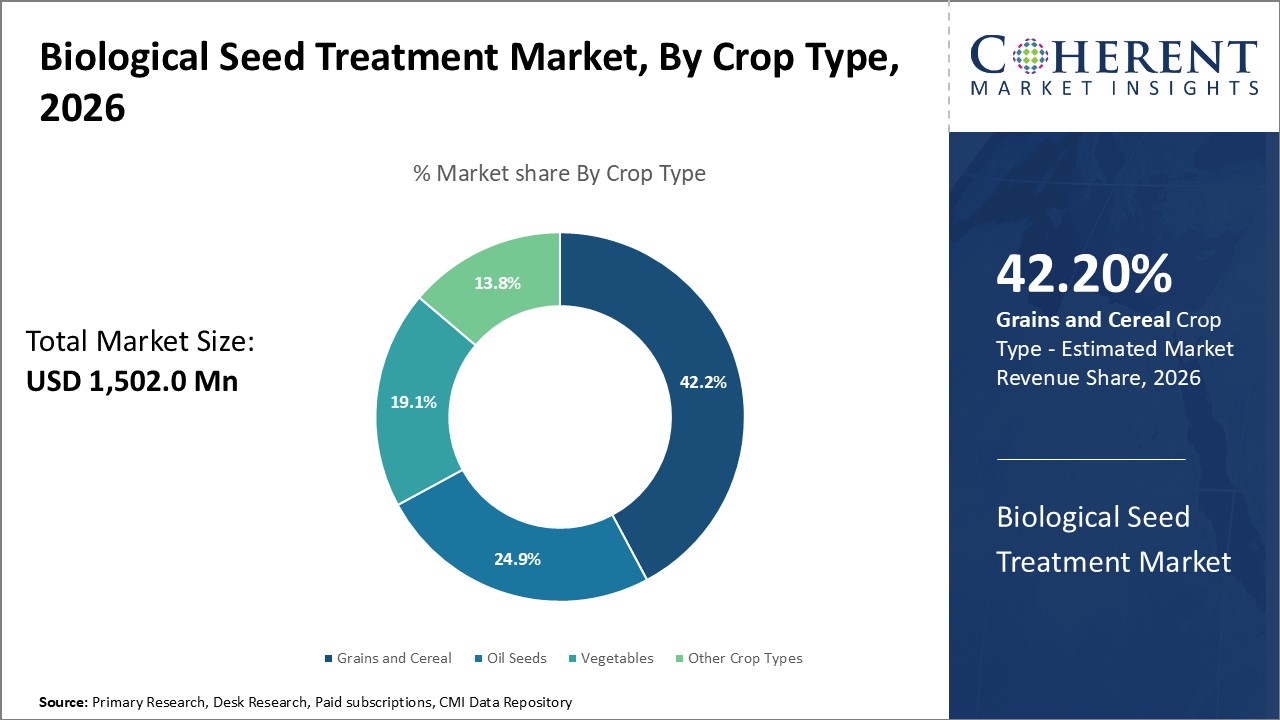
Global Biological Seed Treatment Market Insights, By Crop Type - Grains and Cereals Lead Is Driven by Staple Crop Scale and Sustainability Demand
Based on crop type, the Grains and Cereal is expected to dominate the global market over the forecast period. Corn, wheat, rice, and barley are the most common staple crops. They take up a lot of land to grow and are very important for global food security. To protect these crops from diseases and make sure they keep producing, farmers and agribusinesses spend a lot of money on biological seed treatments. There is also a growing demand for organic and sustainable cereals, especially in North America and Asia-Pacific, where governments are pushing people to use biological inputs.
For instance, in November 2025, Syngenta and Amoéba SA come up with a new biological way to protect cereals and field crops. The bio-fungicide uses the natural lysate of Willaertia magna to fight off major wheat diseases like yellow rust and septoria tritici blotch. This new idea makes biological seed protection stronger, which helps sustainable farming and protects food security around the world by using eco-friendly methods to protect crops.
Regional Insights
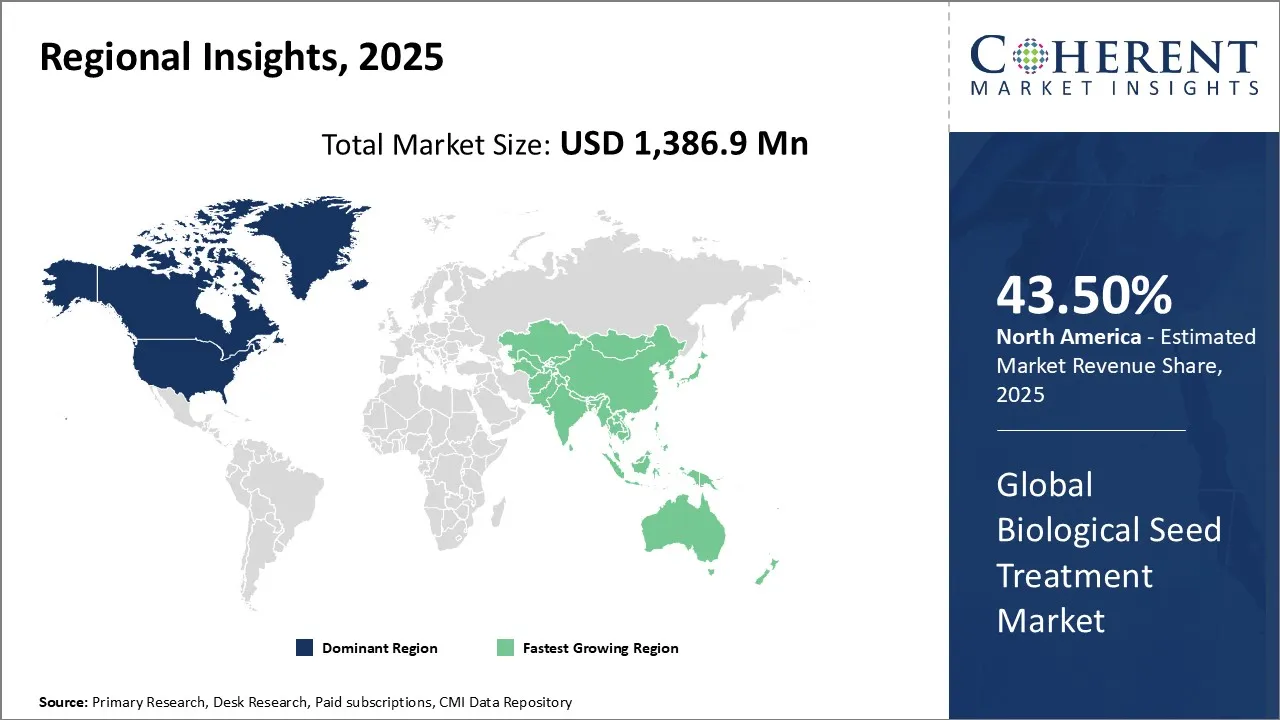
North America Biological Seed Treatment Market Analysis & Trends
In terms of the region, North America is projected to lead the global biological seed treatment market with 43.5% share in 2026. This region is a major contributor to the global biological seed treatment market because of its extensive agricultural production and demand for high-quality agricultural produce. In addition, the government policies for banning certain chemicals are also boosting this industry in the region.
For instance, in September 2026, Bayer’s Susteed launch in North America highlights a breakthrough combining biologicals with seed treatments to protect cereals and field crops. Focused on eco-friendly solutions, it strengthens seed protection against diseases and pests while reducing reliance on chemicals. This innovation supports sustainable farming practices and reinforces North America’s leadership in the biological seed treatment market.
Asia Pacific Biological Seed Treatment Market Analysis & Trends
Asia Pacific is anticipated to be the fastest growing regio in the biological seed treatment market, due to rice and wheat are grown in large amounts there, people feel concerned about food security, and the government is pushing for eco-friendly farming inputs. The region is the fastest-growing market in the world because more people are becoming aware of sustainable farming and the demand for organic food is rising.
For instance, in July 2026, Japan's Sumitomo invested funds into DPH Biologicals to make biological plant nutrition and crop protection products. The company wants to grow in the U.S. market. The partnership is mostly about crop health, but it also helps biological seed protection by making long-lasting solutions stronger. This decision shows that there is a growing global demand for environmentally friendly farming and new biological inputs.
Biological Seed Treatment Market Outlook Country-Wise
The U.S. Biological Seed Treatment Market Trends
The market for biological seed treatments in the U.S. is growing as more individuals want to farm in a way that is good for the environment, there are strict rules against using chemical seed treatments, and farmers need to protect valuable crops like corn and soybeans. Farmers want environmentally friendly ways to boost seed vigor, disease resistance, and yield, which is why biological seed protection and enhancement are so popular.
For instance, in December 2024, UPL released Nimaxxa, a bionematicide seed treatment for soybeans that protects against nematodes in three different ways. The product was first aimed at North America, especially the U.S., but it is expected to grow into South America, especially Brazil and Argentina. Nimaxxa helps protect biological seeds, which helps farming that is good for the environment and protects soybean yields from nematode damage.
France Biological Seed Treatment Market Trends
The demand for France's biological seed treatment market is growing because of strict EU rules that limit chemical pesticides, more people want to eat food that is good for the environment, and the government supports eco-friendly farming. Farmers are using microbial and plant-based seed treatments to boost yields, keep pathogens at bay, and meet the goals of Europe's Green Deal and Farm-to-Fork for sustainability.
For instance, in November 2026, BASF received the first EU approval for its biological fungicide Integral® PRO on sunflowers in France. The seed treatment keeps crops safe from fungal diseases, which is good for the environment. This milestone shows that BASF is a leader in developing environmentally friendly solutions and makes biologicals more important in Europe's growing market for biological seed protection.
Market Report Scope
Biological Seed Treatment Market Report Coverage
| Report Coverage | Details | ||
|---|---|---|---|
| Base Year: | 2025 | Market Size in 2026: | USD 1,502.0 Mn |
| Historical Data for: | 2020 To 2024 | Forecast Period: | 2026 To 2033 |
| Forecast Period 2026 to 2033 CAGR: | 8.3% | 2033 Value Projection: | USD 2,624.7 Mn |
| Geographies covered: |
| ||
| Segments covered: |
| ||
| Companies covered: | BASF SE, Bayer Cropscience AG, Bioworks Inc., Syngenta AG, Agrauxine by Lesaffre, Germains Seed Technology, Koppert Biological Systems, Novozymes, Marrone Bio Innovations, and Groundwork BioAg | ||
| Growth Drivers: |
| ||
| Restraints & Challenges: |
| ||
Global Biological Seed Treatment Market Drivers
Growing use of bio-priming techniques for improved efficiency to augment market growth
Bio-priming is the simple, most economical, and eco-friendly delivery system of beneficial microorganisms in the agro ecosystem. For instance, the United Nations (UN) proposed 17 sustainable development goals (SDGs) after seriously analyzing the situation and potential threats of climate change. These goals aim at collaborative efforts toward the upliftment of social and economic standards with no compromise on the environment and future generations.
New product launch in the market by key players is also propelling market growth
Key players are launching new products all the time, which is driving innovation and increasing adoption in the biological seed treatment market. Advanced microbial and plant-based solutions make seeds stronger, more resistant to disease, and better for the environment. These launches are a big part of growing the biological seed treatment market size. They help farmers with environmentally friendly technologies and make crops more productive overall.
Global Biological Seed Treatment Market Opportunities
Growing demand for chemical-free crops is expected to provide significant growth opportunities. This is attributed to the growing environmental concerns and strict government policies regarding the use of chemical pesticides on fields.
Increasing need for high-value crops along with demand for industrial crops is also expected to provide significant growth opportunities. The high-value industrial crops cultivated in high yielding and deliver a higher net per hectare of product produced. These crops include sugarcane, cotton, hybrid soybean, potatoes, fruits, spices, maize (corn), vegetables, flowers, and herbs.
Global Biological Seed Treatment Market Trends
Increasing food demand with increasing global population
Increased population around the world means more food is needed, which is why farmers are switching to more sustainable methods. This trend drives up the Biological Seed Treatment Market demand as microbial and plant-based solutions that are good for the environment help seeds sprout, keep pests away, and boost yields. As the world's food needs grow, using more biologicals helps productivity.
Adoption of treated seeds with biological agents
The use of treated seeds with biological agents is speeding up the spread of sustainable farming practices around the world. These treatments help seeds germinate, keep pathogens away, and make crops stronger. The Biological Seed Treatment Market growth is increasing as increasingly numerous farmers want eco-friendly solutions. Biologicals are becoming a key driver of productivity and long-term agricultural sustainability.
Analyst Opinion (Expert Opinion)
The market for biological seed treatments is growing steadily as they work well in the field and more businesses are using them. A meta-analysis of 396 global experiments shows that performance improves in a number of ways: germination goes up by about 7%, seedling emergence goes up by more than 90%, plant biomass goes up by more than 50%, disease control goes up by about 55%, and average crop yields go up by about 21%. These statistically consistent benefits are making farmers more likely to grow a wide range of crops.
High-output agricultural areas are where adoption is really taking off. In the 2023/24 season, Brazil's bioinput segment had retail sales of about 5 billion reais (about USD 924 million). The category grew by about 21% each year for the last three years. North America and Europe are still important places where people want seed treatment because it has been used for a long time. In Asia, however, growth is driven by large planting areas and a growing interest in solutions that leave no residue.
Market development is influenced by the growing product lines of top agricultural companies and specialized biological manufacturers. These companies are putting more emphasis on microbial consortia, better formulations, and compatibility with new seed-coating technologies. Some of the biggest problems are that products don't work the same in all areas, formulations aren't stable, and regulatory delays make it harder to register products. Even with these problems, the market is ready for long-term, technology-driven growth because of rising biological adoption, good regional data, and ongoing investment in research and development.
Speak to the analyst
Want personalized insights?
Take the findings above to one of our principal consultants, or have the report rebuilt around the segments, geographies and competitors you actually track.
Global Biological Seed Treatment Market: Key Developments
- In June 2025, Bayer and Kimitec launched two next‑generation biological products to strengthen regenerative agriculture, focusing on eco‑friendly crop protection and resilience. Targeting Europe and North America, the collaboration reduces reliance on chemicals while enhancing seed and plant health.
- In July 2025, Bayer's launch of Yoalo a biostimulant seed treatment for corn, is aimed at North America, especially the United States, where corn is a major crop. Yoalo is a biological innovation that improves crop performance by making seeds stronger and better able to handle stress. It is expected that the business will spread into Latin America, which is going to assist sustainable farming and make the biological seed treatment market stronger.
- In July 2025, Pioneer, a Corteva Agriscience brand, introduced a biological nutrition seed treatment in the United States. This treatment is meant to improve the health of seeds and help plants grow faster. The new idea makes biologicals even more important in sustainable farming by giving plants natural protection and making them stronger.
Market Segmentation
- Global Biological Seed Treatment Market, By Function (Revenue, USD Mn, 2021 - 2033)
- Seed Protection
- Seed Enhancement
- Other Functions
- Global Biological Seed Treatment Market, By Crop Type (Revenue, USD Mn, 2021 - 2033)
- Grains and Cereal
- Oil Seeds
- Vegetables
- Other Crop Types
- Global Biological Seed Treatment Market, By Geography (Revenue, USD Mn, 2021 - 2033)
- North America
- U.S.
- Canada
- Latin America
- Brazil
- Argentina
- Mexico
- Rest of Latin America
- Europe
- Germany
- U.K.
- Spain
- France
- Italy
- Russia
- Rest of Europe
- Asia Pacific
- China
- India
- Japan
- Australia
- South Korea
- ASEAN
- Rest of Asia Pacific
- Middle East & Africa
- GCC Countries
- Israel
- Rest of Middle East & Africa
- North America
- Global Biological Seed Treatment Market: Key Companies Insights
- BASF SE
- Bayer Cropscience AG
- Bioworks Inc.
- Syngenta AG
- Agrauxine by Lesaffre
- Germains Seed Technology
- Koppert Biological Systems
- Novozymes
- Marrone Bio Innovations
- Groundwork BioAg
Sources
Primary Research Interviews
- Biological Seed Treatment Manufacturers
- Seed Coating & Inoculant Technology Providers
- Agricultural Biotech Companies
- Crop Protection Product Developers
- Agronomists & Soil Health Experts
- Seed Processing & Conditioning Facilities
- Agricultural Extension Officers
- Others
Databases
- Bloomberg Terminal
- Thomson Reuters Eikon
- IHS Markit
- Euromonitor International
- S&P Global Market Intelligence
- Statista
- Others
Magazines
- Seed World Magazine
- AgriBusiness Global
- CropLife Magazine
- BioTechniques Magazine
- Farmers Weekly
- Others
Journals
- Journal of Applied Microbiology
- Crop Protection Journal
- Agronomy Journal
- Plant Disease Journal
- Frontiers in Plant Science
- Others
Newspapers
- Financial Times
- The Wall Street Journal
- Reuters
- Bloomberg News
- The Economic Times (Agriculture Section)
- Others
Associations
- International Seed Federation (ISF)
- American Seed Trade Association (ASTA)
- Biological Products Industry Alliance (BPIA)
- CropLife International
- European Seed Association (Euroseeds)
- Others
Public Domain Sources
- Food and Agriculture Organization (FAO)
- U.S. Department of Agriculture (USDA)
- European Commission – Agriculture & Rural Development
- World Bank Open Data
- International Fertilizer Development Center (IFDC)
- Others
Proprietary Elements
- CMI Data Analytics Tool
- Proprietary CMI Existing Repository of Information for the Last 8 Years
Definition: Biological seed treatment is a type of biological fertilizer that is used in the agriculture industry to enhance or protect the crops. It consists of biochemicals, botanicals, and microbials that are effective against plant pathogens, insects, and nematodes.
Get access to 250+ pages report
Every segment, forecast, competitor profile and data table behind the analysis above — available for instant download.
- ESOMAR Member
- ISO 9001:2015 Certified
- D-U-N-S Registered
- GDPR & CCPA Compliant
Missing comfort of reading report in your local language? Find your preferred language:
Transform your Strategy with Exclusive Trending Reports
Frequently Asked Questions
The Biological Seed Treatment Market is estimated to be valued at USD 1,502.0 Mn in 2026, and is expected to reach USD 2,624.7 Mn by 2033.
The CAGR of the Biological Seed Treatment Market is projected to be 8.3% from 2026 to 2033.
Growing use of bio-priming techniques for improved efficiency are fuelling the market.
The seed protection segment is the leading component segment in the market.
High costs biological seed treatment and low availability is the major factors restraining the market.
BASF SE, Bayer Cropscience AG, Bioworks Inc., Syngenta AG, Agrauxine by Lesaffre, Germains Seed Technology, Koppert Biological Systems, Novozymes, Marrone Bio Innovations, and Groundwork BioAg